There are a number of other projects that are bringing additional fossil fuel capacity online, including in new producing countries Guyana and Suriname, and efforts to boost production in others such as Argentina have been stepped up in response to recent changes in political and economic conditions, both internally and externally.
Guyana has seen remarkable development in oil production since US firm ExxonMobil found a huge offshore reservoir in the Stabroek block in 2015. The potential for these reserves to transform the country’s economy meant that there was an overwhelming domestic political consensus to exploit them, even as international climate efforts were ramping up.
Production started in 2019 and set a new quarterly production record of more than 900,000 barrels per day (bpd) in the first quarter of this year. Combined with higher oil prices, this meant that Guyana received a record US$761m in oil revenues for the quarter. And oil revenues have driven a remarkable increase in the country’s GDP per capita, which increased from US$3,840 in 2010 to US$26,990 in 2025, with further growth expected.
There are now four floating production, storage and offloading (FPSO) vessels in operation, with a further US$60bn in investment announced in November 2025 expected to push daily production capacity to 1.7m bpd by 2030. Given the fact that decisions to invest in further capacity were made when the Brent crude price was hovering around US$60 per barrel, these plans are unlikely to be affected even if the end of the Iran war brings prices down from their recent highs.
The price spike caused by the Middle East conflict will in fact bring further benefits to Guyana’s public purse, as it has brought forward the date by which the Stabroek Block will recover its exploration and development costs. Once cost recovery is achieved, a milestone that is expected to be reached around the middle of this year, Guyana’s share of oil profits will increase from 12.5% to 50%, a significant boost to state revenues and a significant change from initial contract terms that critics had argued were tilted too far in ExxonMobil’s favour. The country is also exploring LNG projects, including the Wales Gas Vision, both for domestic use and for export from a planned offshore facility to be built by US firm Fulcrum LNG, although progress has stalled.
For Guyana the incentives are clear, with the IMF highlighting that the country has recorded the highest real gross domestic product (GDP) growth rate in the world in recent years and underlining that the outlook is “highly favourable”. Combined with the fact that the country boasts the world’s largest per capita oil reserves, the conditions are in place for continued strong growth in production capacity.
Although Guyana’s progress from first discovery to first oil was remarkably quick, neighbouring Suriname has faced more challenges in exploiting its own offshore oil fields, in part due to the differing geology of its deposits, which make extracting oil more difficult and expensive.
This has slowed the pace of development, although more than 750m barrels in recoverable reserves have been confirmed in the Block 58 field. The first planned project in this field is GranMorgu, a joint venture between TotalEnergies (40% stake), APA Corporation (40%), and Surinamese state oil firm Staatsolie (20%), with a final investment decision (FID) worth US$10.5bn confirmed in October 2024. In April this year the project’s first FPSO was reported to be 60% complete at a shipyard in China, and production is expected to begin in 2028, with a maximum production capacity of 220,000bpd.
At the same time, Suriname’s first gas development, the Sloanea field, was confirmed to be commercially viable in November 2025. This means that the project, operated by Malaysian energy company Petronas and Staatsolie, can now move towards development. Current forecasts project an FID later this year, and a target of 2030 for first gas production. Petronas has also expanded its interests in the country’s offshore gas fields, signing another agreement with Staatsolie in June 2025 that means it is active in six Surinamese blocks.
These developments signal growing confidence that Suriname will enter global markets for both oil and gas in the coming years, adding to the growing slate of extra capacity that is set to come online. Another key contributor to South America’s fossil fuel frontier is Argentina, where investment in fossil fuels projects has surged since President Javier Milei enacted a programme known as the Régimen de Incentivos a las Grandes Inversiones (Rigi), which offers a range of incentives, legal protections, and stability measures for large projects, in 2024.
While the country’s oil and gas potential has long been known, Rigi has improved the business environment and encouraged a wave of investments in fossil fuels projects, primarily in the Vaca Muerta shale fields in northern Patagonia, which contain a colossal 16bn barrels of recoverable oil reserves and 308 trillion cubic feet of recoverable gas resources. Rigi also covers renewable energy projects, as well as other sectors such as mining, supporting the idea that clean energy and fossil fuels are being developed at the same time.
Oil production at Vaca Muerta surged 32% year-on-year from January 2025-January 2026, pushing Argentina’s overall oil output to 874,000 bpd in February. And international oil companies such as Chevron, Pluspetrol, and Continental Resources have announced a slew of significant investments, meaning that production is expected to see further significant increases.
There are also significant pipeline projects underway, including Vaca Muerta Oil Sur (VMOS), a US$3bn project led by state-run firm YPF to transport oil to a shipping terminal in Punta Colorada, Rio Negro province. This kind of infrastructure will be vital in ensuring that Argentina benefits from a forecast increase in oil production to 1.5m bpd by 2030, according to the Argentine Chamber of Hydrocarbons Exploration and Production. YPF has also published the Argentina LNG project, which aims to boost exports of liquified natural gas, and has agreed to develop an LNG export facility in Patagonia in conjunction with Italian energy company Eni.
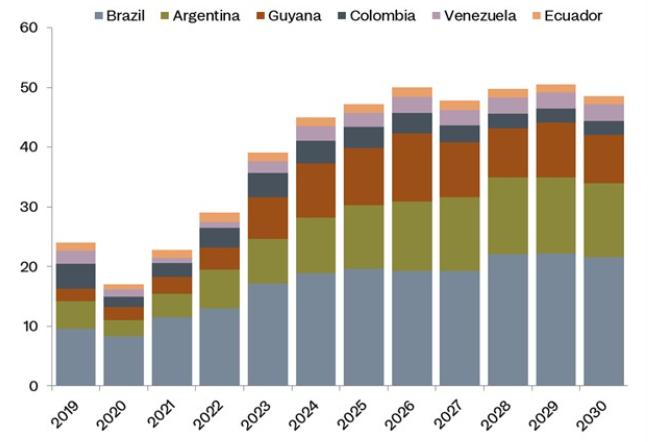
Across South America as a whole, energy consultancy Rystad’s analysis of oilfield investment shows some interesting patterns, as illustrated by Chart 3 (below). Investment in Argentina has spiked since 2023, coinciding with the introduction of the Rigi framework, and Guyana has also seen rapid growth since 2019. Looking ahead, Brazil is set to maintain its position as the largest single recipient of oilfield investment in South America, followed by Argentina and Guyana.
Chart 3: Total investment in South American oilfields (US$bn), 2019–2030
Source: Rystad Energy Upstream Solution.
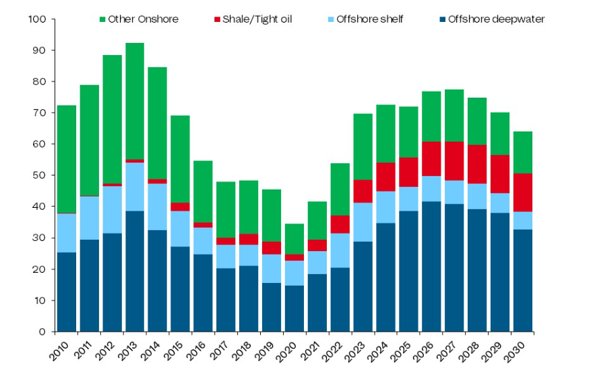
Chart 4 (below) reveals further detail on oilfields investments in the whole of Latin America over a longer time period, rising from 2010 to a peak of US$90bn in 2013 before falling sharply to a recent low in 2020. A strong recovery post-pandemic is expected to continue, with a peak in 2027 before decreasing slightly to 2030. The chart also shows how onshore investment has fallen away, with offshore deepwater now taking the largest share and shale attracting a significant proportion of investment.
Chart 4: Annual Latin America spend by supply segment (US$bn), 2010–2030
Source: Rystad Energy Upstream Solution.
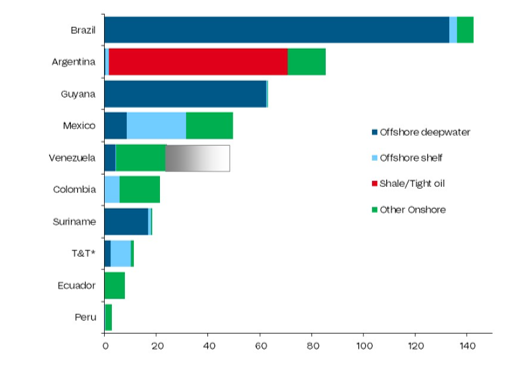
Chart 5 (below) illustrates Rystad’s forecast that more than US$400bn will be invested in the oil sector from 2026-2030. It breaks that figure down by country, with several standout elements to highlight. First, Brazil, Guyana, and Suriname will dedicate almost all of their investment for the period to offshore deepwater, with Argentina accounting for all of these countries’ shale investments.
Chart 5: Latin America spending (US$bn), 2026–2030
Source: Rystad Energy Upstream Solution.
Another thing to note is that Venezuela’s bar is mostly greyed out, reflecting the fact that investment is contingent on political and economic developments in that country discussed in the next case study.
In the gas sector, Guyana, Suriname, and Argentina all feature among the top Latin American candidates to benefit from growing demand for LNG identified by the International Gas Union (IGU) in a report published at the beginning of June. The IGU highlights the fact that the region accounts for only 5% of global natural gas production, despite its vast reserves, and the IGU argues that gas projects can be a key contributor to the energy transition due to the fact that emissions are lower than oil.
Securing natural gas supplies has become a strategic priority for many countries around the world, particularly in Europe, given the recent ban on purchases from Russia in the wake of the country’s invasion of Ukraine and the ongoing disruption to supplies from the Middle East due to the war with Iran. This increases the likelihood of further investments in LNG projects in Latin America, with the IGU also highlighting Peru and Venezuela as potential beneficiaries, although significant uncertainty remains around Venezuela’s ability to realise this potential.