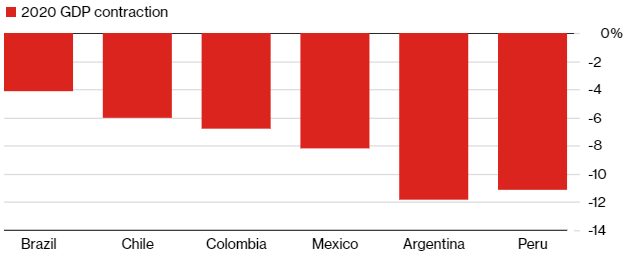
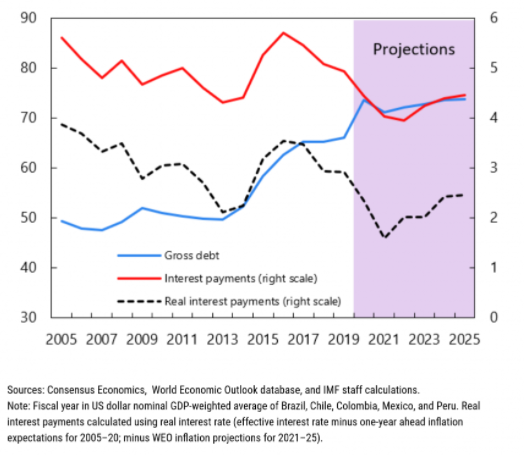
The Covid-19 pandemic was a major shock to the LAC economies. In some senses it was the latest in a long line of external shocks, which have included the Great Depression of the early 1930s and more recently the foreign debt crises of the 1980s, the Asian economic crisis of 1997, and the Great Recession of 2007-2009. These crises have all been characterised by destabilising external events which caused uncertainty, led to capital flight from the LAC countries, and/or triggered widening fiscal deficits as governments struggled to stimulate their faltering economies. In some senses the pandemic was different and more serious, because it involved combined demand and supply-side shocks - a rapid fall in external demand coupled with simultaneous domestic supply reductions as quarantines, lockdowns, and mobility restrictions were imposed. In other respects, the pandemic was more benign – it did not, for example, lead to a sharp reduction in foreign currency reserves across the region. However, the sheer scale of the latest ‘shock’ does differentiate it from its predecessors. Contraction in economic activity in 2020 was the deepest in a generation.
In effect, LAC GDP fell 7.7% in 2020, which according to Eclac was the sharpest fall registered in the last 120 years. Formal unemployment (which excludes the large contingent of informal workers in LAC) rose from 8.1% in 2019 to 10.7% in 2020. Eclac estimates that the poverty rate rose by three percentage points between the two years, from 30.5% in 2019 to 33.7% in 2020, continuing to reverse the reductions that had been achieved during the commodity boom in the 10 years prior to 2012. The IMF estimated that nearly 20m people had fallen into poverty as a result of the pandemic.
At the global level, governments responded to the crisis by ramping up emergency spending. This included medical spending on vaccine development, equipment, and supplies, but also on a whole range of subsidies to help cover costs for furloughed workers, tax relief schemes for companies, and cash-transfer programmes to help poor and informal workers. The IMF has estimated that globally the extra spending was of the order of US$7.8tn (a figure which is set to rise further as the pandemic continues, and as governments continue making cash injections to support economic activity).
In LAC one of the first impacts of the crisis was a significant fall in government revenues. On average (for 16 major economies) government revenues dropped by 0.5 percentage points, from 18.4% of GDP down to 17.9%, a contraction caused mainly by reductions in tax revenues, particularly in the economies of South America. In the three months to May 2020 VAT revenues, closely linked to economic activity levels, dropped by as much as 40% in real terms in some countries. They later rebounded quite strongly, however, as the cash transfer programmes for poor households helped boost private consumption levels. After the initial shock, some countries were able to respond to the crisis by introducing policies to boost the tax take. These included offers to waive interest payments, fines, and surcharges in return for advance payments of 2020 income tax. Mexico' s tax collection agency SAT (Servicio de Administración Tributaria) was able to find additional resources amounting to 2.2% of GDP by targeting previously high levels of evasion and avoidance. In El Salvador, a tax amnesty helped boost corporate income tax receipts. Another important factor affecting economies like Chile and Peru is that mining royalties remained resilient. During the Great Recession of 2007-2009 international mineral and metal prices dropped abruptly, pushing down related royalty payments, but in the 2020 pandemic, the prices of mining exports such as copper actually increased. In the Caribbean countries, the fall in government revenues was partly the result of the collapse in tourism and, for hydrocarbons exporters like Trinidad & Tobago and Suriname, of the fall in international oil and gas prices.
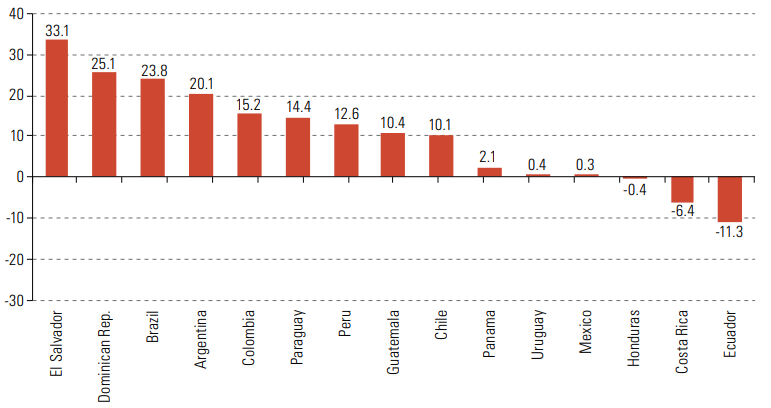
Despite the fall in their revenues LAC countries faced inescapable pressure to increase their spending levels during 2020. Eclac estimates that on average governments boosted spending by an amount equivalent to 4.6% of GDP. Primary spending (excluding interest on borrowing) rose by over 10% in a number of countries, and by over 20% in four of them (El Salvador, Dominican Republic, Brazil, and Argentina). Measured as a proportion of GDP central government spending reached 24.7%, the highest level recorded since Eclac began publishing fiscal data in the 1950s. The previous peak had been 23.3% in 1983, in the midst of the debt crisis known as ‘the lost decade’. In general, LAC governments increased their spending at a speed and volume comparable to the increase in the developed economies such as the US and Europe. The difference, however, is that the developed economies with hard currencies are able to borrow greater amounts to fund their exceptional spending at much lower rates of interest. For developing countries, borrowing costs are significantly higher.
Year-on-year variation in central government primary spending 2019–2020 (percentages)
Source: Economic Commission for Latin America and the Caribbean (ECLAC), on the basis of official figures
One of the main factors driving the increase in primary spending last year was pandemic-related growth in cash transfers and subsidies. These increased by the equivalent of 2.5 percentage points of GDP, or more, in Argentina, Brazil, Chile, Colombia, the Dominican Republic, El Salvador, and Peru. In Brazil two cash transfer programmes, one of which is popularly known as the 'corona voucher' but has the formal name of Auxílio Emergencial de Proteção Social a Pessoas em Situação de Vulnerabilidade Devido a Pandemia da Covid-19, together represent a cash injection into the economy equivalent to 3.9% of GDP. Similar programmes, as a proportion of GDP, represented 1.6% in Argentina, 1.9% in Chile, 2.7% in El Salvador.
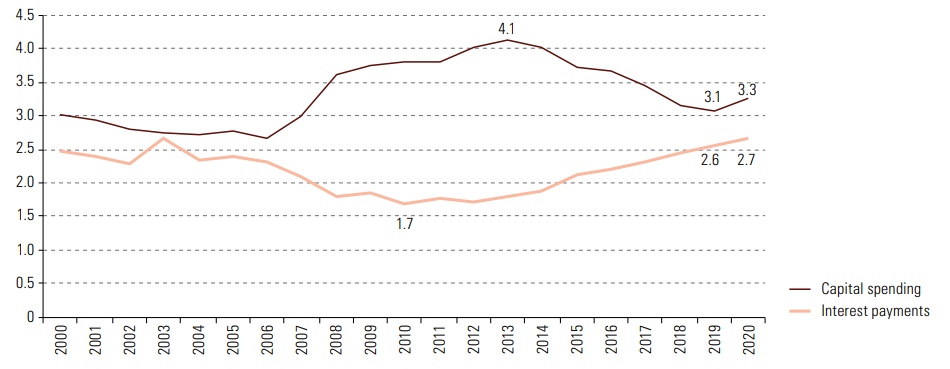
There was also more modest growth in capital spending in the LAC countries, equivalent on average to around 0.2 percentage points of GDP. This was positive since capital spending had been falling consistently year on year since 2013, in part to offset rising spending on interest on loans. However, there was significant variation across the region. Capital spending rose in Brazil, Mexico, Panama, and Paraguay, but it fell in Chile, Colombia, Costa Rica, Guatemala, Honduras, Peru, and Uruguay. For the region as a whole, capital spending has traditionally exceeded interest payments, but the gap between the two has narrowed dramatically.
Latin America central government capital spending and interest payments 2000–2020 (percentages of GDP)
Source: Economic Commission for Latin America and the Caribbean (ECLAC), on the basis of official figures
The net result from these trends was that in 2020 the LAC region experienced one of its largest-ever fiscal deficits, totalling 6.9% of GDP (the primary deficit - before interest payments - was 4.2%). To fund this increase, LAC governments had to increase their public borrowing, which in turn drove up their overall public debt levels. There were some differences by sub-regions. The total deficit in Central America and Mexico was a little lower than average, at 6.3% of GDP. However, for this sub-region, known for traditionally achieving fairly balanced budget outcomes (an average deficit of 2.5% in the preceding five years) the shortfall more than doubled in 2020, the year of the pandemic. In South America, where budget deficits were already significant in the pre-pandemic period, at a five-year average of 3.6% of GDP, they widened further to 7.5% of GDP. In the Caribbean overall deficits were either unchanged or grew, increasing financial stress for already heavily indebted countries like Barbados, Belize, and Jamaica, where public debt is in excess of 100% of GDP.
Latin America central government fiscal indicators 2010–2020 (percentages of GDP)
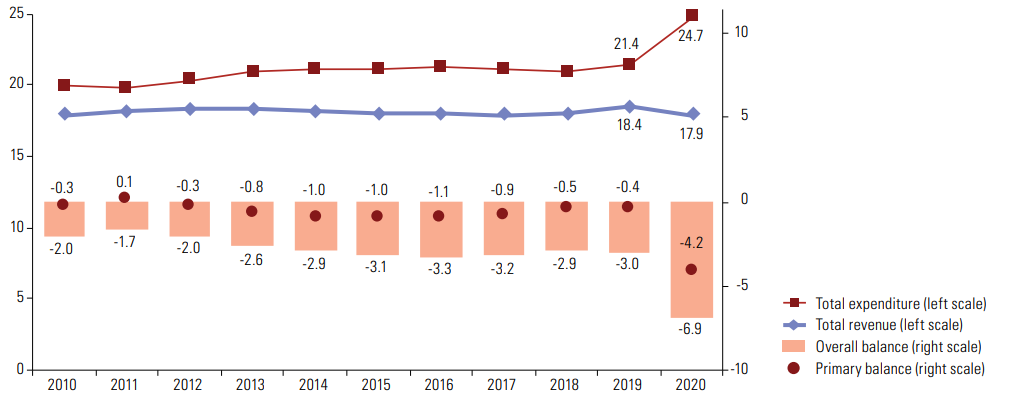
Source: Economic Commission for Latin America and the Caribbean (ECLAC), on the basis of official figures
Higher deficits led directly to higher borrowing and to higher total public debt. Eclac calculates that, on average, LAC's central government public debt rose from 45.6% of GDP in December 2019 to 56.3% in December 2020, an increase of 10.7 percentage points. The most heavily indebted governments were those of Argentina (104.5% of GDP), Brazil (89.3%) and Costa Rica (67.9%). The least heavily indebted were Guatemala (32.5% of GDP), Chile (32.5%), and Paraguay (30.1%). The most rapid increases in public debt during 2020 were experienced by the Dominican Republic, followed by Brazil and Panama. The country with the lowest increases in public debt during the year was Chile. In a number of countries, a significant proportion of public debt is denominated in US dollars or other hard currencies, a potential source of financial stress in the event of significant national currency depreciation, which would make it more difficult to meet debt service obligations.
Gross central government public debt December 2019 and 2020 (percentages of GDP)
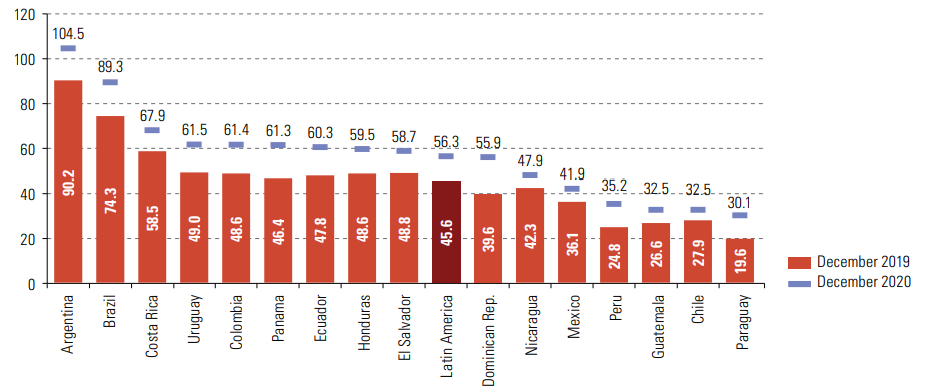
Source: Economic Commission for Latin America and the Caribbean (ECLAC), on the basis of official figures

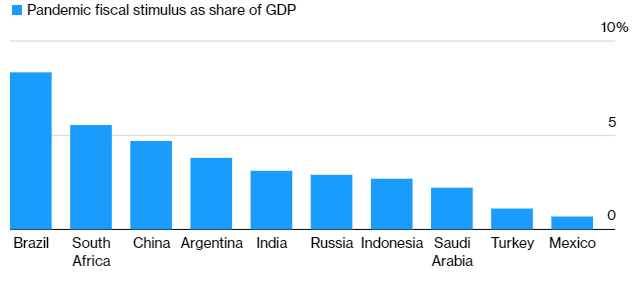 Source: International Monetary Fund
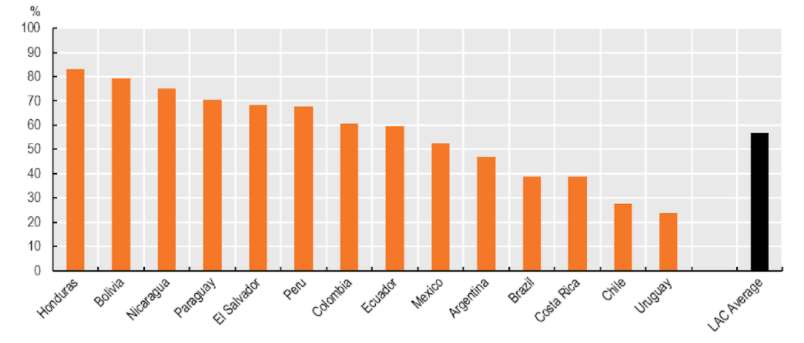 Source: OECD