In search of a new role

Items

  • Introduction

    Patrick de Courcy 10 November 2021 Hits: 2747

    For over a century running up to the 1980s the military leaders of Latin America saw themselves as men with a mission (for most of that time they were indeed men – since there were no, or very few, women in the ranks of the military). The mission was to defend national frontiers from external threat, protect the domestic political status quo from internal upheaval or subversion, and act as guardians of a sacred higher mission to uphold national sovereignty and economic development. One example of their outlook was captured by an article published in 1913 in A Defesa Nacional, a Brazilian military journal. It warned “The Army needs to prepare itself for its conservative and stabilising role amid the social changes in progress. It should be ready to correct internal disturbances, so frequent in the tumultuous life of developing societies.”

    In those years the region saw many coup d’états – military interventions to seize power and displace civilian administrations. These seemed to become more frequent and to spread geographically as time progressed. In the second half of the 20th century the process appeared to receive a double impetus. On the one hand came fear of the Cuban revolution (1959) and the subsequent spread of left-wing guerrilla movements. On the other was the intensification of the global Cold War, which meant that successive US administrations were prepared to ally themselves with Latin American dictators in the hope that they could provide a bulwark against communism. A key element in this clash between rival forces was the development of a national security doctrine (NSD) which justified military takeovers in pursuit of the supposedly higher-level national objectives.

    It was in the 1970s and early years of the 1980s that the region experienced what could be called a period of ‘peak military’. With a few exceptions (among them Mexico, Colombia, Venezuela, and Costa Rica) almost every country came under military rule at some point. By one calculation, in the late 1970s around 90% of the region’s total population was living under some form of military government.

    The nature of civilian-military relations in the period from the 1980s to the start of the 2020s – a four-decade stretch – is perhaps less easy to characterise. One clear and important trend has been a rejection of the human rights violations and authoritarian excesses of military rule, and a reaffirmation of democratic values. Just as the ‘wave’ of militarism crested in the 1970s, so it washed out and receded in the 1980s and 1990s. For the large part, the military returned to barracks. A new generation of elected civilian leaders, many representing the centre or left (and described as the ‘pink tide’) moved centre stage. Latin America was back in civilian clothes again. Much of the debate at the time was about how to ensure the armed forces could be controlled, made more professional, and kept strictly subordinate to democratic control and scrutiny. Military budgets were reduced and there were some experiments with new roles – for example in international peacekeeping. 

    The last 20 years, however, have seen many unanswered questions about the role of the armed forced in the region. Military intervention in politics has not miraculously ceased. While there has been no return to the full-scale 1970s style military coups, the region has seen a series of political crises where the armed forces have unmistakeably taken sides, often helping one group of civilians defeat another. As often happened in the past, military intervention has been egged on and welcomed by divisions within civilian society. Populist leaders of both right and left, such as Jair Bolsonaro in Brazil (elected to a four-year term in 2018) and Andrés Manuel López Obrador (AMLO) in Mexico (elected to a six-year term in the same year) have deliberately expanded the role of the military in domestic matters and looked to them for political support and advice.  

    Enthusiasm for democratic values has waned as the countries of Latin America and the Caribbean (LAC) struggle with low economic growth, high levels of corruption and crime, and low levels of trust in political institutions. Paradoxically perhaps, the collapse in public trust in civilian institutions such as the police, political parties, and the judiciary has helped make the armed forces popular again. Amid frustration with civilian institutions, surveys suggest a significant minority of public opinion would welcome a return to military rule if it solved big problems such as reducing crime.    

    There are also serious and enduring questions about what the armed forces are really for, and how they should be resourced and organised. Latin America has had few conventional wars in the last century, but it faces a multitude of largely internal challenges including street protests, the penetration of civilian institutions by powerful criminal gangs and drug trafficking cartels, natural disasters, climate change threats, pandemic outbreaks, and cyber-security threats. Few countries can claim to have come up with the ideal balance of military and civilian institutions and resources to deal with these problems.

  • Incidents and accidents

    Patrick de Courcy 10 November 2021 Hits: 1189

    What kind of military interventions in the politics of LAC countries have there been in the last two decades? Can any of them be described as constituting a coup d’etat? Is there some kind of pattern or are these ‘incidents and accidents’ completely heterogenous and unrelated? Here, we briefly examine some of these events.

    2009 – Mel Zelaya forced out in Honduras. On 26 June 2009, the Honduras Supreme Court issued a secret order for the arrest of left-wing President Manuel ‘Mel’ Zelaya. Two days later Honduran soldiers stormed the presidential residence and put the president on a military flight to Costa Rica. Partly based on a resignation letter of dubious authenticity, the opposition-controlled Honduran Congress then voted to remove him from office, and to appoint the Speaker of Congress, Roberto Micheletti, who was next in the constitutional line of succession, to replace him.

    In the months before the crisis Zelaya had been seeking support for a non-binding referendum on constitutional reform, which would include consultation on whether to lift presidential term limits (in effect allowing him to run for re-election). The Supreme Court had ruled the referendum illegal and, on those grounds, had ordered his arrest. However, a subsequent Truth Commission in 2011 found that both Zelaya, by insisting on the referendum, and the Supreme Court, by forcibly removing him from office through the action of the armed forces and without due process, had acted illegally. There was also controversy over the role of the military as it had the Supreme Court’s authority to arrest the president, but no legal basis for flying him out of the country.      

    The removal of Zelaya was widely considered to be a coup d’etat, and as such was condemned by the United Nations, the Organisation of American States, and the European Union.  The US administration of President Barrack Obama equivocated, with the president calling events in Honduras a coup, while Secretary of State Hilary Clinton said, “we do not think this has evolved into a coup”.  Washington’s characterisation of the event was important since US legislation requires the ending of military aid to any country where there has been a coup d’état. In practice, US military aid to Honduras continued to flow. But in what could be deemed a sign of change relative to the1970s, the military did not seek to retain power but handed it back to what could be called the country’s traditional political establishment.  New elections were held in November 2009, with the conservative Partido Nacional (PN) regaining power. In the following decade Honduras has remained under the control of the PN, and subject to deep and bitter partisan divisions.  

    2012 - the ousting of Fernando Lugo in Paraguay. Fernando Lugo, the centre-left president of Paraguay who had been elected in 2008, was ousted in June 2012. Lugo’s election had broken a 61-year-old stranglehold on political power exercised by the right wing Asociación Nacional Republicana (ANR – Partido Colorado). The crisis was set off by police action to evict squatters at a farm in Curuguaty, Canindeyú department, in which 17 people died (11 peasants and six police). The president reacted by replacing his interior minister and the chief of police and ordering an investigation. Despite this, the Paraguayan Congress rushed through a hurried impeachment process in under 48 hours, based on five counts of ‘bad performance’ in government. The president was given only two hours to prepare a defence. Impeachment was approved by 115 out of 125 members of Congress. Lugo was replaced by his vice-president who served the rest of his term in office; new elections were held in 2013, and were won by Horacio Cartes of the Partido Colorado, a man who had played an active role in removing Lugo. In that manner the party restored its political dominance in the country.

    The legality of Lugo’s impeachment has long been contested. Many Latin American governments believed the process was manipulated in a manner that itself constituted a ‘rupture of the democratic order’. The Mercosur trade bloc suspended Paraguay’s membership for a period. Some analysts have also suggested that the violent events at Curuguaty were part of a pre-planned provocation set up to topple the government. Analysts have described Lugos’ removal as a ‘civilian coup’. The Paraguayan army, which has long-standing links to the Partido Colorado, remained largely on the side lines during the June crisis, but it can be argued that this inaction itself constituted a form of tacit support for an ouster of questionable legitimacy.

    2016 - the impeachment of Dilma Rousseff in Brazil. Left-wing Brazilian President Dilma Rousseff was removed from office in May 2016, after a five-month long impeachment process. As in the case of Lugo in Paraguay, the impeachment was almost entirely a civilian affair, and was driven by a shift in congressional alliances, with several parties deserting the ruling coalition and aligning themselves with the centre-right opposition. Unlike Paraguay, impeachment followed pre-existing procedural rules and timescales. Supporters of Dilma’s Partido dos Trabalhadores (PT) nevertheless argue that the process was unfair, since the president’s main crime was to break public-sector accounting rules, an administrative violation that some of her predecessors had also committed without consequences.  

    The Brazilian armed forces sought to maintain a low-profile during Rousseff’s impeachment. However, both Dilma herself and her party, the PT, have repeatedly described her removal from office as a coup d’etat. If not perpetrated by the army itself, it was seen as having been executed by the wider political establishment. Some senior officers made clearly partisan statements. General Antonio Mourão, the-then head of the army’s Southern Military Command, called on reservists to “awaken a patriotic battle” against Rousseff. The army high command transferred him to a desk job as a sign of its displeasure (as a retired officer, Mouráo was later to become vice-president in the right-wing government of Jair Bolsonaro, who took office in January 2019).

    2019 – the toppling of the Evo Morales government in Bolivia. The Bolivian political crisis was triggered by disputed general elections in October 2019, in which the ruling left-wing Movimiento al Socialismo (MAS) party of President Evo Morales (in office since 2006) was accused of large-scale electoral fraud. After three weeks of anti-government protests, the Bolivian military and police effectively forced the president and other senior officials to resign. Fearing for his life Morales left the country, having accepted political asylum in Mexico. The second vice president of the Senate, opposition Senator Jeanine Áñez, was sworn in as the new president amid procedural controversy (the initial legislative session that took the decision lacked a quorum). From exile Morales said he had been the victim of a coup d’etat. Despite this, MAS members in Congress eventually reached an agreement with all other main parties to call new elections in which Morales would not be allowed to stand. The Áñez government presided over a period of intense repression, passing, and then withdrawing, a decree that exempted the security forces from liability for human rights violations (36 protestors were killed in this period). New elections were held in October 2020 and won with a comfortable majority by Luis Arce, a member of MAS and a former economy minister under Morales. Áñez was arrested in 2021 on charges of human rights violations.

    The Bolivian police and army clearly decided to support the anti-Morales political parties during the first phase of the protests. In fact, a key turning point was when the country’s police forces announced they would join the protest movement. The head of the armed forces, General Williams Kaliman, also issued a statement saying that in the light of social upheaval, military officials were “suggesting” that the president should resign. There has been a subsequent debate on whether these events constituted a coup d’etat. A coup is often defined as a forceful change in government through the use or threat of violence by a member of the state, often the armed forces. John Polga-Hecimovich, a political scientist at the US Navy Academy, commented at that time that, in the first phase of the crisis, “The military didn’t use violence. It issued a verbal declaration and did not give the president an ultimatum. I think that is the crux of the matter - whether you want to view that as a threat or not. If you view it as a threat, it is a coup. If you don’t view it as a threat, but as a suggestion, then you don’t think it is a coup.”  Those who defend the role of the Bolivian military in the crisis also point out that it showed no desire to take power itself, and ultimately associated itself with a democratic solution – the call for new elections.   

    2021- Bukele puts army boots in Congress. On 9 February 2020, Nayib Bukele, who had been elected president in a landslide victory the preceding year, entered Congress surrounded by army soldiers and police officers in a calculated operation to intimidate legislators from El Salvador’s traditional but much-weakened left and right-wing parties. The short-term aim was to force the assembled deputies to vote through a UDS$109mn package of support for the third phase of the new president’s ‘Plan Control Territorial’ security policy. The president’s action was a clear violation of the autonomy of the legislature. It was explicitly supported by declarations of loyalty from the military and the police force (PNC).

    After a landslide electoral victory in the legislative elections of early 2021, Bukele strengthened his hold on power in May of that year by unilaterally replacing a majority of the Supreme Court membership, and appointing a new attorney general, widely seen as another violation of constitutional rules on the separation of powers. In what some have described as an auto-golpe (‘self-coup’), the president and the compliant legislative assembly also passed a law forcing all judges over the age of 60 into compulsory retirement, replacing them with government supporters. The newly government-controlled Supreme Court also issued rulings lifting the country’s constitutional ban on consecutive re-election, clearing the way for Bukele to contest the 2024 elections.         

  • Military ranking and budgets

    Patrick de Courcy 10 November 2021 Hits: 8709

    To put the behaviour of Latin America’s military in context, it is useful to look at some indications of their size, budget, and staffing levels. According to the annual Global Fire Power (GFP) ranking for 2021, the top ten military forces in Latin America are, by order of importance, those from Brazil, Colombia, Argentina, Venezuela, Mexico, Peru, Chile, Ecuador, Cuba, and Bolivia.

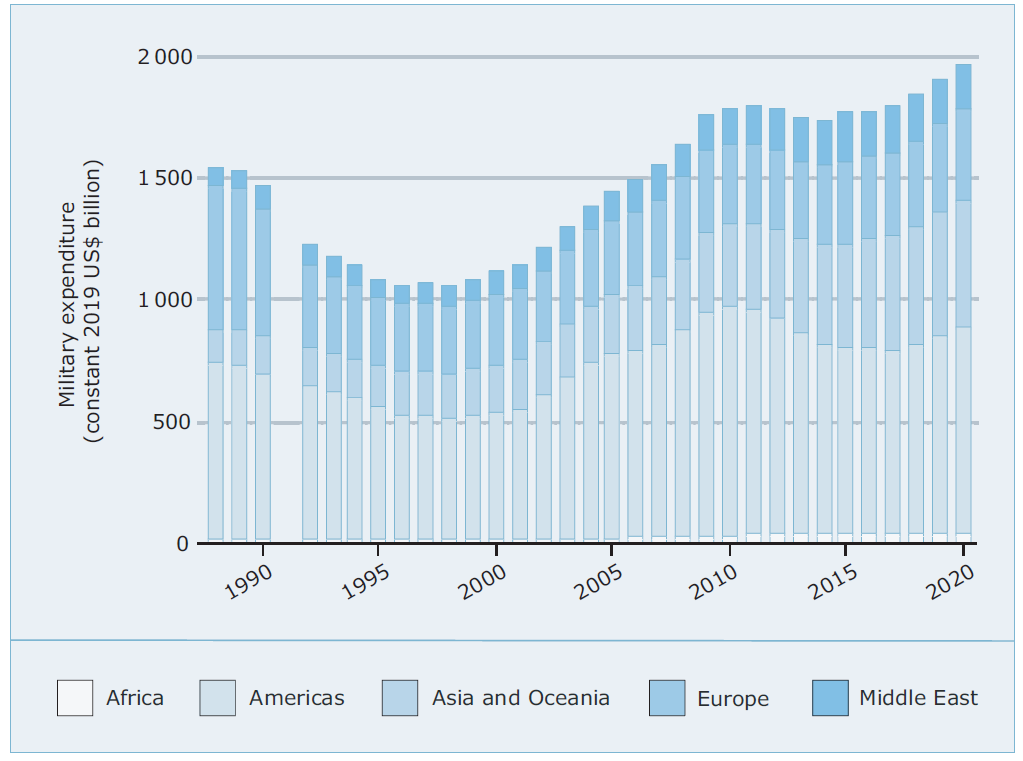
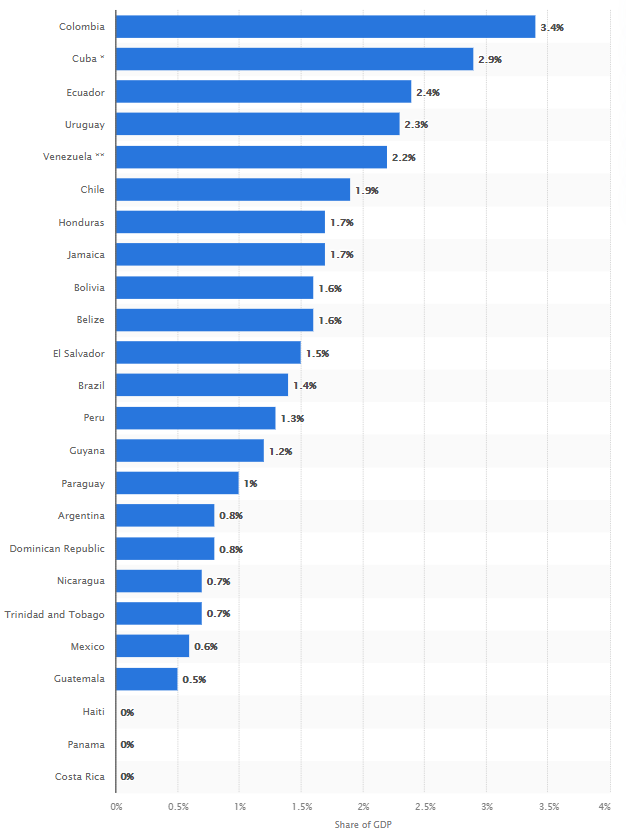
    According to the Stockholm International Peace Research Institute (SIPRI) Latin American military spending peaked in 2010 and was largely on a stable or slightly downward trend thereafter, although there were signs of recovery after 2017. In 2020 Brazilian military spending was US$19.7bn. This represented growth of 2.1% over the preceding decade. As a proportion of GDP Brazilian military spending has averaged 1.4 percentage points. Colombia’s military spend in 2020 was US$9.2bn, up by 28% on the preceding decade and representing 3.4% of GDP. Colombia’s higher growth in defence spending and GDP share reflects the fact that, despite the peace agreement of 2016, it faces a continuing, large scale armed insurgency led by left-wing guerrilla groups. Compared to its population size, Mexico spends comparatively little on its armed forces: US$6.1bn last year, or 0.6% of GDP. That said, expenditure has surged by 36% over the last ten years, reflecting the army’s continuing involvement in the fight against powerful and heavily armed drug cartels

    World Military Expenditure

    Source: SIPRI Military Expenditure Database

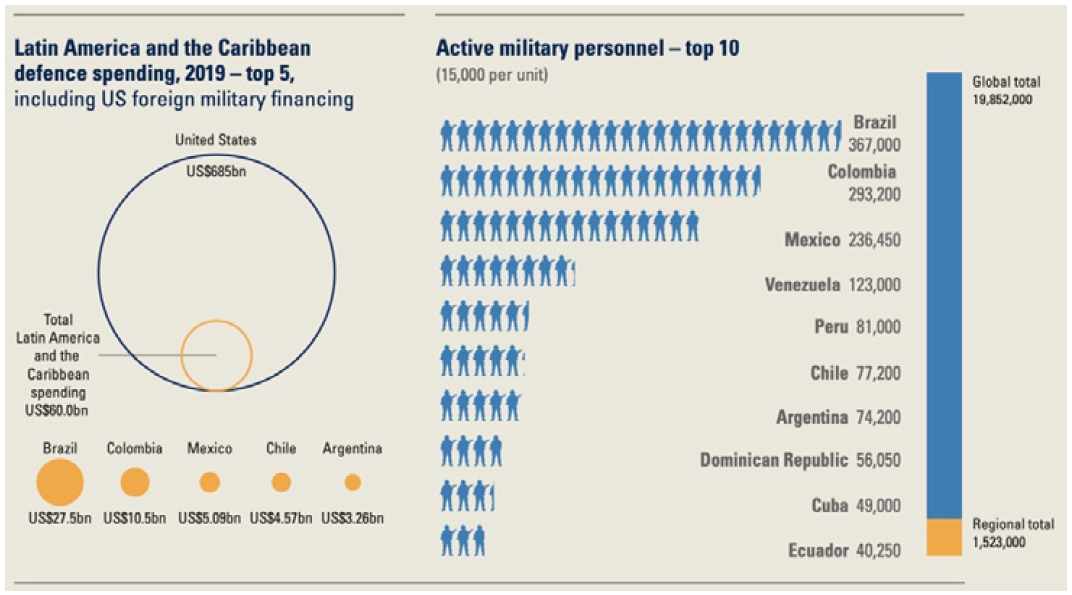
    According to the Military Balance 2020, compiled by the International Institute for Strategic Studies (IISS), total defence spending in the region in that year was around US$60bn, led by Brazil, Colombia, and Mexico. The largest military forces were maintained by Brazil, Colombia, Mexico, and Venezuela.

    While most state-to-state bilateral relationships have been peaceful in recent years, there are still significant areas of inter-state border tensions. The Colombian-Venezuelan frontier is one of them. Colombia claims left wing anti-government rebel groups, such as the Ejército de Liberación Nacional (ELN) and dissident factions of the Fuerzas Armadas Revolucionarias de Colombia (FARC), who refused to demobilise as part of the 2016 peace settlement, are aided and abetted by the Venezuelan government and allowed to maintain military camps on its side of the border from where they launch raids into Colombia. Venezuela counterclaims that Colombian paramilitaries have carried out border incursions into its territory. Matters are complicated by the presence of drug trafficking cartels and illicit gold mining interests. In 2021 one FARC dissident group (the ‘10th front’ initiated combat operations against Venezuela’s Fuerza Armada Nacional Bolivarian (FANB).

    A major development in Mexico has been the creation, starting in 2019-2020, of a new National Guard designed to take over the bulk of the campaign against the country’s powerful drug cartels from the army. Although initially proposed as a civilian-led alternative, after more than a decade of an army led ‘war on drugs’ the new force became increasingly militarised and was largely staffed by personnel transferred from the army.  By 2021 President López Obrador was calling for it to come under the operational command of the ministry of defence (Sedena).

    Latin American military leaders have struggled with aging equipment and constrained public sector finances caused by slower economic growth and the major negative impact of the Covid-19 pandemic which in many cases led to a diversion of funds away from defence to public health. In Argentina, the November 2017 loss of the German-built San Juan TR-1700 submarine, with the loss of all 44 crew, was partly attributed to organisational failures and low budgets.  Some big defence procurement projects have nevertheless moved forward, including the supply of locally built Embraer KC-390 transport aircraft and Gripen E fighters in Brazil. Chile, Colombia, and Peru found it difficult to extend the lifetime of their existing fighter aircraft. With a similar problem on its hands, Argentina was negotiating for the possible acquisition of Chinese-Pakistani JF-17 Thunder fighters.

    Defence/Active Service personnel chart

    Source: IISS

    Among other significant developments in the region in recent years have been large scale undocumented migration flows, principally from Central America through Mexico into the United States, and from Venezuela into the rest of South America, particularly Colombia, Peru, and Ecuador. The Venezuelan diaspora is now calculated at over 5m, making it one of the biggest outflows of its type in the world. To varying extents, in different countries the armed forces have become involved in border and migration control duties. There is also a major and continuing debate over the extent to which Latin American armies can or should be involved in domestic security tasks, particularly in regard to pursuing violent drug trafficking and criminal gangs, and in other activities such as disaster response and relief, public order, and medical epidemics.

    This question became particularly important after the outbreak of massive street protests in October 2019 in Ecuador, Chile, and later Colombia. Governments responded by sending in different combinations of the army, military police (such as the Carabineros in Chile), and civilian police to quell the riots. Army troops and those in specialised anti-riot units such as Esmad in Colombia, were widely accused of committing human rights violations, including the blinding of protestors (by shooting tear gas cannisters directly into crowds) as well various forms of sexual abuse. These reports once more highlighted the need for better disciplined, better trained, and more professional security forces, whether military or civilian.

  • The Zombie theory hypothesis

    Patrick de Courcy 10 November 2021 Hits: 1369

    The military coups of the 1970s and 1980s deeply affected the thinking of analysts and policymakers across the region. Understandably they focused on the military’s presumed ongoing thirst for power, its tendency to infringe civil liberties, and the range of defensive actions that could and should be taken by civilian institutions – everything from reducing budgets to tightening political and administrative oversight. There was however a tendency to think that every civilian-military incident must necessarily be a step in a continuum leading to the seizure power. Concerned that this has been taken too far, some analysts have warned of the danger of seeing everything from the 1970s perspective.

    One is Román D Ortiz, writing for Real Instituto Elcano, who notes the tendency of academic debates in Latin America “to rumble on long after the political and social conflicts that generated them have been superseded”. In his view there is a “zombie debate” in progress around the alleged predilection for coups among the Latin American armed forces. He argues that more than three decades after General Augusto Pinochet handed power in Chile back to civilians, civil military relations are more complex and do not fit neatly into the ‘coup-d’etat’ mould. Things have changed since the 1970s. Despite the crisis interventions listed in the previous section of this report, over the last two decades the armed forced have displayed no underlying appetite for taking and holding on to political power. In Ortiz’s words “the armed forces seem to be utterly convinced that their role does not lie in politics, and that crises need to be resolved by the civilian elites”. Where interventions have happened, the military have supported some civilian factions over others, “subsequently falling back to their institutional role so politicians could continue at the helm and seek a definitive way out of the crisis, typically by means of the ballot box”.  

  • LatinobarĂ³metro on institutions

    Patrick de Courcy 10 November 2021 Hits: 1312

    The role of the military is often determined by civilians, in more ways than one. Political divisions in civil society can create an ‘entry point’ for different types of military influence or intervention. During the long history of 20th century military coups, it was often the civilian leaders of different lobby groups who, seeing their cause frustrated or blocked under the democratic rules of the game, decided to break those rules, invite military rulers to intervene, and deliver a different outcome. In countries like Argentina, representatives of business, farming groups, exporters, or even labour unions, were said to be on a constant lookout for a ‘friendly colonel’ or general who might favour their cause.

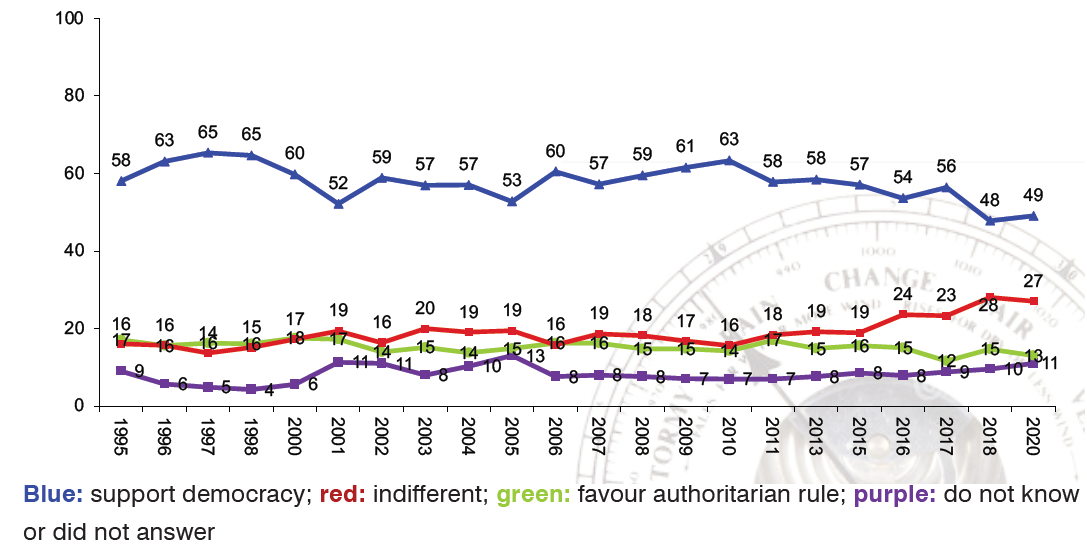
    While coup d’états may be a thing of the past, the role of the military is still deeply influenced by the state of civil society and the relative success or failure of civilian politicians. One interesting and concerning snapshot of this state of play is provided by the Latinobarómetro surveys of public opinion conducted every two years across 18 Latin American countries. The latest report shows that support for democracy has been on a fairly steady downward trend since 2010, when it had peaked at 63%. It then reduced steadily across each subsequent two-year interval down to an average of 48% in 2018, with a marginal recovery to 49% in 2020. The overall regional picture shows a three-way split – 49% supported democracy, 13% specifically favoured authoritarian rule, and 27% were indifferent to the form of government in their country (a further 11% did not know or did not answer).

    Support for democracy over time

    Source: Latinobarómetro

    The over-arching narrative of this fall is that the commodity boom of the first decade of the 20th century, which had enabled significant improvements in living standards, reductions in poverty, and redistribution of income, began to peter out after 2012, introducing a much more difficult period in the second decade of the century, dominated by falling standards of living, rising worries over crime and corruption, and the emergence of anti-government street protests in a number of countries. Going into the 2020s the Covid-19 pandemic added a further ingredient to this cocktail of problems.  

    In the 2020 survey democracy was held in highest esteem in Uruguay (74%), Costa Rica (67%), and Chile (60%), while remaining little-loved in Panama (35% support), Ecuador (33%), and Honduras (30%). Worryingly, support for democracy is also low in the two biggest countries in the region, Brazil (40%) and Mexico (43%), which currently have populist leaders. What seems to be happening is that democratic governments are failing to solve the big problems: poverty, economic inequality, crime, and corruption. Marta Lagos, the Chile-based founder of Latinobarómetro, says the situation was already bad before the arrival of the Covid-19 pandemic last year and has now become “consolidated”. No less than 70% of respondents say they are dissatisfied with their governments. On the other hand, support for authoritarianism has fallen off a bit, down to 13% from 15% last year. 

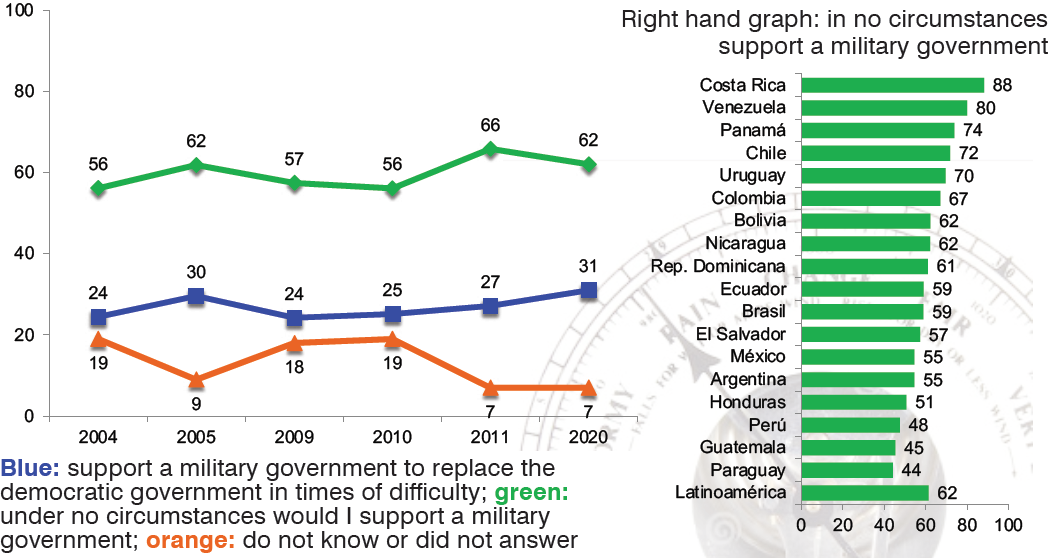
    Support for democracy in different circumstances

    Source: Latinobarómetro

    Lagos also issued a warning. She says the 2020s, the third decade of the 21st century, could turn out to be “a decade of protests” with many countries experiencing waves of popular anger, of the type seen in Chile, Ecuador, and Colombia over the last two years. There will be demands for more social and civil rights. The protests were put on hold during the pandemic, but the lockdown also saw an intensification of the region’s underlying socio-economic problems. As countries return to more normal conditions, she expects the protests to resume. Sixty percent of the respondents said they were prepared to take part in demonstrations to further demands for better health, education, and other basic services. Lagos believes the risk of populism is higher than that of military coups.

    The Latinobarómetro data suggests that, while still concerning, indifference to democracy and support for authoritarianism is not surging ahead. Indifference to the form of government had trended down to 16% in 2010 but increased steadily since then to peak at 28% of respondents in 2018, dropping to 27% in 2020.  Support for authoritarian institutions on the other hand, stood at 15% in 2010, and had gradually edged down to 13% of respondents by 2020. Those who would oppose a military government “in all circumstances” stood at 62% of respondents in 2020, down from 66% in 2011. A preliminary conclusion seems to be that public support for authoritarianism is changing only very slowly over time, and that despite concerningly high levels of support for authoritarianism, democracy still shows signs of resilience.

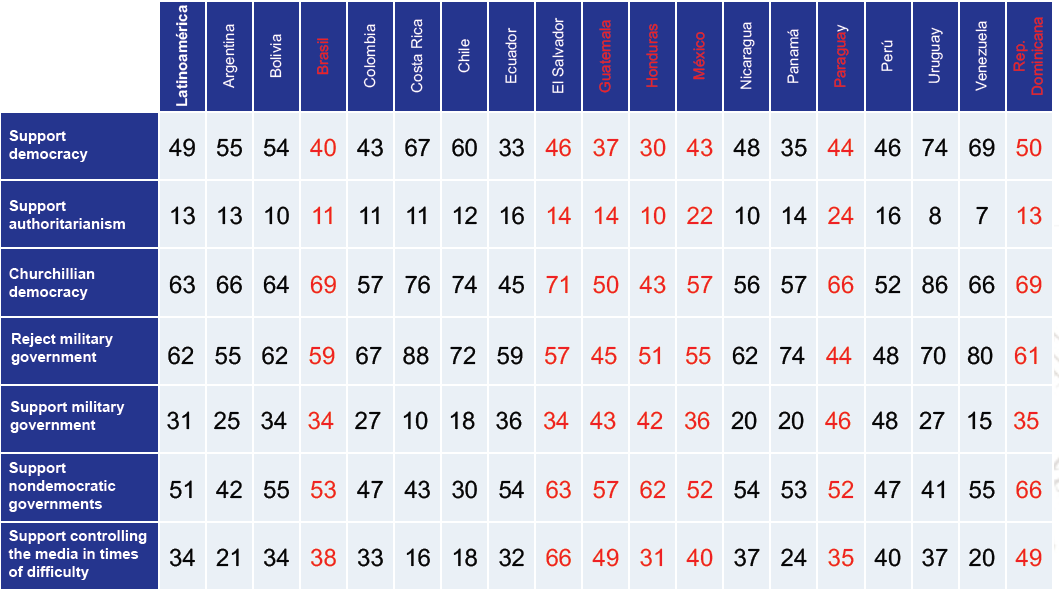
    A country-by-country summary of the Latinobarómetro findings confirms this rather mixed picture. Support for democracy averages 49% and is strongest in Uruguay, Costa Rica, and Chile (countries currently under democratic rule) as well as in Venezuela (which is ruled by an authoritarian left-wing regime). Support for authoritarian governments stands at 13% and is highest in Paraguay and Mexico. Support for ‘Churchillian democracy’ (where respondents are asked if they agree with the statement that democracy is the “least-worst” form of government) averages 63% with highs in Costa Rica, Chile, and Uruguay. On average 62% reject military governments against 31% who support them. Support for military government is highest in Peru (48%), Paraguay (46%) and Honduras (42%). Support for “nondemocratic governments” - a wider definition which includes forms of populist rule – stands at 51% with highs registered in the Dominican Republic, Honduras, and El Salvador.  

    Summary of attitudes

    Source: Latinobarómetro

  • Mexico's unique civil-military pact

    Patrick de Courcy 10 November 2021 Hits: 1414

    The US-based Wilson Centre in September published an interesting report on AMLO’s changing relationship with the Mexican armed forces, under the title ‘Militarisation a la AMLO: How Bad Can It Get?’ The author, Craig A Deare, highlights the key role played by military forces in the 1910-1917 Mexican Revolution, a period in which, according to the best historical estimates, somewhere between 1m and 2m people died in the violence.  Significantly, every single subsequent president, up to 1946, had played a role as an active service general during the revolutionary period. Miguel Alemán, the first real civilian in the job, reached a historic pact that still influences civil-military relations today. Essentially, the president would support military autonomy, and in exchange the military would defend the president against any internal or external threat.

    The enduring pact, it is suggested, is one of the key reasons Mexico was not affected by the wave of military coups that spread elsewhere in Latin America between the 1960s and 1980s. Deare argues that during the long period of rule by the Partido Revolucionario Institucional (PRI) the military was able to draw up its own internal legislation (covering among other things budget, manpower, organisational structure, and rules of engagement), and send it to the legislature where it would be rapidly approved without scrutiny by the PRI majority. The transaction had the appearance of democratic process when in fact it was not. Over the years, the pact was challenged but not broken by the rise of guerrilla movements, student protests, and eventually the collapse of the one-party PRI system. It was also affected by the landmark decision by President Felipe Calderón (2006-2012) to militarise the war on drugs. 

    AMLO took power with a critical view of the army. In opposition he had accused it of involvement in abuse, including the disappearance and presumed massacre of 43 students in Ayotzinapa in 2014. His policy of avoiding confrontation with the drugs cartels and focusing on the socio-economic causes of crime (known as abrazos, no balazos (hugs not bullets) garnered little enthusiasm in military ranks. Discreetly, senior generals expressed concern over AMLO’s proposed policies. During the 2018 campaign AMLO had promised to end the war on drugs, send the military back to barracks, investigate Ayotzinapa and other abuses by the armed forces, and appoint retired officers to the ministries for national security (Sedena) and Navy (Semar), which might be seen as interfering with military autonomy.

    Shortly after his election victory and in the subsequent months, AMLO began to renege on all these promises. As early as July 2018 AMLO was quoted saying it would be “irresponsible” to send the military back to barracks. He also continued to develop his ideas for the creation of a civilian controlled National Guard that would take over the bulk of operations against the drug cartels. Although initially seen as an alternative to the military, the National Guard has morphed over time into a militarised force which AMLO now wants to place under the command of Sedena, thereby reversing his original position on civilian oversight.

    Deare argues that in practice AMLO has expanded the security role of the armed forces without giving them the support needed to succeed in the expanded mission. As one example of this overstretch, he cites the incident known as the Culiacanazo in October 2019 when military forces captured Sinaloa cartel drug kingpin Ovidio Guzmán López (son of Joaquín ‘El Chapo’ Guzmán) but found themselves surrounded and outgunned by cartel forces, forcing them into a humiliating climb-down (Ovidio was released). AMLO, the head of Sedena, and other officials gave contradictory statements trying to explain what had happened. Although the army was at least partly responsible for errors of planning and execution, senior officers felt they had been “thrown under the bus” by the president.

    Notwithstanding these and other setbacks AMLO has continued expanding the military’s role. The army, through Sedena, had already been contracted to build the new Felipe Ángeles international airport (AFIA) in Mexico City. Army engineers were given the job of building sections of the president’s Tren Maya, the southern Mexico tourist train. In an unusual feature Sedena will receive part of the profits of the eventual operation of the train, for use as a supplement to its existing budget. In July this year AMLO announced plans to place the national customs agency under the operational control of the navy. The army has also been ordered to run a controversial anti-poverty programme, the Tianguis del Bienestar (‘wellbeing markets’) which involves donating seized assets (such as smuggled and counterfeit goods) to local communities.

    The report notes that AMLO’s security policies, including the creation and deployment of the National Guard, have notched up few real successes. The homicide rate, at 27.8 per 100,000 inhabitants remains the ninth highest in the world; the top five cities in the world in terms of murders per 100,000 inhabitants are all Mexican. By way of a first conclusion, Deare argues that “the good news in this otherwise bleak picture” is that the Mexican armed forces remain firmly subordinate to the president, and that “the deal put in place in the 1940s continue to hold”.

    A second conclusion is that the expansion of military functions is the responsibility of the president and has not been sought by Mexico’s military leaders, who are not necessarily enthusiastic about taking them on. However, it is also true that most Mexican presidents have used the military for purposes beyond their primary function. While AMLO has continued that tradition, he has done so “to a disturbing and concerning new level”.

    An interesting, related, issue is that despite its involvement in human rights violations, the public largely approves of the military. A recent survey by statistics institute INEGI shows an 86.2% approval rating for Semar, 83.1% for Sedena, and 71.3% for the National Guard. State and municipal police, with 49.5% and 44.6% approval respectively, come off worse. Deare says this suggests “society cares little about the nuances of civ-mil relations theory; they do care about violence and insecurity, and are more comfortable with the navy, the army, and the national guard that they are with any civilian law enforcement agency.”

    The report also suggests that, despite his earlier positions, AMLO has simply reached the conclusion that the military are more trustworthy than many other civilian intuitions. As Deare puts it: “Why task Sedena to build an airport? Because you distrust the private sector. Why task Semar to run a port administratively? Because that is where precursor chemicals from China arrive, and endemic corruption of previous authorities ensured they were delivered to organised crime…Why take the Guardia Nacional…and place it under the control of Sedena? Because you believe that Sedena is likely to perform more effectively.” Another way of looking at this situation, of course, is to note that it highlights the failure of successive Mexican governments to build effective civilian law enforcement, police, and other institutions. Until that problem is addressed, over-reliance on the armed forces is likely to cause ongoing structural imbalances in the Mexican political system.

  • Brazil and creeping militarism

    Patrick de Courcy 10 November 2021 Hits: 1257

    Brazil was ruled by a succession of military governments between 1964 and 1985. After mass campaigns for democracy and direct elections the country was able to restore full constitutional rule in 1985. For the following 34 years, a period of well over three decades, the armed forces remained in barracks, clearly subordinate to the authority of elected civilians. This period also saw a significant role for the Brazilian military in international peace-keeping efforts organised by the United Nations. Brazil was for example a key player in MINUSTAH, the UN stabilisation force for Haiti which was deployed in 2004-2017. Around 2,200 Brazilian military were deployed in the country. However, Brazilian civil-military relations began to change significantly after Jair Bolsonaro, himself a former army captain, took office in January 2019 at the head of a radical right-wing government highly critical of what it described as the civilian and ‘liberal-left’ political establishment.

    In an article in the Journal of Politics in Latin America, Karabekir Akkoyunlu and José Antonio Lima contend that between 2016 and 2020 (a period which covers Bolsonaro’s election campaign and his first two years in office), “a group of activist generals successfully plotted the Brazilian military’s gradual return to the political centre stage with powers unseen since the dictatorship”. In their view this was achieved without breaking the law or obviously suspending the democratic process. They describe it as a “stealth intervention”, a process that fits neither into the traditional model of a coup d’état, nor a scenario where a professional army operates under undisputed democratic civilian guidance. They suggest that Latin America has seen other stealth interventions: among them the move to authoritarian rule during the presidency of Alberto Fujimori in Peru in the 1990s and the take-over of Venezuela by the Hugo Chávez /Nicolás Maduro regime in the years after 1999.   

    The authors say that by the time the Covid-19 pandemic hit Brazil, the military was more engaged in national politics than at any time since the restoration of democracy. The stealth intervention was incremental and achieved without any obvious rupture with the constitution. The authors say this encroachment contrasts with the current view that the military only intervenes defensively in civilian politics when its interests are threatened. They also suggest that the changing role of the military can be part of a wider process, known as “democratic backsliding”.

    Various factors are in play. One is a push factor – the existence of military officers with a praetorian world view. There are also pull factors such as a socio-political crisis that erodes confidence in democracy, and the presence of civilian politicians who seek a pact with the soldiers. In the Brazilian case, the military retained important prerogatives from 1985 onwards. Among other things the armed forces were protected by an amnesty law; the military high command retained control of education training, promotions, and budgets; and military courts had wide jurisdiction. The new system did not bar active-service officers from occupying civilian positions, in effect opening the door to political involvement. Despite reforms in the 1990s that sought to strengthen civilian authority, the role of the military expanded. The left-wing governments of presidents Luiz Inacio Lula da Silva (2003-2010) and Dilma Rousseff (2011-2016) avoided antagonising the armed forces. Despite this conciliatory position most top commanders retained much of the authoritarian ideology of the dictatorship, underpinned by deep-rooted anti-Communism and hostility to the governments of Lula and Rousseff.

    Military expenditure as a % of GDP in selected countries of Latin America and the Caribbean, 2020

    Source: Statista

    Political events created fertile ground for military expansion. The lava-jato corruption scandal and the impeachment of Rousseff in 2016 sharply increased the perception that Brazil’s civilian political establishment was rotten to the core. Rising crime galvanised public opinion and steered it towards hard-line responses. Bolsonaro, a previously fringe far-right politician, was able to gain traction with his claims that life had been safer and better during the dictatorship. A 2017 Pew Global Attitudes survey revealed that 38% of Brazilian respondents were in favour of military rule. A separate poll in January 2019, the month in which Bolsonaro took office, gave 62% support for military involvement. The generals responded to this situation by consistently denying any putschist intent, while at the same time expressing sympathy for those critical of the failings of civilian rule.

    In May 2018 General Sérgio Etchegoyen said there was “not the slightest possibility of a military coup” adding that he saw “no officers of the armed forces considering this scenario”. Many similar statements were to be repeated. There was also what could be called a second stream of public utterances by senior generals which, while still denying any putschist intent, showed them to be deeply partisan. In 2017 General Edson Leal Pujol said: “There is a general dissatisfaction in the nation, and I am not satisfied either. If our representatives are not meeting our expectations, let’s change them.” In 2018 General Ajax Porto Pinheiro, who had led the Haiti peace-keeping force, published a video warning against “the communist threat” and claiming that if the Partido dos Trabalhadores (PT - the party of Lula and Rousseff) returned to power “they will do what their ideology did to countries like Venezuela”. The general directly urged voters to campaign for Bolsonaro. Another important feature of “stealth intervention” was the willingness of President Bolsonaro to co-opt both retired and active service generals into his government as ministers and as heads of state companies and public bodies. Many of these officers had attended the same military academy (the Rio-based Agulhas Negras) with Bolsonaro in the 1970s and shared a similar world view. Lacking his own political party, Bolsonaro used the military appointees as a more reliable support network.

    According to data cited by Akkoyunlu and Lima the number of active-duty officers working in the executive branch rose by 40% to 2,558 in July 2020, up from 1,834 in February 2016.  Also in July 2020, ten of the 23 ministries in the Bolsonaro government were headed by active-service or retired officers, the second highest ratio since 1946, second only to 1975-1977, during the dictatorship. Military officers controlled key state institutions including state oil company Petrobras, the postal service, and the National Department of Transport Infrastructure (DNIT).

    The process of military co-option has not always been smooth. The combination of active service and retired officers has created potential disputes and conflicts of interest. In March 2021, in an unprecedented development, the commanders of the army, navy and air force all resigned simultaneously after Bolsonaro had sacked defence minister General Azevedo e Silva, who had resisted the president’s demands for expressions of personal loyalty from the military.

    The report concludes that in the 2016-2020 period Brazil’s experience shows that “a stealth intervention by the military and executive aggrandisement by elected politicians can go hand in hand, especially as both happen incrementally”. It suggests however that while the end of the Bolsonaro government is likely to reduce military presence and influence, “as long as the military’s tutelary prerogatives remain in place, this presence can regrow, and activist officers can intervene in politics again”. 

  • The Bolivarian armed forces in Venezuela

    Patrick de Courcy 10 November 2021 Hits: 1240

    The powerful domestic political role achieved by the Venezuelan armed forces may, as suggested above, be an example of a particularly radical “stealth intervention”. Hugo Chávez, himself a former army colonel who had led unsuccessful military rebellions, eventually won democratic elections in 1998 and took office as president in 1999. Once in power he set about creating a specially privileged role for the military. A law banning political activity by active-service officers was repealed. Officers were appointed to run military-controlled state companies. The president gained the right to directly appoint and remove military officers, thereby accentuating their personal loyalty to him.

    Among other innovations, in 2005 Chávez introduced the Venezuelan Military Doctrine, which extended the duty to safeguard the country to the entire population. In 2008 an additional entity, the Bolivarian National Militia, was created, as an armed civilian paramilitary force, which was integrated to the professional armed forces. After Chávez died of cancer in 2013, his successor Nicolás Maduro (who unlike Chávez did not have a military background) also further enhanced military privileges and the associated network of loyalty ties.  In 2013-17 12 new military defence companies were created. There are also credible reports that operational military commanders are allowed to take a share of drug, gold, and precious-metals smuggling revenue in the military districts which they command. New military ministers were appointed, and the military high command was reshuffled. Also under Maduro, another party-based militia, known as the colectivos, was created. Described by the government as community-based supporters of the revolution, opponents say they have been involved in extortion, drug trafficking, and murder.  Including these militias, the expanded military is believed to outnumber the professional armed forces, which have some 123,000 staff.

    The economic crisis deepened sharply with the tightening of US economic sanctions in 2019 and an upsurge in opposition protests. This led to speculation that the army might either topple the Maduro government and call free elections or split into rival groups. In coordination with opposition leaders there was in fact an attempted coup-d’etat in April 2019, but it received little support and was easily squashed. Many analysts have subsequently argued that the regime’s intelligence services closely monitor military officers for any sign of opposition allegiance. What is evident is that the top military officials have remained much more loyal to the regime than the opposition had hoped and have resisted all attempts to persuade them to change sides. At the time of writing (November 2021) there are no signs of significant military division, a remarkable state of affairs given the sheer intensity of Venezuela’s prolonged economic and political crisis.

  • The problem - and opportunity - facing civilian politicians

    Patrick de Courcy 10 November 2021 Hits: 1123

    A recurring theme in this report is that anti-democratic interventions by the armed forces, whether fully-fledged ‘old-school’ coup d’etats, or the more recent phenomenon of more limited or stealth interventions, have all been carried out at the request and invitation of different civilian factions. In short, the military have almost always been ‘invited in’ by civilians.  The ‘military problem’ is, at the end of the day, a civilian problem.

    An interesting analysis of this issue is offered by María Victoria Murillo and Steven Levistky, writing in Nueva Sociedad, and focusing on the Bolivian military coup of 2019 as well as some other case studies They argue that some kind of prior failure of the civilian political system lies at the root of military intervention. In Bolivia’s case this was the failure to resolve the dispute around the legitimacy of President Evo Morales’ controversial attempt to get himself re-elected. In their view there are broadly two different types of situations: one, where the option of military intervention is absent, and civilians are therefore forced to reach some kind of negotiated solution to the problem at hand. In the second scenario, when military interventions do go ahead, the net result seems to be negative with political and social polarisation actually increasing (something which was present during the rapid escalation of the Bolivian crisis).

    “Without the military option” Murillo and Levitsky write, “politicians have no short cuts and are forced to negotiate with the tools that the political system gives them. Although the absence of a military option cannot avoid the existence of political crises, it does create incentives to search for and find negotiated solutions to them.” They suggest one example of this happening in practice was Argentina, where after decades of military rule, defeat in the South Atlantic war with Britain effectively removed the military as a viable option of government. As a result, when the country faced the subsequent upheavals of the 2001/2002 default and devaluation crisis, its political class was forced to negotiate a cross-party civilian response, including the appointment of an interim government and a call to new elections. Similarly, the praetorian National Guard in Panama, which had dominated local politics for three decades, was dismantled as a result of the US invasion of 1989. Deprived of this card to play, the authors say, “Panamanian politicians were forced to turn to electoral mechanism as a way of resolving their differences”.

    The alternative scenario, where military rule is present as an option, and interventions do go ahead – often against populist governments – tends to have fundamentally negative results, the authors suggest. “Coups against populist governments elected by big majorities, even if those governments had showed authoritarian tendencies eroding democracy, generally cause polarisation, provoke repression, generate further political instability and instal leaders who pursue revanchist attacks on their predecessors” they warn.  A classic example is the Argentine coup of 1955 which set the scene for decades of violently pro- and anti-Peronist governments and bitter partisan division. Some of those features were also present during the Bolivian coup, where the interim government of Jeanine Áñez launched violent repression against supporters of Morales who were accused of sedition and terrorism. Another example cited is the 2009 coup in Honduras, which as we have seen also increased polarisation, failed to lay foundations for a stable democracy, and intensified the authoritarianism of the existing conservative political establishment.

  • What's the mission?

    Patrick de Courcy 10 November 2021 Hits: 1228

    Perhaps more than at any other time in recent decades, the purpose and role of the armed forces is up for debate. Most Latin American constitutions describe the role of the armed forces as being to protect the nation in cases of external war. The reality, fortunately, is that there have been very few conventional conflicts between rival states in the region during the last century. The list is comparatively short and includes the Ecuador-Peru border skirmishes (1995), the South Atlantic or Falklands/Malvinas war (Argentina and Britain, 1982), the so-called ‘Football War’ (El Salvador and Honduras, 1969) and the Chaco War (Bolivia and Paraguay, 1932-35).

    Responding to internal conflict and unrest has been a much bigger issue. As we have seen, the 1910-1917 Mexican Revolution was a major and cataclysmic internal conflict which left more than a million dead. There was a civil war in Paraguay in 1911-1912. Colombia experienced la violencia, a ten-year civil war (1948-1958) which from the 1960s onwards morphed into an ongoing conflict between conservative governments and left-wing rebel groups which, despite a partial peace agreement signed in 2016, is continuing today. Almost all countries in the region experienced urban and rural guerrilla movements from the 1960s onwards.  In the last four decades the economic and military power of transnational organised crime groups has increased sharply. A number of governments have turned to the armed forces to fight an ongoing ‘war on drugs’ with at best mixed results. Military units have overall lacked the training, resources, and skills needed to fight the cartels while simultaneously upholding human rights and supporting an often-overstretched criminal justice system.

    In fact, one of the biggest headlines of any report on the military’s role in contemporary Latin America must be the enormous mismatch between the current size and structure of these forces and the increasingly wide and diverse range of tasks they are expected to perform, and threats which they are expected to contain. German political scientist Wolf Grabendorff has underlined the sheer range of the roles that the armed forces are being asked to assume in different countries, often to fill gaps and deficiencies left by failed civilian institutions. They have for example been pulled into the war on drugs, a role for which they have been neither trained or equipped, to try and replace corrupt police and weak criminal justice institutions such as prosecutors and courts.

    His list includes responding to the big upsurge in street protests over the last two years in Andean countries like Chile, Ecuador, and Colombia; border and migration control; conservation of water resources; protection of the environment; Covid-19 pandemic response; control of air traffic systems; management of prisons; operation of emergency hospitals; protection of key officials; operation of intelligence-gathering networks; firearm and military equipment production; police support work; mapping services, customs management, major civil engineering and infrastructure projects; and food distribution. Willingly or not, the military have responded to these calls, to the extent that there are now more than 6,000 military officers working in the Brazilian government, more than there were during military rule in the 1970s.

  • The era of intervention is not over

    Patrick de Courcy 10 November 2021 Hits: 1247

    One main conclusion of this report, therefore, has to be simply put: the era of military intervention in Latin America politics is not over. Failures by a range of civilian institutions will continue to create ‘entry points’ for military intervention and some of these will be taken up. They are less likely to take the shape of ‘old school’ coup d’etats, where the armed forces take direct control of political power with the intention of holding on to it for a period of years. That type of intervention is less likely over the next ten years, although it cannot be entirely ruled out. More likely will be short term interventions to resolve disputes between civilians, as well as the wider phenomenon of ‘stealth interventions’ or behind-the-scenes militarisation.

    Another key conclusion is that the armed forces are currently ill-prepared for the challenges of the 21st century. The gap between their existing resources and structure and the security threats they are expected to confront is dangerously wide. At least three waves of deep structural reforms would appear to be necessary. The first is to improve the effectiveness of civilian institutions. Over the last decade these institutions have effectively failed to deliver solutions to some of the region’s biggest problems: poverty, unequal distribution of income, crime, and corruption. For some, that failure makes a case for military intervention, but there are no ‘silver bullets’ or magic solutions. Military governments or militarised interventions have on the whole failed to resolve the shortcomings of the civilians – the ‘war on drugs’ being a notorious case in point. At the end of the day civilian politicians must, through a process of democratic debate and consensus-building, find viable solutions to civilian problems.

    A second wave of reforms is needed to focus on re-assessing the security threats each country faces and finding the best mix of civil and military resource and capabilities to counter them. For some countries a small professional military may be most effective when paired with strengthened civilian border control and law enforcement agencies. In countries with powerful drug cartels there may be a strong case for a military or quasi military police force such as Carabineros in Chile of the new National Guard in Mexico. In almost all countries there is a need to modernise and strengthen the civilian police forces and to rebuild an efficient criminal justice system. Finally, a third wave of reforms can be envisaged to improve democratic oversight and accountability for all defence and law enforcement agencies, whether military or civilian.