It’s not just the money

Items

  • Introduction

    Patrick de Courcy 05 June 2024 Hits: 1904

    For some, the success or failure of corporate Latin America is all about the money. The money numbers tell us which companies are succeeding, and which are failing. Ultimately a profit or loss indicates whether they are competing well, merely surviving, or heading for a fall. The return on investment will attract or scare off investors. Among those who call for a relentless focus on the bottom line, many stress that, in a capitalist market economy, company managers have an overriding legal obligation to maximise returns for their shareholders. In short, making money is seen as the essential raison d’etre for a wide range of companies operating in Latin America, whether small or large, stock-exchange-listed or family owned. The theory is that the pursuit of profit, through the workings of the free market, will lead to greater efficiency and higher living standards for society. Everyone wins.

    Clearly, not everyone believes it works like that. The capitalist free market has defenders but also a wide range of critics. What is interesting is that over the last 20-30 years, without discarding the idea of the central role played by profits, many have concluded that other things matter too. In the 1990s companies began developing ‘vision’ and ‘mission’ statements which attempted to capture the non-financial, harder-to-measure, essence of their activities. The mission statement adopted by US sports manufacturer Nike, for example, is to “Bring inspiration and innovation to every athlete”. E-commerce giant Amazon says it strives “to offer our customers the lowest possible prices, the best available selection, and the utmost convenience”. Chinese-owned TikTok says “Our mission is to capture and present the world’s creativity, knowledge, and moments that matter in everyday life.”

    Mission statements can be seen as existing alongside the profit motive; a good mission statement may increase profitability over the long term by galvanising employee efforts and motivation. Recent decades have also seen the rise of the concept of Corporate Social Responsibility (CSR), the desire among large and successful companies to ‘pay something back’ to society. CSR has been described as a form of self-regulation which “aims to contribute to societal goals of a philanthropic, activist, or charitable nature by…professional service volunteering through pro-bono programmes, community development, administering monetary grants to non-profit organisations for the public benefit, or…[conducting] ethically oriented business and investment practices.” Crudely, CSR can be described as using a small proportion of commercial profits to fund charitable activity, which may, intentionally or not, generate good public relations for the company involved.

    Perhaps the dominant concept of the last decade, however, is another acronym described as an environmental, social, and governance (ESG) approach. The environmental ‘pillar’ of this concept focuses on a company’s impact on the natural environment; the social pillar deals with stakeholders (not just those who earn shares but other groups including employees, trade unions, consumers, and community groups); while governance relates to corporate decision-making processes, accountability, and transparency. The idea is that under each of these headings a company will adopt and work towards achieving sustainable objectives that go well beyond short term profit.

    The growing importance of ESG has been based, at least in part, on various international agreements. One of the most important was reached nearly 10 years ago at the 2015 UN Climate Change Conference, often known simply as “the Paris agreement”. Under its terms signatories agreed to make “nationally determined contributions” (NDCs) of a voluntary nature, designed to reduce climate change risks by limiting global temperature rises this century to less than 2 degrees centigrade above pre-industrial levels, with an aspiration to further limit it, if possible, to under 1.5 degrees centigrade. The Paris agreement also expressed the hope that greenhouse gas (GHG) emissions would peak by 2030 and begin to fall after that (a goal that on current trends will not be met).

    Although, as pointed out, the Paris agreement was voluntary, 195 of the 197 signatories agreed to set national targets, encouraging locally based companies and other organisations in each of those countries to make their own commitments and contributions to carbon-reduction. Overall, companies have faced an evolving mixture of self-regulation, federal or state government regulation, and international pressure of various types. At COP26 (the 26th Conference of the Parties held in Glasgow in November 2021) there were further agreements to phase out coal-burning power plants and to try and reduce carbon dioxide emissions by 45% to reach net zero by 2050. At COP27 (Sharm el-Sheikh, November 2022) there was a focus on funding cleaner energy and the establishment of a Loss and Damages Fund intended to help developing countries mitigate the environmental damage caused by richer, industrialised nations. The Bridgetown Initiative, proposed by Barbadian Prime Minister Mia Mottley, seeks to secure funding on improved terms for developing countries to build up resilience to extreme climate changes.

    In many other areas under the ESG umbrella, companies have been called on to adopt commitments which go beyond the maximisation of short-term profits. Also in 2015, the UN outlined its 17 “sustainable development goals” (SDGs), a series of targets to be achieved by 2030 and tagged as contributing “peace and prosperity for people and the planet” while tackling climate change and working to preserve oceans and forests. The SDGs include “no poverty” (SDG 1), “quality education” (SDG 4), “gender equality” (SDG 5), “clean water and sanitation" (SDG 6), and “decent work and economic growth” (SDG 8). On current trends many of the SDGs will also not be achieved as hoped by the end of this decade, but a number of companies have nevertheless signed up to support their aims. The list includes enterprises like Huawei, Nike, Kimberley-Clark, LEGO, Jet Blue, Discovery Channel, and Hilton Hotels.

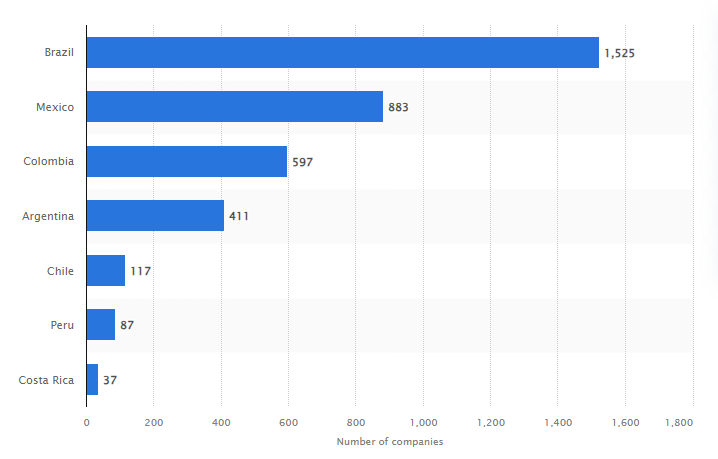
    Number of companies participating in UN environmental, social, and corporate governance (ESG) policies in selected countries of Latin America in 2022, by country
    Source: Statista

    Other companies also picked up on the new thinking. US telecoms company Verizon promised to generate up to 50% of its energy needs from renewable sources by 2025. Axa, the French insurance group, said it would cut ties with the coal industry by 2030. After the death of George Floyd at the hands of Minneapolis police in the US in 2020, a group of companies in that country including Apple, AbbVie, Facebook, Pfizer, Johnson & Johnson, and Procter & Gamble pledged US$340m to further racial justice causes.

    Particularly relevant to companies operating in Latin America, for example, is a long-standing agreement, article 169 of the International Labour Organisation (ILO), which requires meaningful prior consultation with indigenous communities affected by the proximity of major development projects such as mines, oil and gas exploration and production, or hydroelectric facilities. In addition, the Escazú Latin American treaty of 2018 commits signatories to protect the environment as well as protecting the rights of community level environmental defenders. ESG has also been invoked as a way of securing commitments to anti-corruption and transparency in business activity.

    Morally speaking, there is a sense that through SDGs companies can in some senses correct the wrongs of the past. It can be argued that global markets have been decidedly imperfect, allowing the real cost of externalities – like the damage that companies have done to the environment – not to appear on company balance sheets but to be borne by society as a whole. Some argue that, to correct this imbalance, sustainable and ethical practices are now essential for long-term business success.

    Most companies indeed appear to see ESG as essential component of their long-term survival. In a survey in the US in 2019, 72% of adults expressed an interest in sustainable investing. Over 3,000 global investors representing more than US$100trn in assets have signed the UN’s Principles for Responsible Investment, an indication of support for what could be called the ‘ESG movement’. But at the same time, it is also the case that several business and political leaders remain deeply hostile to the concept. They see ESG as a politically driven agenda with dubious measurement metrics. Right wing Florida governor Ron DeSantis, who campaigned unsuccessfully for the 2024 Republican presidential nomination, claims that woke left-wingers are using ESG as a mechanism to prioritise ideology over profits. Former Republican Vice President Mike Pence (2017-2021) says activists are using ESG to achieve policies and objectives that they could not get approved at the ballot box.

    US-based billionaire Elon Musk, who controls companies such as X (the former Twitter), electric vehicle maker Tesla, and rocket manufacturer SpaceX, has described ESG as “the devil”. An anti-ESG bill in the Oklahoma state legislature would require the state administration to withdraw investment in any companies that “discriminate” against the oil and gas industry as part of following ESG policies. Conservative think tank The Heritage Foundation has claimed that ESG “weaponizes capital” and promotes “nearly every left-wing issue”. Vivek Ramaswamy, a US entrepreneur and Republican party activist, has said he will start a firm that will reject ESG and focus solely on maximising financial returns. Larry Fink, CEO of fund manager BlackRock, who supports the concept, has nevertheless taken some distance, saying that the term ESG has become the subject of unnecessary political polarisation.

    Some commentators seek to take a balanced position. Alex Edmans, a finance professor at London Business School, told the BBC that the “three letters” of ESG do not always fit well together. “Environmental and social is about how we serve wider society. Governance is about how we generate returns,” he says, adding that different objectives within the ESG umbrella may be “functionally incompatible”. There may also be conflicting objectives such as mining lithium, which is needed for batteries to power zero emission electric vehicles, but which also creates pollution and may contribute to water scarcity. 

    ESG remains contentious in mainstream politics. Right-wing Brazilian president Jair Bolsonaro (2019-2023) was hostile to increasing company regulations in general, and opposed measures to protect the Amazon rainforest, in particular, where he wanted to see accelerated and unrestricted economic development. Bolsonaro’s term in office overlapped with Donald Trump’s first presidency in the United States (2017-2021). Trump withdrew the US from the Paris agreement, placing him and Bolsonaro on the same page (Brazil considered following suit).

    The US presidential race in 2024 is likely to be a contest between the Republican Donald Trump and the Democratic party incumbent Joe Biden (who has been in office since 2021). At the time of writing, opinion polls show an extremely close race between the two. A second Trump presidency, starting in January 2025, remains a possible outcome, which could lead to new attempts to roll back ESG regulations and downgrade climate change protections. Some right-of-centre Latin American governments could end up supporting a second Trump presidency with anti-ESG positions. Far right Argentine President Javier Milei, who took office in December 2023 at the beginning of a four-year term, has similar views to those articulated by Trump and Bolsonaro. The US election will therefore be highly consequential for global and Latin American companies.
  • The ESG wave is heading to Latin America

    Patrick de Courcy 05 June 2024 Hits: 2503

    Placing uncertainty over the US elections to one side for the moment, at a global level ESG regulations, measurements, and pressure for operational implementation have all been growing rapidly, with a significant impact on companies operating in Latin America. In addition to this global wave, individual countries, including those with the biggest regional economies, such as Brazil and Mexico, are also creating their own more localised regulatory frameworks. In a possibly worrisome scenario for companies, compliance with the new overlapping and evolving rules could prove to be hard to avoid, time-consuming, and potentially costly.

    According to lawyers Pablo Jiménez Zorrilla and Luis Burgeño in 2015 only about 15% of multilatinas (multinational Latin American companies) mentioned ESG issues in their annual reports, compared to 100% now. There may however be long term benefits offsetting those compliance costs, with some evidence suggesting that companies that engage with ESG tend to be more profitable over the long run. Zorrilla and Burgeño cite data showing that companies with higher ESG scores experienced less fall-out and more resilience during the 2020-2021 Covid 19 pandemic, with less volatility in share prices and faster recovery cycles.

    Over the medium and longer term it seems reasonable to forecast that ESG regulations will continue to grow. There may also be efforts to standardise regulations and measurements to avoid conflicting requirements at international, national, and local levels. In January 2023 the EU adopted the Corporate Sustainability Reporting Directive (CSRD) which requires all companies operating across its member countries to submit annual sustainability reports alongside relevant financial statements. These are designed to enhance sustainability reporting and disclosure. In the US, in March 2022 the Securities and Exchange Commission (SEC) proposed similar disclosure of climate-related information for investors. In October 2023 the state government of California approved two bills creating new climate-related disclosure requirements for larger companies, starting in 2026.

    In recent years there has been increased interest in regulating international supply chains from an ESG perspective. Uncertainty over US-China superpower rivalry has triggered a process of ‘nearshoring’ whereby investors are bringing supply chains back closer to key home markets such as the US and EU. For example, many companies have moved production facilities away from China and towards Mexico. The latter is seen as a jurisdiction that is geographically and ideologically closer, and which offers a less risky way to serve the US market. Companies opting for nearshoring must also show they are meeting ESG requirements.

    One important area of focus is human and labour rights. In 2011 the UN published its Guiding Principles on Business and Human Rights (UNGPs) which advocates a “protect, respect and remedy” framework where governments, businesses, and civil society organisations together take measures to enhance human and labour rights. Some governments have for example required companies to report annually on what measures they are taking to address issues of forced or child labour.

    France has a Duty of Vigilance Law which requires companies to prepare a plan for addressing human rights and environmental and health and safety issues in their own operations, in the operations of their subsidiaries, and in the operations of their supply chain partners. Germany has a Supply Chain Vigilance Law to prevent or minimise human rights and environmental risks. Under this piece of legislation, German companies are required to put in place a risk management system, with preventive measures including a complaints procedure. Similar issues are tackled in the Norwegian Transparency Act and the Dutch Child Labour Due Diligence Act.

    The US has gone further with what it terms an “affirmative provenance requirement” for the import or sale of various products. The US Uyghur Forced Labour Prevention Act (UFLPA) establishes a presumption that any goods mined, produced, or manufactured wholly or in part in the Xinjiang Uyghur Autonomous Region of China are banned for import under the terms of its anti-forced labour regulations. In this case the burden of proof lies with the would-be importing company, which must produce “clear and convincing” evidence to show its supply chain is free of forced labour. It is not far-fetched to believe a Latin American country or region might find itself facing similar restrictions.

    In addition to these national government-determined reporting requirements a variety of regional organisations have also proposed various types of ESG initiatives. The Organisation for Economic Cooperation and Development (OECD) has produced Guidelines for Multinational Enterprises on Responsible Business Conduct, which has been used as a model for some national-level laws. It has also published sector-specific advice on supply chains in agriculture, minerals, and clothing and footwear.

  • ESG take-up in Latin America

    Patrick de Courcy 05 June 2024 Hits: 1305

    The Latin America and Caribbean ESG wave is lagging somewhat behind the wealthier and more industrialised countries but is still seen as developing at a significant pace of its own. A number of region-specific factors are in play, some of which are slowing down ESG acceptance, while others may speed it up. Latin America’s rich natural resources and biodiversity mean that the “E” in ESG is particularly relevant, specially so for companies that export to Europe and North America, where ESG requirements are growing in importance for corporate management, environmental activists, and consumer groups.

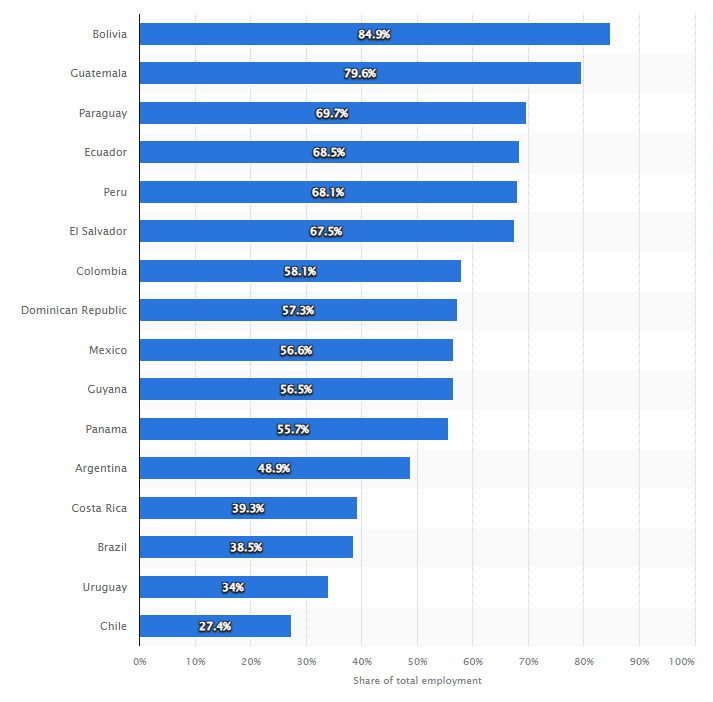
    On the other hand, the region’s proportionately greater number of small and medium scale enterprises (SMEs), and of family-owned companies and informal working, tends to restrict ESG take-up since compliance is seen by these businesses as adding costs and bureaucracy for little apparent short-term benefit. More than half the work force in a number of Latin American countries is employed informally. In Colombia the informal sector represents 58.1% of total employment. Mexico has 56.6% of its workers in the informal sector, while Brazil has 38.5%. Informality in these cases means that workers are ‘off the books’ and have no formal contract of employment, do not contribute to payroll and other taxes, and, by the same token, have limited access to statutory benefits such as education, health, and pensions.

    Reducing informality, which is associated with poverty and inequality, is a policy goal for many Latin American governments. But while such an objective can be seen as giving governments and ESG advocates a common cause, the problem of informality has proven to be deeply embedded and hard to reduce. A company with a high level of informality will be cautious of incorporating ESG goals that will be difficult to measure and fulfil. In effect informality can be seen as a major obstacle restricting ESG to the larger, blue chip companies in Latin America.

    Informal employment as percentage of total employment in selected countries in Latin America and the Caribbean as of 2022

    Source: Statista

    Latin America has long suffered from what has been described as a form of dualism, the existence a formal economy alongside an informal one. Typically, international companies and large domestic businesses subject to high levels of public scrutiny must pay all relevant taxes and meet the full stack of labour, health, and human rights regulations. Yet they have informal locally based competitors who pay lower wages, avoid or evade taxes and bureaucracy, and restrict benefits. It is hard to see this second group moving rapidly or enthusiastically into the highly regulated ESG world.

    Within the larger companies, however, ESG is undoubtedly growing. According to a 2022 survey by the Latin American Regional Forum of the International Bar Association (IBA), ESG is rapidly transitioning from being a “fashionable trend” to becoming a permanent issue for company lawyers, “particularly as the effects of the climate crisis become undeniable and social injustices are brought to light in an unstable economy”. The survey notes that ESG in Latin America tends to closely follow developments and initiatives originating in the EU and North America.

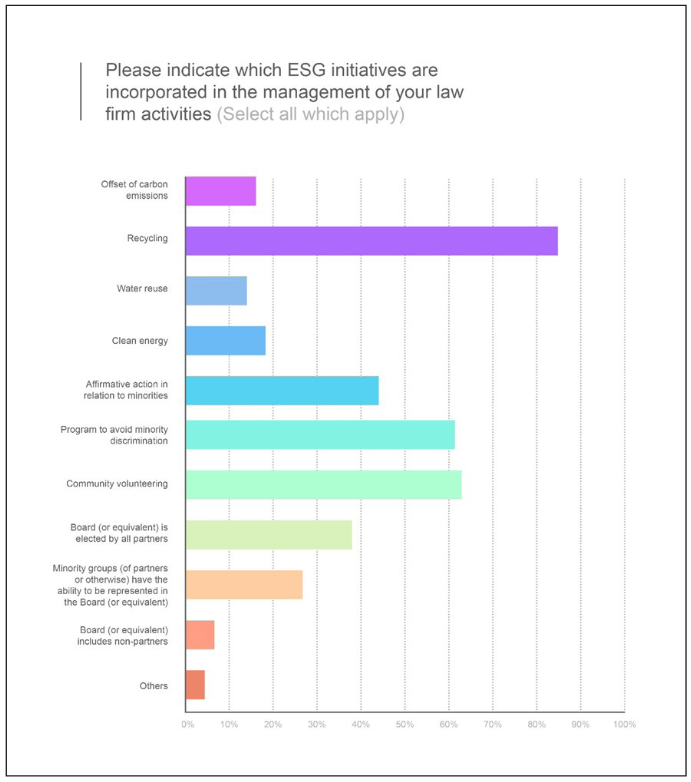
    The IBA finds that issues of compliance and waste disposal are prioritised within the “E” of ESG, with the “S” having gained importance after the Covid-19 pandemic. As mentioned earlier, environmental protection looms large at least partly because of Latin America’s wealth of natural resources. Some level of mandatory ESG reporting exists in roughly half the 16 countries surveyed. But only two of those countries were developing taxonomies, meaning that “the problem of greenwashing and virtue-signalling…remains an obstacle to ESG implementation”.  Around seven out of every ten law firms questioned had worked on ESG-related projects but only half had permanent ESG teams in place. Most ESG work in the region is related to financial transactions with ESG components, and to issues of environmental sustainability.

    Latin American law firms and ESG work

    Source: International Bar Association (IBA)

    The combination of growing ESG requirements, coupled with evolving and sometimes overlapping or contradictory early regulation, has, perhaps inevitably, led to a rise in the number of legal disputes. Legal experts say the growth in litigation is in part driven by Latin America’s strong reliance on natural resource-based industries - such as agriculture, mining, oil and gas, manufacturing, and forestry, all of which are prone to controversy and scrutiny by green lobby groups. Also driving litigation is the fact that the continent has particularly rich biological diversity, accounting for around 60% of known global animal and plant species.

    A further factor is that many Latin American countries have laws and constitutions which specifically recognise climate rights. The Peruvian constitution states that “every person has the right…to a balanced and appropriate environment for the development of life” (Article 2.22). The Ecuadorean constitution states that “the right of the population to live in a healthy and ecologically balanced environment that guarantees sustainability and the good way of living (sumar kawsay) is recognised”. In the same document Mother Nature (Pachamama) is given independent legal personhood. The Brazilian constitution establishes both environmental rights and duties. Governments and communities have a duty to defend and preserve “an ecologically balanced environment”.

    Case Study 1: PSB v Brazil: In 2020 four left wing Brazilian political parties, Partido Socialista Brasileiro (PSB), Partido Socialismo e Liberdade (PSOL), Partido dos Trabalhadores (PT), and Rede Sustentabilidade (Rede), brought a constitutional case against the federal government to the Supreme Court. They argued that the government had failed to properly manage the Fundo Clima (Climate Fund) which had been set up in 2009 to finance projects to reduce greenhouse gas (GHG) emissions. Citing the Paris agreement the plaintiffs said the government’s decision to disband the Fund’s technical committee and governing body was a violation of the government’s constitutional duty to protect the environment. In June 2022 the Supreme Court found in favour of the four political parties

    Case Study 2: Peña v Republic of Colombia: In April 2018 the Colombian Supreme Court ruled that the government had four months to present an action plan to reduce deforestation in the Amazon region. This was the outcome of a case initiated by 25 Colombian children and young people who had filed a tutela (a legal remedy to protect fundamental rights) against the government. The justices agreed with the plaintiffs that the government had constitutional and treaty obligations to protect the Amazon. The ruling stated that the government had an obligation to counter “an imminent and serious harm to the children, adolescents and adults directly affected by this suit, and, more broadly, to all Colombian citizens, both for present and future generations, since it uncontrollably releases carbon dioxide (CO2) into the atmosphere, producing the greenhouse effect, which transforms and fragments ecosystems, altering water resources and thereby harming the water supply of populated centers and causing soil degradation".

    Case Study 3: Waorani Nation v PetroOriental SA: In 2020 three members of the Waorani Nation indigenous group in Ecuador, supported by NGOs Acción Ecológica, Unión de Afectados y Afectadas por las Operaciones de Texaco, and the International Federation of Human Rights, brought a case against PetroOriental SA, a private Chinese-owned oil company. They alleged that gas flaring by the company in the Yasuní National Park contributed to climate change and violated their human rights by generating greenhouse gas emissions (GHG). However, the Ecuadorean Court of Justice rejected the claim, arguing that the plaintiffs had failed to produce enough evidence on how gas flaring violated constitutional or human rights.

    Case Study 4: ESG in BITs: While not a legal case as such, ESG-style language and commitments have begun to trickle through into a number of trade agreements and bilateral investment treaties (known as BITs). An early example was the 2008 Peru-Japan BIT, which states that relevant investment goals “can be achieved without relaxing health, safety and environmental measures of general application”. Ten years later in 2018 the Argentina-UAE BIT noted that “it is inappropriate to encourage investments by relaxing domestic measures relating to health, environment, or other regulatory objectives”.

    Case Study 5: US v PDVSA. Many of the legal cases involving ESG have tended to focus on the environmental dimension, under the “G” for governance there is also an important focus on transparency and anti-corruption issues. In July 2022, for example, a Court in Florida indicted two financial asset managers Ralph Steinmann (a Swiss National) and Luis Fernando Vuteff (from Argentina) on charges of money laundering some US$1.2bn obtained illicitly from PDVSA, Venezuela’s state-owned oil and gas company. The US Department of Justice (DOJ) said the scheme was “a corrupt foreign currency exchange scheme involving bribery of Venezuelan officials”. The US continues to apply international sanctions against Venezuela and has targeted a number of government officials. One of them is Tarek El Assaimi, former oil minister (2020-2023) and vice president (2017-2023) who now faces major corruption charges both within Venezuela and in the US. He was arrested in Venezuela in April 2024. This and many other financial corruption cases indicate that, in an ESG compliance context, companies are facing rising standards of due diligence, anti-corruption, and risk management.

  • An ESG geography

    Patrick de Courcy 05 June 2024 Hits: 1370

    In much of the discussion it has been assumed that companies consider and adopt ESG policies in response to triggers like general consumer concerns for the environment, trade agreements, or new legislation. But geography is also important. In 2022 ratings agency S&P sought to track “exclusionary policies” – situations where investment funds or other stakeholders decide to drop certain new projects or activities on ESG grounds. It found there were four types of exclusion: activity-based, product based, standards-based, and behavioural based.

    Activity-based exclusions apply in environmentally and culturally sensitive areas and conflict zones, and are particularly marked in the mining, agriculture, forestry, and energy sectors. Many of these exclusions affect activity in the Amazon. Product-based exclusions are largely about fossil fuels and affect companies that, for example, are failing to engage with the transition to renewables. Standards-based exclusions occur when there is a failure to meet international standards and regulations. These can involve requirements for independent auditing, anti-corruption, consultation with local communities, and complying with trade sanctions. Behavioural-based exclusions are largely about labour standards, such as banning child or forced labour, and upholding free collective bargaining, minimum hours, and health and safety standards.

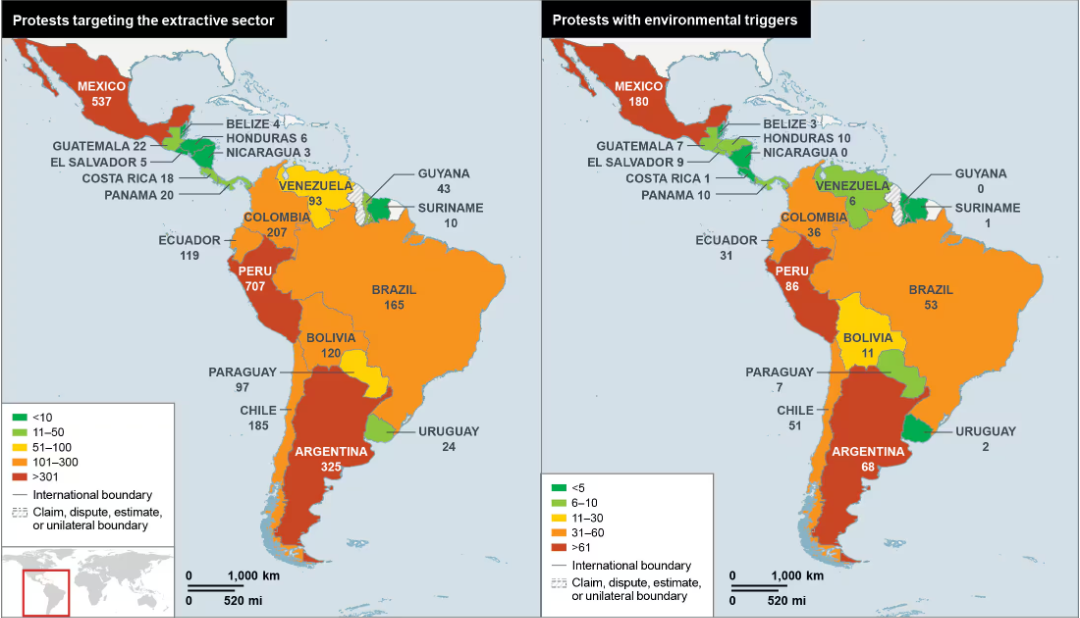
    S&P also identifies what it describes as three main ESG drivers. These are: first, violence against activists (including those defending human rights and land rights); second, community disputes (including those about contamination, water use, employment, and indigenous community participation); and third, deforestation (with links to land rights, indigenous protection, and climate change issues). Local communities often campaign against big new projects in mining and hydrocarbons with hot spots in Argentina, Colombia, Ecuador, Mexico ,and Peru.

    According to a map of Latin America prepared by S&P, in the first nine months of 2022 there were 2,710 protests targeting extractive industries, of which 58% were concentrated in Peru, Argentina, and Mexico. A separate map lists 559 “protests with environmental triggers”. The same three countries – Peru, Argentina, and Mexico – accounted for 60% of the total. 

    Intelligence events showing protests targeting the extractive sector and protests with environmental triggers January 2020-September 2022

    Source: IHS Markit

  • Brazil expects growing ESG funding market

    Patrick de Courcy 05 June 2024 Hits: 1190

    All publicly listed companies operating in Brazil will be required to publish annual sustainability and climate related disclosures, starting in 2026, according to proposals made by the ministry of finance and the country’s Securities and Exchange Commission (Comissão de Valores Mobiliários- CVM). The reporting format is expected to be based on the International Financial Reporting Standards Foundation (IFRSF) and on recommendations from a linked body, the International Sustainability Standards Board (ISSB). Finance Minister Fernando Haddad said he hopes reporting “will generate a virtuous cycle of greater transparency and commitment, allowing the possibility of measuring the issue, so there needs to be a global institutional metric”.  

    Brazil is one of a handful of Latin American countries that are developing an ESG-linked financing market. Some of the financial products under development are ‘green’ and ‘blue’ bonds. Green bonds are designed to fund projects that aim to achieve climate-related or environmental goals, while Blue bonds fund projects linked to maritime preservation and clean water. As this is an emerging market, with a range of different bond types (not only green and blue, but also various types of sustainability linked debt), efforts are being made to build an agreed classification system known as a taxonomy.

    Brazil does not yet have an agreed taxonomy for ESG financing but in the meantime is using international standards such as those set by the International Capital Market Association (ICMA) and the Climate Bonds Initiative (CBI). Verification by a second party opinion is required for a financial instrument to be certified as green, social, or sustainable. According to the CBI, by the end of 2022, Brazil was the third largest sustainable debt market in Latin America; during the year US$7.2bn worth of sustainable debt transactions were reported, taking the total outstanding to US$31.9bn.

    The CBI broke the totals down into five categories: green bonds, social, sustainable, sustainable-linked, and transitional instruments. Green bonds were the largest, with a cumulative total debt of US$15.2bn at the end of 2022, making Brazil the largest issuer in Latin America in that category. Over half (52%) of Brazilian green bonds were used to fund renewable energy, while the rest of the money was flowing mainly to land use projects (20%) and transport (10%). Other smaller recipients of green funding were water supply, sustainable forestry, and biodiversity management.

    In general, a distinction is made between ‘use-of-proceeds’ bonds, where the money raised goes to specific projects, and sustainability-linked bonds, used for general budget purposes but with a yield linked to the country’s performance in key green metrics. The ICMA recommends that sustainability-linked-bonds should use key performance indicators (KPIs) that are “measurable and verifiable by external review”, calibrated, and with variable interest rates.

    In early 2023 it had been reported that Brazilian officials were holding talks with colleagues from Mexico, Germany, Colombia, and Chile to discuss a shared framework for ESG bonds. At the time the Brazilian finance ministry issued a statement saying the aim of the talks was to “build a robust framework that will serve as a reference for an active and constant presence” in markets focused on themes like climate change.

    There is considerable scope for innovation in Brazil’s ESG funding sector. In 2023 Companhia Energética de Minas Gerais (Cemig – a state-owned power company) issued a BRL2bn (US$385m) sustainability-linked debenture, the largest of its type to date. What are called ‘incentivised debentures’ are a strong growth area in Brazil because under Law 12,431 their interest payments and capital gains are tax-free These tax breaks are granted when the debentures are used to fund infrastructure projects, agribusiness letters of credit, and other nominated financial assets. Last year incentivised debentures were issued in a wide range of ESG-related sectors including health, education, public safety, the prison system, urban parks, sports facilities, housing, and urban development.

    The country is developing ESG funding regulations. Rule 160 issued by the Brazilian Securities Commission (CVM) requires that ESG related offerings should provide detailed and externally verified information on the claimed sustainability-linked element. Given the danger of ‘greenwashing’ the CVM also requires stricter transparency and accountability. ESG issuers must explain their objectives and investment strategies, specify metrics and parameters for information disclosure, and specify an independent third party to confirm performance. 

    In September 2023 the Brazilian government launched a Sovereign Sustainable Bond framework, assisted by the InterAmerican Development Bank (IDB) and the World Bank. The framework contains guidelines for ESG-related debt issuance and is expected to lead to increased interest in this type of financing. The finance ministry also said that it was working on a taxonomy, likely to be published this year (2024) and to come into effect in 2026. The ministry is also working on a regulatory framework for trading in carbon credits.

  • Mexico goes for green bonds

    Patrick de Courcy 05 June 2024 Hits: 1370

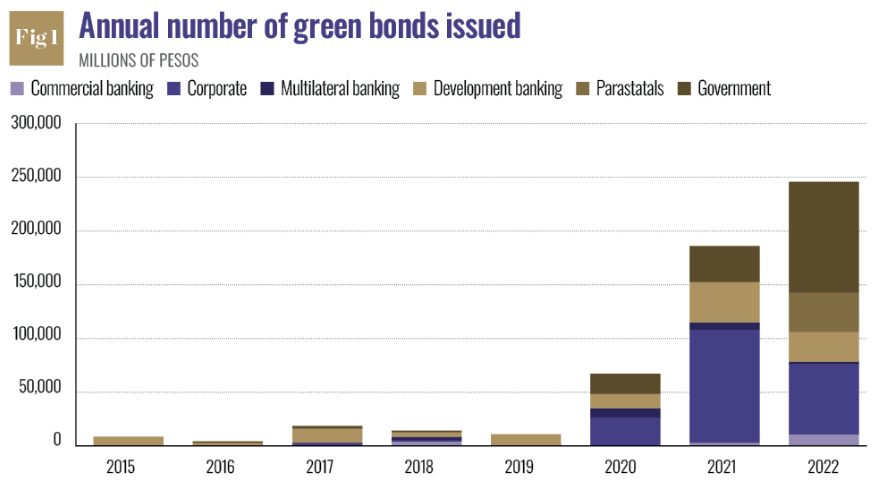
    ESG related green bonds are in fact expanding rapidly in Mexico, strongly supported by investment funds, insurance companies, and banks. The public sector has itself raised MXN131.6bn (US $7.5bn) in green bonds in 2022, 16 times more than it raised in 2015. Issuers include the federal government, state-owned enterprises, and development banks. In 2023 FIRA/Banxico, a bank, launched Latin America’s first international green bond worth approximately US$165m. The money raised by the 3-year bond was earmarked for investment projects to improve the resilience of producers and value chains in the agricultural sector and rural areas, aimed at mitigating climate change risks. 

    Mexican green bonds surge ahead

    Source: World Finance   

    Like Brazil, Mexico does not yet have a full taxonomy of ESG-linked bonds and financial instruments. Pending further government regulation, it has been left to the country’s stock exchanges, via their internal regulations, to provide a framework for the sector. Broadly speaking they have followed the recommendations of the ICMA, as set out its Green Bond Principles (GBP). ESG securities are classified into three groups: Green, Social, and Sustainable.

    For a security to be listed as “Green” the proceeds must be used exclusively to finance or refinance renewable energy, sustainable construction, energy efficient clean transportation, water, waste management, agriculture, bioenergy, forestry “and other similar related projects”. To be listed as “Social” a security must finance or refinance projects supporting a particular social group or sector. And finally, to be listed as “Sustainable”, securities must finance or refinance the activities of both green and social bonds combined.

    In addition to conforming to this three-way classification, issuers must acquire a certified opinion from a “specialised independent party” confirming that the proceeds will in fact be allocated to environmental, social, or sustainable activities. They must also document the objectives of the project or activity, and their decision-making process to secure environmental benefits. In addition, they must confirm that they meet the relevant eligibility criteria, and make an annual report to the stock market, assessing the environmental impact.

    CONSAR, the Mexican pension fund regulator, has also taken some regulatory steps. Since 2022 it has been mandatory for social security pension funds, known as AFOREs, to take ESG criteria into consideration when investing the retirement savings belonging to their clients. Official data shows that in 2022 AFOREs invested MXN110.4bn (US$6.3bn) in ESG bonds, five times the amount invested the year before.

  • The EU and supply-chain deforestation

    Patrick de Courcy 05 June 2024 Hits: 1291

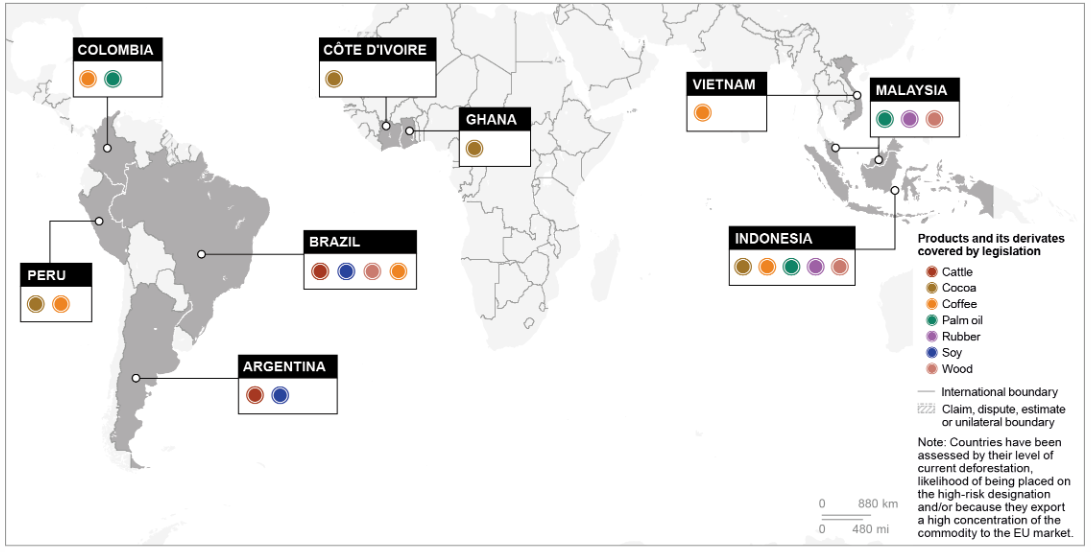
    In mid 2023 the EU approved a Deforestation Regulation, known as EUDR. It applies to imports of seven main commodities: cattle, cocoa, coffee, palm-oil, rubber, soya, and wood, as well as other related products that have been made or fed with such commodities (likely including beef, charcoal, chocolate, leather, and printed paper products). These commodities will not be authorised for import or sale into the EU unless they meet three criteria: they must be deforestation-free; produced in accordance with the relevant legislation of the country of origin; and covered by a due diligence statement to that effect.

    “Deforestation-free” is defined as applying to products that avoid the conversion of forest to agricultural use, and for products using wood, those that avoid the structural degradation of mature natural forests to “other woodland types”. This latter definition is important since it means that wood products could still be banned if the forested area is expanding but is doing so at the expense of older trees, due to increased planting of “other woodland types”. The EUDR definition of the “relevant legislation” is also very wide in scope, creating a potential for confusion and overlapping obligations. Companies must make due-diligence declarations that go beyond deforestation to include compliance with land use, labour, and human rights laws, and those covering indigenous community rights.

    The requirement for EUDR due diligence will depend on the risk profile of the country of origin. Countries are grouped into three tiers: low, standard, and high-risk. Low risk countries get relatively light due diligence; for high-risk countries, companies must provide satellite images and geo-location coordinates. Risk profiles must be drafted 18 months after the EUDR came into force (in other words, by the end of this year, 2024). Due diligence is likely to be extensive. The EU requires very detailed information such as exact time and location of production; a risk assessment covering the presence and protection of indigenous communities; supply chain complexity and “any information that would point to a risk that the relevant products are non-compliant.”

    Suppliers in producing countries must provide certificates of traceability and other documents. Various governments in exporting countries (including Colombia, Indonesia, and Malaysia) say they are concerned that the extra costs could penalise their medium and small-sized exporters, and that the EUDR may violate the non-discriminatory principles of the World Trade Organisation (WTO).

    The legislation envisages significant sanctions for non-compliance. Penalties include fines of up to 4% of the annual turnover of the importing company. Goods may also be confiscated, and the offending companies may be prevented from taking part in EU public sector procurement tenders for a 12-month period. Large companies must be compliant as of 30 December 2024, while for small and medium enterprises (SMEs) the deadline date is 30 June 2025.

    Selected countries impacted by EU anti-deforestation regulation

    Source: S&P Global Market Intelligence

    An initial assessment is that EUDR will have its greatest impact on the palm-oil producing countries (such as Indonesia and Malaysia), on agro-business exporters (Argentina and Brazil), and on cocoa exporters (such as Côte d’Ivoire and Ghana). Some analysts believe the EU has not left enough time or engaged in sufficient prior consultation for producing countries to become rapidly compliant with its requirements. For that reason, there is a possibility that, at least as a short-term measure, exports may be diverted to less demanding markets. Indonesia is considering increasing palm oil sales to Africa, while Brazil may increase soya sales to China.

    It appears that less than half of EU importing companies affected by EUDR are ready to deal with the new supply chain reporting system. According to ratings agency S&P, 34.2% of the largest companies in its S&P Europe 350 index have set targets to reduce, offset, or end deforestation in their supply chains. A share of 35.1% of companies related to food products have also done so, as have 33.3% of those related to paper and forest-related products.

    Companies have expressed concern over the additional costs involved. According to the European Commission (EC) the extra costs of supply-chain tracking systems could fall between US$170m and US$2.5bn a year. This, it says, would be “absorbed by a reduction of profit by operators along the value chain and/or eventually [be] passed through to the final consumer”.

    For Brazil in particular, EUDR presents some significant challenges. While stressing the need to fight climate change, protect the environment, and reach an ambitious zero-deforestation-by-2030 target, President Luiz Inácio Lula da Silva still faces strong domestic resistance from the conservative farming lobby and a need for a costly upgrade of monitoring and enforcement technology across the Amazon and other biomes.

    The underlying problem of deforestation is persistent. Although the pace of deforestation has slowed in the Amazon, it has accelerated in the neighbouring Cerrado biome, a key agriculture and livestock producing region. According to environmental activists Brazil’s top three meatpacking companies – JBS, Marfrig, and Minerva – are continuing to use products associated with deforestation in their supply chains. This is done by ignoring the requirement to submit legal land clearance permits (known as an Autorização de Desmate). Global Witness, one of the lobby groups, says one in three cows from the Cerrado came from farms with illegally deforested land.

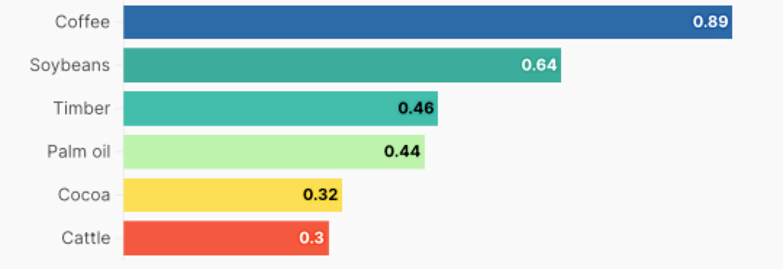
    According to a study by the Rio de Janeiro International Institute for Sustainability (IIS) based on available monitoring and procedures, Brazilian coffee exports are likely to be those at least risk of being declared non-compliant under EUDR. However, beef exports get the lowest “compliance probability index” and, if they fail to improve supply chain traceability, could end up with reduced access to EU markets. Susan Oliveira of IIS comments that “although well-intentioned, zero deforestation regulations act as non-tariff trade measures, hindering the access of Brazilian agricultural products. Despite requiring European operators to undergo due diligence processes, the burden of providing deforestation-free production falls on all links in the value chain.”

    EUDR compliance probability index

    Source: Instituto Internacional para Sustentabilidade (IIS)

    Brazil will likely be classified as a high-risk jurisdiction for EUDR purposes, meaning it will face greater costs. Brazil is the leading member of the Mercosur trade bloc (alongside Argentina, Paraguay, and Uruguay). A long-negotiated EU-Mercosur free trade agreement (FTA) remains deadlocked. Politically Lula objects that both the FTA and the EUDR should be partnerships of equals rather arrangements where one party imposes penalties on the other.

  • Workers’ rights in Mexico

    Patrick de Courcy 05 June 2024 Hits: 1266

    A common thread running through this report is that companies take on ESG commitments in a range of different circumstances. At one end of the spectrum a decision to commit to specific ESG goals may be purely voluntary and reflect a particular company’s vision of a desirable future for the world. At the other end of the spectrum ESG activity may be absolutely obligatory, required by international treaties, national legislation, or regulatory bodies. There are many ‘in -between’ situations between those two points. Companies that float green bonds may, by doing so, be signing up to specific metrics on emissions, decarbonisation, or water use. International trade agreements may make certain types of ESG commitment and reporting obligatory for certain export markets but not for others. A company may choose to take on commitments for PR or marketing purposes or because they will attract particular types of customers. Sometimes there will be a mix of motivations, and these will shift over time.

    The USMCA or US, Mexico, and Canada free trade agreement is an interesting case since, along with domestic labour reforms, it is forcing international companies operating in Mexico to make major changes to their industrial relations, pay higher wages, and support the rights of independent trade unions. This is in contrast to decades of an authoritarian, top-down, labour union leadership which manipulated union elections and signed opaque and undemocratic collective bargaining agreements (CBAs).

    The starting point for change was the introduction of a federal Labour Reform Law in May 2019. This affirmed the rights of employees to vote for their representatives by secret ballot, and to join a trade union of choice. The law also created an independent labour court to resolve differences between the employers and the workers. Conciliation and Labour Registration Centres were created, to mediate in disputes and to keep authentic, up-to-date copies of the CBAs. Reflecting the commitment to a new approach, in 2018 Mexico had also ratified Convention 98 of the International Labour Organisation (ILO) which upholds workers’ freedom of association and the right to organise.

    Writing for US-based think tank Brookings, Alfredo Domínguez Marrufo, general director of the Federal Centre for Conciliation and Labour Registration (FCCLR - a body set up by the reform) says it has had strongly positive results. According to him, formal employment in Mexico has grown to record levels, exceeding 26m. Real wages have increased by 17.8% (in the five years to October 2023), and the national minimum wage is up by 85% over the same period (and by more in northern states on the US border). Outsourcing, which Domínguez says undermines wage levels, was banned in 2021. While these benefits cannot be exclusively attributed to the labour reform, as other factors were also in play, it is clear that it did play a part.

    The second major driver of change has been the renegotiation of the old North America Free Trade Agreement (NAFTA) which was updated and renamed as the USMCA, coming into force in July 2020. A distinguishing feature of the USMCA was that it went beyond purely trade matters to fix minimum labour and environmental standards in an attempt to ensure Mexico-based companies would not have an unfair advantage over their US and Canada-based competitors. Chapter 23 of the agreement commits the signatories to defend workers’ rights in line with the ILO’s definition of fundamental principles covering minimum wages, hours of work, and occupational health and safety. The parties must also promote compliance through “appropriate government action” such as training inspectors. This is also the first FTA signed by the US where there is specific reference to banning the import of goods made by forced labour as well as commitments on violence against workers, protection of migrants, and workplace discrimination. Separately, in legislation approved in 2023, the Mexican ministry of Labour and Social Welfare has also acquired the power to designate certain goods as having been produced by forced labour, which would allow the application of an import ban.  

    Perhaps the most important aspect of the USMCA in terms of labour protection was the introduction of the ‘facility specific’ Rapid Response Labour Mechanism (RRM). The RRM is an independent panel of labour experts which provides a way of resolving disputes and enforcing the rights of workers to free association and collective bargaining that are embedded within the USMCA. When a panel finds that there has been a ‘denial of rights’ it can request the imposition of escalating trade sanctions on the companies involved. These range from suspension of preferential tariffs to a complete ban on imports into the United States of goods produced at the facility.

    In the period in which USMCA has been in force, in other words for just under four years, the RRM has been invoked 23 times. Twenty-two of those times were complaints brought by the United States, through the Office of the US Trade Representative (USTR), against labour practices in facilities in Mexico. The one remaining case was brought by Canada against a plant in Mexico in March 2023. The number of annual RRM cases started low but accelerated: there were two RRM cases in 2021, four in 2022, and 13 in 2023. Initially RRM cases were mainly in the automobile industry but have spread to general manufacturing, services, and mining.

    The US government says that 17 out of the 22 cases it referred to Mexico were resolved to its satisfaction. These cases resulted in Mexican workers receiving US$5m in backpay and benefits, the reinstatements of dozens of dismissed employees, and elections in which workers selected independent unions to represent them in nine facilities. In several cases the US and Mexican governments have agreed remediation plans. In one case a remediation plan was agreed but not implemented because the company involved decided to shut down its operation in Mexico. If governments cannot agree on an RRM case, the matter can be escalated to a RRM Dispute Settlement Panel (RRLP). This has happened twice, involving a mine and a telecommunications facility. Most RRMs have targeted facilities operated by Mexican subsidiaries of US companies, but subsidiaries of companies with headquarters in Europe, Japan, Korea, and China have also been affected.

    An important issue for companies operating nearshoring facilities in Mexico, designed to serve the US market, is that timescales to respond to a complaint are very short. When a petition about a labour rights violation is first made, USTR has 30 days to review the relevant documents and decide whether to support it. If it decides the claim is credible it makes a formal request to the Mexican government, which then has 10 days to decide whether to conduct a review and 45 days to investigate. At this stage the US Treasury may suspend processing of tariffs on imports from the relevant facility. Publicity about the claim may also affect the share price of the company operating the facility.

    Corporate lawyers say the way the system is configured poses some difficulties for companies. There is little clarity on channels for companies in Mexico and the US to present their defence or counterarguments. Executives are not always allowed to attend RRM hearings or to participate in site visits. Recommendations include stepping up knowledge and training about labour rights and employment law. If the number of cases continues rising, both governments will need to hire more experts to assist with management of the panels. There are some signs that RRM cases are in fact poised to expand into the services sector.

    The political background to the USMCA is noteworthy since it was drafted during the Donald Trump Republican Party presidency in the US (2017-2021) but achieved a degree of cross-party support from the Democrats. Trump administration officials were motivated to preserve employment in the US automobile industry and many provisions in the USMCA are indeed designed to maintain or enhance the competitiveness of US production. The addition of ESG-style elements relating to the environment and labour rights was largely at the suggestion of congressional Democrats. Their inclusion was accepted by Republicans who saw them as another way of establishing a level playing field and preventing unfair competition against US-based manufacturing. Finally, the left-wing Mexican government of President Andrés Manuel López Obrador (AMLO) saw benefit in automobile industry provisions seeking to make tariff-free access to the US market conditional on the payment of a higher minimum hourly rate to Mexican workers.

    Liz Shuler, president of the American Federation of Labour and Congress of Industrial Organisations (AFL-CIO, the main US labour federation), has argued that USMCA should be judged by its ability to close “the 10:1 wage gap between manufacturing workers in the US and Mexico, by raising the real wages of Mexican workers”. Her assessment of USMCA is that, together with Mexican labour reform, it has made some progress but that “a number of Mexican states have been dragging their feet on setting up the state and local labour courts that are critical to enforcing the new labour laws”. Shuler is more enthusiastic over the role of the RRMs which she says have led to concrete wins including independent union representation, higher wages, and the reinstatement of dismissed workers.

  • Conclusion: ESG here to stay in Latin America

    Patrick de Courcy 05 June 2024 Hits: 1149

    Briefly, a number of conclusions can be drawn from this discussion.

    • Global and Latin American countries will face growing ESG requirements in the coming years.
    • High levels of informality in the region’s economies and labour markets will limit take-up to larger companies and be the source of a degree of ‘greenwashing’.
    • A Trump victory in the US presidential elections this year, coupled with deregulation efforts by some centre right-governments in the region such as Argentina and Ecuador, could slow, but not reverse, the ESG wave.
    • ESG-related financing including green or sustainability linked bonds is increasing rapidly and will require risk management.
    • As an emerging sector ESG has widely different regulatory frameworks and metrics which will need to be consolidated.
    • The EU Deforestation Regulation, EUDR, which comes into full effect in January 2025, is likely to be an important milestone and test case for supply-chain regulation
    • Labour-protection ESG initiatives like the Mexico-US use of a Rapid Response Labour Mechanism (RRM) may spread to other parts of Latin America
    • Latin American governments face the dilemma that wealthier partners such as the EU and US may use costly ESG compliance and reporting requirements as a form of back-door trade discrimination.