Kick-starting the economy

Items

  • A neo-liberal agenda

    LatinNews 15 January 2020 Hits: 1243

    Addressing Brazil’s economic travails and the government’s widening fiscal deficit was going to be a necessity for whoever won the presidency. In 2018, Brazil was still struggling to recover from its biggest recession in recent history, which saw GDP contract by 7% in 2015-16. Growth was sluggish, unemployment stood at 12.3%, public debt amounted to 76.7% of GDP, and the government’s fiscal deficit totalled 7.1% of GDP.

    Promises to tackle these issues therefore formed a core part of Bolsonaro’s campaign message and efforts to carry out these promises have been at the forefront of the government’s work. Perhaps Bolsonaro’s biggest success during his campaign was that of weaving an economic narrative which convinced high-income voters and the business and financial sectors that he would side with the markets and continue the fiscal austerity measures implemented by his predecessor Temer, rather than follow a nationalist approach to economic policy which his military background and voting history as a federal deputy showed him to previously favour.

    As it was, Bolsonaro embraced a liberal, pro-market economic discourse. His government programme spoke of zeroing the fiscal deficit by undertaking mass privatisations and reducing the size of the state; listed growth, opportunity and employment as a priority; and promised to open up the country’s closed economy and simplify business procedures.

    It remained vague on the particulars of how to achieve all of this, however, and it was Bolsonaro’s pick for economy minister, University of Chicago-trained Paulo Guedes, which convinced most of the business sector to unite behind his candidacy. Frequently confessing his ignorance of economic matters, Bolsonaro indicated that Guedes would have free reign to pursue policies as he best saw fit, heading a newly created economy ‘super-ministry’.

    The reality has been more nuanced. The economy ministry and federal financial institutions have not escaped the internal quarrels and power struggles which have marked the Bolsonaro administration so far, and this year saw some forced resignations following personal disagreements with the president. However, the government has stuck to its efforts to implement fiscal austerity; carried through its promises of sweeping privatisation; taken steps to cut red tape and improve the business environment; and tabled an ambitious programme of fiscal and economic reforms.

  • An ambitious reform programme

    LatinNews 15 January 2020 Hits: 1408

    Pension reform

    A reform to the country’s unsustainable pensions system was quickly adopted as the Bolsonaro government’s flagship economic policy. The process was slow, but ultimately successful. On 10 July, almost five months after Bolsonaro had personally presented the project (a constitutional amendment known as the PEC 6/19) to congress, the pension reform was approved with 379 votes to 131 in the chamber of deputies, garnering the necessary three-fifths support in this momentous first vote. After a second vote in the chamber and two votes in the senate, the approved PEC was promulgated in early November, marking the start of the overhaul of the Brazilian pension system.

    The approval of the pension reform stands out as the Bolsonaro government’s biggest achievement this year. With the government’s social security deficit amounting to R$195.2bn (2.9% of GDP) in 2018, and an ageing population, the pension reform had become an urgent necessity, but it remained a politically costly and unpopular move. The final reform plans for savings of R$800bn (US$196bn) over the next decade. This is less than the R$1tn anticipated in Guedes’ initial proposal, but double the R$400bn savings that a reform which Temer failed to pass had budgeted.

    Guedes’ proposal to switch to a capitalisation system was removed, as was a reform to state and municipal workers’ pensions. A separate constitutional amendment has already been tabled for the latter and will be discussed by congress this year. Certain benefits, scrapped under Guedes’ proposal, were reinstated by congress. However, the approved reform introduces a minimum general retirement age (62 for women, 65 for men) as well as increasing minimum paying-in periods.

    A reform to military pensions, a thorny issue considering Bolsonaro’s military background and support base, was treated separately and approved in early December. It increases minimum service time by five years and plans for a gradual increase in the rate of pension contribution.

    More Brazil, less Brasília

    Buoyed by the approval of the pension reform, Guedes presented a package of three constitutional reforms to congress in November, part of a plan dubbed ‘more Brazil, less Brasília’ – a name which summarises his objective of slimming down and decentralising the Brazilian state.

    These three reforms are the federal pact PEC, the emergency PEC, and the public funds PEC. They broadly aim to decentralise budget decisions and overhaul spending rules for municipalities, states, and the federal state; oblige states and municipalities to abide by a spending cap; and allow for the suppression of the government’s public funds (funds drawn from certain royalties and destined to specific sectors such as healthcare or education) to re-allocate these resources to easing public debt. 

    The package aims to create a “culture of fiscal responsibility,” Guedes declared back in November. It has been well received by economists and certain lawmakers, but it will face opposition on some points, notably the proposal in the federal pact PEC to extinguish some 1,250 smaller municipalities. Although there are hopes that the reforms will pass congress in the first half of 2020, the political reality may prove more complex – and the ‘plano mais Brasil’ will be jostling with other reforms for the attention of lawmakers this year. 

    In the pipeline: administrative and tax reforms

    Two other structural reforms expected from Bolsonaro’s economic team were an administrative reform and a tax reform. Talk of launching these before the end of his first year in office proved too ambitious, however.

    The public administration reform, which would restructure the organisation of public sector careers and cut back benefits to public servants, was held back amid concerns that it would trigger popular protests. The explosion of social unrest across the region in late 2019, notably in Chile, a country which Guedes has frequently held up as a model to follow, sparked fears of contagion in Brazil’s government circles. This appears to have temporarily put the brakes on some of Guedes’ more neoliberal and potentially contentious proposals.

    As for plans to simplify Brazil’s hyper-complex tax system, the government has so far failed to put forward a clear proposal. Different tax reform projects are already under discussion in congress, but the government has indicated that it will come up with its own. There has been talk of merging various federal taxes; of re-introducing a financial transactions tax modelled on the extinct and hugely unpopular CPMF (this has been point of conflict in government); and of making adjustments to taxes on profits and dividends as well as diminishing corporate taxes. Bolsonaro has assured that the burden on taxpayers will not increase, and that any new levies will be counterbalanced by the suppression of other taxes.

    Guedes himself admitted to congress in late December that he is concerned by the lack of advance and consensus on the government’s tax reform efforts. Maia believes that a tax reform will be harder to pass than the pension reform was. There is now talk of the reform being presented piecemeal, in four different stages, and most projections point to it not being implemented before 2021 at the earliest. 

  • Concessions and privatisations

    LatinNews 15 January 2020 Hits: 1275

    Like pension reform, the government’s plans for privatisation are fairly unpopular with the electorate but meet with enthusiasm from the business sector. Although no company under direct state control was sold off in 2019, the Bolsonaro government has continued the investments partnerships programme (PPI) begun under Temer, overseeing concessions in infrastructure and energy. It has also moved forward with divestment within state companies, and laid the groundwork for some further-reaching privatisations in 2020.

    Tenders for airports and maritime ports were particularly successful, with other auctions including railways, federal roads, and oil exploration concessions. The country’s largest offshore oil auction ever, held in November and billed as a ‘mega-tender’ expected to raise US$25bn in signing fees, frustrated expectations and failed to attract international oil companies. It nevertheless still delivered the largest signing fees ever, totalling R$69.9bn (US$17.11bn).  

    Overall, privatisations, divestments, and concessions brought in R$103.3bn (US$25.29bn) in 2019, a figure which the economy ministry notes exceeds the R$80bn pledged by Guedes before investors at the World Economic Forum in Davos, Switzerland, in January 2019. Ten companies were included for study in the government’s national privatisation programme last year, including the Casa da Moeda national mint, and a bill for the privatisation of the state energy company Eletrobras was presented to congress in November.

  • Encouraging results

    LatinNews 15 January 2020 Hits: 1300

    For all the market optimism that met Bolsonaro’s election in late 2018, there were those who sounded cautionary notes. Political polarisation and disorganisation do not lay solid groundwork for lasting reform. While these concerns proved at times to be founded – and had the markets on edge more than once over the course of the year – 2019 has largely closed on victory for Bolsonaro where the economy is concerned.

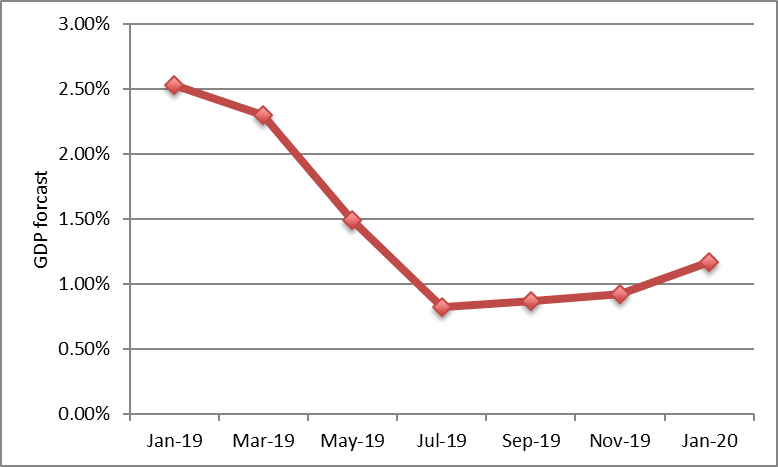
    The success of the pension reform, the promises of further reforms and the results of the government’s measures to reduce spending have borne some fruit. Economic recovery, although still sluggish, is confirmed. After signs that the economy might see a technical recession at the beginning of the year, growth picked up, principally thanks to internal consumption and the agricultural sector. GDP is now projected to grow 1.2% in 2019, and expand 2.2% in 2020. Public debt remained largely stable this year, standing at 77.7% of GDP in November. The fiscal deficit had fallen to 6.36% of GDP in the 12 months to November. The business sector has been responsive; the São Paulo stock exchange (Bovespa) hit several record highs, surging 31.58% over the course of 2019.

    Challenges remain with a slow labour market (unemployment, although falling, remains high at 11.2% and the employment market is sustained by the informal sector), a struggling industrial sector, and an unfavourable international scenario, which can help explain a 7.5% decrease in annual exports and the sharp devaluation that the real suffered in November.

    Evolution of 2019 GDP growth forecast  

    Source: Focus bulletin, Brazilian central bank (BCB).

    Mercosur

    In its early days, the Bolsonaro administration had suggested that the Southern Common Market (Mercosur) regional trade bloc, which includes Argentina, Paraguay, and Uruguay as well as Brazil, would be neither an economic nor foreign policy priority. This shifted following the signing of a historic free-trade agreement (FTA) between Mercosur and the European Union (EU) on 28 June 2019. Although the deal’s ratification by European countries remains in doubt, in large part due to Brazil’s failure to reassure the EU about its environmental commitments, it has been hailed as a diplomatic and commercial victory by Bolsonaro. Mercosur went on to sign an FTA with the European Free Trade Association (Efta) in August. Despite uncertainty hanging over Brazil’s relationship with Argentina under the latter’s new Peronist President Alberto Fernández, Bolsonaro has indicated that Brazil remains committed to the bloc as part of efforts to open up Brazil’s closed economy. These include endeavours to reduce Mercosur’s high common external tariff (CET) as well as talk of separately pursuing bilateral trade deals with other countries, notably the US and China.

    Selic

    From July 2019, Brazil’s central bank (BCB) successively lowered the benchmark interest rate (Selic) from a record low 6.5% to 4.5% by the end of the year. André Rebelo, strategic affairs advisor at the Federação das Indústrias do Estado de São Paulo (Fiesp) private sector lobby, is upbeat about the opportunities this represents for domestic business. However, the low Selic, expected to be maintained at 4.5% throughout most of 2020, makes the country less attractive to foreign investors.