Part I: Taking stock after four years of Trump

Items

  • The impact of Covid-19

    LatinNews 09 October 2020 Hits: 887

    Six months after the start of the pandemic, the United States, along with Brazil and Mexico, the two most populous Latin American countries, were widely seen as having both under-estimated and mis-handled the health crisis. While the future course of the pandemic remains difficult to predict, it is clear that, independently of whether Donald Trump or his Democratic Party opponent Joe Biden wins the US election, it will still dominate regional politics for the medium-term future. The dramatic downturn in the US and Latin American economies, rising unemployment, the collapse in the travel and trade industry, and the expected increase in poverty and inequality of income will all take a number of years (perhaps even more than the full four year 2021-2025 US presidential term) to fix.

    In March-April of this year, measured by a seven-day rolling average death rate, the Covid-19 pandemic looked like being primarily a European crisis. But this changed dramatically in subsequent months: by August-September the epicentre of the health crisis appeared to have shifted decisively to the Americas. In the seven days to 6 September there was an average daily global death rate of 5,381, of which 2,273 or 43% took place in Latin America, and 829 or just under 16% occurred in the United States. In other words, more than half the world’s coronavirus fatalities were taking place in the Americas – nearly 59% (for comparison, the Americas account for roughly 13.2% of the world’s population).

    New deaths attributed to Covid-19 in European Union, United States, Brazil, India, Mexico and United Kingdom

    Seven-day rolling average of new deaths
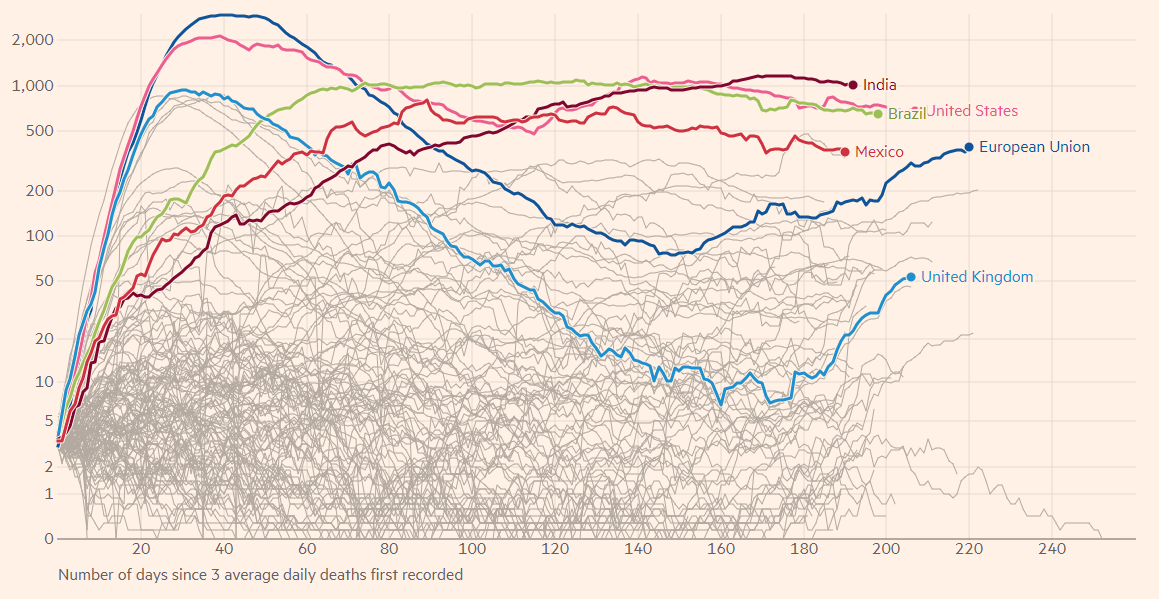
    Source: FT online

    On a cumulative basis, the Americas in general and Latin American and the Caribbean in particular, have been hard hit by the pandemic. As of the beginning of September LAC had around 6.1m cases of coronavirus and 280,000 deaths. In terms of absolute numbers Brazil, Mexico, Peru, Colombia, and Chile had the highest death tolls in the region. Brazil came second in the world by number of deaths, behind the United States (although India was potentially poised to take second place and push Brazil into third). When ranked by cumulative Covid-19 fatalities per 100,000 members of the population, the worst performing country was Peru (90.48 deaths per 100,000) followed by Chile (60.45), Brazil (58.53), and Mexico (51.70).

    The Trump administration’s approach to the coronavirus has been widely criticised. The US president has been erratic in his response to the crisis. He has sought to minimise the impact of the virus, ignored or made little of scientific advice, recommended unproven vaccines and treatments, and failed to coordinate or lead federal, state, and local government responses. The president has been deeply hostile to quarantine and ‘shelter in place’ measures because of their impact on the economy in a year in which he hopes to be re-elected. It has been left largely to state governments to impose a poorly coordinated patchwork of lockdown regimes.

    President Trump has frequently attacked the policies of Democratic Party controlled states and has threatened them with withholding federal funds. Although there was a degree of bipartisan agreement to pass major fiscal stimulus measures (totalling some 13.2% of GDP as of July 2020) that coordination appeared to be breaking down in the final months of the election campaign, risking further turbulence in the labour market.

    Up to a point, the policies of Jair Bolsonaro in Brazil and Andrés Manuel López Obrador (Amlo) in Mexico seemed to come from the same playbook. During the early stages of the pandemic both underplayed the seriousness of the medical threat. Bolsonaro in particular made a point of ignoring social distancing rules, shaking hands with his supporters, and refusing to wear a mask. Both failed to pro-actively coordinate state and federal government approaches to the crisis and were particularly critical of state governments. Both pushed for the early removal of lockdown measures, even at a time when the infection curve was rising. Among the differences, while Brazil pursued major fiscal stimulus, Mexico maintained tight fiscal austerity.

    That said, it does not seem to be the case that Brazil and Mexico copied a flawed US coronavirus blueprint. More likely, populist presidents in all three countries independently and in their own way opted to pursue narrow short-term political gains in their response to the crisis. What also seems evident is that even in the face of large-scale loss of life and acute criticism over ineffective health polices, the popularity of incumbent political leaders remained surprisingly high. Since March President Trump’s approval rating in the US has remained fairly constant in a 40%-45% range. The popularity of almost every single Latin American leader was equal or higher in August this year than it was before the pandemic began in March.

    Although trending downward, Amlo’s approval rating remained consistently above 50% in the first six month of the pandemic. In Brazil, Bolsonaro’s approval seemed to hit a floor of 30% but then rose gradually to 37% during the same period (and to 40% in September according to at least one pollster). Various explanations have been put forward for this, including a ‘rally round the flag’ effect or the positive impact of emergency cash transfer programmes (particularly significant in Brazil). The popularity bump for incumbents may not last but it has been significant in the first wave of the crisis.

    The coronavirus pandemic is still unfolding, and its political and economic effects remain hard to predict. What is clear however is that it is casting a long shadow over both the United States and the LAC region and will impact all of the major issues in the relationship between the two. For the next four-year US administration Covid-19 could become the prism through which all US-LAC issues are viewed. Although they may have benefited from something of an initial free ride in popularity terms, governments in the region that fail to control the virus or to get their economies onto a recovery path from 2021 onwards are likely to face major difficulties and potentially violent popular protests. What the next US president does to help or hinder the recovery process will have a significant influence on future outcomes.
  • Economy and trade

    LatinNews 09 October 2020 Hits: 880

    The LAC region was already experiencing a significant and troubling slowdown in economic growth before the coronavirus pandemic began. Broadly speaking, in the first 15 years of the 21st century most Latin American and Caribbean countries benefitted from strong global growth and an extended global commodities boom, which boosted their export revenues and domestic growth rates. Governments, including many of the centre left (the so-called pink tide) were able to redistribute income, reduce poverty, and encourage the growth of the middle classes. Annual LAC economic growth averaged 3.1% across those 15 years, with some countries registering much higher single-digit percentage growth rates in particularly good years.

    On the downside, the export boom led to a surge in both public and private sector corruption, political cronyism, and poor allocation of resources. Although to differing degrees, most governments in the region failed to diversify their economies, to improve their participation in global value-added chains, or to boost labour productivity. Many experienced widening fiscal deficits and unsustainable growth in their foreign debt burden.

    By 2015 global conditions had become less favourable for LAC. Slower growth in China helped end the global commodities boom. With the electorate deeply dissatisfied with the performance of centre-left administrations, the political pendulum began swinging to the right. There were deep recessions in Argentina and Brazil. Low oil prices and catastrophic mismanagement tipped Venezuela into a steep decline. From 2017 the Trump administration’s protectionist and anti-immigration policies, along with its growing trade tensions with China, caused investment uncertainty, particularly in Mexico and Central America.

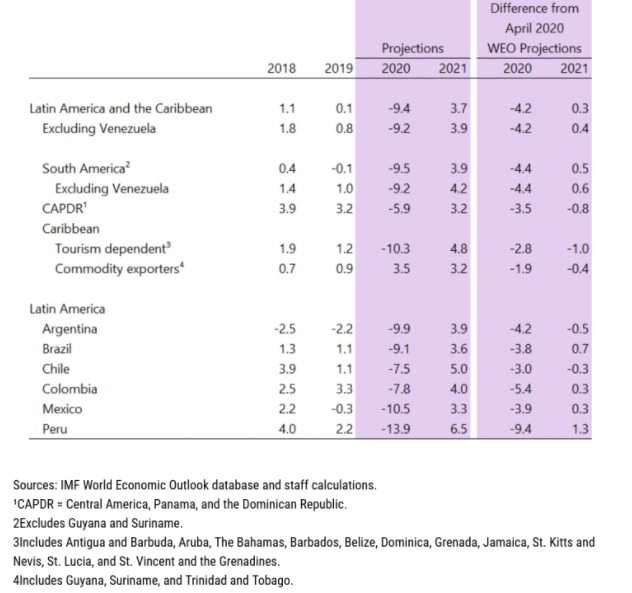
    After 2016 Latin America virtually stopped growing: regional GDP fell by 0.6% in that year, and was flat thereafter, growing by only 0.1% in 2019. In early 2020 the IMF had predicted a regional 1.6% growth rate for LAC based on a recovery in Brazil and other economies. But as the Covid-19 pandemic hit, the IMF changed the forecast to a fall of 5.2% (April) and then to a much steeper contraction of 9.4% (June). The outlook for next year is for a modest post-pandemic recovery with regional growth of 3.7%. A further update is expected in October; some economists suggest that signs of improved performance in the second half of 2020 may mean the outlook for this year improves a little compared to the unprecedented recession expected in the June update.

    IMF forecasts recession in most of Latin American and Caribbean

    Real GDP growth (%)

    The Latin American recession – the worst in a generation – will have a series of long term, negative effects. Inequality of income had been consistently reduced in 2002-2014 but began rising again after that. The UN Economic Commission for Latin America and the Caribbean (Eclac) says inequality will rise in all countries in 2020, with the worst results in the largest economies – Brazil, Mexico, and Argentina. The proportion of the population living in poverty fell to 27.8% in 2014 but is expected to rise by nearly 10 points to 37.2% this year. No less than 45m people are expected to fall into poverty this year, taking the total to 230m. The proportion of people working informally (outside the tax and benefits system) is expected to remain above 50% of the labour force. These workers are particularly vulnerable to coronavirus infection. Added to this, because of the recession in the US, there have been fears that remittances sent home by expatriates will fall (although initial data suggests they remain resilient). Remittances are particularly important for Central America and Caribbean economies.

    The onus of responsibility for getting Latin America and the Caribbean back on a sustainable growth path lies with the governments of the region. However, the policy positions and actions of the next US president will be part of the global environment within which they will be operating. Latin American leaders will assess the role of the next US president in terms of what he may be able to offer them on the road to recovery. The US is important because of its contribution to global growth, its trade and investment links with the region, the role of remittances, and foreign aid.

    A re-elected Donald Trump should be a known quantity – giving more of the same of what the region has already experienced during the last four years. But his political style is by nature unpredictable, so “more of the same” could be a Pandora’s box of the unexpected. So far the US president has not really engaged with Latin American economic issues except to the extent that they impinge on his political agenda. Anti-immigration measures and the protection of US jobs have loomed largest in his approach to the region. So has the imposition of trade tariffs, for example on steel and aluminium.

    These concerns were a major factor in the renegotiation of the North America free trade agreement with Mexico and Canada (now renamed the USMCA). However, despite concessions to US protectionist sentiment, the USMCA, which came into force this year, is proving less disruptive to trade than had been initially feared. Prospects for better market access were also dealt a blow when Trump pulled his country out of the 12-country Transpacific Partnership (TPP) free trade proposal, with negative impacts for Chile, Peru, and Mexico.

    President Trump has made repeated attempts to cut foreign aid to LAC, but these have been overruled by congress, with the result that the foreign aid bill for fiscal year 2020 stood at US$1.72bn, not that different to the US$1.69bn voted five years earlier in 2016. Another important factor in Trump’s approach has been his trade and political rivalry with China, which has led him to exert pressure on Latin American countries, for example by trying to block deals with Chinese telecoms manufacturer Huawei.

    Seen from the economic viewpoint a Biden presidency would offer a more rules-based and multilateral approach to trade issues. This would be welcomed in many Latin American capitals. However, in some areas Biden will not be that different to Trump. The Democrats, and particularly their progressive wing, have been wary of the effects of globalisation and will also want to be seen as protecting US-based jobs. USMCA was approved after the Democratic Party majority in Congress inserted amendments to protect labour rights and environmental protection. Biden is likely to share Trump’s concerns over rising Chinese influence in the region. However, it is likely that Biden will favour increased foreign aid in Central America.

    Another important difference will be that Biden has committed to supporting a Green New Deal. Increased US concern over climate change will bring both opportunities and threats for Latin America. The region’s renewable energy resources have great potential and may benefit from added US investment; however, oil and gas exporting countries will be concerned about the speed of decarbonisation and its impact on prices. During the course of this decade some LAC oil fields could become stranded assets – uneconomic to develop commercially.

    A major issue for the region, which will require large-scale infrastructure investment if it is to become more competitive and resume sustainable growth, will be the stance of multilateral financial institutions such as the IMF, World Bank, and the InterAmerican Development Bank (IDB). The United States has significant voting rights in each of these institutions.

    In a controversial election in September Mauricio Claver-Carone, a Cuban American nominated by Trump, was chosen for a five-year term as IDB president. His appointment broke an unwritten convention that the presidency is always held by a Latin American. There have been concerns (which Claver-Carone denies) that he will bring political partisanship to the role. If Biden wins Claver-Carone’s relationship with a Democratic Party-controlled White House could be tense, which will not be helpful as the bank is called on to play a higher profile role in post-pandemic recovery. The new IDB leader says he will focus on lending to bring digital connectivity to rural areas, to support small and medium size enterprises, and to promote public-private partnerships.

  • Democracy and human rights

    LatinNews 09 October 2020 Hits: 862

    For virtually the entire post-World War II period, successive US governments have formally supported democracy and human rights in Latin America. However, in practice and for motives of political expediency, Washington has a long record of supporting anti-democratic and dictatorial regimes and has been complicit in numerous military coups d’état. For many decades the logic of the Cold War led US administrations to support right-wing military dictatorships, prioritising their anti-communist credentials over and above respect for democracy and human rights.

    Formal democracy has spread throughout the region over the last four decades. Latin America and the Caribbean consists of 33 countries, ranging from small Caribbean island-states through to Brazil, the world’s fifth most populous country. In the early 1980s, 16 or nearly half of those countries were governed by authoritarian, mainly right-wing, and often military regimes. In 2020 by contrast, out of the 33 only three governments, those in Cuba, Nicaragua, and Venezuela, all considered left-wing, were classified as “authoritarian” or “not free” according to rankings compiled by the Economist Intelligence Unit (EIU) or Freedom House. That said, during the last ten years (the 2010-2020 period), as governments have struggled with increasing economic difficulties, corruption, and frustrated middle-class expectations, there have been signs of a deep malaise affecting the region’s democratic institutions. The 2018/19 Latinobarómetro survey of 16 countries found the proportion of respondents happy with how democracy was working in their regions averaged only 39.6%, the lowest level registered since 2004.

    The weakening of institutions – described by some as a form of “democratic diabetes” – a silent disease – has manifested itself in different ways. One has been the rise of populist leaders of both right and left, coupled with declining levels of trust in political parties, politicians, and legislatures. Another has been renewed reliance on the military, whose presence in government rose sharply. There was also a big rise in contested elections with increased claims of electoral fraud. Among them were allegations of widespread fraud in the Honduran elections of 2017; the exclusion of candidates in the Guatemalan elections of 2019; claims of fraud in the Bolivian elections in the same year; and irregularities in the Guyana polls, in March 2020. Other governance concerns include politicised judicial systems, corruption, high levels of crime and violence, and infiltration of state institutions by organised crime.

    The Trump administration has maintained formal US support for democracy and human rights, but in practice the approach has been tactical and transactional. US responses to anti-democratic threats including corruption have been low-key. Generally, Latin America has been seen as a low priority area for US foreign policy. It was not until 2018, well into the Trump administration’s four-year term, that the State Department produced a formal policy document which said US engagement with the region would focus on three pillars: 1) economic growth and prosperity, 2) security, and 3) democratic governance. A further strategy paper in August 2020 emphasized controlling migration and drug trafficking and countering the “malign political influence” of outside powers such as China. While this document also spoke of a commitment to democracy and the rule of law, it did so in the limited context of targeting leftist governments.

    The document spoke of “reaffirming the region’s commitment to democracy and the rule of law, which includes efforts to restore human rights and democracy in Nicaragua and Venezuela and enable a transition to democracy in Cuba”. While all three of these countries have been subject to tightened economic sanctions, the perception is that the Trump administration has soft-pedalled or lacked concern over corruption and human rights elsewhere in the region. The president’s rhetoric has portrayed Latin America as a source of almost entirely negative impacts on the US – illegal immigration, crime, and drugs. Perhaps as a consequence, Latin American public opinion has a predominantly negative view of the US president. A Gallup poll in 2019 in the Western Hemisphere showed that 51% of respondents disapproved of US leadership, while a significantly lower 34% approved.

    A Biden presidency would likely offer a more balanced approach to democracy and human rights concerns in Latin America, and therefore improve perceptions of the US in the region. However, change in this area would be limited. Democratic Party administrations, as well as Republican ones, have often found short term political expediency overrules or limits their commitment to broader principles in defence of democracy and human rights. The Obama administration, which included Joe Biden as vice-president, equivocated over the right-wing military coup in Honduras in 2009, and did not cut off foreign aid to the country, including ongoing support for the military and police.

  • Drugs and crime

    LatinNews 09 October 2020 Hits: 997

    For over 40 years successive US administrations have sought to counter drug production and trafficking in Latin America and Caribbean, and the smuggling of illicit drugs into the United States. The results have been mixed, for reasons linked to conditions in both the drug-producing and drug-consuming countries. In the producing countries high levels of poverty, inequality, unemployment, and social hardship have made it hard to resist the very high profits to be made by drug production and sale. In the consuming countries – mainly in this case in the United States – addiction has been deep rooted, leading to highly price-inelastic demand for drugs. As a result, while the power of different drug cartels has waxed and waned, and governments have experimented with differing antinarcotics policies (from hard-line policing through to a greater concern to tackle underlying causes and offering a public health approach to addiction) the business itself has proven to be extremely resilient.

    At present LAC is a key source and transit zone for cocaine, marijuana, methamphetamines, opiates, and opioids such as heroin and fentanyl. Heroin/fentanyl related deaths in the US have reached epidemic levels. Rising demand has prompted rising drug production in Mexico and Colombia. Over 90% of US heroin consumption is smuggled in through Mexico, and 80% of cocaine on the US market originates in Colombia. In April 2019 China began to impose tighter controls on local production of fentanyl, prompting increased illicit manufacture of the drug in Mexico.

    While most key regional governments have collaborated with US anti-narcotics efforts, some like Venezuela have not. Mexico has seen power shifts between rival cartels, with the Sinaloa cartel losing influence to the Jalisco-based CJNG (Cartel Jalisco Nueva Generación). In the Central American republics, the dominant criminal gangs, Mara Salvatrucha (MS-13) and Calle 18, originally emerged among immigrant communities in southern California in the 1980s. They remain powerful.

    Drug seizures by US Customs and Border Protection (measured in lbs)

      FY 14 FY 15 FY 16 FY 17 FY 18 FY 19
    Cocaine 45,323 38,346 52,838 62,415 51,592 89,207
    Heroin 4,356 6,023 4,224 3,398 5,205 5,427
    Marijuana 438,146 602,821 516,122 366,627 299.419 289,529
    Methamphetamine 19,613 25,495 33,086 46,247 57,440 68,585
    Fentanyl  n/a 70 596 1,875 1,895 2,545

    Source: U.S. Customs and Border Protection

    Throughout the region the high incidence drugs and crime poses an intractable problem, fuelling violence in producer countries and rising drug-related deaths in US cities. The drugs debate has traditionally led to recriminations, with the US accusing Latin America of not doing enough to stop production, and Latin America countering that the real problem is the US failure to restrict demand.

    During his presidency Donald Trump has aligned himself with those who favour a hard-line attack on drug trafficking and criminal gangs. However, much of this positioning has been more rhetorical than effective. While existing security cooperation programmes such as the Mérida Initiative in Mexico or the Caribbean Basin Security Initiative (CBSI) continue, a Congressional Research Service (CRS) report has noted that the Trump Administration “has sought to reduce funding for each US security assistance programme and has reprogrammed, withheld, or not yet obligated significant portions of assistance to Central America due to concerns that those governments have not adequately curbed unauthorised migration”.

    Much of the president’s rhetoric has also been based on the symbolic building of a border wall on the frontier with Mexico, which is physically incomplete and which would likely not reduce smuggling as most drugs that are smuggled into the US come in through existing ports of entry. In Colombia the Trump administration has expressed support for a resumption of aerial spraying of coca crops, a practice suspended since 2016 because of concern over the impact of glyphosates on the health of rural communities.

    It is highly improbable that a Biden presidency would be able to rapidly fix the deeply embedded hemispheric problems of drugs and crime, which have resisted the attentions of multiple Latin American governments as well as successive Democratic and Republican party administrations in the US. Biden has promised a less transactional more integrated approach and has shown particular interest in tackling the link between drugs, crime, and emigration in the Northern Triangle countries of Central America (El Salvador, Guatemala, and Honduras). He has argued that reducing crime and providing local employment is a better way to reduce illicit migration to the US. Biden proposes an integrated US$4bn regional strategy for the Northern Triangle – a significant increase on current US spending in the region.

  • Migration

    LatinNews 09 October 2020 Hits: 927

    A central belief of the Trump presidency has been that it is necessary to reduce inward migration to the United States. During the 2016 election campaign, Trump accused Mexican migrants of being criminals, rapists, and drug traffickers, and vowed to keep them out of the US as a way of protecting US jobs. The background is that the US has experienced a significant increase in inward migration since the 1970s. The proportion of the population composed of immigrants rose from roughly 5% in 1970 to nearly 15% now. Inward migration from Mexico was initially dominant, but in the last two decades most migrants have come from elsewhere, from Asia, India, and China. The flow of immigrants coming from Latin America into the US has also become more diverse, including many originating from Central America, Venezuela, Cuba, and the Dominican Republic. Net migration from Mexico has meanwhile turned negative (in other words, more US citizens are moving to Mexico than the other way round).

    The total number of undocumented or illegal immigrants in the US is estimated at about 11.3m people, concentrated mainly in California, Texas, and New York. Of these it is estimated that around 6m are Mexico-born, and 1.5m are from Central America.

    Trump’s approach to try and roll back inward migration included plans to remove temporary protected status (TPS) visas from around 300,000 migrants from Haiti, El Salvador, Nicaragua, and Honduras. TPS is offered to migrants from countries that have suffered major difficulties such as armed conflict, an environmental disaster, or other extraordinary conditions. Withdrawing TPS would force many long-term migrants to leave the US voluntarily or be deported.

    Trump also sought to suspend the Obama-era DACA (Deferred Action for Childhood Arrival) initiative, which gives protected status to the children of undocumented immigrants. The attempt to end DACA was reversed by a Supreme Court ruling in 2019, on the grounds that the administration had failed to observe the necessary procedures.

    Government policy to separate families on arrival in the US – with children often held in detention centres as their parents are deported - has been highly controversial. The administration also launched “remain in Mexico” Migrant Protection Protocols (MPP) which require migrants and asylum seekers processed at the US-Mexico border to return to Mexico pending a US court ruling on their case. This was complemented with similar so-called third-country agreements with Guatemala, El Salvador, and Honduras allowing those seeking asylum in the US to be held in some of those countries rather than the US itself.

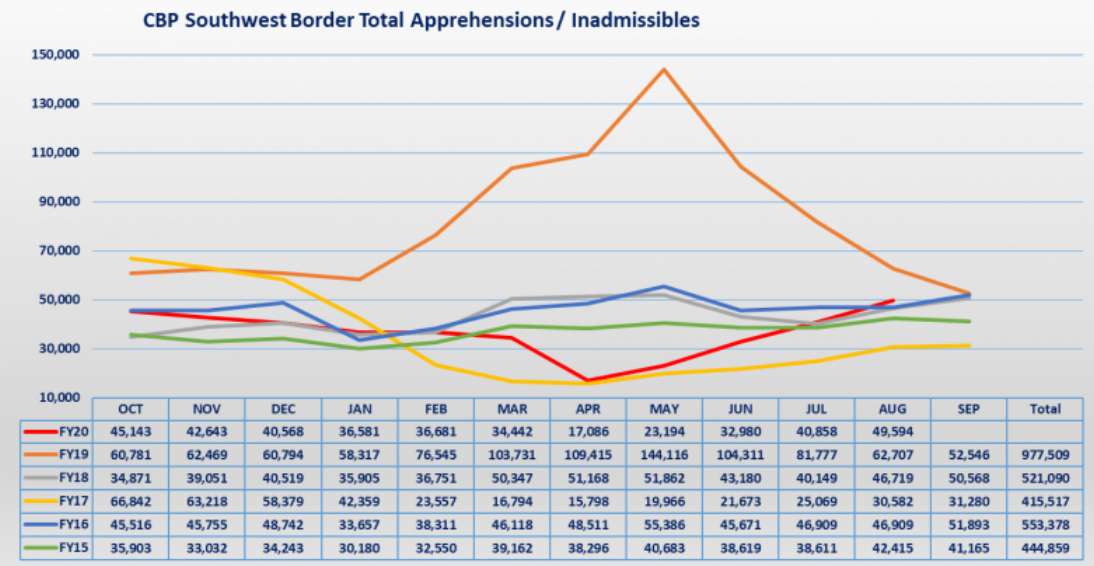
    As with anti-narcotics policy, the results of Trump’s anti-immigration policies have been mixed. Migrant apprehensions at the southwest border – the most widely used metric for illegal immigration - had been steadily declining, reaching a 50-year low before Trump took office. However, they began to rise in mid-2017. By FY2019 they reached a new peak of 977,509, almost doubling on the previous year. A majority of those arrivals were unaccompanied children and families from the Northern Triangle countries. However, in the first 11 months of FY2020 migrant apprehensions have declined relative to the previous year, with the Covid-19 pandemic playing an important role, as non-essential travel and asylum processing have been suspended. Under Title 42 CDC travel restrictions, more than 90,000 immigrants from Mexico and the Northern Triangle countries have been turned back.

    Southwest border migration fiscal year (FY) 2020

    Source: U.S. Customs and Border Protection

  • Climate change

    LatinNews 09 October 2020 Hits: 942

    Climate change and environmental issues have been growing in significance over the last decade. In Latin America there is an intense debate between those who are sceptical over the reality of anthropogenic (human-caused) climate change, and those on the other hand who are convinced that it is happening and argue for major interventions to limit global warming and its harmful effects. The combination of the Covid-19 pandemic, the current deep recession, and climate change effects such as droughts, storms, and forest fires, is causing a threefold crisis for the region. It has led various political leaders to support the idea of a green recovery or of “building back better”. Their argument is that the energy transition - a move away from fossil fuel-based energy and towards renewable sources such as wind and solar – should be accelerated in this crisis, rather than put on hold. There is an emerging focus on responding to rising unemployment by promoting investment, training, and jobs in the green economy.

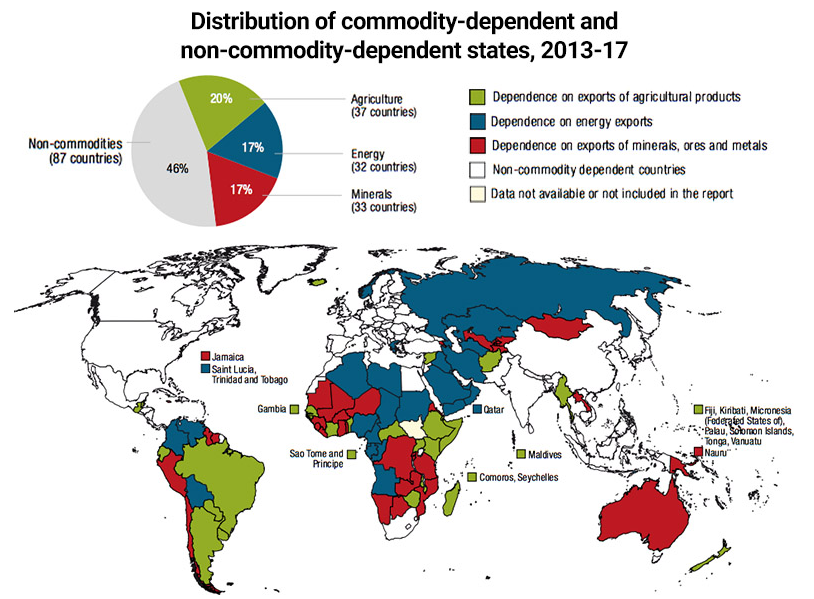
    One reason why climate change is of particular relevance to the region is that Latin America is highly dependent on exporting agricultural commodities, minerals, ores and metals, and energy products such as oil and gas. All of these activities are particularly vulnerable to climate change. A recent UNCTAD study has highlighted the concentration of commodity-dependence in the region. Meanwhile BP, one of the world’s oil majors, has argued that demand for petroleum may peak in the 2020s, and decline thereafter. The company says it will cut its oil and gas output by 40% in the next ten years as it shifts into renewables. If such a scenario plays out the implications for Latin American oil exporters such as Mexico, Brazil, Argentina, and Colombia are far reaching. Some of their major hydrocarbon resources could become “stranded assets”

    Source: UNCTAD

    Climate change has affected the region in multiple ways. In September 2020, for example, France’s President Emmanuel Macron said his country would not ratify the European Union–Mercosur free trade agreement unless it was amended to include stronger guarantees against deforestation. Mercosur is formed by Argentina, Brazil, Paraguay, and Uruguay. The FTA took roughly two decades to negotiate.

    A report by independent experts commissioned by the French government said that the FTA would increase Mercosur beef sales to Europe by 2%-4% a year, but this would require clearing land for livestock grazing that would increase the rate of deforestation in the Amazon to 5% per annum. As it stands, the experts claim the FTA would increase greenhouse gas (GHG) emissions by up to 6.8m tonnes of CO2 equivalents. These numbers are contested by Brazilian officials, who claim the country has already demonstrated that it can increase beef, soya, and maize cultivation while simultaneously reducing deforestation. In the same month Panama announced that because of falling rain and water levels in the system of locks and waterways that make up the Panama Canal, it was having to commission US$2bn worth of new investment to maintain navigability.

    If President Trump wins re-election, US policy will continue to favour fossil fuels and a generally laissez-faire approach to the environment. The government can be expected to continue its efforts to cut back domestic US environmental regulations and red tape, and to expand federal government jurisdiction versus environmental rulemaking at state levels. It is notable that US-owned oil and gas majors have done significantly less than European ones to prepare for the energy transition. The US oil lobby will continue to have special access to the White House.

    In foreign policy terms Washington will do little or nothing to encourage de-carbonisation in Latin America. However, even in this almost completely free-for-all non-interventionist model, it is worth noting that some aspects of the energy transition will continue. For example, high-cost US shale oil and gas producers may not be able to recover from the pandemic-related oil glut, and the wave of bankruptcies affecting that sector of the industry may continue (in other words the fossil-fuel boom-and-bust cycle will remain in place). It is also likely that the US auto industry will continue participating, and in some senses leading, the global trend towards the development of electric vehicles (EVs).

    A Biden presidency on the other hand holds out the possibility of increased action on climate change, initially focused on the domestic US economy. The candidate is committed to major investment in a “Green New Deal” which would include halting oil and gas exploration on federal land, as well as other policies that will increase the price of carbon emissions and provide additional incentives to de-carbonise. Biden’s vice-presidential running mate Kamala Harris is on record saying: “We need pro-labour, pro-environment trade deals – because it’s clear that Donald Trump’s protectionist approach has been a disaster.” While this will be welcomed in much of Latin America, it will also be resisted in some countries, notably Brazil which, as we have seen, has objected to environmental safeguards sought by the EU.

  • The Hispanic vote in 2020

    LatinNews 09 October 2020 Hits: 830

    In some ways an early insight into the Latin American policies of a future US president comes from his or her approach to winning votes within the US Hispanic community. US Hispanics are electorally important. The Hispanic population of the US was estimated at 60.6m in 2019, up from 9.6m in 1970 and from 50.7m in 2010. Hispanics now represent 18% of the US population, up from 5% in 1970 and from 16% in 2010. Hispanics are the second-fastest growing ethnic group in the US after Asian Americans.

    Four out of five of the Hispanic community are US citizens. Seven out of ten are now proficient English-speakers. By country of origin the biggest groups are Mexicans (36.9m or 62% of all Hispanics), followed by Puerto Ricans (5.7m or 9.7%), Cubans (2.4m or 4.0%), and Salvadoreans (2.3m or 3.9% of the total). Since 2010 the fastest growing Hispanic groups have been those of Venezuelan, Dominican Republic, and Honduran origin.

    Around 32m Hispanics are eligible to vote in the 2020 US elections, up from 27.3m in 2016. This represents 13% of the total number of eligible voters, making Hispanics the largest ethnic minority group in the electorate. Eligible Hispanic voters are concentrated in five states: California, Texas, Florida, New York, and Arizona. Their share of total eligible voters is highest in New Mexico (43%), California (30%), Texas (30%), Arizona (24%), and Florida (20%).

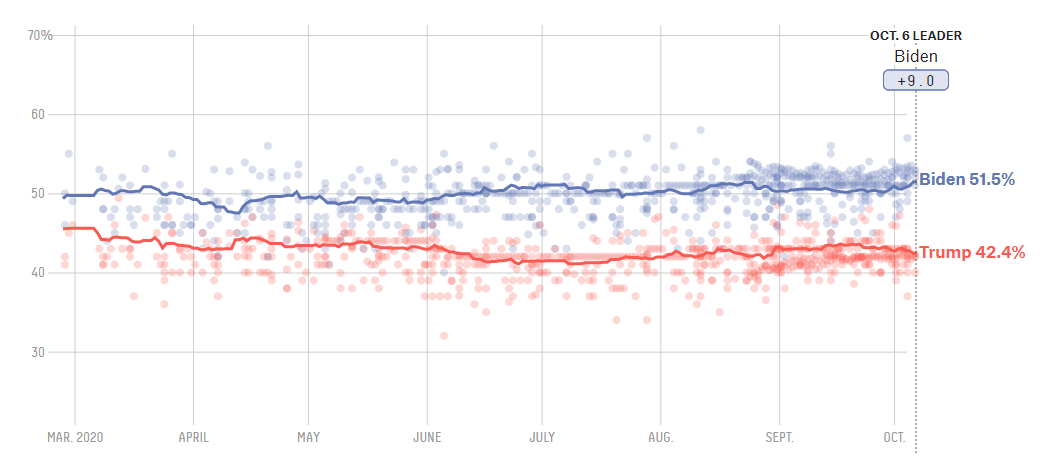
    At national level, opinion polls have shown a consistent advantage in voter intentions favouring the challenger, Joe Biden, over the incumbent Donald Trump. According to the FiveThirtyEight website which calculates a weighted average of polls, Biden was around eight percentage points ahead at the beginning of October on 50.9% versus 42.7% for Trump. However, because of the composition of the Electoral College (which tends to over-represent conservative rural areas) a Democratic candidate needs to be at least 5 percentage points ahead to be able to secure the presidency. The race therefore remained open.

    Who’s ahead in the national polls?

    Source: FiveThirtyEight

    The Hispanic community has traditionally leaned towards the Democratic Party in US elections, but support for Republican candidates has also been significant. Despite his anti-immigrant rhetoric, 28% of Hispanics voted for Trump in 2016, compared to 40% who voted for George W Bush in 2004. Current polls suggest that conservative Hispanic support for Trump remains significant in 2020, particularly in states like Florida and Texas.

    An additional way to look at the election is through the outcome in key swing states. The eight key swing states are Arizona, Florida, Georgia, Michigan, Minnesota, North Carolina, Pennsylvania, and Wisconsin. Hispanic voters are present in all, but particularly so in Arizona and Florida. As noted, Trump’s anti-Mexican rhetoric in the 2016 polls may have alienated Mexicans of Hispanic origin, but many of them were in traditional Democratic-voting states like California.

    This time around the Trump campaign is focusing on conservative Hispanic voters in Florida, many of whom are of Cuban and Venezuelan origin. While Florida as a whole is almost evenly divided between Democratic and Republican voters (Biden had a narrow 2.3 percentage point lead with 48.1% versus 45.8% for Trump according to FiveThirtyEight on 30 September), a September survey of Cuban Americans in the state showed a 68%-30% margin in favour of Trump. In office Trump has played to that conservative constituency, tightening economic sanctions on both Cuba and Venezuela.