Andrés Manuel López Obrador (AMLO) a veteran politician of the Mexican left, took office on 1 December 2018, at the start of a six-year term. With his background as a long-standing critic of previous centrist and right-wing governments, as a supporter of human and migrant workers’ rights, and as a critic of heavy-handed militarised policing, there were reasons to believe his presidency might open up new opportunities for mutually beneficial collaboration between the government and civil society. As a presidential candidate AMLO had promised to expand social programmes to help the vulnerable. Yet for a variety of reasons the relationship between government and civil society worsened dramatically after he took office. In part this may have been due to what could be called the president’s pre-existing support for an authoritarian, populist, illiberal form of democracy. In part also, AMLO changed his own positions after coming to power – for example he moved to support the kind of militarised public security interventions that he had previously criticised. Policy failings by Mexico’s NGOs and quangos may have also had some degree of responsibility for the rapid cooling of the relationship.
As early as February 2019 relations became strained when the new president stated that his government would no longer fund NGOs. This was an important policy shift. A succession of previous governments had funded NGOs in effect as sub-contractors to deliver social programmes through a variety of mechanisms including donations, subsidies, work agreements, and social co-investment programmes, often coordinated by a government body, the National Institute for Social Development (Indesol). Government departments such as the ministry for the environment and natural resources (Semarnat) also traditionally worked closely with NGOs.
According to AMLO the new policy was designed to cut out all intermediaries. NGOs, he argued, harboured their own commercial interests, tended to misuse public resources, and were linked, through conservative and neo-liberal interests, to a right-wing agenda. An excessive number of intermediaries, in any case, were seen as creating opportunities for adding on costs, profiteering, and corruption. Instead, money would be distributed directly to individual beneficiaries and vulnerable groups. NGO activists noted that this approach - with cash sometimes handed out in brown envelopes to intended beneficiaries - could itself be vulnerable to similar or even greater risks of inefficiency, corruption, and politicisation. Coupled with this decision, and as part of the president’s commitment to budget austerity, the new government also began to cut the funding available for quangos, such as environmental protection agencies the National Commission for Forests (Conafor), the National Commission for Natural Protected Areas (Conanp), and the National Fund for Natural Disasters (Fonden), all of which suffered severe funding reductions.
The policy had some immediate downsides. There was insufficient federal support to fight a series of wildfires which broke out in natural reserves including La Encrucijada in Chiapas and the Sian Ka’an Reserve in Quintana Roo. The government however prioritised new high-profile multi-billion-dollar projects such as the Mayan Tourist Train (designed to help develop the impoverished south of the country but cutting through ancestral indigenous lands) and a massive new petrol refinery at Dos Bocas in Tabasco. Considering the negative impacts of these projects Greenpeace concluded that environmental protection was simply “not a priority” for the AMLO administration.
In early 2019 Juan Martin Perez, of REDIM, the Network for Infant Rights in Mexico, said that aid organisations helping low-income communities, the homeless, prisoners, and those with medical conditions had been “forgotten by the government”. Given the funding cuts he added “there is a risk that some NGOs may stop operating since the support granted by the state was completely vital for the continuation of their work”. Overall, the cut in government funding for NGOs was estimated at around US$321m per annum. NGOs responded by seeking out alternative funding streams, but the abrupt change nevertheless forced many to suspend some of their activities.
The government’s ‘go it alone’ approach to social programmes earned it some additional direct criticism. One of AMLO’s signature programmes, called Sembrando Futuro (Seeding the Future), pays farmers in southern Mexico to plant and maintain trees in recently deforested areas. The idea is that by being paid a regular income to replant trees, the farmers will be drawn away from illicit drug cultivation and membership of criminal cartels. The programme is therefore seen as simultaneously reducing poverty and conserving the environment. Total funding is reportedly in the vicinity of US$3bn, and AMLO has been arguing that his programme could be extended, with US assistance, to the Northern Triangle countries of Central America where it would help reduce illegal migration flows heading north to Mexico and ultimately to the United States. However, there have been numerous reports that the programme is not sufficiently monitored and from a technical point of view is poorly designed. Some of these reports suggest that, in a completely counterproductive manner, some farmers have been cutting down their forests, so that they can qualify to receive the re-planting subsidy.
The AMLO government took further action to squeeze NGO finances. In the federal budget ‘miscellany’ law for 2022 income tax regulations were modified to limit tax relief on donations by individuals to charities. Whereas before the rules allowed 15% of income used for certain personal expenses to be tax deductible, with an additional amount of up to 7% of revenue reserved for tax-free charity donations, the new approach sets an upper limit of 15% of income for both types of tax-free contributions. As a result, it is estimated that over 5,000 Mexican NGOs may see their income fall in 2022. NGOs say they are now suffering a form of financial asphyxiation as government officials have asked them to raise at least 50% of their income from private sources, but at the same time are making it more difficult for them to raise income from donations.
Also as part of the 2022 budget cutbacks the AMLO government decided to close down Indesol, since its main role, to distribute funds to NGOs, was deemed no longer necessary or required. Announcing the closure AMLO claimed, without producing any supporting evidence, that there had been waste and duplication and that most NGOs in Mexico and elsewhere do not produce auditable accounts (a claim denied by most). Indesol had been set up in 1994. The abrupt closure put a number of ongoing social programmes in doubt, including a programme designed to help women victims of domestic violence, to promote gender inclusion, and to train social workers.
At the political level, AMLO has been consistently outspoken in his attacks on NGOs. In May and June 2021, he focused on US-funding for Mexico based NGOs. “You cannot receive money from another country for political purposes. It is treason to your country. It’s interference, interventionism, and it is in favour of a coup” the president said in one of his daily press conferences. The foreign ministry formally asked the United States government to freeze funding for the investigative website Mexicanos Contra la Corrupción y la Impunidad (MCCI) and for Article 19, an international NGO which has a Mexico office and that campaigns in defence of press freedoms.
Pro-government media outlets have taken anti-NGO positions and identified leading civil society figures as political opponents. Among them there has been a particular focus on Claudio X González, a member of the MCCI NGO board who has led various civil society campaigns, including some criticising AMLO’s newly created National Guard and his project to build a new airport in Mexico City. AMLO has singled out González for criticism partly because he was a member of the preceding government of Enrique Peña Nieto (2012-2018).
News outlet SinEmbago, aligned with the government, has claimed that NGOs are controlled by a group of intellectual and business leaders close to the five presidents who preceded AMLO’s term in office. Alejandra Sala-Porras, a pro-government academic at state university UNAM, has asserted that Mexican NGOs are positioning themselves to become a direct alternative to AMLO’s government “because existing electoral alternatives are looking very weak”. She also claimed NGOs were close to taking political control in various states, building an alternative power network and seeking to thwart the government by challenging its actions in the courts and by securing obstructive injunctions.
The government has reacted with hostility to NGO and media criticism, particularly around issues such as corruption, which may explain why it has targeted MCCI and other anti-corruption campaigners so intensely. An example came in February 2022 when MCCI published two reports which directly angered AMLO. One stated that, mid-way through the AMLO presidency, eight out of ten government procurement contracts were still being awarded directly, without competitive bidding, increasing the risk of corruption and contradicting a specific electoral promise made by AMLO to reduce that proportion.
In association with investigative news outlet Latinus, MCCI also claimed that AMLO’s elder son, José Ramón López Beltrán, had been living in a luxurious house in Houston, owned by an executive at oil services company Baker Hughes, which in turn had multi-million-dollar contracts with Pemex, Mexico’s state oil company, therefore suggesting at least the possibility of a conflict of interest. Other members of the president’s family have also been implicated in potential improprieties. His brother, Pío López Obrador, continues under investigation after videos appeared showing him receiving stacks of cash during the 2018 election campaign. Following other press reports the government has also said contracts awarded by Pemex to a company linked to AMLO’s cousin, Felipa Obrador, have been cancelled after separate suggestions of a conflict of interests. AMLO responded by delivering a sharp personal attack on the prominent Latinus journalist Carlos Loret de Mola, who the president described as a “coup monger, corrupt, mercenary, without principles and without ideals”. Responding to negative stories by attacking journalists that report them is a regular feature of presidential press conferences

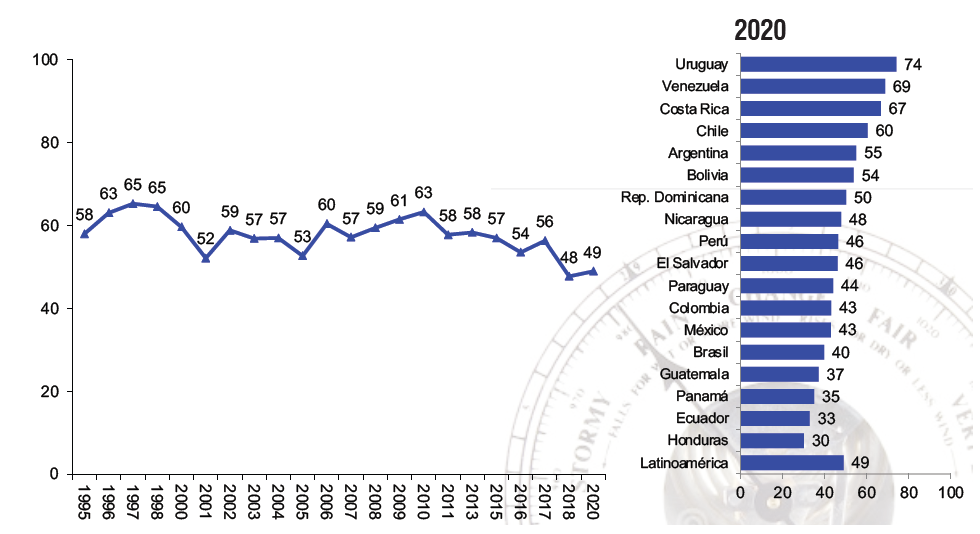
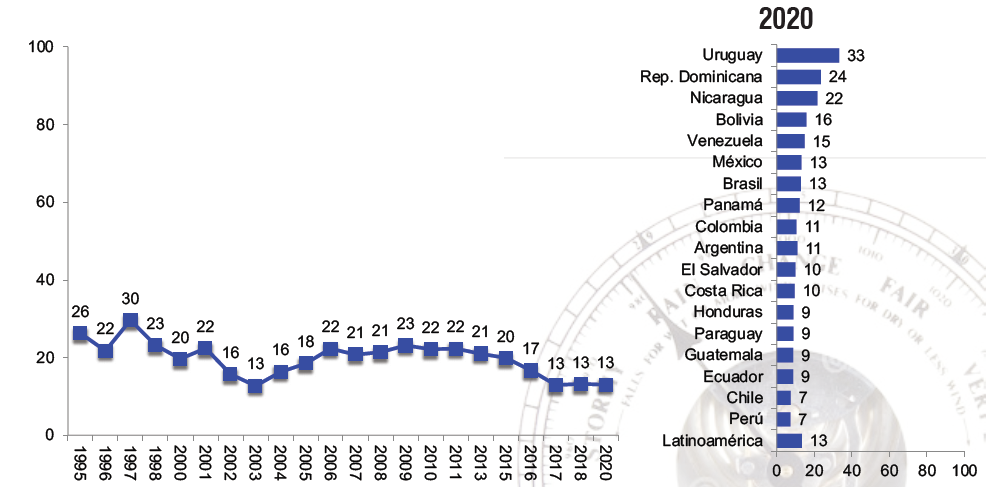 Source: Latinobarómetro