Smoke and Mirrors: the growth of disinformation in Latin America

Items

  • Introduction

    Patrick de Courcy 16 November 2023 Hits: 935

    Over roughly the last ten years the ‘toolkit’ of techniques and technologies that are available to manipulate information, influence public opinion, and have an impact on elections had expanded alarmingly. The manipulation of information, particularly on social media, has become a ‘dark art’ seen as capable of undermining and eroding the foundations of democracy. The expansion of the toolkit, including component parts such as fake news, has been associated in the US with former president Donald Trump (2017-2021), who used these techniques to (successfully) fight the 2016 elections and to (unsuccessfully) claim electoral fraud in the 2020 US elections. However, at a global level Trump is by no means the only practitioner. Many other authoritarian politicians have adopted disinformation techniques. In Latin America they have often been populists of both left and right, as well as self-proclaimed outsiders. In fact, Trump may have learnt some of his techniques from an older generation of Latin American populists. In turn, many present-day Latin American leaders have looked to Trump as an example to emulate.

  • What’s in the toolbox?

    Patrick de Courcy 16 November 2023 Hits: 689

    A large number of techniques are being used, so it is useful to begin with some basic definitions. A research guide compiled by the Library of the University of Michigan in the US suggests there is a wide information ecosystem which is composed of both misinformation and disinformation. Misinformation is “false or inaccurate information that is mistakenly or inadvertently spread: the intent is not to deceive”. On the other hand, disinformation is false information that is deliberately created and spread “in order to influence public opinion or obscure the truth”.

    Fake news is seen as a sub-category or particular form of disinformation. The term was first used as far back as the 1890s to refer to sensationalist stories in US newspapers. However, it was also intensely used by Donald Trump in the 2016 US election campaign to refer to any stories that he disagreed with, or which showed him in a bad light. Because of this some analysts have rejected the term as being too politicised and specific, opting to talk about ‘false news’ instead. The UK government has suggested that fake news is poorly defined and “conflates a variety of false information from genuine error through to foreign interference”.

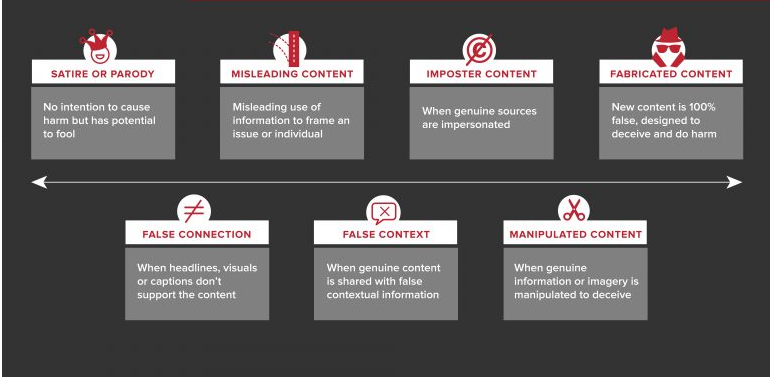
    The University of Michigan further defines fake news as “those news stories that are false: the story itself is fabricated, with no verifiable facts, sources, or quotes”. Such stories may be propaganda intentionally designed to mislead the reader, or clickbait, written to maximise traffic and revenue on social media websites where advertisers pay for the number of page views. First Draft News, a US-based lobby group offering guidance on the use of social media, further breaks down mis- and disinformation into seven types, including satire or parody (considered benign), false context, and manipulated content.

    7 types of Mis- and Disinformation

    Source: First Draft News

    Disinformation is seen as being created by a range of people for a range of different reasons. These include partisan politics, for example misinformation about electoral fraud, but also clickbait-based posts for financial gain, and outright government propaganda such as Russia’s attempt to control the online narrative about the invasion of Ukraine. Sometimes false stories are designed to produce an emotional response and are placed (or ‘seeded’) onto certain websites to entice readers into sharing them. In other cases, bots – computer algorithms – are programmed to impersonate real people and automatically share and promote false news stories.

  • Hate speech in the mix

    Patrick de Courcy 16 November 2023 Hits: 581

    Part of the disinformation toolbox contains or overlaps with the idea of hate speech. As with many other online concepts, there are different definitions for what exactly hate speech is. However, the United Nations defines hate speech as “any kind of communication in speech, writing or behaviour that attacks or uses pejorative or discriminatory language with reference to a person or to a group on the basis of who they are, in other words, based on their religion, ethnicity, nationality, race, colour, descent, gender or any other identity factor.”

    Recent years have seen a major and ongoing debate about how to distinguish between hate speech or other forms of online harm on the one hand, and the legitimate exercise of freedom of expression on the other. If anything, the debate became more polarised after October 2022 when US/South African entrepreneur Elon Musk made the surprise purchase of social media platform Twitter for US$44bn (later renaming it ‘X’), reducing staffing levels and moderation of content while promising to make it a bastion of free speech. The acquisition was broadly welcomed by conservatives and viewed with concern by the left.

    In April this year a joint study of posts on X carried out by US universities USC, UCLA, Oregon State, and UC Merced concluded that daily use of hate speech by those who had previously made similar posts nearly doubled as a result of the takeover. The researchers compiled a hate lexicon of 49 racist, antisemitic, homophobic, and transphobic terms, using an artificial intelligence programme to weed out non-hateful use of those terms, and then comparing total usage numbers before and after the company’s takeover. While the researchers said they could not prove a direct causal link, their approach might help understand how and why people can be radicalised online through what has been called stochastic terrorism, the use of hate speech to incite violent acts. Other academics also say hate speech has increased, while Musk has strongly rejected the claims. Observers of the renewed Israel-Gaza crisis which broke out in October 2023 also spoke of a surge in “misinformation and falsehoods” including “mischaracterised content, misleading captions, false images, out-of-context-and-old videos, and video game footage”.

  • Coming next: social media and artificial intelligence

    Patrick de Courcy 16 November 2023 Hits: 552

    The pace of technological change is unrelenting, with some increasingly sophisticated technologies expanding the potential for disinformation. One of these is the rise of so-called deepfakes. These are artificial intelligence (AI) programmes that use a form of deep learning to produce synthetic videos, photographs, or audio tracks that realistically mimic real people. The technique was initially used by pornographic websites to map the faces of well-known female celebrities onto the bodies of porn stars. Deepfakes have been made of Barrack Obama, Vladimir Putin, and many more international politicians. In 2019 it was reported that a deepfake audio had been used by fraudsters to impersonate the voice of a German chief executive and demand a US$243,000 money transfer. Various techniques can be used to detect whether a video of a politician is genuine or fake, but these all take time and resources.

    In 2023 there have been major advances in AI with potentially revolutionary future effects on employment levels and business models in several economic sectors. Developments include the use of Machine Learning (ML) where computer programmes can learn from and adapt to new information. ML programmes rely on algorithms which can use patterns in past data to make predictions or recommendations. Deep Learning (DL) is a subset of ML which, without direct human intervention, can use analysis of high volumes of text, video, and other data to propose solutions to complex problems. In November 2022 Open AI (a company owned by Microsoft) launched chatbot ChatGPT which can produce human-like text after being trained by ingesting millions of text sources, websites, newspapers, and books. These large language models can hold billions of data sets. However, the programmes, based primarily on identifying patterns and correlations, can be subject to ‘hallucinations’ – falsehoods such as creating fake book references or, in one recent case answering “elephant” when asked which mammal lays the largest eggs.

    The full impact of AI has yet to be assessed. A UK study in early 2022 showed 15% of all businesses had adopted some form of AI, with highest usage in IT, telecoms, finance, accounting, media, advertising, sales, and legal services. Efficiency gains included automating data analysis, improving and automating customer service, and supporting decision-making. Research by the University of Pennsylvania in early 2023 suggested that AI driven by large language models (LLMs) was likely to impact 80% of the US workforce with “at least 10%” of their work tasks affected.

    An August 2023 report by the UN’s Economic Commission for Latin America and the Caribbean (Eclac) concluded that AI can contribute greatly to transforming regional economies, making them “more productive, inclusive and sustainable” but that it is also necessary for there to be “reflection, a strategic vision, regulation and regional and multilateral coordination” to “harness its opportunities and minimise its potential threats”. Eclac Executive Secretary José Manuel Salazar-Xirinachs called for a “watchful” stance on ethical issues involving AI, attention to data privacy, and a focus on “the biases and discrimination in decisions based on intelligent algorithms”.

    From the point of view of this report, increasing AI adoption creates both opportunities and risks. Consultancy McKinsey notes that generative-AI models “will confidently produce inaccurate, plagiarised, or biased results…because the models have been trained on the internet, which is hardly a universally reliable source”.

  • The ubiquity of social media

    Patrick de Courcy 16 November 2023 Hits: 619

    False news and the use of information technology for manipulative purposes takes on added importance because of the explosion of social media usage in Latin America and the Caribbean. Most of these techniques are not being tested in the background but are being deployed directly to millions of internet users. It is estimated that the region’s online population reached over 540m people at the end of 2022, making it the fifth largest regional social media market globally. Within the region Brazil (165m social media users) and Mexico (98m) are dominant. It has been estimated that audiences in the region spend an average of 214 minutes on social media every day, making it by far the most popular form of media, eclipsing more traditional media such as newspapers and linear television. According to an Atlas VPN study in 2022, the region’s heaviest internet users are the Brazilians. Argentines, Colombians, and Chileans.  

    The most common activities when users are online include liking and interacting with posts by others and sending private messages, often through platforms such as WhatsApp and Telegram.  It is estimated that in 2022 advertisers spent around US$5.3bn on social media. The overall value of the ‘influencer’ market in the region could be three times larger than that.

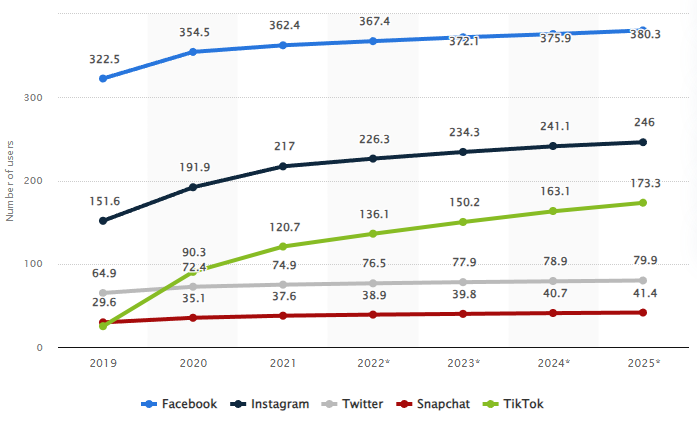
    According to projections compiled by data company Statista, Facebook will remain the most popular social media platform in the region, at 380m users by 2025, albeit with a slowing user growth rate. Chinese-owned TikTok has been the fastest growing, with a particularly strong appeal for young people. It has become the third most popular platform, expected to reach 173m users by 2025. Others include Instagram (currently the second most popular), X (formerly Twitter), and Snapchat.

    Number of social network users in Latin America from 2019 to 2025, by platform (in millions)

    Source: Statista

  • The Cambridge Analytica story

    Patrick de Courcy 16 November 2023 Hits: 604

    The story of the UK-based company, Cambridge Analytica, and the 2016 US elections, illustrates some of the power and the ongoing potential for political manipulation that could be unleashed by AI-based sophisticated data analysis. It has been established that for a number of years in the 2010s the personal data of millions of Facebook users was collected illegally by Cambridge Analytica without their permission. The data was gathered through an app called ‘This is your digital life’ which used it to build up psychological profiles of users and their Facebook friends. It is believed that the app harvested personal data from around 87m Facebook profiles. Cambridge Analytica then mined the data to advise the campaigns of US Republican presidential candidates Ted Cruz and Donald Trump, as well as some initial work in support of the Vote Leave campaign in the UK’s 2016 Brexit referendum. Information on how the data was hacked and used eventually became public largely because of the actions of investigative journalists, as well as former Cambridge Analytica employee, Christopher Wylie, who acted as a whistle blower. Under pressure, Facebook CEO Mark Zuckerberg testified in congress and apologised for the data breach. Facebook was fined US$5bn by the Federal Trade Commission and also had to pay a much smaller fine to the UK regulator for exposing its users to “a serious risk of harm”. In May 2018 Cambridge Analytica filed for bankruptcy.

    The key to Cambridge Analytica’s political work appears to have been to build up detailed psychographic profiles of users allowing micro-targeting of potential swing voters on different online platforms by the Trump campaign team. Messages were tailored to different voter groups. Those considered to be Trump supporters, for example, received reinforcement messages such as triumphant visuals and details of how to get to polling offices. Less committed potential Trump supporters were sent negative graphics or ideas about his opponent, Democratic Party senator Hilary Clinton.

    While the Cambridge Analytica scandal demonstrated a willingness to use stolen social media data for political ends, there is some scepticism over how effective the company was in actually winning votes for Trump. Academics agree that online activity and ‘likes’ can be used to build a psychological profile of individual users, including their religious beliefs and sexual orientation. There is also evidence from the commercial world that advertisements tailored to particular personality types can be more effective. One study found that ads could generate 40% more clicks if they targeted particular personality types. On the other hand, however, there is little hard evidence that micro-targeting personality types can actually deliver extra votes, and some evidence that voters, once they have made up their minds, tend not to be easily swayed by campaign messages in general.

  • Brazil’s false claims of electoral fraud

    Patrick de Courcy 16 November 2023 Hits: 618

    In some ways Brazil’s recent history of social media disinformation has been closely tracking the pathway laid out in the US, only with a two-year time delay. Jair Bolsonaro’s 2018 victory can similarly be attributed to a slick media campaign, whilst maintaining an image of himself as a far-right anti-establishment figure. Then, in 2022 he claimed to have been the victim of electoral fraud after his defeat by Lula, and even incited his supporters to violence, resulting in thousands of people breaking into the presidential palace (Planalto), congress, and the supreme court on 8 January 2023, exactly mirroring the storming of the Capitol in the US two years and two days before.  In the Brazilian case it has been shown that far-right protesters believed their action would trigger an army putsch which would bring Bolsonaro back into office.  

    In both cases extremists had been fired up for months beforehand with an incendiary mix of online propaganda, conspiracy theories, and calculated disinformation. More generally the Bolsonaro presidency was marked by widespread disinformation and constant attacks on traditional media. The president and his supporters relied on intense use of social media to deliver a heavily partisan message to the country. There are fears that this wave of false news may have lasting and deeply harmful effects on the country.

    A critical part of Bolsonaro’s attempt to remain in power beyond the end of his first official term in office was to claim that Brazil’s electronic voting system, despite more than two decades of successful and reliable operation, was deeply flawed and open to manipulation. In classic Trumpian-style, the government insisted on repeating the electoral-fraud narrative despite the complete absence of any significant evidence to support it. During the course of 2022 – election year – Bolsonaro tried to pass legislation replacing the electronic system with an allegedly more secure paper-based one, but he failed to convince congress, including some of his less extreme conservative supporters, that any change was needed.

    A joint investigation by 22 Latin American media groups, found that one of the president’s sons, Eduardo Bolsonaro, had since 2018 taken part in 125 meetings with far-right leaders across the US and Latin America, building a network to support a potential coup d’etat in Brazil, designed to keep his father in office.

    Days after Bolsonaro pére was defeated in the elections by a narrow margin – a defeat which he still refuses to concede – a member of that network, Argentine political consultant Francisco Cerimodo, claimed on YouTube that he had a dossier allegedly revealing anomalies in the Brazilian voting process which had caused a “change of results”. To date, however, the alleged dossier has never been published. Cerimodo falsely claimed that both older model electronic voting machines had not been tested, and that some voting machines had not recorded a single vote for Bolsonaro.

    Despite these false allegations, his YouTube livestream presentation attracted 400,000 viewers and was widely shared by Bolsonaro supporters across Brazil on other platforms including WhatsApp and Telegram. Subsequently, Cerimodo claimed voter secrecy could be breached by accessing the voting machines’ operating logs, a claim which was debunked by Brazilian fact-checking agency Aos Fatos. This particular claim was also used in a petition to the electoral court by Bolsonaro’s Partido Liberal (PL) which sought the annulment of the second-round ballot, but which was unsuccessful; instead the court dismissed the petition and fined the PL for acting in bad faith.

    There were other indications that a far-right international network was supporting the pro-Bolsonaro campaign. US-based Epoch Media Group, identified by Facebook owner Meta as operating a network of accounts in the US and Vietnam to spread misinformation on US politics, gave prominent coverage to the Brazilian electoral-fraud narrative. Steve Bannon, a former Trump consultant and Eduardo Bolsonaro ally, is linked to Epoch and used that and his War Room podcast to spread pro-Bolsonaro propaganda. Bannon made unsubstantiated claims that Jair Bolsonaro’s initial lead in the election results made it “mathematically impossible” for him to have fallen behind in the race.

  • The ‘office of hate’

    Patrick de Courcy 16 November 2023 Hits: 588

    Those who believe the Bolsonaro administration had an explicit commitment to use disinformation as a political tool point to a shadowy organisation known by its critics as ‘the office of hate’. This was, allegedly, an informal organisation formed by Eduardo Bolsonaro, political advisors, friendly bloggers, and wealthy businessmen, which ensured that political opponents or those seen as having betrayed the cause were singled out for online vilification. Former anti-corruption judge Sergio Moro, who resigned as security minister in 2020, was widely insulted across social media and accused of being a communist, a traitor, and a crook. When the health minister disagreed with the president’s anti-vaccination position on Covid-19, there was a proliferation of unsubstantiated online accusations that he was corrupt.

    Joice Hasselmann, a conservative congresswoman who had been close to the president but had a falling out with him, said that immediately afterward distorted images of her began to be published on social media, along with claims that she was corrupt, a prostitute, and “everything else you could imagine”. She added: “There were montages where my face was placed on the body of a pig and was surrounded by men in pornographic postures”.

    A report by Germany-based think-tank Digital Communication Research says that Bolsonaro and his followers built a network on Facebook, mixing hate speech with humour. The network was “coordinated unofficially by several cabinet staff members” and “articulated the official profiles of the Bolsonaro family to followers and sympathisers”, supported by a vast array of anonymous pages. It goes on to say that the structure was used “to blur boundaries between official and spurious discourses”, and to power a series of ‘flaming’ wars against political adversaries and reporters perceived as hostile to Bolsonaro’s interests.

    In December 2021, Brazil’s supreme court (Supremo Tribunal Federal – STF) said it would investigate comments made by President Bolsonaro who in a social media livestream had claimed that Covid-19 vaccinations could increase the chances of developing AIDS. The investigation was expected to include examination of the ‘office of hate’.

  • AMLO’s information wars by press conference

    Patrick de Courcy 16 November 2023 Hits: 798

    Mexico’s President Andrés Manuel López Obrador (AMLO), a left-wing populist, has also used what could be called disinformation techniques to keep the political opposition on the defensive. In his case the strategy is firmly anchored in the mañaneras - long weekday early morning press conferences which he uses to set the agenda and keep himself at the centre of the political debate. In theory at least the commitment to personally communicate government policy sits well with wider promises of openness and transparency. The president, with a down-to-earth style of speaking, has clearly remained well-connected with an important part of the electorate. Now approaching the final year in his six-year presidential term, AMLO continues to register 60%-plus approval ratings.

    However, there is an alternative and much less benign view of the mañaneras-led communications strategy, which is that the press conferences are tightly choreographed and controlled, used principally for the telling of untruths. In various cases the president’s veracity has been questioned by journalists, including his assertion in 2023 that the synthetic drug fentanyl is not produced in Mexico (directly contradicting earlier government claims to have seized an illicit fentanyl production lab). AMLO is also notorious for using the catchphrase yo tengo otros datos (“I have other information”) when confronted with any embarrassing news stories or criticisms. In July 2021 for example, asked by a journalist to comment on his presidency becoming one of the most violent in Mexican history, with over 80,000 intentional homicides at that point, AMLO simply responded that he had “other information”, and that progress was being made.

    Article 19, the freedom of information lobby group, decided to put the issue to a more formal test. In a report published in March 2023 it fact-checked a total of 34 statements made by AMLO at the mañaneras. It found that only two of them were verified by other publicly available information sources. Over a two-year period, it had submitted 84 information requests and 22 further clarification requests concerning the 34 statements made by the president around seven themes – corruption, the economy, the Covid-19 pandemic, autonomous government agencies, social programmes, and crime and security. The government had responded in various ways to the requests. In one case correct information was given, but relevant contextual information was withheld. In two cases there was what Article 19 considered to be a deliberate attempt to mislead. In the largest group of cases (20) it was simply not possible, using published sources, to conclude whether the statement was true or false. In nine cases the statements were false, directly contradicting other published information.

    Article 19 concluded that the presidency was disseminating false information, creating a “profound negative effect” on collective freedom of expression, and violating citizens’ right to be properly informed. It also asserted that Mexico’s federal government was following “a strategy of disinformation within its social communications policy.”

    Ironically, perhaps, AMLO then used a mañanera on 3 May to attack Article 19, saying that US funding for lobby groups critical of his government was a violation of Mexican sovereignty, and that he would take up the issue with Joe Biden. Article 19 in turn listed its long-standing concerns over threats to freedom of the press in the country, noting that since AMLO took office in December 2018 violence against journalists had increased by 85%, and that a total of 37 journalists had been murdered. In 2022 the lobby group recorded 696 attacks on the press, making it the most violent year since 2007.

  • Petro: a president with a loudspeaker

    Patrick de Courcy 16 November 2023 Hits: 608

    On 7 October this year militants from Hamas crossed the border between the Gaza Strip and southern Israel, unleashing a savage spree of killing and hostage-taking. Israel, taken off guard, responded by bombarding densely populated Gazan cities, as well as by cutting off water, power, and other essential supplies. An Israeli invasion of Gaza and a wider-ranging Middle East war both looked like serious possibilities. Across the world governments and foreign ministries found themselves having to take a position on the renewed conflict. For many this meant finding a way to condemn acts of terrorism by Hamas while appealing to Israel to observe international humanitarian law and avoid civilian casualties. The reaction of one country, Colombia, was noteworthy.

    In Latin America, Brazil used its rotating presidency of the UN Security Council to call an emergency meeting in an attempt to de-escalate the situation. Brazil condemned the attacks on Israel, expressed its condolences with the Israeli people, and reiterated its support for a two-state solution to the underlying territorial conflict, to be achieved within mutually agreed borders. Argentina, a country with the largest Jewish community in Latin America, condemned “the brutal terrorist attacks” against Israel. Chile, which hosts the largest Palestinian community in the region, also condemned the Hamas attacks while calling for “direct good-faith negotiations” between Israel and Palestine on a two-state solution to achieve a “fair, full, and definitive” peace agreement.

    Like many of the other countries, Colombia’s initial response released by the foreign ministry, sought to strike a measured and balanced tone. It called for an urgent resumption of dialogue “between Israel and Palestine to begin a peace process that leads to peaceful coexistence, within mutually agreed-upon secure borders … with full support for the territorial integrity of the parties.” However, it did not explicitly condemn Hamas and the message was almost immediately superseded by a stream of angry posts placed on X by President Gustavo Petro, in which he highlighted the mounting number of civilian deaths in the Israeli bombing campaign in Gaza and criticised Israel’s defence minister, Yoav Galant, for ordering a “complete siege” of the strip, and for saying “we are fighting against human animals”. “This is what the Nazis said about the Jews”, Petro retorted, “we cannot allow Nazism to be re-established in international politics”. The Israeli foreign ministry described Petro’s posts as “hostile and antisemitic” adding that Israel would immediately halt all defence exports to Colombia. Deborah Lipstadt, US Special Envoy to Monitor and Combat Anti-Semitism said the US “strongly condemns President Petro’s statements and calls on him to condemn Hamas”. The Colombian president remained unapologetic, stating “if we have to suspend relations with Israel we will suspend them. We do not support genocide.”

    In terms of information management, Petro has in fact taken a leaf out of the Donald Trump playbook despite being on the left, in that he has maintained a constant stream of social media posts and controversies since early October, placing himself at the centre of attention and stirring up his political base of support. The benefit of such a communications strategy is that it enhances a sense of protagonism, allowing the leader to appeal to public opinion directly, jumping over the heads of other institutions such as congress or the judiciary. In this case the president’s statements undermined his own foreign ministry, which had to revise its first public statements to make them align with his subsequent social media comments.

    The background is that, like many of his counterparts, Petro has a deeply hostile relationship with traditional media and sees the new social media platforms as a way of delivering his message directly without any filters or layers of critical scrutiny. In fact, according to a report by Paris-based Reporters Without Borders (RSF), in only 52 countries around the world does the press operate without significant restrictions. Only a handful of Latin American countries fall into that category: Costa Rica, Argentina, Belize, Uruguay, and the Dominican Republic. Colombia does not. Elsewhere in the continent journalists are treated almost like enemies of state. In 2022, 93 Nicaraguan and 16 Guatemalan journalists were forced into exile. Journalists have also had to flee El Salvador, and in 2022, 13 Mexican and seven Haitian journalists were murdered.

    Colombia is mid-way along this spectrum. Particularly in the larger cities, the press is respected and operates freely. “Here the press is strong, we have very good journalists in all media. The press imposes its agenda”, Daniel Pacheco of La Silla Vacía told the Los Angeles Times in October 2023. However, in regional areas journalists are much more likely to be threatened. According to Bogotá-based lobby group Fundación Para La Libertad de Prensa (FLIP), in 2022 there were 218 threats, eight journalists forced into exile, 20 physical attacks, and two murders. The environment has also been affected by media-led investigations into claims that the president’s son was involved in money laundering and illicit use of narco-funding to support his father’s campaign during the 2022 elections.

    Petro senior responded angrily, once more resorting to social media. He accused respected veteran journalist Ricardo Calderón of mounting a “slanderous” investigation and of publishing “false information” over his son’s case. Analysts pointed out that the president has repeatedly singled out mainstream media for hostile comment. In January 2023, for example, he used X to post 34 messages criticising nine different media outlets. Pedro Viveros, a columnist for newspaper El Espectador, commented: “When a politician is populist, the first thing he does is mess with the media, that is the way they guarantee an audience. If the president fights with the media his political group, his mass of followers, will end up following him, which is almost half of the country.”

    There is even some suggestion that pro-Petro activists may be using online disinformation techniques not unlike those deployed by Russia. In a week in mid-August this year, hashtags such as #CaracolMiente, #SemanaMiente, #ElColombianoMiente, #RCNMiente, and #ElTiempoMiente appeared on X, TikTok, Instagram, and VK (the Russian version of Facebook). Caracol, Semana, El Colombiano, RCN, and El Tiempo are among the country’s major media groups, described by the hashtag as “liars”. Tracking report suggested the tags had been mentioned about 3.1m times during that week.

  • Media made in Russia

    Patrick de Courcy 16 November 2023 Hits: 555

    All governments seek to conduct both private and public diplomacy and to project a distinctive image in the world. Public and cultural diplomacy is considered a key and legitimate component of building influence and developing soft power. However, the new social-media toolkit has opened the door to many more indirect and covert routes to manipulate public opinion in Latin American countries.

    In October 2023 Spanish news agency EFE said it had gained access to a confidential US State Department cable, warning various governments that based on information from US intelligence sources, Russia had tried to undermine the legitimacy of at least 11 democratic elections between 2020 and 2022 as well as interfering in 17 countries with the aim of manipulating “domestic narratives”. Within Latin America the cable was addressed to the governments of Argentina, Chile, Colombia, Costa Rica, Dominican Republic, Ecuador, Mexico, and Uruguay.

    It said that in one unidentified Latin American country a protest movement against an electoral outcome had been found to be linked to web pages controlled by Russian intelligence agencies. In another, also unidentified, election, this time in Europe, EFE claimed that the Russian intelligence agency FSB had “used intermediaries to deploy agitators, intimidate election officials and organise protests”. The US intelligence community view is that during the US elections of 2020 Russia had discovered such interventions to be cost-effective as a way of “amplifying local narratives that question electoral integrity, such as reactions to the Covid-19 pandemic”.

    In fact, during the Cold War there was an ongoing and intense propaganda and information struggle between the West and the Soviet Union. However, since Russia invaded Ukraine in February 2022 that war has become hotter. For a variety of reasons, many countries of the Global South have been unwilling to follow the US and Europe in an unequivocal condemnation of Russian aggression. And in a number of Latin American countries Russia has been able to significantly expand its conventional and social media presence. Moscow-controlled outlets like Sputnik and Russia Today (RT) have launched Spanish versions. According to the Reuters Institute, RT en Español is more successful than any other language services of RT, including English, Arabic, German, and French. RT en Español has over 200 Spanish-speaking journalists in Moscow, and regional offices in Caracas, Havana, and Buenos Aires.

    The channel relentlessly follows Moscow’s narrative, blaming the Ukraine war on “Nato aggression”, Washington’s “anti-Russian bias” and more generally on the West’s “neo-colonial foreign policy”. A similar line is taken by the Venezuela-based Telesur TV news channel. According to the Reuters Institute, RT en Español claimed an audience of 18m viewers in 2018, with 25m followers on its social media accounts. The channel’s success has been attributed, amongst other things, to anti-American sentiment and a lack of real knowledge of present-day Russia. Iria Puyosa, a research fellow at the Atlantic Council’s Digital Forensic Research Lab, says Russian information strategy on the channel is to blame any social problems on Western countries while presenting Vladmir Putin as a global leader who brings stability and progress. Russian information strategy also uses troll and bot farms and local influencers to deliver the pro-Russia message. Pro-Russia Spanish influencers have been allowed into the Russian-controlled Donbas region in Ukraine, which is off-limits to most Western reporters.

  • The Chinese presence

    Patrick de Courcy 16 November 2023 Hits: 666

    Chinese or China-linked entities are also active in conventional news outlets and social media in Latin America. According to a report by Virginia-based cyber-security company Nisos in July 2023, “China’s government has yet to reach the same level of domestic engagement as Russia, but that does not mean it is not trying to influence political and cultural perceptions in the region, especially to counter unfavourable perceptions of China following the Covid-19 pandemic, which originated in China.” On the other hand, China’s trade and investment links with Latin America far outweigh those of Russia, potentially allowing Beijing to gain greater leverage.

    The Nisos report indicates that China is using a similar approach to the Russians, deploying conventional media in print, television, and radio, alongside a more covert online disinformation-oriented operation using bots and influencers. Nisos said it has identified three X accounts called ‘hoy_paraguay’, ‘hoy_chile’ and ‘hoyCosta’ linked to the China News Service, a government-controlled propaganda entity. The accounts appear to have been set up to sidestep X’s policy of labelling “state affiliated media”, a policy which subsequently appears to have been abandoned.

    A significant feature is that followers of these accounts are encouraged to download an app which gathers sensitive personal information. Together with links to mainstream Chinese social media accounts Weibo and Weixin the researchers conclude that the apps could be used by the Beijing government to “potentially micromanage narratives and obtain information from dissidents residing abroad”. Nisos researcher Sandra Quincoses commented that light or non-existent social media regulation in Latin America was giving China free rein to “experiment with different strategies that can be implemented elsewhere further down the line, especially in the information space. They are playing the long game.”

  • Down the road of domestic polarisation

    Patrick de Courcy 16 November 2023 Hits: 606

    Politics in Latin America has always been rough-edged, combative, and passionate. It would therefore be a mistake to entirely blame the spread of social media and new emerging communications technologies for the observed increase in partisanship, political violence, and use of hate speech. A wide number of other deeply rooted and structural factors are clearly involved, including inequality, poverty, crime, corruption, and political systems which do not adequately represent the population. That said, it is also evident that some of the more negative aspects of political behaviour have become more harmful, precisely because there is now a bigger and more comprehensive toolkit for disinformation. In short, the new technologies may be allowing what used to be fairly small-scale and localised dirty tricks to become much more widely effective.

    It is also clear that a new generation of political strategists and campaign advisers has emerged, selling their services as masters of disinformation. A series of investigative reports by media outlets that form part of the Centro Latinoamericano de Investigación Periodística (CLIP) has offered a tantalising glimpse into the way these people work. A key figure is an Argentine consultant called Francisco Cerimodo who, as we have seen, played a big part in attempts to undermine the legitimacy of the 2022 Brazilian election. However, according to Chilean online news outlet La Bot, Cerimodo and an associated consultancy, Numen Spa, also played an active but low-profile role in Chilean politics.

    Cerimodo’s first intervention in Chile was a complete failure. He sought to influence the October 2020 referendum, when Chileans were asked whether they wanted a new constitution to be written (apruebo) or for no change to be made (rechazo). While most opinion polls were correctly predicting around 70% support for apruebo, Numen claimed that, using a supposedly much larger online sample, it had established support for apruebo was much weaker, at only 42%. In addition, it argued that if those planning to abstain could be convinced to get out and to vote, rechazo could win. Right-wing leaders of the rechazo campaign later admitted that they had funded the survey and that it was primarily used for disinformation purposes, to manipulate public opinion. Cerimodo later dismissed it as “a sampling error, serious, but still an error”.

    Cerimodo also played a part in the September 2022 referendum when voters were asked whether to approve a progressive constitution written by a constituent assembly dominated by left wingers and independents. By that time opinion in the country had genuinely shifted back towards the right and the new constitution was rejected by 62% of voters. Cerimodo was nevertheless identified as mounting dirty tricks to support the ‘No’ vote. In a published interview with Argentine newspaper La Nación he denied using disinformation but admitted to creating thousands of automatic accounts (in other words, bots) on social media to position political messages in both Chile and Argentina. He added that he had “thousands of trolls” and that he waited 3-4 months between creating and activating them, to avoid algorithms used by Big Tech companies to purge them.

    In the 2022 Chilean referendum campaign, Cerimodo promoted the unfounded scare story that the new constitution would limit property rights and prohibit private home ownership. In fact, the text of the constitutional draft recognised the right to “dignified” housing, a new right compared to the existing constitution. But the leaflet, written by an until-then unknown group called Constitutional Facilitators claimed the state would itself own housing for rental, with private ownership in effect suppressed by politicians. Fact-checking groups said this was a complete distortion. Ownership of the Constitutional Facilitators web domain was traced back to Cerimodo, although he claimed he used it for commercial hosting and support and was not involved in the content.

    A different disinformation technique appears to have been used by a Mexican citizen, César Hernández, using a company called Neurona, and a series of websites calling themselves Revolución 3.0. Hernández has been closely linked to leading members of Mexico’s ruling left-wing party, the Movimiento de Renovación Nacional (Morena) and to other left-wing groups mainly in Venezuela, Ecuador, and Bolivia. The status of this particular fake-news network is however currently somewhat unclear, with its activity and web presence dipping since 2015 when Hernández faced court investigations over alleged misuse of public funds in Spain, Bolivia, and Ecuador. In an apparent acknowledgement of this, in May 2023 Hernández told a journalist “We are Plan B now”.

    According to an investigation by Mexico’s Animal Político news portal and the anti-corruption lobby group Mexicanos Contra la Corrupción y la Impunidad (MCCI), in his hey-day Hernández controlled at least 116 web domains in different countries, of which 31 claimed to be news portals but behave in an “inauthentic manner”. These sites were often inactive, but rapidly came into play during election campaigns. Using strident headlines and vivid images they copied and pasted plagiarised news stories from other sites, selected to support left-wing causes and attack the right, while trying to appear unrelated. They also appear to have bought advertising space. Facebook owner Meta has described such activity as “coordinated inauthentic operations”. Typically, Neurona was involved in promoting Alfredo Ramírez Bedolla, the Morena governor of Michoacán state, while running negative stories about his predecessor and political opponent, Silvano Auereoles of the Partido de La Revolución Democática (PRD).

    Rossana Reguillo, director of digital research at Signa Lab at ITESO, the Jesuit University of Guadalajara, described the approach used as an attempt to create an “echo chamber”, adding: “People get trapped in these dynamics or in these portals that are characterized by the use of strident colours, words in capital letters, bold adjectives. All this undermines the health of public debate and, of course, generates levels of hatred and distrust.” In 2017 Neurona staff used trolls to create content and hashtags attacking Guillermo Lasso, then a right-wing Ecuadorean presidential candidate. These claimed he was preparing a “shock tax package” that would increase income tax by 129%. That was untrue. A proposal for higher income tax had in fact been made, but not by Lasso: it was a recommendation to all candidates proposed by the Ecuadorean Chamber of Commerce.

    Another disinformation practitioner has been identified as a Brazilian citizen, André Golabek, who operates through Venquis, a political consultancy active in various countries, and has been involved in creating troll farms to promote ‘Bolivarian’ politicians in Venezuela, as well as backing a spectrum of left-wingers in Bolivia, Panama, and the Dominican Republic. The company appears to be supporting José Gabriel Carrizo, Panama’s vice-president, who is running in the 2024 presidential race in his country. An investigation by media research group Cazadores de Fake News in 2021 found that at least 187 Twitter (later X) accounts were involved in coordinated posting and inauthentic behaviour to back specific candidates or raise associated issues in Venezuela’s regional elections held that year. The number was later increased to 357.

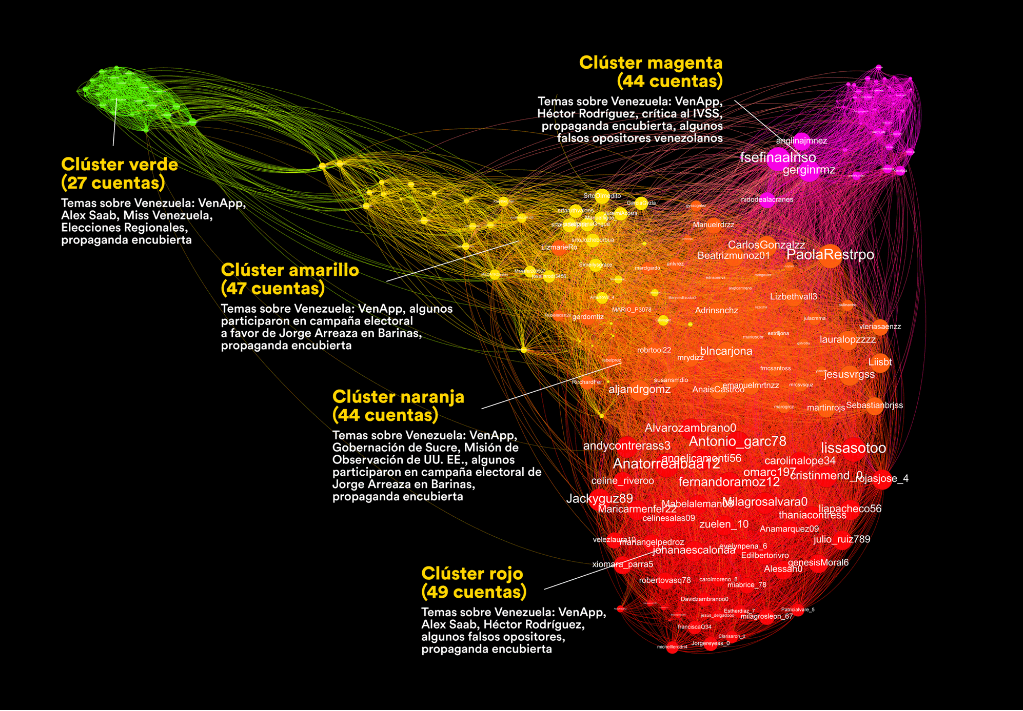
    Cazadores built up an infographic where each dot represented a Twitter account, and each line indicated where one account was ‘following’ another. The result was also colour-coded to represent the type of content each troll was primarily posting. The magenta cluster for example, contained largely false opposition or impostor posts, designed to embarrass anti-government candidates. The yellow cluster posted information to support government-backed candidate Jorge Arreaza in Barinas state, and the red cluster backed Héctor Rodríguez in Miranda. These accounts also contained material attacking opposition candidate Freddy Superlano in Barinas and supporting government-backed financier Alex Saab (facing money laundering charges in the US). There was also content relating to the Miss Venezuela beauty competition, perhaps for clickbait reasons.

    The Bolivarian troll farm
    Source: Cazadores

    Significantly the troll accounts also strongly urged followers to find and download a government app, known as VenApp. In May 2022, President Nicolás Maduro unveiled VenApp, which he said was an application built by Venezuelan computer engineers and intended to allow citizens to report public service and utility breakdowns, as well as generally increasing the efficiency of e-government. However, according to Cazadores, the app had in reality been built by companies connected to Venquis and Golabek, using programmers in Panama and the Dominican Republic.

    In Cazadores’ view, the app has the capacity to gather sensitive personal information (including identity documents numbers, geo-location coordinates, addresses, emails, and telephone numbers) all of which could be used to influence future electoral campaigning and outcomes. It comments “access to high volumes of personal data collected by VenApp could allow the Venezuelan government to microsegment the electorate, breaking it down into smaller groups to which personalised messages could be sent in future election campaigns, tailored to their interests, concerns and needs”.  This approach sounds similar the Cambridge Analytica story mentioned earlier in this report.

  • An army of hipster influencers

    Patrick de Courcy 16 November 2023 Hits: 542

    Something remarkable happened in mid 2023. In a compilation of regional opinion polls carried out by Argentina-based think tank Directorio Legislativo, El Salvador’s authoritarian hipster president, Nayib Bukele, emerged as the most popular Latin American leader with a remarkable 91% approval rating, ahead of Mexico’s Andrés Manuel López Obrador, who had 64% approval, and Brazil’s Luiz Inácio Lula da Silva, with 56%.

    Bukele, who took office in 2019, is credited with successfully cracking down on the criminal gangs that had been tormenting the country’s population, using a draconian state of emergency and mass arrests. Over 70,000 people, equivalent to 2% of the adult population, have been incarcerated without trial. The president has been able to do this because he controls a large majority in the legislature and has a compliant supreme court. Opposition parties, human rights organisations, and the US government among others have complained over a reduction in civil liberties and a loss of democratic freedoms, but they have been largely ignored. Although there is a constitutional ban on consecutive re-election, Bukele has already declared his candidature in the 2024 presidential race.

    What is clear at this stage is that the Salvadoran president, who has a background in political marketing, has relied on an ambitious and far-reaching programme of disinformation to help build his image. Bukele has attacked traditional and critical media outlets while at the same time building up an army of influencers and trolls to promote his image and achievements. Such has been the success of this approach that bukelismo is widely admired across Latin America, for its hard-line crackdown on criminal activity. Roberto Dubon, a communications strategist for the FMLN, Bukele’s former political party, told the Associated Press: “A news organisation doing an investigation can’t compare to the sounding board that these influencers have because they flood your social media with the government’s narrative. What you have is an apparatus to spread their propaganda.”

    The government has hired former journalists to produce slick online videos celebrating military successes against the gangs. A study of 56 pro-Bukele YouTube accounts conducted by Universidad Francisco Gavidia and media research group Factum found that they collectively had more followers than the country’s current population (6.3m) and earn significant revenue through advertising. In a single day last May these channels pumped out nearly 32 hours of pro-Bukele content, mirroring government language; 90% of the videos analysed contained false or misleading information. One account, Noticias Cuscatlecas, was said to earn as much as US$400,000 annually posting videos of violent attacks by alleged street gang members.

    Significantly, in April 2023 the president of congress, Ernesto Castro, announced that he was officially accrediting YouTubers and other social media influencers to “inform with objectivity”. AP spoke with a TikTok influencer who said that apart from covering the legislature for the government, he had been invited to other official events including the Caribbean Games. This contrasts with the persecution of critical media outlets such as El Faro which has been accused of tax evasion and which, for security reasons, has had to move many of its journalists to neighbouring Costa Rica.

    A report by Reuters news agency in late 2022 said it had spoken to three former contractors who had formed part of troll farms run by the Salvadoran government and tasked with manipulating the public debate. The job included online promotion of Bukele and his allies while filing spurious complaints against anti-Bukele bloggers in an attempt to get them closed down by social media platforms hosting their content.

    The government has also used other techniques to restrict information and strengthen its public narrative, for example by withdrawing previously available data on missing persons and the discovery of mass graves, both considered indicators of gang activity. It has also poached staff from the private media sector to work for government-owned outlets. In 2020 around 30 journalists on the independent La Prensa Gráfica resigned and left en masse to work for a new, pro-government newspaper called Diario El Salvador. Sources said they had been offered up to three times their previous monthly salaries.

    Reuters also said it had obtained a copy of an internal US State Department report, written in February 2022, which said the government was paying influencers and “likely bot farms” to tweet pro-government messages “tens of thousands of times” on a given topic to create the appearance of authentic grass-roots support. Bukele’s strategy was to “flood El Salvador with propaganda, demonise the institutions charged with debunking that propaganda – the free press and civil society – and dominate public narratives and repress dissent”.

  • How to regulate social media

    Patrick de Courcy 16 November 2023 Hits: 553

    The developments covered in this report concerning fake news and misinformation clearly point to a potential dystopian Latin American future, where distortion and manipulation erode democratic values and debase public debate. Rather than seeking to understand and address real-world problems afflicting citizens such as inequality, poverty, the lack of employment opportunities, crime, and corruption, politicians and governments will focus on manipulating perceptions and spinning stories to create a favourable impression. In short, authoritarian leaders of both left and right will use disinformation to confuse and distract a pliable electorate and keep themselves in power.

    At least part of the answer as to how this risk should be addressed is to consider wider regulation of social media. However, this too is complex and controversial, and in the eyes of some analysts could even make matters worse by eroding another public good, the right to freedom of expression. Some of these difficulties are illustrated by the debate over fake news regulation in Brazil.

    In April/May 2023 an updated version of Brazil’s so-called ‘fake news bill’ (PL 2630/20) was submitted to congress and was almost immediately criticised by the Big Tech companies, prompting in turn the announcement on 12 May of an investigation by the supreme court into the behaviours of Google and Telegram for campaigning against it. At the beginning of May in a prominent link on its Brazil home page Google had stated “The Fake News Bill could increase the confusion about what is true or false”. Messaging app Telegram likewise stated publicly that the fake news bill would “kill the modern internet” and “create a system of permanent vigilance, similar to countries with anti-democratic regimes”.

    The draft law contained a number of component parts.

    • It would oblige Big Tech companies to monitor and delete accounts and posts considered harmful or linked to criminal activities.
    • App providers would be liable for damages caused by third party providers if they had been paid to boost the reach of specific posts.
    • Big Tech platforms would have a duty of care requiring companies to actively combat the spread of content that violates the rights of minors, incites criminal activity, or spreads disinformation about health issues (this was considered a response to disinformation during the Covid-19 pandemic).
    • Platforms must be transparent about content moderation and to publicly explain their reasons for taking down content.
    • Members of congress would retain immunity for their online speech.
    • The companies would also be subject to external oversight to assess systemic risk, and would have to submit regular reports to a watchdog body (however the bill did not give details about how the watchdog body would function or what powers it would have).
    • The Big Tech companies would also be required to pay for news content that they post.

    Partly because of resistance to the bill, members of the governing coalition in congress subsequently agreed to break it down into separate pieces of legislation due to be voted on independently of each other. Levels of controversy have remained high, however. The proposal that news content be paid for is supported by those who believe that this would encourage the spread of professional, accurate news. On the other hand, critics say it could perpetuate the role of dominant mainstream providers such the Globo News group. Giving members of congress immunity for their social media posts is strongly resisted by those who accuse them of being a key source of disinformation.

    Among those opposing social media regulations in general are Frente Digital, a congressional caucus dedicated to expanding the digital economy (led by a member of Republicanos, the right-wing political party). Another opponent is the Frente Parlamentar Evangélica, which represents conservative evangelicals including Christian networks on radio and social media.

    The leader of the Frente, Eli Borges, is a member of the far-right Partido Liberal (PL) who has previously argued that the fake news bill could limit freedom of religious expression. However, there are also indications that the general public does support the idea of regulation. A poll by DataSenado released in June 2023 revealed that 72% of respondents were worried about the quantity of disinformation on social media. 80% said Brazil needed a law to target fake news, and 91% agreed with the statement that social media greatly shape peoples’ opinions.

    The dilemma over how to regulate social media while preserving and protecting freedom of expression is of course not limited to Brazil. In Chile, for example, the InterAmerican Press Society (SIP, in its Spanish-language acronym) said in July 2023 that the creation of an anti-disinformation committee of congress constituted a “warning light” for freedom of information. This prompted President Gabriel Boric to try and reassure critics, stating that the commission “will not try to define what is true and what is false” and that it would not recommend “punitive measures”.

  • Fake news is worryingly resilient

    Patrick de Courcy 16 November 2023 Hits: 527

    By way of conclusion, it is useful to point out that a number of factors are at work to limit the damage done by disinformation. Although they are economic competitors with rival business models, new and old media can work together to buttress freedom of information. It is noteworthy that some of the exposés of the dark world of disinformation specialists mentioned in this report have been achieved by collaboration between online and traditional media. Some advances can also be made by increasing what has been called ‘information literacy’, raising awareness within the general public of the need to verify online sources of information. The spread of fact-checking websites is also viewed as positive. A benign outcome, combining the minimum necessary regulation of social media with the maximum protection for freedom of expression, is not impossible.   

    However, it has to be said that, with a rapidly expanding toolkit of technologies, the balance of probabilities is that in the next wave of Latin American presidential elections, including in 2024 El Salvador, Panama, the Dominican Republic, Mexico, Venezuela, and Uruguay, disinformation techniques will play an unfortunately large role.