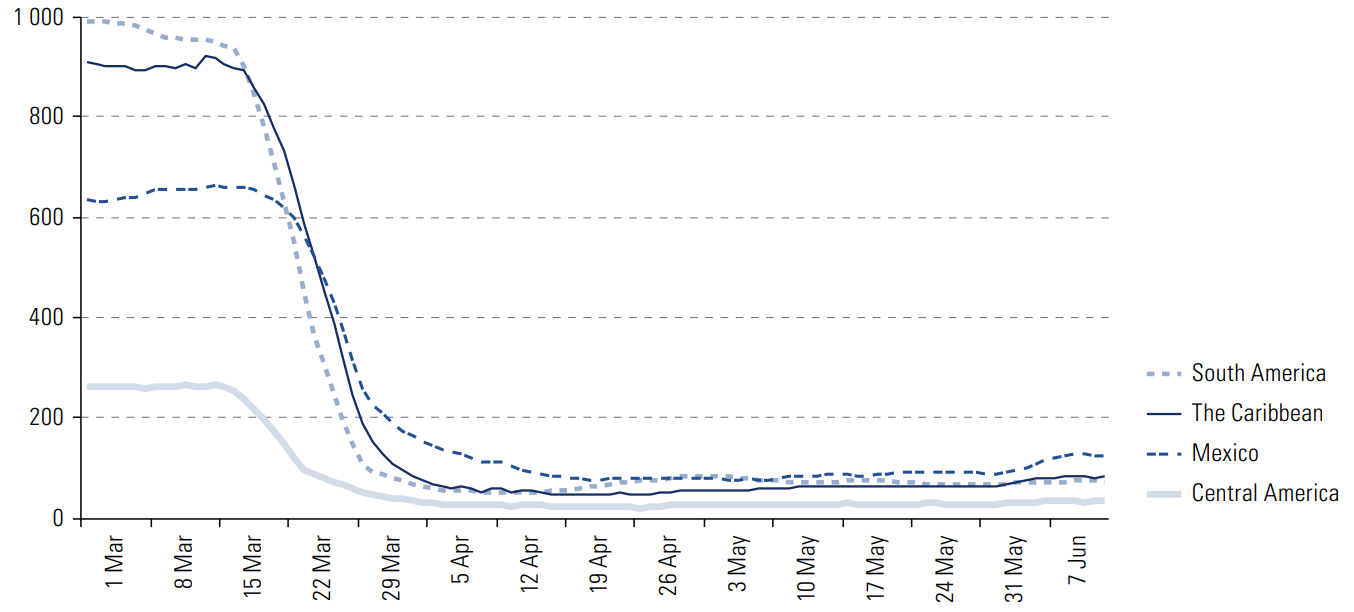
Bad timing for Mexico: In Mexico, the biggest tourist destination in the region, the crisis came at the worst possible time. The country normally receives 40m tourist arrivals every year and was preparing for the traditional wave of spring break visitors from the United States. A lockdown was introduced on 24 March. Air travel was restricted and most of the country’s borders were closed. Various sectors of the economy were temporarily closed with members of the public required to stay at home or work remotely. Rodrigo Conesa Labastida, a lawyer advising tourism operators, said flights and hotel reservations were abruptly cancelled with hotel occupancy rates plummeting.
Later data produced by National Statistics Institute, Inegi, showed that Mexican tourism GDP fell by 43% in the second quarter compared to the first. This was the third consecutive quarter of decline, and the worst quarterly drop since the start of the data series in the early 1990s. Significantly, the second worst quarterly drop, a fall of 8%, had happened in Q2 2009, in the middle of the 2008-2009 global financial crisis. The 2020 fall was particularly acute in the ‘tourism services’ sub sector, which includes transport, lodging, restaurants, commerce, second homes, and timeshares.
Mexico sought to be quick off the mark re-opening the tourism sector. Interestingly, Travel Off Path, a trade website, described Mexico as the world’s top travel destination during the pandemic. The website said it had assessed countries around the world that had received the World Travel and Tourism Council (WTTC) ‘safe travel global safety stamp’, did not impose a 14-day quarantine on new arrivals, and followed safety protocols. Mexico did well because of its “easy entry requirements and extra precautions…to protect travellers”. The Caribbean resort of Cancún had been the first city in the world to receive the WTTC Safe Travel Stamp. Other countries from the region on the list were the Dominican Republic (placed 3rd), The Bahamas (4th), Jamaica (5th), and Costa Rica (6th).
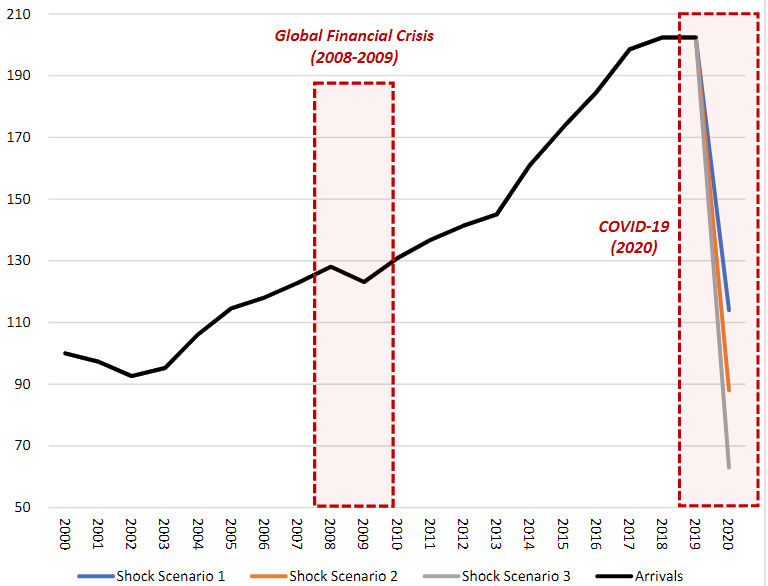
A two-thirds drop in the Caribbean: Because of high levels of tourism-dependence, the impact across the countries of the Caribbean was severe. According to the Caribbean Tourist Organisation (CTO), arrivals to the region fell by 63.7% in January-August 2020. This meant that 14.3m fewer trips were made, compared to 2019, the preceding year. Tourist arrivals from the US, the Caribbean region’s biggest market, were down by 65.3%. Arrivals from Europe fell by 62.5%, while those from Canada dropped 50.8%. Cruise ship arrivals dropped by 58.4%. Neil Walters, the acting CTO secretary general said that despite the beginnings of a recovery (32 Caribbean destinations had re-opened by late November 2020) it was still expected that arrivals for 2020 as a whole would fall by somewhere between 50% and 70%. The Caribbean Development Bank (CBD) estimated that the collapse in tourist arrivals could lead to GDP falls of 15%-30% among the Caribbean countries in 2020, with public debt rising by 15%-60%.
Walters nevertheless tried to focus on some potential upsides. He said that while the pandemic was having a severe impact, “it allows for a reset, since travel and tourism is affected globally, and every major region has lost its share of international arrivals”. In other words, the Caribbean might have an opportunity to increase market share. He noted that in 2019 international arrivals to the Caribbean had grown faster than global arrivals. Walters added: “The efforts made by Caribbean destinations to control the virus with some success, have created a marketable position as a healthy region”. He also argued that for many years the Caribbean tourism industry had been in need of an overhaul but had frequently put it off, to concentrate instead on tending to business as usual and rising short-term demand. The crisis was therefore an opportunity for the regional tourism business to re-think and reposition itself in the emerging 'new normal'.
Argentina’s lost long weekends: Strict national quarantine measures were imposed in Argentina on 20 March. They lasted for an initial 37 days, after which different provinces began to ease them back on a region-by-region basis. It took significantly longer to re-open the country to international travel. Faced with second wave infection spikes, various different restrictions remained in place for most of the year. It is estimated that the national tourism industry lost 11.6m overnight travellers and 11.5m same-day tourists during the six long holiday weekends that fell between March and August this year, representing financial losses of ARS78bn (around US$980m). In March-June hotel and restaurant activity is estimated to have fallen by between 31% and 66% relative to year-earlier levels.
As in other countries, re-opening Argentina’s tourist economy has proved longer and more complicated than shutting it down at the beginning of the pandemic. At the end of November for example, the province of Mendoza, famous for its Andean mountain ranges and temperate vineyards, was hoping to formally re-open as an international tourist attraction but was awaiting federal government approval of its plans. Provincial tourism minister Mariana Juri said the target was to attract mainly Chilean and Brazilian tourists arriving by road and by air. Re-opening the road crossing on the Argentina-Chile border – which the federal government had not yet authorised - was crucial. Provincial minister for government Víctor Ibañez said Mendoza had been working for most of the year to achieve a balance between protecting lives and livelihoods. After reaching a plateau, coronavirus contagion rates had begun to decline. Juri said the province had opted for a cautious, step-by-step reopening strategy. “We are looking for ways to make the tourist comfortable” she said, adding “that’s why we are thinking about opening outdoor attractions, like our national parks, about gastroeconomic tourism, and about cultural activities”. The province’s vineyards and wineries have adopted social distancing and other health protocols to minimise contagion risks.
Brazil’s troubled re-opening: Brazil, LAC’s largest country by both size of population and by value of economic activity, was particularly hard hit by the pandemic. The federal government under President Jair Bolsonaro sought to minimise the severity of the health threat and to prioritise a rapid re-opening of the economy. Most quarantine measures were imposed and later relaxed by state-level governments. Rather like the United States, where a similar policy was followed by President Donald Trump, the result was rapid contagion and a high death rate.
Brazil was one of the region’s first countries to fully re-open its borders at the end of July. By early November Rio de Janeiro had lifted all restrictions on the use of its famous beaches, as well as on bars and discotheques. Newly arriving tourists must now show they have purchased health insurance. They are not however required to undergo mandatory testing or to self-isolate. The rapid re-opening was partly intended to boost tourism’s contribution to economic recovery. According to Embratur, the country’s tourism institute, at the time of opening the country had 45,000 hotels with an occupancy rate of only 45%. On a voluntary basis many hotels introduced health protocols, such as temperature checks for arriving guests and contactless room keys. According to CNC, the Brazilian tourism and commerce industry association, the industry had its worst month in April 2020 when its revenues fell to BRL4bn (US$704m), down by nearly 80% on year-earlier levels. By September 2020 revenues had recovered to BRL12.8bn (US$2.25bn), although this was still 35.6% down on the comparable year-earlier performance.
Despite this improvement, the contagion rate remains high in some states including Rio, suggesting restrictions could be re-imposed, or that visitors, concerned for their safety, may simply decide to give Brazil a miss. The (southern hemisphere) summer season Carnival in Rio, an event which normally attracts millions of visitors, is in doubt. In September the city authorities said the Samba schools’ parade, due to be held in February 2021, had been postponed indefinitely. It is not clear if the associated street parties will take place regardless. The authorities in nearby São Paulo, meanwhile, have said they are postponing the samba processions there from February to October 2021.
On 10 November the Brazilian government launched a package of measures designed to re-start the tourism industry, still crippled by the effects of the Covid-19 pandemic. Tourism minister Marcelo Álvaro Antonio said they were based on four pillars: support for companies and employment; structural and quality improvements at tourist destinations; introduction of bio-security protocols; and travel promotion and incentives. The programme will run until end-July next year. There were however few details on the overall value of the programme or how the funding will be distributed between public and private sectors. The government has committed to make BRL5bn (US$937m) available in credit lines for tourism companies. Among examples of other types of assistance on offer were support for bio-security training and infrastructure investment. The minister said one of the aims was to encourage domestic tourism, through a programme called “Rediscover Brazil” and through a “Responsible Tourism” quality seal, designed to promote health and safety standards.
Brazil’s tourism sector is estimated to account for 8.1% of GDP and to directly and indirectly support 7m jobs. The minister said the industry had performed well in 2019, with 2.6% growth (double the average for the economy as a whole) and increased employment. That performance had been cut brutally short in early 2020 by the pandemic, which forced Brazil to close its frontiers, and triggered state-level lockdowns. According to the government’s estimates tourism revenues dropped by 37.2% in the first half of 2020, with job losses surging to a total of 364,044.
Opinions on the speed and strength of the likely recovery in Brazilian tourism differ. International media coverage of the continuing spread of the coronavirus in Brazil, and of President Jair Bolsonaro’s ongoing rejection of scientific advice on the pandemic, as well as his climate change denials, cannot be positive for the country’s image. In fact, international tourists might think twice before choosing to visit a country with the world’s second highest coronavirus death count (over 170,000 at the end of November, behind the US at 260,000-plus).
Limited re-opening of Peru’s Machu Picchu: One of Latin America’s most iconic attractions, the ruins of Machu Picchu, the Inca city in the Peruvian Andes, re-opened at the beginning of November, after a seven-and-a-half-month closure. Prior to its closure Machu Picchu had always been crowded, handling up to as many as 5,000 visitors a day. Under new health protocols visitors are limited to 30% of formal capacity, or 675 per day, 75 per hour. The use of face masks is obligatory, and tour groups are limited in size to no more than seven, who must maintain social distancing of at least two metres.
The Peruvian government had introduced a rigorous lockdown in March but, despite some initial signs of success, infection rates soared and the economy crashed – estimates for GDP in 2020 suggest a contraction of up to 12%. Before the pandemic national annual tourism revenues in Peru were running at around US$5.5bn. Peruvian tourist operators hope that the re-opening of Machu Picchu will begin a sustainable recovery for the industry, starting with domestic visitors and then bringing back international travellers. Peru began gradually re-opening international flights in October, with visitors now required to show they have tested negative for the virus 72 hours before flying. Visitors to Machu Picchu usually also go to the ancient city of Cusco and other attractions in the Andes.
Chile struggles with the complexities of re-opening: In Chile the tourism sector was hit by Covid-19 just as it was beginning to recover from deep disruption caused by anti-government protests that swept across the country in the last quarter of 2019. Here too the impact was unprecedented. According to tourism association Fedetur a total of 300,000 tourism jobs have been lost during the course of 2020, with a further 150,000 temporarily laid off under a furlough regime, with their future uncertain in the longer term. Fedetur executive vice-president Helen Kouyoumdjian says shifting regional quarantine regulations across the country have created a “terribly complex” situation for the industry, with some areas still closed to domestic and international tourists. It was not until late November that inward international tourism was authorised, initially only through one point of entry, the Arturo Merino Benítez international airport in Santiago.
Kouyoumdjian says Chilean operators have been following official guidelines and preparing for a new normal. “Tourism is going to change. Social distancing around tourist destinations is going to be different. We are working on new protocols for restaurants, for tour routes, for guides, and for adventure tourism. The aim is to reassure the tourist that the activity is safe,” she says. Yet at the same time she adds that the industry is puzzled by inconsistencies in the new rules. For example, shopping malls are open and operating with much less restrictive regulations than those imposed on tour operators, while national parks, easily adaptable to social distancing protocols, remain closed. Fedetur fears tourism may be suffering from unfavourable treatment relative to other sectors of the economy.

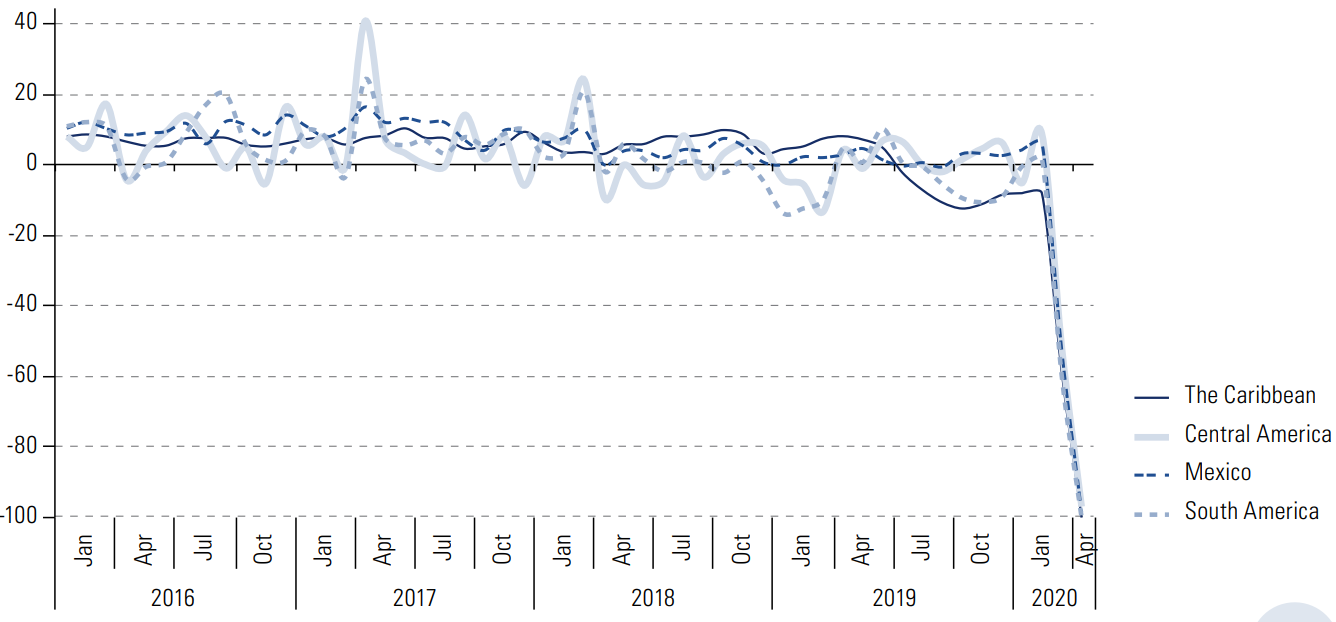
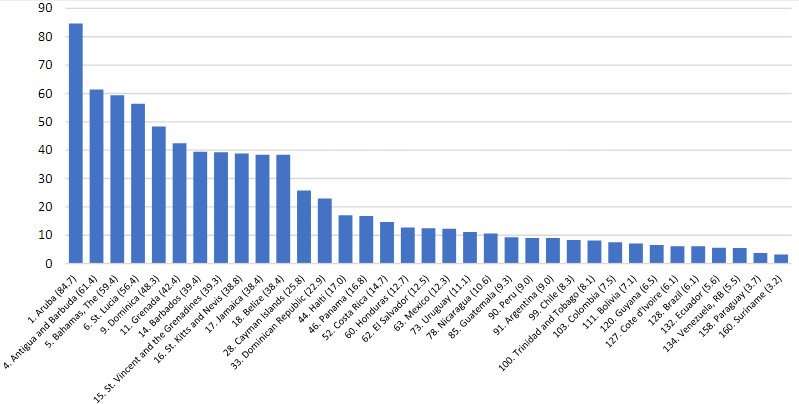
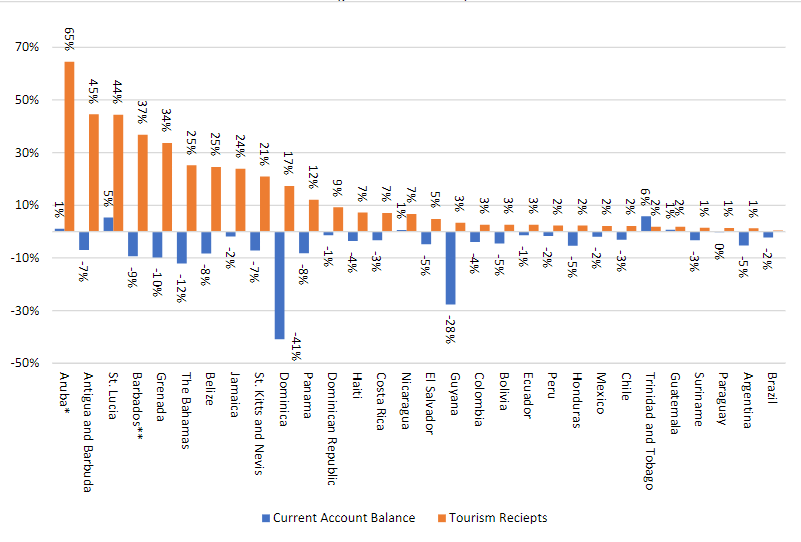 Notes: (*) Data for 2017 for Aruba, and (**) 2016 for Barbados , and 2018 for all other countries.