The Latin American middle class: attitudes, aspirations, and spending power

Items

  • Introduction

    LatinNews 22 December 2017 Hits: 409

    This report will investigate Latin America’s changing middle classes. Our starting point consists of four main headlines, each of which we investigate and scrutinise in some detail.

    The first is that there has been a major expansion of the Latin American middle class, associated with the commodities boom experienced in the decade running to 2012. The second is that more recently the rate of growth has fallen back and for some sectors of the new middle class population there is a real danger of regression. Thirdly, we argue that global economic and technological changes are likely to have a major impact on the social and political attitudes of the Latin American middle class. Finally, changes in attitudes, aspirations, and spending power are creating a new mix of threats and opportunities for businesses and other institutions in the region which one way or another address the needs of the middle classes.

  • The expanding middle class

    LatinNews 22 December 2017 Hits: 365

    There is a general consensus that Latin America’s middle class has been growing, although not everyone uses the same definitions or metrics, or covers the same time-scales for measurement. The World Bank published one of the key studies on the subject in November 2012[1]. This found that the Latin American middle class, defined as those earning between US$10 and US$50 a day per capita, had increased by 50%, from 103m people in 2003 to 152m in 2009. By the later date, that meant that 30% of the total population of the region could be described as middle class. The report noted that for decades, efforts to reduce poverty and lift more people into the middle class had progressed at a very slow rate; however, there was a sharp acceleration in the decade to 2012, attributed to the boom in commodity exports and to “changes in government policies that emphasised the delivery in social programmes alongside economic stability”.

    This 2012 report highlighted that much of the growth in the middle class took place in Brazil (responsible for 40% of the overall increase) followed by Colombia (where over half the population improved their economic status in 1992-2008) and Mexico, where 17% of the population joined the middle class between 2000 and 2010. For the region as a whole, upward mobility was increased due to a number of factors, including higher levels of education, more formal employment, greater urbanisation, greater participation by women in the labour force, and smaller families.

    The World Bank report highlighted some issues that, five years on, continue to be at the top of the economic and political debate in the region. On its definition, the region’s population can be divided into four main classes: the upper class (a small minority or around 2% of the total population earning over US$50 a day), the middle class (as stated, earning between US$10 and US$50 a day), a ‘vulnerable class’ (earning between US$4 and US$10 a day), and the poor (earning less than US$4 a day). At the time it was written (2012) it estimated that the middle class and the poor represented roughly the same proportion of the overall population (around 30% each). But it focused attention on the largest single group, what it called the “fourth” or vulnerable class, consisting of those who have emerged from poverty but have not yet become middle class. It stated that according to its research, “Members of this vulnerable class, representing 38% of the population, fared better income-wise than the poor, but lacked the economic security of the middle class.” This group, it said, was “sandwiched between the two”. Much of the subsequent debate has centred on where some of the vulnerable might be heading under various future socio-economic scenarios: upward into the middle class, or back downward into the ranks of the poor.

    The same report picked up on another question that has loomed large in the debate on Latin American development: the role of the state. World Bank officials say that globally, the expansion of the middle class has usually meant better governance, deeper credit markets, and greater spending in social sectors such as health and education. But in the Latin American case the link between middle class growth and these beneficial developments could be less strong, for various historical reasons. Since the second half of the 20th Century, Latin America’s relatively small upper and middle classes had limited commitments to, and expectations of, their governments. Put bluntly, they have traditionally paid little in tax, and expected little back in public services. The report says, “As a result the state was typically small and the middle classes tended to opt out of public services, paying privately even for core services such as electricity and security.”

    What the new expanded middle class expects from the state is arguably one of the central issues in current Latin American politics. In the report the World Bank suggests regional governments should explicitly incorporate the goal of equal opportunities in public policy “to break the perception that the system is rigged in favour of the most privileged”. They should also embark on “second generation reforms” to the social security system to enhance fairness and efficiency, and “break the vicious circle of low taxation and low quality of public services, by investing some of the region’s commodity windfall to improve the quality of public services…and administration.” Five years later, in a more austere fiscal environment, most analysts acknowledge that there is no longer a commodity windfall available to spend: but the need for a more efficient and equitable state is as acutely present as ever.

    A more recent report covering the expansion of the middle class was published in October 2016 by the Inter American Development Bank (IDB), titled Social Pulse 2016: Realities and Perspectives[2]. This estimated that in the preceding decade the middle class had nearly doubled in size to reach 186m people. This report is particularly valuable since it uses harmonised household surveys conducted across 22 Latin American and Caribbean countries. It established that the key period of middle class expansion was in the six years between 2002 and 2008, and that the pace of transformation subsequently slowed in the following six years, coming after the global economic crisis of 2008/09. In fact, poverty reduction in the first six years was 11% faster than in the second; the numerical growth of the middle class was 35% greater in the first six years than in the second.

    Marcos Robles, one of the report’s authors, made the point that the social gains from growth were not equally distributed among social groups or between countries and that Latin America still has the most unequal distribution of income of any of the world’s regions. He pointed out for example, that children have benefited least from social programmes and cash transfers. As a result, the prevalence of extreme poverty among children in Latin America is currently three times greater than the prevalence of extreme poverty among the elderly. The IDB said governments faced possibly their biggest challenge to meet the needs of the vulnerable, one of the largest population groups (although in this report the vulnerable are defined slightly differently as those earning between US$5 and US$12 a day). More positively, there are signs of greater employment participation by women. Women’s earnings have increased from 28% of household income in 1996 to 35% in 2014. Suzanne Duryea, an IDB economist, said, “The economic empowerment of women is changing family dynamics and transforming societies in the region. The traditional dominance of large families living in one household is beginning to give way to greater diversity, including more one-parent families and more elderly people living on their own.

    Given the average contraction in regional economic growth from 2015-2016, more recent analysis has focused on the possibility that the gains made during the commodities boom may be at risk of slipping away. In May 2016 a report on the region published by the Financial Times argued that “Economic hardship induced by the end of the commodity super cycle and ballooning government deficits has started to unwind many of the advances achieved by those at the bottom of the social pyramid.” This unwinding process, it suggested, was “toxic” both for consumer markets and for the region’s young democracies. As an example of the political effects the report highlighted the impeachment of Brazilian President Dilma Rousseff then underway. Although the impeachment case was technically justified by her violations of budget regulations, it was in truth, the Financial Times maintained, a verdict on what was described as a “stunning” 11-point negative swing in GDP growth, from 7.5% in 2010 to a 3.8% contraction in 2015. After a decade in which an estimated 40m Brazilians had gained “C” status – equivalent to middle class membership in the Brazilian socio-economic classification system – in 2015 almost 10% of them had been pushed back down into what the Financial Times called “the new and politically volatile group known as the submerging middle class”. This in turn risked setting up a vicious circle of worsening household finances, falling consumer confidence, and falling popularity for incumbent presidents across much of the region.

    Writing for the World Economic Forum in January 2017, Andrea Willige argued that the growth of the middle class in Latin America had in fact come to a “grinding halt”. She used World Bank data to point out that between 2002 and 2012 over 10m Latin Americans had joined the ranks of the middle classes every year. But between 2013 and 2014 that number dropped to 3.5m. Poverty had however continued to decline: therefore she confirmed the view of other analysts that the fastest growing group in 2014 and 2015 was in fact the vulnerable, those that the World Bank considered prone to falling back into poverty. The expansion of the vulnerable – now the most populous group in the region – was therefore a worrying trend.

    Slowdown

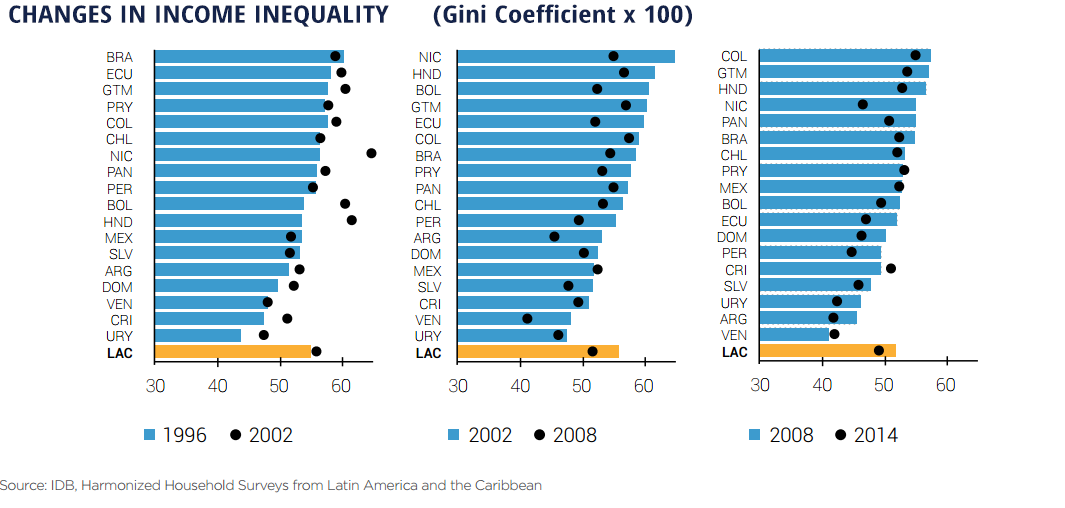
    Various studies have shown that the Latin American middle classes grew as a result of two factors: a combination of economic growth on the one hand, and a reduction in inequalities of income on the other. To say the same thing differently, the economic ‘cake’ became larger and was simultaneously shared out more equally. Redistribution of income took place through various mechanisms, including inflation-beating increases in minimum wages and targeted conditional cash transfers for the poor (such as Bolsa Familia in Brazil) and other social programmes. Inequality of income is measured through the Gini index on a scale of zero (perfect equality) to 1.00 (perfect inequality). For Latin America as a whole, the Gini index was virtually unchanged from 1996-2002, but it fell by 4% from 2002-2008, and went down again, but by slightly less, from 2008-2014. In the key 2002-2008 period the reduction in inequality was significant in all countries except Mexico. In that period countries such as Argentina, Bolivia, Ecuador, Peru and Nicaragua saw drops of nearly 10% in the Gini index. From 2008-2014 inequality continued to decline in all countries except Venezuela and Costa Rica. As the table shows, inequality remains highest in countries like Colombia, Guatemala, Honduras, and Brazil. Those with the lowest Gini scores – signifying the lowest level of inequality – include Uruguay, Argentina and Venezuela (although the Venezuelan data may be open to question because problems of statistical measurement).

    Despite this improvement, as has been mentioned, Latin America is still the most unequal region of the world. Eleven of the 20 most unequal countries in the world are in the region. The average Gini score for the region is 4 percentage points higher than the average for Africa, 11 points higher than in China, and 16 points higher than Europe and Central Asia.


    [1] Francisco H.G. Ferreira, Julian Mesina, Jamele Rigolini, Luis Felipe López Calva, Maria Ana Lugo, Renos Vakis. Economic Mobility and the Rise of the Latin American Middle Class.

    [2] https://publications.iadb.org/handle/11319/7863?locale-attribute=en

  • Demographic change

    LatinNews 22 December 2017 Hits: 306

    The expansion of the middle class has taken place against the backdrop of significant demographic changes in Latin America, which are important to examine in some detail. Perhaps the most important feature of these changes is that the Latin American population is now beginning to age. The region has been enjoying an important long term ‘demographic dividend’ – a fall in the dependency ratio (the proportion of the total population that is not of working age). But by the mid-2020s or early 2030s, this demographic dividend will go into reverse: the number of dependents relative to the total population will start increasing again. How societies react to that major turning point will have profound implications for the nature of the Latin American middle class.

    According to the Economic Commission for Latin America and the Caribbean (ECLAC), by the middle of 2016 there were 625m people in the region. This was nearly double the population in 1975. The number of inhabitants will continue growing, but the pace is slowing from 2.5% a year from 1970-1975 to an expected 0.3% from 2045-2050. What is also happening is that the composition of the population by age groups is changing. In the 1970s most populations could be represented as a pyramid structure, with the younger age groups being the most numerous at the base of the pyramid, and the older groups becoming progressively smaller as you move higher up towards the apex of the pyramid. Very slowly, however, the pyramid has begun to mutate its shape. For many countries it is now pear shaped: the ‘bulge’ represented by the numerically largest age group has moved up from the base – it is no longer formed by the very young, but by teenagers and twenty-somethings. Over a period of decades as that generation moves in to its thirties and forties the pyramid shape is in fact in the process of being turned almost completely upside down. There will be a time later in the 21st century when the elderly will eventually become the largest group of all.

    What this does is create a U-shaped dependency ratio over time. As recently as the 1990s the dependency ratio was just under 70%, meaning that of every ten Latin Americans only three were of working age (defined as between 14 and 65 years old). Those three had to earn their own living but also produce enough economic output to care for the remaining seven. At that stage the vast majority of the dependents were the very young – under the age of 14. But as members of that generation began to complete their schooling and enter the world of work, the dependency ratio began to fall. Since the 1990s the ratio has come down progressively, reaching 50.3% in 2015. ECLAC expects it will continue dropping to 48.4% in 2025, which will be its lowest point. This means that in the current and following decade, out of every ten members of the population, five are dependent, and the other five are of working age. After that point, the dependency ratio will begin to increase again, largely driven by the growing number of people who will be over the age of 65. As we go into the 2030s and 2040s, the proportion of Latin Americans of working age will reduce. According to ECLAC’s projections, the dependency ratio will start pushing upwards, reaching 59.2% in 2050. At that point for every ten people in the population, six will be dependents and only four will be of working age.

    The implications of the end of the demographic dividend and the ageing of the Latin American population are multiple and far-reaching. The fundamental issue is that those in work will have to become more productive to provide for a growing proportion of elderly dependents. Different countries are beginning to grapple with this issue. The costs of defined-benefit, pay-as-you go publicly funded pension systems are already rising in an unsustainable fashion in many countries in the region. This has led to waves of pension reforms and a move to defined contribution private pension systems. Whether public or privately provided, it is clear that existing pension coverage across Latin America is inadequate and needs to be expanded. Governments have had to begin considering unpopular remedies such as increasing pension contribution rates and/or raising the minimum age of retirement.

    More generally there is a big difference between public and private provision for a ‘young’ middle class on the one hand, and for an ‘older’ middle class on the other. As the middle class ages, there will be less demand for young family homes and more for retirement apartments. The balance between owning and renting accommodation may change. Demand for ‘third age’ managed housing estates may rise. Entirely new industries may come to Latin America – for example care-home provision (traditionally, the elderly in the region have been cared for by their extended families, but this may change). In the financial sector the need for retiree-focused saving and investment products will increase. Less public investment will be required for primary education, but demand for other types of education and training may rise. The balance of retail product offers – from supermarkets through to department stores – may also shift.

    Also part of the equation is the issue of where the Latin American middle classes will live. Latin America is already the most urbanised region in the world, with around 80% of the total population living in cities. The ageing process will play out at different speeds in different cities. According to estimates cited by Horacio Terraza, a World Bank expert on urbanism, Mexico City, already one of the world’s most populous cities, will reach its peak population by 2050, and begin to decrease after that date. The population of Santiago de Chile will peak in 2041. It is calculated that San Juan de Puerto Rico has already peaked – in 2012. Other cities will keep on growing for much longer. Manaus in the Brazilian Amazon and Panama City in Central America will not reach their population peaks until sometime in the decade starting 2070. It follows that at faster or slower rates, within each city the age profile and the demand for services and housing will change accordingly. According to a World Bank calculation, for every 100 residents under 15 years of age, the typical Latin American city currently has between 30 and 70 people aged 60 years or over. By 2050 that range will rise to between 80 and 180. On average, there will be more over-60s than under-15s. The up-ending of the traditional urban demographic pyramid, will change many of Latin America’s cities.

    The middle classes may re-asses the desirability of living in the region’s mega-cities (those that have populations of over 10m). It is evident that once cities exceed a certain size, economies of scale may reverse and become diseconomies of scale. The diseconomies or ‘externalities’ include high levels of crime, long commuting journeys, traffic congestion and pollution. Some argue that at a certain stage in the development process mega-cities begin to lose their appeal and a second wave of smaller cities start offering a more attractive environment and better productivity gains. According to the Inter-American Development Bank (IDB) there are 645 “intermediate” cities in the region (with populations ranging between 100,000 and 2m), which are home to over 200m people (around 35% of the regional population). Of these, the IDB says 242 (over a third) are “emerging” locations, meaning they are making a dynamic contribution to national economies. Their populations and output growth rates are above the national average. For that reason they are of particular interest to a wide range of companies selling consumer goods and services.

  • The problem of informality

    LatinNews 22 December 2017 Hits: 298

    The issue of informal employment is probably more acute and problematic in Latin America than anywhere else. The ‘informal’ are defined as those who work outside the official tax and benefits system. Typically, they have no written contracts of employment, do not benefit from protected hours and conditions of work, and receive limited or non-existent social benefits. Being informal means that the employee is in a fragile position: he or she has little protection against sliding back into poverty.

    Data from the IDB shows that informality is highest among the nearly 30% of the Latin American population classified as poor, and although lower, informality remains very pronounced by international standards, among the vulnerable population (38% of the total) and among the middle class (another 30% of the population). Among the poor, informality averages 70%, meaning seven out of ten workers make no contribution to public social security systems. For ‘middle sector workers’ (those between the third and eighth decile of per capita income) informality is roughly 50%, meaning that only five out of ten contribute to the social insurance system. What this means is that being middle class in Latin America is less secure than being middle class in other regions of the world. The chances of slipping back or ‘submerging’ are greater, and there is less of a protective social security net if things go wrong.

    Informal work in Latin America is typically seen as prevalent among the very poor, including occupations such as street selling, domestic service, subsistence farming, and working on construction sites or other manual roles. This is an important part of the current reality, but there is also widespread informality among what could be seen as more middle class or quasi-middle class roles, ranging from taxi drivers through to electricians and plumbers. Quite affluent, professional people may also find themselves in informal sectors, including architects and accountants.

    Broadly speaking, Latin America can be broken down into three groups according to levels of labour informality. The highest level of informality is present in countries like Bolivia, El Salvador, and Guatemala where more than 80% of households do not have any member contributing to social security schemes. A second group has informality rates raging between 60% and 70% and includes countries like Peru, Colombia and Mexico. The lowest levels of informality can be found in countries like Uruguay, Costa Rica, and Brazil, and range between 40% and 50%.

    Informality

    The case for reducing informality is strong, but progress in doing so has been very slow. The countries in Latin America that have lower rates of informality also tend to have more stable and established middle classes. Greater formality is beneficial in many connected ways. If a greater proportion of the working population pays taxes, government’s fiscal position and ability to invest and provide social services will improve. Crucially, greater formality almost always implies there is potential to increase productivity. It is the larger, more formal companies that are able to capture economies of scale. They are also more likely to offer on-the-job training. Research has shown that many of those working informally do so in very small, low-capital enterprises, with very low levels of productivity.

    The transition to formality remains difficult, however. Part of this difficulty relates to the high costs of formality and associated red tape: the sudden transition to paying high sales and payroll taxes can make many small businesses simply not viable. There is also a very important cultural factor. Many of those in informal roles simply do not trust governments, or find themselves working in such a day-to-day struggle to survive that they cannot see the longer-term benefits of paying into health or unemployment insurance schemes. Some in any case earn a living on the border of legality (such as street sellers or unregistered miners). For some, the quality of the public schemes they are being offered is so poor that the decision to remain ‘outside the system’ is understandable. Out of necessity and because of shifting opportunities, many Latin American workers move backwards and forwards between formal and informal employment. The amount transitioning from one status to the other can be as much as 15%-20% of the total labour force. Yet official social programmes often fail to adapt accordingly. For example, the Peruvian state pension scheme only pays benefits to those with 20 years or more of regular, documented an uninterrupted contributions made in formal employment.

    Santiago Levy, writing for the Brookings Institution, points out some of the perverse effects of the rule about contributions in countries with high formal-informal transits. “Consider this: Peruvian workers, if employed formally, are forced to save 13% of their salary in an account they cannot pledge as collateral for any other loan, nor use in the case of an emergency; and, when they reach 65 years of age, are more likely than not to have their savings returned to them in one lump-sum payment (with interest net of commissions). From this point of view, it is not surprising that workers will perceive that a part of their contribution, rather than being a future benefit for them, is really a tax associated with their formal status.”

    While those working informally or in self employment may be seen as entrepreneurs who can potentially create successful new companies, the reality is that only the very few make this transition. According to a study by the Development Bank of Latin America (CAF), 28% of Latin America’s work force is self-employed, compared with just over 6% in the US.[1] But 90% of Latin America’s small businesses are very small with fewer than four employees. Pablo Sanguinetti of CAF has commented that many of the self employed “are there, not because they are able to run a dynamic business, but basically because they have no other employment opportunities”. Given poor initial skills, low productivity and zero or limited access to training, most of these companies are unable to improve their capacity and skills base, and are poorly placed to manage a transition to the formal, wage-paying sector. This is described as an “informality/low productivity trap”. Of the total number of small businesses in the region CAF estimates that only one in four have the capacity to break out and achieve dynamic growth.


    [1] Emprendimientos en América Latina: desde la subsistencia hacia la transformación productive.

  • The fourth industrial revolution

    LatinNews 22 December 2017 Hits: 321

    The attempt to bring a greater part of the Latin American population into the tax and social security system faces a major additional complication: the advent of a global digital revolution, sometimes called the ‘fourth industrial revolution’. This is the headline used to describe a range of technology developments including increased automation, the use of industrial robots, the Internet of Things (IoT), cloud computing, artificial intelligence, blockchain software, and 3D printing, among others. At a global level the effects of this revolution on traditional patterns of work and employment could be far-reaching; they are not yet fully understood. According to the IDB, existing global estimates say the share of jobs that could be replaced by robots ranges from 5% to 47%, depending on the method of calculation used.[1] Against this it is estimated that each new technology job can generate 4.9 other jobs as part of a ‘spillover effect’. The threat of job losses through technology varies from country to country and sector to sector.

    For the agricultural sector in Uruguay the risk is said to be as high as 82%, and particularly acute for those with low levels of formal education, the young, and for men. In the transportation sector in Argentina the risk is calculated at 76%. According to early information on robot numbers, Switzerland, Germany, Japan, and South Korea currently have the highest number of robots per industrial worker – more than 20 per thousand. In the LAC region Mexico and Brazil have the most robots, but at 1-2 per thousand industrial workers they are still far behind the more developed countries.

    It is possible that the fourth industrial revolution will radically erode the stability of employment in Latin America’s middle classes. On the other hand Marcelo Cabrol, an IDB expert, takes an optimistic stance. He argues that if Latin America and the Caribbean (LAC) respond with the right combination of reforms, strategic investment, and skill development, it will create an opportunity not just for new business ventures, but also to close some of its social and economic inequality gaps. The challenge, he argues, is to build innovative eco-systems and emulate what is being done by entrepreneurial states like those in South Korea and Israel.


    [1] Robotlution: The Future of Work in Latin American Integration 4.0

  • The international dimension

    LatinNews 22 December 2017 Hits: 333

    The growth of the Latin American middle class is without a doubt an important trend in itself: it is also useful, however, to put that growth in an international context. Research by Homi Kharas for the Brookings Institute in the US[1] published in mid-2017 used updated purchasing power parity prices to calculate the size of the global middle class. He found that around 3.2bn people could be described as members of the global middle class at the end of 2016, around 500m more than had originally been estimated (perhaps because of this his estimates of the size of the middle class in Latin America are significantly higher than those produced by the World Bank and IDB). Kharas suggested that in as little as two to three years there might be a tipping point, where a majority of the world’s population might, for the first time ever, be from middle class or rich households. Significantly, most of the new entrants to the middle class are likely to come from Asia. Middle class spending is now estimated to account for one-third of the global economy. The geography of the middle class is also changing. China and India are accounting for a bigger share of the global middle class, while the previously dominant European and North American middle class is stagnating.

    The global expansion of the middle class raises some of the same issues and dilemmas, as does its expansion in Latin America. Kharas suggests a larger global middle class may imply a happier population, at least for new entrants, but adds, “there is little evidence to suggest that this will create pressure for more democratic governance or for better delivery of public services, both of which are required for sustained growth”. Governments may struggle to meet demands for universal health care, public education, pensions, and affordable housing. A critical issue will be “getting the right balance between taxes on the middle class and services to support them”.

    If Kharas’ global projections are correct, there are some key implications for Latin America. First, the region’s middle class is growing numerically, but at a slower rate than in other parts of the world. As a result he projects Latin America’s share of the global middle class to fall from 9% in 2015 to 6% by 2030. Second – and potentially of critical importance – the composition of the global middle class is changing. In more ways than one, by 2030 Latin America will be living in a different world. At present, the bulk of Latin America’s international trade is conducted with Europe and North America, which between them represent (using data from 2015) 35% of the global middle class. But by 2030 their share of the global middle class will have shrunk by 14 percentage points to only 21%. The increasing size and importance of the Asia-Pacific middle class stands out as a major factor in Latin America’s future. Asia-Pacific’s share of the global middle class is set to increase from 46% in 2015 to 65% in 2030 – up by 19 percentage points.

    The change is also evident when countries are ranked by the size of total middle class spending. In 2015 the largest middle class market in the world was the United States with 13% of the global middle class spend, followed by China (12%), Japan (6%) and India (5%). By 2030 however, China will be the largest middle class market in the world with 22% of the global spend, followed by India (17%) the US (7%) and Indonesia (4%).

    Number (in millions) and share of the global middle class by region
      2015 2020 2025 2030
      Number % Share Number % Share Number % Share Number % Share
    North America 335 11 344 9 350 8 354 7
    Europe 724 24 736 20 738 16 733 14
    Central and South America 285 9 303 8 321 7 335 6
    Asia Pacific 1380 46 2023 54 2784 60 3492 65
    Sub-Saharan Africa 114 4 132 4 166 4 212 4
    Middle East & North Africa 192 6 228 6 258 6 285 5
    World 23030 100 3766 100 4617 100 5412 100
    Source: Brookings Institute

    These numbers suggest that Latin America’s already evident ‘pivot’ towards the Pacific is likely to continue and intensify. They also suggest that while Latin America’s dependence on agricultural and mining commodity exports may continue, there will at least be an opportunity to diversify and increase value added exports to Asia. The massive growth of the middle class in China and India suggests those economies will become more diverse, transitioning to greater reliance on consumer goods and services. This may create a wider range of export opportunities for Latin American countries. Conversely, large Asia-based consumer-oriented companies are likely to play a bigger role in Latin America. Some of the pioneers – such as Huawei in telecoms and Great Wall, Chery and JAC Motors in the auto sector – are likely to be joined by many more.

    The shopping mall: alive and well in Latin America

    Those who have highlighted the growth of the middle class in Latin America sometimes assume that the associated changes in attitudes, aspirations, and consumer behaviour must follow a similar pathway to that experienced during the much earlier growth of the middle classes in Europe or the United States. While this may be right in some important respects, there is also much to suggest that there are also important differences in the two experiences. One example is the shopping mall. Nolan Gray, director of policy at the US-based Centre for Market Urbanism, has pointed out that the shopping mall appears to be dying in the United States, but in contrast, is in rude good health in Latin America.

    Shopping malls have indeed peaked in the US. Only one new mall has been built in the country in over a decade. Of the roughly 1,100 shopping malls still operating in the US, it is estimated that around 25% are due to close by 2022. Meanwhile, there has been a boom in the construction of new malls in Latin America – about 100 were built in 2016. The largest mall in the western hemisphere used to be the Mall of America in Bloomington, Minnesota. Now it is the Albrook Mall in Panama City.

    Gray attributes the boom in Latin American malls to several factors. One important driver is the numerical growth of the middle class. According to his numbers the middle class grew up by 50% from 2003-2009 and now accounts for around 30% of the total population of the region. He says that the growth of the middle class in the US from 1945-2005 led to increased car ownership, suburbanisation, and shopping malls. There has been a similar script in Latin America, with some variations. One is that Latin American cities generally have much higher levels of crime and poorer-quality urban environments than in the US. That means that the mall, as a safe place, often with its own private security guards, is seen as more attractive. Parents can feel more relaxed about letting their children meet and shop in the malls. In contrast US cities have generally lower crime levels, and as a result, over the last 25 years there has been a boom in what Gray calls “walkable urban neighbourhoods” with a proliferation of restaurants, bars, salons, and “experiential retail” outlets. In short, the US has rediscovered and renovated the “Main Street” urban and retail environment that malls had once threatened.

    Another major difference is that online shopping has not advanced as much in Latin America as it has in the US. In the US goods can be ordered online and delivered rapidly and efficiently to almost any address in the entire country. Latin America’s online distribution networks in contrast are much less developed: poor transport and limited delivery systems means there are large parts of each country where online shopping is just not feasible. The net result is that visiting a mall remains an attractive option, not only in the mega-cities, but also in the second tier of regional and medium-sized cities.

    Finally, perhaps learning from the difficulties that malls have faced in the US, developers in Latin America have been able to innovate and try out new and more diverse approaches. In the US the centrepieces of malls tended to be large department stores (such as Sears, JC Penney, and Macy’s): these retailers have however entered a period of relative decline, to some extent bringing the malls down with them. In Latin America, in contrast, malls are being built to include units as diverse as hospitals, call centres, office spaces, and residential apartments.

    One example of how these trends can play out is the development of malls and mixed-use areas in the Santa Fé business district west of Mexico City, near the highway to Toluca. Here too there is a background of middle class growth: in the ten years to 2010 the Mexican middle class grew to 44m, up from 37m, according to Inegi, the national statistics institute. Initially a large landfill rubbish site, after the destruction caused by the 1985 Mexico City earthquake, Santa Fé was redeveloped as a new business district, modelled on La Defence in Paris. Development was led by the construction of a new 20-hectare campus for the privately owned Universidad Iberoamericana, which was inaugurated in 1988. Over a 20-year period a large number of corporate headquarters and office blocks were built, followed by up-market residential apartments, shops, and commercial centres.

    It is now estimated that over 200,000 people work in Santa Fé every day. The district is also home to Centro Santa Fé, a shopping mall of over 100,000 square metres and car parking for 5,000 vehicles that opened in 1993 and is among the largest of its kind in Latin America. The development includes major department stores like Palacio de Hierro and Liverpool. Property developers say higher land prices and difficulties in finding the necessary space mean there are unlikely to be many more very large shopping malls on the scale of Centro Santa Fé. Current development is more focused on neighbourhood shopping centres, with floor space roughly between 15,000-20,000 and 50,000 square metres. To be viable such a centre usually needs to house a medium- to small-sized supermarket, a film theatre, a gymnasium, and a range of restaurants and shops. Most developers build and operate, leasing out the retail spaces to a number of outlets. It is seen as a long-term business. Many shopping malls are built as part of a combined project with residential apartment blocks. The advantage of this approach is that the developer can structure a mixed financial return consisting of capital from the sale of residential units and revenue from rental income in the commercial centre. The commercial centre usually requires refurbishment and updating every 3-5 years. In the long term developers also have the option of partially or fully divesting the shopping centre to release capital for new projects.


    [1] Homi Kharas, The Unprecedented Expansion of the Global Middle Class

  • Segmenting Latin American consumer markets

    LatinNews 22 December 2017 Hits: 388

    International and locally based companies need to understand the changing Latin American middle classes to optimise their product development and marketing strategies. One recommendation is that they should base their approach on market segmentation by age groups. A retail consumer markets survey by Nielsen segments the adult Latin American consumer market into four main groups: the Millennials (aged 21-34 in 2017 and representing 33.8% of the total); Generation X (aged 35-49, representing 31.4% of the total); the baby boomers (aged 50-64 years, 21.8%); and the ‘silent generation’ (aged 65-plus, accounting for 13.0% of the total). Across these age groups, the study say there is a comparatively strong demand for premium products. Millennials are particularly interested in hair care; Generation X in oral care products; baby boomers in dairy products; and the ‘silent generation’ in both dairy products and body care items.

    Consumer preferences vary according to national characteristics and recent economic experience. Brazil has been marked by the deep recession of 2015 and 2016. A Nielsen analyst commented, “This recession is changing the type of consumption Brazilians are making in order to save money; however, they are more demanding than ever. Thirty-nine per cent of Brazilian families have a trendsetter housewife who is looking for innovations and the best products”. There are indications that the Brazilian recession triggered changes in lifestyles and spending patterns, in which some categories of products actually gained, rather than lost sales. One example: sales of alcoholic beverages rose by 8% in value during the recession year of 2016, attributed to the fact that many consumers stopped going out to restaurants and bars as much as they had in the past. Instead, more people went back to entertaining at home, which led to increased supermarket sales of beer and other alcoholic drinks. There were also signs that with lower purchasing power, some consumers were prepared to search out better value, ‘premium’ products.

    In Mexico, Nielsen detected changes in the role of women consumers. More are said to be questioning traditional roles focused around bringing up children. “With the influence of fast-paced lifestyles and modern technology, traditional housewives are becoming modern housewives with a focus on being practical, healthy, informed, and cost conscious,” the report commented. Millennial women are seen as leading consumer decision-making in over one-third of Mexican households; Generation X housewives are having to return to work to help the family budget. Despite tight budgets both generations of women are seen as being more prepared to buy premium products for their children. In Colombia there were also indications that parents are prioritising their spending on premium products for their children, but are more prepared to ‘trade down’ to lower-priced items for their own use. There are also signs that Colombian women, who traditionally favour locally made products, are becoming more open to exploring global brands and trends.

    A separate report by the Economist Intelligence Unit highlights the growth of the Latin American middle class in mega-cities, but also in the so-called ‘second tier’ cities. It forecasts that by 2030 the number of people in Latin America’s 122 largest cities earning over US$15,000 annually will have more than doubled to over 88m. The mega-cities are showing some signs of maturity: most growth and consumer concentration on the other hand, is expected to occur in the medium-sized cities which at present are starting from a lower base and are for the moment lagging behind in terms of infrastructure and service provision. This report sees the region as a whole on a moderate recovery path from 2017 onwards, although performance will vary from country to country. Despite a range of challenges, including corruption, weak public institutions, and poor quality public sector services, the report nevertheless highlights strong growth in the urbanised population and increased spending power indicating that there is “immense potential” in the both the region’s mature and in its emerging urban markets. By 2030 the region’s six mega-cities (Mexico City, São Paulo, Rio de Janeiro, Buenos Aires, Lima and Bogotá) are expected to add over 20.7m additional consumers.

    However, size is not the only important factor. A smaller city like Montevideo, the capital of Uruguay, will offer the highest concentration of inhabitants earning over US$15,000 a year (73.1% by 2030). Other cities with a high concentration of affluent inhabitants in 2030 will include Hermosillo in Mexico and San José, the capital of Costa Rica. The fastest growth rates for consumers earning over US$15,000 per annum will be found in Bolivian, Ecuadorean, and Peruvian cities. Among them will be Santa Cruz, Cochabamba, and La Paz in Bolivia, Guayaquil in Ecuador, and Chiclayo, Arequipa, and Trujillo in Peru.

  • Politics: what does the middle class want?

    LatinNews 22 December 2017 Hits: 306

    Establishing the political implications of the at-first rapid, then slower growth of the Latin American middle classes, including perhaps some backsliding into the ‘vulnerable’ category over the last two-three years, is not straightforward. The key issue is how that growth impacts on voter preferences and on the strength of democratic rule. Before discussing that issue directly however, it is worth considering two initial points. The first once more relates to developments in what has been happening to the middle classes in other parts of the world. The second relates to the complex but interesting interplay of actual and perceived class membership.

    Put in its crudest form, one of the striking features of recent years is that middle class sectors in the developed world – and particularly in the United States and Europe – appear to be suffering a process of relative decline, while the middle classes in the emerging world are expanding. According to the US-based Pew Research Centre, in 2015 the middle classes in that country, which had been in a numerical majority for over four decades, became a minority again. There were more people in upper and lower income households (121.3m) than in middle class households (120.8m). In the period between 1970 and 2014 the number of those in the upper income brackets has increased by roughly the same percentage as the middle class has shrunk – by one-fifth. The middle class share of US aggregate household income dropped from 62% to 43% in that period.

    Something similar has happened in Europe. According to the European Commission and the International Labour Organisation (ILO), the European middle classes expanded numerically very strongly in the 1980s and 1990s, but began to fall thereafter. The fall became particularly intense after the global economic crisis of 2008/2009. There is an intense debate over why this is happening in both the US and Europe, with factors such as globalisation, the decline in traditional manufacturing, a general loss in competitiveness, fiscal austerity, and tax and spend policies that are skewed in favour of upper income groups all being mentioned. Technological change and the increasing use of automation is also referenced. Politically, many argue that the decline in the middle classes and the breakdown in traditional blue-collar employment has fuelled a turn to the populist and anti-immigration right, marked for example by the election of Donald Trump as the president of the United States.

    One perception is that globalisation has been kind to the middle classes in emerging economies, but harsh for the middle classes in the developed world. How this perception will in turn influence government positions on globalisation and protectionism is not immediately evident. These is clearly a lot at stake since pro-globalisation, pro-free trade policies have arguably been a key driver of emerging economy growth in recent decades. Economic growth in much of Latin America has benefited from globalisation – South American economies such as Brazil benefitted from booming raw material demand from China, while Central American economies and Mexico benefited from close integration into the US. Increased protectionism could have a serious impact on this process.

    The second important point is that there can be quite a significant gap between actual class membership – using World Bank classification by income – and perceived membership. The regular annual public opinion survey across 18 countries in the region published by Chile-based think-tank Latinobarómetro at the end of October 2017[1] made this point. One subjective measure of economic wellbeing is to allow survey respondents to place themselves into four main categories: those who have enough income to get to the end of the month with ease and can make savings; those who have just about enough to cover their outgoings; those who are falling short by a small amount; and those who are falling short by a large amount and are in serious difficulty. Interestingly, in the 22 years that the annual surveys have been conducted, despite some fluctuations, the four groups have not changed radically in size. There has however been some improvement in perceived affluence. Those who consider themselves well off and can save have grown from 38% to 42%; those who describe themselves as being in serious difficulty have fallen from 36% to 31%.

    Respondents were also asked to auto-define their social class, and given three options: to describe themselves as upper class, middle class, or lower class. For Latin America as a whole the largest group said they were lower class, but this proportion has dropped from 58% in 2013 down to 45% by 2017. The second-largest group defined themselves as middle class, rising from 36% to 42% between the same two dates. Those that described themselves as upper class rose from 4% in 2013 to 9% in 2017. Latinobarómetro points out that those who describe themselves as middle class are not always within the World Bank income group of US$10 to US$50 a day. In Bolivia 53% of the population says it is middle class, but according to the World Bank only 10% is actually earning enough to be in that category. Latinobarómetro explains this by saying a significant proportion of the Bolivian population now feels empowered and included; how they feel about social class is subjective and culturally relative. The importance of perceived social class is two-fold: on the one hand it affects broad patterns of consumption and influences consumer marketing strategies; on the other it may be critical in influencing political and voting preferences.

    The broad picture presented by the 2017 Latinobarómetro public opinion survey is that, irrespective of the comparative growth of the middle classes, there remain serious concerns over the strength and performance of Latin American government institutions. The survey showed that across 18 countries in the region support for democracy has dipped to 53% of respondents, down from 61% in 2010. On average, only a third are happy with how democracy is working, three-quarters think decisions are taken mainly for the benefit of the rich and powerful, and 62% think there has been no progress in the battle against corruption. Marta Lagos, Latinobarómetro director, says “There is no indicator telling us that democracy is improving. It is doing badly in many countries in the region.” She adds that while in Venezuela democracy might be described as in a “terminal” state, elsewhere countries are suffering from what she calls “democratic diabetes” – an illness “that everyone is suffering from, nobody can see, and which, if not treated, is still a killer”.

    A recently published USAID report, The Political Culture of Democracy in the Americas 2016/17, which also used Latinobarómetro survey data, draws four sobering conclusions for the region as a whole. First, support for democracy is lower in 2016/17 than it was in previous years; in fact within each country support appears to be lowest among the younger, the less educated, and the less wealthy. Second, a significant portion of the population (around 40%) would support a coup d’etat by the executive power, including the shutdown of the legislature, if that offered a way of reducing crime or corruption. Third, trust in political parties has slumped to the lowest level since the Latinobarómetro surveys started over 20 years ago. And fourth, partisan affiliation (party membership) fell by a substantial 10 percentage points in 2016/17 – an indication perhaps that political volatility might be on the increase.

    It is possible to argue that the two largest countries, Brazil and Mexico, are suffering particularly acute versions of this general malaise. In a ranking of 29 western hemisphere countries including the US and Canada, support for democracy was highest in Uruguay (82.4%), followed by Canada (79.2%), Argentina (77.2%) and the US (73.0%). Brazil was down in 23rd position (52.4% support for democracy) with Mexico in 27th (49.4%). Likewise, when countries are ranked according to the proportion of the population that would support a coup, Brazil and Mexico appear quite high up the list. Out of 22 countries where the question was asked, Mexico was in fourth place in terms of the proportion of respondents who would support a coup in an environment of high levels of crime (47.5%) and fourth again for those who would do so in high levels of corruption (49.9%). Brazil was ranked ninth for those who would support a coup in the high crime scenario (37.4%), and tenth for those who would support one in the high corruption scenario (34.6%). Trust in elections was also particularly low in Mexico (only 26.2% of respondents) and Brazil (23.4%). Just under one in ten Brazilians said they trusted political parties (9%); Mexico scored only marginally better (13.8%). The average for Latin America was 15%.

    Support for democracy trending down
    % respondents expressing support for democracy in Mexico, Brazil, and Latin America

    Support

    Source: Latinobarómetro

    Various analysts have expressed the fear that the apparent weakening of democratic institutions in Latin America’s two largest countries could lead to a populist backlash. Writing in Foreign Policy in October, Robert Muggah and Brian Winter spoke of “a real risk of hard populist turns to the right and to the left that could radically change policies towards security, trade, the economy, and Latin America’s relationship with the world, including the United States”. While both Mexico and Brazil currently have centrist or centre-right governments and will enjoy positive, but modest economic growth from 2017-2018, they note various danger signals. These include pockets of high unemployment among 15-29 year olds (around 20m of them are unemployed in the region as a whole), low paying jobs which force people into the informal economy, and a very high incidence of crime in specific urban areas (Latin America has 43 of the 50 most murderous cities in the world). Crime has a deeply corrosive effect and tends to encourage voters to support hard-line law and order policies (despite evidence that these policies have had little positive effect).

    Political parties are the least trusted
    Percentage of Latin American respondents expressing trust in...

    Trust


    Source: Latinobarómetro 2017

    [1] Corporación Latinobarómetro, Informe 2017

  • Possible future scenarios

    LatinNews 22 December 2017 Hits: 310

    The outlook for the Latin American middle class is uncertain. What can be said with certainty is that it is now much larger than it was: about three out of ten Latin Americans are now middle class, according to the World Bank classification, and when asked, just over four out of ten Latin Americans say they consider themselves to be middle class. There are different ways of counting but anywhere between 190m and 285m people can be said to form the Latin American middle class. That group will continue to play a central role in the region’s social, economic, and political development. It currently represents almost 10% of the global middle class. We also know with some certainty that the age composition of the regional middle class is shifting: over the next few decades it will gradually become older. The ageing process will also have far-reaching social, economic, and political implications. There are some indications that in coming years some members of the middle class may begin to move out of the region’s mega-cities into a second tier of intermediate cities, where there is less congestion, pollution and crime, and the prospect of a better quality of life.

    There is a lot we don’t know. Critically, we don’t know how strongly the middle class will continue to grow. We do know that the new middle class is precarious and prone to slipping back into vulnerable status and informality. In some countries there have been signs of regression and talk of a ‘submerging’ middle class. Having experienced the commodities super-cycle and a subsequent recession, much depends on how strong and sustainable the Latin American recovery will prove to be over the next few years, and on whether governments can successfully use tax and social programmes to create more socially inclusive societies. The tipping point at which Latin America’s middle classes become the numerically largest group in society is still some way ahead. We also don’t know how the spread of new digital technologies (including industrial automation, driverless vehicles and the Internet of Things) will revolutionise employment in both the world’s developed and emerging economies. Nor, amid all this, do we have clear idea of how middle class political affiliations are changing, apart from understanding that we appear to be entering a period of increased volatility.

    One way of dealing with an uncertain future is to consider a range of likely scenarios. This is exactly what was done in a joint report for the IDB and the Atlantic Council (a US-based think tank) published in mid-2017. The report envisages four major scenarios for the future. The first is called “muddling through” and is a kind of base case, envisaging a continuation of existing trends. It looks at the quality of governance, regional integration, and adaptation to climate change. In this scenario the share of people defined as middle class in Latin America is expected to increase by 57m from 288m in 2016 to 345m by 2030.

    The second scenario consists of two paired alternatives. The more positive of the two is called “Governance on the Rise” and imagines that the middle classes push Latin America’s democratic governments to successfully tackle a range of difficult but necessary reforms. As a result there are social and economic benefits from greater government transparency, stronger institutions, and increased accountability. The regional economy is expected to grow by an additional 7%-10% on top of the “muddling through” scenario. The negative version of “Governance on the Rise”, however, is called “Illicit World Afloat” and imagines a failure of the political system to deliver. Corruption is pervasive, a weakened rule of law reduces state capacity, and global crime syndicates gain more traction. As a result there is a brain drain and foreign direct investment into the region shrinks by more than 50% relative to the “muddling through” scenario.

    The third option is another set of paired possibilities that looks at how Latin America countries cooperate and trade between themselves. Its positive version is called “Toward Integration” and imagines that closer cooperation leads to better trade, increased investment in infrastructure and human capital, and better financial collaboration and energy integration. It assumes that infrastructure investment will rise to nearly 5% of GDP. The negative version of this scenario is called “Fragmentation Prevails” and envisages that Latin America’s countries are pulled in different economic, political, ands social directions. As a result the level of regional exports falls by an annual amount of around US$200bn.

    The fourth scenario looks at climate change and assesses the negative impact it has on the regional economies, although it also imagines a more positive scenario, where Latin America becomes the world’s bread basked and its “global green leader”. These scenarios may not exhaust the possible futures for Latin America’s middle classes. But it is possible to conclude that continued middle class growth will depend on better governance at a time of unprecedented economic change: political decisions taken by Latin American voters in the next few years will be crucially important.