
The state of indigenous politics in Latin America

Items

  • Introduction

    LatinNews 23 July 2019 Hits: 2019

    For centuries the experience of many indigenous groups in Latin America has been one of resistance.

    From slavery under colonial masters to marginalisation and oppression today, indigenous peoples from Mexico to Brazil have struggled to reconcile their beliefs, traditions, and way of life with the development of modern nation states, many of which attempted to homogenise multiple identities around common language and culture, or were built to exclude indigenous interests.

    There are more than 1,000 indigenous communities in the region, many with their own languages and dialects. Some want to be left to live in isolation, and others are increasingly moving to urban areas. Addressing so many indigenous groups living in different nation states as one monolithic entity is impossible, and disrespectful to the diversity of indigenous peoples, but there are some general trends that can be observed.

    To this day, racism and poverty keep many indigenous groups on the edges of Latin America’s societies, and they are among the most disadvantaged in the region. While they make up less than 8% of the regional population, indigenous people represent 17% of the region’s extremely poor. Land rights and the defence of ancestral territory is a common concern among many indigenous groups, as is opposition to extractive projects which encroach on these lands or affect their traditional way of life. Climate change is also increasingly important to some indigenous groups who are being forced to adapt ancestral agricultural practices in the face of unpredictable weather patterns, and the protection of culture and language is another common goal.

    Chart1

    Recent decades have seen the emergence of indigenous leaders and organisations that work to promote these interests. As Latin America transitioned to democracy in the 1980s, indigenous social movements and organisations started to appear, leaning heavily on the defence of land rights. However, state policies largely discouraged indigenous groups from entering the political sphere, and the organisations struggled to make headway. This political exclusion has weakened party systems, particularly in those countries where the indigenous population is sizeable.

    By the 1990s indigenous movements were more developed and were able to better articulate their demands. According to indigenous politics expert Donna Van Cott, the rise of indigenous movements is also linked to the collapse of the political left in Latin America in the late 1980s and its resurgence from the mid-1990s. In the absence of viable leftist options, whether through collapse or a move to the political centre, indigenous movements in various countries were able to enter the political scene and even attract support from non-indigenous people.

    As a result, indigenous groups have come to play an increasingly important role in national life, but their influence varies drastically across Latin America. In many countries social movements have been the most common vehicle for articulating indigenous demands, but electoral politics is also increasingly popular. The strategic choice to favour social movements or party politics has ignited many debates: should indigenous people play by the rules of an alien system that may have oppressed them for so long, or improve representation through social movements and hope to pressure the state from the outside?

    However, in some places this choice is irrelevant as the democratic process has broadened, and some argue that indigenous political representation is democratising democracy.


    Chart2

    Indigenous legal rights have been bolstered thanks to international laws and conventions. This includes the International Labour Organisation (ILO) Convention No. 169 of 1989 on the rights of indigenous and tribal peoples, which requires indigenous communities to be consulted before major extractive or hydroelectric projects are started, the United Nations (UN) Declaration on the Rights of Indigenous Peoples (UNDRIP) of 2007, which “emphasises the rights of indigenous peoples to maintain and strengthen

    their own institutions, cultures and traditions and to pursue their development in keeping with their own needs and aspirations”, and other treaties. However, there is a disconnect between signing an agreement and being able to ensure it is applied to indigenous groups. Despite a regional consensus to recognise indigenous rights and guarantee political representation, gains are fragile even in those countries where most progress has been made. The recent setbacks in Brazil, where successive governments have attacked hard-fought indigenous rights in the name of economic development, are a prime example. It is also important that indigenous actors protect democratic institutions when they do manage to gain ground, according to Van Cott. This is particularly relevant in the case of Bolivia, where the country’s first indigenous president, Evo Morales, stoked controversy by changing the constitution in order to run for a fourth term.

    At the other end of the spectrum lies Chile, which is experiencing the violent consequences of excluding the Mapuche indigenous people from its political system. Mexico, which has the largest indigenous population in the region, is also a focus due to a disconnect between President Andrés Manuel López Obrador’s positive pronouncements on indigenous peoples and his backing of projects that threaten their rights. So too is Guatemala, which has the largest proportion of indigenous people in Latin America and is experiencing a resurgent movement following the end of a bloody civil war, which saw a former military dictator convicted of genocide against the indigenous Maya.
  • Brazil

    LatinNews 23 July 2019 Hits: 466

    Brazil is home to around 900,000 indigenous people belonging to more than 300 different ethnic groups, according to the 2010 census, which have long struggled to protect their interests from those who think they hold back the economic development of the country.

    The key issue for Brazil’s indigenous groups is the demarcation of lands, which refers to the protection of indigenous territories to allow them to maintain a traditional way of life and preserve the environment where they live. There are currently 713 indigenous areas covering a total 117,387,341 hectares, mostly in the Amazon. The region is home to 419 indigenous areas that cover 23% of Amazon territory and represent 98.33% of total indigenous lands, according to NGO Povos Indigenas no Brasil. The process to recognise these lands started in the 1980s thanks to the work of the Fundação Nacional do Índio (Funai), and by the 1990s a legal framework was established. However, in recent years demarcation rates have been falling. During the term of former president Fernando Henrique Cardoso (1995-2002), 175 indigenous areas were demarcated. Former president Lula da Silva (2003-2011) added 87, Dilma Roussef (2011-2016) just 11, and Michel Temer added no new demarcations from 2016-2019. This decline has come at the same time as the congressional rural caucus has increased its influence, according to the Articulação dos Povos Indígenas do Brasil (APIB), a national indigenous organisation.

    The caucus, known as the Parliamentary Rural Assembly, represents business interests that want to develop indigenous lands to drive economic growth. The largest bloc in Brazil’s congress, the right-wing ‘ruralista’ Parliamentary Farming Front (FPA) currently controls 225 of 517 seats in the house of representatives and 32 seats of 81 in the senate. The sector promotes its interests by highlighting its importance to the Brazilian economy as a whole: in 2017 agriculture and agribusiness accounted for 44% of exports and 23% of the country’s GDP, a 13-year high, according to Brazil’s National Agriculture and Ranching Confederation.

    The influence of the ruralistas and the agribusiness lobby has been blamed for a decline in demarcations that has been accompanied by increasingly severe attacks on indigenous rights, contravening existing laws and agreements. The constitution of 1988 guarantees indigenous rights to land, protections for natural resources on those lands, and a ban on evictions. Brazil also ratified ILO Convention 169 in 2002 and voted in favour of the United Nations Declaration on the Rights of Indigenous Peoples (UNDRIP) in 2007, as well as the Organisation of American States (OAS) American Declaration on the Rights of Indigenous Peoples in 2016. However, Temer’s short time in power saw new policies that rights groups argue contravened the constitution and international conventions. Challenging land laws and precedents and underfunding Funai to the extent that it could no longer operate constituted an “open attack” on indigenous rights, according to former Funai chairman Márcio Santilli.

    This has continued under current President Jair Bolsonaro, who has promised to assimilate indigenous groups into Brazilian society and encourage the development of their lands. From January, when Bolsonaro came to power, to March 2019, there were at least 14 cases of illegal invasions of indigenous lands, according to a report from Amazon Watch, which uses data from the Conselho Indigenista Missionário, the Indigenous Missionary Council (Cimi), a monitoring group that is part of the Catholic church. Bolsonaro also moved to hand responsibility for the demarcation of indigenous lands to the agriculture ministry (Mapa) rather than Funai, sparking opposition from indigenous groups, human rights organisations, and environmental defenders, as well as the federal public prosecutor’s office (MPF) and the supreme court.

    The International Work Group for Indigenous Affairs (IWGIA) sounded the alarm in an April 2019 report, claiming that there is a “severe risk of a deterioration of the constitutional rights of the indigenous peoples of Brazil”. Violence is also an increasingly important issue, with Brazil the world’s deadliest country for those defending human rights and the environment, according to the 2017 ‘Defenders’ report by NGO Global Witness. Agribusiness drives killings more than any other industry, according to the report, and many victims are indigenous people defending their land from exploitation. The situation has worsened under Bolsonaro, whose aggressive rhetoric has been accompanied by a spike in rural violence, particularly against indigenous people and landless activists. “The president is so explicitly anti-indigenous it’s going to be really interesting to see what plays out,” said Roberta Rice, a political scientist at the University of Calgary, told LatinNews.

    Of the South American nations, Brazil is also home to the largest known concentration of indigenous peoples living in isolation, with 69 groups so far reported. This adds another layer of complication to indigenous policy given the debate between those who want to leave uncontacted peoples alone, and those who believe they should be assimilated into society. While there are grave risks, indigenous groups are more organised than ever and better prepared to face the challenge. Since 2004 indigenous groups have gathered in Brasilia for the Acampamento Terra Livre (ATL), camping and marching in the capital city and seat of Brazil’s state institutions. The aforementioned Apib was formed in 2005, and now organises the ATL along with the Mobilização Nacional Indígena (MNI). The ATL provides a space for groups from across the country to articulate their demands, and the 2019 event attracted thousands of people from more than 300 different indigenous groups, who came to protest Bolsonaro’s indigenous policy. It also helps to improve coordination with political representatives and international civil society, according to NGO Amazon Watch.

    Following ATL 2019, the MNI published a list of demands including the protection of land rights enshrined in the constitution, adherence to international treaties and human rights mechanisms, and the shelving of anti-indigenous legislative initiatives. Interestingly the movement has positioned itself to attract support from non-indigenous groups. “Our struggle is not only to defend the original peoples of the country, but also to advance a just, pluricultural, multi-ethnic, solidarity-based society,” said Sônia Guajajara.

    Perhaps inspired by the rhetoric of Bolsonaro, indigenous mobilisation stepped up a gear with a series of regional indigenous events. However, indigenous interaction with traditional political parties historically has been limited. Some took hope in the 2002 election victory of the leftist Partido dos Trabalhadores (PT) due to its stance on indigenous rights, but experts say that concrete changes did not match up to campaign rhetoric. However, indigenous leader Sônia Guajajara, who leads Apib, was the vice-presidential candidate for Brazil's leftist Partido Socialismo e Liberdade (PSOL) in the 2018 election, running alongside Guilherme Boulos, from the landless movement Movimento dos Trabalhadores sem Teto (MTST).

    Guajajara is one of the first two indigenous people to run for federal executive office in Brazil, the other being serving vice-president Hamilton Mourão, who declared himself indigenous to electoral authorities ahead of the 2018 election. However, Mourão has been known for making racist comments about indigenous and black communities in Brazil, and Guajajara has said that his claim to indigenous ancestry was “opportunism”. Mourão has never revealed which indigenous group he belongs to.

    More encouragingly for indigenous representation, Joênia Wapichana became the first indigenous woman to hold a seat in the chamber of deputies. A lawyer by training, Wapichana was elected federal deputy for Roraima state for the Rede Sustentabilidade (REDE) party, and also serves as president of the Comissão Nacional de Defesa dos Direitos dos Povos Indígenas (Cnddpi). Rice believes that this shows indigenous politicians are “starting to actually engage with the poor, to try and make a difference from inside, rather than relying on other people's parties trying to promote their interests…. That’s the more effective way to actually speak for yourself.” However, the Wilson Center reports that the typical profile of an elected federal deputy is still male, white, married, and highly educated, so there remains a long way to go in terms of diversity.

    It is interesting to note that many prominent voices in indigenous movements are women. In addition to Guajajara and Wapichana, another key figure is Maria Eva Canoé, a leader of the Canoé indigenous group from Northern Rondônia state and a member of the council of the Coordenação das Organizações Indígenas da Amazônia Brasileira (COIAB). The indigenous women’s movement is also planning its first ever march in Brasilia in August, to be held in conjunction with the Marcha das Margaridas (Daisies’ March), which has been led by women rural workers each year since 2010.

    Brazil’s indigenous movement has received international support, particularly from civil society organisations worried about the environmental impact of deforestation, which is intrinsically linked to indigenous land rights. In addition to international conventions on human rights, a March 2018 ruling from the Inter-American Court of Human Rights (Corte-IDH) raised hopes that external pressure could help to guarantee indigenous rights in Brazil. The court ruled that the Brazilian state had failed in its constitutional duty to protect the Xucuru indigenous people after taking 16 years to demarcate the group’s territory. It is thought that the ruling could strengthen indigenous rights in the face of renewed attacks from politicians.

    Other external influence could come from Brazil’s trade partners. While the US and China are not known for prioritising environmental issues, the European Union, which accounted for 18.3% of Brazilian exports in 2017, has come under pressure to examine the role of trade in rights abuses in Brazil. More than 300 organisations called on the EU to suspend negotiations with Brazil over the worsening human rights and environmental situation as negotiations for a free-trade agreement (FTA) between the EU and the Southern Common Market (Mercosur) countries – Argentina, Brazil, Paraguay, and Uruguay – moved towards their conclusion. Rights groups later condemned the deal for sacrificing forests and rights for trade, but the episode highlighted widespread international support for indigenous movements in a region as emblematic as the Amazon.

  • Bolivia

    LatinNews 23 July 2019 Hits: 595

    Bolivia is an outlier, as the country has been ruled by indigenous President Evo Morales since 2006.

    In that time, Morales has managed to significantly improve the situation for Bolivia’s indigenous people. According to the 2012 census, 41% of the population over the age of 15 declared themselves indigenous, with the vast majority from the Quechua and Aymara groups. Most indigenous people live in the Andean area, with a non-indigenous economic elite based in the lowland Santa Cruz department in the east of the country.

    Bolivia ratified ILO 169 in 1991 at a time the indigenous political movement was still weak, with parties taking less than 2% of the vote at elections. However, by the early 2000s indigenous parties were making serious inroads, and in 2005 Evo Morales came to power following a landslide victory, winning 54% of the vote for the Movimiento al Socialismo (MAS) Party.

    According to Roberta Rice, this success is down to a large indigenous population and the success of a “two-pronged strategy based on opposition in the streets and in parliament as well as their capacity to combine competing class and ethnic-based demands”. MAS was able to unite diverse civil society groups thanks to strong mobilisation and organisation, Rice continues.

    Morales quickly shut down the Ministry of Indigenous and First Peoples Affairs (MAIPO) with the understanding that indigenous demands should be met throughout government, rather than through one ministry. In 2007, Bolivia became a regional leader by ratifying the UN Declaration on the Rights of Indigenous Peoples (UNDRIP). In 2009 Morales introduced a new constitution, which is the strongest in the region in terms of indigenous rights, making Bolivia a plurinational state and allowing indigenous peoples to build institutions for autonomous self-governance and justice. He was re-elected by an even wider margin in the 2009 and 2014 elections.

    While it appears that Morales ushered in a new era for indigenous rights in Bolivia, that is only partly true. Indigenous peoples may have consolidated 21% of the country’s area as collectively-owned land (23m hectares), but moves towards indigenous autonomy butt up against the state-led, resource-driven model of development favoured by Morales. There is a constitutional provision stipulating that all non-renewable sources remain under state control, which means there is only so far that self-government and self-determination can go. The constitution grants indigenous peoples prior consultation on planning measures that would affect them, but does not establish the right of consent, and indigenous groups cannot veto extractive projects on their lands. In practice this has led to conflict between the state and indigenous groups affected by the extraction of non-renewable resources.

    This conflict has also extended to issues beyond resource extraction to local projects working towards indigenous autonomy. In December 2009, MAS campaigned against several referenda campaigns for autonomy due to worries that the party would be excluded from local politics if the ‘yes’ campaign prevailed. In April 2010 local elections, MAS parachuted in its own candidates rather than selecting those that had been put forward by communal assemblies, highlighting the tensions that can arise when an indigenous president does not govern according to indigenous traditions, and even works against a traditional demand of indigenous political movements – the right to autonomy – in favour of maintaining a party line.

    In recent years, and after more than 12 years in power, it has become increasingly difficult for Morales to hold MAS together. What started as a broad alliance of organisations representing ‘cocaleros’ (coca producers), rural indigenous peasants and important labour sectors, such as miners, has been showing signs of strain as Morales struggles to please all its members, which is particularly difficult in an underdeveloped country like Bolivia.

    Balancing rhetorical commitments to environmental protection, indigenous autonomy, and economic development has proven difficult. One example is the proposed highway construction project through the Isiboro Sécure National Park and Indigenous Territory (Tipnis). Denounced by a coalition of environmental activists and indigenous peoples living in the territory, the project was resisted. A harsh government crackdown in 2011 led to indigenous groups such as Consejo Nacional de Ayllus y Markas del Qullasuyu (CONAMAQ) and the lowland-based Confederación de Pueblos Indígenas de Bolivia (CIDOB) withdrawing from the MAS ‘Unity Pact’.

    In fact, by December 2018 a significant sector of indigenous organisations had withdrawn support for the government. This rejection is based on a failure to uphold the constitution, as well as Morales’ failure to adhere to the indigenous principle of ‘shared power’. In some indigenous groups, such as the Tacana, leaders can only serve one term before someone else takes over. After three election wins, Morales attempted to change the constitution to run for a fourth term. This was rejected by voters at a referendum, but Morales then went to the courts, who allowed him onto the ballot. Rice says the campaign for a fourth term is “really not a great idea” and is “going to be very controversial going forward”.

    This determination to remain in power, as well as attacks on critical media and the naming of loyal judges, has led to allegations of authoritarian tendencies. Opposition is growing despite annual economic growth of just under 5% on average for Morales’ entire presidency and impressive gains for some of society’s poorest. According to World Bank data, Bolivian GDP more than tripled from US$11.452bn in 2006 to US$37.509bn in 2017, and income per capita tripled from US$1,120 to US$3,130 over the same period. In addition, income is now more evenly distributed. According to INE, the National Statistics Institute, the proportion of the population living in poverty has dropped from 59.9% down to 36.4% during Morales’ tenure, and the proportion of the population living in extreme poverty has fallen from 38.2% to 15.2%.

    Despite these impressive numbers, Morales and MAS face a real fight in elections scheduled for October 2019. MAS was only able to muster turnout of 37% of its members at January 2019 primaries, although the vote was criticised as largely unnecessary as every main party had already declared its candidate. Morales’ main rival in a fragmented opposition is former president Carlos Mesa (2003-2005), who will run for Comunidad Ciudadana. The party was formed in October 2018 and is made up of the Frente Revolucionario de Izquierda (FRI) and La Paz Mayor Luis Revilla’s Soberanía y Libertad (Sol.bo).

    If Morales were worried about alienating voters by exploiting their lands, he has shown no sign of changing strategy. In April 2018 the government revealed plans to exploit the Tariquía nature reserve in the Tarija department for hydrocarbon deposits, sparking protests. The issue has not gone away, with local residents staging a 24-hour strike on 27 March, and there are suggestions that the issue could serve as a rallying point for opposition parties ahead of the elections. It also provides a fresh example of broken promises to respect indigenous autonomy.

    While Morales is attracting growing criticism, Rice does not believe that gains in indigenous rights are under threat. “I'm not sure that there is really a strong opposition in Bolivia to take over and create a backlash against indigenous rights,” she said. “Even without Morales, indigenous people have their place in the political system.” While some indigenous groups may have turned against the government, this is not a sign of wider issues, according to Rice. “I think the backlash is more against Evo Morales becoming a more hegemonic, populist, centralising power in the state,” she said.

  • Chile

    LatinNews 23 July 2019 Hits: 556

    Chile has a had a historically complicated relationship with its indigenous groups, which number nine in total.

    The largest group by far, according to the 2017 census, is the Mapuche (1,754,147 people), followed by Aymara (156,754), Diaguita (88,474), Atacameño (31,800), Quechua (27,260), Colla (16,088), Kawésqar (5,298), Rapanui (5,065), and Yámana or Yagán (131). This adds up to a total of 2,158,892 people, or 12.8% of Chile’s total population. However, only 1,585,680 people, or 9% of the population, are recognised as indigenous by statute.

    These groups suffer Chile’s highest rates of poverty, illiteracy, and underdevelopment, according to the IWGIA. In 2017 the Araucanía Region, where 25% of the population is Mapuche, had the highest rate of poverty in the country (17.2%). This compares to a national average of 8.6% and highlights the unequal treatment of indigenous groups. A report from Chile’s Ministry of Social Development reveals that in 2017, 30.2% of indigenous people suffered multidimensional poverty, compared with 19.7% of non-indigenous, and indigenous people generally earn less money than non-indigenous people for similar jobs.

    Chile may have created the Special Commission of Indigenous People (1993) and the National Corporation for Indigenous Development (1993), as well as adopting the UN Declaration on the Rights of Indigenous Peoples in 2007 and ILO Convention 169 in 2008, but it is the only country in South America not to recognise indigenous peoples in its constitution. This has been a bone of contention for indigenous groups, whose rights are currently governed by a law that doesn’t meet the standards of international law on the rights of indigenous peoples, according to IWGIA.

    In 2017 former president Michelle Bachelet launched a consultation process aimed at drawing up a new constitution, and a draft version was sent to the national legislature in March 2018, but the process is now suspended. Bachelet noted that her draft would address “an historic debt – constitutional recognition of indigenous people”, which has been a long-term promise to indigenous groups, but her successor President Sebastián Piñera has done nothing to address their demands. Instead he has antagonised the Mapuche with several moves including plans to revoke Convention 169 and two bills designed to open indigenous lands to business interests.

    The Mapuche conflict centres around the demands for the restitution of ancestral lands, known collectively as Wallmapu, which stretch across Patagonia from the Argentine Atlantic to the Chilean Pacific coast. The Mapuche lands have been systematically eroded by intrusive campaigns since the first contact between Spaniards and the Mapuche. Since the return to democracy in 1990, the Chilean state has sold off lands in the region to forestry and other industries, igniting a violent struggle which has been suppressed by a heavy police presence and the controversial use of anti-terrorism laws to prosecute activists.

    The November 2018 murder of Mapuche activist Camilo Catrillanca shone a further spotlight on the issue. Violent clashes and social unrest increased after the killing, and an April 2019 protest march calling for peace and the demilitarisation of La Araucanía shone another spotlight on the Mapuche struggle. The political committee of the Temucuicui Mapuche community called on all Chileans, not only Mapuche, to join in the march, with organisers also pushing the government to respect the Mapuche’s right to self-determination.

    “We the Mapuche do not need to ask permission to protest, we just want to have a dialogue with the government, but this repression that we have yet again suffered from breaks off all progress of conversation with them,” Marcelo Catrillanca, Camilo’s father and one of the organisers of the march, told local daily El Austral Temuco. President Piñera described the events as a “setback” in relations between the government and the Mapuche, but the reality is that the Chilean state has never worked out how to interact with the Mapuche.

    While the Mapuche have organised in community groups, they have been unable to enter electoral politics. There have been attempts to construct a Mapuche political party, but legal requirements have frustrated them. Mapuche activists signalled their intent to take back indigenous lands, defend natural resources, improve cultural cohesion, and revitalise traditional authorities, known as lonkos, under the banner of the Partido Nacional Mapuche Wallmapuwen. They want to make Wallmapu an autonomous region with an assembly and executive elected by the local population and ensure that Mapuche and non-Mapuche people can live under their own culture. This means ensuring the possibility of using the Mapuche language in state institutions and teaching it in schools.

    The party filed papers to electoral authorities in 2007. However, to this day it has not been authorised due to rules which state that parties must register in eight of Chile’s 15 regions, or in three contiguous regions, as well as meeting requirements on the number of signatures from supporters. Pedro Mariman Quemenado, a member of the Partido Nacional Mapuche Wallmapuwen, said that the party couldn’t include material on the Mapuche flag, or the idea of Wallmapu, as electoral authorities considered it secessionist. He claims that this is discriminatory because it means the party cannot reflect Mapuche ideology. Mariman also claimed the party struggled for support due to popular disillusionment with party politics in general, and the fact that political parties aren’t a traditional form of Mapuche organisation.

    Another issue is that Chile’s regional administrative officials, known as intendants, are appointed by the president. They chair ‘regional cabinets’, which are made up of officials from devolved ministries, and hand down instructions to regional governors, who are also appointed by the president. This means that although Chilean government is decentralised, its democracy isn’t. As a result, the Mapuche have struggled for representation on a regional and national level.

    It is also interesting to note that while indigenous political movements are generally associated with ‘progressive’ or left-wing politics, Mapuche political organisation has been linked to right-wing conservatism since the 19th-century. This may have limited their ability to work with leftist organisations that are stereotypically seen as allies. The Mapuche have struggled to make inroads under governments of differing political stripes, said Rice. “They really don’t have many allies,” she said. “Even when it was a left turn government like Bachelet.”

    Rice suggests that the Mapuche would benefit from guaranteed seats in Chile’s national congress, a practice that already exists in Colombia to ensure participation and provide an opportunity for parties to coalesce around them. “It’s a stepping stone to get into the system,” she said. Alternatively, the Mapuche should appeal to international actors for support, according to Rice. “The other strategy is to go transnational when a government is unfriendly, to name and shame them,” she said. This is particularly important with a fragmented, localised indigenous movement. “It’s very regionalised so it’s out of focus, especially from the capital city,” Rice added.

    In summary the Mapuche experience of Chilean politics can be characterised as a frustrating one. “The Mapuche are very solid in their political culture” with a clear set of goals, said Dr Natividad Gutierrez Chong, a sociologist at the Universidad Nacional Autónoma de México. However, there is no way they could participate politically because Chile is very backward in terms of indigenous political representation and the Mapuche have no official recognition, she said. The process of forming a party has proven too difficult for the Mapuche and they have given up on that route, said Gutierrez Chong. She believes that the Mapuche were pushed down the path of violent resistance by this closing of political space, and they will not stop making themselves visible. “The more they are denied by the state the more they will try to find another solution,” she said. Future outcomes depend on whether the government continues to criminalise protest or attempts to negotiate and minimise the cost of its current policy, said Gutierrez Chong.

  • Mexico

    LatinNews 23 July 2019 Hits: 396

    Home to one of the most emblematic indigenous political movements in Latin America, Mexico has nonetheless struggled to make much headway in improving conditions for its indigenous population.

    That population is the largest in the region at around 11m people, but this figure represents just 10% of the total population. Indigenous groups are incredibly diverse, with 68 languages and 364 registered dialects spoken. They are also concentrated in a handful of Mexico’s 32 states, with six states (Oaxaca, Chiapas, Veracruz, Estado de México, Puebla, and Yucatán) home to 64.8% of the indigenous population, according to 2015 figures from Mexico’s national social policy evaluation council (Coneval). These states are largely found in the south and south-east of the country.

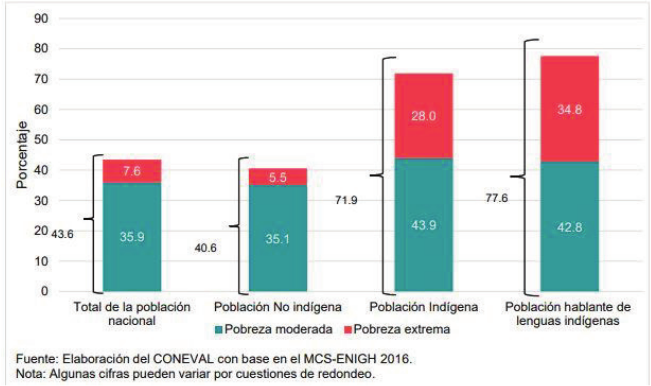
    One of the enduring problems facing indigenous groups in Mexico is inequality, according to the ‘Desigualdades en México 2018’ report from Colegio de México (Colmex), a public university based in Mexico City. Around 75% of the country’s indigenous population was considered poor in 2012, a figure almost double that for non-indigenous Mexicans. By 2016 that figure was 71.9%, according to Mexico’s National Council for the Evaluation of Social Development Policy (Coneval), which also said that opportunities for indigenous people to develop were limited due to inequality. Data show that 28% of indigenous Mexicans were living in extreme poverty in 2016, which means they couldn’t afford a basket of basic goods known as the ‘canasta básica’.

    Percentage of the population in moderate and extreme poverty according to ethnicity, Mexico, 2016

    Chart3

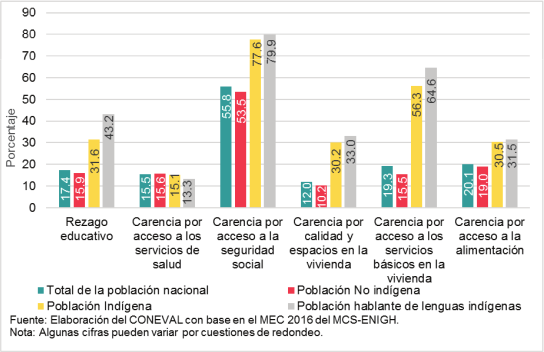
    Percentage of the population by social deprivation according to ethnicity, Mexico, 2016

    Chart4

    Source: Coneval

    As in many other countries in the region, indigenous politics is tied up with questions over land. Despite attempting to declare the end of land reform upon taking power in 1970, President Luis Echeverria (1970-1976) was forced to back down by a wave of indigenous and peasant protests, and authorised a huge land reform programme. Poor implementation has led to unintended consequences, including disputes over land ownership that continue to drive violent conflict to this day, such as the Chalchihuitán-Chenalhó issue in Chiapas state. Members of the two indigenous groups have been displaced by violence because the Secretariat of Agrarian Reform drew new boundaries that did not take into consideration traditional boundaries set by a river.

    Mexico signed ILO Convention 169 in 1990 under President Carlos Salinas (1988-1994), who also amended the constitution in 1992 to recognise Mexico as a pluricultural nation. A wave of legislation followed at a federal and state level. Today, 25 of 32 states grant indigenous peoples the right to prior consultation, and there are autonomous indigenous governments in Chiapas, Michoacán, and Oaxaca states. However, there is a significant implementation gap, with many indigenous people claiming that advances in formal legislation have not affected everyday life for their communities. While the benefits may not have been felt yet, indigenous groups are still better off with the law on their side, according to Rice. “Legislation is like a tool that they have. If they didn’t have that they’d be much worse off in the long term,” she said. “At least they have something on paper that they can use to try and get it enforced.”

    Advances in land reform in the 1970s were brought about by a burst of indigenous organisation, according to Gutierrez Chong, with groups articulating a huge range of political and economic demands. However, it wasn’t until 1994 that Mexico’s indigenous struggle came to prominence as the Ejército Zapatista de Liberación Nacional (EZLN) declared war on the federal army in protest at the signing of the North American Free Trade Agreement (Nafta), besieging towns in Chiapas state. The movement eventually led to the signing of the San Andrés Peace Accords in 1996, which included the first legal commitment to recognise the rights of indigenous peoples in Mexico. Little progress was made in implementing the demands, leading to another wave of mobilisation in 2001 aimed at institutionalising indigenous autonomy. While legislation was approved by congress, it was watered down and eventually rejected by the EZLN, whose members are known as Zapatistas.

    These frustrating interactions with the state led to a change in strategy among indigenous groups, who turned their backs on electoral politics, according to Rice. For example, the EZLN turned inward and looked to build “de facto self-governing communities”. However, Gutierrez Chong emphasises that while the EZLN is one of the most famous indigenous organisations in the world, there are lots of others in Mexico. “It’s easy to generalise that all indigenous people follow the EZLN but there is a huge mosaic of indigenous organisations,” she said. In Guerrero state, Mixtec and Tlapeneco communities have taken matters into their own hands, organising volunteer police forces, known as the Comunitaria. The initiative has reduced crime and insecurity and shows the possibilities of informal institutions. While the state says that the Comunitaria is illegal, it does give some de facto recognition.

    Under President Enrique Peña Nieto (2006-2012), Mexico saw a massive uptick in conflicts between state or corporate interests and indigenous groups, according to Sicetno, an online research project that covers indigenous political culture in Latin America. Communities organised to defend their territory against planned extractive projects, with mining projects attracting particularly large protests. This may be one reason for the EZLN’s return to electoral politics with the 2017 candidacy of María de Jesús Patricio Martínez, an indigenous Nahua also known as ‘Marichuy’, in conjunction with the National Indigenous Congress (CNI).

    Rice believes that her candidacy may also be a response to previous difficulties in ensuring the government would act on the San Andrés Peace Accords. “It’s almost as if those adversities are starting to shift their strategies again, more towards elections, which I think is huge,” she said. “I think the Zapatistas may be learning from Ecuador and Bolivia and deciding now is the time to actually participate.” While Marichuy was ultimately unable to run for president after failing to collect the necessary number of signatures from supporters, her campaign did serve to draw attention to indigenous politics. She gained the public support of left-wing intellectuals, and ran an efficient campaign, according to local online publication Animal Politico, which revealed that Marichuy’s 3,500 volunteers gathered endorsements at a higher rate than any of her independent rivals.

    Gutierrez Chong, who is currently investigating why indigenous voters did not come out in support of Marichuy, believes that her collapse may be due to a lack of strategy. Indigenous politicians cannot assume that they will collect indigenous votes, she said, and must develop a strategy just like any other candidate. However, Gutierrez Chong also believes that Mexicans like to see a certain glamour among their political class, almost as if they are a monarchy. “An indigenous president would be ridiculed,” she said, adding that racism against indigenous people is a “huge problem”. And Gutierrez Chong observed a lack of interest in Marichuy during the campaign. “Nobody paid attention to her,” she said. “That silence is also interesting.”

    For Rice, an indigenous candidate would have to look beyond indigenous voters to make an impact. “They would have to almost become the alternative party,” she said. “Not just for indigenous people but for environmentalists and women’s rights, expanding their mandate to bring in non-indigenous supporters.” However, Rice points out that in other countries, such as Ecuador, indigenous parties have been damaged after making deals. “There is always a risk in electoral politics as to who you make alliances with,” she said. “I’m sure the Zapatistas are worried about that and I’m sure there is a lot of debate within the movement on whether to really participate in elections or not.”

    The winner of the 2018 election, Andrés Manuel López Obrador, has faced opposition from indigenous groups despite making some positive moves to further their rights. After winning the election, López Obrador was rejected by the EZLN as a member of the “false left”, continuing a long-running feud. Since then, the EZLN has spoken out against López Obrador’s planned Tren Maya, a 900-mile railway in the Yucatan peninsula, as well as another railway project in the Isthmus de Tehuantepec and a thermoelectric plant in Huexca, Morelos state. The group accuses López Obrador of abusing a series of public consultations in order to legitimise the projects, which have sparked considerable opposition. In the case of the Tehuantepec project, the CNI and the EZLN have called on indigenous communities to boycott the consultation and said they would not support the project even if it passes the consultation.

    For his part, López Obrador has moved to restructure the federal body for indigenous policy, replacing the National Commission for the Development of Indigenous Peoples with the National Institute of Indigenous Peoples (INPI). His government has also promised to work on compliance with the San Andrés Accords, indigenous autonomy, and indigenous decision-making on the use of natural resources. This may sound good on paper, but an implementation gap could turn out to be a problem once more.

    That said, Gutierrez Chong is largely optimistic about the future of indigenous politics in Mexico. She believes that while indigenous movements have lost some of their capacity to organise since 1994, indigenous people want to be part of the electoral system and integrate into existing parties. “Basically, they want to form part of a political system where there has been no room for them to participate,” she said. As for indigenous candidates for the presidency, Gutierrez Chong is less certain. “I think that maybe there will be another Marichuy,” she said. “Maybe.”

  • Guatemala

    LatinNews 23 July 2019 Hits: 379

    Indigenous groups in Guatemala face many of the same structural problems that affect similar groups in other Latin American nations, but their case is particularly interesting given the relative size of the indigenous population and the effects of civil war.

    Guatemala is home to one of the largest populations of indigenous people by percentage of the total of any country in the Americas, with 44% of the population fully indigenous, according to official figures. However, the country does not possess reliable data on its indigenous population, according to the IWGIA. The last census took place in 2002 and the effectiveness of the 2018 Population and Housing census is in doubt due to an ongoing political and institutional crisis. However, we do know that most indigenous people are Maya, consisting of 22 different ethnic groups including K’iche’, Q’eqchi, Kaqchikel and Mam, as well as Xinca and Garifuna groups. Plus, it’s worth noting that despite the idea of a homogenous Maya indigenous group, historical conflicts, for example between the K’iche’ and Mam, have prevented them from working together.

    The country is one of the poorest in Latin America, and indigenous groups suffer disproportionately. Almost 80% of indigenous people live in poverty, according to a March 2018 report by Inter-American Commission on Human Rights (IACHR), and the rate of extreme poverty is three-times higher in the indigenous population than in the non-indigenous population. Chronic malnutrition affects eight of every ten indigenous children, according to the UN Children’s Fund (Unicef). There has been little improvement in social, economic and political inclusion in recent years, with the IWGIA citing “rates of unequal public investment and the persistence of discrimination, exclusion and racism”.

    One explanation for this inequality is land tenure insecurity, according to a UN special envoy, who also highlighted Guatemala’s historical debt to its indigenous groups, which have suffered marginalisation and exploitation for centuries, as well as bearing the brunt of the 36-year civil war that ended in 1996. Some 250,000 civilians were killed or disappeared in the conflict, many of them indigenous, and former dictator General Efrain Rios Montt was convicted of genocide against the Maya as a result of his “scorched earth” tactics in rural areas during the war.

    Violence against indigenous groups continues to this day, whether the targets are rights defenders or politicians. For example, two indigenous politicians were murdered in the northern Petén department in the run up to the 2019 elections, and a report from NGO Frontline Defenders revealed that 26 human rights defenders (HRDs) were killed in Guatemala in 2018, the majority of whom were indigenous. This represents a 136% increase from 2017, and a particularly murderous period from 9 May-4 June 2018 saw seven HRDs killed. All seven were indigenous, and five were members of peasant farmers’ organisation Comité de Desarrollo Campesino (Codeca). According to the local human rights NGO Unidad de Protección de Defensores y Defensoras de Derechos Humanos en Guatemala (Udefegua), there is a link between President Jimmy Morales’ (2016-present) criticism of Codeca and the spate of killings of HRDs in May-June 2018. On 5 July 2019, two more Codeca members were shot dead during a peaceful protest over land rights.

    Peace accords signed in 1996 include several conditions designed to improve conditions for indigenous groups, but the Consejo Nacional para el Cumplimiento de los Acuerdos de Paz (CNAP), an organism which monitors their implementation, has found serious shortcomings. The budget for reparations has been cut back, conflicts over land ownership continue, and while Guatemala is a signatory to ILO 169, CNAP says the views of local communities have been ignored in a majority of cases.

    The UN Special Rapporteur on the rights of indigenous peoples, Victoria Tauli-Corpuz, echoed many of these concerns following a May 2018 visit to Guatemala. She pointed out the criminalisation of protest movements and racial discrimination that permeates society, as well as an upsurge in violence and forced evictions against those that defend their land. Campaigns for land rights and opposition to extractivism have provided a rallying call for indigenous organisations such as Codeca, which is known for organising protest marches and putting up roadblocks.

    Guatemala is a hotbed of mining activity, including the world’s third-largest silver mine San Rafael Escobal. Canadian mining company Tahoe Resources invested around US$500m to develop the mine but work was suspended in July 2017 after Guatemala’s top court (Corte de Constitucionalidad – CC) ruled that there had been a failure to adequately consult the local indigenous Xinca community, as required by ILO 169. Despite calls from various sectors to reopen the mine, it remains shuttered and Tahoe sold its operations to another Canadian company, Pan American Silver, in January 2019. However, not all indigenous mobilisations have been so successful. Protests against nickel mines near the town of El Estor, Izabal, have resulted in the death of a protester, forced evictions, and complaints of environmental damage. Despite widespread concerns, the mines continue to operate.

    Other examples are the demonstrations in favour of the UN-backed International Commission against Impunity in Guatemala (Cicig). On 14 January, protesters took to the streets to speak out against President Morales’ attempts to expel Cicig, with Codeca, along with indigenous organisations Comité de Unidad Campesina (CUC) and Comité Campesino del Altiplano (CCDA), organising at least 26 roadblocks. However, President Morales has successfully dismantled the Cicig and its mandate will end on 3 September.

    While indigenous social movements are highly active, and indigenous groups represent a significant part of the population, they suffer serious underrepresentation in party politics. Only 18 of 158 congresspeople were indigenous for the period 2015-2019, according to NGO the International Work Group for Indigenous Affairs (IWGIA). This is a symptom of the historic political and social marginalisation of indigenous groups, which have struggled to influence national politics. This can be explained in part by the so-called ‘discourse of concealment’ – the suppressing of certain identities that started under the rule of colonial Spain – but also by a certain scepticism on the part of indigenous communities to engage with the electoral process as a way of bringing about change.

    One example is the 1999 referendum on a proposed amendment to the constitution, which included the recognition of indigenous rights. Indigenous groups voted against the amendment, preferring to concentrate on building a grassroots movement, according to some experts. However, Rice believes the ‘no’ vote was a bad move. “For me that was a big mistake,” she said. “You need to have a constitution that has things set up in there.” The ‘no’ vote may also have been a sign of misgivings toward the existing system, according to Rice. “They don't trust the elections, they don't trust constitutional reform,” she said. “It's much more of a social movement that’s detached from the political system. Then you get the political system that you have in Guatemala, because people are not engaging with those institutions.”

    However, it appears that indigenous attitudes towards electoral politics have been changing in recent years. Nobel Prize winner Rigoberta Menchú ran in the 2011 presidential election but gained just 3.27% of the vote. The fact that her Movimiento Político Winaq party had just one seat in congress from 2015-2019 provides further evidence that indigenous involvement in democracy is still developing. That said, indigenous politics took an exciting turn in November 2018, when the electoral court registered a new party, Movimiento para la Liberación de los Pueblos (MLP), ahead of the June 2019 general election. MLP is the political arm of Codeca and campaigned on familiar themes such as corruption, land rights, and the nationalisation of the electricity sector. Presidential candidate Thelma Aldana also pushed for a plurinational constitution in Guatemala, which would represent a significant advance in recognising the rights of indigenous groups. Aldana gained just over 10% of the vote in a surprise performance, which may have been facilitated by the barring of frontrunners Zury Rios and Thelma Aldana from the election.

    “With dignity, without a single advertising spot on radio or television, independently of the results, we are making history,” tweeted the party following the results. In a report by electoral watchdog Mirador Electoral, MLP reported total spending of Q15,436 (US$2,000) to March 2019 compared with Q1.97m for the UNE party of first round winner Sandra Torres. The MLP later rejected the results of the election due to alleged voter fraud, complaining that in various parts of the country its logo did not appear on ballot sheets and citing evidence of vote-buying by various parties, but its performance marks a departure for indigenous politics in Guatemala. The party won one seat in congress, which means that it will have an opportunity to influence matters in the formal political system as well as through social movements. Aldana’s campaign also increased the visibility of the indigenous struggle and allowed her to introduce key ideas to a national audience. Although Guatemala’s political system is racked by allegations of corruption, and the country appears to have been stuck in a perpetual political crisis in recent years, recent developments are encouraging for indigenous representation. 

  • Interviews

    LatinNews 23 July 2019 Hits: 404

    In this section we feature highlights of interviews with three experts in indigenous politics: Dr Roberta Rice (RR), associate professor in political science at the University of Calgary; Dr Natividad Gutierrez Chong (NGC), a sociologist at the Universidad Nacional Autónoma de México; and Manuel Martinez Espinosa (MME), a political scientist at the Universidad de Ciencias y Artes de Chiapas. Responses have been edited for length and clarity.

    Why do indigenous groups struggle for representation?

    MME: The conquest and colonisation of Latin America is the biggest determining factor in the history of indigenous groups. Due to this process, communities that were disparate before the arrival of the Europeans were unified (due to their condition of being colonised), and the previous social order was destroyed in order to form a new one in which indigenous groups were given social status, a political role, an economic function, and a juridical category. Despite countries becoming independent, their situation did not improve. In fact, there are even cases where conditions worsened for indigenous groups.

    RR: Modern nation states were built in opposition to or against indigenous people. Officials couldn’t wish away indigenous people, so they just built nation states as if they didn’t exist. They have incredibly weak institutions because they only reflect a small percentage of the population, and they are clientelist and elitist. It really doesn’t serve any interest other than a small ruling minority. There was no space to even talk about indigenous rights until recently, really until the 1990s when indigenous people actually mobilised as indigenous people.

    How has the situation for indigenous people changed in recent years?

    RR: Since 2017 we have more countries shifting to the Right, like Brazil. You actually have a lot more unfriendly governments to indigenous people. We’re going to see an uptick in indigenous protests because governments are really clamping down on indigenous rights and indigenous initiatives.

    During the left turn there was a nice synergy between governments and indigenous movements. Now governments have shifted, and indigenous people are almost a target of a backlash against indigenous rights.

    How are international conventions on indigenous rights influencing resistance to extractive projects?

    RR: In Peru, groups in the highlands haven’t traditionally mobilised around their indigenous identity, but in response to extractive industry and international rights like the UN declaration there are groups that are reclaiming their identity as a way to protect their lands and territories. It’s politicising indigenous identity in places where it wasn’t before. More people are embracing their indigenous identity.

    It’s the same trend around the globe. Where there are extractive industries you have all these groups claiming their indigenous identity, even in Asia and Africa. There is no definition of indigeneity, it’s about self-identification.

    Can international conventions on indigenous rights be enforced in a region where the rule of law is generally weak?

    RR: Even in Bolivia where you have an indigenous president and an amazing constitution and laws, they fall short. Only when indigenous movements mobilise around specific projects does the government actually make legislation. That’s what it really takes: mobilising.

    Is protest more effective than being inside the political system?

    RR: I think you need both. You need some leverage inside congress and people protesting on the outside. I don’t think it’s a choice between protesting or proposal making but combining them together.

    The Zapatistas have their own distinct model where they turn their backs on the government, but when officials changed the terms of the San Andrés Accords there was no one there in congress to say “hey, this is not what was agreed upon”. They had no voice inside the system, so you need both.

    The problem in Chiapas, where Zapatistas told their supporters not to vote in elections, is then you get very conservative governments who are anti-indigenous. That doesn’t really help their cause because this sort of de facto autonomy is not legal, and if you have an anti-indigenous regime in power it can really target their land and territory.

    What is the role of women in indigenous political movements?

    RR: Indigenous women are becoming much more of a priority in the region, much more vocal. We had the indigenous candidate in Mexico and recently in Guatemala as well, and there are a lot more studies on the role of indigenous women. They seem to be an important voice for change on the front lines of social movements, and now they’re entering electoral politics. That's a very important trend.

    What conditions are conducive to strong indigenous movements?

    RR: Ironically it is sometimes a blessing when you have weak institutions because social movements can have more space to organise and pressure the government. If you take a case like Chile, where the state is strong and has a lot of resources, the government treats the Mapuche as terrorists for defending their forests and lands. It’s sometimes harder because they’re fighting a strong state. There’s a lot more repression going on in Chile than countries like Ecuador or Bolivia, where you have a weak state and strong indigenous movements. In Chile it’s hard to start a party because existing parties are so strong they take the main indigenous candidates, but in Bolivia the parties are so weak it’s so much easier to start a party.

    What influence do historic patterns of incorporation have on contemporary indigenous politics?

    RR: The historical prevalence of populist parties or Marxist parties really shapes the trajectory of a country. Peru (note: it has a weak indigenous political movement) has a very strong Marxist history, and Marxists organise along class lines and downplay ethnicity as dividing the struggle. It makes it much harder to organise as indigenous people rather than as workers and peasants. Bolivia and Ecuador (note: they have strong indigenous political movements) had a weak leftist Marxist movement, there were more populist parties, so there was more space to articulate indigenous identity.

    Are indigenous political movements a positive or a negative for democratic nation states?

    RR: The reason why nation states are so weak is because they are in opposition to indigenous peoples. Bringing indigenous political movements into the system can strengthen democracy and even strengthen the state by making it much more inclusive. They’re working within the system: they’re voting, they’re forming parties. They’re trying to reinvigorate democracy, which is something that shouldn’t be feared but championed.

    What is plurinational constitutionalism?

    RR: It’s about indigenous autonomy within the state. Bolivia and Ecuador have constitutions that say they are plurinational states, it shows that indigenous peoples are a nation within the nation state, not just an ethnic minority. It’s a watershed moment. For indigenous groups it’s not about vengeance, it’s about moving together forward, being recognised as equal partners, as sovereign bodies within this nation state.

    What comes next?

    NGC: The situation for indigenous peoples in Latin America is not good, but visibility is better than ten years ago. I tend to be optimistic; things are better than before. Indigenous identities have suffered a lot, but it is interesting to see they are rising again. However, I think that racism will increase as indigenous people gain positions of power and visibility and other people feel threatened.

  • Conclusion

    LatinNews 23 July 2019 Hits: 359

    The panorama for indigenous rights in Latin America is complex, and it would be wrong to conclude with pan-regional generalisations. While recent forays into electoral politics in Mexico and Guatemala provide hope for indigenous political movements, the continued exclusion of the Mapuche in Chile provides a frustrating, and violent, counterpoint. Bolivia has seen more than a decade of indigenous rule, and yet Evo Morales has lost considerable report after struggling to reconcile party politics with indigenous ideals. In Brazil, indigenous groups are gearing up for what looks set to be a massive battle as President Jair Bolsonaro attempts to shake off the country’s economic malaise by opening indigenous territories to development.

    In terms of strategy, there appears to be a growing appreciation for electoral politics even in those places where indigenous groups have preferred to articulate their demands through social movements. National governments shouldn’t feel threatened by this development, but rather reform institutions to encourage indigenous participation as a way of strengthening the nation state, which remains weak in many parts of Latin America.

    Cooperation between indigenous groups, civil society, and international organisations is increasing awareness of indigenous issues. This transnational approach has started to bear fruit, although the level of engagement varies from country to country. There is also an opportunity for indigenous groups to gain support for their campaigns against extractive projects by framing them as part of the struggle to deal with the climate crisis.

    Each country in Latin America is at a different point in the process of recognising and guaranteeing indigenous rights, but in general the direction of travel is positive as indigenous groups become more organised and empowered than at any time in recent history.