The state of the labour market in Latin America

Items

  • Introduction

    LatinNews 17 May 2019 Hits: 1354

    Paid work is the primary source of income for most people around the world. Labour markets are supposed to match employers with workers, but maintaining a healthy labour market is not easy.

    Creating enough formal, full-time, stable jobs that fit the skills of the workforce is a constant challenge, and Latin American economies face their own particular set of issues. Across the region, a combination of factors keeps too many workers in informal, precarious employment, either under-employed or unable to find work.

    Some of these issues are long-term and structural, related to institutional and legal frameworks that haven’t changed in too long. Others relate to more contemporary developments, such as globalisation and the development of new technologies that are upending the world of work as we know it. Existing economic structures are changing, and the institutional response will determine which nations benefit most from what experts call the ‘fourth industrial revolution.’

    • Fourth Industrial Revolution

    The term ‘Fourth Industrial Revolution’ was coined by Klaus Schwab, the executive chairman of the World Economic Forum, in a 2015 article in Foreign Affairs magazine, and formed the subject and title of his 2016 book. Schwab includes in his definition technologies that combine hardware, software, and biology (cyber-physical systems), and emphasises advances in communication and connectivity. Schwab expects this era to be marked by breakthroughs in emerging technologies in fields such as robotics, artificial intelligence, nanotechnology, quantum computing, biotechnology, the Internet of Things, the Industrial Internet of Things (IIoT), decentralised consensus, fifth-generation wireless technologies (5G), 3D printing, and fully autonomous vehicles.

    The aim of this report is to explore the major themes affecting labour markets in Latin America and how countries in the region are responding to a world of work in flux. First, we will look at major statistical trends, before moving on to salient issues such as the informal economy, the potential impact of artificial intelligence, and gender issues, using individual case studies to illuminate the subject at hand.

  • Key facts and trends

    LatinNews 17 May 2019 Hits: 480

    Labour markets are inextricably linked with national economies. Strong macroeconomic performance does not necessarily translate to improved labour market conditions, but it can allow governments to spend more on labour market policies. Here we examine persistent issues and trends in the region.

    Economic growth is predicted to rebound in the region, from 1.0% in 2018 to 2.0% in 2019 and 2.6% in 2020, according to the International Labour Organization (ILO) World Employment and Social Outlook report for 2019. This should bring about a slight decrease in unemployment rates to 8.0%, after they increased from 6.3% in 2008 to 8.1% in 2017. Of course, this regional trend disguises the performance of individual nations, such as continued progress in Brazil, where unemployment decreased from 13.1% in 2017 to 12.5% in 2018. In fact, it is worth pointing out that Brazil, home to 40% of the region’s economically active population, has an outsized influence on regional figures. As a result, a decrease in Brazil covers up for slight increases in Argentina (9.0% to 9.4%) and Guatemala (2.3% to 2.8%).

    As the United Nations Economic Commission for Latin America and the Caribbean (Eclac) revealed in its ‘Social Panorama of Latin America 2018’ report, regional labour markets remain very unequal, perpetuating both poverty and inequality. According to the report, Latin American labour markets can be characterised by insufficient, low-quality jobs which do not provide access to social protection schemes, low wages that are less than the official minimum wage, and long hours. Eclac notes that these challenges are even more pronounced for women, young people moving from education to work, indigenous communities, Afro-descendants, and those with disabilities.

    Under-employment is an important consideration, according to Eclac. In some cases, new jobs may offer insufficient hours to meet the financial needs of workers, a common problem with zero-hours contracts. This has been a particular problem in Argentina, Brazil, and Chile, where employment rates rose but some new jobs did not meet needs. Even worse-off were those in Costa Rica, Peru, and Uruguay, where employment fell, and underemployment rose. This means that the total number of jobs decreased at the same time as hours were cut at the jobs which remained. On the other hand, Colombia and Ecuador saw decreases in the rate of employment and underemployment, perhaps suggesting the elimination of poor-quality jobs, while Mexico, the Dominican Republic, and Paraguay experienced a combination of increased employment rates and falling underemployment rates.

    However, it is also necessary to think about the high rate of informality which characterizes labour markets across Latin America, where an average of 53% of workers toil in the informal sector, according to the ILO. This means that there are around 150 million workers in the region who do not have any access to labour protections, a theme which will be explored in greater detail later in this report. As a result of high informality rates, public spending on labour-market policies is low. Latin American nations generally don’t spend much on training, direct job creation, unemployment benefit, or entrepreneurial stimulus, all of which have the potential to improve labour conditions. As we will see, informality plays a huge role in perpetuating harmful labour conditions, and there are a number of strategies which national governments can use to encourage formalisation.

    According to Jacqueline Mazza, a labour markets specialist and an adjunct lecturer in the Johns Hopkins University SAIS Latin American Studies Program, it is important to divide Latin America and the Caribbean up into subregions. Central America, with its generally very poorly performing economies and low income, is considered separately from South America, and Mexico, a much stronger performer, is also separate, Mazza told LatinNews. However, performance is not uniform even in these subregions. “You have a lot of outliers in many ways,” said Mazza, with Costa Rica performing better than its Central American neighbours and Venezuela, which is often not included in regional labour market statistics, a black mark on an otherwise strong Andean region. The Southern Cone is also a strong performer, although Brazil has suffered in recent years, says Mazza.

    The Latin America and Caribbean region (LAC) also shows important variations between urban and rural areas. Open unemployment rates are generally lower in rural areas, especially in countries where agriculture is an important source of jobs. National average unemployment rates are also generally lower than those in urban areas, but both tend to follow the same trend. Wage employment growth has been affected by slow economic growth rates from 2015-2017, but a modest recovery saw wage employment creation increase in the first half of 2018, especially in Mexico and Brazil. Own-account work, or freelancing, has been expanding faster than wage employment in the region in the past five years, decreasing the quality of average employment. Freelancing is characterised by more precarious conditions, and this is especially true when economic growth is slow. The prolonged trend towards more freelance work has become a worry.

    Another measure of employment quality is contributions to social security programmes, which is affected by job creation, or destruction, and shifts between formal and informal sectors. This means that overall employment quality could be boosted using formalisation policies, without needing to create large numbers of new jobs. However, job creation is important due to what is currently a young population.

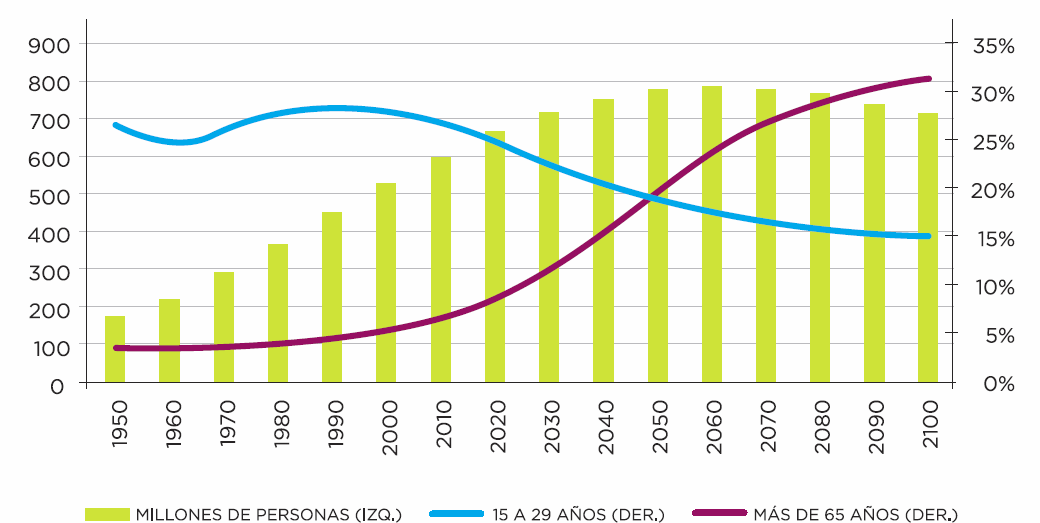
    Balance of age groups in the LAC population over time

    Population balance

    Source: CELADE

    Around 27% of the regional population is under 30 years old, according the ILO. While this could be seen as a demographic advantage, it’s also a challenge because there are lots of young people that need work. At the same time, the region is ageing fast. By 2050, 15-29-year-olds will represent just 18.6% of the population, and the proportion of over-65s will increase from 6% in 2000 to 19.5% by 2050, according to data from Celade (the population division of Eclac). “Despite there is a myth that states that we live in a young region, the truth is we are growing older faster than the rest of the world,” explained Carmen Pagés, Chief of the Labor Markets Division at the Inter-American Development Bank (IDB).

    Case study: Brazil

    As the world’s eighth-largest economy, Brazil plays an important role in Latin America. According to Jacqueline Mazza, the country is typically an engine for Southern Cone economies, particularly in terms of regional trade. However, the crisis of 2015-2016 has upended that relationship. “It really can no longer play that role,” said Mazza. “It’s a much more unreliable economic partner.”

    In the face of these economic struggles, former president Michel Temer (2016-2018) introduced a flagship labour reform programme in November 2017, designed to create millions of jobs by facilitating hiring practices. Henrique Meirelles, finance minister at the time, claimed that 6m jobs would be created. However just 529,500 formal jobs were created in 2018, and unemployment remains high. Reformers had hoped to create flexible, part-time jobs too, but they have not materialised. At the same time, labour unions suffered economically due to new rules which mean workers have to opt-in to pay union fees, whereas they were previously taken directly from their pay packets. “The reform has improved the dynamic in work relations but on its own it is not capable of creating jobs,” Helio Zilberstajn, a professor of labour relations at the Universidade de São Paulo, told local news website G1 in December 2018.

    With Temer’s reform failing to live up to its billing, Brazil faces ongoing issues in the labour market. “What we have in Brazil is a real distinction between the low skilled poorly-educated bottom, the poorly-skilled middle, and the higher-performing sectors which aren’t labour generating enough to begin pulling up the labour market,” Mazza told LatinNews. “What needs to change is what needs to change in most of Latin America.”

    President Jair Bolsonaro, who came to power in January 2019, has his own plans to open up the labour market. After Temer’s reform permitted firms to sign individual contracts with workers and weakened trades unions by cutting their income by as much as 86%, Bolsonaro wants to allow a choice between two kinds of contract. The first would mean individual contracts to be negotiated with an employer, while the second would be a standard contract that guarantees labour rights under the current law. It is not yet clear whether employees or employers would ultimately decide which kind of contract to use.

    There are also worries over the future of the manufacturing sector as the ‘fourth industrial revolution’ takes hold. Participants at a World Economic Forum (WEF) event in Sao Paulo said that investment in education and training will have to increase to make sure Brazilian workers are prepared for the changing world of work. This means training workers in social skills such as communication, critical thinking, and analysis, which are currently a problem. Half of companies who took part in a ManpowerGroup in Latin America survey said that they couldn’t find workers with the right social skills, compared with 36% of respondents in Organisation for Economic Co-operation and Development (OECD) countries, and Brazil was identified as one of the nations with the worst skills gap.

    It appears that business leaders are aware of what needs to change. Brazil’s ‘Agenda 2019’ Survey, carried out by consultancy Deloittes in November 2018, revealed that 48% of 826 participants wanted the Brazilian government to support digital transformation and invest in research and development. Nine in ten respondents said that they would increase spending on training in 2019, while 46% of firms who said that they might have to lay off workers attributed potential losses to automation or replacement by more skilled employees.

    These survey results suggest that business leaders are aware of the labour market challenges ahead, but the government will play a vital role. So far, Bolsonaro has raised concerns over the future of workers’ rights by shutting down the labour ministry and talking about getting rid of labour courts. He has also signed off on a 4.6% increase to the monthly minimum wage, which is lower than planned by Temer. Aside from that, Bolsonaro has only released vague economic plans, which make it hard for analysts to predict what comes next.

    According to Leonardo Athias, a researcher at the IBGE national statistics institute, the slow recovery of the labour market provides an explanation for increasing poverty levels. He says that Brazil needs an improvement in labour market conditions as well as public policies aiming for fairer income distribution. Whether a Bolsonaro government agrees, or is able to implement such policies, only time will tell.

  • The informal economy

    LatinNews 17 May 2019 Hits: 445

    The issue of informality in labour markets is one that receives a lot of attention, but the exact definition of the term is not universally agreed upon. However, informality commonly refers to undeclared labour, tax evasion, and unregulated or unlicensed activities. In less developed countries, these activities are likely performed for survival on a small scale, according to the OECD.

    Informality rates are higher in countries where economic development is low, and people engage in informal labour as a survival response in the face of poverty. Those rates are also linked to the quality of regulation and the capacity of the state to enforce those regulations. The majority of researchers believe that a high informality rate decreases productivity and holds back economic growth, and governments generally do their best to bring informality rates down. Informality means fewer contributors to social security programmes and lower rates of education, as well as reducing labour unionisation. It also makes for lower tax takes, according to the OECD, and research shows that both individuals and companies in Latin America show low rates of compliance with income taxes. This means that the redistributive income of personal income tax is low, and there is less money to spend on social policies.

    The informal economy in LAC has been declining slowly, and tax collection has tripled from 2% of GDP in 1946 to 6% in 2016. However, it remains an important issue. According to July 2018 figures from the ILO, 53.1% of the region’s workers are in the informal economy. Encouraging the transition to formality means making the benefits outweigh the costs. For example, benefits such as easier access to credit or dispute resolution in the judicial system must be more important than avoiding costs associated with formality, such as licenses, taxes, and regulations, if an economic actor is to choose to join the formal sector.

    As things stand, around 150m workers remain in the informal economy in Latin America and the Caribbean. ILO statistics show that the proportion of informal workers in LAC is higher in Central America (58.0%) and the Caribbean (57.6%) than South America (50.8%). On a national level, Uruguay (24.5%) has the lowest level of informality in the region, whereas Guatemala, Honduras, Nicaragua and Bolivia all hover around 80%. There is also an important gap between urban and rural areas, which have informality rates of 47.0% and 68.5% respectively region-wide. Figures also show that informality rates drop as education levels rise. Those without any education (82.2%) are most likely to be part of the informal sector, dropping to 72.5% for primary education, 50.8% for secondary education, and 33.5% for tertiary education.

    So far there have been a number of initiatives to encourage workers to join the formal sector. According to the OECD, simplified tax schemes for small taxpayers are common across Latin America, designed to act as a bridge for them to formalise. Individual countries such as Uruguay have also tried to boost formalisation by offering incentives. In 2008 the government extended health benefits to dependent children of employees in the formal sector, resulting in a 1.3% decrease in informality rates. In Colombia, a 2013 tax reform cut employer payroll contributions and led to the creation of 213,000 formal jobs, cutting informality rates by 1.2%-2.2% nationwide.

    In addition to creating formal jobs, workers need to be trained in order to be able to meet the skills demanded by these jobs. “It’s a paradox; there are lots of people looking for work, but a large proportion of those people have little to no skills that make them employable in the long term,” said Jonas Prising, global CEO at workforce consultancy ManpowerGroup. This is particularly important for young people. In Mexico, the overall percentage of informal workers fell from 60% to 57% from 2009-2017. In Q3 2018, the national statistics institute revealed that informality rates were as high as 82.1% and 78.5% in the southern states of Oaxaca and Chiapas respectively, revealing important regional variations.

    Research published in March 2018 by Mexico’s National Council for the Evaluation of Social Development Policy (Coneval) also found that 59.9% of Mexico’s young people remained in informal jobs in 2017, dealing with uncertainty over the duration of employment, poor access to training, and lower income. Under former president Enrique Peña Nieto (2012-2018), efforts to reduce informality were largely unsuccessful. Now, President Andrés Manuel López Obrador has included funding for a youth apprenticeship programme called ‘Jóvenes Construyendo el Futuro’, a M$44.3bn (US$2.3bn) scheme which aims to train 2m young people and provide job opportunities to keep them away from criminal gangs, in the 2019 budget. A similar programme in the Dominican Republic called ‘Juventud y Empleo’ increased the prospects of formal employment of participants by 17%, while participants in the ‘Projoven’ scheme in Peru had a better chance of getting a job with health insurance (3.8%) and pension coverage (3.3%) compared with non-participants.

    The informal economy makes it impossible for workers to improve their skills, consigning them to poorly-remunerated, low-productivity jobs. It also means that many people reach retirement age without a pension, leaving them with no choice but to keep working. As Jacqueline Mazza explains, those in the informal sector work until they physically cannot do so any longer because there is no social security system. A lack of reforms would mean that Latin America is left with an ageing population and poorly remunerated workers that aren’t paying the necessary tax bills to provide for the inactive population.

    However, implementing non-workplace pensions for society’s poorest relies on a strong state which offers systematic sponsorship and collaboration, said Mazza. “Only certain countries are able to move forward substantially, when you put it together we have low coverage,” she said. “What we really risk is these large populations without any source of income.” In January 2019, Mexico’s López Obrador also promised to M$100bn (US$4.93bn) for a pension scheme for people over the age of 68. Of the 13m people that are eligible for the scheme, around 70% have no retirement income.

    Other ways to reduce informality include the use of technology. When an electronic payroll system was introduced in Peru, allowing employers to send monthly tax reports to authorities, non-agricultural informal employment decreased from 75% in 2004 to 68% in 2012. Governments can also reduce the burden of taxes and red tape. In Brazil, a 2009 programme targeting entrepreneurs who employ at least one member of staff reduced business registration costs, leading to a 5% increase in the number of formal firms in eligible industries, and halved monthly taxes, which boosted registration rates by 2%.

  • Artificial intelligence and robots

    LatinNews 17 May 2019 Hits: 416

    Consultants trumpet the potential of technology to drive economic growth in the region, but what could the advent of automation and artificial intelligence (AI) mean for the labour market?

    Changing technology presents challenges for workers who risk being left behind if they cannot adapt. Throughout human history advances in production have led to wide-ranging changes, but some say that the ‘fourth industrial revolution’ has made the pace of change even faster because there are several technological revolutions going on at the same time.

    According to professional services company Accenture, artificial intelligence could create a whole new workforce. “It can replicate labour activities at much greater scale and speed, and even perform some tasks beyond the capability of humans,” writes the company in its analysis of how AI could boost economic growth in South America. For some, that means that artificial intelligence could take over routine tasks from human workers. This would affect sectors such as manufacturing, where robots can be used on assembly lines.

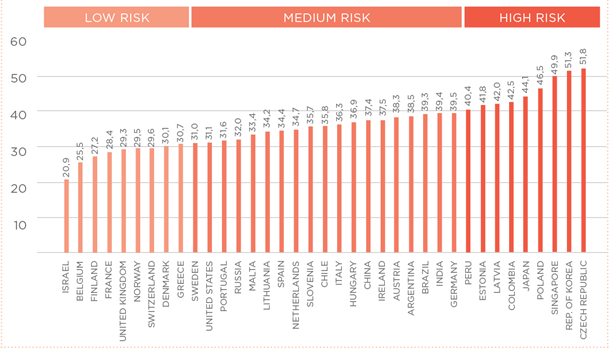
    Risk from automation for 37 selected countries (%)

    Automation risk

    Source: IDB

    Research by the IDB found that 36%-43% of jobs in Latin America could be lost as AI spreads across the continent, factoring in education levels, productive structures and the ratio of robots per industrial worker. According to the report, countries with greater inequality and lower GDP per capita are most at risk. As the graph shows, 42.5% of jobs in Colombia are at risk of automation, and the country is joined by Peru (40.4%) in the high-risk bracket. In the formal economy, Accenture has found that 27% of jobs require mainly routine tasks, and 40% require a moderate amount of routine work. On a national level, a 2017 report from consultancy firm McKinsey found that 52% of jobs in Mexico are vulnerable to automation, and the technology could encourage firms to re-shore manufacturing to the US as its decreasing costs negate the country’s low wage advantage. This means that a huge number of formal jobs are at risk, and these workers could be pushed into the informal economy if they do not ‘reskill’ using education and training programmes.

    As mentioned previously this will require wide-ranging reforms and increased spending, and some experts worry that governments will not be able to respond quickly enough. Researchers at the MIT Center for Digital Business claim that technology has the potential to destroy millions of jobs and worsen inequality if labour markets cannot find ways to work with AI rather than fighting against it. However, other experts such as Jacqueline Mazza warn against getting too carried away about the threat of automation. “There is a difference between automation affecting the job and automation completely replacing the worker,” she said, pointing out that the two sometimes get confused. “Robotics completely replacing the worker is in relatively narrow segments at this point, and even narrower in a place like Latin America.”

    Mazza agrees that certain jobs will change, and digital skills will be necessary for a larger range of jobs, but she suggests that Latin America will be able to deal with these developments. “It can adapt to most of the changes in automation and its impact on the market by the same human capital investments that are needed for growth,” said Mazza, which means retraining people to make the most of new technologies or emphasising skills which machines do not yet have, such as social and behavioural skills.

    Experts at the World Economic Forum have said that 65% of current primary school students will do jobs that do not yet exist. It is up to LAC governments to ensure that they get the education and training they need to take advantage of the digital dividend and prevent the labour market from being polarised as low-skilled workers are stuck with old technology and the highly-skilled monopolise the rewards. If not the existing skills gap, which Cisco estimates at almost 500,000 technological professionals in 2019, will expand, further impeding the adoption of digital technology in LAC countries. By 2025, that shortfall could reach 1.2m just for programmers, according to the company.

    The most important takeaway here is that the impact of new technologies will depend largely on the policies that govern them, according to the World Bank. Instead of restricting the spread of technology, governments should encourage the development of skills that will allow workers to benefit as equitably as possible from digital transformation. Whether they can do so relies on education and training systems that appreciate the new realities of the labour market.

  • Education and training

    LatinNews 17 May 2019 Hits: 400

    Latin America suffers from a significant skills gap which experts say is only getting worse as regional economies undergo digital transformation. Education and training systems are absolutely essential in matching workers with jobs, but studies show that the current approach is not working.

    The significance of education and training in labour market and macroeconomic performance should not be underestimated. Data show that the number of years spent in education is responsible for 28% of the GDP per capita gap between LAC countries and OECD countries. If we consider the quality of human capital available, education is responsible for 60% of this difference. As productive sectors evolve as part of the fourth industrial revolution, the labour market needs capable workers with up to date skills to ensure that LAC countries can move towards a knowledge- and innovation-based economy.

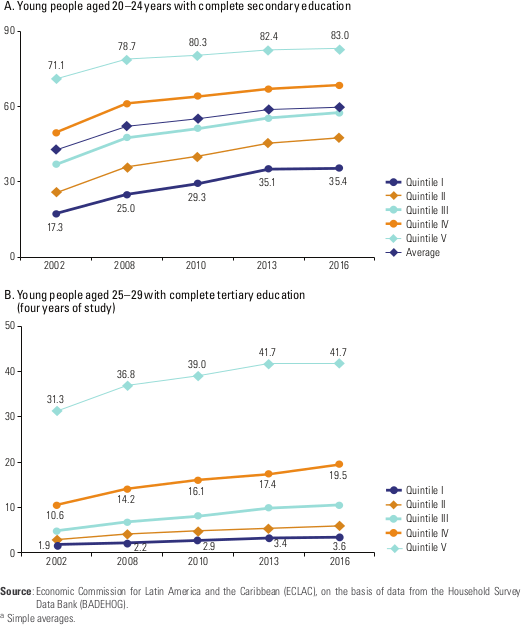
    Latin America (18 countries): young people aged 20–24 years with complete secondary education, and young people aged 25–29 with complete tertiary education (four years of study), by income quintile, 2002–2016a (Percentages)
    Education

    At first glance, certain education statistics are improving. LAC countries’ investment in education systems grew from an average of 3.6% of GDP in 1995 to 5.3% in 2013; student-teacher ratios for the region decreased from 24.4 to 17.3 from 2000-2014, suggesting that class sizes are decreasing; and the Programme for International Student Assessment (Pisa) education study reveals that there were 20 times more computers available to students in 2015 compared with 2000, implying improvements in school infrastructure. However, experts say that the efficiency and equity of expenditures is low compared with other regions, and more spending is necessary.

    The 2015 results from the tri-yearly OECD Programme for International Student Assessment (Pisa) show that educational coverage and attainment improved for the 10 LAC countries involved in the study. The percentage of adolescents aged 15-19 who finished primary school increased from 86.9% to 92.4% from 2000-2015. Attainment for maths, reading, and science also increased almost 10%, 6%, and 5% respectively, with Brazil, Chile, Colombia, Mexico, and Peru receiving special mention for improvements. However, LAC countries scored poorly for social and problem-solving skills.

    In addition, the results show that LAC countries spend far more on teachers and human resources than other regions, which suggests that stronger labour unions funnel resources to teaching staff. Experts suggest that this could leave less money for pedagogical inputs and ancillary services. Attempts to reform the education systems in Peru and Mexico have fallen foul of teaching unions, whose members oppose the introduction of teacher assessments designed to improve the quality of teaching.

    However, education reform needs to address the allocation of funding as well as professionalising teaching. Many public universities do not charge fees, which Jacqueline Mazza believes is a key reform area in Latin America. Mazza uses Chile as an example of a country that has achieved economic growth with a strong social policy, including pensions and a sound attempt to elevate the lower- and middle-income sections of society. One area that has proved a stumbling block is education, where proposals to charge university fees have led to huge protests.

    “Subsidies in education in Latin America are highly skewed to the top, that is university education being free and leaving less subsidy for primary and secondary,” said Mazza. And graduates are not meeting the demands of the labour market either, despite drawing government funding away from primary and secondary education, from which more people would benefit. “Latin America produces, for the money it invests in higher education, few engineers and IT professionals,” said Mazza. “The innovation sector is not fed by the university system.” Access to courses related to science, engineering, and robotics must increase to drive innovation, say experts, with further investment. For example, Colombia’s former finance minister Mauricio Cárdenas said that the country spends 10% of oil royalties on science and technology.

    As things stand, 38%-40% of employers say they can’t find talent to fill job vacancies, according to ILO human resources specialist Fernando Vargas. Firms need people with language, technological, and social skills, which are in high-demand as the fourth industrial revolution continues, but they struggle to find them. “Our education has not changed,” said Vargas during an ILO regional meeting in October 2018. “We have education systems from the 19th and 20th century [which do] not teach people to solve problems.”

    If education systems struggle to meet the demands of the labour market, perhaps training schemes can be used to reduce skills gaps. According to a 2017 ILO report called ‘The Future of Professional Training in Latin America and the Caribbean’, LAC countries have long boasted specialised public training institutes, and there are increasing numbers of private alternatives as well as in-firm training schemes. However, Mazza says that the quality of training is poor and does not respond to the demands of the labour market. “They are training systems based, if we are lucky, in the 1950s,” she said. “Beauticians, carpenters, I mean it’s a really odd disconnect between what the economy needs and what the training systems and technical institutes train.”

    These skills gaps show a serious mis-adjustment of supply and demand in the labour market given high levels of un- and under-employment among young people, suggesting that training systems need to be more dynamic in order to adjust to the changing conditions of the digital transformation. One solution could be the introduction of workforce development programmes, which combine education and training throughout a worker’s career. “Right now in Latin America if you drop out of school it’s hard to go back,” said Mazza. “What needs to change is the availability of training over the course of a lifetime.” Such schemes would also help the one in five 14-25-year-olds who are looking for work but failing to find it, with little change in those numbers in recent years.

    The increased use of public-private partnerships could be one way of boosting dynamism in education and training, as well as targeting young people who are neither studying nor working (known as Ninis in the Spanish acronym). Mexico’s aforementioned ‘Jóvenes Construyendo el Futuro’ programme is one example, which will provide grants to companies to pay apprentices. This kind of dual learning model has been used effectively in other countries, encouraging unemployed people back to school or providing training opportunities that boost their chances of finding formal employment. Costa Rica, which has the highest rate of youth unemployment in Central America (27%) according to the Central American Observatory of Social Development, is also discussing a law that would enable dual learning programmes, while at the end of January 2019, Guatemala passed the ‘Law for Strengthening Entrepreneurship’, which will introduce business classes in primary and secondary education as well as creating a new legal entity for entrepreneurs.

    Moving forward, LAC countries require serious reforms to improve education coverage, quality, and equity. The region lags behind developing regions such as South East Asia and Eastern Europe in terms of quality, said Alejandro Werner, Americas director at the International Monetary Fund (IMF), and the labour force must be better trained and more agile to deal with digital transformation.

    And it’s not just enough to encourage people to spend more years at school in order to increase the earnings of lower income sectors. Research published by the World Bank shows that a significant increase in total years of education from 2004-2014 resulted in unequal income gains between the top 60% of earners and the bottom 40%. Those who were already earning higher wages saw greater income gains, providing further proof of the complexity of labour market policy. Latin America needs to join the global conversation on technological adoption, updating labour regulations in a changing world of work, and how to better connect education and business if it is to be competitive in global markets.

    Case study: teachers protest reforms

    Attempts at education reform in Peru have pitted reformers against teachers and their unions, as well as resulting in the politicisation of an issue of national interest.

    The drive to reform was started by Jaime Saavedra, who first served as education minister under President Ollanta Humala (2011-2016). Saavedra’s main aim was to make Peruvian education more meritocratic, planning to introduce performance-based pay for teachers, improve education quality, modernise management systems, and close the educational infrastructure deficit.

    By 2015, Peru was improving in the OECD’s educational rankings based on assessments for 15-year-olds, and was the fourth-best improver in the Pisa tests from 2012-2015. Saavedra succeeded in convincing government, business, and the media that education reform should be a priority, and at first his plans were well-received. However, moves to regulate private universities in 2014 provoked opposition from political rivals, some of whom profited from the business of education. The highly-regarded Saavedra had been kept on as education minister by President Pedro Pablo Kuczynski (2016-2018), who declared education a national priority, but amid political wrangling he was ousted in 2016.

    Saavedra’s successor, Marilu Martens, took over in December that year and continued with plans to boost the monthly minimum wage for teachers by around 30%, the first meaningful pay increase for a decade. The pay hike was part of a larger package of measures that would see education spending jump from 3.7% of GDP in 2017 to 6% by the end of 2021, but trouble was brewing over performance evaluations for teachers. Those who failed could lose their jobs, which provoked opposition from the teachers’ union Sindicato Único de Trabajadores de la Educación del Perú (Sutep) and ultimately resulted in a 15 June 2017 strike that lasted for three months.

    The dispute was eventually resolved after the teachers’ pay rise was brought forward and the government promised to provide teacher training. Martens struggled to negotiate a deal due to the splintering of Sutep into regional factions, and by September 2017 she was ousted after education was once again used as a political football. The weakness of both the education ministry and the central Sutep union has raised fears of further strikes.

    While Peru has made some progress in improving results, huge problems remain. Average scores may be going up, but there are huge inequalities between urban and rural education, according to Ricardo Cuenca from Peruvian think-tank Instituto de Estudios Peruanos (IEP). Another issue is public perception of teaching, said Cuenca, who believes that the profession is associated with low salaries and low prestige.

    Fixing these issues requires bold initiatives like those introduced by Saavedra, but a weakened education ministry doesn’t have the political capital to force through controversial regulations. The main Sutep union remains weak, and more radical factions called a strike on 3 July 2018. However it was called off after two weeks as the vast majority of teachers ignored calls to walk out of classrooms, illustrating continued divisions in the union movement that will make it hard to negotiate future deals.

    Education reform showed early promise before politics derailed its good intentions. Political instability in recent years has not helped to create favourable conditions for reform, but some argue that Saavedra attempted to change too much, too quickly by going after private universities. In doing so he managed to politicise the issue and the ousting of Saavedra and Martens left the education ministry weakened.

    Peru is not the only country to struggle with professionalising teaching. The introduction of performance assessments was also met with strident opposition in Mexico, where they form part of the 2012-2013 education reform introduced by former President Enrique Peña Nieto. Convincing entrenched vested interests to allow change has never been easy, and both episodes underline the difficulties of pushing through sweeping reforms in the Latin American context.

  • Trade unions and the labour market

    LatinNews 17 May 2019 Hits: 421

    While the influence of teachers’ unions in disrupting education reform may suggest that the union movement is powerful in Latin America, that’s not entirely true. Traditional public sector unions, characterised by links to political movements such as the Peronists in Argentina and the Partido Revolucionario Industrial (PRI) and the National Action Party (PAN) in Mexico, are capable of causing significant disruption, but for the most part the trade union movement is relatively weak in terms of its capability to affect individual employment rights.

    During the period of dictatorships in Latin America (1970s-late 1980s), trade unions were disbanded and persecuted. Since the return of democracy, their influence has remained generally low in the private sector despite a number of union-friendly reforms in the 1980s and 1990s. As Mark Anner of Pennsylvania State University, US, wrote, union membership fell despite the loosening of legislation. For example, union facilitation reforms in El Salvador saw the number of manufacturing unions increase by 12.5%, but the unionization rate in the sector fell by 14%, according to government data from 2001. A larger number of smaller, fragmented unions has in fact led to a decrease in collective bargaining power, argues Anner, and a general trend towards increased flexibility in individual employment law may have undermined reforms that ostensibly favour labour as a collective.

    According to 2018 report by the Universidad Nacional de San Martin, Argentina, Uruguay (30%), Argentina (28%), and Chile (23%) have the highest unionisation rates in Latin America. Brazil, Costa Rica, and El Salvador are tied on 19%, followed by Mexico (13%), Panama (12%), and Colombia (10%). At the bottom of the ranking are Guatemala (3%), Nicaragua (5%), Peru (6%), and Paraguay (7%).

    Experts such as Graciela Bensusán of the Universidad Autónoma Metropolitana (UAM), Mexico, argue that Latin American unions have been weakened as governments adopt economic reforms in response to globalisation. In Chile, unionisation rates have declined and unions have weakened, even as the country underwent significant economic growth in the 1990s and 2000s which saw it become a high-income nation with high levels of economic formality.

    In Mexico, union influence has been severely degraded due to the existence of so-called ‘ghost unions’. Employees are forced to join as a condition of employment, and the ‘protection contracts’ that they sign allegedly protect the interests of the employer, not the worker. Data may show high unionisation rates on paper, but in practice it is low. This is because an estimated 90% of collective bargaining agreements are protection contracts with these ghost unions.

    However, the situation may be changing in Mexico, as in September 2018 the Senate approved the International Labour Organization convention 98 on the right to organise and collective bargaining. Federal labour law is also set to change to allow freedom of association, and the union movement is hopeful that President Andrés Manuel López Obrador could end protection contracts and create a new forum for dialogue between businesses and workers. Unionisation rates are also falling as workers sign individual contracts, weakening the traditional unions.

    While reforms could favour labour in Mexico, workers’ movements in South America are concerned as the continent’s pink tide of left-leaning governments rolls back and the region takes a rightward turn politically. Chile’s President Sebastián Piñera provoked nationwide strikes after proposing to “reform the reform” introduced by his left-wing predecessor Michelle Bachelet. In other countries such as Colombia, trades unionists suffer violent repression for their work. Labour market conditions such as the killing of trades unionists were a major reason for the delay in Colombia being admitted to the OECD, a decision which was finally approved in May 2018. Violence against union leaders is also a problem in Central America, where it has been suggested that street gangs known as ‘maras’ have been encouraged to engage in union-busting by employers in the textile industry.

    In those countries where the state cannot guarantee the physical safety of union leaders, it is impossible to envisage how these leaders could come to change policy. It also suggests a wider problem with enforcement. Even in those countries where union leaders are not physically attacked, the state’s capacity for enforcing labour legislation is generally low. Another brake on the effectiveness of unions is the high rate of informality in the labour market. According to the ILO, 53% of workers are part of the informal economy, rising to around 80% in lower-middle-income countries like Guatemala, Bolivia, and Nicaragua, which makes organising labour more difficult.

    Migration and the labour market: Call centres in Central America

    Since the turn of the century, Central America has become an increasingly popular site for ‘nearshore’ industries serving the US market, including business process outsourcing (BPO) call centres offering customer services to both English- and Spanish-speakers.

    The region is close to the US both geographically and in time zones, and offers low operating costs. Attracted by tax incentives dangled by governments competing for a good source of youth employment opportunities, myriad companies have driven recent expansion in the industry. There are around 70 call centres in El Salvador alone, providing 25,000 jobs, according to Salvadoran investment agency Proesa. Sykes, Hotels.com, and Kodak are just a few firms that have outsourced customer services to El Salvador, and the proliferation of call centres has driven a boom in private English schools.

    One chain of schools, English4CallCenters, now boasts ten locations in El Salvador and two in neighbouring Guatemala. Founded in 2014, it has 1,000 students each term. This is a good example of the private sector meeting the demands of a local labour market that is not satisfied by the state education system. However, call centre companies have their own preferred source of labour: deportees from the US. Salvadorans that have spent considerable amounts of time stateside boast high levels of fluency, a better accent, and the personal experiences to be able to relate to callers on a cultural level.

    It has even been reported that recruiters wait at airports for deportation flights to arrive, offering deportees jobs before they disperse. While many are glad to have money coming in, others complain about long shifts, quotas, and little opportunity for advancement. Employee turnover is high, and call centre companies themselves appear to acknowledge that these are not long-term positions, with adverts talking up flexibility and temporary work. Call centre workers generally benefit from the labour protections offered by formal, salaried work – a rarity in Central America, where the majority of jobs are informal – and governments are happy to generate jobs for young people that keep them off the streets and out of trouble.

    For that reason, there is still a lot of interest in the BPO sector in Central America. In September 2018, Panama granted tax breaks to call centres in a bid to attract more investment, and in February that year Costa Rica celebrated the opening of a new Amazon facility providing 350 new jobs. The US giant made its first investment in Costa Rica in 2009 with 30 employees, and the latest opening means that it had 900 total employees in the country as of February 2018. There was also more call centre investment in Honduras in January 2019, but the picture is slightly different in Guatemala.

    In 2018, the BPO sector contracted by 12%, with the value of exports dropping to US$600m, down from US$720m in 2017. A 2013 study suggested that the BPO sector would provide 100,000 jobs by 2020, but so far 45,000 have been created, according to Ninoshka Linde, call centre expert at the Guatemalan Exporters Association (Agexport). Manuel Gordo, CEO of BPO provider Allied Global, said that companies had been put off by broken promises over tax incentives. A lack of success in training workers to a high level of English fluency was also cited as a reason for the contraction, and highlights once again the issue of human capital in remaining competitive in regional and global markets.

  • Gender issues in the labour market

    LatinNews 17 May 2019 Hits: 602

    Women have made great strides in labour market participation in recent decades, but there are still a lot of improvements to be made in Latin America.

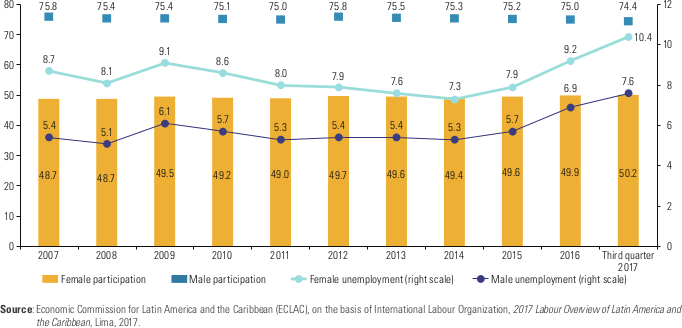
    According to a January 2019 report from Eclac, 50.2% of women are active in the labour market compared with 74.4% of men. Over the past 50 years this number has increased significantly, but the rate of increase slowed from the early 2000s onwards. This slowdown has affected vulnerable women – the poorly educated, those with young children or low-income partners, and those in rural areas – the most, according to the IDB. This research suggests that this may be explained by unusually strong economic growth in Latin America during the 2000s. It may seem paradoxical, but better labour market conditions due to economic growth may encourage women to stay at home and perform traditional gender roles as their partners are earning more money. In contrast, a tough labour market may mean that both the male and female partners are forced to work.

    Latin America and the Caribbean (weighted average for 24 countries): activity and employment rates, by sex, 2007–2017
    (Percentages)

    Gender

    IDB researchers also claim that better social protections may encourage women to stay at home, as do conditional cash transfer programmes that were common in Latin America during the 2000s as governments spent more on social policies. However, female participation is also limited by structural factors, including horizontal segmentation which restricts them to certain sectors. Care giving jobs are one example – comprising education, health, social assistance, and domestic employment – which represent 27.7% of women’s jobs. The countries with the highest proportion of female workers in the care sector are Argentina (42.8%), Uruguay (38.4%), Chile (34.9%), Brazil (33.7%), and Costa Rica (32.6%). This is an extension of women’s care giving role in the home, according to Eclac, where they perform unpaid labour which also constitutes a barrier to finding decent work. This is referred to as the ‘double burden’, as women’s increasing participation in the labour market did not lead to a fairer division of domestic chores. According to World Bank statistics, women spend three hours more than men on household labour per day.

    Eclac statistics also show that unemployment was higher among women (10.4%) than men (7.6%) across the region in 2017. Low productivity sectors employed 51.8% of working women in 2017, and 82.2% of working women were not members of a pension scheme. At the same time, 48.7% of women in employment earn less than the minimum wage, and earn on average 16% less than men. The concentration of women in lower-quality jobs means that they are likely to miss out on the benefits of the digital transformation because they are largely excluded from the highly-skilled sectors that are set to expand. Manufacturing is the second-largest sector for female employment, with 11.5% of employed women. Across the region there are generally more men than women employed in manufacturing, but the opposite is true in Colombia, Guatemala, Nicaragua, El Salvador, and Honduras. The latter four Central American nations are home to maquiladora textile firms which could explain this phenomenon.

    If the current generation of women are restricted to certain low skilled jobs, statistics from the next generation are far from encouraging. Female students are underrepresented in science, technology, engineering, and mathematics (STEM) disciplines, which offer pathways to high-skilled jobs. According to Eclac, just 34.6% of STEM graduates are women, and this gap could widen. However, if women receive the right training to make the most of new technologies, they could benefit thanks to more flexible working hours which are better suited to family care. That said, it would be more beneficial for women’s well-being if the division of unpaid household labour became more equitable.

    Women now tend to spend longer in education than men, but this has not improved access to higher paying jobs. In fact, for skilled jobs, the wage gap can be as high as 25.6%. Improving the situation means changing laws, and better female political representation has been linked to policies that are favourable to women’s inclusion in the labour market. As women are largely excluded from decision-making positions, they are currently less able to influence policy, according to Eclac,

    However, improving equality in the labour market would bring major benefits. If more women can be brought into the labour market it would boost economic growth and the distribution of income, as well as reducing poverty, according to Eclac. In El Salvador, Eclac director Alicia Bárcena claimed that poverty could be cut by up to 12% if more women were earning. Major target groups include rural women and rural indigenous women, according to Jacqueline Mazza, who have lower participation rates. As growth in the overall labour force slows, governments need to look at the pockets of the population where women have so far not been entering the labour market, she said. “The next generation really needs a change if we are going to keep up with other regions,” said Mazza. “So it’s really about opening up those last segments where there is discrimination in the labour market.”

    Case study: Laboratoria

    While national governments can struggle to implement successful labour market policies on a large scale, entrepreneurs across the region are proving what can be achieved at a more local level. Among their number is Mariana Costa Checa, a young Peruvian who set up a coding school for girls called Laboratoria.

    The social enterprise started with a single site in the Peruvian capital, Lima, in 2014, training women to be web developers and user experience designers during a full-time, six-month boot camp. Laboratoria focuses on women from low-income families whose access to education is limited, ensuring accessibility by only charging those students who successfully find a job in the tech sector, and thereby working to close the gender gap in the industry. “Female tech talent is being wasted in Latin America,” a Laboratoria spokesman told LatinNews. “For that reason it’s important to generate this talent so that the digital economy can be more diverse, competitive, inclusive, and offer opportunities for everyone.”

    After early success in Lima, Laboratoria has since expanded to Santiago, Chile; Mexico City and Guadalajara, Mexico; and Sao Paulo, Brazil. So far over 1,000 women have graduated from Laboratoria’s four sites and over 700 now work in the tech sector, according to company figures. These graduates now earn up to three times as much as the average salary, according to the spokesman, providing a significant boost to their economic freedom in a region where many women are limited to poorly-remunerated, informal work.

    In contrast to the traditional public education systems, the Laboratoria bootcamp is set up to emulate the world of work with a focus on practical tasks. This means that graduates are prepared for the first job, rather than needing further in-firm training. Laboratoria has been praised by figures such as Facebook founder Mark Zuckerberg and former US president Barack Obama, and works hard to cultivate links with the private sector. The company runs an outreach programme which contacts human resources teams to identify technological needs that graduates could fulfil, and also runs corporate training sessions for firms to assist them with their digital transformation. Laboratoria also counts on support from the Inter-American Development Bank, Omidyar Network, Draper Richards Kaplan Foundation, Microsoft, Citi Foundation, and Blackrock.

    Boot camp graduates are the perfect fit for Peru’s booming tech industry, which has suffered from a huge skills gap, and it looks as though the company will struggle to keep up with regional demand. By 2025 the software development industry will employ 1.2 million people in Latin America and the Caribbean, according to the Inter-American Development Bank, which means plenty of job opportunities for developers and designers.

    As things stand, Laboratoria is responding to a number of labour market issues on a small scale. It provides vocational training that aligns with the needs of the private sector, boosts women’s participation in the labour market, and increases their chances of finding well-remunerated, formal employment. While it is understandably easier for a small, agile operation to train 1,000 women in five years than government to overhaul nationwide systems, there are valuable lessons to be learnt. For the private sector, continued shortfalls in national education systems may encourage investment and partnership with focused training centres like Laboratoria.

  • Interview: Dr Jacqueline Mazza

    LatinNews 17 May 2019 Hits: 857

    Jacqueline Mazza is currently an Adjunct Lecturer in the Johns Hopkins University SAIS Latin American Studies Program. Previously she was Principal Labor Markets Specialist at the Inter-American Development Bank (1993-2014).

    This telephone interview has been edited for length and clarity.

    What are the biggest labour market challenges in Latin America and the Caribbean?

    They’re actually pretty universal across the region. I put them on poor job quality. The principal problem is the large numbers of informal workers, which are at low labour productivity levels, and low wages that are associated with that low productivity work. Often what we talk about is the inability to move into higher quality work. The key labour market problem in Latin America is a human capital one. Latin America is a middle-income region, but it has the most stagnant labour productivity levels in the world.

    What is your take on the progress of education reform in Latin America?

    Education reform in Latin America has failed. We’ve been looking at these reform movements which just dance around the edges of what Latin America fundamentally needs. The only changes we’ve had is when you can take over a small subsystem of the education system by attacking some types of schools. One area of success in Mexico has been a particular technical school within its training system, to orient [them] more to business. It’s too small scale to affect the big picture of education quality, but it has been helpful.

    If you were a businessperson looking to invest in Latin America, where would you do so?

    It’s where you’ve seen this innovation in the technical training institutes. When they are ready to partner with the private sector you can get something much more systematic in terms of the skills needed by the private sector. Most of the Southern Cone and Andean regions have really achieved reasonable growth rates and sound macroeconomic policies. They are a good place to invest, it’s really a human capital problem that’s holding back their ability to be much more competitive in a global market. One of the areas for investment is for domestic consumption in food and services as well as to follow the development of a regional labour market with your investments. That is to look to replicate investments in one country and facilitate the market across borders. Another is countries like Costa Rica, Uruguay, that have begun to develop high tech parks and manufacturing. Most of the region is in good shape, it’s just that the Costa Ricas and the Uruguays, that is small economies where the level of security is very high, are very attractive for niche investments.

    What should labour market priorities be?

    We spoke about rural indigenous women being the most troubled part of the labour market along with afro-descendants. In that lower-wage sector we have a real issue with those left behind in the labour market then contributing to crime and insecurity. What Latin America really needs from a labour market perspective is to intervene on those who need the skills upgrade the most and target those who have been left out so far.

    Why are workers skills not matched to jobs?

    There is blame on all parties. There is a long history of developing methods and curriculums for training that are highly outdated, but the other part is the private sector in Latin America poorly articulates what it needs in terms of skill development. The key in any training system reform is this public-private collaboration that continually changes and adapts.

    How does Latin America and the Caribbean compare to other developing regions of the world?

    I think it’s the flexibility and the ability to be more forward thinking outside of your political box. In all of Latin America they change programmes just because it was the former government’s success story, and as a result we disconnect from the programmes that were effective for political reasons. South East Asia does not have the institutional rigidities that we can see in Latin America and the Caribbean. They have more longer-term, more forward-thinking governments in terms of these institutional changes and they have really taken off in terms of educational reform and in more strategic investments, that is marrying training with sectional growth industries.

    How can labour markets be improved?

    The region needs to begin to think of its labour market as more regional than as individual countries, particularly when we are talking about demand industries and the ability to move across countries. This is particularly true for smaller markets such as healthcare in the Caribbean. Some markets are so small that your school system and your university system can’t train to the quality that you need. You need more regional approaches to sectoral development and then the ability of workers to work across countries. In Latin America we restrict particularly low-skilled and middle-skilled migration. They allow the most high-skilled migration inter-regionally, but what we need is to be able to advance careers and skill development by working across regions.

    What other factors should be considered when it comes to labour markets?

    The growing role of crime and insecurity in Central America, where the outflow of workers due to insecurity is so bad it represents a problem for new investment. Security is a labour market constraint, even to the extent of people being able to get safely to employment. The other issue I wanted to raise is demographically Latin America has had what we called for a while a youth dividend, but those trends are changing. The population is getting older and the average population growth rate is slowing down, so the labour force is not going to be growing substantially. When Africa looks at its growth, it looks at a bulging working age population. In Latin America it won’t be the plus for economic growth that it has been in the past.

  • Conclusion

    LatinNews 17 May 2019 Hits: 409

    For governments, there is a pressing need for education reform that provides young people with the skills they need to find work in the formal sector, especially given the demands of the fourth industrial revolution.

    In addition to formalisation programmes, states need to focus on boosting labour market participation among young people and women, especially rural indigenous women. As a region, Latin America can offer plenty of opportunities for the private sector. The challenge is ensuring that the right conditions are in place when making an investment. That could mean looking to standout performers such as Costa Rica and Uruguay, small countries that are attractive to niche investments, or partnering with national governments in larger markets, such as Mexico, on public-private training schemes. Shaping the curriculum of these training schemes is important, whether in partnership or through more effective communication of private sector needs. Significant productivity growth is possible in Latin American markets, and companies that proactively seek and create opportunities will be best placed to benefit.