Tren de Aragua in the eye of the storm

Items

  • “Very, very dangerous people”

    Abbi Dicker 11 September 2025 Hits: 2441

    Who or what is the Tren de Aragua? In an interview with news network CNN on 21 March this year US President Donald Trump had his answer: “They’re a group of thugs. They come from the prisons of Venezuela. They’re very, very dangerous people…They are tough people, they’re bad people. We don’t want them in our country.” A week earlier Trump had made a more formal statement claiming the Tren (TdA) “is a foreign terrorist organisation…a hybrid criminal state that is perpetrating an invasion and predatory incursion into the United States”. Separately the US president also stated that “TdA has been sent here by the hostile Maduro regime in Venezuela…and is conducting Irregular Warfare” against the US.

    Unsurprisingly, the Venezuelan government of President Nicolás Maduro had a radically different take. Interior and justice minister Diosdado Cabello said the gang had been dismantled in 2023 and that its continued “existence” was no more than “a falsehood peddled by the political opposition”. Earlier, in February 2025, President Maduro had accused the US FBI and DEA of having “promoted and organised” the TdA from Colombia but maintained that they had been defeated in that enterprise. Trump’s claims of an “invasion” of the US were “fabricated lies”; the gang had been politically exploited by the opposition with international support.

  • The context: a country in a state of collapse

    Abbi Dicker 11 September 2025 Hits: 1188

    If, as an academic exercise, anyone wished to identify the social conditions that might most contribute to a crime wave, looking at Venezuela over the last decade might be a good place to start. In terms of GDP, the economy has suffered a truly world-leading collapse. Between 2014 and 2021 GDP dropped by 75-80% according to reliable estimates. A fragile recovery has been seen across the last four years, but the economy remains little more than one quarter of its size ten years ago.

    This catastrophic fall in output value has been partly caused by uncontrolled hyperinflation, particularly in 2018, when prices reportedly grew by 130,000% prompting widespread shortages of food and other goods and services essential for survival. Prices are now rising at a lower, double digit percentage rate, partly because of the de facto dollarisation of the economy. This partial stabilisation, too, is very fragile and could go into reverse, as the government continues to print money to cover a wide and volatile fiscal deficit. Amid a lack of maintenance and investment the oil sector – the country’s prime foreign exchange earner – continues in crisis. Production is currently under 1m barrels per day compared to 3m bpd in the 1990s.

    Reliable data is limited but the sharp compression of living standards is likely to have fed through to increased crime rates. Unemployment is in double digits: in 2020 it was estimated that 82% of Venezuelans were living in poverty and 53% in extreme poverty. Last year’s homicide rate, often taken as a proxy for crime in general, was 26.2 per 100,000 inhabitants, one of the highest in Latin America. However, the homicide rate has been trending down in recent years. In any case, crime trends, like many other social statistics, have to be handled with caution.

    According to lobby group the Venezuelan Observancy of Violence (OVV) the government systematically under-reports the true number of homicides, only counting those in the official data where formal criminal proceedings have been initiated. Human rights activists say people trafficking has increased, often with the complicity of government security personnel. There has been a surge in contract killings, where according to the OVV both victims and victimisers tend to be young men aged 12-29 and recruited from the most vulnerable sectors of the population, affected by economic hardship and food shortages. 

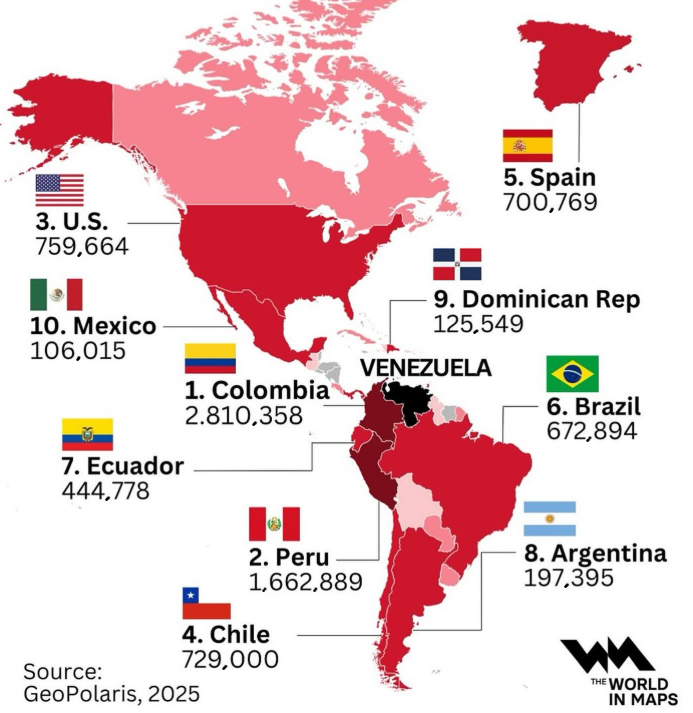
    Most significantly, Venezuelans have reacted to the crisis by leaving their country in their millions – between six and eight million according to independent estimates. This is vitally important in at least two senses. First, as they endure economic hardship, Venezuelan migrants are often forced to travel without documents and made to work in the informal economy, simultaneously turning to crime as perpetrators, and being vulnerable to criminal exploitation as victims. Second, and critically, the widely scattered Venezuelan diaspora provides criminal cartels such as the TdA with an ideal marketing ‘point of entry’ to develop crime in neighbouring countries including people trafficking and extortion. There are documented cases where Venezuelan criminals are starting out by preying on Venezuelan migrants in neighbouring counties. Typically, the Venezuelan victims incur large debts to be smuggled across the border, and once they gain employment or set up small businesses in the country of destination the same predators will demand regular payments of protection money. The criminals will then use their strength in the diasporas to challenge home-grown rivals.

    The Venezuelan diaspora
    Top 10 biggest communities

  • Origins: Tocorón prison

    Abbi Dicker 11 September 2025 Hits: 1282

    There is a broad agreement among reporters that the TdA first emerged as a criminal force around 2014, in a prison in the Venezuelan state of Aragua, around 130kms west of the capital Caracas. The establishment’s official name is the Centro Penitenciario de Aragua, but it is widely known as Tocorón prison. Its inmates also call it “la Casa Grande” or Big House. Like various other penitentiaries across the country, Tocorón has had a form of hybrid management where the official prison authorities partially withdraw, letting prison gang leaders, known as pranes, take over the day-to-day running of the facilities, as well as associated criminal activity.

    This has happened against the background of the wider Venezuelan social and economic crisis, marked by hyperinflation and recession, which has drastically reduced resources across the entire criminal justice system. Researchers say that by 2023 at least eight of the country’s 53 penitentiaries were openly run by the gang leaders inside them, who had imposed their own form of internal organisation. It is also estimated that at least half of the country’s 25,000 strong prison population is directly managed by the pranes. This partial withdrawal of the state is also evident in out-of-prison policing, where law enforcement has given de facto control of large neighbourhoods to street gangs in exchange for promising to reduce violence and inter-gang conflict.

    A major pran, Héctor Rustherford Guerrero Flores, aka El Niño Guerrero, emerged in Tocorón, leading an illicit criminal business empire that included drug trafficking, robbery, extortion, contract killings, and illegal mining. Tocorón leaders have been involved in gold mining at a site in nearby Bólivar state known as Kilómetro 88. A handful of other top leaders emerged alongside El Niño. After serving time in La Casa Grande, Larry Álvarez Núñez, aka Larry Changa, moved to Chile participating in low-profile criminal activity there before being eventually identified by police. Another leader, Yohan José Romero, aka Johan Petrica, was a criminal from Miranda state who joined forces with the other Tocorón pranes and was particularly involved with gold mining.

    There is some controversy over how the organisation got its name. In 2014 local business leaders said they were being extorted by an organisation calling itself the Tren de Aragua. Some security analysts say various criminal groups were involved in rigging contracts for a central Venezuelan railway, a project which never came to fruition, but which was deeply implicated in corruption. The criminal groups involved are said to have spoken of themselves as railway branches, such as Tren del Llano, Tren del Oriente, Tren del Norte, and so-on, with the TdA eventually adopting the similar moniker. However, some analysts reject this story of the birth of the TdA brand pointing out that none of the founding members of the group had any known links to the railway syndicates operating in the vicinity.

  • A dystopian hotel?

    Abbi Dicker 11 September 2025 Hits: 1195

    Many media outlets have focused on sensationalist claims that TdA leaders led a life of blatant luxury in Tocorón. There have been claims that the prison has its own private residential homes, a nursery, a swimming pool, a baseball and a football pitch, horses, food stands, eateries, a night club, and mobile phone sales points. The available evidence suggests that these claims are largely true. One revealing account was made by Venezuelan journalist Ronna Rísquez who managed to gain access to the prison, posing as a visiting family relative of one of the prisoners. On approaching the compound, she said she had to cross three external National Guard checkpoints. At the last of them, she had to leave her identity card, crossing the boundary into the area controlled by the Tren.

    Once walking through the grounds, she noticed heavily armed men driving around on motorcycles: these, she was told, were prison enforcers. They looked both well-fed and well-dressed. Others doing the motorcycle round were tasked with checking on the prison generators, required because of Venezuela’s frequent power cuts. They also saw the nursery, the swimming pool, and the infamous Tokio discotheque, where sports and entertainment celebrities had been seen. Dotted around was a restaurant, food stands, an upscale clothing shop, and bars offering whisky and rum. There was also a makeshift bank where prisoners paid a weekly US$15 fee to ‘the cause’ – the prison management. At a little distance, a line of houses was described as millionaire’s row, used by the top criminals and their families. Supplies of crack and cocaine were also available for sale, along with cripy, a home-grown and particularly potent version of marijuana. However, it seems that drug addiction is not rife through the prison. The Niño Guerrero is reportedly not a drug user.

    Further along the route were some half-ruined buildings inhabited by thin, ill-looking men. These were the ‘underclass’ of the prison social system, called in prison jargon varones or manchados. They were kept there in insalubrious conditions because they were unable to pay the weekly contribution to the ‘cause’, or because they had HIV, tuberculosis, or Covid 19, or had been caught thieving or breaking rules set out by the pranes. In this area of the prison there were dirty puddles and deposits of scattered rubbish. Former prisoners say that those who failed to pay the weekly US$15 were held here, given warnings, physically beaten, and in some cases shot and killed.

    Those suffering terminal diseases were also summarily executed. The prison had a rudimentary justice system - every Monday the pranes heard reports of conflicts and complaints and decided what punishments there should be. They could include shooting the transgressor in the foot (known as a patero) or shooting him dead. Former prisoners say these homicides were largely kept secret: certain people just disappeared from the prison and were not heard of again.

    Apart from horses kept in stables, Tocorón also had a makeshift zoo, inhabited by, among other specimens, a jaguar, a puma, a white eagle (Rey Zamuro), toucans, and monkeys. Leaving after her visit, Rísquez said the place struck her as surreal, dystopian version of Disneyworld, a theme park she had visited as a young girl. Once exiting back through the National Guard checkpoint, she was able to see the logbook, which showed at least 10 visitors had been staying in prison for more than a week.

    Former prisoners say that Tocorón had its own internal social system. Right at the bottom were the manchados or varones, followed by those known as ovejas (sheep) or bautizados (the baptised). El Niño Guerrero has been a follower of a form of evangelical Christian beliefs and considered this group as being “true Christians” who were required to read the Bible and work as servants. The next rung up was formed by the gariteros (prison guards) which included the men patrolling the grounds on motorcycles. They were said to be the eyes and ears of the prison leadership.

    Next came the luceros de la baja (lowland stars), an armed shock force which protected the leadership. They were allowed to leave prison two times a week for Tren De Aragua business. Former prisoners have described them as “cruel and bloody”. A further step up the hierarchy were the luceros de la alta (highland stars) who formed the leadership’s inner circle of trust. They were allowed out of prison as required and could travel inside and outside Venezuela. The top of the pyramid in Tocorón had been occupied by three principles or pranes of which the most important was the Niño Guerrero. However there had also been speculation that there might be a sort of overlord of the whole structure, potentially a minister in the Nicolás Maduro government.

  • The prison business model

    Abbi Dicker 11 September 2025 Hits: 1222

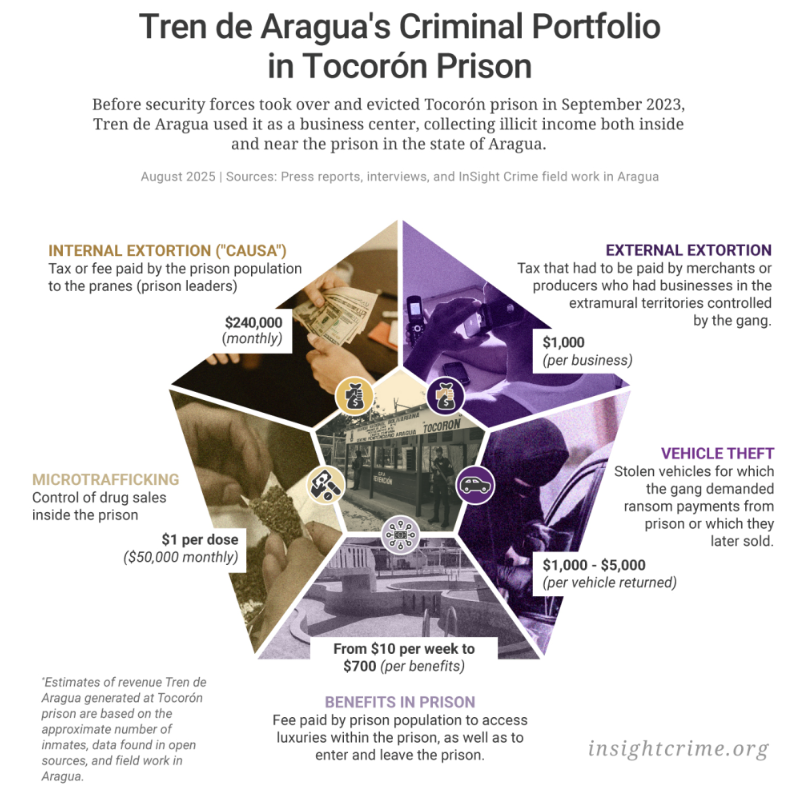
    The Casa Grande was part of a sophisticated and ruthlessly pursued business model. At its centre was the weekly payment to the cause that every prisoner must make. There are no official figures on prison occupancy rates. However, the prison was built with a capacity to hold 5,000 inmates, and there were reports of up to 10,000 being held there. This means that TdA was receiving an annual income of between US$3.9m and US$7.8m from its prison population, which went towards paying its operating costs. It also explains why gang leaders wanted to maximise the prison population (and sometimes refused to release those who were coming to the end of their sentences).

    There have been many additional illicit revenue-earning activities. Extortion payments (sometimes called vacunas or vaccinations), were often laundered through a local charity, Fundación Somos el Barrio JK. Some local companies were allowed to make their extortion payments in kind, delivering truckloads of food and drink to the prison. Companies that refused to pay for their protection faced the threat of violence. In 2019 the Puig biscuit factory was destroyed in an arson attack for that reason. In 2022 local businesses told journalists off the record that they all had to pay. TdA members also operated WhatsApp-based phishing scams and used bogus Facebook Marketplace car sale offers to attract and rob unsuspecting victims.

    Tocorón prison also became a hub for weapon sales. It offered a wide range of pistols, grenades, and assault rifles, many being models used by FANB, the Venezuelan armed forces. They include AR-15s and AK-103 Kalashnikovs. The AK-103 is the main weapon used by the Venezuelan military and the suggestion is that officers have sold consignments of them to criminal gangs. Demand for weaponry is particularly strong in nearby Bolívar state where rival syndicates vie for control of gold mining operations. Weapons are also provided across the border to Brazil, where criminal groups such as Primeiro Comando da Capital (PCC) are a major force. The economics of the gun trade are compelling. High end assault rifles are sold for US$5,000 each in Venezuela, but on the Brazilian market they are worth up to USS$20,000.

    Other criminally controlled businesses include car theft, scrap metal contraband, people trafficking, kidnapping for ransom, retail drug sales, wholesale drug trafficking, contract killings, and illegal mining. While it is hard to find credible estimates, it seems reasonable to deduce that the TdA’s total annual income is running in the hundreds of millions of US dollars.

    It is also clear that the Tren moved quickly to take advantage of mass immigration flows that began after 2014. At first the main direction was away from Venezuela to countries elsewhere in South America, particularly Colombia, Ecuador, Peru, and Chile. However, as a result of the Covid-19 pandemic of 2020/2021, many Venezuelan expatriates lost their jobs in those countries and were forced to return home. The Tren rapidly created a new business, escorting impoverished Venezuelan migrants through the network of pathways or informal border crossings connecting Venezuela and Colombia, and known as trochas. They catered to migrants lacking travel documents. Venezuelans unable to pay the crossing fee were required to carry drugs or other contraband in exchange for eventually being allowed to get across.

    Later the cross-border operation became more sophisticated. The TdA created its own ‘travel agency’ offering travel packages for a fee. Typical of such arrangements, according to media reports, was the case of Camilo, a Venezuelan living in Peru, who because of the Covid-19 pandemic wanted to return home. He paid US$800 for a package deal, travelling by bus in a group, back through Ecuador and Colombia to Venezuela. The group was organised and accompanied by a woman ‘tour guide’ who arranged tickets, hotels, and meals. Nobody asked to see travel documents at any point (Camilo had none). At Cúcuta, the last stop before the Venezuelan border, the guide told them they would have to make a final US$2 payment “to the Tren de Aragua” for permission to cross the border. 

    People and sex-trafficking is another important business for the TdA. Members of the organisation recruit young Venezuelan women, usually aged just over 18 but often younger. They are offered the chance to work as escorts or prostitutes, earning money to pay back the Tren for its investment in them (mainly inflated travel costs), on the promise that once the debt has been paid off, they will be free agents. But the moment the women arrive in the country of destination the TdA breaks its promises, seizes their passports, effectively keeping the women as prisoners, and forcing them to work as prostitutes for little or zero pay. Sex trafficking is also linked to the use of the women as honey traps for extortion purposes.

    Within the Tren de Aragua’s structure, running prostitution operations is divided up by geographical markets (plazas) and placed under the control of luceros de la alta who report directly to the gang leadership in Tocorón. According to calculations by Colombian prosecutors, the plaza in Kennedy, a suburb of Bogotá, was generating around US$635,000 a month for the Tren de Aragua. The Tren is also credited with muscling in on prostitution in Chile, forcing previously independent sex workers to pay an informal operating licence.  

  • Death of the Tren?

    Abbi Dicker 11 September 2025 Hits: 1185

    Tocorón prison’s central role in running the Tren’s criminal empire may – or may not – have come to an end on 23 September 2023. On that day up to 11,000 troops under the command of CICPC (the Scientific, Penal, and Criminalistic Corps) raided the prison, blowing up the bars of locked cells. Unlike a prison seizure in 2011, on this occasion there was no resistance from the inmates. None of the three principals or pranes were in their cells when the raids took place. Specialist website InSight Crime quoted sources who said that the Niño Guerrero had imposed a curfew for three days before the raid, taking out weapons, money, and people through a tunnel. A local prisoners’ rights lobby group, Una Ventana para la Libertad (A Window for Liberty), said the operation to take over the prison had been discussed beforehand with the authorities, allowing the TdA leadership to make its getaway.

    Those in the Venezuelan government who claim that the Tren de Aragua does not exist cite the September 2023 takeover as their main evidence, but their accounts are short on detail and sometimes contradictory. The day after the raid the interior and justice minister, Remigio Ceballos, visited the prison where he claimed “All those structures that called themselves the pranato have been totally dismantled. They even existed with a name, the Tren de Aragua, but they do not exist. The Tren de Aragua does not exist.”

    Senior officials in the Caracas government have at times claimed that the Tren and other criminal megabandas have been created by the opposition political parties. Government supporters have also claimed that El Niño Guerrero is a US spy charged with destabilising the Venezuelan government. Foreign minister Yvan Gil has described the Tren as “a fiction invented by the international media”.

    The takeover was undoubtedly a blow for the Tren, but it is likely that it fell short of the full “extinction” that the government has claimed. It seems that the organisation, which can now count on an extensive international criminal network, may have been forced to renegotiate the terms of its activity in Venezuela. Javier Mayorca, a security consultant, told InSight Crime that the clampdown was in part because Venezuela had come under pressure from left-leaning Colombian President Gustavo Petro to clean up its act. The Caracas government may have also wanted to show itself 'tough on crime' ahead of the July 2024 presidential elections (which Maduro claimed to have won despite opposition and international reports of massive fraud). Or it may have been that Tocorón had simply become too powerful.

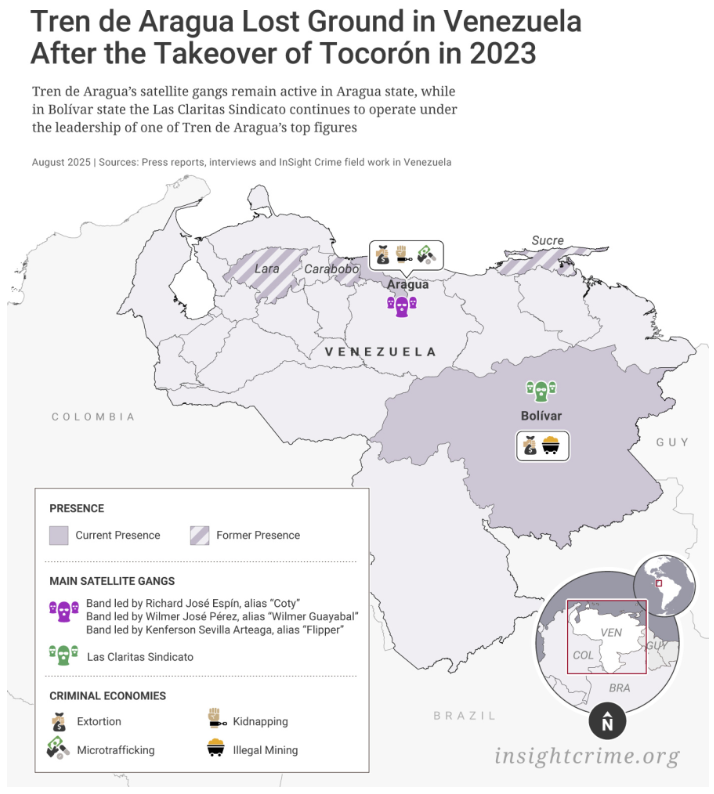
    Certainly, there are signs that Tocorón’s local influence has waned and indications of fragmentation among various satellite gangs. According to InsightCrime, remnants of the Tren are still present in its former hub in the San Vicente neighbourhood. An attempt to establish a new stronghold in Táchira state on the border with Colombia was reportedly blocked by Colombia’s Ejército de Liberación Nacional (ELN) guerrillas who are dominant in that area. The Tren has also been held back in Lara and Carabobo states. The arrest of gang leader alias El Pilo, (Carlos López) has been a setback in Sucre.

    It also appears that low-level members of the security services have been punished for their collusion, with several prison guards being sacked for giving El Niño Guerrero advance notice of the raid, and some 50 members of the National Guard under investigation. Some political heavyweights associated with the TdA have in any case seen their careers begin to decline. Prison minister Iris Varela (2013-2017) who helped put in place the system of pranes, became a deputy in the National Assembly, where she subsequently lost power and influence. More spectacularly, Tareck el Aissami, who was governor of Aragua (2012-2016) and was considered an ally and even a sponsor of the TdA, rose to become vice president but was accused of corruption, dismissed in 2023, and was arrested in 2024.   

    InSight Crime’s conclusion is that the 2023 raid was a “definitive switch” for Tren de Aragua “from a state-sponsored criminal group to an enemy of the state”. To the question of where El Niño Guerrero, the money, and the weapons ended up, InSight suggests that “The Tocorón pran decided to link up with his old friend and fellow Tren de Aragua founder, Yohan José Romero, alias Johan Petrica. It is likely he left Tocorón, with his close circle, weapons and money, and headed down to Bolívar state, to the town of Las Claritas, to find sanctuary and regroup.”

  • Life after death: international expansion

    Abbi Dicker 11 September 2025 Hits: 1232

    Colombia: Body parts in Bogotá

    In recent years the Tren de Aragua has grown rapidly across South America. One of the most important opportunities for expansion has been Colombia, its immediate western neighbour. The two counties share a porous, 2,200 km-long border, and because of the Venezuelan crisis nearly 3m Venezuelan expatriates now live in Colombia. The Tren de Aragua began its local activities charging tolls for those wishing to cross the border through the informal pathways or trochas. The rate was set at US$10 per crossing and US$125 for passenger buses. TdA cells were also established in several Colombian border towns with the Tren beginning to branch out, taking a share in other smuggling and people trafficking businesses.

    The TdA stepped up its presence in various townships in Norte de Santander department, such as its capital Cúcuta, La Parada, and the municipality of Villa del Rosario. Until 2022 the Simón Bolívar International Bridge, the main legal crossing point in the area, was closed, in effect forcing cross-border travellers to follow the illegal TdA pathways and pay the crossing fee. The organisation moved beyond charging cross-border travellers to demanding protection money from small businesses and running prostitution and retail drug sales (known as narcomenudeo).

    There have also been signs of fragmentation. The AK-47 gang, originally part of Tren de Aragua, became independent at the local level, and has been linked to around 50 murders in Cúcuta. Attempts by the Tren to gain control of illicit business in the Colombian department of Arauca were largely fended off by the ELN, the Colombian guerrilla movement which dominates the border area.  

    The TdA also sought to muscle in on the capital, Bogotá, with mixed results. In 2022 and subsequent years dismembered corpses wrapped in black plastic rubbish bags began appearing in public places in the capital in neighbourhoods such as Kennedy, Bosa, and Los Mártires. The gruesome discoveries were seen as a public warning from the Tren that rival criminal groups should stand down. According to the Bogotá secretary for security Aníbal Fernández: “The Tren de Aragua organisation is the main group responsible for homicides in which bodies have left in bags in public spaces in several areas of the city.” Yet, it has been difficult for the Tren to expand to other Bogotá neighbourhoods where incumbent gangs are refusing to cede control. The same is true of Medellín, Colombia’s second largest city, where a local group, the Oficina de Envigado, remains dominant.

    Peru: beware the junior partners

    The Tren’s arrival in Peru, around 2018, was similar in various respects to what happened in Colombia. The cartel initially focused on exploiting the Venezuelan diaspora in the country, which more than tripled to 1.5m by mid-2023. Its initial focus was on extorting sex workers and offering Venezuelan women and girls jobs as restaurant waitresses – a way of tricking them into debt bondage and prostitution. Other Venezuelan migrants were also targeted for extortion.

    Where local Peruvian crime groups were established the Tren adopted a policy of infiltration, offering their services as non-threatening junior partners in various criminal enterprises. This however was a trick, with the new arrivals quickly pivoting into a hyper-violent takeover. As in Bogotá, dismembered body parts in rubbish bags began appearing in public places as a macabre warning to existing gangs. The Tren also circulated videos of rival gang members being tortured and murdered.

    In Peru, as in Colombia, the Tren found itself unable to push aside some long-standing indigenous criminal structures. So, for example, it was unable to dislodge the Tota family in San Miguel, or to penetrate the city and port of Callao, a key drug trafficking hub. Perhaps more so than in Colombia, various Tren de Aragua splinter groups have emerged. Police say there are at least four main factions: the Gallegos, the Hijos de Dios, Dinastía Alayón, and PHS. There are also a few smaller breakaway groups, sometimes being characterised as anti-Tren. One is Carro Azul, which has challenged the Gallegos. Factions normally have a degree of autonomy in their territories and business lines, but the fragmentation may also reflect something of a leadership vacuum since the Venezuelan government’s raid on Tocorón prison in 2023.

    Crime and security have become major issues in Peruvian politics and are likely to remain an important theme in next year’s general election. Data from lobby group Ojo Público indicates 219 individuals linked to the Tren de Aragua were arrested between 2015 and October 2023, with large-scale arrests continuing in 2024 and 2025. In June 2024, 17,000 police were involved in a nationwide sweep which reportedly led to the arrest of 520 suspected Tren de Aragua suspects. As in other countries, it is at times difficult to discern clear trends. In February this year for example, police general Aldo Ávila Novoa said the Tren was “completely broken up”. This contrasts with last year’s statement by the then prime minister, Gustavo Adrianzén, that the Tren de Argua is Peru’s “enemy number one”.

    Chile: land of criminal opportunity

    Many of the factors that helped the expansion of the Tren de Aragua in Colombia and Peru were also present in Chile. They include a large Venezuelan diaspora, many of whom entered the country illegally through the northern border with Bolivia and settled in nearby towns. As in the other two countries the Tren’s first victims were Venezuelan migrants who were forced into prostitution, while other low-income migrants were extorted or subject to loansharking. Interestingly the Tren was less attracted to retail drug sales or trafficking, showing little interest in the country’s ports. There were also some important differences with Peru and Colombia.

    First, many Chilean territories and business lines were unexploited by local criminal groups, creating opportunities for the Tren to move in relatively easily. Second, Chile is a comparatively wealthy country, with a high GDP per capita. This means that the proceeds of crime are higher than otherwise would be the case. Third, and of great importance, is that Chile is one of the most peaceful countries in the region, as measured by the homicide rate. This can be seen as both an advantage and a problem. It is an advantage because Chile has a history of stability, efficiently organised law enforcement, and a well-resourced criminal justice system, which should enable it to move forward in the fight against crime. But it is also a problem because Chile is unaccustomed to the extremely high levels of violence employed by the Tren. It therefore has to react and reorganise amid intense political scrutiny (general elections are due this November).

    It is known that Larry Álvarez Núñez, aka Larry Changa, a Venezuelan national and former inmate of Tocorón prison, arrived in Chile in 2018 and adopted an extremely low profile running a food truck business in central Santiago selling arepas (a corn-based flatbread popular in Venezuela). With the benefit of hindsight, it appears he was assessing the ‘lie of the land’ for the TdA to gain a foothold on the way to seizing the Chilean market. By the time Chilean police had realised he was not just a street food seller, but a major cartel kingpin, Changa had moved on to Colombia, where he was arrested in 2024. He is facing extradition to Chile.

    Changa is thought to have set up the first TdA cell in Chile, in the northern region of Tarapacá, based in the city of Iquique and taking charge of the border crossing business. Another cell was set up in Arica, close to Chile’s border with Peru. Run by Los Gallegos, a TdA faction based in Peru, it developed integrated crime schemes, trafficking women into prostitution while at the same time organising smuggling and extorting family members. In Arica this cell took ruthless control of Cerro Chuño, a temporary tent-city settlement of some 3,000 migrants. Those who resisted its leadership were forced to leave at gunpoint.

    As in the neighbouring countries, in Chile the TdA has also suffered from fragmentation and factionalism. Tren del Coro, a splinter group, broke off from Los Gallegos in 2022, sparking a war which elevated Arica to become Chile’s murder capital that year. Both factions remain present and inter-gang rivalry is reportedly once more raising crime levels in the city. In Chile the TdA has developed new criminal techniques, such as extortive kidnapping where victims who fail to pay protection money then get abducted and made to hand over larger quantities of cash or valuables. The organisation is also innovating - police say they have identified one cell which used shell companies and crypto currencies to send US$13.5m abroad for the purpose of money laundering.      

  • The Ronald Ojeda story

    Abbi Dicker 11 September 2025 Hits: 2006

    On 21 February 2024 Ronald Ojeda, a former lieutenant in the Venezuelan army, was kidnapped in Chile. Ten days later his corpse was found, bearing signs of torture, in a suitcase partially encased in cement. For more than a year since his death, Chilean police have been investigating the case. At least 12 members of the Tren de Aragua have been arrested in connection with the crime. Chilean public prosecutor Héctor Barros has said the focus of the investigation is on a spin-off from the main criminal organisation, known as Los Piratas de Aragua, a group of 23 individuals who he says have a “distinct dynamic and internal hierarchy”. The US authorities also reported arresting a man named Rafael Gómez Salasin (aka El Turko) thought to be one of the intellectual authors of the abduction and murder. Very significantly, a witness was quoted as saying that the crime had been ordered by Diosdado Cabello, the Venezuelan minister of the interior and justice, who is generally considered to be number two in the Venezuelan regime (after President Nicolás Maduro).

    Suspicions of a politically motivated crime were accentuated when members of the Chilean Policía de Investigaciones (PDI) said they had found a fingerprint in the elevator of Ojeda’s home which matched that of Alexander Granko Arteaga, a colonel in the Venezuelan army, who is also head of the General Directorate of Military Counterintelligence (DGCIM).

    Ojeda is very likely to have been targeted because of his alignment with his country’s opposition. He was arrested in Venezuela in 2017 along with three other soldiers, jointly accused of acts with “conspiratorial purposes” and the “planning of terrorist actions”. In November 2017 while being transferred between military prisons, Ojeda and eight other imprisoned ex-soldiers were able to overpower their captors, seizing their weapons and vehicle and escaping. One ex-soldier died and two were injured in the gun battle.  

    Ojeda was among the survivors who went into hiding, later to arrive in Chile in 2018, having first spent some time in Peru – an emigrant route followed by many of his compatriots. In January last year Venezuelan defence minister Vladimir Padrino published a decree announcing the “demotion and expulsion” of 33 military officers, including Ojeda. From his new base in Chile Ojeda was an outspoken critic of the Maduro regime, saying he had been tortured while held by the DGCIM and frequently posting anti-government content on social media.

    The Ojeda case has caused a sharp deterioration in diplomatic relations between Chile and Venezuela. Both countries’ current governments are left of centre, but Chile’s President Gabriel Boric is democratically elected and a promoter of human rights, while Venezuela’s Nicolás Maduro is an authoritarian who supresses political opposition. Boric has taken the view that the investigation and trial of those accused of Ojeda’s killing should be allowed to conclude before considering the next political diplomatic steps. Earlier this year justice minister Jaime Gafardo said, “If the commission of a political crime is confirmed in Chilean national territory, ordered by a high authority of a foreign government, Chile will exercise all the actions available to it in the national and international legal system.”

    The Ojeda case takes on extra significance because in its investigation and verdict, the Chilean court may provide hard, evidence-based confirmation of a link between the Tren de Aragua and the Venezuelan government. In effect the allegation is that the Caracas government commissioned a contract killing from the Tren for political motives. While many politicians would perhaps use different words and context, the case appears to vindicate Trump’s claims that the Tren de Aragua is a “foreign terrorist organisation” and that President Maduro is a cartel kingpin.

  • Donald Trump’s ‘invasion model’

    Abbi Dicker 11 September 2025 Hits: 1185

    On the night of 15/16 March this year, three aircraft landed at San Salvador airport. They arrived from the United States and were carrying onboard 238 Venezuelan deportees and 23 Salvadoran citizens for repatriation. Earlier that same day President Trump had announced he was invoking the Alien Enemies Act of 1798 to carry out these summary deportations. He said many of those on the flight were criminals. The controversial law, which has been on the statute books for over 200 years, has gathered some dust: it has not been used since the Second World War. In line with its terminology Trump said the United States was a victim of “irregular warfare” waged by a criminal network, the Tren de Aragua, which aimed to destabilise the country. Earlier, on 19 February, the State Department had designated the TdA as a foreign terrorist organisation (FTO), following an executive order to that effect signed by Trump on the day he took office in January.

    In the face of a supposed invasion the law allows the executive to order mass summary deportations, without the need for court approvals and appeal procedures. Of the Venezuelans on that flight, 137 were deported under the terms of the 1798 Act. The move was rapidly challenged in the US courts, one of which issued an injunction not to proceed, which was ignored by the government. Legal debate about whether the law is applicable or not is continuing. Trump administration officials adopted a belligerent stance. US Border Czar Tom Homan said he did not “care what the judges think in the Alien enemies’ case”.

    An important point is that if the 1798 law stands, foreigners in the United States may be subject to immediate deportation without any right to appeal whatsoever. This is because Trump and El Salvador President Nayib Bukele, who are close political allies, reached an agreement that on arrival the deportees would be held in Centro de Confinamiento del Terrorismo (Cecot), El Salvador’s new maximum-security jail. The US would pay El Salvador the custody costs of holding the deportees for at least a year. Critically, under the terms of El Salvador’s ongoing state of emergency, the government can hold anyone without charge or trial. That means a migrant can both be deported from the US and held in El Salvador without the right of legal appeal.

    Trump clearly sought to extract maximum publicity value from the deportations, promoting his hard line against crime and immigration. At the airport the deportees were filmed for the TV cameras, flanked by prison guards, and forced to walk in a crouch, past a line of heavily armed police, before being transported by bus to CECOT. Migrant and human rights groups pointed out in the United States that there was no public confirmation of the identities and charges against the deportees. The government claimed many on the flight were members of the Tren de Aragua but gave no evidence to back up this claim.

    US media reporters found cases in which the suspects had been arrested by ICE (Immigration and Customs Enforcement) because they sported tattoos, in the mistaken belief that was a sign of gang membership. In fact, Salvadoran gang members favour tattoos, but they are generally not used by Venezuelans affiliated with the Tren de Aragua. A statement by ICE acknowledged that “many” of the deportees were not accused of any crimes in the United States but had been “vetted” and found to be Tren de Aragua affiliates.

  • Unfair deportation: the Kilmar Abrego story

    Abbi Dicker 11 September 2025 Hits: 1123

    One of the deportees on the flights to El Salvador ordered by President Donald Trump in mid-March was a Salvadoran citizen, Kilmar Abrego García. The US political battle over crime and migration was to pluck him abruptly from relative obscurity, turning his case into a hotly contested and high-profile example of the issues involved.

    It rapidly became clear that Abrego García should not have been on the flight at all. He had never been charged with, or convicted, of any crime, either in El Salvador or the United States. He had however admitted entering the US illegally in 2011 at the age of 16. He said he had done so to escape gang threats. Acknowledging that claim, in 2019 a US immigration judge had granted him “withholding of removal” status, which allowed him to live and work legally in the United States.

    At the time he was arrested and deported Abrego García was living in Maryland with his wife and children, who are US citizens. The US government initially accepted that a mistake had been made. In a court filing in April, it said ICE (Immigration and Customs Enforcement) “was aware of his protection from removal to El Salvador” but still deported him because of “an administrative error”. Once in El Salvador Abrego García was held in the notorious CECOT prison: his lawyers say he was tortured, beaten, and suffered sleep deprivation there.

    Despite the evidence of a miscarriage of justice, the US administration nevertheless dug in its heels. It claimed Abrego García was a member of MS-13, a Salvadoran criminal street gang, which he has denied. Abrego García’s wife filed a suit requesting that he be returned to the US. As a result, a US District Court ordered the government to arrange for his return. The administration appealed that ruling, but it was unanimously upheld by the Supreme Court which said the authorities had an obligation to “facilitate” his return to the US. There was then further legal argument over the meaning of the word “facilitate”. The Trump administration refused to actively request El Salvador to release him. It was eventually agreed that Washington could meet its obligations by providing an aircraft and allowing his re-entry into the US.

    Although litigation continues on this aspect of the case, with defence lawyers seeking access to key documents which the government claims it cannot share since they involve “state secrets,” Abrego García was returned to the US on 6 June this year. At the same time the Department of Justice (DoJ) said it was indicting and re-arresting him in Tennessee on charges of “conspiracy to unlawfully transport illegal aliens for financial gain” and “unlawful transportation of aliens for financial gain”. He denies both charges.

    A federal judge ordered that he be released pending trial, but after only three days he was re-arrested. His defence lawyers say the DoJ offered a plea bargain saying that if he pleaded guilty to the people smuggling charges he would, after serving prison time, be deported to Costa Rica, one of the safer countries in Central America. He refused the deal: his legal team was meanwhile investigating filing a new request for political asylum. The DoJ is also threatening to deport Abrego García to Uganda, a country with which he has no ties. A ruling by US District Court judge Paula Xinis temporarily banned any new deportation attempt telling a deputy district attorney active in the case that “your clients are absolutely forbidden at this juncture to remove Mr Abrego García from the continental United States”.

    The Trump administration has kept up its hostile running commentary on the case. On social media Homeland Security advisor Kristi L Noem wrote that “President Trump is not going to allow this illegal alien, who is an MS-13 gang member, human trafficker, serial domestic abuser and child predator, to terrorise American citizens any longer” while Trump himself called him “an animal” and Attorney General Pam Biondi said “he will no longer terrorise our country”. Critics of the administration pointed out that Abrego García has not been charged or proven guilty on any of these alleged crimes.

    Elora Mukherjee, a law professor at Columbia University, told Slate, the online magazine, “The administration is punishing Mr Abrego García for his willingness to speak out about the abuses he suffered at CECOT. The administration is targeting him because he’s trying to seek justice and hold them accountable for their administrative mistake in sending him to El Salvador.”

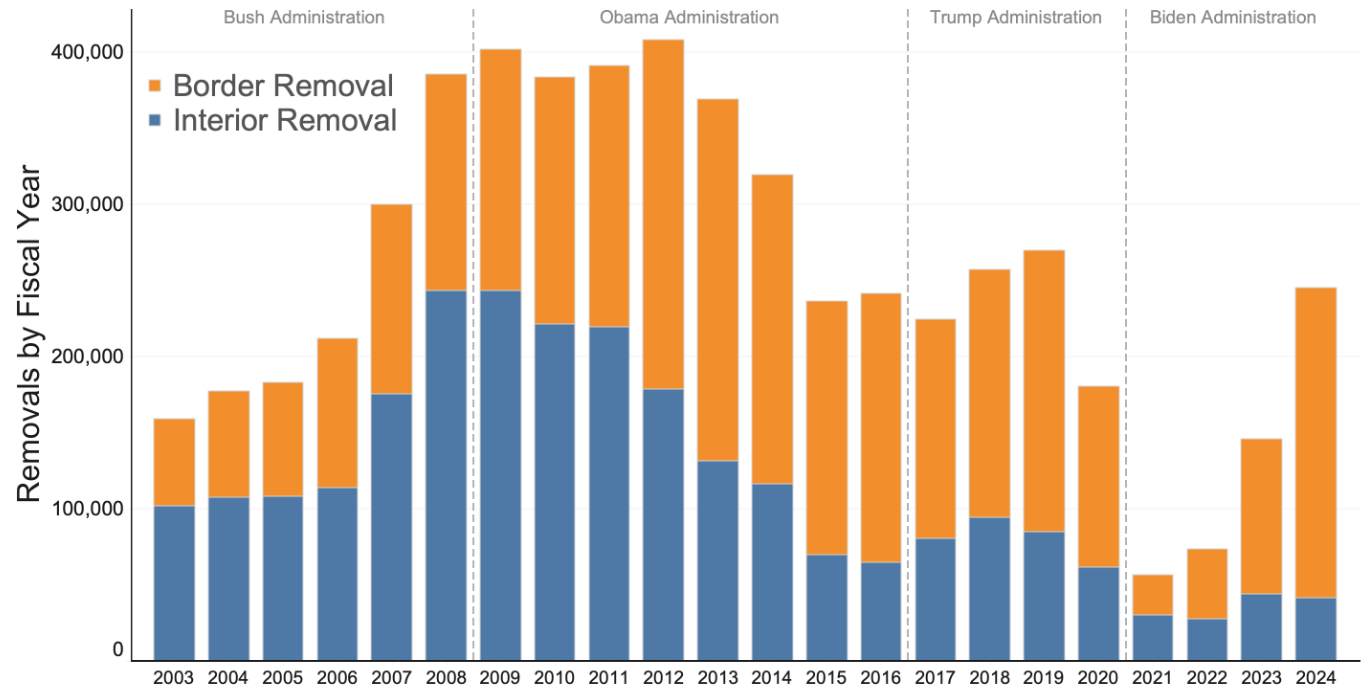
    Looking at the big picture, the Trump government’s focus on immigrant crime, the push to allow express deportation without due process, the search for host countries like El Salvador willing to accept those being expelled, and the treatment of individuals like Abrego García, all seem to point to a sustained attempt to create the institutional architecture needed to allow the fast-track expulsion of large numbers of foreign residents from the country. An important side-issue is that Trump is also pushing back against the judiciary to prevent it applying checks and balances to executive branch. How far or fast this will progress is not clear. The Trump administration has set itself the target of deporting 1m undocumented migrants for each year of his presidency, but in the first nine months of 2025 it is estimated that the number was significantly lower at around only 332,000. The pace of deportations is picking up, however, rising to 1,500 a day, a level not seen since the presidency of Trump’s Democratic Party predecessor Barrack Obama (2009-2017) who, according to the New York Times, earned himself the nickname of “deporter in chief”. In fact, in fiscal year 2019 during the Obama administration, 974,000 migrants were deported, a number which has not been exceeded in any year since.

    The outcome of the legal battles over the Alien Enemies Act and of next year’s mid-term congressional elections are likely to significantly influence the pace of future deportations. According to the Department of Homeland Security deportations are set to surge because of a big increase in the budget for ICE – up to US$76bn in the next fiscal year – that was voted through as part of Trump’s “One big beautiful bill”. Among other things ICE’s fleet of aircraft is being expanded to allow for more deportation flights.

    Deportation from interior and border enforcement (2023-2024

    Notes: “Border” refers to removals initiated as arrests by Customs and Border Protection, usually near the border. “Interior” refers to the removals initiated as ICE arrests, typically in the interior. Data for 2024 is extrapolated from first five months of FY24)

    Source: The Transactional Records Access Clearing House (TRAC) at Syracuse University

  • Is there a connection between crime and migration?

    Abbi Dicker 11 September 2025 Hits: 1126

    Over the last decade many Latin American politicians have successfully attracted voters by appealing to citizen concerns over inward migration, safety, and crime. The issue has also loomed large in the United States where two-time President Donald Trump has used it to his advantage, for example by appealing to nativism, extending the border wall between the US and Mexico, and, as we have seen, by preparing the ground for mass deportations. Many populist politicians have reaped benefits from promoting mano dura (iron fist) anti-crime and anti-immigration policies.

    An examination of opinion polls around the region shows that concerns over crime and migration are widespread, but also that attitudes can be quite complex and even contradictory. In Chile, according to the National Urban Citizen Security Survey (ENUSC) of 2022, 70% of respondents believe that migrants increase crime rates. Nearly 75% of respondents have a worse opinion of migrants who have arrived in the country in the last five years, compared to those who arrived earlier. A total of 51% of respondents believe that less than half of migrants are respecting local law. Despite this however, 76% of respondents report experiencing positive personal interactions with migrants.

    According to a Reforma–Washington Post survey conducted in Mexico in 2019, only 7% of respondents support giving residency to Central American migrants, with a larger group – 33% - saying they would be open to temporary stays. A majority – 55% - favours deporting undocumented migrants. A slightly narrower majority – 51% - supports using the National Guard to deter illegal migration. More than 60% of respondents say migrants take jobs and benefits that should go to Mexicans.

    An earlier Mexican poll, conducted in 2018 for newspaper El Universal, found that 64.5% of respondents feel that the presence of Central American migrants increases violence or unemployment. In a follow-up poll that proportion increases to 73%. A total of 56% say the president should take tougher action against migrants and 58% oppose migration from Central America.

    A multi-country survey by Gallup International found that in most countries in Latin America there is a net negative attitude towards immigration (negative views exceeding positive views). This was the case in Ecuador (net support of -53%), Colombia (-34%), Brazil and Panama (both -11%) and Argentina (-3%). The exceptions in this survey were Mexico and Peru which had net positive views.

    A 2023 report by the InterAmerican Development Bank (IADB) found that security remains the most prevalent issue in public discussion “confirming that host societies’ attitudes are strongly influenced by the belief that the arrival of migrants leads to an increase in crime and delinquency”. The report analysed social media platforms and found that 22% of the conversations were “xenophobic tweets” (defined as messages containing discriminatory language targeting migrants).

    A 2022 survey for the Lloyd’s Register ‘World Risk Poll’ found that more than 43% of people from Latin America and the Caribbean believe that crime and violence is the greatest threat to their safety, while over one-third (37%) would permanently move to another country. In countries such as Venezuela (60%), Ecuador (50%), Argentina (49%), Colombia (47%), and Mexico (46%) crime was seen as the top threat.

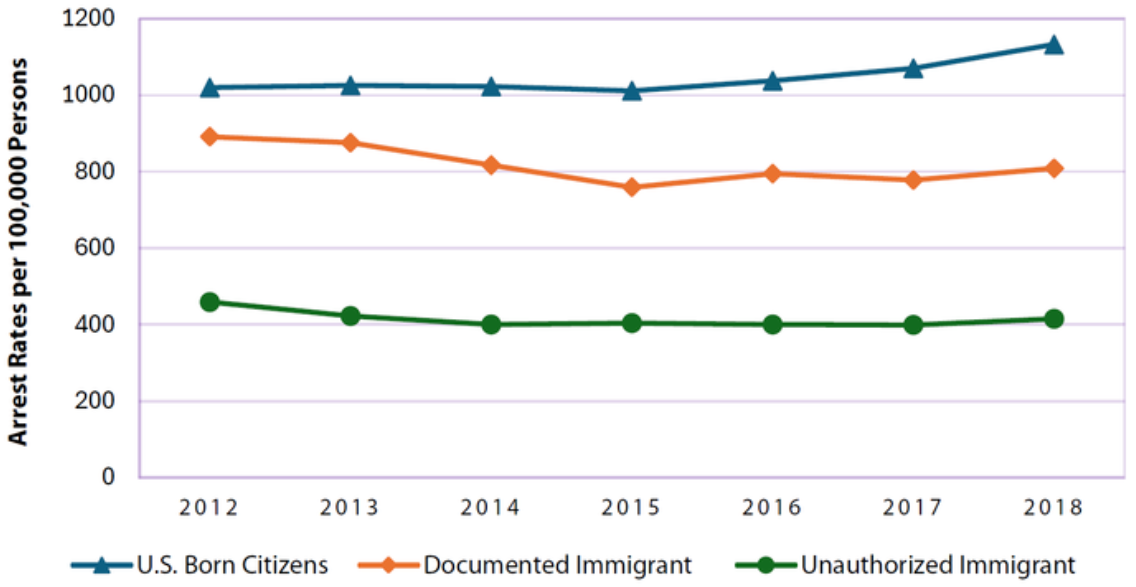
    In contrast to the public view, there is significant evidence questioning whether immigrants are indeed more likely to commit crimes than the general population. In October 2024 a report for the US think tank Migration Policy Initiative (MPI) concluded that “Immigrants in the United States commit crimes at lower rates than the US population, notwithstanding the assertion by critics that immigration is linked to high rates of criminal activity”. The conclusion was in part reached by analysing data from Texas, the only state that records criminal arrests and convictions by immigration status.

    This showed that the arrest rates per 100,000 inhabitants were consistently higher for US-born citizens than for immigrants, whether documented or not. The report also cited official data from 2020 showing immigrants were 60% less likely to be incarcerated than the US born. In addition, nearly 90% of immigrant prosecutions are for violations of immigration-related laws. US-born citizens are ten times more likely than immigrants to be incarcerated for weapons-related offences, five times more likely for violent offences, more than twice as likely for property crimes, and twice as likely for drug offences,  

    Texas Study: Overall Offending Rates by Citizenship and Legal Status

    Source: Migration Policy Institute

  • Conclusion: answering four key questions

    Abbi Dicker 11 September 2025 Hits: 1285

    By way of conclusion, it is worth asking – and seeking to answer - four questions that have run through most of the narrative of this report.

    Does the Tren de Aragua exist? The answer is yes, definitely so. Over the last decade multiple sources, testimonies, news outlets, and events have all confirmed the organisation’s presence and growth in Venezuela and neighbouring countries. There is also convincing evidence of Venezuelan government complicity in the Tren’s activities, including the contract killing of Ronald Ojeda.

    It is also true that no organisation lasts forever and that the Tren suffered a serious setback in 2023 when the Venezuelan government changed position and raided its headquarters in Tocorón prison. The future for the Tren is therefore uncertain. It may be able to rebuild its operations, move its headquarters to Bolívar state and reassert central control of its subsidiary cells in Colombia, Peru, and Chile. On the other hand, however, those cells may fragment and become independent, changing their name along the way. Indeed, the Tren may choose to rebrand itself entirely, adopting a new name for the whole operation.

    Is the Tren de Aragua invading the United States? Emphatically no. Neither is the Cartel de los Soles, another Venezuelan cartel identified by Trump. The reality is that it has suited President Trump to talk up the threat posed by the TdA and the Cartel de los Soles, to create a sense of national emergency so as to meet the criteria for invoking the Alien Enemies Act of 1798, itself seen as key to firing up the mass deportations that Trump promised during the election campaign.

    US law enforcement agencies say the Tren is present in many cities and states, including El Paso, New York, Chicago, Texas, and Colorado and is involved in drug dealing, theft, sextortion, and shootings. But running criminal operations in another country falls well short of the dictionary definition for invading it. The Tren’s criminal US presence is in any case much smaller than, for example, that of Mexico’s Sinaloa or CJNG cartels. There has been much media coverage of Tren activity in the city of Aurora, Colorado, but this has involved around 12 people in a city of 400,000. According to the Washington Post, a National Intelligence Council (NIC) assessment earlier this year found that the Venezuelan government was not directing an invasion of the United States by the TdA prison gang.

    Is immigration driving up crime rates in Latin America? The best short answer is “it depends”. The forced mass exodus of Venezuelans after 2014 clearly created opportunities for criminal groups like the Tren to exploit their vulnerability as they sought refuge in other countries, cashing in on people trafficking and extortion, and from there diversifying into other criminal activities.

    However, there is no evidence of a strong and underlying link between migration and increased crime, a talking point much loved by a whole generation of Latin American populist politicians. The available research for countries like Chile, Peru, and Colombia is that immigrants commit fewer crimes than those who are native born, proportionate to population. The situation is complex; there are a number of factors in play and this may yet change. But with general elections due in all three of those countries in the next 12 months, and nationalist sentiment on the rise, it is likely that many politicians will continue to wrongly assert that immigration raises crime rates.

    Will the US begin mass deportations of Latin Americans? Probably yes. As we have seen, deportations have increased in the second Trump presidency, but they still fall short of an ambitious target of 1m a year. Stepping up deportations was an election promise which still seems to attract support: 57% in July according to a Marquette University poll (although this was down from 68% in March). The Republican congress is supportive, and the ICE budget has been boosted. However, the courts may still impose legal restrictions on the kind of express deportations the administration is seeking, and depending on his wider performance, Trump could lose next year’s mid-term elections turning one, or both houses of congress against him.