Trump, Venezuela, and what’s to come

Items

  • The end of an era?

    Patrick de Courcy 18 February 2026 Hits: 1571

    At round 2am local time in the morning of 3 January this year, a force of some 150 US military aircraft used bombs and missiles to attack a series of targets in Caracas and outlying areas, clearing the way for approximately 200 Special Forces troops to come in by helicopter, surround a presidential compound at a military base in the capital, and capture President Nicolás Maduro and his wife Celia Flores. Despite armed resistance by his Venezuelan and Cuban bodyguards, Maduro surrendered; by 3.29 am he and his wife were extracted by aircraft and transferred to the USS Iwo Jima, part of a naval task force stationed in the south Caribbean. The next day Maduro and Flores were taken to a New York court where they were indicted on charges of narco-terrorism conspiracy, cocaine trafficking, and possession of firearms, which they denied. The next hearing in the case is due in March. The operation to extract them from Venezuela, and bring them to a US court, codenamed Absolute Resolve, was widely deemed to have been a success.

    While the US government has released limited information on the operation, President Donald Trump said it had been a “perfectly executed” expression of American military power. US Government officials praised a “precision operation” and noted that no US lives were lost. Venezuela’s interior minister said around 100 people had died, a number that includes 32 Cuban military and intelligence personnel.

    A subsequent report from the US-based think tank, Centre for Strategic and International Studies (CSIS), using commercial satellite images, found battle damage at four main military bases around Caracas: the Fort Tiuna Military Complex, La Carlota Air Base, La Guaira Port, and El Higuerote Airport. It also found evidence of a series of coordinated attacks on Venezuelan air defence units to create space for a safe helicopter entrance corridor. From this, CSIS concluded it had been an operation which was “laser focused” on the capture of Maduro with “minimal collateral damage” and, as such, very unlike the broad shock-and-awe US air attacks in Iraq in 1991 and 2003. Incidentally, CSIS also concluded that levels of preparation in the National Bolivarian Armed Forces of Venezuela (FANB) were low, with no defensive mobile deployment of Russian-made air defence units; this may have been explained by the use of electronic warfare techniques by the attacking forces to disrupt communications.

    Any complex military operation of this type is by nature high risk. Many still remember the failed helicopter rescue attempt to extract US hostages from Iran in 1980, which led to the mission being aborted and to the death of eight members of the US military. This time, according to off-the-record military sources cited by the New York Times, the first helicopter in the US attack formation, an MH-47 Chinook, was hit by ground fire and one of its two pilots was seriously wounded. The giant helicopter struggled to stay airborne. Had it crashed, the fate of the entire mission would have hung in the balance. But it was still able to continue airborne. The soldiers it was carrying joined the others to seize Maduro, who had been trying to escape to a steel reinforced room in the compound. All helicopters returned intact.

    The CSIS report acknowledge that the successful extraction of Maduro is far from the end of the story. Backed by its military capabilities, the US administration has put Vice President Delcy Rodríguez into office to replace Maduro, and President Trump has in effect said he is “running Venezuela” himself pending plans to stabilise the country. CSIS said the objectives of Operation Absolute Resolve include “getting Venezuela to cut its ties to malign external actors like Cuba, Russia, China, and Iran”; to increase oil production; reduce illegal immigration to the United States; eliminate drug exports; and improve the treatment of the population. Secretary of State Marco Rubio’s version of the objectives are, first, to stabilise the country, then to assist with its economic recovery, and finally to hold elections and support the emergence a new democratic leadership. To date, Trump and other officials have announced no firm commitments or timescales for restoring democracy.

    An important point is that Trump campaigned in the 2024 elections on a promise to end US involvement in “forever wars” in places like Iraq, Syria, and Afghanistan. There is also a large body of evidence that suggests the US became bogged down in Iraq because it lacked a coherent security plan and opted not to work with some of the remnants of the old regime. The approach in Venezuela has been radically different, with a clear attempt to limit US boots on the ground (as it happened, US boots were on the ground for only around 3-4 hours). The military operation was less of an invasion and more of a decapitation of a hostile regime. That said, the US could still find itself getting dangerously entangled in Venezuela, as well as in other countries in the hemisphere. We will return to this point later in the report.
  • Is the Monroe Doctrine coming back?

    Patrick de Courcy 18 February 2026 Hits: 817

    There is a case to be made that the events in Caracas on 3 January represent a fundamental shift, a turning point or watershed, in relations between Latin America and the United States, with the countries of Latin America and the Caribbean having to cope with a deep change in the US foreign policy stance. Under Trump the US administration is becoming more interventionist, more interested in the undisguised assertion of power in its sphere of influence, more focused on self-interest (captured by the MAGA slogan – Make America Great Again), more preoccupied with reducing crime and migration, less democratic, and more protectionist. The 3 January mission to decapitate the Venezuelan government stands out as a milestone on that journey. In this report we will be looking at other examples and referring to US strategy and foreign policy documents that help understand the change that is taking place.

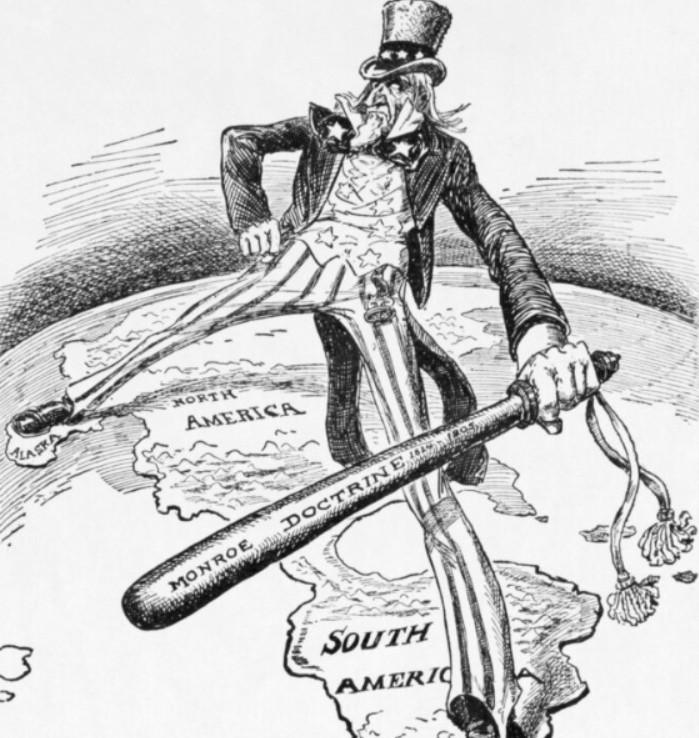
    One approach is to ask if the Monroe Doctrine, or some modernised version of it, is now coming back into play. In 1823 US President James Monroe presented congress with a declaration of foreign policy intent that was later to become known as the Monroe Doctrine. The original text was composed of only a few paragraphs in the president’s seventh annual message to congress. These warned European powers not to interfere in the Western Hemisphere, stating that “the American continents…are henceforth not to be considered as subjects for future colonisation by any European powers”. The document was written amid concern over Spanish efforts to re-colonise the hemisphere as well as worries over the expansionist postures being taken at that time by Britain, Russia, France, and others.

    Uncle Sam and the Monroe Doctrine

    Source: Louis Dalrymple

    The Monroe Doctrine became a key component of US foreign policy, which pledged that the US would not intervene in Europe and would, on the other hand, view any European attacks on its hemispheric neighbours as aggression against itself. The doctrine came to be summarised as “America for the Americans” or as part of a geopolitical view in which Latin America and the Caribbean were seen as forming the backyard of the United States. US President Theodore Roosevelt (1901-1909) gave the doctrine a harder edge, declaring in 1904 that the US had the right and responsibility as an “international police power” to curb “chronic wrongdoing” in the hemisphere such as fiscal insolvency and civil unrest. This was widely seen as an assertion of US power in its sphere of influence in the western hemisphere.

    Another Roosevelt, President Franklin D Roosevelt (1933-1945), also tweaked the doctrine, giving it a more democratic gloss by acknowledging the rights of self-determination, non-interference, and mutual respect in the region in what he described as a Good Neighbour policy. The creation of the Organisation of American States (OAS) in 1948 and President John F Kennedy’s (1961-1963) Alliance for Progress also sought a leadership role - by consent - for the US to promote economic development, democracy, and multilateralism across the Western Hemisphere.

    In the eyes of many nationalists and left-leaning politicians in Latin America the Monroe Doctrine, despite its good intentions, in its various manifestations has been a tool of outright US hegemony, used to justify multiple military interventions. In this regard the US has a long track record. Writing earlier this year in ReVista - the Harvard Review of Latin America - John Coatsworth noted that between 1898 and 1994 (nearly a century) the US intervened 41 times in Latin America and the Caribbean, removing and replacing governments it disliked. In 17 of the 41 cases there was direct intervention using military force. In 24 cases the US played a more indirect role. Some of the more notorious cases include the US-backed coups in Guatemala in 1954 and Chile in 1973.

    One blunt deduction from these statistics is to note that, on average over the last century, the US has invaded a Latin American or Caribbean neighbour roughly once every six years. However, in recent decades, supported by the spread of democratic governments in the region and a widespread recognition of the value of sovereignty, multilateralism, and self-determination, the US appeared to have become notably less interventionist. At 37 years, the gap between the US invasion of Panama to oust President Manuel Noriega (1989) and the strike on Caracas which removed Maduro (2026) is well above the six-year average. But this 37-year lull may turn out to be a high-water mark for US non-interventionism. It is possible that the time gap between US invasions or interventions will now likely begin to shorten again as the US under Trump becomes more interventionist and hegemonic while governments in the region struggle to contain increasing complex threats to democratic stability (among them crime and climate change).

    Trump has spoken quite frequently of his support for the Mondore Doctrine. During his first presidency, in his September 2018 speech to the UN General Assembly, he said: “It has been the formal policy of our country since President Monroe that we reject the interference of foreign nations in this hemisphere.” He has identified Russia and China as external threats to the Western Hemisphere similar in some ways to the threat posed by Europe when the Monroe Doctrine was first formulated. Between the two Trump administrations the conservative Heritage Foundation (which produced a much-quoted policy document known as Project 2025) called for a “rejuvenation” of the Monroe Doctrine. In comments to journalists after the operation to extract Maduro, the US President jokingly referred to a “Trump Corollary” to the concept, styling it as a “Donroe Doctrine” (after his Christian name Donald).

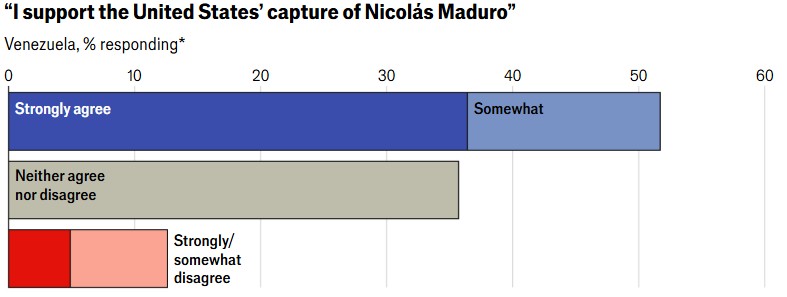
    *600 respondents

    Source: Premise/The Economist, 9th-13th January 2026

  • Boats and tankers under threat

    Patrick de Courcy 18 February 2026 Hits: 687

    Other forms of US military pressure against Venezuela preceded and ran in tandem with Maduro’s ouster under Operation Ultimate Resolve. There were two main components. One was a series of attacks to destroy so-called ‘go fast boats’, high-powered speed boats navigating in international waters in the Caribbean and in the Pacific and allegedly used for transporting drugs. According to the official narrative these boats were, and still are, being used by transnational criminal groups for the purposes of drug and people trafficking into the US. Many of these criminal groups had earlier been designated by the Trump administration as foreign terrorist organisations (FTOs). Part of the administration’s rationale for capturing Maduro was the claim that he was directly involved in FTO activities threatening US interests. The US Navy also seized several Venezuelan oil tankers for allegedly violating long-standing US-imposed oil sanctions. US officials, including the president, said that revenue from sanctioned oil sales would be controlled by the US government.

    As an example of these ongoing operations, on 23 January US Southern Command reported it had struck a boat in the eastern Pacific, killing two of its crew (a third survived). The navy said the boat had been sailing along a “known narco-trafficking route”. By late January, after four months of these US strikes, a total of 36 boats had been destroyed, with the death toll of crew standing at 125. The US government claims the strikes are part of the lawful pursuit of organised criminals. However, many legal experts reject that view saying that in the absence of due legal process – including the right to trial in a court of law – the deaths must be considered unlawful extrajudicial killings. Opposition members of the US Congress believe they also may be considered war crimes.

    Writing for the UK-based Royal United Services Institute (RUSI) analysts Gil Guerra and Emma Isabella Sage say Trump’s justification for military attacks against presumed Venezuelan cartels “is testing the limits of US law and policy…and in this case the end may not justify the means”. They note that the administration’s case is internally inconsistent, the target is amorphous, and there is no clear end-state.

    One inconsistency is the claim that Venezuela is a major source of drugs entering the US. In fact, according to the US-compiled Consolidated Counterdrug Database, around 210 tonnes of cocaine transit Venezuela each year on the way to the US, representing less than 10% of the total volume entering that county every year. In fact, about 90% of cocaine entering the US every year does so via Colombia and Mexico.

    The RUSI experts add that bypassing the US congress while seeking to ratchet up military pressure on Venezuela is a high-risk approach. The US president might find himself unwittingly escalating a “special military operation” into a “small war” at a time when his supporters question the “forever wars” pursued by his predecessors and his popularity is under pressure ahead of upcoming mid-term elections. Mistakes – such as unintended civilian deaths caused by US military action – could lead to escalation. Tellingly, the authors say that despite legitimate reasons to intervene in Iraq, the US and its allies sought to base the war on the unproven presence of weapons of mass destruction. When that proved false, support for the war collapsed. They argue a similar story could play out in Venezuela, with the White House using “exaggerated narratives” to portray criminal gangs as terrorist groups. “When that narrative inevitably unravels under scrutiny, the administration will have squandered credibility it could have spent on more defensible interventions” the authors conclude.

  • The big picture; US national security strategy (NSS)

    Patrick de Courcy 18 February 2026 Hits: 619

    In November 2025 the US State Department and intelligence agencies completed work on a new document summing up the country’s National Security Strategy (NSS). The NSS is updated around every four years, reflecting the thinking of successive administrations. The 2025 version was released in early December, almost exactly a month before the launch of Operation Absolute Resolve. It is unlikely that that publication of the NSS triggered the subsequent military operation against Venezuela only 30 days later, but the NSS did set out some fundamental shifts in US attitudes to national security and those changes influenced and informed the planning and execution of Absolute Resolve.

    The 2025 NSS attracted widespread comment and controversy. Secretary of State Marco Rubio said he had written much of the text. Analysts noted that US great power rivalry with China and Russia – a dominant theme in earlier reports – is now played down with passing references to “managing European relations with Russia” and the need to “rebalance America’s economic relationship with China”. In contrast to the reduced emphasis on superpower rivalry and virtual silence on the Russian-Ukrainian war, there was a much higher than usual emphasis on the Western Hemisphere and other issues closer to home (such as trade, migration, and crime). The document also stands out for its unusually stark attacks on Europe, saying that the continent faces economic decline and “civilizational erasure”.

    Unlike earlier editions, the tone of the 2025 NSS is often aggressive and adversarial. It accuses the country’s elites of badly miscalculating the domestic populations’ willingness “to shoulder forever global burdens” saying that “they placed hugely misguided and destructive bets on globalism and so-called ‘free trade’ that hollowed out the very middle class and industrial base on which American and economic and military pre-eminence depend”. The new strategy, the document says, should answer three questions: what does the US want, what are the means to getting it, and how can ends and means be connected?

    In terms of the ultimate objectives these are characterised as “the continued survival and safety of the United States as an independent, sovereign republic whose government secures the God-given natural rights of its citizens and prioritises their well-being and interests”. Much of the details that follow is familiar from Trump’s many speeches and comments: protection from invasion, full control of borders, reduction of inward migration, a resilient infrastructure, modernised nuclear capabilities including a Golden Dome missile defence system, and aspirational statements such as “We want the world’s strongest, most dynamic, most innovative and most advanced economy”. There is also a commitment to further develop soft power and to the “restoration and reinvigoration” of American spiritual and cultural health.

    An NSS paragraph on US security strategy in the Western Hemisphere states:

    “We want to ensure that the Western Hemisphere remains reasonably stable and well-governed enough to prevent and discourage mass migration to the United States; we want a Hemisphere whose governments cooperate with us against narco-terrorists, cartels, and other transnational criminal organizations; we want a Hemisphere that remains free of hostile foreign incursion or ownership of key assets, and that supports critical supply chains; and we want to ensure our continued access to key strategic locations. In other words, we will assert and enforce a ‘Trump Corollary’ to the Monroe Doctrine.”

    Elsewhere and in relation to the Western Hemisphere the document states “we will deny non-hemispheric competitors the ability to position forces or other threatening capabilities, or to own or control strategically vital assets in our hemisphere,” a comment seen as referring to China (which is not mentioned by name throughout the document).

    The NSS calls for four steps relating to military dispositions in the Western Hemisphere. These are, first, an increased presence relative to other lower priority theatres of operation; second, a more “suitable” Navy and Coast Guard presence to fight drug and people trafficking; third, targeted border deployments to fight criminal cartels “including where necessary the use of lethal force to replace the failed law enforcement-only strategy of the last several decades”; and, fourth, establishing or expanding access to strategically important locations.

    In terms of the means necessary to achieve strategic objectives the document highlights the country’s “most enviable position with world leading assets and advantages” in areas such as military strength, the economy, energy, technology, and soft power. In the section on bringing means and ends together there is extended praise for President Trump (listing multiple claims that are also familiar from his own speeches and press conferences). In flattering mode, the NSS states “President Trump uses unconventional diplomacy, America’s military might, and economic leverage to surgically extinguish embers of division between nuclear-capable nations and violent wars caused by centuries-long hatred”.

    The document acknowledges the principle of non-interventionism but provides its own escape clause, should it be needed, stating flatly that “for a country whose interests are as numerous and diverse as ours, rigid adherence to non-interventionism is not possible”. It also plays down the importance of promoting democratic values. In its words the US will “reward and encourage the regions’ governments, political parties, and movements broadly aligned with our principles and strategy…But we must not overlook governments with different outlooks with whom we nevertheless share interests and who want to work with us.”

    In late January the US government published the National Defence Strategy (NDS), a sister document to the NSS compiled by the Pentagon. This stated that the US will offer “more limited” support to its traditional allies than in the past, and that its main priorities lie in the Western Hemisphere rather than in competing in Asia against China. The document says that relations with China are to be approached “through strength, not confrontation”. Russia, which invaded Ukraine in 2022, is described as a “persistent but manageable threat to Nato’s eastern members”. Within the Western Hemisphere the NDS takes up one of Trump’s recurring themes, the demand to annex or at least control strategic territories. The text states the Pentagon “will guarantee US military and commercial access to key terrain”, especially the Panama Canal, Gulf of America, and Greenland. However, there is no mention in this instance of Canada, which Trump also says say should become part of the US.

  • China maintains LAC focus

    Patrick de Courcy 18 February 2026 Hits: 847

    Coincidentally with the publication of these documents, the Chinese government published its own Latin America and the Caribbean (LAC) strategy paper in December giving a clear signal that it intends to continue expanding its footprint in the Western Hemisphere. It outlines five programmes for building a China-LAC community as follows: they are Solidarity, Development, Civilisation; Peace; and People-to-People Connectivity. The Solidarity programme, for example, covers political and international collaboration, but also requires LAC partner countries to recognise the One China policy which prevents recognition of Taiwan as an independent country.

    The Development programme is the longest, covering economic and commercial relations. Under that heading China commits to “share [the] development opportunities of Chinese modernisation”. It sets out an expansive agenda of cooperation in finance, energy, infrastructure, manufacturing, agriculture, food security, science, and technology. Artificial intelligence (AI) and other hi-tech sectors such as aviation, aerospace, and semiconductors are also mentioned as fields for collaboration. US analysts have warned that China intends to expand dual-use infrastructure in the region, combining civilian and commercial use with potential military and strategic applications. China’s LAC partners are being encouraged to join the Beidou Navigation Satellite system and to build an associated development centre. The paper also notes Beijing is looking to partnerships to build logistics supply bases for China’s Antarctic expedition.

    The Chinese strategy paper stands on its own merits, but it can also be seen, in part at least, as responding to the earlier US NSS publication. From Beijing’s point of view the most worrying aspect of the NSS is its commitment to build a military capable of denying aggression anywhere in the First Island chain (which includes Okinawa, Taiwan, and northern Philippines). According to think tank CSIS many analysts believe that by stepping up the Chinese presence in LAC, Beijing is highlighting its willingness to push back against the US globally and on matters relating to its core interest – asserting its claim to Taiwan.

    A total of seven LAC countries still have diplomatic relations with Taiwan, rather than with the mainland Peoples’ Republic of China (PRC). They are Belize, Guatemala, Haiti, Paraguay, Saint Kitts and Nevis, Saint Lucia, and Saint Vincent and the Grenadines. The language of the Chinese LAC strategy paper suggests Beijing will continue its carrot and stick policy to try and flip some on the list, persuading them to break with Taipei and recognise Beijing instead. Since 2016 nine LAC countries have flipped in that way to recognise the PRC. China’s current efforts in this regard are likely to prioritise Guatemala and Paraguay.

    The Beijing government was quick off the mark to reject US military action in Venezuela. On 5 January foreign ministry spokesperson Lin Jian told a press conference that the US action “is in clear violation of international law, basic norms in international relations, and the purposes and principles of the UN Charter”. Beijing called on the US to release President Maduro and his wife. Lin called on parties involved in the Venezuelan crisis to “respect Venezuela’s right to independently choose its development path, and work for stability and the return of order”.

  • Trump’s use of tariffs

    Patrick de Courcy 18 February 2026 Hits: 785

    Donald Trump has for many years supported protectionist economic policies and opposed globalisation. The novelty of the first year of his second term in office is that he sought to pursue these protectionist and nationalist policies much more aggressively than had been expected, and as means to exert undisguised political leverage against both diplomatic friends and foes alike. In short, import tariffs have been turned into diplomatic weapons.

    In January 2025 an initial skirmish was fought with Colombia. The left-leaning government of Gustavo Petro refused landing rights to two US military aircraft which, on the orders of the new US administration, were deporting Colombian undocumented migrant workers. President Trump threatened to apply an immediate 25% tariff on all imports of Colombian goods into the United States, causing Petro to back down.

    Trump also began applying punitive 25% tariffs on Mexican and Canadian goods, demanding that their governments should tighten border security and interrupt the flow of illicit drugs, such as fentanyl. To give some time for negotiation, the measure was paused for a month but implemented as of March. The Mexico City and Ottawa administrations criticised Washington’s unilateral action which they said was also a violation of the three countries’ USMCA free trade agreement.

    On 2 April 2025, described by Trump as “liberation day”, the president unilaterally imposed “reciprocal” tariffs on 90 countries. Despite the essentially false claim of reciprocity, the tariffs were set by the US government using a rather crude formula which aimed to eliminate the deficits in US trade with its partners. The announcement triggered a stock market fall and unleashed a trade war between the US and China. It has been calculated that because of “liberation day” average US import tariffs rose from 2.4% in 2024 to 18.6% in 2025. In the Western Hemisphere, Mexico and Canada benefited from a USMCA exemption but still had to pay higher tariffs on some products. At a global level Trump justified these big increases saying they are necessary to reduce a widening US trade deficit with the rest of the world (US$904bn in 2024, nearly double its value in 2016). However, if Mexico is excluded there was actually a US$106bn US surplus in its trade with LAC, putting the economic rationale for the exercise in doubt.

    It is also evident that many of the key decisions are political. Most of Latin America now must pay a 10% tariff, but in August Trump imposed a punitive 50% tariff rate on Brazilian products. This reflected Washington’s essentially political demands that the Brazilian Supreme Court should drop the trial of former president Jair Bolsonaro (2019-2023) a close ally of the US president. The US also imposed visa and other restrictions on the chief justice of the Brazilian Supreme Court, not only for presiding over the Bolsonaro trial, but for ordering restrictions on US-owned social media networks. 

  • Latin America swings to the right

    Patrick de Courcy 18 February 2026 Hits: 655

    This year, several important Latin American countries are changing political direction. Analysts have in the past argued that Latin America experienced a pink tide – a swing to the left -- in the first decade of the 21st century. By the 2020s a more conservative approach had already begun to spread through the region, favouring not only traditional, establishment parties, but also more far-right, outsider or anti-system politicians.

    Ideology is not the only explanation for the swings. In the early part of this century the commodities boom gave governments of the day, which happened to be left-wing, extra income to redistribute for social programmes and poverty reduction. This helped boost the appeal and extend the incumbency of those governments and political movements, but it eventually dried up, introducing a period of economic austerity. More recently, worries over corruption, crime, and security have tended to favour right-leaning political parties who have begun to notch up significant electoral victories. Some analysts say that a core of angry citizens now vote against incumbent administrations, whether they are of the left or the right. But the fact remains that between mid-2025 and the end of 2026, a period of 18 months, there will have been eight presidential or prime ministerial elections across Latin America. At the time of writing no less than five of those elections have been held, resulting in a swing to the right. Three will be held during the rest of this year (Peru, Colombia, and Brazil). The right appears poised to mount a strong challenge in each of those three countries.

    Ready to move to the right?

    Country

    Date

    Election/commentary

    Bolivia

    17 August 2025

    After two decades of leftist rule by the Movimiento al Socialismo (MAS), Rodrigo Paz, a political centrist, wins the presidential race on the second ballot held on 19 October

    Guyana

    1 September 2025

    Irfan Ali is re-elected at the head of the Peoples’ Progressive Party (PPP) – ready to work more closely with Washington on security and oil issues

    Argentina

    26 October 2025

    The party of far-right President Javier Milei wins decisive victory in mid-term elections. The US provides critical financial assistance.

    Ecuador

    16 November 2025

    Incumbent right-wing President Daniel Noboa suffers a setback when his plans for constitutional reform and authorisation of foreign military bases are rejected by over 60% of voters in a referendum.

    Honduras

    30 November 2025

    Incumbent LIBRE left wing coalition is heavily defeated in general elections. Amid recounts and claims of fraud presidential victory is contested between Salvador Nasralla (centre) and Nasry Asfura (right).

    Chile

    14 December 2025

    The far-right candidate, José Antonio Kast, wins the second-round ballot defeating Jeannette Jara, who represents the incumbent leftwing coalition

    Costa Rica

    1 February 2026

    Laura Fernández, the centre-right “continuity candidate” wins a landslide victory.

    Peru

    12 April 2026

    General elections in Peru. Presidential race still in early stages but opinion polls show former far-right mayor of Lima Rafael López Aliaga, centre-right Mario Vizcarra, and populist right Keiko Fujimori leading a wide field

    Colombia

    31 May 2026

    The ‘total peace’ strategy of the incumbent left-wing coalition led by President Gustavo Petro has failed, with increasing levels of violence paving the way for a possible swing to the right in the May general elections. Left winger Iván Cepeda was leading the race in late 2025 but strong challenges are being mounted by Abelardo de la Espriella from the hard right and Sergio Fajardo in the centre.

    Brazil

    4 October 2026

    Brazil has the largest population and economy in Latin America and its political choices are influential. Now centre-left incumbent Luiz Inácio Lula da Silva is leading in the opinion polls to win what would be a fourth presidential term. Despite in-fighting. Strong far-right and centrist challenges are expected.


    Evan Ellis, a defence specialist at the US based Centre for Strategic & International Studies (CSIS) argues that the likely emergence of a group of governments aligned with, and interested in strengthening, relations with the United States presents Washington with “enormous strategic opportunities”. He argues that the shift to US-friendly governments is not directly a response to US foreign policy but is being driven by domestic factors including “bad experience with past left-leaning regimes and apprehension about new ones”.

    Ellis plays down the impact of Trump’s strong-arm tactics. He says “receptivity to the United States has benefited greatly from the massive political shift in the region, a phenomenon largely unrelated to the new US policies and tone, and arguably despite them…There is no guarantee that this fortuitous coincidence of political conditions will persist, and reasons to worry that it might not.” In fact Ellis believes that the aggressive Trump style is likely to be counter-productive in the long term, and, as an unintended consequence, potentially opens the door to greater Chinese influence in the region. He calls on the US and receptive Latin American countries to build a partnership based on the idea that “investing in a secure prosperous region with strong and democratic institutions is fundamental to inoculating the region against criminals, terrorists, populist authoritarians and extra-regional adversaries”.  

  • 2026: a year of heightened risk

    Patrick de Courcy 18 February 2026 Hits: 614

    One way of assessing the change in circumstances that is happening in Latin America and the Caribbean is to look at it from the perspective of heightened political risk and uncertainty. Many LAC governments have reason to be fearful about the way the Trump agenda is playing out in the Western Hemisphere.

    Putting it bluntly, the risk of direct US military intervention has increased quite sharply, not least thanks to the revival of the Monroe Doctrine. The attack on Caracas and the capture of President Maduro came with a clear warning that something similar could, if deemed necessary, happen elsewhere in the region. The Trump government and its predecessors have for long opposed the authoritarian left-wing regimes of Venezuela, Cuba, and Nicaragua. Venezuela, as we have seen, has now been put under Washington’s control with the force of arms. Cuba’s economy meanwhile is in a state of collapse, and the US is cutting off oil supplies to further increase the pressure on the ruling Communist Party. US officials have avoided talking about regime change, but some form of limited military strike against either Cuban or Nicaraguan targets, justified as a necessary targeting of drug trafficking cartels and their “terrorist” activities, cannot be ruled out. A year ago, such a policy would have been considered unthinkable; now the probability is small but is still definitely more than zero.

    There is also a previously unimaginable, but now more-than-zero chance of US military strikes against Mexico and Colombia. In terms of GDP and population these are two of the largest countries in the LAC region, after Brazil. They also have had long-term strategic partnerships with Washington including close cooperation to try and cut off illicit drug flows entering the US. Both are democracies and are highly active in regional diplomacy. However, those credentials have not been sufficient to prevent a stream of US officials talking openly to the press about potential US strikes on cartel targets in both countries. There have been briefings about potential military operations on Mexican soil against the drug cartels, a unilateral action, and one where prior Mexican permission would not necessarily be sought. On 8 January this year, for example, President Trump told Fox News that US ground operations in Mexico were possible. He said, “we are going to start now hitting land, with regards to the cartels…the cartels are running Mexico”.

    Similar comments were made about Colombia. After the US military operation to seize Maduro in Venezuela, the US president appeared to hint that something similar might happen in Colombia. Without citing any supporting evidence Trump said Colombia was “run by a sick man who likes making cocaine and selling it to the United States. And he’s not going to be doing it very long, let me tell you.”

    As 2026 progresses Latin American governments also face an unusually high level of ongoing uncertainty over the application of US tariffs. Those countries that are highly dependent on exporting to the US are most exposed to potentially sharp falls in revenues if Washington imposes new tariffs at short notice – something which, as we have seen, can been triggered by transactional political considerations. The most exposed to tariff/trade risks include Mexico (around 80% of Mexican exports go to the US, equivalent to 28%-31% of GDP) but also the Central American economies such as Honduras, Costa Rica, Guatemala, and El Salvador.

    Latin American countries are particularly exposed during election years. One example of the Trump administration’s electoral bullying came during the Honduran presidential elections of November 2025. In contrast with the tradition of observing diplomatic neutrality during elections, Trump publicly endorsed right-winger Nasry ‘Tito’ Asfura, one of the three presidential front runners. The US president described Asfura as “the man who is standing up for democracy and fighting against Maduro”, while dismissing the other two front runners as either “working with the Communists” or being a “borderline Communist” that could not be trusted. The US president threatened to cut off economic aid to Honduras if Asfura was not elected. Days before the election Trump also pardoned Juan Orlando Hernández (2014-2022), a former president from Asfura’s party, who was serving a 45-year sentence in a US on drug and arms smuggling charges. Asfura went on to be declared the winner by a very narrow margin and amid multiple claims of electoral fraud.

  • What chances of a nationalist backlash?

    Patrick de Courcy 18 February 2026 Hits: 635

    Nationalism and anti-American sentiments have traditionally run high in Latin America and the Caribbean, at least partly in response to the application of the Monroe Doctrine in its most imperialist forms. The response to the armed operation to extract Maduro gives some sense of how the faultlines in regional diplomacy currently lie. As might be expected the authoritarian left-wing governments of Cuba and Nicaragua rejected the incursion. Cuba’s President Miguel Diaz-Canel accused the US of a “criminal attack” and of practising a form of “state terrorism”. Nicaragua condemned the strike and called for Maduro’s immediate release. Broadly speaking the response of many of the other governments has been influenced by their sense of frustration with Maduro who consistently rejected their efforts to reach a political settlement to solve the Venezuelan conflict and whose disastrous policies forced millions of Venezuelans to emigrate, burdening the social programmes of neighbouring countries. In short many were happy to see Maduro’s back, even though they had mixed feelings over the method of his departure.

    The response from the democratic left-wing governments of Brazil, Mexico, and Colombia was also to condemn the US action but to do so using more diplomatic language. On the other hand, a number of countries that have aligned themselves with the US under Trump praised it: these included Argentina, El Salvador, and Ecuador. Argentina’s President Javier Milei accused Maduro of clinging to power and of “rigging elections” saying his departure was “excellent news for the free world”. Ecuador’s right wing President Daniel Noboa posted on social media: “To all the narco-chavista criminals, your time is coming. Your structure will completely collapse across the entire continent.”

    Mexico’s reaction was carefully worded. It did not mention the US by name, stating in general terms that “intervention has never brought democracy, never generated prosperity and never created lasting stability”. The Mexican foreign ministry did sign a joint rejection of the action, along with Brazil, Colombia, Uruguay, and Spain, but it did not post the document on its website. Brazil was more direct and upfront in its condemnation: the incident, it said was “yet another extremely dangerous precedent”. Brazil nevertheless acknowledged the need for a balanced relationship with Washington. Celso Amorim, the Brazilian president’s chief foreign policy advisor, told the New York Times “of course we want to have good relations with the United States. It is a very important country in every sense. But there is no way to avoid condemning this action.” President Petro of Colombia, who has had a volatile and adversarial relationship with Trump, much of which has played out on social media, said the US had “kidnapped” Maduro adding “no one in their right mind would bomb the homeland of Bolívar” [the nineteenth century hero of the wars of independence against Spain].

    A poll conducted by mobile phone in Venezuela by The Economist and Premise in January (immediately after the military operation) found that the removal of Maduro was highly popular. A total of roughly 50% of respondents supported the operation, 35% were neutral, and 13% opposed it. More than half said their opinion of the United States had improved because of the operation. The results must be assessed with caution, of course, since things could yet change and potential conflicts may still emerge. For example, two-thirds believe new presidential elections should be held, and 91% of them want the polls to be held within a year. The US government may prove to be out of step with these sentiments since it has made no firm commitment on when elections will be held. And while 45% of respondents say they will vote for opposition leader María Corina Machado, only 10% express support for the US-appointed interim President Delcy Rodríguez. The post-Maduro honeymoon period may not last as long as Washington has been hoping.

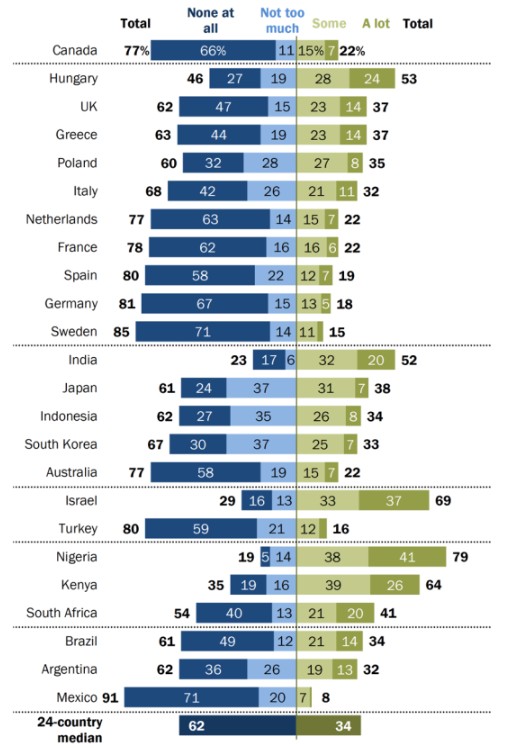
    In contrast to these short-term results for Venezuela, at regional level available polls show Donald Trump remains unpopular. US think tank Pew Research Centre measured confidence in Donald Trump as a world leader across 24 countries in 2025 and found that 62% were not confident of his ability “to do the right thing regarding world affairs” while 34% took the opposing view. Three Latin American countries were included in the survey. Those not confident in Trump were 61% in Brazil, 62% in Argentina (both close to the global average), and a large outlying 91% in Mexico. In general confidence in Trump is higher among men (43% to 27% in Brazil) and among those who identify as right-wing.

    Confidence in Trump as a world leader

    % who have confidence in U.S. President Donald Trump to do the right thing regarding world affairs

    Note: Those who did not answer or said “Never heard of this person” are not shown

    Source: Pew Research Center, Confidence in Trump in 24 Nations, Spring 2025 Global Attitudes Survey

    Could there be a nationalist and anti-Yankee turn in public sentiment in the next few years? Such a reaction cannot be excluded, nor can its opposite. As we have suggested, domestic politics may be the key driver. As well as seeking economic security, voters have been looking for a reduction in crime, corruption, and immigration. A generation of populist politicians have promised to deliver quick results in these areas. With some variations, their agenda in their different countries is similar to Trump’s in the United States. It follows that if they are highly successful their popularity ratings will rise further and regional support for Trump will also increase.

    But a much more problematic scenario is also possible. Turning round crime and corruption is a complex challenge that requires extra resources, new policies, and significant time. A militarised version of the War on Drugs has been underway for decades in various parts of the region – particularly in Colombia and Mexico – and is widely considered to have failed. At the moment, despite a relatively new president pushing hard line policies in Ecuador, levels of violence there also remain very high. Only El Salvador under Nayib Bukele’s authoritarian rule claims to have brought the homicide rate to near zero, but it has done so at the cost of undermining civil liberties and enforcing mass incarceration. It is also not clear whether the Salvadorean experience is exportable.

    On a one-to-two-year time horizon, slow or insufficient progress improving security could be a blow to this new generation of right-leaning populist leaders, reducing their standing in the opinion polls. Some of Donald Trump’s high-profile interventions might also backfire. If there are future military interventions it is not guaranteed that they will all be as precise and accurate as the Caracas raid. It is not impossible for a US strike against cartel bases in Mexico or Colombia to go bad, for example by causing unintended civilian deaths which might turn opinion dramatically against Trump. It is worth noting that on a smaller scale Trump’s temporary punitive tariffs levied against Brazil, set at 50% and initially introduced in August 2025, were politically counterproductive for him and were eventually rolled back by Washington. Trump’s officials had been wrong-footed by a rally-round-the-flag effect. President Lula da Silva, seen as defending the national interest against arbitrary action by a meddling superpower, benefited from rising approval rates. The far right, led by Trump ally and former president Jair Bolsonaro (2019-2023), also lost ground because it was cast as being unpatriotic, supporting a foreign power that was actively causing economic difficulties for Brazilian companies.

  • Examining the future (1): Mexico

    Patrick de Courcy 18 February 2026 Hits: 891

    Mexico will play a key role in Western Hemisphere relations over the next few years. In terms of population, territory, and GDP, Mexico is one of the largest countries in the LAC region, after Brazil. However, unlike Brazil, Mexico also shares a long 3,145kms border with the United States. Through the nearshoring of manufacturing businesses it is closely integrated with the US economy. This makes both countries strategic partners, whether their politicians like it or not. Bilateral relations cover a wide range of issues including both legal and undocumented migration, crime and drug trafficking, employment, and manufacturing.

    Trump’s initial political successes in the US came from populist attacks on Mexico and Mexicans, who were according to him associated with corruption, crime, job losses, and de-industrialisation in the US, as well as various forms of cultural erosion. In Trump’s first presidency the border wall was extended as a symbolic attempt to shut out foreigners. Since then, there have been further nativist policies, including large scale deportations of undocumented Mexicans and increasing threats of military action against Mexican drug cartels

    Mexico’s President Claudia Sheinbaum took office in 2024 after comfortably winning mid-year elections at the head of her left-wing political party, Movimiento de Renovación Nacional (Morena). Mexican presidents have six-year terms so barring anything unforeseen Sheinbaum will be in office until 2030. In the interim there will be US mid-term congressional elections this year (November) with Trump’s four-year term ending in January 2029.

    Despite her party’s tradition of leftwing nationalism Sheinbaum has made a name for herself for responding to Trump’s demands calmly and pragmatically while seeking to keep what she describes as a “cool head”. One example: after Trump told Fox News in January that the US was considering “ground operations” in Mexico to hit the cartels, Sheinbaum said “There will be nothing of the sort in Mexico, that’s President Trump’s way of speaking. We have a relationship based on cooperation and collaboration, not subordination. We have always said no to these operations.” Sheinbaum also cited a bilateral security agreement signed with Secretary of State Marco Rubio in September last year which “guides our actions on both sides of the border; each country has its own tasks to accomplish on its own territory”.

    That said, the Mexican president is likely to remain under constant pressure from a more assertive US. A hardline on Mexico has become electorally necessary in the eyes of the MAGA movement. On the other hand, reducing the violence of the criminal cartels which have embedded themselves in Mexican society for three decades or more is a difficult task, and not one easily solvable though surgical US missile strikes or other largely performative activities. The US is itself of course a significant part of the problem because its massive retail consumption of cocaine and other drugs turns production and trafficking into super-profitable activities for the Mexican cartels. A further factor of complexity is that Mexico, Canada, and the US are due to renegotiate their USMCA free trade agreement this year. During negotiations the Trump administration may seek further protectionist and tariff increases, ratcheting up uncertainty among Mexico-based businesses and investors.

    Sheinbaum remains popular (with an approval rate still above 70%) and, with national elections not due until four years’ time, she has some political room for manoeuvre. That said, economic growth is sluggish, criminal groups remain strong, and Trump-related uncertainty is high: this increases the possibility that Mexico may become exasperated and that its stance on bilateral relations will harden sharply at some point in the coming years. A US military strike on Mexican territory is likely to be a red line for Sheinbaum. If it happens it could trigger a surge in ani-Yankee sentiment and major diplomatic crisis.

  • Examining the future (2): Brazil

    Patrick de Courcy 18 February 2026 Hits: 727

    Brazil has the largest economy and population of Latin America. It has traditionally aspired to lead the region and has campaigned to win a permanent seat on the UN Security Council. General elections are due to be held in October this year. The race remains open, but current polls suggest that the incumbent centre-left president, Luíz Inácio Lula da Silva, is set to win re-election to what would be his fourth four-year presidential term. On the far-right Lula has been opposed by former president Jair Bolsonaro (2019-2023) a close political associate and family friend of Donald Trump’s. Bolsonaro is currently banned from running for public office since he was found guilty last year by the Supreme Court of conspiring against democracy and given a long (27 year) prison sentence. At the moment one of his sons, Flavio Bolsonaro, is due to stand as his proxy in the presidential race, but that may change as various right-leaning individuals and political parties are discussing potential coalitions.

    Perhaps unlike other countries in the region Brazil stands out because of the close ideological and personal links between the Trump and Bolsonaro families. There are remarkable similarities in the recent political history of both countries. Trump supporters (January 2021) and bolsonaristas (January 2023) have attacked and broken into the headquarters of the legislative powers in each country. Both Trump and Bolsonaro have, without credible evidence, pronounced recent elections in their countries (in which they were the losers) to be rigged and fraudulent. Both have faced multiple claims of conspiring against democracy and committing acts of corruption. However, Trump has fared better at the hands of the US courts than Bolsonaro did before the Brazilian ones: he survived two impeachment attempts and other court cases to run for, and win, a second presidency. Bolsonaro on the other hand was found guilty of plotting a coup d’etat and sentenced to 27 years in prison, which he is currently serving at a penitentiary in Brasília. He is therefore out of the running for a second presidency.

    From the point of view of Lula and his officials the largest threat is that the bolsonaristas may seek to disrupt and undermine the 2026 elections. Relations between Trump and Lula have improved as the two countries have toned down their dispute over punitive tariffs and over other issues such as social media regulation. But Trump might still intervene to destabilise the election campaign, along the lines of how he did during last year’s Honduran election.

    If Lula is victorious in October US-Brazil relations are likely to follow along their current course: the diplomatic mood music will be broadly positive but the two governments will remain on opposing sides in relation to a number of important issues, including trade, multilateralism, Chinese influence, and the role of the Global South (through associations such as the Brics group). A win for the bolsonarista right on the other hand, will likely increase political uncertainty and polarisation at home. It will also give added momentum to the swing to the right across the region, creating fertile conditions for joint military action against drug cartels and for further tightening of borders.

  • Examining the future (3): Colombia

    Patrick de Courcy 18 February 2026 Hits: 558

    Colombia depends less on the US economy than Mexico, but it has long standing military and security links with Washington. Colombia is the world’s top producer of coca, the leaf used to manufacture cocaine. It also has one of the largest armies in the region, with direct experience of combat after decades of conflict with various types of armed rebel groups. In fact, the country remains home to Latin America’s longest lasting guerrilla insurgencies. During the presidency of Bill Clinton in the 1990s the US government signed a strategic military cooperation agreement known as Plan Colombia, which allocated around US$10bn to develop counterinsurgency, drug crop eradication, and the strengthening of the state’s presence around the country. Despite that history of collaboration, Trump has favoured an adversarial approach to left wing Colombian president, Gustavo Petro, now in the last of his four-year presidential term.

    Petro has had a volatile, largely social media-based relationship with Donald Trump. In September last year the US withdrew Petro’s travel visa after the Colombian leader took part in a pro-Palestinian demonstration in New York. In October Trump called Petro an “illegal drug leader’”. After US strikes on suspected Colombian drug trafficking boats Petro accused Trump of committing “murder”. In January, after US forces captured Venezuelan president Nicolás Maduro, Petro said the US was guilty of kidnapping. Trump responded by saying that Petro should “watch his ass”. On 4 January Trump threatened Colombia with military action, eliciting a 677-word social media response from Petro claiming he would “take up arms” if needed.

    Despite these verbal fireworks the two men had what they described as a “cordial” meeting in Washington on 3 February. They said they had agreed to work together to counter narcotics flows from Colombia into the US. Petro said he asked Trump for help to capture drug cartel leaders living outside Colombia. The US president said they had also discussed economic sanctions and collaboration to market Venezuelan gas.

    General elections are due to be held on 31 May. Petro cannot stand for re-election because of term limits, but his leftwing coalition is supporting former senator Iván Cepeda, who is currently one of the front runners according to opinion polls. The other front running candidate is a far-right political outsider, Abelardo De La Espriella. Also still in with a chance are the centrist former mayor of Medellín Sergio Fajardo, and a representative of the traditional right, Paloma Valencia. If Cepeda, who is widely seen as less volatile than his mentor Petro, wins he will face multiple challenges. Peace talks with various rebel groups are stalled. The Petro government is unpopular with business. There is also bad blood between the outgoing president and congress. Cepeda might struggle to develop an effective anti-cartel policy that can attract US support and persuade Trump to shelve his threats of military intervention.

    While centrists Fajardo and Valencia might achieve a more constructive dialogue with the US on drugs and crime, they are significantly down in the presidential race ranking. the real surprise could come from De La Espriella, a lawyer who supports hard line security measures, harsher sentencing, and building more prisons. He has promised to break diplomatic relations with Cuba and Nicaragua. He champions traditional family values and opposes the ideas of gender identity, abortion, and feminism. He has publicly praised Trump.

  • Conclusion: the year of uncertainty

    Patrick de Courcy 18 February 2026 Hits: 680

    Based on the ground covered in this report it is possible to reach various future-looking conclusions

    • President Donald Trump has become, and will continue to be, more interventionist and unpredictable, as he applies an updated Monroe Doctrine across the LAC region.
    • Latin American governments will continue to be threatened by US economic sanctions if they fail to meet Trump’s demands for action on migration and crime.
    • Following US military intervention in Venezuela in early 2025, further limited strikes against cartel targets in different countries remain a possibility within the next 12-24 months
    • In the last year and a half, amid anger over crime and corruption, Latin American voters have swung round to elect politicians of the populist right.
    • These new governments are likely to have initially good relations with the administration in Washington, but Trump’s transactional approach to politics and ideological differences within the right will feed into persisting uncertainty.
    • Resolving underlying issues of crime, violence, drug trafficking, and corruption is likely to require sustained long-term policy efforts, stretching beyond Trump’s time in office. It will be difficult to maintain the necessary political coalitions to keep it going.
    • Four key countries are likely to shape LAC security and political relations with the US in the next year: they are post-Maduro Venezuela, Mexico, Brazil, and Colombia.
    • A period of regional turbulence in US-LAC relations will have the unintended consequence of promoting China as a more reliable economic partner.
    • Mexico will remain under intense US pressure, likely focused on talks this year with Canada to review the functioning of the USMCA free trade agreement.