
Who's competing for power in 2019?

Items

  • Introduction

    LatinNews 07 January 2019 Hits: 4918

    El Salvador’s presidential election on 3 February represents an opportunity for Nayib Bukele, of Gran Alianza por la Unidad Nacional (Gana), to end the dominance of the country’s traditional parties. Bukele has galvanised support through dissociating himself from the political establishment.

    Guyana will face a general election by 21 March (subject to legal challenge). On 21 December 2018, the current coalition government lost a no-confidence vote in parliament by 33-32 votes after one member crossed the floor. Under the constitution, elections have to be held within 90 days. With the promise of vast wealth from new-found oil, the new regime could find itself in a strong position for the foreseeable future. In May, Panama will go to the polls in presidential, legislative, mayoral and local government elections. On 2 October last the local media released a survey on voting intentions which showed Laurentino Cortizo, a former agriculture minister (2004-2006) of the opposition Partido Revolucionario Democrático (PRD), as the current favourite, with between 39%-42% support. Whoever wins the presidential race, they will be under pressure from the start to demonstrate progress in tackling public corruption, a key voter concern. Guatemala will see elections in June for a new president, a new legislature, and 333 new mayors. Guatemala’s political class remains badly discredited due to the various corruption scandals to have emerged in recent years. Incumbent President Jimmy Morales won the 2015 election on the ticket of the Frente de Convergencia Nacional (FCN-Nación) on the back of his pledge “Not corrupt, not a thief”. But so far, Morales’ promises have rung hollow, and with no clear frontrunner the issue of corruption will continue a primary issue for prospective presidents.

    October will see a raft of elections across the region. Argentina will elect a new president and legislature, and the direction the ballot will take will depend on incumbent president Mauricio Macri’s ability to show the electorate that his policies are succeeding in turning around the country’s economic fortunes. Macri could face a determined challenge from former president Cristina Fernandez (2007-2015). Also in October, Bolivia will elect a new president and legislature. Incumbent President Evo Morales (Movimiento al Socialismo, MAS) will have another tilt at the presidency, despite the constitution barring him from running, and a 2016 referendum suggesting the population stand behind the constitutional ban. Court rulings have given him permission to stand again, however, and a divided opposition means he stands a good chance. Still in October, Haiti will face national legislative elections. Haiti is determined to hold its legislative elections in October, in an attempt at a semblance of normality in a country where electoral processes are usually characterised by uncertainty and interruptions (the last protracted electoral cycle stretched over a year and a half amid delays caused by fraud allegations and natural disasters). Uruguay’s 27 October presidential and legislative elections could see an end of the rule of the Frente Amplio (FA). Although no presidential candidate will be announced until the nationwide primaries have been held on 30 June, a range of polls from late 2018 show that the centre-right opposition Partido Nacional (PN) stands a good chance of defeating the ruling FA, a broad coalition of centre-left to left-wing parties. This would bring about a swing to the right in Uruguay where the FA has held the presidency since 2005, arguably the most successful of the ‘pink tide’ governments that came to power in the region at the turn of the century.
  • El Salvador: Bukele favourite to end FMLN-Arena dominance

    LatinNews 07 January 2019 Hits: 2424

    Date: 03 February 2019

    Type: Presidential

    Main contenders: Nayib Bukele, Gran Alianza por la Unidad Nacional (Gana); Juan Carlos Calleja, Alianza Republicana Nacionalista (Arena), Partido de Conciliación Nacional (PCN), and Partido Demócrata Cristiano (PDC); and Hugo Martínez, Frente Farabundo Martí para la Liberación Nacional (FMLN).

    Nayib Bukele, 37, is in a strong position to end the political duopoly of the ruling left-wing FMLN and main opposition right-wing Arena stretching back to 1989. Thirty years on, Bukele, the former mayor of San Salvador (2015-2018) has a strong following on social media, especially among the younger generation disillusioned with the long hegemony of the country’s two main political parties. He has galvanised support through dissociating himself from the political establishment, leading to an acrimonious fallout with the FMLN, which ejected him from the party in 2017 for “verbal aggression” towards a councillor.

    Bukele went on to form a leftist party Nuevas Ideas which he attempted to register before the supreme electoral tribunal (TSE) to contest the presidency. The TSE barred Nuevas Ideas from competing in the elections, however, on the grounds that it had failed to meet the party registration requirements. Bukele then sought to run on the ticket of the left-wing Cambio Democrático (CD) but when the TSE also blocked this party from competing, he accepted the presidential candidacy of the right-of-centre Gana despite ideological differences and his previous criticism of the country’s principal political parties. Gana, a moderate offshoot of Arena formed in 2010, is the third-largest party in El Salvador.

    Bukele, not unlike other ‘outsiders’ in Latin American presidential elections, is thriving on his criticism of the establishment. He will have to reach some kind of accommodation with it if he is to govern, however, as Gana only has 10 deputies in the 84-seat legislative assembly, where Arena (37) and its allies the PCN (nine) and PDC (three) have a resounding majority. With the next legislative elections not until 2021, a hostile legislature could block his agenda. This could lead to political confrontation, with Bukele trying to pressure (or even bypass) the legislature through the exercise of popular power by staging popular consultations. Bukele could also struggle to fill his cabinet.

    Bukele has by far the largest social media following of the presidential candidates and he has demonstrated a willingness to use this to apply pressure to the country’s state institutions. On 6 December he urged his followers on Twitter to march on the TSE headquarters denouncing electoral fraud in what turned out to be a mix-up over party colours on ballot papers. Scores of supporters heeded Bukele’s call and some burst into the TSE building. Bukele’s rivals censured him but he refused to drop his allegations against the TSE, even when Gana completely distanced itself from him over the incident, although he did stress his support for only peaceful demonstrations.

    Without mentioning Bukele by name, Hugo Martínez has warned against taking “a leap in the dark [as a result of which] we could lose everything”. The FMLN candidate has presented a campaign manifesto, ‘Por un país Mejor’, promising, inter alia, more investment in education and the creation of a special inspectorate within the national police force (PNC) to guarantee respect for the human rights of young Salvadoreans and reduce stigmatisation. This is an acknowledgement of growing evidence that many youths are being mistreated by the PNC, wrongly suspected of belonging to mara gangs. Martínez has refused, however, to renew a dialogue process with the mara gangs: “would you talk with someone who has killed 20 people? Would you feel comfortable? Would you let them use your car, bicycle? Some of the leaders of these gangs, who are no longer young, have turned crime into an industry.”

    Martínez has sought to project a different image of his party after its abject defeat in municipal and legislative elections in March 2018. A former foreign minister, Martínez says he is the most politically experienced of the three presidential candidates but this could be part of the problem. Voter sentiment suggests a desire for change after nearly 10 years of FMLN governments. Martínez is languishing in third in the opinion polls. He is refusing to discuss alliances ahead of a possible second round in March should no candidate win an outright majority on 3 February.

    Juan Carlos Calleja is better-placed in the polls than Martínez but still at some remove from Bukele. His candidacy has not made much of an impression but he could benefit from voter concerns about Bukele’s confrontational tactics, especially among the older generation. Calleja is the vice president of Grupo Calleja, which owns El Salvador’s largest supermarket chain, Súper Selectos. He has sought to broaden Arena’s appeal by insisting that he will put the country and national interest above political ideology and narrow party interests. “The people no longer want solutions from the Left or the Right,” he said during the campaign.

    Calleja cannot be discounted. Arena’s electoral machinery will give him an advantage in terms of getting the vote out when it comes to election day. President Salvador Sánchez Cerén is trying to bolster Martínez’s candidacy with some electoral sweeteners but the FMLN’s popularity has been on the wane for several years and it will be difficult to reverse its fortunes at this late stage. The big question is whether Martínez will endorse Bukele in the event of a possible run-off between the Gana candidate and Calleja in March.

  • Guyana: Winner takes all

    LatinNews 07 January 2019 Hits: 2349

    Date: By 21 March (subject to legal challenge)

    Type: General Election, consisting of concurrent elections for President, National Assembly, and Regional Democratic Councils. The President is the leader of the party that receives the most votes in the National Assembly and Regional elections.

    Main contenders: On 21 December 2018, the coalition government led by President David Granger lost a no-confidence vote in parliament by 33-32 votes after one member crossed the floor. Under the constitution, elections have to be held within 90 days. The outgoing government consists of A Partnership for National Unity (Apnu), of which David Granger’s People’s National Congress Reform (PNCR) is the main component, and the Alliance for Change (AFC). The main opposition party, led by Bharrat Jagdeo, who is barred from standing for a third presidential term, is the People’s Progressive Party/Civic (PPP/C).

    In the 2015 general election, Apnu/AFC won by 33 seats to 32 for the PPP/C, it and also secured the presidency for David Granger with 50.29% of the vote.

    Since the 2015 general election, Guyana has made significant oil discoveries. First Oil is due in 2020, and whichever party is in power then will be able to use oil money and the power of incumbency to entrench its position perhaps for a long time. The PPP/C won five consecutive elections before losing in 2015.

    The central fact of Guyanese politics, which cannot be overstated, is the ethnic divide between those Guyanese of East Indian descent and those of African descent. The 2012 census figures showed that people of East Indian descent make up 39.8% of the population, those of African descent make up 29.2%, and the mixed-race population is 19.9% of the total. Amerindians add a further 10.5%. Apnu is largely supported by the African community, and the PPP/C by the Indian community. The AFC was created to appeal across the ethnic divide.

    But if race remains the unshakeable centrality of Guyanese politics, almost everything else is in flux, starting with the coalition. Apnu and AFC contested the November local elections separately rather than as coalition partners, and as a result the AFC revealed its political weakness by failing to make inroads into PPP/C strongholds (its main purpose as the multi-ethnic component of the coalition) and ended up losing ground in several constituencies where it had performed well in 2011. Since then, the AFC’s position in the coalition has further deteriorated as it was an AFC member (Charrandas Persaud) who defected in the vote of no confidence to give the opposition their victory. Apnu’s difficulties are compounded by President Granger’s ill-health (he is receiving cancer treatment in Cuba).

    The PPP/C has its own difficulties in that leader Bharrat Jagdeo, whose political position has been strengthened by winning the political gamble of holding a no-confidence motion, is constitutionally barred from standing again for the presidency. Whoever does stand in the party’s name will likely be controlled by Jagdeo.

    Overall, the PPP/C seems to be in the stronger position of the two main parties. It has the political wind in its sails, and by advancing the date of the general election from 2020 to 2019 it has cleverly forestalled the coalition’s undoubted intention of loosening the purse strings as the election approaches.

  • Panama: All change again?

    LatinNews 07 January 2019 Hits: 2464

    Date: May 2019

    Type: Presidential, 71 seats in the unicameral legislature, 77 mayors and other local government officials.

    Main presidential contenders: Laurentino Cortizo (Partido Revolucionario Democrático, PRD); Rómulo Roux (Cambio Democrático, CD); José Isabel Blandón Figueroa (Partido Panameñista, PPA); Saúl Méndez (Frente Amplio por la Democracia, FAD); Ana Matilde Gómez (independent).

    With pre-electoral surveys few and far between, on 2 October the local media released a survey on voting intentions by pollster CID-Gallup which showed Laurentino Cortizo, a former agriculture minister (2004-2006) of the opposition PRD as the current favourite, with between 39%-42% support. The PRD, which is running with the smaller Movimiento Liberal Revolucionario Nacionalista (Molirena) as the ‘Uniendo Fuerzas’ alliance ahead of the 2019 vote, last held office in 2004-2009 under former president Martín Torrijos. Second, with 17%-19% backing, was Rómulo Roux, a former foreign minister (2012-2014) under the previous CD government led by former President Ricardo Martinelli (2009-2014) (who was extradited from the US in June 2018 to face charges related to his activities whilst in office). The CD is running in an alliance known as ‘Un Cambio para Despertar’ in conjunction with the CD dissident group Alianza. Third, on between 11%-13%, was Ana Matilde Gómez (an independent) while the PPA’s José Blandón, who is Panama City mayor, was fourth with 6%. The PPA has sealed an electoral alliance, ‘Panamá Podemos’, with the small Partido Popular. The survey, which had a 2.81% error margin, also showed that 34% of the 1,210 respondents said they would vote for the PRD, followed by the CD (21%) and PPA (8%).

    While it is worth pointing out that no government in more than five decades has won immediate re-election in Panama (and the constitution stipulates that a president may not be elected for the same office in the two presidential terms immediately following), the PPA administration led by President Juan Carlos Varela has been unpopular. Indicative of this, Blandón, who has had a good approval rating among Panama City residents, has sought to distance himself from President Varela, saying he neither seeks nor needs the president’s endorsement. As well as Varela’s weakness in the 71-member unicameral legislature which has left him struggling to push through key initiatives (the PPA has just 12 seats to 26 for the PRD and 25 for CD), this lack of popularity stems in large part from his failure to address concerns about public corruption, the leading electoral issue according to the CID-Gallup survey (cited by 30% of respondents). A long-running public complaint, these concerns have intensified under Varela due to the April 2016 ‘Panama Papers’ scandal (when over 11m confidential documents were leaked from the offices of Panama-based offshore law firm Mossack Fonseca) and the scandal involving Brazilian engineering firm Odebrecht which broke in December 2016. This involved reports that, as part of a region-wide scheme, over US$59m was paid in bribes to Panamanian government officials between 2010 and 2014 to secure public works and infrastructure contracts.

    While President Varela himself has faced some uncomfortable questions over the Odebrecht scandal (and calls from the opposition to be investigated), officials from the previous two administrations (CD and PRD) have also been implicated. These include Martinelli’s sons, Ricardo and Luis Enrique Martinelli, arrested in November 2018 in the US on corruption charges. With the political class badly damaged as a result, doubts persist more generally as to how far the other parties are able to convince regarding their pledges to address corruption. Aside from the Odebrecht case, the previous CD government led by President Martinelli – who now faces eight cases before the supreme court (CSJ) on charges related to his time in office – has since faced corruption allegations. In a press release issued following his extradition in June 2018, international NGO Transparency International (TI) estimated that as much as 1% of Panama’s GDP, (some US$600m), may have been lost to various corruption schemes during his presidency. A 2017 TI press release described the “Martinelli proceedings” as one of the world’s emblematic cases of grand corruption. Yet despite all of this, the CD has ratified Martinelli as its candidate for the Panama City mayoralty.

    As regards the two main contenders, while yet to finalise his manifesto, the frontrunner Cortizo has cited the main pillars of his future government as: state of law – to strengthen the justice system and institutions; combatting poverty and inequality; and a creating competitive economy to generate jobs. His strong showing in the polls could stem in part from the fact that it has been a decade since the PRD – Panama’s biggest party with 560,505 members as of April 2018 – were last in office. The focus on public corruption has centred more on the PPA and Martinelli’s administration, although it is worth pointing out that PRD members have also been implicated in the various scandals. Meanwhile Roux has cited as his key priorities: better economic growth and more jobs; citizen security; and better transparency with regard to state administration & integral reforms to the constitution, among other things.

    Economic slowdown

    In the CID-Gallup poll, unemployment and the high cost of living were cited by 18% and 12% of respondents respectively as their biggest concerns. While Panama is one of the fastest growing economies, both in Central America and Latin America as a whole, it has suffered due to a strike in the construction sector at the start of the year. This led the International Monetary Fund (IMF) to announce on 1 June that it was revising Panama’s growth for 2018 down from 5.6% to 4.6%. Yet the IMF press release did note that “the coming on stream of a large copper mine will lead to an upward revision of our growth projection of 5.8 percent in 2019 (by about 1 percentage point)”.

    • Weak legislative presence

    The public is not alone in its perception that corruption would seem to be on the rise in Panama. TI’s most recent (February 2018) Corruption Perceptions Index showed Panama sliding to 96th place out of 180 countries in 2017, down from 87th in 2016. Yet, while below Costa Rica (ranked 38%, up from 41st in 2016) it is worth pointing out that Panama was still above its other Central American neighbours: El Salvador, Guatemala, Honduras, and Nicaragua.

  • Guatemala: No clear frontrunner

    LatinNews 07 January 2019 Hits: 2348

    Date: June 2019. If a presidential candidate fails to win 50% +1 of the votes, a second-round run-off will take place, most likely in August.

    Type: Presidential, legislative (all 158 seats in the unicameral legislature), municipal (333 mayoral seats in 22 departments).

    Main presidential contenders: So far declared are: Sandra Torres (Unidad Nacional de la Esperanza [UNE]); Alejandro Giammattei (Partido Vamos); Zury Ríos (Valor); Fredy Cabrera (Todos); Mauricio Radford (Fuerza). Other newly created parties, such as the centre-left Movimiento Semilla and the peasant-led Movimiento para la Liberación de los Pueblos (MLP), have yet to declare their candidates.

    Guatemala’s political class remains badly discredited due to the various corruption scandals to have emerged in recent years. A well-known comedian and political neophyte, President Jimmy Morales won the 2015 election on the ticket of the Frente de Convergencia Nacional (FCN-Nación) (set up in 2004 by members of the military veterans’ association [Avemilgua]) on the back of his pledge “Not corrupt, not a thief”. President Morales, who defeated former First Lady Sandra Torres (UNE) by 67.44%-32.56% in the run-off, had capitalised on widespread anger over public corruption after President Otto Pérez Molina and his vice president Roxana Baldetti (Partido Patriota [PP], 2012-2015) were forced to quit over a corruption scandal uncovered by the attorney general’s office (AG) and United Nations (UN)-backed anti-impunity commission in Guatemala (Cicig).

    Since taking office however, Morales’s pledge to combat corruption has rung hollow. Following three calls by Cicig for him to be investigated over illegal campaign finance, in August 2018 President Morales said he would not extend Cicig’s mandate when it expires in 2019. Cicig began operating in the country in 2007. President Morales has since refused to allow Cicig’s director Iván Velásquez (who, along with Cicig, enjoys unprecedented levels of support) back in the country after he left for a meeting in the US in September. As well as the accusation of illegal campaign financing, Cicig has also been involved in efforts to prosecute President Morales’ brother and son, respectively Samuel and José Manuel Morales, for corruption.

    A crowded electoral race

    With 26 parties vying for the 2019 June general elections, Guatemala’s party system remains highly fragmented. Many of the new acronyms on the list of registered political parties that can put forward candidates for the 2019 elections are not as new as they seem as a number of parties dissolved by the electoral authorities (TSE) have simply recycled candidates and morphed into ‘new’ organisations with different names. Six parties are currently being dissolved by the TSE for engaging in illicit campaign funding: the ruling FCN-Nación, Encuentro por Guatemala (EG), Compromiso, Renovación y Orden (CREO), Visión con Valores (Viva), Unión del Cambio Nacional (UCN), and Partido de Avanzada Nacional (PAN). Four other parties have already been dissolved for breaking the law: Gran Alianza Nacional (Gana), PP, Libertad Democrática Renovada (Líder), the main opposition party during the 2011 elections, and Corazón Nueva Nación (CNN).

    With the TSE due to formally call the election this month, as yet there have been no pre-electoral surveys for either the presidential or legislative contests. The 158-member unicameral legislature is one of the country’s least-trusted institutions, with political parties considered little more than vehicles for clientelism and private business interests.

    • Dubious behaviour

    One example of recent congress behaviour which has attracted criticism was the approval in October 2018 of changes to the criminal code which, among other things, absolve political parties’ general secretaries of criminal responsibility for illegal electoral campaign funds received by their parties.

    Of the candidates formally declared, the most well-known is Torres. Under the Colom administration, Torres became popular in rural areas after she led a number of social welfare programmes such as the conditional cash transfer programme Mi Familia Progresa. However, the success of many of these programmes was overshadowed by corruption allegations. Colom and several of his cabinet members face trial on corruption charges. In 2013, Torres’ sister, Gloria, one of the UNE’s founders, was also arrested and charged with fraud. Other well-known contenders include Alejandro Giammattei, a former head of the prison service under the Oscar Berger administration (Gana, 2004-2008), running for his political outfit Partido Vamos. Giammattei, who in May 2011 was acquitted of involvement in a criminal ring inside the interior ministry and police, has previously run three times for the presidency for different political parties (in 2007, 2011, 2015). Also well-known is Zury Ríos, the daughter of the late dictator Efraín Ríos Montt [1982-1983]) who was found guilty of genocide and crimes against humanity in 2013 but whose sentence was annulled on a technicality. A far-right politician, Ríos served as a congresswoman for 16 years.

    Of the new parties, one name touted as a possible candidate is former attorney general (AG) Thelma Aldana (2014-2018), who has been credited with significant progress with regard to addressing impunity – not least the landmark case which saw Pérez Molina resign. There has been some speculation that she might run with the new centre-left Movimiento Semilla, which has cultivated good relationships with foreign diplomatic missions as well as the grassroots social organisations that led the 2015 anti-corruption protests that forced out Pérez Molina. If Aldana – who became hugely popular as Cicig’s most important ally – did decide to run as its candidate, the party could suddenly become one of the main contenders in the electoral race.

  • Argentina: The return of Peronism?

    LatinNews 07 January 2019 Hits: 2417

    Date: October 2019

    Type: General election: presidential, legislative.

    Main contenders: Cabiemos coalition (Cambiemos), Propuesta Republicana (PRO), Unión Cívica Radical (UCR), Coalición Cívica para la Afirmación de una República Igualitaria (CC-ARI), Partido Justicialista (PJ, Peronists), Peronismo Federal (PF), Frente Renovador (FR).

    After four years of significant economic turbulence, Argentina’s centre-right ruling Cambiemos coalition is expected to struggle in its attempt to retain the presidency this year. President Mauricio Macri, who has yet to confirm if he will be seeking re-election, had promised that his administration would fix Argentina’s macroeconomic imbalances and return the country to the path of sustainable economic growth. However, 2018 was another dismal economic year for Argentina with sky-high inflation and the domestic economy set to post negative growth. This has opened the door for the political opposition to mount a strong challenge for the presidency should it succeed in uniting behind a charismatic candidate, sparking fears that a populist Peronist leader could once again rise to power by promising a return to state largesse.

    Although President Macri has not confirmed his candidacy it is widely expected that he will seek re-election. Macri is a solid candidate with opinion polls showing that he still enjoys significant public support and that he remains a strong contender for the presidency even if he is unable to win it outright in a first round – where he would need to win 45% of the valid vote or 40% and maintain a ten-percentage point difference over his nearest rival. Pointedly, barring a challenge by a prominent Cambiemos figure such as the popular governor of Buenos Aires province, María Eugenia Vidal, Macri is seen as the most likely presidential candidate for the centre-right ruling coalition. However, whether Macri is successful in retaining the presidency will very much depend on Peronism’s ability to coalesce behind a single presidential candidate.

    • Vidal

    Since becoming the first female to be elected governor of Argentina’s most populous province, Vidal, a member of Macri’s PRO party, has succeed in maintaining high approval ratings of around 46%. This has prompted some speculation that Vidal could seek to contest the Cambiemos presidential nomination given that her approval ratings are currently higher than Macri’s and that opinion polls have found that her candidacy would be supported by as much as 55% of respondents. But Vidal, a close ally of Macri, has repeatedly stated that she has no intention of running for the presidency in 2019 and that her objective is conclude her current gubernatorial term ending in December.

    The Peronists remain deeply divided following their electoral defeat in 2015 after 13 consecutive years of rule by the Frente para la Victoria (FPV, Kirchneristas) leftist-populist party faction. Macri’s 2015 electoral victory has been partly attributed to the stagnant economy resulting from the implementation of unorthodox economic policies by successive Kirchnerista governments, but also due to Peronism’s failure to field a consensus presidential candidate, with the more moderate party factions refusing to back the candidate favoured by then-president Cristina Fernández (2007-2015), who now is a sitting senator. The party is still very much divided along these fault lines, with the more hard-line factions supportive of a new presidential bid by Fernández, who retains a considerable level of public support and who polls currently suggest would push Macri to a second-round vote (which Fernández is projected to lose).

    Meanwhile, moderate Peronist party factions – such as the PF and FR – remain staunchly opposed to another presidential bid by Fernández, who is currently the subject of various corruption investigations. But the moderate PJ factions have so far failed to unite behind a single candidate or even a clear set of policies (including on the economic front). As such, various moderate Peronist leaders including Miguel Ángel Pichetto, the president of the national senate, Juan Manuel Urtubey, the governor of Salta province, Juan Schiaretti, the governor of Córdoba province, and Sergio Massa, a former national deputy and presidential candidate for the FR in 2015, have all mooted their candidacy and called for moderate factions to coalesce around their candidacies. However, so far none of the moderate Peronist presidential hopefuls has succeed in securing the support of any of their rivals.

    The mandatory, simultaneous, and open party primaries (Paso) due to be held in August should help to provide a clearer picture of the situation in the PJ and whether any of the moderate pre-candidates can muster more support than Fernández to secure the PJ’s presidential nomination. Even after the Paso produce a Peronist presidential candidate, be it Fernández or a moderate, he or she will have to work hard to secure the party’s full support if they hope to win the presidency.

    Cambiemos out to consolidate foothold

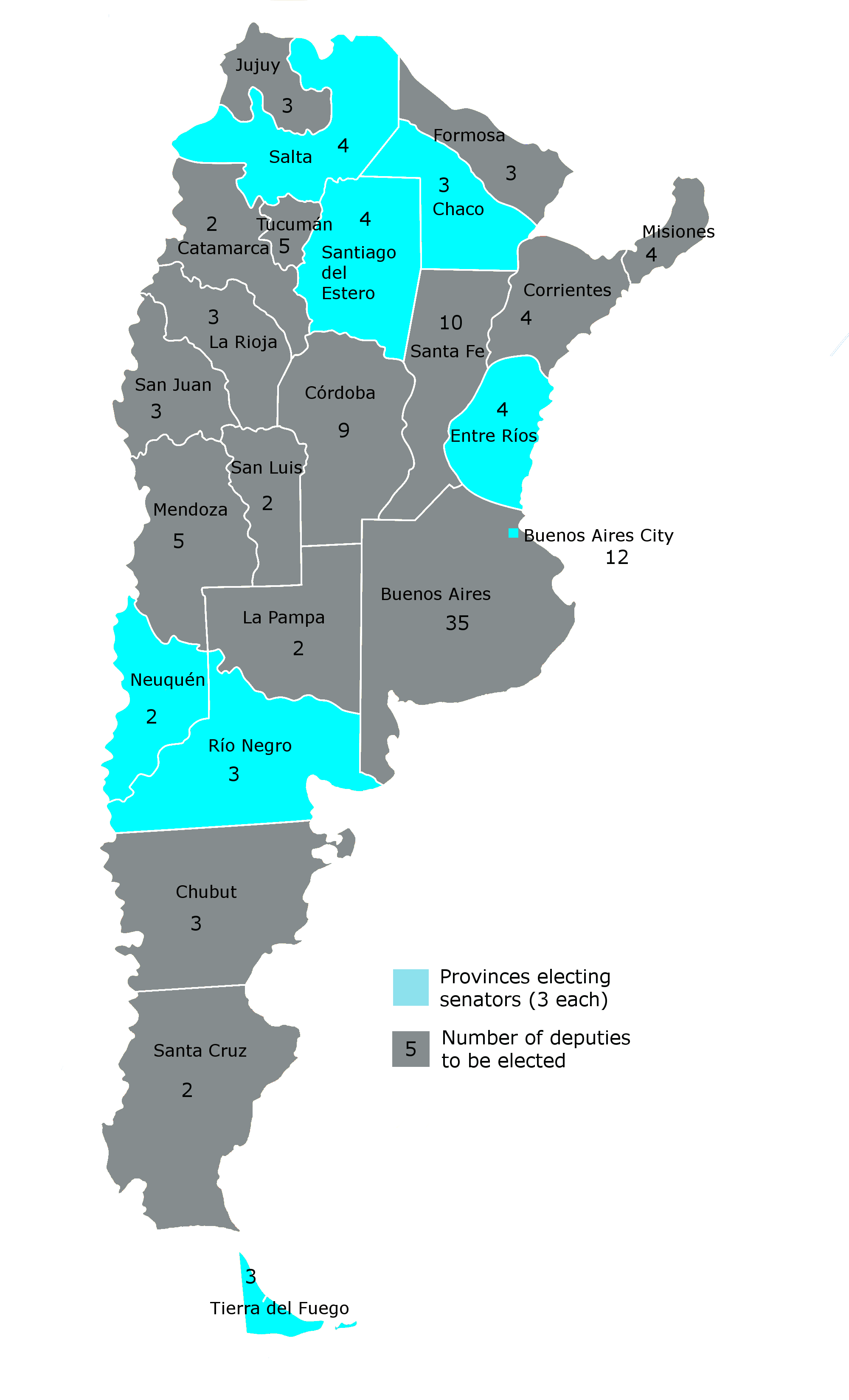
    The federal legislative elections will see over half (130) of the seats in the 257-seat chamber of deputies come up for grabs, as well as one-third (24) of the seats in the 72-seat senate. These elections are seen as posing a big challenge for the ruling coalition, which despite Macri’s victory failed to secure a legislative majority in the 2015 polls (it has 108 seats in the lower chamber and 25 in the upper chamber). It is expected that after four difficult years it will be hard for the Cambiemos member parties – which include Macri’s right-wing PRO, the centre-left UCR, and the centrist CC-ARI – to make significant gains in either chamber.

    The fact that the Macri government has been able to advance its legislative agenda without a majority by relying on the support of moderate PJ factions and the growing divisions within the Cambiemos partners over government policy could lead to a loss in voter support for the ruling coalition. The challenge for the Cambiemos members is thus first to reinforce internal unity first and then convince the electorate that giving it a stronger representation in congress is necessary.

    For Peronism the challenge in the legislative contest is to maintain the clear majority it has in both chambers (136 seats in the lower chamber and 44 in the upper chamber) despite the deep divisions between its radical and moderate factions. Against this backdrop, the conformation of a single legislative candidate list in each province (see map below) will prove to be key for the PJ. Should the rival factions fail to achieve this, then they would risk splitting the Peronist vote and opening the door for other parties to make gains against it. However, achieving this will be no mean feat, not least because many hard-line Peronist political figures still have high rejection rates among the general electorate, while moderate figures are increasingly viewed with distrust and seen as being allied to Macri by many Peronist voters.

    Argentina election map

  • Bolivia: A controversial re-election

    LatinNews 07 January 2019 Hits: 2457

    Date: October 2019

    Type: Presidential, legislative (all 130 seats in the chamber of deputies and all 36 seats in the senate).

    Main presidential contenders: Evo Morales (Movimiento al Socialismo); Carlos Mesa (Comunidad Ciudadana); Oscar Ortiz (Bolivia Dice No); Virginio Lema (Movimiento Nacionalista Revolucionario); Jaime Paz (Partido Demócrata Cristiano); Víctor Hugo Cárdenas (Unidad Cívica Solidaridad); Ruth Nina (Partido Acción Nacional Boliviano); and Félix Patzi (Movimiento Tercer Sistema).

    First elected in 2005 and then re-elected in 2009 and 2014, President Evo Morales is seeking a further term in office. His candidacy however remains controversial. Under the 2009 constitution (passed under his Movimiento al Socialismo [MAS] government) two consecutive re-elections are possible – meaning that technically another term should not be possible. In February 2016 the government staged a popular referendum on whether to change the constitution to allow President Morales to run again which rejected the amendment (by 51.30%-48.70%). Despite this in December 2018 the electoral court (TSE) upheld a ruling by the constitutional court (TCP), issued the previous year, which accepted an appeal by the MAS and allows Morales to seek a further term in office on the grounds that the constitutional ban on re-election violated his political rights.

    The referendum result had marked a watershed moment for President Morales who had hitherto enjoyed high levels of popularity based on his anti-poverty efforts, made possible through revenue from the nationalised hydrocarbons sector which returned to state control after he took office in 2006. Yet amid growing voter disillusionment stemming from various official corruption scandals, his defeat in 2016 owed in large part to an influence-trafficking scandal which implicated him directly, involving his former girlfriend, Gabriela Zapata, and a Chinese company, CAMC (although he has since been vindicated). 

    Although the MAS has yet to publish its official 2019 manifesto, Morales announced at the beginning of 2013 his government’s objectives for the next ten years which included commitments to reduce poverty and inequality; and under the ongoing economic and social development plan for 2016-2020 the intention is to invest US$48.5bn with the aim of reducing inequality and cutting extreme poverty from 17.3% of the population (total 11.2m) in 2014 to 9.5% in 2020 and general poverty from 39.3% to 24% over the same time frame.

    Opposition divided

    While the opposition remains fractured, a key point in common is their opposition to what they see as the growing authoritarianism of the Morales administration, stemming from his insistence on running again, and wider doubts about the independence of the country’s institutions (see below).

    Yet as in recent elections, there is little sign of any unity. One main contender is Comunidad Ciudadana which was forged in October 2018 and comprises the Frente Revolucionario de Izquierda (FRI) and La Paz Mayor Luis Revilla’s Soberanía y Libertad (Sol.bo). Comunidad Ciudadana is fielding former president Carlos Mesa (2003-2005) as its presidential candidate.

    The other main opposition alliance is Bolivia Dice No – an explicit nod to the referendum result – whose presidential candidate is Senator Oscar Ortiz. Launched in November 2018, Bolivia Dice No is a reincarnation of the alliance between Samuel Doria Medina, the leader of the main opposition Unidad Nacional (UN), and Santa Cruz regional governor Ruben Costas, forged in the previous 2014 general election which saw Morales take 61.4% of the vote overall, followed by Doria Medina with 24.23%. Yet, in a sign of continued divisions, two weeks after the Bolivia Dice No alliance was announced, Doria Medina quit, citing “differences of strategy”. He has since said he will back the candidate most likely to defeat Morales.

    The latest electoral surveys offer contradictory messages. A survey published by opposition daily Página Siete on 2 December, which interviewed 800 people and had a 3.5% error margin, showed Mesa on 34% of voting intentions to 29% for Morales. Another pre-electoral poll by Ipsos, published at the end of October, showed Morales ahead on 39% of voting intentions, followed by Mesa on 25%. The survey interviewed 1,000 people and had a 3.1% margin of error.

    Concerns about the TSE

    The TSE has long been subject to concerns about its independence from the MAS, which also controls the legislature with 25 seats in the 36-seat senate and 89 in the 120-seat lower chamber. Furthering these concerns, on 22 October TSE president Katia Uriona resigned, citing doubts about the court’s institutionality. She said it had “reached a stalemate” for decision-making on fundamental issues. Uriona’s resignation followed that of TSE vice president José Luis Exeni, who cited health concerns, at the start of October.  Mesa and other opposition leaders seized on the resignations as evidence of an institutional crisis and indicative of pressure from the MAS. Another former president, Jorge Quiroga (2001-2002), warned that Morales’ “desire” to perpetuate power is “destroying” the TSE.

    Concerns regarding the independence of institutions like the TSE would seem to be backed up by the 2017-2018 Rule of Law Index in January 2018 by the World Justice Project (WJP), an international civil society organisation, which measures rule of law adherence in 113 countries worldwide. The January 2018 report showed that Bolivia dropped two positions for overall rule of law performance (from 104th in the 2016 WJP Rule of Law Index) to 106th out of 113 countries in the 2017-2018 edition. Its score places it in 29th place out of 30 countries in the Latin America and Caribbean region – ahead only of Venezuela.

    • Primaries

    A novelty introduced by a new law on political parties passed at the end of July by the MAS-controlled bicameral national legislature, primaries are due to take place on 27 January to formerly elect presidential slates at a cost of some B$27m (US$3.9m). At the time of the law’s approval, opposition figures like Carlos Mesa complained that the mechanism of holding primaries was designed to provide legitimacy to Morales’ candidacy after the 2016 referendum. Mesa and other opposition candidates have since called for the primaries to be cancelled, arguing that they are a waste of public money and redundant given that the presidential running slates for the political parties registered to vote have already been declared.

  • Haiti: An opportunity for the opposition

    LatinNews 07 January 2019 Hits: 2369

    Date: October 2019

    Election type: National legislative elections, with 10 out of 30 senatorial seats up for election, and all 119 seats in the chamber of deputies.

    Main contenders: Parties in the Alliance des parlementaires pour Haïti (APH) governing coalition: Parti Haïtien Têt Kalé (PHTK), the party of President Jovenel Moïse; Konvansyon Inite Démocratique (KID); Ayiti an aksyon (AAA); Bouclier; Organisation du peuple en lutte (OPL), which has begun to turn against the PHTK. Opposition parties: Vérité; Fanmi Lavalas (FL); Plateforme Pitit Dessalines; Fusion des sociaux-démocrates haïtiens (Fusion); Inité patriyotik.

    Haiti is determined to hold its legislative elections in October, in an attempt at a semblance of normality in a country where electoral processes are usually characterised by uncertainty and interruptions (the last protracted electoral cycle stretched over a year and a half amid delays caused by fraud allegations and natural disasters). President Jovenel Moïse’s PHTK and its allies currently have a comfortable majority in the senate and chamber of deputies, but this majority will be tested in the October elections as the government has been engulfed in a political crisis. Protests over an increase in fuel prices in July led to the resignation of then-Prime Minister Jack Guy Lafontant, and Moïse himself has been facing calls to step down (his term which began in 2017 runs until 2021).

    The last months of 2018 were marked by violent anti-corruption protests, some of which turned deadly. Widespread public anger against Moïse and the PHTK has been stoked by the revelations that some US$2bn in funds from Petrocaribe (Venezuela’s discounted oil initiative) were embezzled – a scandal implicating officials from the two previous presidencies, including that of Moïse’s predecessor and close ally Michel Martelly (2011-2016). Moïse and the government led by the new Prime Minister Jean-Henry Céant find themselves in a position of constant firefighting and are even beginning to lose the support of some of their allies in parliament. For example, the seven OPL deputies who formed part of the APH have now turned against Moïse, requesting his resignation.

    The atmosphere is therefore favourable for the opposition to gain some ground in the October elections, if it succeeds in organising itself and turning public anger into votes. Haiti is plagued by low voter turnout (the provisional electoral council celebrated a 27.44% turnout for municipal and senatorial elections in 2017 as a success, after turnout reached just 21.09% in the 2016 presidential election) and the country’s political landscape is characterised by fragmentation and shifting alliances between disparate parties. An anti-government coalition has begun to emerge, however. Known as ‘secteur démocratique et populaire’, it brings together some 20 parties including Vérité (which currently holds 14 seats in the chamber of deputies, the second-largest after the PHTK, and three in the senate), FL (which has eight deputies and two senators currently), and Pitit Dessalines, the party of former presidential candidate Jean-Charles Moïse.

    The mobilisation of Haitians in recent months, through social media and at the initiative of some opposition parties and groups (such as Collectif 4 Décembre 2013), might offer a glimmer of hope that there is a degree of reengagement in the political process. However, there is little to indicate that the disparate groups that form the opposition could succeed in offering a coherent solution to Haiti’s struggles through a parliament that is seen as largely ineffective.

    • The CEP

    Haiti’s elections will be overseen by the provisional electoral council (CEP), as the government has thus far failed to form a new permanent electoral body, despite this having been previously cited as a priority. Léopold Berlanger, the president of the CEP, estimates that the October legislative elections will cost US$50-US$75m. This, along with the government’s failure to address concerns raised by observation missions during the last elections (such as the CEP’s lack of transparency and an outdated voter roll), will not help reinstate public trust in institutions.

  • Uruguay: The end of the FA’s run?

    LatinNews 07 January 2019 Hits: 2639

    Date: 27 October 2019. Run-off to be held on 24 November if no candidate obtains 50%+1 of the vote in the first round.

    Election type: Presidential and legislative elections (99 seats in the chamber of deputies and 30 seats in the senate).

    Main contenders: Frente Amplio (FA); Partido Nacional (PN, Blancos); Partido Colorado (PC, Colorados); Partido Independiente; Partido de la Gente.

    Although no presidential candidate will be announced until the nationwide primaries have been held on 30 June, a range of polls from late 2018 show that the centre-right opposition PN stands a good chance of defeating the ruling FA, a broad coalition of centre-left to left-wing parties. This would bring about a swing to the right in Uruguay where the FA has held the presidency since 2005, arguably the most successful of the ‘pink tide’ governments that came to power in the region at the turn of the century. However, the FA is now battling with the same problems that brought about the demise of its neighbouring allies, albeit to a lesser degree, namely internal tensions and corruption scandals, as well as a stagnant economy, public concern with rising crime, and political disengagement.

    A poll released by Grupo Radar in December shows the FA in the lead with 33% of support, followed by the PN with 27% and the PC with 15%. A survey conducted at the same period by consultancy Equipos put the PN in the lead with 34% of support, while the FA collected 30% and the PC, 11%. The race is set to be a tight one, and there is talk from the PN of seeking to create a coalition with several other parties to defeat the FA. The idea of an alliance between the PN and the PC is no longer the impossibility that it once seemed, and the PN may come to rely on its historical opponent to guarantee its victory. Edgardo Novick, FA critic and the leader of the up-and-coming Partido de la Gente who is sometimes described as Uruguay’s milder version of Brazil’s Jair Bolsonaro, has also expressed his disposition to forming alliances if it means defeating the FA.

    At this stage, the FA must focus on rallying behind a unifying candidate. The incumbent Tabaré Vázquez (who also held the presidency from 2005-2010) cannot run for re-election; charismatic former president José ‘Pepe’ Mujica (2010-2015) is also retiring from politics, he is now 83. Reflecting internal divisions, the FA has already confirmed four pre-candidates for its primaries. The favourite is the governor of Montevideo, Daniel Martínez, although Carolina Cosse, the current minister for energy, industry & mining, is preferred by Mujica’s faction within the FA. The PN also has a crowded race for the primaries. The frontrunner is Luis Lacalle Pou, a younger generation senator who lost the presidential run-off to Vázquez in 2014. Behind him is senator Jorge Larrañega, who promises a tough line to fight insecurity. Juan Sartori, a multimillionaire businessman, shocked the political establishment by entering the race for the PN primaries in December, but while he is a highly visible figure, his support does not exceed 2%. Meanwhile, the favourite to win the PC nomination, former president Julio María Sanguinetti (1985-1990; 1995-2000), has not yet formally announced his pre-candidacy.

    Should the FA succeed in turning the tide of public opinion and produce a winning presidential candidate, it will most likely be constrained by an opposition majority in the national assembly. The FA’s slim legislative majority has got steadily thinner at each election, and it currently has only 15 representatives in the senate (out of 30) and 50 in the lower chamber (out of 99). Combined, the PN and PC currently have 14 senators and 45 deputies.

    • Concerns with violence

    Although Uruguay remains one of the safest and most peaceful countries in Latin America, violence is on the rise. The government recorded 218 homicides in the first six months of 2018, up from 131 in the same period in 2017, and Uruguayans have cited insecurity and violence as their second-biggest concern after unemployment. This poor security record for the FA is reflected in its eroded support, and it could lead to the emergence of tough ‘law-and-order’ discourses in the election campaign, à la Jair Bolsonaro in Brazil.