
Caribbean & Central America - February 2026
JAMAICA: Dealing with the consequences of Hurricane Melissa
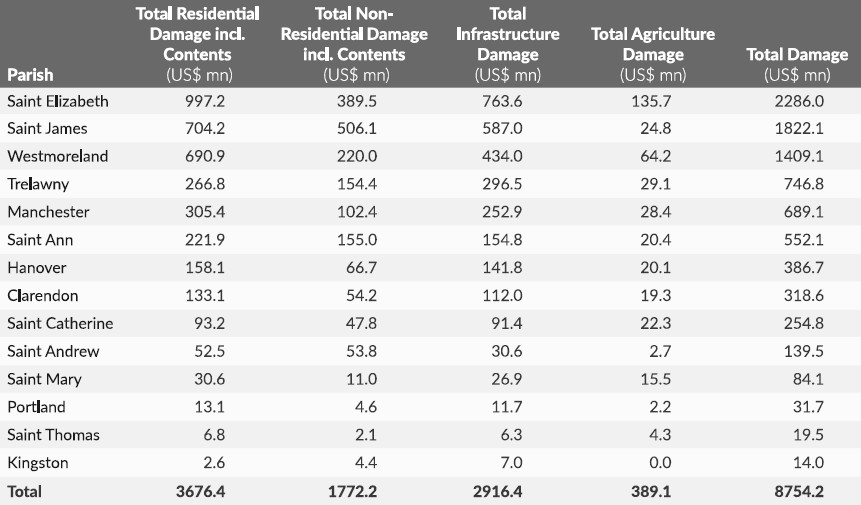
The International Monetary Fund (IMF) announced on 16 January that it had approved a disbursement of US$415m to Jamaica “to address the impact of Hurricane Melissa” which is estimated by the World Bank to have caused US$8.75bn of direct damage to infrastructure and to residential, non-residential, and agricultural assets.
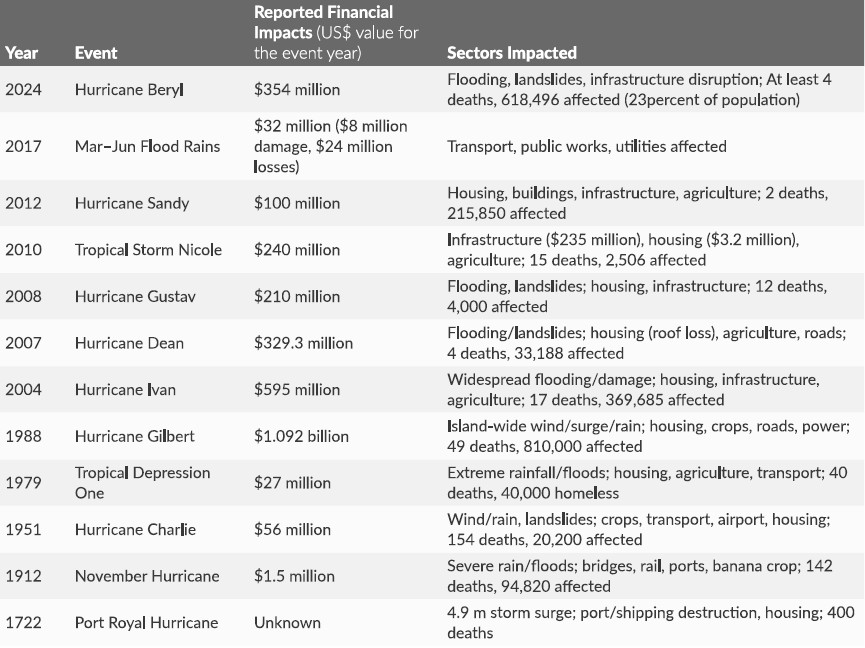
According to the World Bank’s Global Facility for Disaster Reduction and Recovery (GFDRR), since 2000 “the frequency and severity of storms increased significantly, with more systems passing near or directly impacting Jamaica than in the previous two decades” (see Table 1). Since 2000, Jamaica has been affected by Hurricanes Ivan (2004, US$595m damage); Dean (2007, US$329m); Gustav (2008, US$210m); Sandy (2012, US$100m); and Beryl (2024, US$354m). Tropical Storm Nicole (2010) caused US$240m in damage and the 2017 floods US$32m. The total estimated damage suffered by Jamaica from natural disasters since 2000, including Hurricane Melissa, amounts to US$10.6bn, which is 44% of current GDP.
Table 1: Summary of recent historical disasters in Jamaica
 Source: Global Rapid Post-Disaster Damage Estimation (GRADE) Report / Hurricane Melissa 2025 Jamaica
The impact of Hurricane Melissa to infrastructure has been estimated at US$2.9bn by the World Bank’s Global Rapid Post-Disaster Damage Estimation (GRADE) report, published on 19 November. There was widespread damage to transmission lines, distribution networks, substations, and power generation. The importance of resilient design was reinforced by the different experiences of the Eight Rivers Solar Park, which suffered extensive damage, and the Wigton Wind Farm which, according to the GRADE report, showed that “well-engineered utility-scale renewables can perform robustly under extreme winds”. The report emphasised that the experience of Hurricane Melissa highlights “infrastructure as both a major source of direct damage and a priority asset class for resilience upgrades”.
The damage to housing was an even more significant US$3.67bn and reflected the high vulnerability of Jamaica’s housing stock. The biggest damage occurred in houses without adequate roof-to-wall connections, thus reinforcing the need to strengthen and enforce building codes, particularly in rural and low-income areas. The GRADE report notes that “cost-effective ‘build back better’ options, such as hurricane straps, improved roof anchoring, enhanced bracing, and wind-resistant roof geometries, have repeatedly demonstrated strong cost-benefit ratios in the Caribbean”.
Tourism is another area that has suffered badly, with severe damage to large resorts such as Sandals and Iberostar as well as to smaller boutique hotels. For a tourism-dependent economy, the consequences of this disruption will be significant for some time to come. In 2024, more than 4.3m tourists visited Jamaica, and the sector contributes over 30% of Jamaica’s GDP. Hurricane Melissa struck not long before the all-important winter season, further heightening the economic blow.
Agriculture is another sector that has suffered badly, with damage estimated at US$389m. The GRADE report says: “The loss of more than 41,000 hectares of farmland, 1.25 million animals, and major shares of vegetable, banana/plantain, fruit tree, yam and coffee production directly undermines the subsistence and market incomes of tens of thousands of farmers in the most heavily affected parishes”. These are areas where “household resilience is already low and where agriculture remains the primary economic anchor”. With some rural communities still suffering from the effects of Hurricane Beryl in 2024, the impacts of Melissa are compounded.
Table 2: Total damage from the effect of Hurricane Melissa in US dollars by asset class and parish
Source: Global Rapid Post-Disaster Damage Estimation (GRADE) Report / Hurricane Melissa 2025 Jamaica
Another important consideration is the fact that the estimated total damage of US$8.75bn relates to physical damage and does not include the overall economic consequences. The GRADE report notes that in the past the indirect economic effects have been in the range of 40% to 125% of the direct damage, which in Melissa’s case would equate to additional costs of between US$3.50bn and US$10.94bn. Also, the damage estimate of US$8.75bn is based on replacement costs, whereas the cost of building back better is likely to be 1.5-2 times higher.
The US$415m funding from the IMF’s Rapid Financing Instrument (RFI) is not sufficient to compensate for all of Jamaica’s hurricane-related costs. It is primarily intended to help meet the urgent balance of payments needs. The current account balance is projected to deteriorate from a surplus of 1.0% to a deficit of 2.0% of GDP in FY2025/26 and to a deficit of 5.3% of GDP in FY2026/27. According to the IMF, the overall effect is an external financing need of US$1.4bn which “will be covered by the activation of Jamaica’s multi-layered disaster risk financing strategy” alongside support from the IMF and other international financial institutions.
Clearly the challenge is enormous, but the IMF has been keen to emphasise that Jamaica’s disciplined economic policies over many years have “created buffers that are helping to address the economic fallout” of Hurricane Melissa. In its 16 January press release, the IMF says that over the last decade Jamaica had become “a model of economic discipline” and that it had taken important steps “to strengthen institutions and increase the country’s preparedness for natural disasters”.
The reduction in the country’s debt burden has been Jamaica’s most significant achievement, falling from 144.9% in FY2012/2013 to 62.4% in FY2024/25, and despite the severe shock of Hurricane Melissa, the IMF believes the country’s debt burden will remain sustainable. It is projected to increase to 68.6% of GDP in FY2025/26, but the IMF reports that the authorities remain committed to returning a downward path for the debt-to-GDP ratio “once the hurricane shock has receded”. The IMF says that Jamaica’s overall risk of sovereign stress is “moderate”, noting that after the Covid-19 shock, public debt “quickly resumed its downward trajectory”.
Hurricane Melissa is different because of the need for substantial reconstruction spending in the near term, but the IMF expects that the debt-to-GDP ratio will once again begin “declining modestly over the medium term”. The IMF is projecting a debt-to-GDP ratio of 58.4% in 2035.
There will be significantly weaker growth in the near term, with the economy expected to contract by 4.3% in FY2025/26. Output is only expected to return to the pre-hurricane level in 2028 following growth of 0.8% in 2026, 3.0% in 2027, and 2.0% in 2028. Thereafter, from 2029-2035, the IMF is projecting average annual GDP growth of 1.5%.
However, the IMF warns that there is a risk that the spillovers from Hurricane Melissa could create “more severe and long-lasting effects on the economy and balance of payments than is currently expected”. For instance, the IMF’s projections assume that tourism capacity will recover by the end of 2026, but recovery could be more protracted if reconstruction efforts fall behind current plans.
The IMF also points out that the back-to-back occurrences of Hurricanes Beryl and Melissa in consecutive years “underscores that natural disasters are an ever-present risk to economic activity, public debt, and financial stability, and could repeat even as Jamaica tries to recover from Melissa”.