
Caribbean & Central America - March 2026
BARBADOS: Mottley extends her dominance
For the third election in a row, on 11 February the Barbados Labour Party (BLP) led by Prime Minister Mia Mottley won a 30-0 clean sweep in the house of assembly. The resounding victory reflected the BLP’s strong record of economic management along with the popularity of the prime minister who has become a significant figure on the world stage arguing for action against climate change. The only element of the result that can give any comfort to the main opposition Democratic Labour Party (DLP), led into the election by BLP-defector Ralph Thorne, is that it has retained its position as the main repository for anti-BLP votes. While the DLP managed 27.31% of the votes cast (against the BLP’s 69.83%), the three other opposition parties and independents gained just 2.87% of the vote. On the other hand, the BLP’s share of the vote was actually up on the 69.26% it received in the 2022 election but still below the 73.47% with which it won its first clean sweep election in 2018 following two terms of DLP rule.
The most obvious source of the BLP’s continuing political dominance is its record of competent economic management alongside memories of the DLP’s economic mismanagement. The DLP’s misfortune was to take power in 2008 at the time of the global financial crisis. The electorate understandably overlooked the poor economic performance in its first term on the grounds that the crisis was global, rather than being caused domestically. Even so, the February 2013 election was a close one, with the DLP squeezing home by 16-14 seats. But the DLP failed to take advantage of its renewed mandate to re-establish economic good order.
In the first quarter of 2018, with an election due in May, the economy contracted by 0.7%. The fiscal deficit, although heading down, was still at 4.2% in FY2017-18 despite the government having promised a small surplus in its May 2017 budget. Unemployment was another electorally unfavourable factor, standing at 10% in December 2017; and gross central government debt had risen to 151% of GDP, up from 145.9%. Nor was there much hope for improvement. At the time of the 2018 election, the central bank was forecasting growth for 2018 within the range of -0.25% to 0.25%. And so the DLP was summarily dismissed by the electorate in the first of what has now become three clean sweep election victories for the BLP.
Within weeks of coming to power in 2018, the BLP had to admit that public debt was actually now 171% of GDP, and by early June the government was having to suspend external debt payments and was facing up to the need to take some bitter medicine from the International Monetary Fund (IMF). At the same time, the credit ratings agency Standard & Poor’s (S&P) downgraded Barbados’ long-term foreign currency rating to selective default (SD), from CCC+/C previously, due to a missed coupon payment.
It was never going to be easy dealing with this legacy, but then the Covid-19 pandemic struck, followed by two natural disasters in 2021 – volcanic ashfalls from neighbouring St Vincent & the Grenadines and the Category 1 Hurricane Elsa – which further damaged the vital tourist industry. According to World Bank data, in 2018, the year in which the BLP came to power, the economy shrank by 1.3%. There was then near-zero growth of 0.2% in 2019 followed by the -14.4% collapse in 2020. GDP then rebounded to pre-pandemic levels in 2021. Given that 2022 promised a big recovery (in the event, 17.2%) it was quite a surprise when Mottley called the election 18 months early, opting for 19 January 2022.
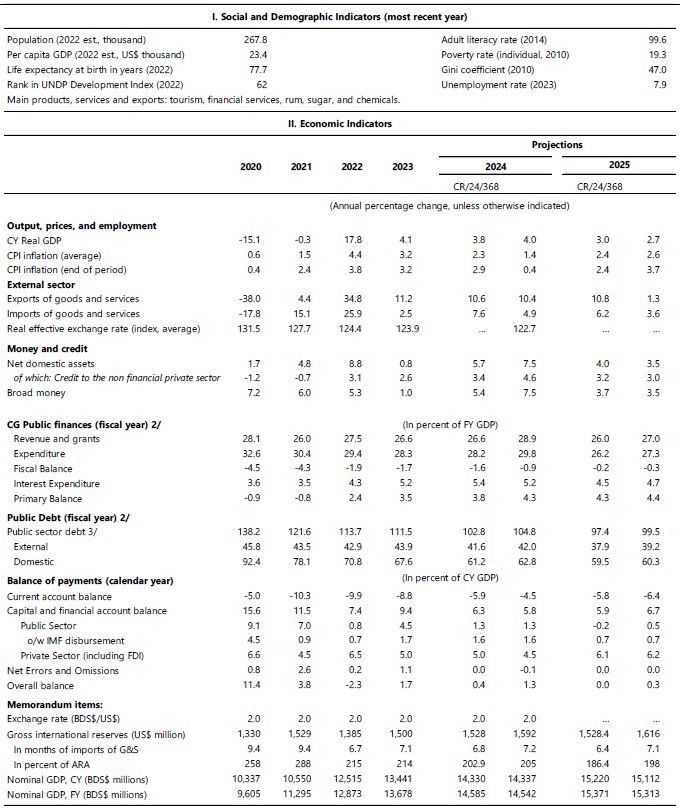
Source: IMF Fifth Reviews Under the EFF and RSF facilities, June 2025
The prime minister’s ostensible reason for calling the 2022 election before its due date was to heal divisions over the country’s ditching of the monarchy to become a republic in November 2021, but it seems more likely that Mottley was concerned that the IMF-endorsed temporary relaxation in the primary balance target for FY2021/22, to counter the lingering effects of Covid-19 and the impact of Hurricane Elsa and the volcanic ash inundation, was due to end. As the IMF put it in a December 2021 evaluation: “The authorities will have to compensate this short-term fiscal accommodation with higher primary surpluses in the medium term to safeguard debt sustainability”.
The IMF was also calling for reforms to state-owned enterprises (SOEs), pension reform, and the introduction of a fiscal rule to “support fiscal sustainability”. None of this was likely to be easy for the government, and so while it seemed counter-intuitive to go to the polls before the economic recovery had truly set in, Mottley took the gamble – and it more than paid off with a second total victory.
Now Mottley has led the BLP to a third consecutive clean sweep, an astonishing political achievement in any circumstances but particularly given that the memories of DLP mismanagement will inevitably have faded somewhat. However, the BLP did undoubtedly perform well in its second term. As expected, 2022 saw a massive 17.2% bounce back in economic activity, which was followed by 2.9% growth in 2023 and 2.5% growth in 2024, according to the World Bank. The central bank has put GDP growth in 2025 at 2.7%.
In its June 2025 reviews of Barbados’ Extended Fund Facility (EFF) and the Resilience and Sustainability Facility (RSF) arrangements, the IMF reported that “program performance has remained strong… The authorities have exceeded the primary fiscal surplus target for FY2024/25… Public debt has fallen below 105% of GDP, and the authorities remain committed to bringing it down to 60% of GDP by FY2035/36.” The IMF added that “the authorities’ implementation of the home-grown economic recovery and transformation (BERT 2022) plan and ambitious climate agenda has remained strong” [BERT is the Barbados Economic Recovery and Transformation Programme].
One particular area for IMF praise was the progress that the Mottley government has made in reforming SOEs. By 2019, the number of SOEs in Barbados had reached 58, with annual government transfers to these enterprises amounting to 5.9% of GDP. Under the BERT 2018 plan, cost-reduction measures included reduction in staff headcount, mergers, closures, and the renegotiation of expensive supplier contracts. Revenue enhancing measures included tariff adjustments for public transport and water, and new levies on sanitation, health, and tourism services.
The BLP manifesto outlined the goals for BERT 3.0 which it says are to focus on “economic transformation through competitiveness and productivity”, which “means re-industrialisation, export orientation, and a deliberate push into the digital economy, new services, new manufacturing, and new global opportunities”. There was a promise to “give middle-income families more room to breathe – more disposable income, more confidence, more ability to plan, save, travel a little, and enjoy life”, and there was a promise over the next five years to “place deep focus and investment into Young Barbados and commence the transition for the next generation of Barbadian leaders”.
Away from the economy, the BLP’s electoral prospects were greatly aided by the prime minister’s high and positive international profile. At the United Nations Climate change conference (COP27) in Egypt in November 2022, Mottley’s Bridgetown Initiative for reforming the global financial system received strong support not just from leaders from the Global South but also from the likes of President Emmanuel Macron of France and IMF Managing Director Kristalina Georgieva who praised Mottley’s “unbelievable leadership and perseverance”. Mottley had told the COP27 gathering: “This world still looks too much like it did when it was part of an imperialistic power. The global north borrows with interest rates between one and four percent. The global south, around 14%.”
In practical terms, Mottley’s Bridgetown Initiative has led, inter alia, to the incorporation by multilateral lenders of ‘natural disaster clauses’ into loan agreements to enable the pausing of debt repayments after climate-related shocks, and the IMF has created a US$40bn Resilience and Sustainability Trust (RST) “to help low-income and vulnerable middle-income countries build resilience to external shocks and ensure sustainable growth, contributing to their longer-term balance of payments stability”.
The Bridgetown Initiative also provided critical momentum to the establishing of the Fund for Responding to Loss and Damage (FRLD) which was launched at COP28 and has received pledges of US$789m. Appropriately, the FRLD’s pilot phase was launched in Barbados in April 2025 and is known as the Barbados Implementation Modalities (BIM). Commenting on the BIM launch, Barbados’ deputy senate president Elizabeth Thompson said: “This outcome is a great one for Barbados, the Caribbean, and climate vulnerable countries generally. It is a clear indication of the importance and necessity of Barbados’ engagement and advocacy on climate change and other issues critical to the island’s development and the well-being of Bajans.”
In addition to her strong advocacy on climate change and for small island developing states (SIDS), Mottley has also called regularly for reparations for slavery, and she has worked to bring Africa and the Caribbean closer together.
Mottley was also the first Caribbean leader to comment in detail over the US capture of Venezuela’s former president Nicolas Maduro (2013-2026) in January. In an address to the nation, Mottley warned: “What we saw happening in Venezuela is uncharted territory. Small states really survive in an international law-based order. Conflict has consequences, and we are living them today.” She added: “Our principles are very clear. Anything that happens contrary to an international rules-based order is of grave concern to us as a people in Barbados and as a region.”
This message was repeated prominently by Mottley in the BLP’s election manifesto, with a quote from the first prime minister of Barbados, Errol Barrow (1966-1971, 1986-1987), saying: “Friends of all, satellites of none”. Mottley pointed out that although Barrow was from the rival DLP, she wanted to include the quote in the BLP manifesto because of its importance in stating the country’s national interest. In her manifesto message, she went on to say: “Given that small states are vulnerable in the multilateral space, our protection comes from an international rules-based order and by our defining ourselves by an ethical principle which tells the world who we are and lets people know what they can expect from us. While small size might suggest fragility or vulnerability, in our case it comes with strength of character.” The manifesto pledged that the BLP would continue to project Barbados as a “global thought leader” and as a leader on issues affecting SIDS, and there was a pledge to establish a Caribbean SIDS Diplomatic Academy and Centre of Excellence with a headquarters in Barbados.
And so Mottley’s domination continues on the back of the BLP’s record of competent economic management and her own rising international star. But despite her impressive electoral record, there is a warning for Mottley in the particularly low voter participation in the last two elections. This could be blamed on the DLP’s unpopularity, and the apparent certainty that the BLP would win re-election, but the trend is still worrying whatever the reason. When the BLP was first returned to power in 2018, 60% of the electorate participated in the vote. This fell to 43% in 2022, and in the latest poll it was down to just 37%. In terms of votes, more people voted for the BLP in 2013 (74,121), when it lost, than in 2026 (71,109) when it won all 30 seats.