Caribbean & Central America - March 2026
Economic Highlights
PANAMA | Still on EU tax haven list. On 17 February the European Union (EU) opted to keep Panama on its list of non-cooperative jurisdictions for tax purposes in its latest update. The list was first established in 2017 and is updated twice a year. The decision is a major blow for the government led by President José Raúl Mulino, for which Panama’s removal from such lists is a priority. In July 2025 the EU removed Panama from its list of countries with strategic deficiencies in their anti-money laundering (AML) and counter-terrorist financing (CFT) frameworks. In response to the EU’s latest decision, Mulino said restrictions would be maintained on European companies participating in public tenders – a threat he first announced in October 2024 to the media in response to Panama remaining on the list. Writing on social media, however, he said that Italy, Greece, and Spain do not have Panama on any list so there is “no problem” with these countries.
NICARAGUA | Trade deficit shrinks. On 27 February Nicaragua’s central bank released new figures showing that the country’s total exports in 2025 reached US$8.91bn, up 15.4% on 2024. Total imports reached US$11.40bn, up 7.5% on 2024. This leaves a trade deficit of US$2.49bn, down 13.8% on 2024. Exports were driven by agriculture, which totalled US$1.29bn last year, up 46.1% on 2024 due to an increase in volume and prices of coffee; mining, which totalled US$2.01bn, up 44.4% on 2024; and fishing and aquiculture which totalled US$186.4m, up 6.7%. The country’s main export markets are the US, which accounted for 38.0% of total export value last year, followed by Canada (17.4%), and El Salvador (9.4%), among others. Exports to the US were up 24.8% last year while exports to Canada were up 73.7% year-on-year.
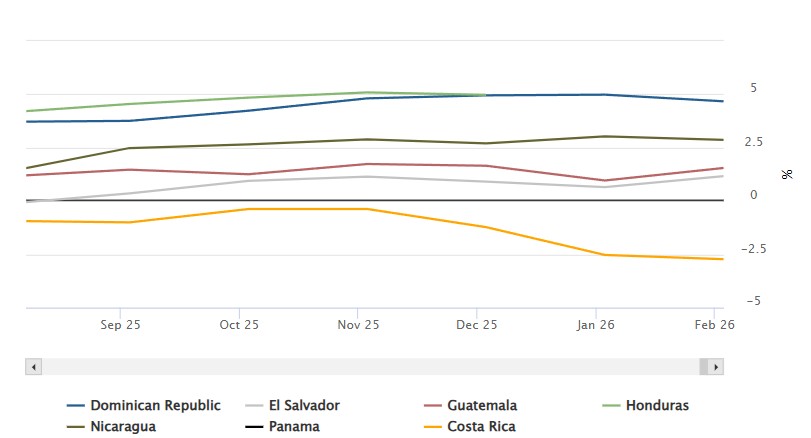
Central America & Caribbean: inflation rate
Percentage variation (year-on-year)
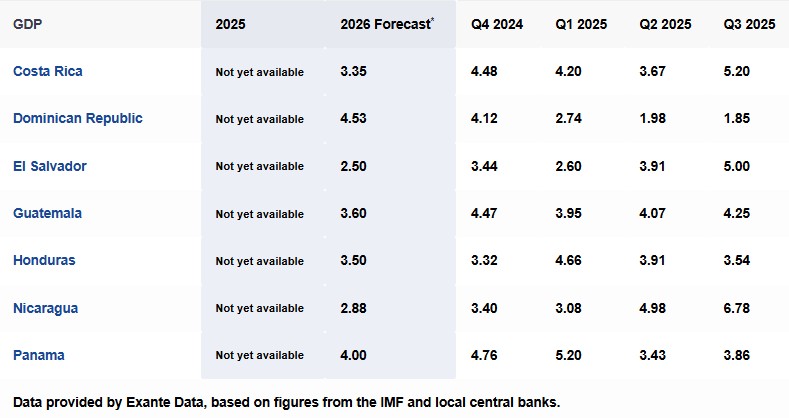
Central America & Caribbean: GDP growth (%)
Quarterly figures are year-on-year growth