
Caribbean & Central America - April 2026
REGION: Searching for agreement on labour migration
At the beginning of March, the International Organization for Migration (IOM) and the Caribbean Community (Caricom) hosted its 10th in a series of ‘Conversations on Migration in the Caribbean’, with the focus on ‘Migration and the Caribbean Workforce’. The strong message emerging from the discussions was that a combination of an aging population, declining birth rates, and outward migration is resulting in labour and skills shortages, particularly in sectors such as healthcare, education, construction, agriculture, and public services. Central to the discussion was an early 2026 International Labour Organization (ILO) study on ‘Free movement of persons in the CARICOM region: A labour market analysis’.
In his introduction to the discussion, IOM’s Caribbean Coordinator Patrice Quesada described the demographic changes in the Caribbean as “basically a time bomb”. He said: “The demographic decline is probably one of the most existential threats together with climate change that is affecting the Caribbean space”, and he argued that a discussion around labour needs, and the role that migration can play, is “extremely important”.
Migration within Caricom is regulated by the 2001 Revised Treaty of Chaguaramas which led to the creation in 2006 of the Caricom Single Market and Economy (CSME). Members, with the exception of The Bahamas, committed to the goal of free movement of nationals within Caricom. Haiti is also a partial exception due to a lack of institutional and administrative capabilities. Initially the agreement covered only skilled workers, although in July 2025 Barbados, Belize, Dominica, and St Vincent & the Grenadines agreed to free movement for their respective nationals without the need for a work or residency permit. There is also a deeper arrangement for free movement within the Eastern Caribbean Economic Union (ECEU) established by the member of the Organisation of Eastern Caribbean States (OECS).
Under Caricom rules, all nationals have the right to stay in other Caricom member states for six months, but this does not automatically include the right to work or provide services. Those defined as undesirable can also be excluded. However, key categories of skilled workers are allowed to seek employment in CSME member states without a work permit, including university graduates, artists, musicians, sports persons, media workers, nurses, teachers, qualified artisans, domestic workers, agricultural workers, and private security personnel. Skilled workers can apply for a Caricom Skills Certificate as proof of their eligibility.
For the ILO, the central message of its study is that well-governed labour migration “can be a powerful driver and enabler for realising decent work, economic development, and regional integration”, but better coordination is required within Caricom, along with an effective skills recognition system and “robust protection of migrant workers’ rights”.
There are a number of special factors that impact upon the free movement debate within the Caribbean, including large disparities in per capita income (ranging from circa US$2,500 in Haiti to US$39,500 in The Bahamas) and in population (from 12m in Haiti to 50,000 in St Kitts & Nevis). Haiti accounts for 8m of the region’s 14m working age population and 60% of the region’s 8.8m workforce. Another key factor is that the combination of population aging and net outward migration is expected to result in population decline in nine Caricom member states, as illustrated in Table 1 below. Here again, however, Haiti is the exception. Its labour force grew by an average of 4.1% per annum from 2000-2024 compared with 0.6% per annum for the rest of the Caricom region.
Population growth rates, by Caricom member state, 2000-2025 and forecast 2025-2030 (%)
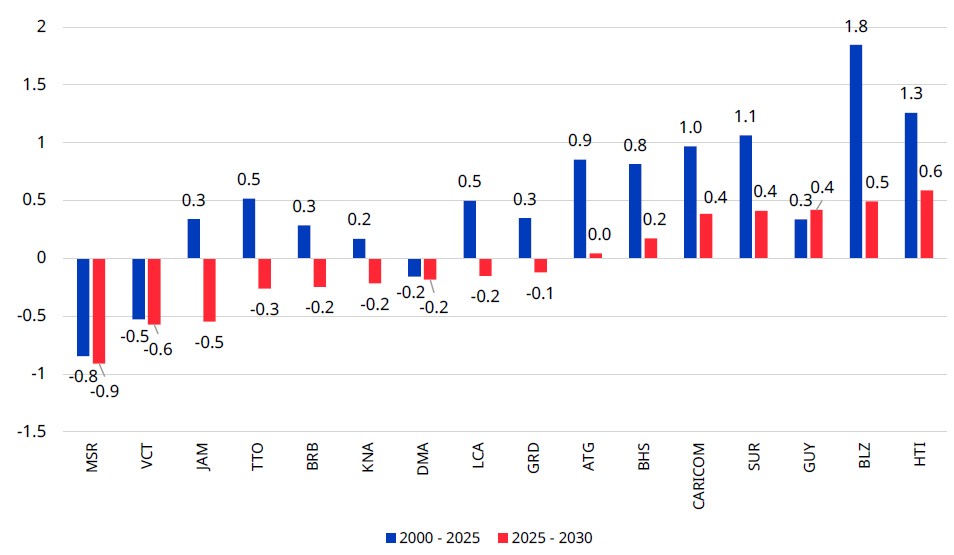
Source: United Nations World Population Prospects (WPP), taken from International Labour Organization (ILO) 2026 study, ‘Free movement of persons in the CARICOM region: A labour market analysis’.
There are three main goals for Caricom migration policy. The first is to better facilitate the movement of people for economic reasons; the second is to improve training levels so that there is a better match between supply and demand for skilled labour; and the third is to address the problem of migration of skilled labour to countries outside of Caricom, primarily to North America and Europe.
That lack of suitable training, rather than just outward migration, contributes to the labour shortages in skilled occupations can be seen in the fact that a higher share of non-Caricom nationals can be found in high-skilled occupations (38%) than in the national workforce in general (27%). Another indicator that young people are not being trained for the jobs available can be seen in the percentage of young people not in employment, education, or training (Neet). Some 24% of all 15-24 year olds in the region are defined as Neet. The overall unemployment rate for the region is around 12%, but this falls to 6% if Haiti is excluded.
With regards to the outward migration problem, a partial solution, at least, is suggested in the ILO report, which notes (quoting a World Health Organization 2019 study) that while 60% of healthcare workers currently residing in the Caribbean would migrate if the opportunity arose, 92% would stay if conditions improved. In addition, 26% if the healthcare diaspora would consider returning if conditions in the home countries improved.
Labour shortages in agriculture occur for a different reason: the low pay and disincentives of the rural life for young people. Excluding Haiti, agriculture now employs only just over 10% of the workforce, with the services sector accounting for just short of 70%. Yet there are still shortages in the agriculture workforce, with Jamaica, for instance, importing many agricultural workers from Mexico and the Philippines. Haiti would seem to provide an obvious solution to the problem, but Haiti is only a partial member of the CSME, and in any case the Caricom regime of free movement for skilled workers does not encompass low-skilled agricultural workers.
Remittances
There are, of course, upsides to the outward migration. Remittances from outside the region account 7% of GDP across the Caribbean and nearly 20% in Haiti and Jamaica. These remittances can be particularly important at times of economic disruption, as after a natural disaster for example.