
Caribbean & Central America - June 2026
REGION: Building state capacity seen as key to protecting Caribbean democracy
The recently published Democracy and Development Report 2026 for Latin America and the Caribbean (LAC), from the United Nations Development Programme (UNDP), describes the Caribbean as “one of the most democratic regions in the developing world”, but it also cautions that Caribbean democracies are “under pressure”. Although the recent elections in Antigua & Barbuda and The Bahamas, with voter participation of 62.4% and 66.4% respectively, would suggest that the region’s democratic ethos is continuing to flourish, the UNDP’s concerns are not without substance as some of the less encouraging recent voter turnout figures in Table 1 below indicate, most particularly the figures for Barbados (42%), Dominica (32%), Jamaica (40%), and Saint Lucia (48%).
Divergent trends in voter turnout in recent elections
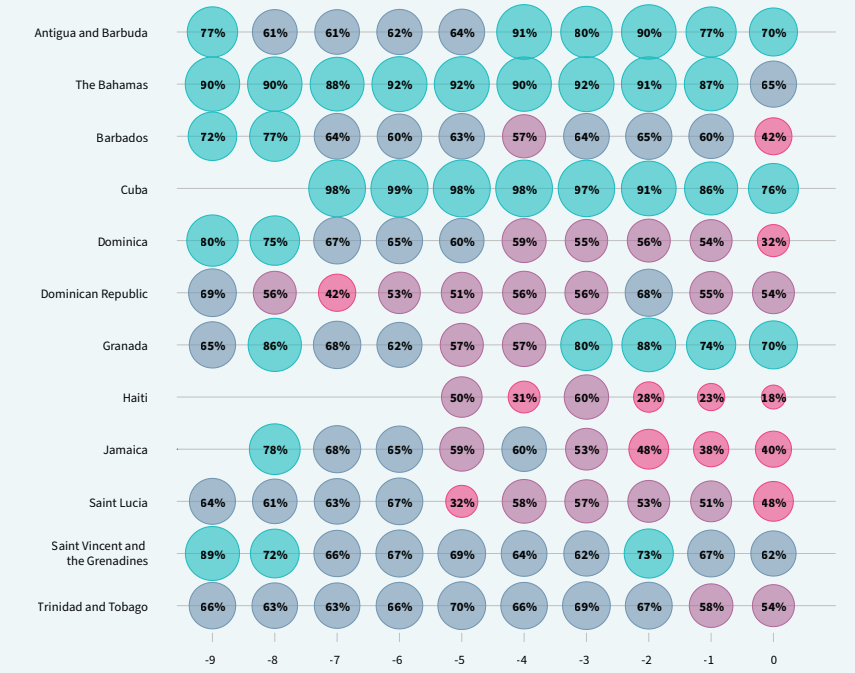
Note: 0 aggregates the data from the most recent elections, -1 aggregates the preceding voter turnout data, and so on back to the first studied (-9).
Source: UNDP
The UNDP report, which was published on 11 May, begins by noting some of the shortcomings of the Westminster-style system that dominates in the English-speaking Caribbean. These include the concentration of power in the prime minister, and the first-past-the-post ‘winner takes all’ voting system, both illustrated in the two most recent elections, in Antigua and Barbuda and The Bahamas.
On the face of it, the Bahamian result, in particular, would suggest a healthy democracy, with the 66.4% turnout increasing from an already high 65% in 2021. In the 12 May election, the ruling Progressive Liberal Party (PLP) led by Prime Minister Philip Davis retained power with a resounding 33-8 victory over the opposition Free National Movement (FNM) under Michael Pintard, making Davis the first leader since the FNM’s Hubert Ingraham in 1997 to win re-election. However, the PLP’s 80% of the seats in parliament came on the back of a much lower 51% of the vote.
In the 30 April Antigua and Barbuda election, the turnout was 62.4%, and although down nearly eight percentage points from the 70.3% turnout in 2023, it was also well within the acceptable range. The Antigua and Barbuda Labour Party (ABLP) under Prime Minister Gaston Browne won an emphatic 15-2 victory, with one seat each going to the United Progressive Party (UPP), under Jamale Pringle, and the Barbuda People’s Movement (BPM) led by Trevor Walker. However, Browne’s ABLP won 88% of the seats on 60.8% of the vote. By contrast, the UPP ended with under 6% of the seats on 37.3% of the vote. Also Browne’s victory was his fourth in a row, reinforcing the total dominance of the country’s politics by the prime minister.
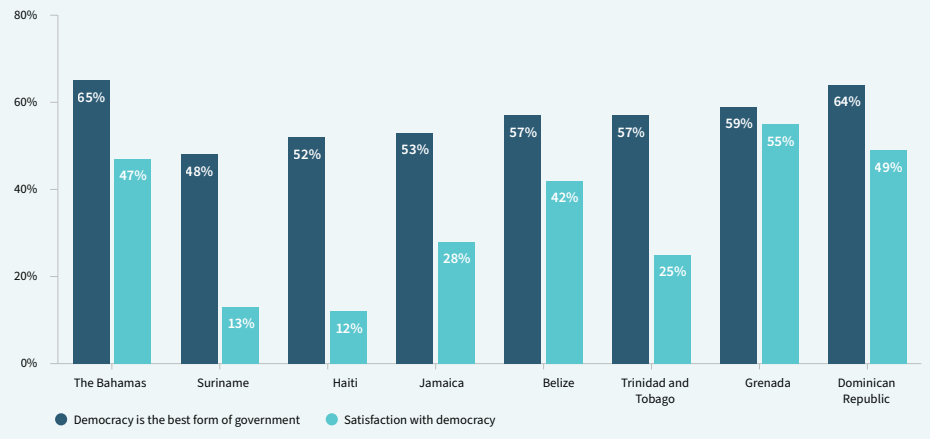
One of the UNDP report’s principal findings is the declining satisfaction with what democracy is seen to be delivering. Table 2 below indicates that although democracy is recognised by most as the best form of government, satisfaction with what democracy is delivering is much lower. In Jamaica, for instance, 53% of respondents say that democracy is the best form of government but only 28% are satisfied with it. The pattern is mostly repeated in the eight countries surveyed, except notably in Grenada where 59% believe democracy is the best form of government and 55% are satisfied with it.
Falling voter satisfaction with democracy
Source: UNDP
Reviewing the data in Table 2, the UNDP report warns that the gap between support for democracy as the best system and levels of satisfaction with the outcome of democratic government is a potentially dangerous one. It warns: “This gap reflects a pressure that, if not effectively addressed, may undermine the very foundations of democratic coexistence”. The risk, it adds, “is not an immediate abandonment of the regime, but rather a gradual erosion of legitimacy and of the bonds of trust that sustain the democratic contract. It is precisely within this gap that the main pressure on Caribbean democracies is concentrated today.”
Given the English-speaking Caribbean has, in the UNDP’s words, “a well-earned reputation as a bastion of representative democracy, respect for the rule of law, and defence of democratic institutions”, this warning might seem exaggerated. However, the UNDP also points out that the region’s record is not pristine. Grenada, under the People’s Revolutionary Government from 1979-1983, and Trinidad and Tobago in 1990, when Islamist radicals mounted a failed coup attempt, have both suffered constitutional disruption. In Guyana, the 21-year rule of Forbes Burnham (1964-1985) was marked by authoritarianism and rigged elections, and although free and fair elections have been held since 1992, in 2020 then-president David Granger (2015-2020) attempted, ultimately unsuccessfully, to subvert the result of the general election, refusing to concede defeat for five months of legal wrangling.
For the UNDP, the main challenge is the state’s capacity to deliver. The UNDP argues that democracy “acquires legitimacy” when citizens feel the effective presence of the state in their daily lives, most particularly in the key areas of education, health, justice, security, and social protection. It says: “The link between State capacity and human development is crucial: democratic institutions generate legitimacy and a shared sense of direction, but it is State capacity that enables the translation of these decisions into tangible outcomes that improve people’s well-being.”
The right to vote, the separation of powers, and the rule of law are “non-negotiable minimums” for democracy, but they are not sufficient. Democracy also has to enable people “to live better”. When this expectation is not met, “the result is not a rejection of democracy as a principle, but rather a growing distance from its day-to-day performance”.
Relatively small workforces and limited technical resources are among the factors that limit the capacity of Caribbean civil services, compounded by the migration of skilled professionals to larger economies and competition from the private sector.
As a result, the UNDP warns, “many countries struggle to strengthen core State functions”. Failures of the education system are an additional problem. Across the Caribbean, enrolment rates in tertiary education are below 25%, which is half the rate in Latin America (52%). Below the tertiary level, in the 2024 Caribbean Examinations Council (CXC) results, only 4.9% of students passed five or more subjects.
The problem with the failure of education in the Caribbean goes beyond its effect on state capacity; it is also one of the reasons for declining satisfaction with democracy. The failure of the education system to provide a path to advancement, diminishes public trust in the system and, in the UNDP’s words, “weakens the social contract”.
Another area where a lack of progress is feeding dissatisfaction is health. While most countries in the Caribbean have made important gains in life expectancy, with a range of 66 to 76 years, it is still below the 77.8-year average in Latin America. And healthy life expectancy is below 70 in most Caribbean countries, including Barbados (67), Jamaica (67), Trinidad and Tobago (66), Belize (65), St Lucia (65), St Vincent and the Grenadines (64), Grenada (64), and The Bahamas (64).
The UNDP emphasises how important strengthening health provision in the Caribbean is to maintaining faith in democracy. It says: “Ensuring equitable and timely access to health care is not only a sectoral objective, but an essential component of the social contract…The State’s capacity to protect the health of its population becomes a tangible indicator of legitimacy and an indispensable condition for social cohesion and democratic stability.”
Security is another area where the state has to deliver or lose legitimacy, yet the Caribbean has some of the highest murder rates in the world. In 2022, 12 of the 20 countries with the highest murder rates globally were Caribbean states. This has led both Jamaica and Trinidad and Tobago to declare states of emergency in an attempt to counter rising gang violence and organised crime. However, the UNDP says, “many security institutions (police) lack the capacity and forensic resources to eradicate crime and continue to be hampered by outdated legislation and inefficient justice systems. Low level trust in the police forces and the government further aggravate eradication efforts.”
In some parts of the Caribbean, for instance in Haiti and (to a much lesser, but still important extent) Jamacia, the expansion of gangs and criminal organisations has led to non-state actors controlling territory, providing parallel government structures, and regulating access to key services.
Then there is climate change, which is putting ever greater pressure on the resources of the state. For example, in 2017 more than 3m people were displaced in a single month due to hurricanes. Between 2001 and 2020, extreme weather events increased by 85% compared to the previous two decades, according to figures cited by the UNDP, resulting in losses amounting to 3.6% of aggregate GDP. Rising sea levels are another threat, averaging 3.6 millimetres per year from 1990-2020. As a result, the UNDP reports, the region faces an estimated requirement for adaptation of “more than US$100bn, equivalent to approximately one-third of its annual economic output”.
In conclusion, for the UNDP the key to strengthening democracy in the Caribbean lies in building state capacity. It says: “The link between democracy, State capacity and human development is crucial: democratic institutions generate legitimacy and a shared sense of direction, but it is State capacity that enables the translation of these decisions into tangible outcomes that improve people’s well-being.”
But how can this be achieved? Not surprisingly, the UNDP does not have a magic wand. For the UNDP, greater regional and intraregional cooperation is a key starting point. It says: “Given the small scale of many Caribbean States and decline in democratic satisfaction, strengthening administrative, fiscal and technical State capacities is essential to provide public goods, guarantee rights and respond to citizens’ expectations. Regional cooperation, capacity-building initiatives and partnerships with civil society, the private sector and international organizations can play a crucial role in overcoming these barriers and promoting sustainable development and governance in the Caribbean.”
The importance of building “capable, stable and professionalized public administrations” is emphasised, as is the need for meritocratic civil service systems “combined with accountability mechanisms” that “help reduce clientelism or institutional capture, promote public trust and the continuity of welfare-oriented public policies”.