
Caribbean & Central America - August 2026
REGION: Addressing the fertility problem
A row in The Bahamas over the recruitment of 300 teachers from Ghana has provided a timely reminder of the demographic challenges for the Caribbean, which the United Nations Economic Commission for Latin America and the Caribbean (Eclac) is due to address in Uruguay at the upcoming 18-20 August Regional Conference on Population and Development in Latin America and the Caribbean.
The Bahamas has a shortage of teachers and is seeking to fill the gap by recruiting from Ghana. But the Bahamas Union of Teachers (BUT) is objecting on the grounds that, firstly, some 2,000 teachers in The Bahamas are still waiting for the conclusion of salary negotiations, with hundreds having unresolved matters on terms and conditions, and secondly, because Ghana itself is short of at least 50,000 teachers and maybe as many as 90,000.
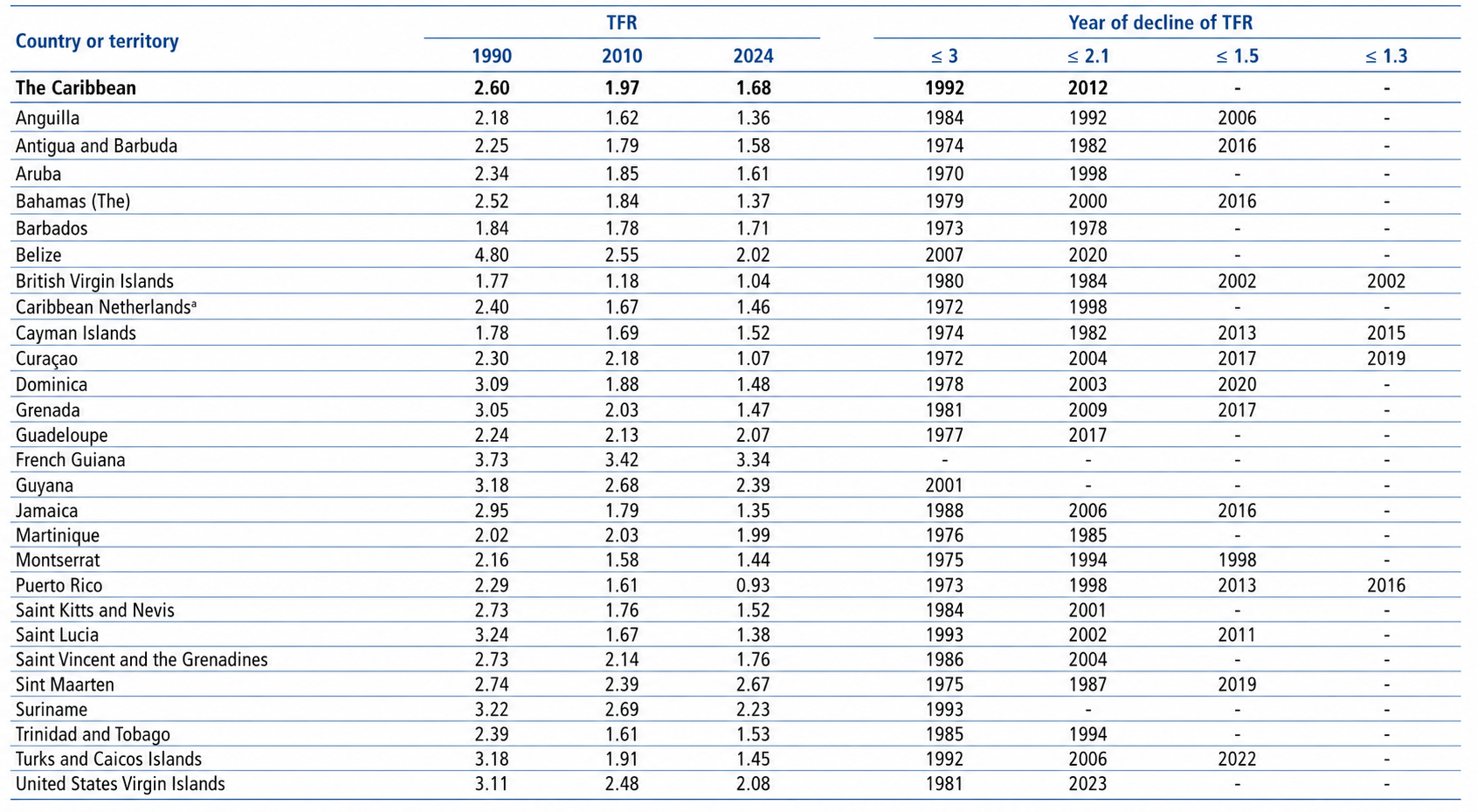
Labour shortages are something that The Bahamas, along with the majority of Caribbean countries, is having to face up to. As Table 1 below illustrates, The Bahamas is one of the countries in the Caribbean experiencing the sharpest decline in fertility rates, down from 2.52 in 1990 to 1.37 in 2024, well below the replacement level of 2.1. To compensate, the country imports high-skilled workers for its financial and hospitality sectors, in particular, and low-skilled workers (primarily from Haiti) for construction and agricultural jobs. Around 15% of the total Bahamian population is made up of immigrants.
Total fertility rates in 1990, 2010 and 2024, and years of decline. (Number of live births per woman aged 15–49, and year).
 Source: Economic Commission for Latin America and the Caribbean
In its October 2025 report ‘Low fertility in Latin America and the Caribbean: Emerging trends and dynamics’, Eclac notes that in the Caribbean, by 2024, only French Guiana, Sint Maarten, Guyana, and Suriname had fertility rates above the replacement level of 2.1. All the other 20 countries or territories in the Caribbean were below replacement level, with ultra-low rates in Puerto Rico (0.93), British Virgin Islands (1.04), and Curaçao (1.07). The average fertility rate in the Caribbean stood at 1.68.
The Caribbean is also a region of net emigration. According to World Bank figures, as of 2020 it was estimated that 18% of all Caribbean nationals were living abroad, according to the UN’s International Organization for Migration (IOM). Of the Caribbean UN member states, the figures were: Dominica, 52%; Grenada, 36%; Jamaica, 27%; Cuba, 13%; St Kitts & Nevis, 49%; St Vincent & the Grenadines, 33%; Barbados, 26%; Dominican Republic, 13%; Antigua & Barbuda, 40%; Suriname, 32%; Trinidad & Tobago, 19%; The Bahamas, 12%; Guyana, 36%; St Lucia, 28%; Haiti, 13%; and Belize, 12%.
The rapid drop in fertility rates is attributed by Eclac to a combination of factors including the decline in mortality; broader access to education, especially for women; increased female participation in the labour market; widespread access to modern contraceptive methods; and progress towards greater gender equality. It is also argued that a “second demographic transition” has materialised as a result of cultural transformations in “post-materialist” societies.
The Eclac report paraphrases the Belgian academic Ron Lesthaeghe as saying that “such societies prioritize self-realization and individual autonomy (in contrast to traditional family-related obligations), along with greater acceptance of different lifestyles, more egalitarian relationships and non-normative individual life-course trajectories… Collectively, these factors are thought to erode the altruistic rationale for having children.”
Initially, the effect of falling fertility rates is a drop in the proportion of young people in the population, thus facilitating a demographic dividend when the proportion of working-age population peaks relative to dependents. However, as fertility continues to decline, and life expectancy increases, so the population ages, putting increased pressure on pension and health systems. The old age dependency ratio for the Caribbean, based on the number of older persons per 100 persons of working age (that is between the ages of 15 and 64), increased from 13 in 2012 to 18 in 2024, according to Eclac. It is expected to increase further to 28 by 2040.
In the final chapter of its report, Eclac looks at how public programmes and policy can help overcome the low-fertility problem, and it emphasises four key areas, namely financial support for families with children, parental leave, childcare services, and flexible working arrangements. However, it stresses, “isolated policies are unlikely to bring about sustained structural change; the impacts depend largely on coherent coordination and the integration of policies within a broad regulatory framework, with adequate financing and sustained political will”. Eclac also warns against “natalist approaches that reinforce gender stereotypes and inequalities”, adding that “policymaking should adopt a rights-based approach that actively involves both men and women in childbearing”.
The Regional Conference on Population and Development in Latin America and the Caribbean was created in 2012, and to date five sessions have been held. At the October 2025 meeting in Santiago, Chile, Eclac was requested to prepare a new study on the “challenges and opportunities” that low fertility and ageing populations pose for the region. This will be presented at the 18-20 August gathering in Montevideo, Uruguay.