
Mexico - August 2026
World Cup tourism numbers present a mixed picture
A total 7.8m people visited Mexico City (CDMX), Jalisco state capital Guadalajara, and Nuevo León state capital Monterrey during the Fifa World Cup, beating pre-tournament projections, but a closer look at the data reveals a mixed picture of the tournament’s impact on the tourism sector.
Officials had predicted that a total of 5.5m tourists would visit the three host cities from 8 June to 19 July, meaning that their estimates were handily beaten. However, Mexico’s tourism ministry (Sectur) told Bloomberg that foreign visitors made up only 40% of these total visitors, with domestic travellers making up the lion’s share. In addition, the majority of travellers, 4.5m, visited on day trips, rather than staying overnight.
Day trippers spend far less than those that stay over, with no lodgings to pay for or even maybe an evening meal. This is one possible explanation for why tourism spending during the World Cup reached only M$42bn (US$2.4bn), according to Sectur, far below pre-tournament forecasts of US$3.4bn in economic impact. Hotel occupancy averaged 66% in the three host cities during the tournament, up 13% compared to the same period last year, spiking to 85%-90% on match days. However, airport passenger arrivals were also lower during the World Cup than during the same period in 2025, confirming that the results have been something of a mixed bag.
Nonetheless it is worth emphasising that the World Cup followed a period of strong performance for the tourism sector, which is an integral part of the Mexican economy that contributes about 9% of GDP. In June, President Claudia Sheinbaum revealed that a record 34.5m foreign travellers visited Mexico in the first four months of this year, with the number of cruise passengers increasing 13% year-on-year to 4.88m.
Furthermore, Mexico handled the World Cup well, with fears around cartel violence affecting matches and the fan experience coming to nothing. As a result, although the World Cup’s impact on tourism may have been mixed during the tournament, officials are hoping that it will provide a lasting boost in the coming months due to the positive experiences of most visitors. The tourism ministry is reportedly forecasting at least a 5% boost in visitor numbers in the next few months, and Tourism Minister Josefina Rodríguez Zamora said that people left Mexico “talking about our cuisine, our traditions, our landscapes, but above all, about the hospitality of the Mexican people. That is the most valuable legacy of the World Cup and the best tourism promotion our country could ask for.”
Tourism risks
Cartel violence remains a constant threat to tourism, and Sheinbaum’s attempts to combat their influence, rather than letting them operate in the shadows, increases the risk of flare ups. Then there are natural phenomena, with climate change making extreme weather events more frequent and intense, as well as encouraging the growth of toxic sargassum seaweed blooms on the beaches of the Gulf of Mexico and the Caribbean that draw millions of visitors per year. Sheinbaum appears to appreciate the gravity of the situation, promising M$2bn in funding for a plan to combat sargassum, including two seaweed trawlers designed to stop it reaching the shore.
Economic Highlights
MEXICO | GFCF up year-on-year. On 5 August Mexico’s national statistics institute (Inegi) announced that gross fixed capital formation (GFCF) increased by 2.4% in year-on-year terms in May, although it fell by 0.4% in monthly terms. This follows a 4.0% monthly rise in April, when GFCF rose by 5.2% in annual terms, according to the latest figures. The annual rise in May was the result of a 2.0% increase in construction investment, while investment in equipment and machinery was up by 2.5%. The monthly decline was caused by a 2.4% drop in construction investment, while investment in machinery and equipment rose by 1.5% compared to April.
MEXICO | Remittances rise in first half of 2026. On 3 August Mexico’s central bank (Banxico) announced that the country received US$30.76bn in remittances in the first half of 2026, up 3.1% year-on-year and a record for the period, according to Spanish newspaper El País. In June alone, inflows totalled US$5.47bn, up 4.2% year-on-year, reflecting a 0.4% rise in the number of transfers and a 3.8% rise in the average remittance amount, to US$422. Some 99.2% of inflows in the first half of this year arrived electronically. The June remittance total is down on US$5.61bn received in May.
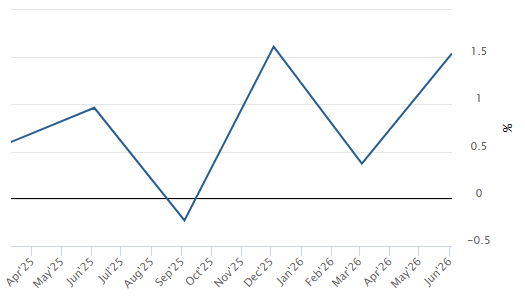
MEXICO | Estimated GDP rebound in Q2. On 30 July Mexico’s national statistics institute (Inegi) released preliminary GDP figures for the second quarter of 2026, showing an estimated increase of 1.5% in quarterly terms and 2.1% in yearly terms. This follows a quarterly decline of 0.6% and 0.4% yearly growth in the first quarter of the year, according to the latest figures. Activity in the primary sector (agriculture) grew by 3.3% in quarterly terms, the secondary sector (manufacturing) grew by 1.6%, and the tertiary sector (services) by 1.5%. In year-on-year terms, the primary sector grew by 7.3%, while the secondary sector increased by 0.8% and the tertiary by 2.5%.
Mexico: GDP growth
Percentage variation (year-on-year)
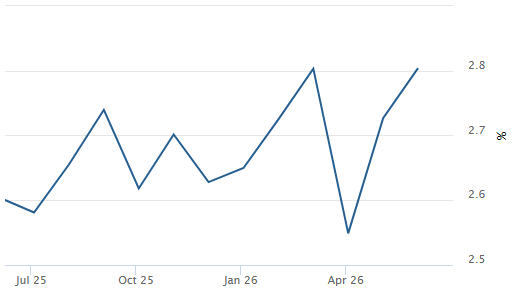
Mexico: unemployment rate
Economically active population
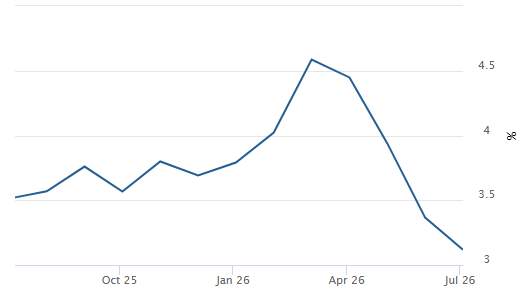
Mexico: inflation rate
Percentage variation (year-on-year)
Source (all graphs): National Statistics Institute (Inegi)