Andean Group - September 2026
Economic Highlights
PERU | Mining revenue surges. Peru’s mining and energy ministry (Minem) reported on 2 September that fiscal revenue generated by the mining sector rose by 80.1% year-on-year in the first half of 2026. Total fiscal revenue reached PEN22.79bn (US$6.78bn) between January and June, up from PEN12.65bn in the same period of 2025. Metallic mining generated the bulk of the total, contributing PEN19.44bn, or 85.3% of fiscal revenue for the sector. New mining royalties added PEN2.13bn (9.4%), while non-metallic mining brought in PEN962m (4.2%). The special mining levy contributed PEN172.8m and separate mining royalties added a further PEN85.3m. Minem said the increase “reflects the significant contribution of mining activity to state revenue”. It added that the results came against a backdrop of favourable international metals prices and strong operating performance across the industry. The ministry said it expects fiscal revenue from mining to remain strong in the second half of 2026, citing continued output from major mines, international metals price trends, and overall momentum in mining activity.
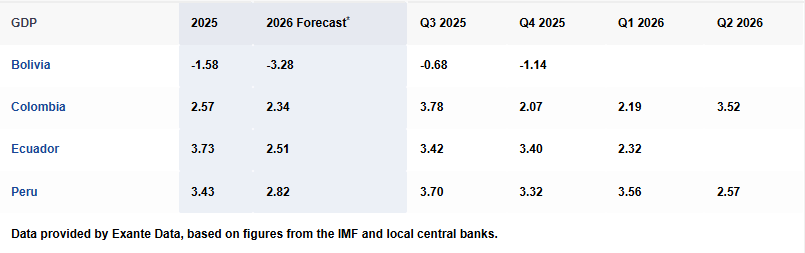
BOLIVIA | Economy back in the red. Bolivia’s central bank (BCB) said on 20 August that economic activity suffered a “pronounced deterioration” in the first half of 2026, falling by an estimated 3.34% between January and June. It said that this reversed a slight recovery of 0.06% during the first three months of the year. The BCB identified the major anti-government protests in May and June, which included roadblocks across the highway network, as a principal factor in this year’s economic contraction, compounding problems posed by fuel shortages. The biggest contraction between January and June was seen in the construction sector (-27.3%), followed by transport and communications (-9.5%) and trade (-8.6%). In contrast, activity in the extractive sector increased by 9.9%, while the agriculture, forestry, and fishing sector grew by 3.2%. The BCB predicted that GDP will contract by 3.6% in 2026, “as a result of the contraction in the construction sector, higher costs for imported inputs, climatic effects, and the deterioration of household incomes in real terms”.
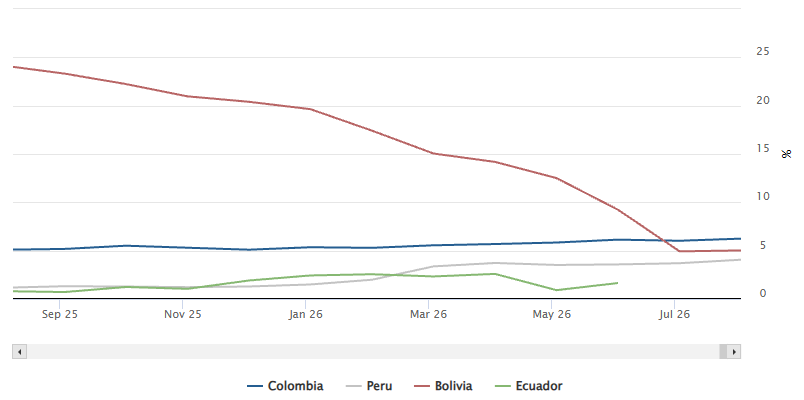
Andean countries: inflation rate
Percentage variation (year-on-year)
Andean countries: GDP growth (%)
Quarterly figures are year-on-year growth