
Caribbean & Central America - April 2020
REGION: Coronavirus highlights need to reform labour markets
Central American economies generally have high rates of labour market informality, which makes it more difficult for states to handle pandemics such as the ongoing coronavirus (Covid-19) outbreak.
Interestingly for a term that gets a lot of attention from economists, the exact definition of labour market informality is not universally agreed upon. However, it commonly refers to undeclared labour, tax evasion, and unregulated or unlicensed activities. In less developed countries like those in Central America, these activities are likely performed for subsistence on a small scale, according to the Organisation for Economic Cooperation and Development (OECD).
Informality rates are higher in countries where economic development is low, and people engage in informal labour as a survival response in the face of poverty. Those rates are also linked to the quality of regulation and the capacity of the state to enforce those regulations.
Most economists believe that a high informality rate decreases productivity and holds back national economic growth. Governments generally do their best to bring informality rates down, but Central American nations have struggled to do so. This has been thrown into sharp relief by the Covid-19 pandemic, which has shone a light on informality as a major social issue. With so many people unable to respect lockdown measures because they need to earn cash each day in order to survive, it has been even more difficult for Central American nations to fight the virus than other countries where rates of formal employment are higher.
Honduras is one country that continues to struggle with high levels of informality and low levels of female employment which restrict economic growth, according to a new World Bank (WB) report released in February. According to the ‘Jobs Diagnostic Honduras’ report, 58% of all jobs in the country are “informal”, one of the highest rates of informality in Latin America. Most informal jobs are in services (28%), agriculture (19%), and industry (11%). Many of informal workers are self-employed, but a significant proportion of wage earners (41%) are also employed “off the books”.
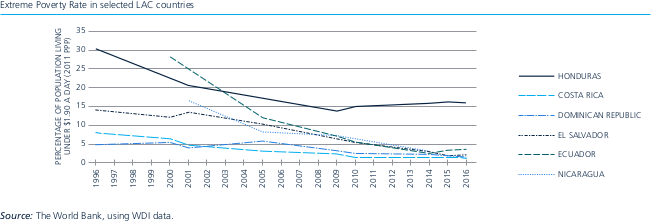
Employment informality is closely linked to the country’s persistently high poverty and disappointing economic growth over the last two decades. Honduran per capita GDP remains one of the lowest in the region at US$2,500 in 2018, according to the WB. The proportion of the population in extreme poverty halved from 30% to 15% in 1996-2008 but has begun to creep up since then.
According to WB officials, Honduras’s economic growth potential is being undermined by the fact that a large proportion of the workforce, particularly women, is inactive. No less than 38% of the working age population (WAP) is inactive. Only 47% of working age women are active compared to 88% of men. Most people (88%) not in employment, education, or training (known as Neets in English or Ninis in Spanish) are women. This very high proportion is explained by the existence of multiple barriers to formal female employment. They include the demands of childcare duties, social conventions that require women to carry out unpaid housework, the threat of violence in public transport, and gender discrimination in places of work.
The private sector contribution to increased formal employment has been disappointing. Formal private sector employment grew by 2.5% in 2012-2015, according to the WB report, compared with 10% in Nicaragua and to an average of 5% in other Central American and Caribbean countries such as the Dominican Republic and El Salvador. A survey of local companies showed job creation was limited by a lack of credit (18%), competition from companies using informal workers (16%), taxes (11%), and red tape (8%).
Many of these characteristics are shared by other Central American nations. Statistics from the International Labour Organisation (ILO) published in 2018 show that the proportion of informal workers is higher in Central America (58.0%) and the Caribbean (57.6%) than South America (50.8%). In Guatemala and Nicaragua, the informality rate hovers around 80%.
Several important disparities are apparent in the regional figures. For example, the rate of informal employment is higher among Central American women (61.8%) than men (55.6%), and higher for 15-24 year-olds (70.5%) than adults aged 25 and over (55.5%). The rate of informality falls as the level of education rises from 78.5% for those with no education to 74.5% for people with primary education, 58.0% for those with secondary and 33.5% for those with tertiary.
Figures for Central America also show a rural-urban divide, with informality rates of 67.4% in rural areas compared to 50% in urban areas. It’s also interesting to note that 70.5% of agriculture workers are informally employed, compared to 53.7% in industry and 56.2% in services, according to the ILO.
Costa Rica has traditionally had lower rates of informal employment than its Central American neighbours, but a 2018 report from the International Trade Union Confederation found that the rate rose from 36% in 2010 to 45% in 2016. Panama is another country that has seen increasing rates of informality in recent years, from 43.6% in August 2018 to 44.9% in 2019, according to a report from the country’s statistics institute. In this case, slowing economic growth led to job losses in the formal sector, pushing more people into informal employment.
Informality means fewer contributors to social security programmes and lower rates of education, as well as labour unionisation. It also makes for lower tax takes, according to the OECD, and research shows that both individuals and companies in Central America show low rates of compliance with income taxes. This means that the redistributive income of personal income tax is low, and there is less money to spend on social policies.
In July 2019 the Guatemala-based think-tank Central American institute for fiscal studies (Icefi) issued a report decrying the poor performance of tax collection across the region in the first half of 2019. Icefi forecast that if this continued in the same vein for the rest of the year, Central America’s average tax revenue would fall for the second consecutive year to 13.7% of GDP.
The informal economy makes it impossible for workers to improve their skills, consigning them to poorly-remunerated, low-productivity jobs. It also means that many people reach retirement age without a pension, leaving them with no choice but to keep working. Those in the informal sector work until they physically cannot do so any longer because there is no social security system. While Central America still has a generally youthful population, it is starting to age. Even in Guatemala, which has had the highest fertility rate in Latin America for decades, the number of children born per woman has been declining rapidly, from 4.60 in 2000 to 2.87 in 2018, according to the WB. This means that without reforms, Central America will be left with an ageing population and poorly remunerated workers that aren’t paying the necessary tax bills to provide for the inactive population.
Another threat
Reducing informality and enacting reforms that allow workers to develop their skills will be increasingly important with the advent of artificial intelligence (AI). Research by the Inter-American Development Bank (IDB) published in 2018 found that countries with greater inequality and lower GDP per capita are most at risk of losing jobs to AI. In 2018, an estimated 75% of workers in Guatemala and El Salvador were in jobs at high risk of being lost to automation. In Costa Rica that figure is 68%, falling to 65% in Panama and Nicaragua.
At the same time a 2017 report from consultancy firm, McKinsey, found that technology could encourage firms to re-shore manufacturing to the US as its decreasing costs negate Central America’s low wage advantage. This could affect the maquiladora textile factories that proliferate in the region. It also means that a huge number of formal jobs are at risk, and these workers could be pushed into the informal economy if they do not ‘reskill’ using education and training programmes.
In 2016 the ‘Future of Jobs’ report from the World Economic Forum said that 65% of current primary school students will do jobs that do not yet exist. It is up to Central American governments to ensure that they get the education and training they need to take advantage of this ‘digital dividend’ and prevent the labour market from being polarised as low-skilled workers are stuck with old technology and the highly-skilled monopolise the rewards.
The most important takeaway here is that the impact of new technologies will depend largely on the policies that govern them, according to the WB. Instead of restricting the spread of technology, governments should encourage the development of skills that will allow workers to benefit as equitably as possible from digital transformation. Whether they can do so relies on education and training systems that appreciate the new realities of the labour market.
Governments in Central America already knew that encouraging informal workers to join the formal economy was an important task. The coronavirus pandemic has magnified the negative effects of having a large informal sector, and these issues are only going to become more pressing as technology impacts the world of work and the population of Central America starts to age. Regional leaders should look to use technology for their own benefit in similar ways to Peru, which has reduced informality by moving to an online tax system or incentivise the move to the formal sector 1y extending certain benefits to registered workers. Of course, these initiatives have a limited impact without a holistic plan to develop industries and train people to work in them, but so far too little is being done.
World Bank proposals
The World Bank report outlines options to increase growth in well-paid formal jobs. It recommends measures designed to increase agricultural productivity, and reforms of education and skills training to better match company needs. It also emphasises the need to improve childcare and increase safety on public transport so as to encourage more female employment. Another policy proposal is that the government should focus on investing in labour-intensive industries.