
Caribbean & Central America - May 2020
REGION: Unprecedented pressure on Caribbean economies
In its latest Quarterly Bulletin, published in late April, the Inter-American Development Bank (IDB) looks in detail at what the coronavirus (Covid-19) pandemic could mean for six Caribbean economies: The Bahamas, Barbados, Guyana, Jamaica, Suriname, and Trinidad & Tobago.
For three of these economies (Bahamas, Barbados, and Jamaica) tourism is a vital industry; for the other three oil & gas and commodity prices are the key issues. Both groups will suffer as a result of the coronavirus pandemic, but the tourism-dependent economies will suffer the most severe economic downturns. And what the IDB has to say about the three tourism-dependent countries on which the report focuses applies equally if not more to many other countries and territories across the Caribbean. As Table 1 below shows, of the 25 top tourism-dependent countries/territories worldwide, no less than 12 are in the Caribbean.
Table 1: Percentage contribution of tourism to GDP and employment of 25 most tourism-dependent countries (average from 2015-2019)
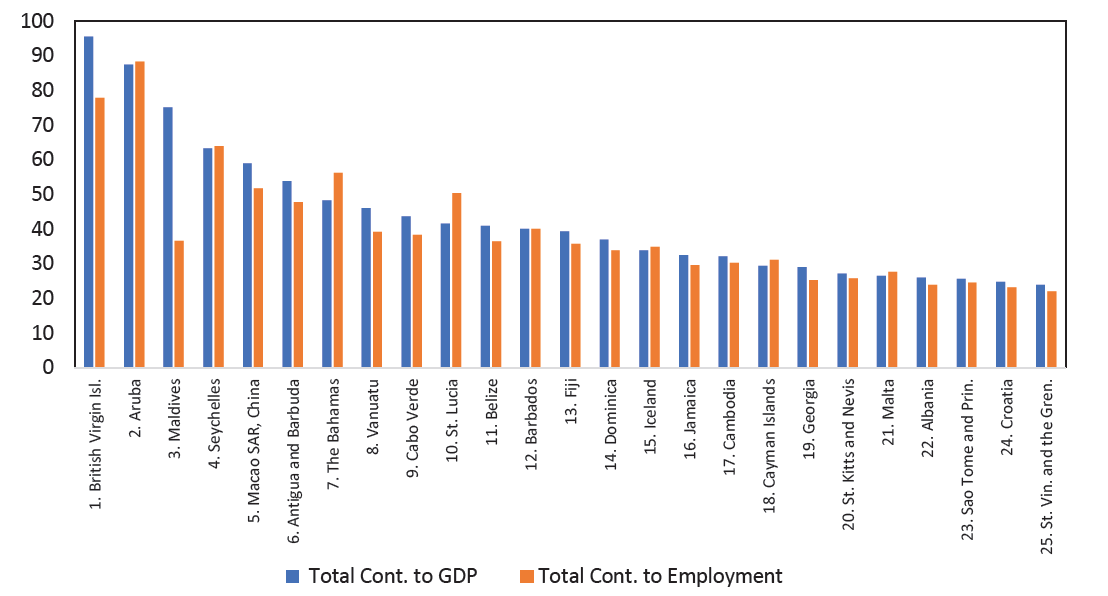
Source: IDB calculations based on data from World Bank/World Travel and Tourism Council
How deep the damage will be, however, is still a wide-open question. Without doubt it will be bad; the question is how bad. The IDB report looks back over six other disruptive episodes, namely the 11 September 2001 terrorist attacks; the severe acute respiratory syndrome outbreak (Sars) of 2002-2003, the global financial crisis of 2008-2009, the 2009-2010 swine flu (H1N1) pandemic; the Ebola outbreak of 2013-2016, and the Zika outbreak of 2015-2016. Of these it finds that only the global financial crisis led to an appreciable decline in tourism in the Caribbean countries under review. However, the IDB notes that the largest single year reduction in year-on-year arrivals in any of the countries was 6%, and it adds: “The near-complete shutdown of both passenger air travel and cruise ship activity beginning in March 2020 would imply a much larger shock to tourism arrivals and related receipts for 2020”. It concludes that the Covid-19 pandemic is without precedent when it comes to the shock to tourism in the Caribbean.
The only slightly redeeming feature about the present crisis is that it has occurred in March when the high season for Caribbean tourism is generally October to April, and to estimate the possible impact of the crisis, therefore, the IDB has three time horizons for the shutdown, that is through end-June 2020, end-September 2020, and end-December 2020. It also looks at the effect of three levels of shock over these time horizons, namely a 25%, 50%, or 75% loss of tourism activity.
In the worst-case scenario, a 75% loss of tourism activity lasting through to end-December, the IDB estimates that The Bahamas would lose 10.5 percentage points of GDP relative to the pre-crisis baseline estimates for 2020. For Barbados, the estimated loss would be 6.5 percentage points, and for Jamaica 5.4, reflecting the relative importance of tourism to each country.
The implications of all this for individual livelihoods and wellbeing will be immense, but the extent to which governments in the sub-region will be able to alleviate and mitigate individual suffering will be limited. As the IDB points out, while some countries like The Bahamas have experienced a rise in the public-debt-to-GDP ratio in recent years, even those like Barbados and Jamaica that have reduced their debt-GDP ratios still have debt burdens that “remain extremely high by regional and international standards”.
Jamaica has reason to feel particularly aggrieved with fate. On 10 November 2019, the country graduated with success from an arduous six-and-a-half-year International Monetary Fund (IMF)-supervised economic reform programme. In its final review of Jamaica’s performance, the IMF Executive Board lavished praise on the Jamaican authorities for having demonstrated “an exemplary commitment to reforms under two consecutive IMF-supported programs…with considerable sacrifices by the Jamaican people”.
When the People’s National Party (PNP) government led by then-prime minister Portia Simpson-Miller (2006-2007; 2012-2016) turned to the IMF in 2013, Jamaica’s public debt had soared to 147% of GDP, unemployment was over 15%, inflation stood at 9.4%, and foreign exchange reserves, as a consequence of the collapse in the bauxite market after the global financial crash, had shrunk to under US$1.5bn. By the time of its graduation from IMF tutelage, now under a Jamaica Labour Party (JLP) government led by Prime Minister Andrew Holness, Jamaica’s public debt was under 100% of GDP and (according to the IMF) “on track to meet the legislated target of 60% of GDP by March 2026”, unemployment was at a record low of under 8%, foreign exchange reserves were up to US$3.5bn, and inflation was under 4%. Now the benefits of all that hard work are in jeopardy.
“Borrowing not the answer”
Perhaps the only positive for the sub-region is that the international community is fully aware of the immense stresses being imposed on the finances of Caribbean nations, and many will agree with the United Nations Economic Commission for Latin America and the Caribbean (Eclac), which has warned that borrowing is not an option. Alicia Bárcena, Eclac’s executive secretary, had an online discussion with Caribbean heads of government and finance ministers on 29 April to discuss the options.
Bárcena’s response to what she heard was to say: “We are putting the Caribbean first in everything we do...”. She added: “Caribbean economies have the highest debt ratios in the world [averaging 68.5% of GDP in 2019]. Reductions in production and income along with increases in borrowing will further rise debt burdens. Debt is rooted in external shocks, compounded by the impact of natural disasters and inherent social and economic structural weaknesses…Borrowing is not the answer to confront this crisis. Caribbean countries need grant support fast. There is need for urgent intervention to ensure liquidity. Let me say that we are very much on board. We are part of this. A game plan for the short term is needed and we have to work on this, together with Caricom [Caribbean Community], ACS [Association of Caribbean States], and OECS [Organisation of Eastern Caribbean States]”. Bárcena concluded: “We will continue to advocate for this debt relief, for grants, for concessional funding for the Caribbean countries”.