
Caribbean & Central America - August 2020
REGION: Finding a way forward for the Caribbean
Apart from Haiti, for which fate seldom has a kind gesture, in terms of health the Caribbean has been relatively untouched by the coronavirus (Covid-19) pandemic. As detailed last month [EB-20-07], the same cannot be said about the economies of the Caribbean, in particular those of the small tourism-dependent countries. The latest forecast from the Eastern Caribbean Central Bank (ECCB) says that the economy of the Eastern Caribbean Currency Union (ECCU) will contract by between 10% and 20% in 2020, and debt is once again becoming a major concern.
Figure 1 below shows just how much worse the economies of the Eastern Caribbean will fare compared both with advanced economies and the global economy in general, a fact that becomes starker when it is seen that the Eastern Caribbean outperformed the other two categories in 2019.
Figure 1: Economic growth for Global, Advanced and ECCU economies 2019-21
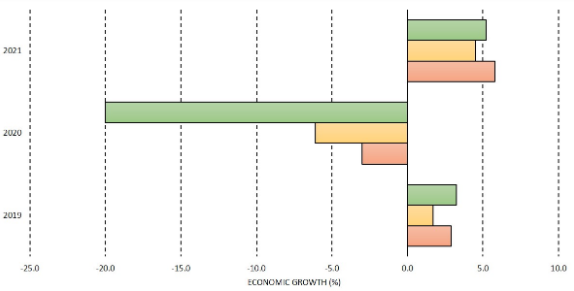
Notes: Green = ECCU Economies, Orange = Advanced Economies and Red = Global Economies. Data as of May 2020. ECCU worst case scenario shown in chart
Source: Communique of the 96th meeting of the ECCB Monetary Council
With regard to the all-important question of jobs, the Inter-American Development Bank (IDB) says that the tourism-dependent economies of the Caribbean could see anywhere from 12% to as much as 20% of their tourism-related labour force badly affected. In its latest Caribbean Quarterly Bulletin, the IDB added: “Many individuals and households in the region will suffer, implying severe social costs that are difficult to capture with economic aggregates”. And it concludes, starkly: “Taken together, this suggests that the Caribbean could be the most adversely affected region in the world in terms of the economic impact of Covid-19”.
The debt question is clearly a serious concern. The ECCB warns: “Total public sector debt of the region is expected to rise in both nominal terms and as a percentage of GDP during 2020”. It lamented “the reversal of the significant progress made by member countries to meet the Debt-to-GDP target of 60% by 2030. At the end of 2019, the Debt-to-GDP ratio stood at 65%”. And it said that it “recognised that Member Governments will need to contract additional debt to fund critical support for their economies during this difficult period. The combination of economic contraction and the necessity of additional borrowing means a rise in the Debt-to-GDP Ratio in the short term”.
The IDB is equally gloomy on debt, acknowledging that deficit spending in response to the crisis will result in an increase in debt, but it adds with brutal realism that it will be necessary “to recover fiscal sustainability following a build-up in public debt”.
Caribbean leaders are acutely aware of the near impossible choices they face, and it is no surprise that they are looking for external help. The prime minister of Barbados, Mia Mottley, is calling for a Caribbean Marshall Plan, referring to the US-funded recovery plan for post-war Europe – and she, like others, is linking this to long-standing calls for reparations for slavery from the old colonial and slave-owning powers. The combination of the immediately adverse effects of the Covid-19 pandemic, the longer-term consequences of climate change, and the renewed focus on racial inequalities through the Black Lives Matter (BLM) protests has given added momentum to this argument.
Speaking at a Caribbean Community (Caricom) Reparations Commission (CRC) virtual meeting in early July, Mottley said: “Economic transformation and growth depends on an international compact for the Caribbean. Covid-19 has already led, in many instances, to a doubling of expenditure in health and social care support, a quadrupling in other cases, because all of a sudden you go from tourism sectors that are earning to tourism sectors with zero revenue and therefore lack the capacity to employ anyone…The combination of the appropriateness of the reparations argument, as well as the reality of the economic implosion that has taken place as a result of the global pandemic, requires urgent conversations to begin to understand that a world that was rooted in immorality or a world that was rooted in people profiting from crimes against humanity runs counter to the very things at the democratic level that we have asked both small states and large states to be able to reflect”.
The prime minister of St Vincent & the Grenadines, Ralph Gonsalves, who took over the chairmanship of Caricom from Mottley at the beginning of July, reiterated this call in a statement marking Emancipation Day on 1 August. Gonsalves said: “I urge all in Caricom to focus on reparation for the enslavement of Africans on Emancipation Day 2020. In our region, and elsewhere, we need to have a more thorough-going public education programme on the meaning and significance of reparatory justice for the Caribbean. Further, our governments must ramp up the political, diplomatic, and international legal struggle for reparation. All hands are required on deck as a matter of urgency”.
In an opinion piece published by the Jamaica Observer on 2 August, veteran Caribbean diplomat Sir Ronald Sanders brought the question back to climate change in general, and food security in particular. He pointed out that “at least seven of the 14 [Caricom] countries import more than 80 per cent of the food they consume, resulting in the region's annual food import bill estimated in 2019 at US$5bn”. Sanders added: “This serious vulnerability has been alarmingly exposed by the Covid-19 pandemic, as the foreign exchange earnings of countries have diminished. Stark choices have had to be made about foreign purchases. Should the priority be medicines, food, or building materials? This has caused governments to encourage more local food production. However, these belated efforts in agriculture will be frustrated, if not overturned, by uncurbed climate change. Extreme heat, droughts, floods, salt water encroachment due to rising sea levels and storms have harmed agricultural productivity and caused food price hikes and income losses. These events have wiped out crops, bankrupted farmers, and forced them out of business, in many cases permanently”.
It may all sound rather apocalyptic, but there can be no serious doubt that the Caribbean faces an unprecedently difficult time. Even if the Covid-19 health challenge is solved relatively soon, the setback to the Caribbean will have been immense, with all the recent good work on reducing external debt seemingly wasted.
So, whether cast in terms of reparations or not, what seems certain is that substantial external help for the Caribbean will be required. As a recent analysis from the United Nations Conference on Trade and Development (Unctad) put it, there are only two ways to cope with the catastrophic fall-off in earnings that much of the Caribbean is currently experiencing, by borrowing or spending international reserves. Yet, as Unctad says, “Access to capital markets is increasingly difficult, even more so for…indebted, poorly diversified countries with low levels of international reserves, sufficient to cover a few months of imports…Without international assistance, the economic consequences of the pandemic will be devastating”. That is undoubtedly true, but, as Sanders emphasises, climate change will ensure that there is no respite in the longer term.