
Caribbean & Central America - April 2021
REGION: Caribbean faces long-haul recovery
In a Country Focus briefing released on 12 March, the International Monetary Fund (IMF) warned: “Much the same as some patients could suffer from lingering illnesses long after the coronavirus [Covid-19] infection has passed, the pandemic’s economic fallout might be felt in the [Caribbean] region long after the health emergency is controlled”. The reason, says the IMF, is the combination of the region’s reliance on tourism with the “small size and limited room to manoeuvre” of many of the countries.
As the table below shows, the small tourism-dependent islands of the Caribbean fared particularly badly in 2020. If the exceptional case of oil-rich Guyana is excluded, only Trinidad & Tobago (-7.8%) and St Vincent & the Grenadines (-4.2%) avoided double-digit GDP contractions, and some economies will continue to contract in 2021, namely Dominica (-0.4%), Grenada (-1.5%), St Kitts & Nevis (-2.0%), and St Vincent & the Grenadines (-0.1%) – and the latter is now likely to fare considerably worse than forecast given the eruption of La Soufrière volcano.
Real GDP annual percentage change
| 2020 | 2021 | 2022 | 2026 | |
| Actual | ||||
| Antigua & Barbuda | -17.3 | -3 | 11.9 | 3 |
| Bahamas | -16.3 | 2 | 8.5 | 1.5 |
| Barbados | -17.6 | 4.1 | 7.7 | 1.8 |
| Belize | -14.1 | 1.9 | 6.4 | 2 |
| Dominica | -10.4 | -0.4 | 5.8 | 1.5 |
| Grenada | -13.5 | -1.5 | 5.2 | 2.7 |
| Guyana | 43.4 | 16.4 | 46.5 | 3 |
| Jamaica | -10.2 | 1.5 | 5.7 | 2.2 |
| St Kitts & Nevis | -18.7 | -2 | 10 | 2.7 |
| St Lucia | -18.9 | 3.1 | 10.7 | 1.4 |
| St Vincent & Grenadines | -4.2 | -0.1 | 4.9 | 2.7 |
| Suriname | -13.5 | 0.7 | 1.5 | 1 |
| Trinidad & Tobago | -7.8 | 2.1 | 4.1 | 1.5 |
Source: World Economic Outlook 2021
The main issue is going to be money for stimulating a recovery. The IMF estimates that the already over-indebted Caribbean will suffer a financing gap of “around US$4bn”, or 4.8% of 2020 regional GDP.
But the IMF has no magic wand to wave. It recommends further economic support for the region “until the recovery is entrenched”; thereafter it is much the same old recipe of restoring debt sustainability through “well-calibrated and appropriately balanced revenue and expenditure measures to reduce the primary deficits while minimising the contractionary impact on growth”.
The IMF does also mention, but without necessarily endorsing, that the Caribbean Community (Caricom) has launched a Caribbean Economic Recovery and Transformation Plan (Cert) “to develop a financing strategy to support post-pandemic investment needs”. The Cert plan has been modelled on the Barbados Economic Recovery and Transformation Plan (Bert). For the further development of Cert, Caricom has established a planning committee under the chairmanship of Barbados’ prime minister, Mia Mottley, and including five ministers of finance or economic affairs from the region and the governor of the Eastern Caribbean Central Bank.
Speaking in mid-January, the Barbados ambassador to Caricom, David Comissiong, said that Caricom will “lobby at the international level” for an increase in the IMF members’ special drawing rights (SDRs) allocation and it will focus on “refinancing of the debt that Caribbean countries have incurred on account of Covid-19, at very low, fixed interest rates and with a seven- to 10-year moratorium on repayment”. Beyond that, according to Comissiong, the Cert will also “seek to amend downwards and extend the fiscal and debt reduction targets that the international financial institutions expect Caribbean countries to meet, which would give the governments more fiscal breathing space”.
These calls for help over debt are becoming increasingly persistent. On 29 March, United Nations Secretary General António Guterres joined the prime ministers of Canada and Jamaica, Justin Trudeau and Andrew Holness, in calling for “far bolder steps” to prevent a debt crisis, including a moratorium on debt repayments, targeted debt relief, and reforms to the international debt architecture.
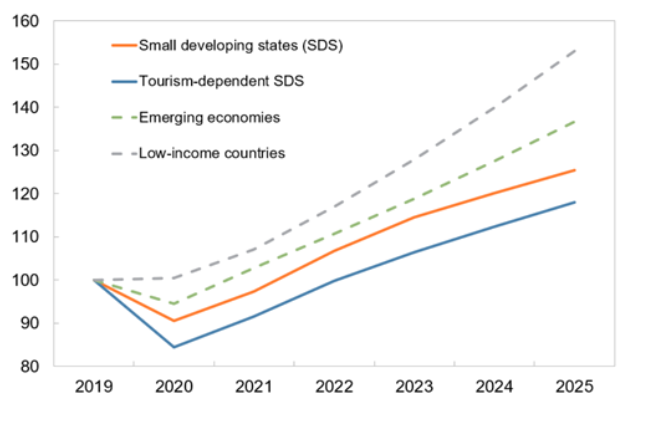
However, there is a general feeling that the early-April Spring meetings of the IMF and World Bank did not deliver enough even though there was a proposal to increase SDRs by US$650bn. After the meetings, the managing director of the IMF, Kristalina Georgieva, talked about there being good news with “light at the end of the tunnel”, but she also warned: “Yet, while there is light, the crisis continues to cast a dark shadow. Economic fortunes are diverging dangerously. A small number of advanced and emerging market economies, led by the US and China, are powering ahead. Weaker and poorer countries are falling behind in this multi‑speed recovery”. The Caribbean is very definitely in this second category. As the graph below shows, tourism-dependent small developing states (SDS) have suffered more and will recover more slowly than SDS in general or than low-income countries and emerging economies.
Countries more reliant on tourism had worse recessions (GDP in US Dollars, 2019 = 100)
 Source: IMF, World Economic Outlook database and IMF staff calculations
But the Caribbean poses a special problem because many of the region’s countries are categorised as middle income or even high income, despite their clear vulnerabilities. In a question-and-answer session after the Spring meetings, Georgieva acknowledged this, saying that “middle‑income tourism dependent countries are in a very difficult position”, and she added that “we are, of course, concerned how we can rally more support so they can be on a more prudent path to recovery”. She did not, however, provide the answer.