
Caribbean & Central America - August 2022
REGION: Despite risks, Caribbean tourism is bouncing back
The Caribbean summer Carnival season, with events running across June, July, and August, is now underway after an enforced two-year break caused by the coronavirus (Covid-19) pandemic in 2020 and 2021. The return of festivities comes amid positive signs for the crucial tourism sector.
Already this year Trinidad and Tobago was able to hold its carnival on the traditional dates in February, with other countries delaying until the summer. In Barbados, that meant later street parades for the Crop Over festival. Jamaica's carnival, usually held in spring, was delayed to July this year, and has just concluded. In Grenada, Spicemas 2022 is due to be held in early August. In Bahamas this year’s festivities, including the Junkanoo parade, were held in April. Vincy Mas has meanwhile returned to St Vincent and the Grenadines.
The return of carnival has been closely watched by those trying to assess the strength of the recovery in tourism, one of the Caribbean's main industries, a prime source of foreign currency, and a generator of employment. “Carnival...is the largest economic impact event in Jamaica. It’s number 1 in terms of what we have for the economy” says Kamal Bankay of the Jamaica Carnival National Stakeholders’ Committee. The Barbados Association of Masqueraders says Carnival there attracts US$150m a year in spending, and that there is no other event “that pulls in that kind of money in such a short space of time”. In Grenada Kelvin Jacob, head of the Spicemas Corporation, says: “Carnival is very important to our tourism. It is one of the biggest sellers and brings the largest set of people onto the island.”
The wider tourism picture is indeed beginning to look more positive this year. Speaking in late June, Nicola Madden-Greig, president of the Caribbean Hotel and Tourism Association (CHTA), said: “We are very excited to see that Caribbean tourism is recovering much faster than had been anticipated originally, and we are seeing that we are the second fastest recovering globally.” She added that the region was still behind its pre-pandemic 2019 peak by 36.1% but that in terms of its contribution to GDP for 2021 the sector was up by 36.6% over 2020 and had recovered some 311,000 jobs.
Madden-Greig was using data from the UK-based World Travel and Tourism Council (WTTC). This showed that, at a global level, tourism’s contribution to GDP nearly halved from 10.3% in 2019 to only 5.3% in 2020, but it rose again to 6.1% last year. For the Caribbean region, that V-shaped pattern of recession and recovery was more pronounced, with the comparable figures being 13.9% in 2019, 7.1% in 2020, and 9.1% in 2021. Last year Caribbean tourism GDP was US$39.3bn, and the sector employed 2.35m people (still beneath the pre-pandemic total of 2.75m). Visitor spending, at US$18.2bn last year, is still taking time to recover from the pre-pandemic total of US$36.4bn. Most tourists still come from the US (61% of the total last year), followed by France (4%), Canada (3%), and the UK (2%).
More recent statistics suggest that the Caribbean recovery is gaining pace. Madden-Greig said arrivals in January and February this year were weak because of continuing worries over the Omicron Covid variant, but that the March-June period in contrast saw “really strong demand”.
According to a June 2022 report by Spain-based travel data and analytics company Forward Keys, international tourist arrivals on the books in the Americas, Q3 2022 vs 2019, showed that in the Americas different sub-regions are recovering at different rates. Leading the way are the countries bathed by the Caribbean Sea: Mexico, Central America, and the Caribbean (+5%). Top-performing destinations in the sub-region include Costa Rica (+24%), the Dominican Republic (+13%), and Jamaica (+17%), which have surpassed their performance in summer 2019 and 2021. Quickly catching up are destinations such as Panama (- 29%), Barbados (-18%), and Guatemala (-12%). While these have not achieved their 2019 levels, they have significantly improved on their 2021 performance. Meanwhile, arrivals in the Turks and Caicos (+47%), El Salvador (+24%), and Belize (+23%) have levelled out.
For the region, simply “revving up” the tourism sector is not sufficient. Governments have to face some big short-and-long term challenges. One key issue is that the sequence of external shocks that have hit the industry is not necessarily over. Covid-19 is still present, and vaccination rates in many Caribbean islands are low. In Jamaica and St Vincent half of the population remains unvaccinated, meaning a damaging new spike in contagion cannot be ruled out (and indeed, might even spread as a result of Carnival-themed mass public events). The region also must battle with climate change and the damage inflicted by hurricane seasons. A sobering report on The Bahamas by the Inter-American Development Bank (IDB) says a combination of Dorian, the Category Five storm that hit the island in August/September 2019, causing US$3.5bn worth of losses, and the later outbreak of Covid 19 (another US$9.15bn in losses) was devastating. The report states the Bahamian economy will only return to pre-pandemic levels by 2024.
YTD 2022 as % of YTD 2019
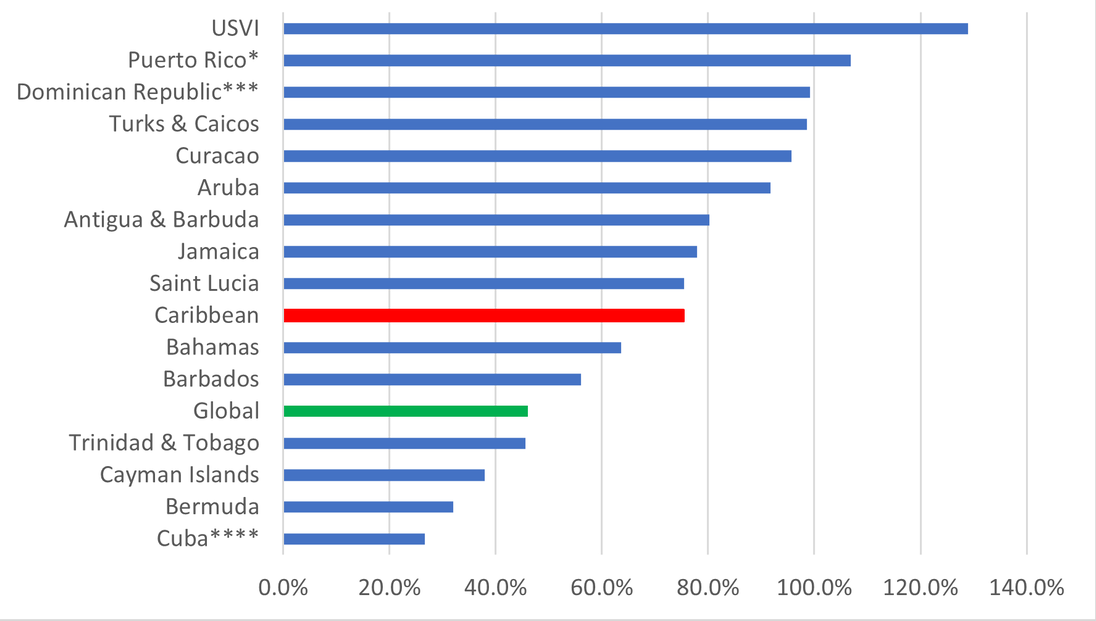
Note: this refers to total tourism arrivals per country. Those registering over 100% (only two) are back up to pre-pandemic levels.
Source: Tourism Analytics
For the Caribbean region as a whole the pandemic shock was rapidly followed by further global disruption caused by the war in Ukraine, with associated increases in international energy prices and negative impacts on the domestic cost of living. The World Bank has predicted a slowdown in global economic growth, although it still expects Caribbean GDP to rise 6.9% this year and by 6.5% in 2023 largely because of the tourism revival.
That said, there are measures governments can take to try and sustain and strengthen the current recovery. One is to improve airlift. While the major destinations are reasonably well-served by commercial airlines, the pandemic-related collapse of regional airline LIAT has left a gap in air services. Edmund Bartlett, Jamaica's tourism minister (who also chairs the Organisation of American States Inter-American Committee on Tourism - OAS-CITUR) has called for policies to allow regional carriers to develop. He has also suggested a move to a jointly managed airspace and a common Caribbean visa regime.
Demands from tourism executives
Tourism executives have called for increased training, upgrades in infrastructure, better support and financing for job creation by small and medium-sized enterprises (SMEs) in the tourism sector, more effective marketing, and investment in the growing use of IT and digital business processes. Jamaica’s tourism minister, Edmund Bartlett, has also sought to build links with Middle East: in July he participated in the first “Caribbean Saudi Arabia Summit” held in the Dominican Republic, where he spoke of developing new markets in Asia, Africa, and the Middle East.
Cuba
Cuba reported 682,297 arrivals in the first half of this year, over five times the comparable period last year. Still, the country is one of the four slowest to recover. The Cuban government says it is aiming to host over a million visitors in July-October and is trying to upgrade its stock of available hotel beds. For 2022 as a whole it wants to attract 2.5m tourists. That is still very significantly below the pre-pandemic total of 4.27m visitors.