All Categories

Subcategories

  • COLOMBIA: Questions about transitional justice

    LatinNews 07 June 2018 Hits: 777

    The peace agreement with the former guerrilla group Fuerzas Armadas Revolucionarias de Colombia (Farc) is coming under increasing scrutiny, not least because Iván Duque, the frontrunner in the second round presidential ballot due on 17 June, says that if elected he will review the terms of the deal. Particular attention is being given to the role of the transitional justice system (JEP).

    On 5 June the US based NGO Human Rights Watch (HRW) submitted an ‘amicus curiae’ (friend of the court) brief to Colombia’s constitutional court arguing that it should address “significant flaws” in the justice component of the peace accords. The court is reviewing a November 2017 bill that outlines how the JEP is supposed to work. HRW says there are shortcomings in the bill that would allow war criminals to escape meaningful punishment. In particular, it questions the definition of “command responsibility” in the bill. It also criticises provisions that would bar human rights defenders from serving as judges in the JEP.

    The JEP is facing scrutiny from various (and sometimes ideologically opposed) quarters. The transitional courts have been criticised for allowing some demobilised Farc guerrillas to leave the country. One of the beneficiaries of this ruling is Fernando Arellán, a former guerrilla sentenced in absentia to 40 years in prison for his involvement in a 2003 bomb attack on the ‘El Nogal’ social club, which left a toll of 36 dead and 200 wounded.

    As a demobilised ex-combatant Arellán has not immediately been called upon to serve his sentence but instead comes under the JEP’s jurisdiction. The justice ministry said that while it respected the JEP’s independence it could not support the decision to let Arellán travel abroad, which “delegitimised” the transitional justice system. Matters are complicated because the JEP authorities say the decision to allow Arellán and five other former guerrillas to leave the country was improperly taken by Néstor Raúl Correa, its former executive secretary (it should have been taken by the JEP Court of Amnesty and Pardon). Duque’s right-wing Centro Democrático (CD) party is asking for Correa to be prosecuted for abuse of authority.

    Duque has made clear that if he is elected he will seek a reform of the JEP system that he currently describes as “a monument to the impunity of the Farc”. Commenting on the Arellán case he said “it is shameful that we are beginning to see these elements of impunity. I hope the country as a whole will react against this.” The latest polls show an increased probability that Duque will win the second round run-off ballot: according to pollster Yanhaas, in early June he had 52% support against 34% for Petro. The winner of the second round will take office on 7 August, at the start of a four-year term. Therefore, the stage is beginning to be set for a political debate later this year on whether and how to toughen the transitional justice provisions of the peace agreements.

    • Justice

    Human Rights Watch Americas Director José Miguel Vivanco said the peace accord with the Farc did not do enough to guarantee justice to victims of serious atrocities committed during the armed conflict. “The court has a chance to lay the groundwork for meaningful accountability both for senior army officers and Farc guerrillas who committed war crimes,” Vivanco added.

  • Mexico: OECD strikes a cautious note over 2019 prospects

    LatinNews 24 May 2019 Hits: 742

    The Organisation for Economic Co-operation and Development (OECD) has highlighted Mexico’s weak prospects for 2019, projecting a deceleration of real GDP growth from 2% last year to 1.6% this year. This chimes with recently-released first-quarter data, which showed that the economy actually contracted on a quarterly basis. However, the OECD remains upbeat about the outlook from 2020, anticipating a renewed – albeit moderate – acceleration.

    In its Economic Survey report, the OECD struck a relative balance in terms of acknowledging the progress made so far, but also highlighting areas of weakness that continue to hamper economic performance. It highlighted the economy’s integration into global supply chains; a loosely-cloaked reference to close trading ties with the US, the destination for around 90% of Mexico’s exports. Indeed, in GDP terms exports of goods & services registered average annual growth of 5.7% from 2014-2018, at a time when overall GDP growth was much weaker, at an average annual rate of 2.6%. Private consumption has also been supported by solid growth in remittances and more rapid credit growth. 

    Structural constraints remain largely unaddressed

    However, the OECD identified a number of areas in which Mexico has made little progress and which are contributing to the weak outlook for 2019. These include declining oil production, which according to Pemex statistics fell by over 11% in the first quarter, to 1.9m barrels/day from just under 2.2m b/d a year earlier. The OECD highlighted the extent to which this is dragging on overall economic growth, as well as fiscal revenues. It also raised concerns about weak investment, both from domestic investors and foreign ones, which is likely to reflect policy uncertainty under the administration of Andrés Manuel López Obrador. Although in some areas the new president has adopted a more market-friendly stance than many investors initially feared during his campaign, his approach has not been consistent and decisions such as the cancellation of an airport construction project in late 2018 have kept investors wary. 

    And while some improvements have been made in terms of the overall investment climate as a result of reforms passed under the previous government, the fact that implementation is still ongoing is diluting their potential impact. As a result, long-standing structural problems such as low levels of productivity, sub-standard education provision, high levels of crime, weak competition, and widespread informality remain largely unaddressed, which is continuing to drag on economic performance.

    First-quarter GDP disappoints

    This analysis appears to be substantiated by the release of first-quarter GDP data, which showed a surprise quarter-on-quarter contraction of 0.2% on a seasonally-adjusted basis. This brought year-on-year growth to just 0.5%, marking the worst result since the 2009 recession. So far only the initial flash estimate has been released, with the full breakdown of demand- and supply-side data unavailable, so it is difficult to assess the precise factors explaining the particularly disappointing performance. However, it appears that the manufacturing sector will be largely to blame, since primary output (mainly representing agricultural production) grew reasonably firmly in the first quarter, while tertiary activity (services output) registered a deceleration but still recorded positive annual growth. Secondary activity, however (which includes industrial output, mining, utilities, and construction) contracted by 0.6% quarter on quarter from January-March and by 2.1% on a year-on-year basis. 

    Such weak first-quarter data suggests that, if anything, the OECD’s forecast of GDP growth of 1.6% in 2019 appears overly optimistic, since it would require a fairly sharp pick-up during the remainder of the year. Given that headwinds from a weaker external backdrop will continue, at least in the near term, this may prove challenging. The OECD is continuing to forecast an acceleration in GDP growth to 2% in 2020, driven by firmer exports, private consumption and – to a lesser extent – investment. 

    The expectation that private investment is likely to pick up in the medium term may, however, prove too optimistic, with other recent developments pointing to a still-inconsistent approach towards the foreign investor community from the López Obrador government. The most salient example of this was the announcement in early May that the bidding process for the construction of new refinery in Dos Bocas was being abandoned, with the award instead being handed to the state oil firm Pemex, which is itself heavily-indebted and arguably overstretched (see our next article, Resource nationalism: will it work?). 

  • BRAZIL: Talk of legalising Amazon gold mining raises red flags

    LatinNews 01 August 2019 Hits: 3699

    A meeting in Brasília on 29 July between Brazil’s Foreign Minister Ernesto Araújo and his French counterpart, Jean-Yves Le Drian, was an opportunity for both to highlight the economic benefits that the European Union (EU)-Southern Common Market (Mercosur) trade deal will bring their countries. Le Drian stressed, however, that France expects Brazil to abide by its environmental commitments as part of the deal, a point he repeated on more than one occasion during his four-day visit there.

    Brazil’s President Jair Bolsonaro may have promised his French peer Emmanuel Macron that he will keep Brazil in the 2015 Paris Agreement on climate change and respect the country’s environmental commitments – a pledge that helped seal the EU-Mercosur deal in June [WR-19-26] – but he has since given every indication to the contrary. As Araújo and Le Drian were agreeing on a joint working group to collaborate on meeting the emissions-curbing terms of the Paris Agreement, Bolsonaro was telling journalists about his plan to legalise gold mining in protected indigenous territories in the Amazon.

    This is not the first time that Bolsonaro has expressed his intention of legalising extractive and agricultural activities in the Amazon’s protected areas, particularly indigenous territories. But his latest comments come not long after he dismissed the severity of deforestation levels in the Brazilian Amazon [WR-19-29] and were made in the context of the death of an indigenous leader in the northern Amazonian state of Amapá, which has fuelled concerns over the adverse environmental and human rights effects of illegal mining.

    Emyra Waiãpi, a leader of the indigenous Waiãpi people, was found dead by fellow members of his community on 23 July. His death was confirmed on 27 July by the federal indigenous rights agency (Funai) and the federal police (PF), who noted that the indigenous leader’s body had stab wounds. The council of Waiãpi villages (Amapi) said that he was killed by non-indigenous people.

    The Waiãpi also denounced the attempted invasion of some of their villages by a heavily armed non-indigenous group to the Funai, who called upon the PF and the army for reinforcement in investigating these reports. The invaders were assumed to be illegal gold miners. The Funai’s Amapá branch concluded on 27 July that the threat to the indigenous people from the presence of illegal invaders was real, but the PF has since said that it found no sign of confrontation or invasion in the concerned Waiãpi villages.

    The incident, nevertheless, elicited a reaction from Michelle Bachelet, the United Nations High Commissioner for Human Rights. Bachelet noted that the Bolsonaro government’s policy of encouraging mining in the Amazon “can lead to incidents of violence, intimidation and assassination of the type inflicted to the Waiãpi people”, and urged the government to review its indigenous policies, to keep them in line with indigenous rights and environmental sustainability efforts.

    Senator Randolfe Rodrigues, who represents the environmentally minded Rede Sustentabilidade (Rede) party for the state of Amapá, raised similar concerns. He told BBC Brasil on 28 July that the Bolsonaro government is encouraging illegal invasions for gold mining, such as the ones reported by the Waiãpi. Although it is now unclear whether there were illegal miners on Waiãpi territory last week, it is not the first time that the government has been criticised for its stance on the matter. As well as violating indigenous rights, illegal mining contributes to deforestation and environmental destruction, and failure to curb this activity will contribute to discrediting the green credentials that France is urging Brazil to uphold.

    A change of heart?

    President Bolsonaro, who presented himself as a champion of the EU-Mercosur deal after it was reached, might already be changing his mind. France has interpreted Bolsonaro’s last-minute cancellation of a 29 July meeting with French Foreign Minister Jean-Yves Le Drian, followed by the live streaming of him getting a haircut instead, as a voluntary snub meant to signal the Brazilian president’s discontent with French pressure on environmental issues. The opinion of the US could be an influencing factor also. US Commerce Secretary Wilbur Ross has implied that the terms of the EU-Mercosur deal could represent an obstacle to a Brazil-US trade deal – although a distant prospect, it is not one Bolsonaro would want to compromise.

  • BRAZIL: Amazon murders shine a light on region’s challenges

    Patrick de Courcy 01 July 2022 Hits: 2071

    The disappearance and murder of Dom Phillips, a British journalist, and Bruno Araújo Pereira, a Brazilian indigenous expert, in a remote area of the Brazilian Amazon in early June shocked the country and reverberated well beyond its borders. If any good can be said to have come of the two men’s brutal deaths, it is that they are helping shine a light on the criminal dynamics at play in the Amazon and the consequences of the dismantling of environmental and indigenous safeguards under President Jair Bolsonaro.

    Phillips and Pereira went missing on the morning of 5 June, as they sailed down the Itaquaí river in direction of the town of Atalaia do Norte in the western Amazon, near Brazil’s border with Peru. They were returning from a four-day trip speaking to indigenous people near the Vale do Javari reserve (Brazil’s second largest indigenous territory, home to the largest number of uncontacted groups in the world), as part of Phillips’ research for a book he was writing on the survival of the Amazon rainforest.

    Pereira knew the area well: he used to be the coordinator for isolated and recently contacted peoples at Funai, the government’s indigenous protection agency. He was demoted by the Bolsonaro administration in 2019, and then took leave of absence from Funai, instead working independently with the Univaja indigenous organisation in the Vale do Jaravi to help the indigenous organise and defend their land – work for which he was being threatened.

    After a week, the search for Phillips and Pereira became a murder investigation. On 15 June, a suspect in custody confessed to having killed the two men and led the police to where the remains were buried. At the time of writing, four men had been arrested for their involvement in the murders, covering up the crime, and disposing of the bodies; police were searching for a further four suspects.

    The authorities’ response to the situation has been widely criticised. There was a delay before search efforts by the security forces began; Funai initially sought to distance itself from Pereira and the work he was doing (a court order subsequently banned the organisation from denigrating Pereira and Phillips); President Bolsonaro reacted callously to the disappearances, suggesting at different points that the two men had gone on an “inadvisable…adventure” and that Phillips was disliked for his critical journalistic coverage.

    Local indigenous communities were far more committed to the search efforts than the federal police (PF) and the army. Yet the PF did not acknowledge the work of the indigenous in a press conference after the bodies were found. The corporation also announced on 17 June that it considered that the murderers had acted alone and not under orders from a criminal group – contradicting its previous position and ignoring information passed on by Univaja, which has collected material on the activities of an organised mafia involved in illegal fishing and poaching on the indigenous reserve.

    Motives and crime

    The man who confessed to shooting Phillips and Pereira is a local fisherman.  Amarildo Oliveira de Costa, known as ‘Pelado’, had had run-ins with Pereira over his illegal fishing; witnesses saw him threatening Pereira, Phillips, and an indigenous patrol group days before he killed the two men, and local news site Amazônia Real cites indigenous sources saying Oliveira had been “worked up” against Pereira for a while.

    In that region, illegal fishing – notably of the endangered pirarucu, one of the world’s largest freshwater fish – is closely intertwined with drug trafficking. Oliveira is believed to run an illegal fishing ring at the service of a Peruvian named Rubens Villar Coelho ‘Colômbia’, who then sells the fish across the border – and reportedly uses this trade as a front for drug-trafficking. Coelho has been cited as giving the order for the still unsolved assassination of Maxciel Pereira dos Santos, a Funai agent who was executed in the tri-border town of Tabatinga in front of his wife in 2019.

    Due to its location close to both Peru and Colombia, the Vale do Javari indigenous reserve has become a key area for drug trafficking. As well as the illegal fishing and poaching – only the indigenous have the right to fish and hunt on their land – the territory is threatened by illegal gold mining. Combatting these criminal activities has become increasingly challenging in recent years – a direct result of President Bolsonaro’s policies.

    His administration has gutted Funai and environmental protection agencies such as Ibama, removing qualified career civil servants from technical positions, cutting funding, and adopting a discourse that has emboldened those who are criminally exploiting the Amazon’s natural resources. Reports have emerged showing that the government in Brasília had received multiple warnings about the deteriorating situation around the Vale do Javari, but that nothing was done about it. Univaja’s work, which Pereira actively supported, aims to fill the role of the absent state and try and protect the indigenous land – which is home to particularly vulnerable uncontacted peoples – from invasion.

    “There has been a vertiginous increase in violence in the region,” Eliesio Marubo, an Univaja lawyer, told the senate in June. “We are, literally, in the crosshairs of organised crime. We are defending our people until the last indigenous person. If we fall here, it will be due to our work defending our region.”

    Funai workers protest

    Amid countrywide calls of “Justice for Dom and Bruno”, workers from the Funai government indigenous agency have staged walkouts, demanding the resignation of Funai director Marcelo Xavier, a police officer who was appointed to the position in 2019 by the Bolsonaro government. Indigenistas Associados (INA), an organisation representing Funai employees, recently released a report outlining how Funai has come to pursue an anti-indigenous agenda under the current government, serving the interests of rural landowners over the indigenous peoples it is supposed to protect. The situation is “difficult, tiring, dangerous”, Pereira told daily Folha de São Paulo in an off-the-record conversation that was published after his death.

  • COLOMBIA: Another hammer blow to Farc dissidents

    Patrick de Courcy 21 July 2022 Hits: 3804

    Dissident forces of the Fuerzas Armadas Revolucionarias de Colombia (Farc) guerrilla group have come under sustained pressure over the past year, losing a string of top-level commanders. Defence Minister Diego Molano Aponte announced another significant blow on 15 July, stating that Néstor Gregorio Vera Fernández (‘Iván Mordisco’), the leader of a nationwide alliance of dissident Farc units, had been killed in an airstrike in the southern department of Caquetá. Mordisco’s apparent death came just two months after that of his predecessor, Miguel Botache Santillana (‘Gentil Duarte’).

    Announcing that Mordisco had been killed in an 8 July airstrike in Caquetá’s San Vicente del Caguán municipality, Molano described the military operation as “a death blow to the Farc dissidents”. This bold proclamation was dampened somewhat by the fact that the authorities have yet to identify Mordisco’s body. However, national police commander Jorge Luis Vargas said that personal items found at the scene, including clothing and electronic devices believed to belong to the guerrilla leader, meant that his death was all but certain and that his body had either been destroyed by the bombing or removed by guerrillas.

    Mordisco’s apparent death is a big blow to the Farc dissidents. He had emerged as the successor to Duarte, who with mixed results had sought to unite under one banner the Farc units that rejected the 2016 peace accords. Duarte’s dream was never fully realised, but he succeeded in bolstering alliances between a disparate collection of units that might otherwise have descended into infighting. Mordisco, as the leader of the Comando Coordinador de Occidente (CCO – a grouping of eight dissident units in central and south-western Colombia), was the natural heir to this guerrilla federation after Duarte died in clashes with an unidentified armed group in the Venezuelan state of Apure on 4 May.

    With at least seven former high-ranking members of the Farc’s old guard having died in clashes since the start of 2021, it is unclear whether there are any remaining commanders with sufficient heft to unite the dissident forces into a cohesive army. Mordisco’s alliance was further hobbled on 17 July, when President Iván Duque announced that the leader of the 33rd Front, Roque Antonio González, had been killed in a military operation in Tibú, Norte de Santander.

    The relentless attrition of dissident leaders, and the lack of obvious candidates to replace them, could plausibly lead to the breakup of the CCO, and will likely dash any plans for a return to a nationwide, top-down command structure resembling the original guerrilla group.

    It is unclear whether Mordisco’s death will help president-elect Gustavo Petro in his goal of striking a peace agreement with the Farc dissidents. Mordisco’s allies will be weakened by his killing, and they may find themselves tempted by Petro’s offer of dialogue. They may also feel that the left-wing Petro, who is supported by Comunes, the political party of the Farc, is likely to grant them peace on more favourable terms than future presidents.

    However, a splintering of Mordisco’s alliance would further complicate a heavily fragmented criminal landscape, increasing the difficulty of reaching a sweeping settlement with the bulk of dissident groups. Mordisco’s death is also likely to encourage renewed offensives by rival guerrilla groups, including the Ejército de Liberación Nacional (ELN) and the rival dissident Farc unit Segunda Marquetalia, particularly in eastern Colombia.

    New JEP ‘macro-cases’

    Colombia’s transitional justice court (JEP) announced on 15 July that it will open four new ‘macro-cases’ as part of its investigation into crimes committed by all sides during the internal conflict. ‘Macro-case 10’ will be the first of these to be launched and will cover a range of crimes committed by the Farc, including assassinations, forced disappearances, forced displacement, sexual violence, and the use of landmines. This will be followed by the opening of three other cases: ‘Macro-case 8’, covering crimes committed by the security forces in conjunction with paramilitary groups; ‘Macro-case 9’, covering crimes against ethnic minorities; and ‘Macro-case 11’, covering sexual violence.

  • PERU: Setback in prosecutors’ case against Kuczynski

    Patrick de Courcy 25 May 2023 Hits: 3546

    Peru’s former president Pedro Pablo Kuczynski (2016-2018) earned a short-term reprieve on 22 May when a judge ordered prosecutors to restart their investigation into him. The ruling was obtained after Kuczynski’s lawyers claimed that his right to defence had not been respected. Prosecutors are seeking a 35-year sentence for the 84-year-old Kuczynski, who is accused of creating a criminal enterprise that allegedly received some US$12m in bribes from the Brazilian construction firm Odebrecht.

    This latest setback for prosecutors will bring further delays to a legal process that has proceeded at a snail’s pace since Kuczynski resigned over the Odebrecht scandal in 2018. Placed under pre-trial house arrest in 2019, the ageing former president was granted conditional release in 2022. Kuczynski’s family now contends that his worsening health problems should prevent him from receiving a prison sentence.

    Appeals for clemency on health grounds will likely intensify now that the investigation has been prolonged. Kuczynski’s lawyers had called for the investigation’s annulment on the grounds that prosecutors abruptly wrapped it up without giving Kuczynski the chance to fully contest the allegations against him. Kuczynski claims to have proof that the funds paid by Odebrecht to his company, Westfield Capital, represent payment for advisory services provided by Westfield before he became president.

    Securing a resolution to the Odebrecht allegations, which contributed to a deep public distrust in Peru’s political class, has proved elusive for prosecutors. The setback in the Kuczynski case followed a step forwards in efforts to convict former president Alejandro Toledo (2001-2006), also accused of taking bribes from Odebrecht, who was extradited from the US to Peru in April [WR-23-17]. But few expect Toledo’s case to advance swiftly, with the ongoing trial against another former president, Ollanta Humala (2011-2016), setting a slow-moving precedent.

    The difficulties in bringing these former presidents to trial will only worsen the crisis of trust in Peruvian democracy. With general elections due to be held in April next year, the spectacle of them simultaneously fighting corruption allegations could increase the possibility that voters will again select a populist outsider, as they did with the ill-fated Pedro Castillo (2021-2022).

    Boluarte to testify on protest deaths

    Peru’s attorney general’s office has summoned President Dina Boluarte to testify on the deaths of protesters during the crackdown on anti-government protests which gripped Peru at the start of the year [WR-23-03]. Whilst prosecutors are seeking to interview Boluarte on 31 May, her team is attempting to push back the session by one day. The commander of the armed forces, General Manuel Jesús Gómez de la Torre Araníbar, has also been summoned to testify, along with other security officials. Prime Minister Alberto Otárola said on 24 May that “the president of the republic will not make use of her right to silence” during her questioning by prosecutors.

  • TRACKING TRENDS

    Patrick de Courcy 06 July 2023 Hits: 2383

    MEXICO | Rising remittances offset by strong peso. Mexico’s central bank (Banxico) has released its latest report on remittances, revealing a continued upward trend in the amount of money sent to the country from abroad. In May 2023, remittances totalled US$5.69bn, a 10.7% annual increase. This growth can be attributed to a 7.4% rise in the number of transactions and a 3.1% increase in the average remittance amount, which stood at US$391.

    However, this record level of remittances is somewhat offset by a stronger-than-usual Mexican peso, as the currency has been appreciating against the US dollar since the end of last year.

    The peso’s strength against the dollar means that recipients in Mexico get fewer pesos for the US dollars they exchange. Without adjusting for inflation and not considering transaction fees, US$100 received on 30 May 2022 could have been exchanged for M$1,960, whereas US$100 on 30 May 2023 was equal to around M$1,756. Therefore, for every US$100 in remittances received in May 2023, families receive M$204 or 10% less. These figures highlight that even though the total amount of remittances has increased, the purchasing power from these remittances has slightly decreased in the local economy.

  • TRACKING TRENDS

    Patrick de Courcy 09 November 2023 Hits: 2012

    BRAZIL | Bird flu concerns persist. The agriculture ministry announced on 7 November that it would extend the national animal health emergency for another 180 days. The emergency was first declared on 22 May due to rising cases of the H5N1 strain of bird flu (avian influenza). In May it was first detected among wild birds and in July the first case among domesticated birds was detected.

    The agriculture ministry insists that there have not been any confirmed cases among commercial poultry so there is no need to suspend poultry exports. However, the number of total cases has now reached 139.

    The most recent cases, in late October and early November, were detected in the south-eastern states of Rio de Janeiro and São Paulo, as well as the major poultry-producing states in the south of the country, Santa Catarina and Rio Grande do Sul.

  • CHILE: Government migration plan under fire

    Abbi Dicker 19 December 2024 Hits: 1659

    A plan by the government led by President Gabriel Boric to allow around 182,000 undocumented migrants to gain permanent residence in Chile has come under fire from both the right and the left.

    The government says its plan amounts to a “limited regularisation” of the migrants’ status, aimed at those who entered the country illegally between June 2023 and February 2024, and who voluntarily took part in a subsequent biometric registration process, a first step to capture their personal details and issue Rol Único Tributario (RUT) tax numbers via the police (Policía de Investigaciones – PDI). Long-term legal residency is to be offered to those who have employment or family links in Chile. Migrants with a criminal record do not qualify.

    The proposal was met with horror on the right and concern on the left. Luz Ebensperger, a senator for the northern region of Tarapacá for the Unión Democrática Independiente (UDI), which is part of the right-wing Chile Vamos opposition coalition, said the proposal was “unpresentable” and that the government cannot simultaneously claim it is securing the country’s border while “incentivising illegals by regularising their status”.

    Members of President Boric’s governing coalition were also less than enthusiastic about the idea. Deputy Raúl Soto of the left-of-centre Partido por la Democracia (PPD) said that at a time of rising crime the government should focus on border security, maintain efforts to deport illegals, and disincentivise migration into Chile. He insisted that “mass forgiveness is not politically viable”. The deputy interior minister, Luis Cordero, the government official most identified with the policy, has been supported, however, by the business community and the farming sector. 

    Juanita Goebertus, the head of Latin America for the US-based NGO Human Rights Watch (HRW), also defended the proposal as “very positive”, but she maintained that successive Chilean governments, including the present one, have a dismal record, restricting migrant and asylum seeker rights, often in a “mistaken” populist belief that blocking migration and deporting migrants restricts crime.

    The evidence, Goebertus said, points towards the reverse: that the presence of legal migrants working in formal employment reduces criminality. For context she noted that Colombia has “regularised” and given work permits to 2.5m previously undocumented migrants (mainly Venezuelans), with another 500,000 in the pipeline.

    Matters were not helped on 16 December when thousands of migrants queued up at Víctor Jara football stadium in Santiago, many in the mistaken belief that they could achieve resident status – in fact the call was for prior biometric registration and the issuance of RUT numbers. Various government officials gave contradictory explanations for the process, causing chaos and forcing an early stop to the registrations. Deputy Jaime Araya, an independent within the PPD, said “we are seeing disorder and the expectations that are being created in the migrant population. This will have a real demonstration effect.”

    With general elections due in less than a year (November 2025) the migration issue is likely to once more play a prominent part in the campaign. In recent years Chile Vamos, the traditional right-wing coalition, has been partly outflanked by the rise of the far-right Partido Republicano (PR), which has been more aggressive in rallying anti-immigrant sentiment. It admires and emulates the anti-immigrant rhetoric used by US President-elect Donald Trump.

    However, there is a chance that the outflanker may itself be outflanked. A new rising figure of the far-right is Johannes Kaiser, a deputy and YouTube influencer who has broken away from the PR and now describes himself as a “paleolibertarian”.

    In a Pulso opinion poll published in early December, Kaiser came in fourth place in the presidential race with 8.1% support, narrowing the gap behind the PR’s leader José Antonio Kast, in third place with 10.4%. First place in the ranking went to the Chile Vamos candidate Evelyn Mathei, with 26.4%, and second place was taken by left-winger and former two-time president Michelle Bachelet (2006-2010; 2014-2018), with 13.1%.      

    Legal action

    The UDI has warned that it may take legal action against the plan, which it says is unconstitutional. Others on the right described the government’s move as an unacceptable “perdonazo masivo” (‘mass forgiveness’).

  • ECONOMIC HIGHLIGHTS

    Patrick de Courcy 19 June 2025 Hits: 1970

    HONDURAS | Remittances slow in monthly terms. On 21 May Honduras’ central bank (BCH) released new figures showing that remittances sent to Honduras in April totalled US$983.31m. This was down from US$997.32m in March. In the first four months of 2025 remittances to Honduras totalled US$3.61bn, up from US$2.98bn over the same period in 2024. Remittances to Honduras totalled US$9.74bn in 2024, up from US$9.18bn the previous year. The latest (2023) World Bank figures estimate that remittances account for 26.1% of Honduras’ GDP.

    PANAMA | Panama Canal Authority reveals five-year investment plan. On 14 May the Panama Canal Authority (ACP) announced plans to invest more than US$8.5bn over the next five years to “keep the waterway modern, competitive, and sustainable”. One of the key programmes included is a US$3bn investment in new businesses, including a gas pipeline. In addition, US$2.5bn will be invested in infrastructure, US$1.6bn will be invested in the Rio Indio Lake programme, which will see the construction of a new lake in the middle section of the Indio River watershed to guarantee water supply to nearby communities, and US$700m will be invested in environmentally sustainable tugboats.

    In an official statement, the ACP stated: “These investment programmes have a solid, sustainable focus to continue providing greater economic contributions to the country, taking advantage of its geographic location, and contributing to Panama’s socioeconomic progress”.

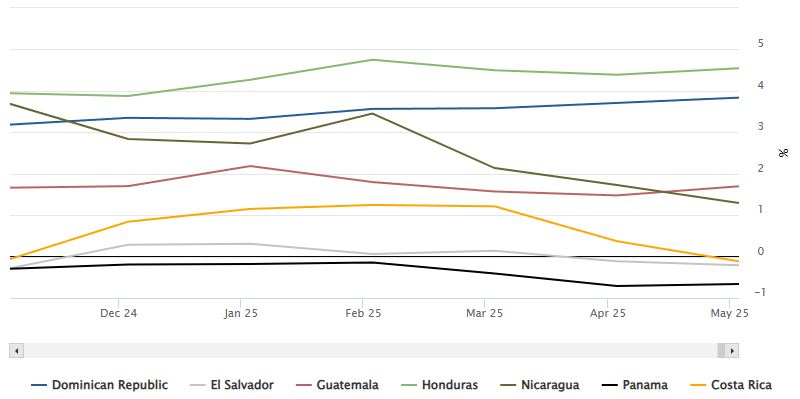
    Central America & Caribbean: inflation rate
    Percentage variation (year-on-year)

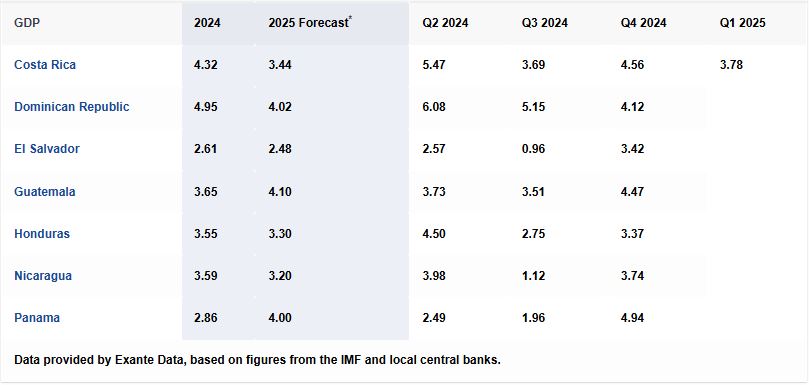
    Central America & Caribbean: GDP growth (%)
    Quarterly figures are year-on-year growth

  • BOLIVIA: Judicial realignment continues

    Abbi Dicker 11 September 2025 Hits: 2077

    Bolivia’s judicial system continues to produce rulings that are favourable to the right-wing opposition, which is poised to take power following the 17 October presidential second round, and detrimental to the ruling left-wing Movimiento al Socialismo (MAS). The crushing defeat suffered by the MAS in the August first round seems to have altered the stance of the judiciary. After years of accusations that they was serving as a tool for the MAS, judges are moving quickly to improve the legal situation of imprisoned opposition activists [WR-25-34]. Meanwhile, outgoing President Luis Arce is now the subject of an investigation for alleged abandonment of a pregnant woman.

    President Arce is facing a criminal complaint in Cochabamba department after being accused by a woman of abandonment after he impregnated her – an offence punishable under Bolivian law by up to three years in prison. Cochabamba’s chief prosecutor, Osvaldo Tejerina, told the local news agency Fides on 8 September that an investigation had been opened to look into the allegations.

    Bolivian media is reporting that the woman in question was a former official in the Arce administration. Arce, who is married, allegedly denied that he was the father of the child, who has since been born, and told the woman to remain silent for fear of harming the electoral chances of the MAS. Arce told journalists on the same day that, as the allegations were in relation to a personal matter, he would defend himself using private lawyers rather than those employed by the government.

    Meanwhile, the legal situation of Arce’s imprisoned predecessor, Jeanine Áñez (2019-2020), continues to improve. On 5 September a court in Sacaba, Cochabamba, ruled that Áñez should be released from her pre-trial detention on genocide charges, regarding the army’s massacre of 11 protesters after she took power under disputed circumstances in November 2019.

    Áñez will not be released from prison as she is also serving a 10-year sentence for illegally assuming the presidency. Last week’s decision means, however, that no more time will be added onto her sentence for the Sacaba killings, or for a separate massacre of 10 people in Senkata, La Paz department, for which charges were also dropped in late August.

    With these rulings following last month’s release from prison of leading opposition campaigners Luis Fernando Camacho and Marco Antonio Pumari, the judiciary has certainly pivoted from its stance of recent years, when it was accused of imprisoning critics of the government. It remains to be seen whether judges are merely responding to the collapse of the MAS by asserting their judicial independence, or whether they are seeking to ingratiate themselves with the next government – due to be led by either the centre-right candidate Rodrigo Paz or right-wing former president Jorge Quiroga (2001-2002).

    Bolivia’s recent history suggests that a politicised realignment may be taking shape. The justice system has long been accused of backing the ruling party, and was accused of issuing politicised rulings under Áñez, Arce, and Evo Morales (2006-2019).

    Morales, who is facing human trafficking charges relating to an alleged relationship with an underage girl, is likely to provide the biggest legal flashpoint in the coming months. Holed up in his political stronghold of Chapare, Cochabamba, authorities have not attempted to arrest him for fear of unleashing fierce unrest by his supporters. The question now is whether law enforcement and the courts are sufficiently emboldened by the change of government to move against Morales.

    Paz and Quiroga promise clean campaign

    The two candidates in Bolivia’s 19 October presidential second round, the centre-right Rodrigo Paz and right-wing Jorge Quiroga, signed a pledge on 10 September committing them to a clean campaign. At an event organised by the supreme electoral court (TSE), they promised to respect the results, to not spread disinformation, and to share their plans for government “in the context of a respectful, informative, and balanced campaign”.

  • ARGENTINA: Education spending boost belies economic malaise

    Abbi Dicker 16 July 2026 Hits: 490

    After two years of regular student-backed protests against spending cuts in higher education, the government of President Javier Milei in mid-June agreed to increase pay for university workers. While the increase may have defused some of the social discontent, it fell far short of the sector’s demands and again highlights Milei’s delicate balancing act between fiscal austerity and political survival. It is that uphill battle that has some investors questioning whether Milei will even be around after next year’s election.

    The government’s concessions to public universities included an increase of 24.33% for workers’ wages by between June and October; of 20% for operating expenses; and of 50% for university scholarships. The deal provides an additional Ar$50bn (US$34m) in funding for university hospitals.

    But all that falls far short of what is needed in higher education, which has been squeezed by Milei’s austerity measures since late 2023, according to the national inter-university council (CIN) and higher education workers’ unions. They demand automatic spending increases in line with inflation as established in the law of university financing., which the Milei administration has done everything possible to ignore.

    The university financing law was approved by congress in August 2025 but vetoed by Milei. Legislators then overruled the veto. Then there were several court rulings on the matter that the government challenged or ignored until a supreme court ruling on 25 June that upheld a lower court injunction forcing the administration to comply with the law.

    The government’s handling of the whole episode is symptomatic of how Milei is antagonising an increasing share of the population, including legislators and judges, with his apparent indifference to widespread concerns, from deteriorating public services to the cost of living.

    On paper, the right-wing libertarian continues to score a number of victories in fixing the country’s economy. GDP is growing for the second straight year and expanded more than expected in the first quarter. Public finances are in better shape than they have been in decades. And in June, the World Bank provided guarantees for commercial loans of up to US$2bn, a key measure to sidestep capital markets and seek cheaper financing through banks.

    But in practice, such advances are not generating enough noticeable improvements for common citizens. Despite rising economic growth, unemployment is increasing as well, while real, or inflation-adjusted wages, have fallen again this year. Since Milei took office in December 2023, roughly half a million workers have lost their jobs. Unemployment has ranked among voters’ top concerns for the past year, according to a survey conducted by polling firm AtlasIntel. 

    Despite a slight recovery in June, the government’s approval as measured by the government confidence index (ICG) compiled by the Universidad Torcuato Di Tella, a private university in Buenos Aires, showed monthly decreases in January-May, with the largest monthly drop in confidence registered in April (-12.1%), before a monthly rise of 3.9% in June. The ICG registers a score of public confidence ranging from 0 to 5, and Milei’s score 30 months into his term stood at 2.07, which is higher than most of his recent predecessors at the same point in their presidencies, with only Néstor Kirchner (2003-2007) registering a higher score of 2.42 after 30 months in office.

    Lack of confidence

    Economy Minister Luis Caputo acknowledged that the government’s credibility had been tarnished and that the lack of confidence made economic policy more difficult, but he blamed it on an historic predisposition of Argentines. “Naturally Argentines think they will end badly because they always have,” Caputo said during a TV interview in May. “That is the part that is incredibly difficult for us because we inherited the worst economic situation in history and we lack the basic raw material any policymaker needs, which is credibility,” he said.

  • In Brief – Bahamas; Panama/Colombia

    LatinNews 11 April 2012 Hits: 1492

    The Bahamas | Election date set. On 10 April Prime Minister Hubert Ingraham of the ruling Free National Movement (FNM) announced that the next general election will be held on 7 May. The total number of seats to be contested in the parliament is 38, down from 41 in the 2007 general election. In the 2007 election, the conservative FNM won 23 seats against the 18 taken by the left-leaning Progressive Liberal Party (PLP). Ingraham will be seeking a fourth term in office; he previously served between 1992 and 2002.

    Colombia/Panama | Ferry.  On 10 April a Panamanian businessman, Augusto Terracina, the manager of Aventura 2000, which administers the port Colón 2.000 on Panama’s Caribbean coast, said that a new ferry between Colón and the Colombian city of Cartagena de Indias would begin operating from 10 May. Terracina said that the ferry “Nissos Rodos”, of the cruise line Panamerican Seaways, can carry approximately 1,500 people. The project has an investment of US$15m.

  • In Brief- Mexico

    LatinNews 18 September 2012 Hits: 1270

    POLITICS| Calderón’s labour reform discussed by congress. On 17 September Mexico’s senate began to examine a new labour reform proposal submitted by the outgoing president Felipe Calderón, which he hopes to approve before he hands over power to President-elect Enrique Peña Nieto on 1 December next. The proposal has been criticised by deputies from the opposition leftist coalition, Movimiento Progresista, on concerns that it will undermine the country’s labour unions by, among other things, forcing them to make public their financial accounts and demanding the introduction of free, direct and secret ballots to elect union leaders. Calderón’s ruling Partido Acción Nacional (PAN) and Peña Nieto’s Partido Revolucionario Institucional (PRI), respectively the second and first largest parties in congress,  have agreed to work together to push through the reform proposal which calls for constitutional amendments and so requires a two-thirds congressional majority for approval. The coordinator of the technical commission in charge of analysing the draft proposal, Blanca Alcalá (PRI), said that the commission had agreed to expedite the bill’s introduction to the plenary.

  • Pointers

    LatinNews 11 April 2013 Hits: 2088

    MEXICO | Media & journalists under attack. In the last week of February the newspaper El Siglo de Torreón (Coahuila) suffered three drive-by shootings, in the last of which one passerby was killed and another and a police officer guarding the premises were injured. On 3 March, Jaime Guadalupe González, editor of the online news service Ojinaga Noticias (www.ojinaganoticias.com.mx), based in Chihuahua, was shot dead on his way to work — the first fatality among media workers since President Enriqe Peña Nieto took office on 1 December. Three days later the premises of two other media in Chihuahua state — El Diario and TV Canal 44 of Ciudad Juárez  — became targets of drive-by shootings, and in Coahuila banners hung in several cities threatened the life of Francisco Juaristi, director of the Zócalo newspaper group, which publishes local issues in Saltillo, Monclova, Piedras Negras, and Ciudad Acuña.

    On 11 March the Zócalo group announced that it would no longer publish any information related to organised crime, because ‘there are no guarantees or security for the full exercise of journalism.’ A similar decision was taken in July 2012 by the newspaper La Mañana of Nuevo Laredo, Tamaulipas.

    According to Artículo 19 (A19), a campaigning anti-censorship NGO (named after Article 19 of the Universal Declaration of Human Rights), in 2012 in Mexico there were 207 aggressions against journalists and media workers — 20% more than in 2011. In a study released on 13 March, entitled Doble asesinato: la prensa entre la impunidad y la violencia (‘Double Murder: the Press between Impunity and Violence’) it reports that between 2006 and 2012, the years of the Calderón administration, there were 879 aggressions: 53 murders, 12 disappeared, and 40 attacks on media premises with firearms or explosives.

    Reporters were the principal victims, accounting for 44% of all cases, and journalists of audio-visual media accounted for another 27%. At the presentation of the report, Marcela Turati of the news magazine Proceso drew attention to the growing phenomenon of forcible displacement of threatened journalists. In 2012, she said, there were 31 cases, of which 23 in the state of Veracruz.

    According to Reporters Without Borders (RWB), Mexico has become the second most dangerous place of the world for journalists (after Afghanistan).

    ▪ The A19 report is available at: http://articulo19.org/informe2012/

    MEXICO | Police vetting moving at snail’s pace. At his confirmation hearing in the senate on 20 March, the newly appointed executive secretary of the national public security system (SNSP), Monte Alejandro Rubido García, admitted that the aim of vetting all serving police officers is unlikely to meet the scheduled deadline of October this year. The original deadline had been 3 January. Rubido said that though the federal law enforcement agencies might be able to meet the deadline, the state-level forces could be facing a ‘complex’ problem.

    Days earlier the security secretary of Hidalgo, Alfredo Ahedo, had reported that at least 30% of the state’s 8,593 police officers and security workers had failed the ‘control & confidence’ tests.

    Another target, the establishment of ‘single commands’ of all state-level police forces, has hit a major snag: in Edomex six municipalities, all run by opposition parties, refused to sign the agreement introducing that system on the grounds that it would detract from their constitutionally enshrined autonomy. ‘Not all municipalities are the same,’ said a spokesman for the group, ‘so it is not viable to apply the same security system to all of the communities.’

  • BRASIL: Las relaciones sufren otro revés

    LatinNews 11 June 2013 Hits: 891

    Florencio Randazzo, el ministro de transporte de Argentina, anuncio el 4 de junio que el gobierno estaba expropiando la concesión de un ferrocarril de carga a la compañia América Latina Logística (ALL) de Brasil y la concesión de un tren turístico, alegando incumplimiento de acuerdos contractuales. ALL dijo el 6 de junio que "tomaría todas las medidas legales" en respuesta a la decisión del gobierno.

    En una conferencia de prensa, Randazzo dijo que ALL era culpable de "graves" violaciones, incluyendo el fracaso de invertir y la acumulación de multas por un valor del 30% de la concesión. "Si el gobierno tiene que tomar el control de más ferroviarias estaremos dispuestos a hacerlo. Queremos reducir nuestros costos de carga", Randazzo declaró.

    En el aspecto legal, el gobierno de Buenos Aires cree que se trata de un caso 'abierto y cerrado'. Randazzo ha sido citado diciendo: "si ellos no están contentos, déjenlos que vayan a las cortes. Ellos no han cumplido con las metas y tendrán que irse". La cuestión es si ALL sentirá que vale la pena tomar la vía legal para buscar compensación.

    ALL perderá su licencia de carga para rutas entre Mendoza y Rosario y entre Misiones y Buenos Aires; mientras una compañía local, Sociedad Comercial del Plata (SCP), perderá su concesión para operar un tren de pasajeros (Tren de la Costa) en el norte suburbano de Buenos Aires, junto con un parque de diversiones asociado.

    La razón oficial de la finalización de las concesiones podrá ser el no cumplimiento de los acuerdos contractuales, pero es posible que el gobierno de la Presidenta Cristina Fernández, con difíciles elecciones legislativas en octubre, esté buscando jugar una carta populista. Desde que el catastrófico accidente en un tren de pasajeros en el vecindario de Once en febrero del 2012, que causó la muerte de 51 personas, los operadores privados de trenes han sido impopulares.

    La pregunta es si esta nueva línea dura contra las compañías ferroviarias hará algo para estimular la declinante popularidad del gobierno. Aunque, ciertamente, elevará las preocupaciones de los inversionistas sobre Argentina, y podría también presionar aún más las relaciones con Brasil.

    Con base en Curitiba, Brasil, ALL es uno de los mayores operadores de trenes comerciales de América Latina. No hizo ningún comentario sobre la decisión del gobierno de Argentina de forma inmediata, aparte de decir que no habían sido notificados formalmente de que las licencias fueron revocadas.

    En una nota reguladora a la bolsa de valores de São Paulo el 4 junio, ALL señaló que sus operaciones argentinas representan el 6,5% de su ingreso neto, pero no contribuyen a las ganancias antes de interés, impuestos, depreciación y amortización (Ebitda). Y señaló directamente que la unidad “ALL de Argentina, ha perdido representación en las ganancias de la compañía, mientras exige una desproporcionada atención de su administración".

    Las compañías brasileras crecientemente están hallando que es difícil operar en Argentina, y alguna forma de respuesta política puede esperarse de la administración de la Presidenta Dilma Rousseff. En marzo el gigante minero, Vale, se retiró de un proyecto minero de potasio en Argentina, citando a la inflación, la tasa de cambio, y a las demandas de las administraciones provinciales como factores que elevaron los costos. Miles de trabajadores perdieron su empleo como resultado de esta decisión. Se dijo que el ex presidente, Lula da Silva (2003-2010), estaba en conversaciones con Vale acerca de su retirada. Petrobrás, la petrolera estatal brasilera, ha reconfirmado esta semana que esta; considerando vender parte de sus activos en Argentina.

    En abril, la Presidenta Fernández se reunió con Rousseff en Buenos Aires. A pesar de la usual afabilidad después de la reunión, los negociadores presentes dijeron que el humor entre las dos fue extremadamente tenso. Brasil ha pedido que el ministro de comercio interior de Argentina, Guillermo Moreno, sea prohibido de futuras reuniones bilaterales debido a su agresivo estilo de negociación. A fines de mayo, Cristóbal López, un empresario argentino cercano a Fernández, vio rechazada su oferta para comprar el 51% del holding de Petrobrás Argentina debido a las preocupaciones de Vale acerca de sus lazos con el gobierno de Argentina.

    * La situación concerniente a la concesión del Tren de la Costa parecía de alguna manera diferente. SCP es parte del grupo Soldati de Argentina, que actualmente enfrenta procedimientos de bancarrota. Incapaz de conducir el servicio de pasajeros de manera que dé ganancias, fuentes dicen que SCP ya había hablado con funcionarios del ministerio de transporte en mayo acerca de 'voluntariamente' abandonar la concesión. Sin embargo, la firma fue tomada por sorpresa por la decisión de también poner fin a la concesión del parque de diversiones, el Parque de la Costa.

    Rousseff aprueba creación de cuatro universidades federales

    La presidenta Dilma Rousseff ha aprobado la legislación para crear cuatro nuevas universidades federales en el norte y el nordeste del país, bajo el Programa de Apoio a Planos de Reestruturação e Expansão das Universidades Federais Brasileiras (Reuni).

    Las nuevas instituciones estarán ubicadas en Cariri, en Ceará (Universidades Federal do Cariri [UFCA]), en Pará (Universidade Federal do Sul e Sudeste  do Pará [Unifesspa]), con las otras dos en Bahía (Universidade do Oeste [Ufob]), y (Universidade Federal do Sul da Bahía [Ufesba]).

    El objetivo es que para el 2018 las universidades puedan acomodar a 38.000 estudiantes y emplear a 1.700 profesores, a través de 145 cursos de graduados, De acuerdo con el gobierno, entre el 2003 y el 2010, se han construido 14 nuevas universidades federales y 126 campus universitarios y unidades académicas bajo el esquema Reuni, aunque los críticos dicen que algunos de los esquemas fueron innecesariamente retrasados por el mal planeamiento.

    • Éxito de Maracanã

    El 2 de junio funcionarios de Río de Janeiro respiraron aliviados después de que el renovado estadio de fútbol de Maracanã pasó con éxito su primera prueba, a pesar de que las obras en las afueras del estadio, que seguían en marcha, casi frenaron el primer partido programado contra Inglaterra. El estadio, con una capacidad total de 79.000 espectadores, está siendo puesto a punto con un costo estimado de R$1,2mm (US$560m) antes de la Copa de las Confederaciones del 2013, la Copa Mundial del 2014 y los Juegos Olímpicos de Verano del 2016. Tenía fijada la fecha para su terminación en diciembre del año pasado.

    • Deuda africana

    El periódico Khaleej Times de los Emiratos Árabes Unidos describió la decisión de Brasil, anunciada el 29 de mayo, de perdonar las deudas soberanas adeudadas por naciones africanas, que totalizan unos US$900m, como una demostración "genuina de liderazgo y diplomacia de vanguardia". Un total de 12 países serán beneficiados, incluyendo Congo, Tanzania, Zambia, Costa de Marfil, Gabón, Guinea, Guinea Bissau, Mauritania, Senegal y Sudán.

  • Ecuador: Correa govt optimistic about EU trade deal benefits

    LatinNews 28 August 2014 Hits: 3118

    “We have closed the negotiations and closed them well,” Ecuador’s foreign trade minister, Francisco Rivadeneira, said on 11 August in reference to the trade agreement struck with the European Union (EU) in July. A long legislative journey awaits before the trade accord can take effect but Rivadeneira was keen to stress that it had been “a very positive negotiation for Ecuador”, with widespread benefits for exporters and “extremely small” costs which were “difficult to identify”. He argued that the repercussions of failing to reach an accord would have been very negative, with “enormous unemployment in the country”.

    Ecuador completed its association agreement, to use the preferred nomenclature, with the EU on 17 July in Brussels. It will be at least two years before the accord actually takes effect though, as it now has to endure a laborious and labyrinthine passage through the European parliament, the parliaments of all 28 EU member states, and Ecuador’s national assembly. In the meantime, Rivadeneira said Ecuador had won a promise from EU negotiators to use “all their political will in order to ensure that the products that don’t [presently] pay a tariff continue exempt until the accord takes effect.”

    The trade benefits that Ecuador enjoys with the EU under the General System of Preferences (GSP Plus) expire in December 2014, when its exporters would technically stand to lose significant ground to Colombian and Peruvian counterparts because of higher tariffs. Peru and Colombia signed a free-trade deal with the EU in 2012 as part of the Andean Community (CAN) trade bloc, which was provisionally applied with Peru in March 2013 and with Colombia in August last year.

    Ecuador’s export federation, Fedexport, says that Ecuadorean exports would face tariffs of between 2% and 40% to enter the European market without the GSP in place, costing exporters about US$375m annually. Currently, 60% of Ecuador’s total exports benefit from the GSP.

    The EU is Ecuador’s biggest market for non-oil exports. Ecuador had a very small trade surplus with the EU in 2013, with its exports to the bloc totalling €2.5bn (US$3.4bn), and its imports from the EU amounting to €2.4bn. Ecuador’s export sector is optimistic that exports to the EU could rise by around US$500m under the association agreement.

    Banana boost

    Ecuador is the biggest supplier of bananas to the EU. Almost one in four bananas traded in the EU last year came from Ecuador. Failure to secure a trade agreement with the EU would have seen Colombia muscle in and ultimately usurp Ecuador’s position of pre-eminence. Eduardo Ledesma, the president of the association of banana exporters of Ecuador (AEBE), described the agreement as “tremendously positive for the banana sector, since we had a fairly high tariff differential with Colombia.”

    Under the EU deal with Colombia, the banana tariff will fall each year to reach €75 (US$101)/t by 2020. Under the new structure, Ecuador’s banana exporters will only pay €1 (US$1.35) per tonne extra compared to Colombia and Costa Rica from 2016-2019; and the same from 2020 onwards.

    The current tariff of €132 (US$178) for Ecuador was set to fall to €122 (US$164) for 2015, but without a free trade deal in place with the EU, Ecuador would have had to pay on average up to €32 (US$43) per tonne extra over the same period. Based on last year’s volume of banana exports, this equates to some €45m (US$60m) in savings. Ecuador’s banana exports to the EU totalled US$667m in 2013, down 7% from US$715m in 2012; but they stand at US$359m for the first five months of 2014 compared with US$308m in the same period last year. Ecuador’s banana exports to the EU in 2013 were more than double the amount produced within the EU, such as Spain’s Canary Islands and the French departments of Guadeloupe and Martinique, which will now seek more protection via subsidies.

    Other exports to gain

    Other Ecuadorean exports that stand to benefit from the improved access to EU markets are shrimp, cacao, coffee, fruits, nuts and cut flowers. Shrimp exports to the EU totalled US$625m in 2013, up 27% from US$492m in 2012. Shrimp exports were also up by a whopping 45% in the first five months of 2014 to US$356m, compared with the US$245m of exports in the same period last year. Cacao exports reached US$139m in 2013, up 38% from US$101m in 2012. They are also up 39% in the first five months of 2014 to US$71m compared with US$51m of exports in the same period last year. Coffee and tea exports stood at US$138m in 2013, up slightly from US$132m in 2012.

    Rivadeneira said 76% of Ecuador’s exports would immediately enter the EU tariff-free. He also expressed the hope that the EU would also eliminate the requirement for visas, as it did with Colombia and Peru, although this was not included in the deal. He said that the government would implement “an arsenal of tools to reduce the negative effects” for certain sectors, including sensitive products like milk, meat, cereals and vegetables.

    This is crucial, because the Ecuadorean government made a big song and dance about not signing up to the original trade deal along with Colombia and Peru in 2012. Fundamentally this was because of a pathological aversion to the concept of free trade (hence the insistence on the term ‘association agreement’). It is not clear that Ecuador has negotiated a deal which is really any different in substance to other trade deals or exactly what the “arsenal of tools” Rivadeneira has at his disposal to protect sensitive products are; presumably it will mean subsidies of some sort.

    Ecuador will receive zero-duty access to the EU market for industrial goods, which could assist Ecuador’s agro-industrial industry. The EU will get better access to the country’s public procurement, as well as Ecuador’s adherence to the World Trade Organization (WTO) regulations regarding the protection of intellectual property rights. “I’m delighted we’ve been able to conclude this ambitious and comprehensive agreement with Ecuador,” the EU trade commissioner Karel de Gucht said. “It will boost our bilateral trade and investment, and act as an important driver for development in Ecuador.”

    Deepwater port gets presidential go-ahead

    Ecuador will seek investment to go ahead with the construction of a deepwater port in Posorja, a small fishing town at the delta of the Guayas River about 120km from the coastal city of Guayaquil, President Correa announced in mid-August.

    In November 2013, the government contracted the Spanish state-owned consulting and engineering advisory firm Ingeniería de Sistemas para la Defensa de España (Isdefe) to find the ideal location for a 15-metre-deep-water port in the province of Guayas. Isdefe settled on Posorja. It is worth noting that in 2006, a US$450m concession to build and operate a deepwater port in Posorja was awarded to Spain’s Alianza Internacional Portuaria (Alinport), but work never began and authorisation for it was later revoked. President Correa said there were three international companies interested in investing in the deepwater port now (he did not reveal which), adding that he had “no problem if it is private investment, mixed investment or public investment as long as it’s quick”.

    The race is on because when the third set of locks in the Panama Canal open in 2015, it will mean that ships with up to a 15m draft will be able to pass through. The ‘Simón Bolívar’ port of Guayaquil currently only has a depth of 9m. At present 58% of national freight goes through the state-owned, independently managed port of Guayaquil, rising to 82% if the 22 private ports located on the access channel into this port are included. The president fired a broadside at these private ports, which he described as parasitic, contributing just 5% of their profits to the State. He also said that the government had looked into dredging to 15m metres at the ‘Simón Bolívar’ port but it was “technically and economically unviable”, otherwise it would have done. The opposition mayor of Guayaquil, Jaime Nebot, begged to differ, and accused the Correa government of trying to undermine the country’s main business hub, long opposition administered. Correa said this was nonsense, insisting that the Simón Bolívar port would continue operating, with the government seeking to make it a specialist destination for cruise ships which would be “extremely beneficial for Guayaquil”.

    Posorja

    Posorja has a population of around 28,000. The new deepwater port would not only allow bigger ships to dock but speed up the loading and unloading of containers. The transport and public works minister, María de los Ángeles Duarte, said that one of the drawbacks of the port of Guayaquil was that it was very slow for freight ships, dependent, among other things, on the tide. Posorja, currently a private port, would be transformed with renovated piers and docks, and the town would undergo a major facelift, with myriad infrastructure projects, including perimeter roads, a seafood distribution centre and housing programmes. President Correa promised to step in if ‘speculation’ pushed house prices up quickly.

    EU response

    “It [the association agreement] will provide for a solid and predictable framework for Ecuadorean and European traders and investors and will also contribute to regional integration in one of the fastest-growing markets for European firms in Latin America,” the EU trade commissioner, Karel de Gucht, said. “We now have to take the necessary steps to make sure the agreement is applied as quickly as possible.”

    • Mayor Jaime Nebot accused President Correa of trying to strip the port of Guayaquil of its pre-eminence, leaving it with “tourism, coasting trade or the crumbs of freight to the Galápagos islands”. He said the government had refused to dredge to 15m at the port even though it was “technically possible” and said Correa was not watching over the port of Guayaquil’s interests but wanted to “attend its burial”. He also accused Correa of conspiring to isolate private ports and cast doubt on his intention to construct the deepwater port in Posorja, claiming that he intended to build one “with public money in Manta” instead. Manta, located in the northern coastal province of Manabí, is the terminus for the ‘multi-modal corridor’ between Manta and the Brazilian city of Manaus, which aims to improve imports and exports between Asian markets and the Amazon.

  • TRACKING TRENDS

    LatinNews 22 October 2015 Hits: 2314

    CUBA | Russian loan

    The Russian government has given its Cuban counterpart a €1.2bn (US$1.36bn) loan to build a new electricity generation plant, Russia’s state news agency (RIA) revealed on 19 October. According to the RIA report, the funds are to be used to build electricity generation units with a capacity to produce up to 200MW to feed the ‘Máximo Gómez’ and Este Habana thermoelectric power stations. The project is part of the Cuban government’s US$10bn development plan to double Cuba’s electricity production capacity from 18,746 gigawatts per hour to 30,299 gigawatts per hour by 2030.

    The loan was agreed by the two governments following Russian President Vladimir Putin’s visit to Cuba last year, when he also agreed to forgive 90% of Cuba’s outstanding US$32.5bn debt with Russia. According to the RIA report, following the release of the funds for the loan, Russia’s council of ministers also approved a new US$100m credit line for the modernisation and expansion of Cuba’s ‘José Martí’ steelworks.

    PANAMA | Doubts over Panama Canal expansion completion date

    The Panama Canal Authority (ACP) has been forced to address doubts as to whether the April 2016 completion date for the Panama Canal expansion project will be met. In a statement, the ACP said it had received “updated information” from Grupo Unidos por el Canal (GUPC), the consortium comprising Spain’s Sacyr Vallehermoso, Italy’s Impreglio, Belgium’s Jan de Nul and Cusa responsible for the design and construction of the third set of locks (the biggest project under the US$5.2bn Canal expansion plan) regarding “the localised seepage found in the concrete sill between the lower and middle chamber of the Canal’s expanded Pacific Locks.”

    The same ACP press release notes “in a recent letter, GUPC wrote that the localised seepage was the result of insufficient steel reinforcement in the area which was subjected to stress from extreme condition testing. After careful examination of all the other sills in both lock complexes, GUPC stated that in addition to reinforcing the sill that presented the issue, they would also reinforce the first and second sill in the Cocoli Locks and the first three sills in the Atlantic-facing Agua Clara Locks as a preventative measure, though these sills have not presented any issue”.

    The same ACP statement notes that “GUPC also verbally indicated that the completion date for the Expansion Project will remain April 2016, as planned; however, the ACP is awaiting formal confirmation from GUPC, in the form of a comprehensive report which should also include the root cause of the detected filtrations”.

    The completion date of the expansion project, which is 95% complete, was pushed back following a dispute in late 2013 with GUPC over cost overruns [WR-14-01].

    REGION | Central American customs union

    A Central American customs union could become a reality by 2021, the secretary general of the Central American economic integration secretariat (Sieca), Carmen Gisela Vergara, said last week. The establishment of a sub-regional customs union comprising Belize, Costa Rica, El Salvador, Guatemala, Honduras, Nicaragua and Panama is one of the commitments assumed by these countries during the signing of an economic association agreement with the European Union (EU) in 2013. In September of that year, the EU assigned €10m (US$11.3m) to help set up a customs to help to facilitate bilateral trade. Little visible progress has been made on the matter since then. However, speaking at the Euroforo Guatemala 2015 conference held in Guatemala city, Vergara said that during a June summit of the Central American integration system (Sica), Sieca presented the Sica member states with a “road map” to establish a full customs union within six years.

    Vergara also noted that the adoption of a common customs regime between Guatemala and Honduras is scheduled for 1 December. The Honduran national congress, however, has recommended postponing this until after a new president takes office in Guatemala in January 2016.

    • Panama Canal

    On 9 October the Panama Canal Authority (ACP) issued a press release stating that the Panama Canal closed fiscal year 2015 with a record 340.8m PC/UMS tonnes (Panama Canal Universal System Tonnage), up 4.3% on FY2014. This figure represents an increase of 7.1m tonnes compared to the previous record of 333.7m PC/UMS tonnes set in fiscal year 2012.

  • COSTA RICA: Solís pleads progress despite fiscal stasis

    LatinNews 17 May 2017 Hits: 779

    President Luis Guillermo Solís delivered an upbeat assessment of his government’s achievements in his penultimate state-of-the-nation address to the legislative assembly on 3 May. He focused on advances in reducing poverty, especially indigence, and the reactivation of the economy as foremost among these. Solís was forced to acknowledge, however, that his government had not been able to push through a crucial fiscal reform as it had hoped.

    President Solís said that his government had lifted 10,440 households out of poverty (and 9,700 out of extreme poverty) last year, and that the 20.5% poverty rate for 2016 was the lowest for seven years. Solís said that the economy had grown by 3.7% in 2015 and 4.1% in 2016; that exports of goods increased by 7.5% in 2016 on the previous year, and services 12%; and that foreign investment stood at US$2.76bn, up 9% on 2015.

    Solís also maintained that the fiscal deficit had come down, from 5.4% of GDP in 2013 to 5.2% in 2016 thanks to “austere government”, but that “the current levels of indebtedness are strongly pressuring public finances and compromising medium-term development…” This was a clear swipe at the political opposition in the 57-seat legislative assembly which continues to condition support for a fiscal reform on the Solís administration cutting wasteful spending and has repeatedly thwarted the efforts of his minority ruling Partido Acción Ciudadana (PAC) to advance a tax bill.

  • TRACKING TRENDS

    LatinNews 08 June 2017 Hits: 527

    COSTA RICA | First pineapple exports to China. On 1 June four Costa Rican companies – Upala Agrícola, Productos Agropecuarios Visa, Agromonte, and Acón – became the first companies to begin exporting Costa Rican pineapples to China after the move was authorised in March 2017. The world’s biggest exporter of pineapples, Costa Rica is currently the only country in Central America to have established diplomatic relations with mainland China, having made the switch from Taiwan in 2007.

    According to Costa Rica’s national chamber of pineapple producers and exporters (Canapep), the Chinese government has so far authorised a total of 20 Costa Rican companies to export pineapples to China. The two countries have had a free trade agreement (FTA) in place since 2011. According to the most recent figures from Costa Rica’s foreign trade ministry (Comex), bilateral trade with China reached US$2bn in 2015, out of Costa Rica’s total trade of US$25bn. Of this US$2bn, (down 1.2% on 2014), Costa Rican exports amounted to US$81m.

    A press release by Comex from March 2017 notes that as well as bananas, Costa Rica is also currently authorised to export cow hide, beef, shrimp, and dairy products to China while talks are also under way with a view to opening up the Chinese market for Costa Rica to export pork, chicken, seafood, beef offal, and melons.

    PANAMA | Rapid growth. According to a report released on 31 May by Panama’s national statistics institute (Inec), the country’s GDP grew by 6.2% in the first quarter of 2017 compared with the same period in 2016. An April 2017 report by the Economic Commission for Latin America & the Caribbean (Eclac) is forecasting 5.2% GDP growth for 2017 for Panama – the highest in Central America.

    • New airport master plan

    President Luis Guillermo Solís recently unveiled the official master plan for a new US$2.94bn international airport to service Costa Rica’s capital, San José. The Solís government hopes that the new airport will begin operations in 2027, with an initial capacity to accommodate 7.8m passengers, generating 80,000 jobs (directly and indirectly) and contributing an additional US$1.6bn annually to GDP.