
All Categories

Subcategories

  • BRAZIL: Economy remains resilient in first quarter

    Abbi Dicker 04 June 2026 Hits: 613

    The International Monetary Fund (IMF) has described Brazil’s economy as “remarkably resilient” in the face of external shocks such as the volatility of global oil prices in recent months. Although economic growth is expected to slow in the short term, the IMF projects Brazil’s growth to strengthen in the medium term. This positive assessment came as new GDP figures released by Brazil’s national statistics institute (Ibge) showed higher-than-expected quarterly growth for the first quarter of 2026.

    The IMF conducted an Article IV consultation in Brazil from 18-29 May, and its preliminary end-of-mission findings were announced on 1 June. “Brazil’s economy has continued to demonstrate remarkable resilience in the face of multiple shocks”, according to Daniel Leigh, who led the IMF consultation.

    “Brazil is relatively cushioned from global oil price increases stemming from the war in the Middle East by its status as a net oil exporter and the high share of electricity from renewable energy sources,” he said in a statement. Leigh said that “risks to the growth outlook are tilted to the downside, including from further deterioration of geopolitical tensions and tighter financial conditions,” but he also declared that “Brazil’s strong policy frameworks, sound financial system, adequate reserves, and flexible exchange rate continue to support resilience”.

    According to the statement, there have been signs of economic recovery in early 2026, and in the medium term the IMF expects Brazil’s growth to strengthen to 2.5%. The latest Ibge GDP figures, published on 29 May, show that Brazil’s annual growth rate in the year through Q1 2026 stood at 2 %, slower than the 2.3% annual figure registered for the same period in 2025. However, when comparing Q1 this year with the latter half of 2025, there have been clear signs of improvement. Brazil’s economy in Q1 grew by 1.1% compared with the final quarter of last year. This quarterly growth rate marks a significant acceleration compared with 0.1% quarterly growth rate in Q3 2025 and 0.3% in the fourth quarter last year.

    The first quarter GDP growth rate is also higher than the 1% median estimates of analysts surveyed by both Bloomberg and Reuters. But Bloomberg highlighted that growth in Q1 was driven not only by a surge in the agricultural sector, which grew by 2% in quarterly terms and posted an accumulated annual growth rate of 7.5% in the year through Q1 2026, but also by the fiscal stimuli of the government led by President Luiz Inácio Lula da Silva.

    Lula has shown no sign of ceasing his generous public spending, given the context of the presidential election in October when he will seek another term in office. With a view to lifting the public mood and boosting Lula’s popularity in the months ahead of the election, the government has been implementing measures aimed at boosting consumer confidence, such as the new ‘Desenrola’ (Untangle) household debt renegotiation programme launched in early May, as well as measures to shield Brazilian consumers from the impact of fuel price shocks, such as tax cuts and subsidies in March and April to support diesel producers and importers.

    Although the IMF statement on 1 June did not criticise the Lula government for its eagerness to roll out subsidies and social benefits, Leigh did call for “meaningful fiscal reforms” to “place public debt on a firm downward path”. Bloomberg also highlighted the inflationary risks of the government’s fiscal generosity.

    Economic forecasts

    On 1 June the central bank published the latest edition of its Focus bulletin, a weekly survey of private sector economists, which showed an annual growth forecast of 1.90% for 2026, up slightly from 1.89% in the previous week’s bulletin and from 1.85% a month earlier. The market analysts also projected that annual inflation this year could reach 5.09%, up from 5.04% a week earlier and 4.89% a month earlier. This would be well above the upper limit of the official inflation target range of 3.0% +/-1.5 percentage points.
  • REGION: Wanted Argentine judge hides in Chile

    LatinNews 19 September 2011 Hits: 749

    President Sebastián Piñera of Chile is unlikely to have a quiet ‘national month’ (September), as problems, at home and abroad, seem to stalk him around every corner. President Cristina Fernández of Argentina delivered the latest blow; members of the Chilean cabinet have confirmed that she will not attend the 18 September independence celebrations in Santiago. Though no specific reason was cited for the cancellation, there is widespread agreement in the local Argentine media, as well as in the Chilean administration, that the decision was taken to send a message to Santiago: relations with Buenos Aires will suffer substantially if Piñera’s government were to grant political asylum to Otilio Romano, a (now-suspended) judge for the province of Mendoza, wanted in relation to human rights violations committed during the last military dictatorship (1976-1983). An un-named source from the Piñera government has been quoted by the Argentine daily La Nación as saying that Fernández’s decision was an “unfriendly act”.

    The case undoubtedly has implications for bilateral relations as well as for domestic Chilean politics. Chile’s right-wing Unión Demócrata Independiente (UDI), the larger partner in Piñera’s ruling coalition, has long pushed for the extradition of Sergio Galvarino Apablaza, a former guerrilla, wanted in connection to the 1991 murder of a UDI founder and former senator, Jaime Guzmán. Apablaza has been given political asylum in Argentina [WR-10-40]. Romano’s case gives Piñera the chance to turn the other cheek, to emphasise that Chile trusts the Argentine judicial system, which ordered Apablaza’s extradition, and gives him an opportunity to show that his right-wing government will not shield wanted suspects of human rights violations. Granting Romano’s request would destroy Chile’s chances regarding Apablaza.

    Chile has appealed against the political decision by Argentina’s national committee for refugees (Conare), which overrode the Argentine supreme court’s decision mandating Apablaza’s extradition. Now it’s the turn of the Chilean Conare to review Romano’s asylum request. The Chilean Conare is headed by the national chief of immigration and international police, prefect Raúl Sepúlveda, two representatives of the ministry of interior, two representatives of the foreign ministry and a representative of the UN’s High Commissioner for Refugees (Acnur) – the latter has voice but no vote. The Conare’s decision ends up as a recommendation to the deputy minister of the interior, Rodrigo Ubilla.

    Argentina can file a formal extradition request only after Mendoza’s council of magistrates formally removes Romano from the bench. If this were to happen, it would increase pressure on the Chilean government since, according to the president of the Chilean supreme court of justice, Milton Juica, the Chilean court would likely rule in favour of extraditing Romano – Juica, however, made a point of stating that this view is based on what the media has reported and not in-depth knowledge of the specific circumstances of the case.

    Compensation for victims (and victimisers?)
    This week, Alberto Breccia, Uruguay’s secretary of the presidency, told the local paper El País that the Uruguayan state will pay compensation (estimated at US$500,000) to Macarena and Juan Gelman for the forced disappearance of María Claudia García Iruretagoyena de Gelman. Earlier this year, an Inter-American Court of Human Rights (IACHR) landmark ruling had ordered Uruguay to pay Macarena Gelman US$180,000 in compensation [WR-11-21].
    Separately in Argentina, a federal judge called on Minister of Justice Julio Alak to clarify if 68 people listed as ‘forced disappearances’ in the so-called ‘Conadep list’, added in the 2006 update, were in fact killed during attacks on military bases during the constitutional governments of Juan D. Perón (1973-1974) and his widow and successor, María Estela Martínez (1974-1976). Alak will also have to explain if their descendents received compensation and, if so, why.

    • UDI points to Fernández’s contradictions

    The president of the Unión Democráta Independiente (UDI), Senator Juan Antonio Coloma, pointed out this week that if Argentina files a request for Romano’s extradition it would be a hypocritical move. “It is a paradox. The Argentine president is requesting exactly what she denied [Chile] and it’s going to look like a shameless act”, he said.

  • COLOMBIA: Santos constructs Liberal powerbase

    LatinNews 15 December 2011 Hits: 4804

    President Juan Manuel Santos is preparing for a potential political showdown with his predecessor Alvaro Uribe (2002-2010). The man elected as the heir to Uribismo is undermining its very foundations in order to buttress his own powerbase as distinct from that of Uribe. He is doing so by encouraging the reunification of the Partido Liberal (PL), traditionally the dominant party in Colombian politics prior to the rise of Uribismo in 2002.

    At a PL convention at the weekend the party elected its youngest leader in history, Simón Gaviria, 31, the current president of the lower chamber of congress, who promised “profound Santismo” in his quest to bring the party right to the heart of government. Its influence can be seen in a number of government initiatives, including the flagship victims and land restitution law, which was criticised by Uribe.

    It was no accident that the main issue at the PL convention was the party’s reunification. Simón Gaviria said the party had “open doors for any prodigal son who wanted to return”. Gaviria, like Santos (and, notably, unlike Uribe) is the scion of an important political dynasty: his father is former president César Gaviria (1990-1994), who had controlled the rump of the PL during the wilderness years after Uribe (and Santos) left its ranks.

    Santos had planned to attend the convention but was prevented by severe wet weather conditions, which possibly provided a convenient excuse for what, upon consideration, he might have deemed rather too provocative and politically incorrect. But he sent a message extolling the PL’s “key role in the government of national unity”, and professing that he had “never renounced (his) liberal ideology, which surpasses party affiliations”. 

    The message was conveyed by his interior minister, Germán Vargas Lleras, another former member of the PL, who broke away to form Cambio Radical (CR) in 2002 and played a big part in blocking a potential second re-election bid by Uribe. A strong Santista current in the Partido de la U, which Santos formed to drive Uribe’s re-election in 2006, is also strengthening ties with the PL.

    Santos brought the PL to the heart of government earlier this year by appointing Rafael Pardo, the party’s previous president, to the position of labour minister in November, much to the irritation of Uribe. Beyond his ideological affinity, however, his decision to fortify the PL again, and to seek to restore it to its former prominence, is adroit; it is born of political pragmatism.

    By marginalising the more conservative wing of Uribismo, Santos is calculating that he can curtail Uribe’s influence in readiness for the day when the sparring with Uribe, which has characterised his first 16 months in power, degenerates into open conflict. This could otherwise complicate policymaking, especially as the next elections in 2014 draw closer.

    • Position of strength

    The Partido Liberal (PL) under Rafael Pardo won just 4.4% of the vote in the presidential elections in 2010. From this nadir, its recovery has been rapid. It reasserted itself as the largest party in the country in October’s regional elections by winning six departments - Atlántico, Bolívar, Guainía, San Andrés, Sucre and Tolima – and seven departmental capitals. After this positive result, Santos invited Pardo to join his cabinet. Simón Gaviria is now determined to shape the PL in Santos’ image.

  • ARGENTINA: Money-laundering accusations irk Uruguay

    LatinNews 02 May 2013 Hits: 1286

    “The dead can’t complain, but they get pissed off all the same.” José Mujica, the president of Uruguay has a tendency to speak in a mixture of idioms and riddles. His comment on the accusation by an Argentine journalist that the Uruguayan banking system was used to launder money siphoned from public works projects approved by Argentina’s late former president Néstor Kirchner (2003-2007) was no exception. Still, having called Kirchner’s widow, the current Argentine president Cristina Fernández, “an old hag” less than a month ago, the circumlocution was perhaps designed to avoid offence.

    Jorge Lanata, the Argentine presenter of the investigative programme Periodismo para Todos, claimed that Uruguay was used to launder money by the businessman Lázaro Báez. Báez, a friend of Kirchner from Santa Cruz, was a bank teller of modest means before amassing a fortune as the only public works contractor in the province during the Kirchner presidency. Lanata claims that kickbacks from these projects went through Uruguay to Panama, Belize, Caribbean islands and finally Switzerland.

    Investigations

    Following a request by two Argentine opposition congressmen, Graciela Ocaña (Confianza Pública) and Manuel Garrido (Unión Cívica Radical), the Uruguayan authorities have now launched three investigations into the claims. Their investigation will focus on the purchase of a farm by Daniel Pérez Godín, an adviser to Báez and the manager of the luxury hotel Alto Calafate, which is owned by Fernández. He paid US$14m for the 24-hectare farm, which was valued at just US$4m. Meanwhile, Uruguayan customs officials are to look into a series of flights by private planes travelling from Argentina to Uruguay which Lanata alleges were used to transport millions of dollars.

    Mujica expressed a degree of scepticism about what he called Lanata’s “poetic licence”, and stressed that the Uruguayan banking system had more controls than the journalist had accounted for. “Nobody can bring US$5m to Uruguay, drink a coffee and return without being queried about that sum,” he said. However, he did also acknowledge the possibility that the flights could have been used for nefarious purposes. “There is illegal trafficking which could be used for any reason,” he said. Mujica added that Lanata’s remarks were part of the heated domestic political debate in Argentina where “they exchange all kinds of accusations. But I don’t think that it was his intention to attack Uruguay”.

    UN criticises judicial reform

    The government’s plans to “democratise” the judiciary continue, with minor alterations, despite increased domestic and international criticism. The latest high-profile critic is the UN’s Special Rapporteur on the Independence of Judges and Lawyers, Gabriela Knaul. On 30 April, Knaul issued a statement requesting the Argentine government “reconsider” its proposals. The cause for Knaul’s concern focuses on the plans for elections to the powerful supervisory body, the council of magistrates.

    “Providing the opportunity for political parties to propose and organise the election of the members of the Judicial Council threatens their independence, thereby seriously jeopardising the principles of separation of powers and the independence of the judiciary, which constitute fundamental elements of any democracy and the rule of law,” she said in a statement.

    The draft law’s proposal to limit the timeframe for injunctions against the state was also criticised. “The use and the period of validity of precautionary measures against the State cannot be restricted. Otherwise, access to justice will not be fully guaranteed.” The government responded with its customary prickliness; the foreign ministry issuing a statement claiming the UN official’s comment “not only strays from the professional standards…expected from the head of an organisation such as the rapporteur, but it also shows a lack of balance.”

    • 'Blue dollar' closing in on ten

    The black market rate for dollars continued its precipitous rise this week, and is getting close to breaching the ten peso mark. On 30 April, the blue dollar was priced at Arg$$9.37 (to buy) and Arg$9.40 (to sell). Meanwhile, the official rate for the US currency rose to Arg$5.14 (buying price), and Arg$5.195 (selling price).

  • RASTREANDO TENDENCIAS

    LatinNews 19 September 2014 Hits: 495

    PERÚ | Optimista presupuesto 2015. El 10 de septiembre, en su último acto como ministro de economía & finanzas de Perú, Luis Miguel Castilla presentó la propuesta de presupuesto 2015 ante el congreso nacional. Basado en la expectativa de que la economía se recuperara totalmente de su actual desaceleración, el presupuesto pronostica un crecimiento del PIB del 6% el año próximo. La economía peruana ha sufrido una marcada desaceleración desde mediados del 2013, provocando preocupaciones de que después de más de una década  de un crecimiento promedio del 6,5%, ésta ahora se está quedando sin impulso. Sin embargo, al presentar la propuesta de presupuesto de PEN130,62mm (US$46,48mm), Castilla dijo que aunque la desaceleración era más pronunciada de lo esperado, con el pronóstico oficial de crecimiento para este año revisado hacia abajo al 4,2%, del 5,7%, esto sería revertido totalmente el año próximo, con la economía recuperando su tendencia de crecimiento a mediano plazo. Castilla señalo a los alentadores signos de que la actividad económica global se estaba recuperando, lo que debería ayudar a estimular la declinante demanda por las exportaciones peruanas. Él agregó que en apoyo de la recuperación el gobierno del Presidente Ollanta Humala continuaría adoptando “medidas apropiadas” para asegurar que la economía peruana no se estanque. Castilla dijo que el presupuesto 2015, nominalmente 12% más elevado que el de este año, era parte del esfuerzo del gobierno por inyectar más fondos públicos a la economía para “cerrar las brechas” y estimular aún más el crecimiento. Además de una demanda más débil por las exportaciones peruanas, el bajo nivel de la actividad económica interna este año que ha sido atribuido a una caída en la inversión privada, que se estima que ha caído un 5% desde inicios del año. Según Castilla, US$2,68mm del presupuesto 2015 serán destinados para programas de inversión del gobierno, con un adicional US$769m asignados para los sectores económicos y sociales. Manteniéndose en línea con el objetivo clave del gobierno de promover el ‘crecimiento con inclusión social’, Castilla también señaló que el 40% del presupuesto iría en promover el desarrollo social con el enfoque centrado en la educación, la salud, y la seguridad nacional. El problema para el gobierno de Humala es que, aunque positivas, las últimas cifras económicas están lejos de ser alentadoras. El día después de la renuncia de Castilla, quien fue reemplazado por Alonso Segura Vasi, el Instituto Nacional de Estadísticas e Informática (Inei) difundió el 15 de septiembre las últimas cifras oficiales de crecimiento para julio. Mientras que el 1,16% de crecimiento en julio fue cuatro veces más grande que el 0,3% registrado en junio (la tasa mensual más baja desde el 2009), llevando al nuevo ministro a declarar que la desaceleración ya había tocado fondo, el crecimiento fue menor que el pronóstico de consenso del mercado de 1,95%. Mientras que muchos sectores mostraron un incremento en la actividad, áreas clave como las manufacturas (-5,72%), minería (-1,61%) y construcción (-6,02%) todas cayeron. Las últimas cifras del Inei hicieron que los analistas recorten de nuevo sus proyecciones de crecimiento para el 2014 al 3,9% y para el 2015, al 5,5%, ambas cifras menores que las proyecciones oficiales revisadas del presupuesto.

    COLOMBIA | Crecimiento moderado en el segundo trimestre. El 16 de septiembre la agencia de estadísticas de Colombia (Dane) difundió sus últimas cifras económicas que muestran que el crecimiento en la primera mitad del año fue de un sólido 5,4% año en año. El resultado del primer semestre fue el resultado de un moderado crecimiento del 4,3% en el segundo trimestre después de que la economía presentara un fuerte crecimiento del 6,5% en el primer trimestre. Un informe de Dane afirma que el crecimiento en los primeros seis meses del 2014 fue conducido por los sectores de la construcción y el financiero, que crecieron un 14,2% y un 6,1% respectivamente. Sin embargo, las cifras muestran que la actividad económica en general comenzó a decaer en el segundo trimestre, incluso más de lo esperado. Antes de la difusión de las cifras del Dane, los analistas locales pronosticaron que la actividad económica caería un 4,6% –considerando el potencial de crecimiento económico trimestral a largo plazo– teniendo en cuenta la caída estacional en la demanda interna. Pero el informe de Dane muestra que mientras que aún hay actividad por encima del promedio en cinco de los nueve sectores monitoreados por la agencia, algunos sectores clave, incluyendo el de manufacturas (-1,4%) y la minería (-2,2%) todos presentaron crecimiento negativo. Mientras esto ha hecho que la Asociación Nacional de Industriales (Andi) exprese moderadas preocupaciones, los analistas locales han dicho que la caída en la actividad más profunda de lo esperado podría eventualmente ser positiva pues podría asegurar que la economía no se recaliente.

    • Venezuela-Colombia, el contrabando reducido a la mitad

    El 11 de septiembre autoridades en Colombia y Venezuela sugirieron que la decisión del 9 de agosto del gobierno venezolano de cerrar temporalmente la frontera compartida cada noche (de 10:00pm a 05:00am) ha producido una caída de hasta el 50% en el contrabando a través de la frontera. Los datos de la Policía Fiscal y Aduanera (Polfa) de Colombia apuntan a una caída de- 40%-50% en el comercio ilegal en el fronterizo departamento de Norte de Santander, después de la implementación de la medida. Al otro lado de la frontera en Venezuela, la Unidad de Estudios Económicos de la Cámara de Comercio del estado de Arauca estima que la actividad del contrabando ha caído un 20%-30%. Los hallazgos han sido saludados como “positivos” por la presidenta de la Cámara de Comercio Colombo-Venezolana (CCV), Magdalena Pardo. Pero Pardo fue clara en que “se necesita hacer más para eliminarlo”.

  • Pointers

    LatinNews 26 February 2015 Hits: 1870

    - Campaigns close in El Salvador ahead of 1 March legislative and municipal elections.

    - Guyana's parliament to be dissolved on 28 February, ahead of the 11 May general elections.

  • Pointers

    LatinNews 18 March 2015 Hits: 3478

    -Colombia’s GDP grew by 4.6% in 2014, lower than the 4.9% registered in 2013 according to the latest report by the national statistics agency (Dane).

  • TRACKING TRENDS

    LatinNews 01 October 2015 Hits: 658

    PERU | Showing off at Sahic

    Peru is currently among Latin America’s top four most attractive countries for tourism sector investment, along with Brazil, Colombia and Mexico, the president of the South American Hotel & Tourism Investment Conference (Sahic), Arturo García Rosa, claimed on 28 September. García’s comments were made at the opening of Sahic’s VIII annual two-day conference, which was held in Lima this year.

    García said that Peru had “important touristic” destinations and “a stable economy [and] these are two key factors when it comes to making [investment] decisions”. This was backed up by Peru’s deputy minister for tourism, María del Carmen de Reparaz, who also attended the Sahic conference. De Reparaz said that all of this was the result of the technical work that the Peruvian government has been carrying out for many years now to promote the country as a major touristic destination, “advancing along with public security and economic policy… we work with a macro view here”.

    De Reparaz went on to present to the over 350 hotel industry representatives from 30 different countries, a portfolio of 33 hotel development project proposals, valued at US$241m, that the government is looking to develop with private sector investment. De Reparaz said that these projects will complement the government’s planned infrastructure development projects (see sidebar).

    De Reparaz’s appeal for private investment came on the back of the release of a new report by Peru’s foreign trade & tourism ministry, on 21 September, which found that the country received 3.21m foreign tourists in 2014, 2.5% more than in 2013 and a new record. According to the report, 58% of these tourists came from other Latin American countries, while 42% came from the US and Canada and further afield from Europe, Asia and Oceania. This is said to have generated US$3.83bn for the country.

    COLOMBIA | Oil sector investment strategy

    On 29 September the Colombian government led by President Juan Manuel Santos presented a new plan designed to maintain the current levels of domestic oil sector investment and activity amid the sharp fall in international oil prices.

    A statement from the mining & energy ministry said that the main objective of the new strategy is to promote more oil exploration by making such projects more economically attractive and making the approval process more effective. Mining & Energy Minister Tomás González explained that the plan was to improve oil exploration efforts by conducting new valuation, classification and prioritisation of hydrocarbon deposits.


    González added that the strategy also involved the strengthening of the national hydrocarbons agency (ANH), the agency that oversees the sector, which is to be given more powers so that it can adopt more flexible and dynamic procedures for awarding oil concessions in order to ensure that Colombia remains “attractive for investors”.

    • Infrastructure development projects

    The Peruvian government’s planned infrastructure development projects include the construction of a cable car that will improve access to the Kuélap archaeological site (which has been on the United Nations Educational Scientific and Cultural Organization [Unesco]’s list of tentative world heritage sites since 2011), located in the northern Amazonas region, and the development of tourism facilities at Lake Yarinacocha, also located in Amazonas.

  • In Brief – Nicaragua

    LatinNews 06 June 2016 Hits: 1587

    POLITICS | Ortega formally declared as FSLN presidential candidate.

    On 4 June Nicaragua’s President Daniel Ortega formally declared his presidential candidacy for the ruling Frente Sandinista de Liberación Nacional (FSLN) ahead of the November general elections. In office since 2007, Ortega, who has not yet named a running mate, is widely expected to secure a third consecutive term, given that the FSLN controls the country’s main institutions, including the supreme electoral court (CSE). The announcement comes after on 2 June, the main opposition coalition, Coalición Nacional por la Democracia (CND), which is fielding Luis Roberto Callejas, a national deputy for the Partido Liberal Independiente (PLI, the senior CND member), announced that Violeta Granera, the leader of the civil-society grouping Movimiento por Nicaragua (MpN), will be Callejas’s presidential running mate. The latest poll by M&R Consultores, published in the investigative daily Confidencial on 13 May, gave the FSLN 63.7% of voting intentions to just 5% for the PLI while 24% of respondents refused to say how they would vote.

  • PARAGUAY: Combating ‘dirty money’ in electoral campaigns

    LatinNews 27 February 2020 Hits: 2321

    Following months of debate, and amid public pressure, Paraguay’s congress has approved a new bill that seeks to stop the financing of political campaigns with ‘dirty money’ - funds obtained from dubious sources. This has been hailed as a major step forwards in the fight against corruption and money laundering and in the strengthening of Paraguay’s democracy. It should also help to improve Paraguay’s international image at a key moment for the country.

    The ‘political campaign financing control’ bill was promoted by the small opposition Partido Patria Querida (PPQ). The issue of irregular campaign financing has long been a bone of contention between the country’s smaller and main political parties. The smaller parties repeatedly accuse the traditional parties of resorting to irregular and even illegal sources of financing to the detriment of political pluralism. But taking advantage of the fact that one of the recommendations by the Financial Action Task Force (FATF) as part of its current review of Paraguay’s efforts to combat money laundering was to tighten the rules on political campaign financing, the PPQ presented a bill to this effect in November 2018.

    Initially the bill was given short shrift by the ruling Asociación Nacional Republicana-Partido Colorado (ANR-PC). But, with the country threatened with being blacklisted by the FATF the government led by President Mario Abdo Benítez eventually came out in support of the PPQ initiative and urged congress to approve a bill on the matter.

    The bill tabled by the PPQ proposed the establishment of a new publicly available political campaign financing register to which all candidates would have to submit information, including their sworn declaration of assets. The register is to be maintained and supervised by the electoral and tax authorities and the national secretariat for the prevention of money and asset laundering (Seprelad), a government agency. The idea is that Seprelad will supervise the sources of financing for all electoral campaigns from general elections to party primaries.

    However, legislators from various parties (but mainly from the ANR-PC) had some reservations about the PPQ’s proposal and introduced modifications to the bill before approving a version of it on 4 February by the chamber of deputies. This version of the bill stipulated that the proposed rules would be applied to all national electoral campaigns but not to party primaries. Crucially, it also proposed that the entities in charge of monitoring financing sources should be the electoral and tax authorities but not Seprelad.

    The modifications to the bill were rejected by supporters of the original PPQ initiative, including the Comisión de Escrache Ciudadano protest group, which has been leading public campaigns against political corruption. They argued that the changes introduced by deputies betrayed the spirit of the original bill.

    • Comisión de Escrache

    The Comision de Escrache Ciudadano was created in July 2018 after a group of self-convened demonstrators, outraged by the numerous corruption allegations against national legislators, decided to organise and lead public derision (‘escrache’) campaigns targeting individual legislators. After naming and shaming them, the group stages noisy demonstrations outside individuals’ homes and calls on local firms to refuse to serve them and their families. The actions of the Comisión de Escrache has succeeded in forcing the impeachment or resignation of various legislators accused of corruption.

    The Comisión de Escrache staged a series of demonstrations outside congress to pressure senators to reject the modified bill and to approve a new version that includes all the main aspects of the original bill. The pressure exerted by the Comisión, the government, and the legislators from the PPQ and other parties had an effect.

    On 14 February the senate unanimously approved a new version of the bill that more closely resembled the original during an extraordinary session. Moreover, in another extraordinary session on 17 February, the chamber of deputies unanimously approved the bill after several (mainly ANR-PC) legislators changed their minds and backed the incorporation of some aspects that just a few days earlier they had decided to remove.  

    The approval of the bill was celebrated by its supporters. They maintain that the initiative will help to improve the transparency of electoral campaigns significantly to the benefit of democracy. They urged President Abdo Benítez to sanction the bill into law before 7 March - the deadline set by the electoral authorities to introduce any legislative changes that are to be implemented in the municipal elections scheduled for November. Abdo Benítez also hailed the approval of the bill and pledged to promulgate it as soon as a copy of it is placed on his desk.

    Abdo Benítez described the bill as “another tool” that would allow the authorities to clamp down on criminality and money laundering. In fact, Abdo Benítez said that with approval of the bill a total of 13 separate legislative initiatives have been approved under his administration to improve the fight against money laundering, including the 12 initiatives presented by the government in response to the FATF recommendations.

    Cuevas case ramps up pressure

    The case of ANR-PC deputy Miguel Cuevas, who has been formally accused of various acts of corruption by the attorney general’s office, most likely also influenced the decision by ANR-PC legislators to vote in favour of the ‘political campaign financing control’ bill.

    Cuevas, a former president of the chamber of deputies (2018-2019), has been accused of illicit enrichment, influence trafficking, and of lying in his declaration of assets, with the accusations dating back to the time when he was mayor of the city of Sapucái (1996-2010) in Paraguarí department, and Paraguarí governor (2013-2017).

    Cuevas disappeared from public view after the chamber of deputies voted to lift his immunity from prosecution in August 2018. However, he turned himself in to the authorities on 20 February after the courts dismissed his habeas corpus appeal and a judge issued an arrest warrant against him. Cuevas was then placed in preventive detention pending trial.

    Cuevas’ arrest served to focus public attention on the numerous corruption cases affecting national legislators and the need to ensure that there are higher standards for those elected to public posts.

    Dengue emergency

    In addition to approving the ‘political campaign financing control’ bill during its 17 February extraordinary session, Paraguay’s chamber of deputies also approved the resolution declaring a national emergency over the outbreak of dengue fever passed by the senate a week earlier. The current dengue outbreak has left a toll of 20 dead and over 5,000 confirmed cases (among which were President Mario Abdo Benítez and his wife) so far this year, the worse dengue outbreak in the country in recent years. The approval of the opposition-sponsored resolution was controversial as the government did not consider it to be necessary, arguing that it was addressing the situation. But legislators agreed that the government’s response has been inadequate and that more needs to be done.    

  • ECONOMIC HIGHLIGHTS

    LatinNews 19 June 2020 Hits: 1470

    REGION | Icefi warns of drop in tax take. In a report published on 20 May the Guatemala-based think-tank Instituto Centroamericano de Estudios Fiscales (Icefi) forecast that Central America’s tax take will fall by US$3.85bn (0.92% of regional GDP) in 2020 due to the coronavirus (Covid-19) pandemic. Icefi also expects that the regional tax take as a percentage of GDP will fall from 14% in 2019 to 13.1% in 2020. According to Icefi, Costa Rica reported an accumulated tax take of ₡1.29trn (US$2.3bn) as of 31 March, up 4.7% on the same period in 2019. El Salvador reported a tax take of US$1.76bn to 30 April, a 11.2% drop on the same period in 2019. Guatemala’s tax take to 30 April was Q21.45bn (US$2.78bn), up 1.1%. Honduras reported tax take of L27.19bn (US$1bn) to 30 April, was 6.8% down. Nicaragua registered tax take of C$19.27bn (US$561m) as of 31 March, was down 9.6%. Panama reported a US$1.3bn tax take to 30 April, a 23.7% drop.

    EL SALVADOR | Slump in remittances. On 15 May El Salvador’s central bank (BCR) released a new report which showed that remittance inflows to El Salvador in the first four months of 2020 totalled US$1.6bn, 9.8% lower than in the same period in 2019. This fall in remittance inflows was attributed to the impact of the coronavirus (Covid-19) pandemic. However, there were discrepancies in the remittance inflows to El Salvador’s ‘Northern Triangle’ Central American neighbours. While remittances to Honduras fell by 6.3% year-on-year in the first four months of 2020 to US$1.5bn; remittances to Guatemala increased by 0.3% to US$3bn.

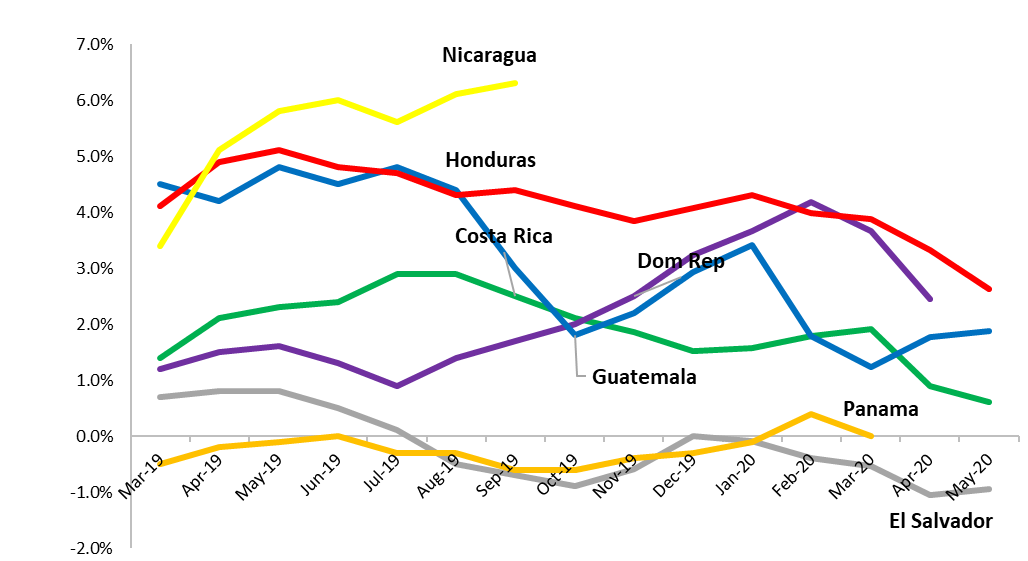
    Central America & Caribbean:​ Inflation
    Monthly year-on-year figures

    Central America & Caribbean, selected countries: GDP growth (%)
    Quarterly figures are year-on-year growth
    GDP  end 2019* 2020 forecast** Q1 2019 Q2 2019 Q3 2019 Q4 2019
    Costa Rica 2.1 -3.6 1.8 1.4 1.9 2.9
    Dominican Republic 5.1 0 5.7 3.7 4.8 5.8
    El Salvador 2.4 -3 1.8 2 2.7 2.96
    Guatemala 3.5 -1.3 3 3.5 4 3.9
    Honduras 2.7 -2.8 3.5 1.9 2.4 2.5
    Nicaragua -3.9 -5.9 -9.1 -3.1 -2.9 -0.2
    Panama 3 -2 3.1 2.9 2.7 3.3
    *Figures from local central banks **Figures from the United Nations Economic Commission for Latin America & Caribbean April 2019
    Quarterly growth based on figures from the local central banks
  • MEXICO: Disillusion grows with Ayotzinapa investigation

    Patrick de Courcy 02 October 2025 Hits: 1682

    Mexico marked the eleventh anniversary of the disappearance of 43 students from the Ayotzinapa rural teacher training college in Guerrero state on 26 September. The case continues to test the Mexican government, highlighting enduring challenges in securing accountability, institutional capacity, and the State’s broader handling of the enforced disappearance crisis. In the run-up to the anniversary, President Claudia Sheinbaum’s administration appeared to face growing scrutiny over its management of the investigation.

    President Sheinbaum met with the parents of the students on 4 September. Ahead of the meeting, Sheinbaum indicated she would present advances in the investigation, particularly in relation to the analysis of telephone records from the night of the disappearance and the days after. However, families left the meeting “disappointed”, according to their lawyer, Isidoro Vicario Aguilar, as no substantive new findings were disclosed. The meeting was the first since Vicario took over the case following the resignation of the long-time lawyer for the families, Vidulfo Rosales, on 21 August. Rosales has since joined the team of the new supreme court (SCJN) president, Hugo Aguilar Ortiz.

    The meeting also followed the appointment of Mauricio Pazarán as lead prosecutor for the case on 16 July, replacing Rosendo Gómez Piedra. Gómez’s leadership of the special investigation and litigation unit for the Ayotzinapa case (UEILCA), which sits within the federal attorney general’s office (FGR), had been widely criticised due to poor results and bad practice. Local human rights group Centro de Derechos Humanos Miguel Agustín Pro Juárez (Prodh) welcomed Gómez’s departure, highlighting the time lost under his tenure and the urgent need for more capable leadership. The change in UEILCA leadership, as well as the recent replacement of the head of the national search commission (CNB), reflect the government’s attempts to correct past deficiencies and rectify controversial appointments. However, they also highlight the high turnover and structural weaknesses that continue to prevent progress in the Ayotzinapa case and other forced disappearance investigations.

    • CNB

    On 29 July Mexico’s interior ministry (Segob) announced the resignation of Teresa Reyes Sahagún as head of the national search commission (CNB). Reyes’ 2023 appointment had been criticised by rights groups due to her lack of technical experience and the opaque selection process. On 11 September, Sheinbaum appointed Martha Lidia Pérez Gumercindo to head the CNB. While rights groups again decried the lack of transparency in the appointment process, Pérez Gumercindo’s experience – over two decades in criminal law and human rights, including leadership of the FGR’s special prosecutor’s office for forced disappearances – may help restore some legitimacy to the institution.

    Following the meeting, Sheinbaum demonstrated another attempt to prove her administration’s commitment to accountability, transparency, and impartiality in the Ayotzinapa case, requesting support from the United Nations (UN) in identifying experts for a new group of independent investigators. The previous inter-disciplinary group of independent experts (GIEI) withdrew in 2023 after the armed forces refused to release crucial information in relation to the case [SSR-23-09]. The UN, which has monitored the case from the start, has repeatedly criticised government inaction and supported claims from the GIEI and the students’ families that the armed forces were obstructing investigations.

    The Ayotzinapa case has now outlasted two administrations. The disappearances took place under the presidency of Enrique Peña Nieto (2012-2018), who was heavily criticised for his handling of the case. His successor, Andrés Manuel López Obrador (2018-2024) promised progress but left office without resolving the case and on bad terms with the students’ families. Sheinbaum took office promising renewed investigative rigour and dialogue with the families, but a year into her term, tangible results remain limited. Sheinbaum will need to address challenges including the high turnover of key personnel and potential role of the armed forces if her government is to make any measurable investigative progress and fulfill a key campaign promise.

  • TRACKING TRENDS

    LatinNews 22 July 2011 Hits: 1541

    NICARAGUA | Private pressure. President Daniel Ortega faces a challenge other than that posed by his political opponents ahead of general elections in November. The harmonious state of relations he has managed to maintain with the powerful private sector lobby (despite his radical leftist rhetoric) is at risk, amid renewed unrest from the so-called ‘No Pago’ (no pay) movement, comprised of medium-sized producers demanding the renegotiation of defaulted loans.
        Ortega has hitherto preserved ties with big business as a result of booming exports and foreign investment receipts, and his refusal to touch tax reform. On 12 July, the private sector lobby, Consejo Superior de la Empresa Privada (Cosep), and the national microfinance association (Asomif) issued a joint statement demanding a “firm response” from the government in relation to a revival of unrest staged by the ‘No Pago’ movement across the country over the past month.
        Initially stirred up by Ortega himself in June 2008 when he backed protests by debtors against the micro-finance institutions (MFIs) – although he has since distanced himself from this stance –, the main complaint of the ‘No Pago’ movement is that MFIs, whose gross loan portfolio is some US$538m, including funds from savings and credit cooperatives, according to a 2011 report from the think tank Funides, charge interest rates that are too high, leaving borrowers swamped by unmanageable debt.
        According to a leader of ‘No Pago’, Omar Vílchez, 13,758 debtors owe US$43.9m of overdue debt to the Nicaraguan banking system. One of his proposals is that those who owe more than US$10,000 (1,788 people, whose total debts come to US$24.5m) should have their debts restructured at a “symbolic rate of interest” over a 10-year period.
        The Asomif-Cosep, however, complain that since 2008 uncertainty caused by the actions of ‘No Pago’, together with the economic crisis, resulted in losses of US$80m from foreign donors. They argue that a further US$300m earmarked for the current agricultural cycle is currently at risk.

    COSTA RICA | Chinchilla’s challenge. President Laura Chinchilla has admitted that the Caja del Seguro Social (CSS), social security fund, faces an unsustainable financial crisis. Her comments came days before an indefinite strike began on 19 July in the medical sector as hospital staff, as well as community clinics, protested against cuts in disability pay.
        It is the first labour dispute Chinchilla has faced since taking office in May 2010. Union organisers insist that the strike will continue until the government meets their demands. The government insists that the CSS, which is funded by employee, worker and state contributions, needs urgent reform, primarily because the government is cash-strapped and running a fiscal deficit which looks set to exceed 5% of GDP for the second straight year.

    REGION | Remittances. Remittances increased 9.5% in the first half of 2011 on the same period last year to US$2.18bn, according to the central bank (Banguat). The president of Banguat, Edgar Barquín, predicted that remittances would break all previous records and reach US$4.5bn in 2011, surpassing the US$4.32bn recorded in 2008 before the onset of the global economic slowdown.
        El Salvador, meanwhile, received US$1.81bn of remittances from expatriates in the first half of 2011, up 4.3% on the same period in 2010, according to the central bank.

    CUBA | Restrictions. Private businesses, or the so-called cuentapropistas, self-employed Cubans, in the historic centre of Havana will have to pay a tax towards the preservation of the designated World Heritage Site, according to a new decree published by the Cuban government in the official gazette. The size of the tax will be set shortly by the finance ministry, and will be payable either in Cuban pesos or convertible pesos.
        The state planning institute is considering setting up bazaars, as the number of cuentapropistas grows, to ensure that the physiognomy of Havana, and other cities, is not fundamentally altered by private stalls setting up wherever they choose. They will also have to acquire a licence from the Oficina del Historiador de La Habana (OHCH).

  • Russia hints at talks with Taleban - CIB 31 March 2011

    LatinNews 06 September 2011 Hits: 6

    While the rest of the world’s attention has been focused on the Middle East and Japan, Russia has been making some interesting noises about Afghanistan.

    Russia understands that the Obama administration made a major strategic error in December 2009 when it announced that US forces would begin withdrawing from Afghanistan in July 2011. From that moment onwards, the Taleban knew that it was only a matter of a relatively short time before it could reassert its influence in the country. The Taleban’s confidence on this point was boosted by the knowledge that its supporters in the Pakistani military had drawn the same conclusions.

    This confidence within the Taleban (and Pakistan) that they would prove to have more staying power than the United States can only have been boosted by current events in the Middle East, where the challenges to the US can hardly be overestimated. They will be calculating that faced by potential strategic disaster in the Arabian Peninsula, continuing uncertainty about the futures of Egypt and Jordan, and possibly renewed difficulties in Iraq, the US is bound to have its attention diverted from Afghanistan.

    It seems that Russia has been reading the same tea leaves. At the moment Moscow has no direct contacts with the Taleban, but on 28 March Russia’s special presidential envoy to Afghanistan, Zamir Kabulov, said that Moscow was “open for discussion with them”. Kabulov went on to say that Moscow’s concerns are “terrorist, extremist, and narcotics threats” coming from Afghanistan, and he added: “We would like them [the Taleban] to know that a government that will seek ways to solve those issues would be acceptable to us.”

    Earlier this month during a meeting in Jeddah, Kabulov had told Marc Grossman, the US president’s special representative for Afghanistan and Pakistan, that Russia opposes a continuing foreign military presence on Afghan territory.

    Kabulov’s remarks were followed up on 28 March by Russia’s Foreign Minister Sergey Lavrov, who responded to questions about a continuing US military presence by saying that the Afghans themselves should decide how they will live. He aded: “I think they will take a serious look at the advantages of neutral status”. That judgement would, of course, be more certain of fulfilment under a Taleban regime.

    Interestingly, what Lavrov sees as “neutral status” does not exclude joining the Shanghai Cooperation Organization (SCO) which links the former Soviet republics of Central Asia with Russia and China. In an interview with Interfax on 27 March, Kabulov said that Russia “fully supports” Afghanistan joining the SCO.

    Behind this desire to pull Afghanistan into Russia’s sphere of influence is a belief in Russian policymaking circles that Russia is under growing strategic threat. General Makhmud Gareyev, president of the Military Sciences Academy, suggested last week that Russia’s geopolitical position is as bad as it has ever been in its history. He noted that US military forces “are present in any strategic direction – west, south, east, and north”. He is equally concerned by the rise of China.

    Russia’s strategic angst has only been increased by preliminary findings of the latest census. The full report is not due to be published until the end of 2012, but initial data suggests that in the last eight years Russia’s population has decreased by 2.2m, the equivalent of a third of the residents of the Moscow region. Some analysts think the position could be even worse as some local statistics bodies are suspected of exaggerating the size of local populations.

    Apart from the strategic issues driving a possible rapprochement between Russia and the Taleban, the drug question is a key motivator. In Moscow’s view, the US is not doing anything like enough to prevent the flow of Afghan heroin to Russia. According to Kabulov: “For the United States...Afghan heroin poses no direct threat: they have enough not only of Colombian cocaine but also synthetic drugs. That’s it. Perhaps because of this they have no direct interest.”

    The Taleban is another matter. Before the Taleban was ousted from power and came to rely upon the heroin trade to finance its insurgency, it ran an effective, if brutal, anti-heroin campaign. During the 1990s, Afghanistan was the main source of the world’s illicit heroin supply, but from July 2000 until the Taleban’s downfall over a year later, the Taleban’s ban on cultivating opium poppy resulted in the near cessation of poppy growing in Taleban-controlled areas and a fall in the global heroin supply by 65%.

    A return to such a policy would suit Moscow very well, particularly if linked to the considerable side benefit of an American withdrawal. The catch would be the Taleban’s support for militant Islam, but even here there is a template that Russia could adopt. Iran has largely refrained from supporting militancy in Central Asia, the Caucasus, and Russia in return for Moscow’s support against the US. It is likely that Moscow believes there would be no good reason why the Taleban could not reach a similar accommodation. If Kabulov does move to “open discussions” with the Taleban that will be the second item (after drugs) on the agenda.

    NOTE: According to sources in Karachi, the Taleban has created a unit based in Pakistan’s North Waziristan called Lashkar-e-Khorasan (LeKh) whose sole purpose is to identify, capture, and execute people acting as spies for the US – particularly those helping the US in its drone campaign.

  • In Brief – Panama

    LatinNews 02 July 2012 Hits: 1205

    Ruling party retains congress. On 1 July Deputy Sergio Gálvez of the ruling Cambio Democrático (CD), was elected president of Panama’s 71-member unicameral national assembly for 2012-2013 with 42 votes. The CD has 36 seats in the congress while its ally Molirena has four. The main opposition groups, Partido Revolucionario Democrático and Partido Panameñista, have 17 and 12 seats respectively

  • TRACKING TRENDS

    LatinNews 14 July 2011 Hits: 471

    DOMINICAN REPUBLIC | Government rocked. The ruling Partido de la Liberación Dominicana (PLD) has bestridden national politics for seven years but it suddenly looks vulnerable with just 10 months until presidential elections. For one thing it will be without its talisman, President Leonel Fernández, who cannot seek re-election, but even if he were able to stand Fernández would be up against it. Public opinion has no respect for reputations and Fernández’s star is waning. A CID Gallup poll published this week gave him an approval rating of just 30%, dwarfed by a disapproval rating of 63%.

    The civil society organisation Foro Social Alternativo (FSA) staged a national strike on 11 July. It was felt most keenly in the national district and the province of Santo Domingo, as public transport ground to a halt and shops did not open for business. Protesters demanded a reduction in food, fuel and medicine prices, and a 35 % increase in the salaries of public employees, including the police and military. They also reiterated a long-standing demand for education funds to be increased to 4% of GDP, in compliance with a law Fernández himself introduced in 1997. They also complained about perennial power shortages despite electricity tariffs having been increased by as much as 20% last November.

    The protesters gave an ultimatum: the government must address some of their concerns by 14 August, after which they promised to carry out further protest action and marches. The main opposition Partido Revolucionario Dominicano (PRD), whose presidential candidate former president Hipólito Mejía (2000-2004) will hope to tap into public disillusionment in next May’s elections, leant its support to the strike action.

    The economy minister, Temístocles Montás, said the demands of the protesters were “practically impossible” to satisfy. Montás said the fact the government was facing a tough economic situation was not down to poor policies but rather the global economic slowdown and the high cost of importing fuel. He said the strike had only succeeded in damaging economic stability, increasing inflation, and pushing prices up further and the Dominican peso down further.

  • In Brief – Chile

    LatinNews 08 January 2014 Hits: 1818

    POLITICS | Lower chamber approves first step towards ending binomial system. On 7 January, Chile’s chamber of deputies approved (by 73 votes in favour and 10 against), an amended bill eliminating the constitutional provision (Art. 47) that fixes the number of lower chamber seats at 120. The move is widely considered the first reforming step towards ending Chile’s binomial electoral system, which assigns two deputy seats to each electoral district and which smaller parties complain favours the country’s two main coalitions. A version of the bill was first approved by the lower chamber on 15 October 2013 but it underwent minor changes after being analysed by a congressional committee. The latest version, approved by the senate on 11 December 2013, now goes to the executive for promulgation.

  • MEXICO: Lagarde calls for financial inclusion

    LatinNews 16 July 2014 Hits: 2820

    At a two-day financial inclusion forum in Mexico City in late June, President Enrique Peña Nieto, Finance Minister Luis Videgaray and IMF Managing Director Christine Lagarde focused on what they said is a key sector of the population: the unbanked.

    Not everyone in Mexico has a bank account. In fact, most people don’t. Financial exclusion is possibly one of the biggest single obstacles to faster economic growth in the country. Discussion of the issue at a high-powered forum in late June revealed two things: first; that the problem is deep-rooted and widespread, and second; that the International Monetary Fund (IMF) thinking about the relationship between inequality and growth may be changing quite fundamentally.

    Most of Mexico’s poor don’t do banking. Only 27% of the adult population has access to financial services, compared to 40% on average across Latin America and the Caribbean. The unbanked tend to be made up of the poor, small informal enterprises, and women. Only one of every five Mexican women is served by a formal financial institution. Globally, some 2.5bn people don’t have bank accounts: Mexico seems to have a particularly important concentration of them. The other side of the coin, noted Finance Minister Videgaray, is that a majority of the population – around 60% - have used informal savings or credit networks. Half of Mexico’s rural municipalities lack banks or cash machines.

    A novelty at the forum was the strong call for 'pro-poor' reform made by Lagarde, perhaps at odds with the traditional perceptions of an IMF that appeared indifferent to the fate of lower income groups. She noted that despite recent progress in lifting people out of poverty, Latin America remained the most unequal region of the world. Bringing financial services to the poor had “enormous advantages”. As she put it, “greater financial inclusion is a proven mechanism through which governments can work to reduce inequality and strengthen the role of women in the economy. Improved access to finance allows households to smooth out consumption over time and insure against risks. It also encourages entrepreneurship, and it may allow small businesses to grow beyond subsistence and informality, and ultimately contribute to strong and durable growth and job creation”.

    Lagarde suggested that extending banking services, along with reducing informality in labour markets and the recent education, telecoms and energy reforms  were all important steps to increase competitiveness and kick Mexican growth into a higher gear, above the slow 2.3% average GDP expansion it has registered in the last 15 years. Videgaray and other Mexican officials were keen to point out that the reforms approved so far do have a financial inclusion component. Videgaray noted that the 2013 banking reform required all state-owned banks and lending institutions by law to have gender-targeted lending programmes. “We know that lending to women is a low risk business, because they pay back the debt when they are trusted to do so. Mexican development banks are now obliged to believe in, and bet on women” he said.

    Lagarde was also optimistic about the potential of new mobile technologies to boost financial inclusion. She noted the success of M-PESA, the Kenyan mobile payments system that now offers nationwide coverage independent of traditional banks, and noted that Mexico was experimenting with a government-to-person (G2P) payments system called ‘Oportunidades’ which “has helped draw previously unbanked beneficiaries into the formal financial network”.

    Lagarde’s comments offer a glimpse of the IMF’s progressive change of thinking over the relationship between inequality and growth. For decades, the fund’s insistence on the need for economic adjustment via austerity programmes has put it in the position of favouring growth over redistribution, or growth at the expense of equality. However, it sponsored a major academic study published in February this year which argued that “It would … be a mistake to focus on growth and let inequality take care of itself, not only because inequality may be ethically undesirable, but also because the resulting growth may be low and unsustainable”. One of the authors of the paper, Jonathan Ostry, said at the time, “we find that inequality is bad for growth… in and of itself. And we can say that redistribution by itself doesn’t seem to be bad for growth, unless it is very large”. The finding led Nicholas Mombrial of the anti-poverty group Oxfam to state: “In the bad old days, the IMF asked governments to cut public spending and taxes. We hope that this research and Christine Lagarde’s recent statements are a sign that they are changing their tune”.

  • TRACKING TRENDS

    LatinNews 07 August 2014 Hits: 1438

    ECUADOR-PERU | Energy cooperation road map. Energy authorities from Ecuador and Peru met in the Galapagos Islands on 31 July to discuss the possibility of developing a “road map” for oil and gas cooperation. During the two-day ‘binational Ecuador-Peru workshop’ 40 delegates from both countries led by Ecuador’s non-renewable resources minister, Pedro Merizalde, and Peru’s energy & mining minister, Eleodoro Mayorga, exchanged and analysed information about their respective countries’ oil fields with a view to “maximise opportunities and take advantage of existing oil infrastructure and facilities in the areas of activity in both countries”. They also discussed jointly exploiting heavy crude oil and natural gas deposits in northern Peru and Ecuador’s southern coastal areas.

    After the meeting Mayorga said that “Ecuador and Peru share similar and complementary geological and logistical characteristics in hydrocarbon blocs located in the border area”, and that the objective of the discussions was to find ways to take full advantage of these. Mayorga said that Peru’s northern oil pipeline could be used to transport Ecuadorean light crude located in border deposits that Ecuador has been unable to exploit due to a lack of infrastructure; and that Peru could also consider exporting any surplus natural gas to Ecuador “as long as we can satisfy market demand in Piura and Tumbes”, Peru’s north-western regions bordering Ecuador.

    Mayorga also said that an independent consulting firm will now be contracted to identify and quantify existing oil and gas deposits in both countries; and conduct technical and financial viability studies to determine the level of demand and pricing for hydrocarbons in both countries. The two ministers also agreed to hold a follow up meeting in late September to go over the progress made in order to have a report ready to present at the next bilateral presidential meeting scheduled to take place in Ecuador’s border city of Arenillas on 28 October.

  • TRACKING TRENDS

    LatinNews 05 February 2015 Hits: 1156

    COLOMBIA | Responding to low oil prices

    President Juan Manuel Santos sought to assuage concerns this week about the declining price of oil. President Santos said that his government would focus on propelling the construction and housing sector to try and mitigate the impact on the economy of the fall in the price of oil and keep down unemployment, which closed 2014 at 9.1%, the lowest level for 14 years, according to the national statistics department (Dane).

    Speaking on the state television programme Agenda Colombia, Santos conceded that the economic scenario over the coming years was “not so buoyant” as in recent years and that the fall in the price of oil would have an impact, especially on investment.

    “What we are doing is seeing how to neutralise those negative aspects with a greater dynamism in sectors like construction and housing,” said Santos. He argued that Colombia still had “room for manoeuvre” because public finances had been handled responsibly, and that his government would strive to keep down unemployment, maintaining that during his first term (2010-2014), the goal of creating 2.5m jobs was met, with around three-quarters of these being in the formal sector.

    Santos was responding to the somewhat bleak prognostication of the central bank, Banco de la República, which confirmed last week that the current price of oil was “more than 50% below the level in mid 2014”, resulting in “a fall in national earnings, with repercussions for the trade balance and public finances”. It predicted that the economy would grow by 3.6% in 2015, lower than the government’s forecast of 4.2%.

    ECUADOR | Rodas and Correa scramble to deliver the Quito metro

    Mauricio Rodas, the opposition mayor of Ecuador’s traffic-congested capital, has announced that the longstanding project to build an underground metro in Quito will go ahead.

    Upon taking office in May 2011, Rodas, who belongs to the opposition Sociedad Unida Más Acción (Suma), got into a major funding row over the metro with President Rafael Correa. Correa had pledged to put up half the money for the scheme, which was originally costed at US$1.5bn by Rodas’s predecessor, Augusto Barrera of Correa’s ruling Alianza País (AP). Barrera had (controversially) paid the Spanish metro company Metro de Madrid US$29m for that cost estimate.

    Ahead of his (failed) bid for re-election as mayor in February 2014, Barrera began initial construction works for the two main stations without waiting for the main tender, with the ever-worsening congestion a key issue in the Quito contest. However, the four bids submitted to the new municipal administration for the main project in July 2014 came in well above US$1.5bn (ranging between US$1.7bn and US$2bn), shrouding the project in uncertainty and prompting Rodas to ask Correa to help make up the shortfall (Rodas more or less accused Barrera of incompetence).

    With central government finances under pressure from falling oil prices, however, Correa declined and retorted that the municipality would have to find the funds itself.

    However, with one eye on the presidential election in 2017, in which both men are expected to compete (Correa, pending final congressional approval of a constitutional amendment to allow him to do so; and Rodas for the second time, having placed a distant fourth in the 2013 contest), it is in their mutual interest to get the project up and running.

    On 2 February Rodas said the municipality was willing to assume close to US$500m in additional debt from multilateral lenders to finance the project. Correa, for his part, agreed to sign off on a guarantee for the increased municipal debt.

    Rodas will now begin negotiations with the most competitive bidder, a consortium comprising Brazil’s giant Odebrecht and the Spanish engineering firm, Acciona.

    Rodas also recently announced the construction of several cable car systems for Quito, similar to those in La Paz (Bolivia) and Medellín (Colombia). These are due to be finished before the metro, which is scheduled to take 42 months in all, and should allow him to stake a legacy claim as the man that revolutionised public transport in the capital, the country’s largest electoral district.

    • Quito metro

    Officially known as the ‘Quito Metro Line One Project’, the scheme envisages a 23-km metro running north-south through Ecuador’s capital, with 15 stations in total, six of which will be integrated with the metropolitan bus service.