Nearshoring Promises and Challenges

Items

  • From globalisation to nearshoring

    Patrick de Courcy 16 May 2023 Hits: 2540

    Globalisation has arguably been the dominant economic story of the last three to four decades. In simple terms it reflects a worldwide trend to open up economies and societies, reducing border controls, creating integrated chains of production, and vastly increasing trade. Globalisation has been seen as the engine driving increased prosperity, reduced poverty, and a global expansion of the middle classes. Yet it has also been associated with inequality and a power shift in favour of ‘first world’ governments and corporations. Globalisation is seen by some as an existential threat to smaller nations and communities. Politically, it has generated a bitter debate between supporters and critics. The last 2-3 decades of political upheavals in the Middle East, Afghanistan, Africa, and to an extent Latin America itself, can be seen in terms of a conflict between pro- and anti-globalisation forces.

    For economies like those of the US, Europe, and Japan, taking advantage of globalisation meant supporting ‘offshoring’ – the process by which the world’s largest companies have moved part of their production chains to developing economies. Offshoring coupled with reduced trade tariffs and non-tariff barriers allowed these companies to take advantage of lower labour costs, achieve greater economies of scale, and increase their profitability. China, a key protagonist in the story, had already begun to open up to the world economy from the 1970s and was able to achieve a major expansion of its export-oriented manufacturing output. For much of the 1990s and 2000s Chinese economic growth was in the high single or low double digits, in percentage terms. In the first decade of this century surging Chinese commodity imports triggered a Latin American economic boom.

    But it is clear that over the last decade globalisation has lost momentum. There is less talk of offshoring nowadays. Some analysts talk instead of de-globalisation. Various developments have marked this change. In the more affluent countries in the 2010s many disillusioned voters turned against open markets. Some saw globalisation and the rise of China as the cause of job losses, de-industrialisation, and decay in so-called rust-bucket areas. This in turn helped trigger the rise of right-wing populist sentiment. In 2016 the UK electorate voted for Brexit – to leave the European Union. This on its own can be seen as an example of de-globalisation. In the same year Donald Trump won the US presidential elections standing as a maverick anti-establishment Republican and offering a volatile mix of America First policies, including hostility to China and immigrants, along with the construction of a symbolic wall on the border with Mexico. In the UK, Boris Johnson, a Conservative offering a comparable mix of protectionism and anti-immigration sentiment, was elected prime minister in 2019. Other European countries also witnessed an electoral shift to the authoritarian right.

    Some of these changes may be reversed in the current decade, but others will be long-lasting. While Trump was defeated by Joe Biden of the Democratic Party in the 2020 US elections, the new president stopped well short of resuming support for globalisation. On the contrary, Biden has passed legislation which gives the state a leading role in protecting US-based jobs and investing in high technology and renewable energy. Like Trump before him, Biden remains deeply suspicious of China and prepared to impose trade sanctions.

    Two further developments suggest that a return to the era of unrestrained globalisation is not on the cards. The Covid-19 pandemic swept around the world mainly in 2020-2021, causing over 7m deaths (as of April 2023). This can deservedly be described both as a catastrophe and as a major game changer. Governments were forced into economic lockdown, realising that many features of globalisation that they had previously taken for granted - including mass transport, air travel, tourism, low-friction border crossings, and unrestricted trade - were all vulnerable and prone, in an emergency, to be rapidly shut down. There is a realisation that the balance between open trade and national resilience and self-reliance needs to be somehow recalibrated. Significantly, while the worst of the pandemic appears to have passed, major economies have continued to be affected by labour shortages and bottlenecks of different types. Faced by a global shortage of semi-conductors (most of which are currently manufactured in China and Taiwan), Biden is offering subsidies and incentives to increase US-based production.

    The other major development is the Ukraine war, triggered by the Russian invasion which began on 24 February 2022. The war has, for the moment at least, destroyed the post-Cold War consensus that trade, liberalisation, and the joint pursuit of prosperity would gradually ease superpower rivalries. Countries like Germany that for decades pursued closer trade-based relations with Russia have had to rethink entirely and set about eliminating their dependence on Russian energy and gas. Here too a quick return to the status quo ante is hard to see happening. Higher energy prices caused by the war may endure for years. US policy analysts believe a Chinese attempt to regain control of Taiwan by military force is a deeply troubling prospect, but one that cannot be entirely ruled out.

    Looking forward, in one possible de-globalisation scenario the world’s economy could split in two, in a form of decoupling. New York-based brokers Global X commented in a recent research note that while international trade volumes are now some 9% above their pre-pandemic peak, “the world is rapidly moving towards two major trading blocks, with one aligned towards the US and the other towards China. This is expected to bring both economic and geopolitical consequences with trade between the two blocks likely to continue declining.”    

    Turning to the implications for Latin America, there are at least three things that may replace offshoring. These are ‘onshoring’, ‘reshoring’, and ‘nearshoring’. Onshoring refers to companies that base their production in their home country but may move it around within different sub-regions to optimise operational costs. Reshoring on the other hand means bringing back previously offshored production to the home market, be it the US, the EU, or Japan. The political rationale for doing so is clear: it boosts self-reliance and creates jobs at a time of heightened concern over future labour market trends, marked by uncertainty over issues such as long-Covid, homeworking, automation, and artificial intelligence (AI). The economic rationale for reshoring may be less clear cut than the political one, and is likely to depend on the type of activity involved. For many activities, a return to the home market could mean an increase in labour and other costs. However, it seems reasonable to expect governments to support a degree of reshoring particularly on national security grounds. Some jobs could even go back to the United States from Latin America – however this is unlikely to affect a big proportion of its work force.

    Much more consequential on the plus side of the ledger for Latin American countries is the potential impact of nearshoring. This suggests that companies that moved part or all of their production from the US to China in the 1990s are now in the process of bringing these activities back closer to home – for example, to serve the US market from various close-by locations in the Americas. The potential advantages for doing so are numerous. First, in any scenario of rising tension between the US and China, companies will be able to avoid or mitigate a wide range of political risks. By having downsized or closed their China operations these companies will eliminate the likelihood that in a scenario of rising super-power tensions they might face sanctions, adverse tax decisions, or, ultimately, expropriation. By bringing these operations closer to home it is argued, they will be better protected by the rule of law, by investment guarantees, and by shared, market friendly, democratic values, one reason why nearshoring has also been called ‘friend shoring’.

  • How big is the nearshoring trend?

    Patrick de Courcy 16 May 2023 Hits: 1881

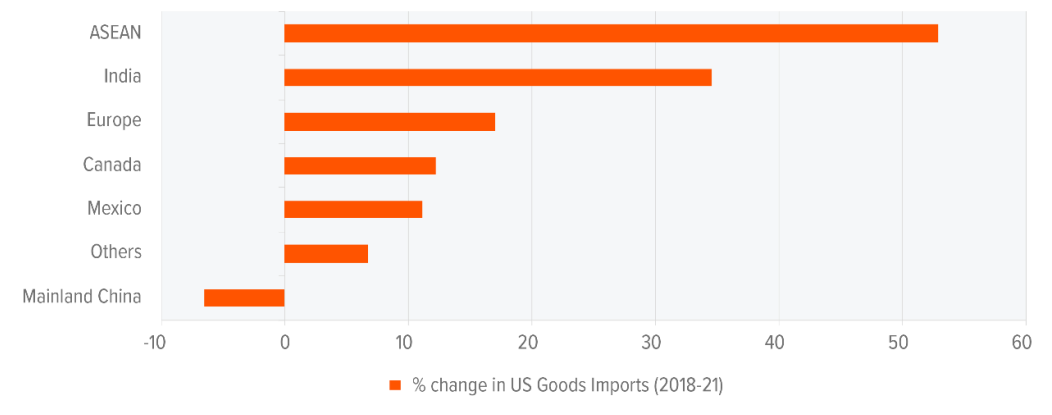
    Some efforts have been made to quantify nearshoring and identify future winners from the process. US Census Bureau data shows, for example, that in 2018-2021 US imports from China contracted by 5%-6% while imports from Asean (Association of Southeast Asia Nations) grew by over 50% followed by imports from India (+35%) and those from Europe, Canada, and Mexico (all in the 10%-20% range). Total US imports in 2022 were US$3.27tn. If China were to lose an additional 5% of its share of US imports that would represent roughly US$165bn of US market share that would be available to be captured by other, non-Chinese exporters.

    Impact of supply chain reorganisation (%)

    Source: Global X ETFs with information derived from: US Census Bureau  

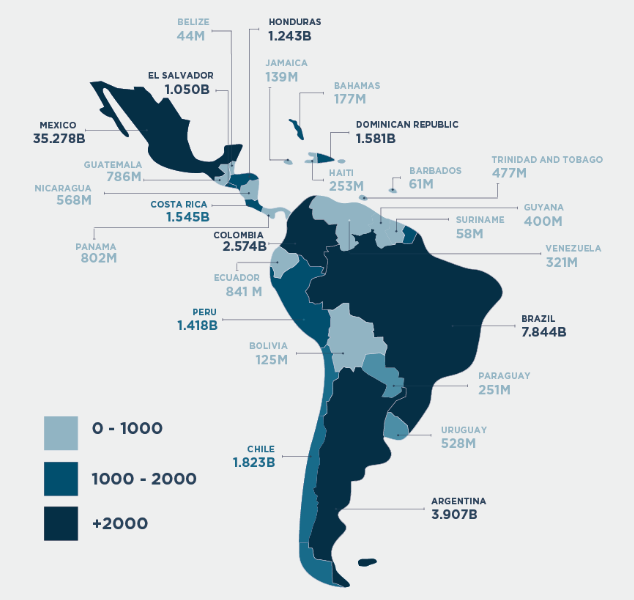
    It is widely acknowledged that Mexico, with a large, shared border with the United States, is a major player in the rise of nearshoring in Latin America, with other important protagonists including Brazil, Central America, and Colombia. In June 2022 the InterAmerican Development Bank (IDB) conducted an exercise to try and assess the country-by-country potential for capturing nearshoring benefits. It identified two areas for quick wins - increased exports to the US on the one hand, and increased exports to the wider Latin American region on the other. A third category covered wider medium-term opportunities. The IDB’s main conclusion was that, across the region, nearshoring could add an annual US$78bn in additional exports of goods and services, with the ‘quick wins’ in sectoral terms to be found in the auto industry, textiles, pharmaceuticals, and renewable energy. The total number for export gains was made up of US$64bn in increased physical exports and US$14bn in increased services exports.

    By countries, Mexico stood to gain most, with an extra US$35.28bn in physical exports, or more than half of the expected total Latin American gain. Mexico was followed in order of importance by Brazil (a gain of US$7.84bn), Argentina (US$3.9bn), Colombia (US$2.57bn), Chile (US$1.83bn), the Dominican Republic (US$1.58bn), Costa Rica (US$1.54bn), Peru (US$1.42bn), Honduras (US$1.24bn), and El Salvador (US$1.04bn). Commenting on the results the-then president of the IDB, Mauricio Claver-Carone, said that “increased environmental concerns, along with the heath crisis and the recent invasion of Ukraine by Russia, have presented an opportunity in which the region can contribute to the global economy and the fight against inflation by taking a more active role in global supply chains in a way that is sustainable and equitable.”

    Analysis by IDB economists focused on the multiple benefits companies can achieve by stepping up their participation in global value chains (GVCs). They argued that participation in GVCs increases productivity through transfers of technology and knowledge, by creating jobs, and by increasing opportunities for women. According to the analysis, an increase of 10% in a country’s GVC participation rate increases its per capita GDP by a higher 11%-14%. To maximise nearshoring benefits the IDB also recommended what it called a ‘3i’ strategy of focusing on investment, infrastructure, and integration. Increased benefits were available in each of these areas. For example, the IDB calculated that, in terms of integration, harmonising the region’s 33 preferential trade agreements could result in a 12% increase in intra-regional trade. Likewise, under the infrastructure heading, the IDB estimated that a 10% reduction in international shipping costs “increases the value of exports by at least 30%”.

    Total nearshoring opportunities by country additional exports of goods
    M: US$ Millions, B: US$ Billions

    Source: IDB

  • Case study 1: Mexico

    Patrick de Courcy 16 May 2023 Hits: 1825

    It is evident that Mexico is far and away the largest current player in, and future benefactor from, the expansion of nearshoring in Latin America. Uniquely in Latin America, Mexico shares a 3,122 km long land border with the United States, the world’s richest economy. Mexico, along with Canada, therefore, has unrivalled physical proximity to the world’s economic superpower. This alone offers enhanced and competitive logistics costs, with ample road, rail, maritime, and air routes. Mexico has the world’s third-largest number of airports (2,315), 102 ports, 27,000kms of railway tracks, 365,000 kms of roads, and 40 land border crossings with the United States.

    Perhaps most significantly, for the almost three decades since 1994, Mexico has been a member of a free trade agreement (FTA) with the US and Canada, initially known as the North American Free Trade Agreement (NAFTA) but renegotiated and renamed in 2020 as the United States, Mexico, and Canada Agreement (USMCA). USMCA is in effect a single market with low and in some cases zero internal cross-border tariffs, and with a comprehensive rule-based system covering a range of issues including the resolution of trade disputes and environmental, sanitary, and labour standards.

    This history means that many international companies are already present in Mexico and familiar with its operating conditions, allowing them to see new nearshoring projects as a relatively low-risk opportunity for expansion. The US currently imports roughly US$575bn per annum from China and US$450bn from Mexico. It is widely expected that the former number will fall, while the latter will increase. Apart from offering much lower transport costs than those in China, Mexico is seen as offering greater geopolitical stability, stronger intellectual property protection, and better protection of environmental and labour rights. In addition, Mexican wages, commodity costs, healthcare costs, and taxes tend to be comparable or lower than those in China. On the tax front the government’s máquila programme (IMMEX) offers fiscal incentives and tariff and VAT exemptions on the acquisition of key raw material and machinery inputs. Given China’s still heavy reliance on coal-fired electricity, Chinese manufacturing activity also tends to have a larger carbon footprint than the comparable activity in Mexico. However, there are also some forces at work in Mexico that may limit the potential for nearshoring gains which we will discuss later in this report. 

    Mexico’s wide network of FTAs and investment protection agreements with other countries is also significant. It currently has 10 FTAs, with investment protection provisions, with the following groups and countries:

    1. Comprehensive and Progressive Agreement for Trans-Pacific Partnership - CPTPP – composed of Australia, Brunei, Canada, Chile, Japan, Malaysia, New Zealand, Peru, Singapore, and Vietnam;
    2. Chile;
    3. Pacific Alliance (Chile, Colombia and Peru);
    4. Colombia;
    5. Central America (Costa Rica, El Salvador, Guatemala, Honduras, and Nicaragua);
    6. USMCA (US and Canada);
    7. Japan;
    8. Panama;
    9. Peru;
    10. Uruguay.

    Mexico also has around 30 Bilateral Investment Treaties (BITs) which are designed to protect investor rights and treat foreign investment in an open, transparent, and non-discriminatory fashion. Among the 30 are agreements with Argentina, Bahrain, Belgium, China, Cuba, Denmark, France, Turkey, UAE, UK, and Uruguay.

    A potential collective nearshoring target was set out in the January 2023 North American Summit, the regular meeting of the leaders of the three USMCA countries, which brought together Prime Minister Justin Trudeau and Presidents Joe Biden and Andrés Manuel López Obrador. The three committed themselves to reducing all Asian imports into the USMCA market by 25%, replacing those with goods and services produced inside USMCA (in other words, a shift to be achieved by some combination of reshoring and nearshoring). According to estimates cited by Brookings, the US-based think tank, between US$60bn and US$150bn could flow into Mexico over the next decade as production is moved closer to North American consumption centres.

    Nearshoring by business sector: Last year the Mexican economy ministry said that an estimated 400 global companies were considering setting up new operations in Mexico to capture nearshoring benefits. By sector Mexico’s largest category of exports to the US market is motor vehicles followed by auto-parts. Companies currently assembling vehicles in Mexico include BMW, Ford, General Motors, Honda, Mercedes, Stellantis (which owns brands such as Chrysler, Citroen, Fiat, and Jeep), Toyota, Volkswagen, and others. In 2022 Volkswagen, BMW, and Kia all announced plans to step up their investments in Mexico, at least partly focused on re-tooling to switch from internal combustion/fossil-fuel powered vehicles to electric vehicles (EVs). Global component manufacturers also present in northern Mexico include Quanta of Taiwan (onboard EV computer systems), Saint-Gobain of France (windshields), and Faurecia, also from France (car seats). Significantly, Harald Gottsche, head of a BMW plant in San Luis Potosí state, said that for some of his production lines the key aim is to “increase our share of locally produced parts to be more resilient against supply-chain disturbances”. Other business sectors in northern Mexico are also well placed to benefit from increased nearshoring. They include electronics, semi-conductors, aerospace, critical minerals, batteries, logistics, and medical equipment.   

    In March 2023, Daikin, a Japanese air-conditioning manufacturer, said it had decided to move some of its production capacity used to supply the US market from Thailand to Mexico. It said it would hire 2,000 staff in Mexico over the following 18 months. Some of the company’s manufacturing, currently located in the US, would also be moved south down to Mexico. The company said Mexico was attractive because of the availability of skilled labour. In addition, manufacturing wages were seen as being lower in Mexico than in China.

    In the semi-conductor sector Mexico is poised to benefit from the US CHIPS act and the Inflation Reduction Act (IRA), both of which offer subsidies to support reshoring in the US, but also provide support for nearshoring in Mexico and Canada. Taiwan Semiconductor Manufacturing Company (TSMC), for example, has announced plans to invest US$40bn in a new US-based chip fabrication plant. US-based delivery company UPS says it is investing in expanded facilities in Mexico to capture increased demand from nearshoring. In March 2023 Mexico’s Grupo Financiero Banorte said it was creating 800 new jobs “to capitalise on the opportunities from nearshoring”.

    The Tesla decision: In February 2023 Tesla, the Elon Musk-owned, US-based EV manufacturer, announced a landmark decision to build a plant near Monterrey, capital of the northern state of Nuevo León. Foreign ministry officials said the investment would be worth around US$5bn and involve building a major EV production plant on a 4,000-acre site. Company officials said that in time the total value of the investment, Tesla’s third factory outside the United States, could reach US$10bn. President López Obrador played a vocal and public part in negotiations, initially lobbying for the plant to be located elsewhere within Mexico. His lack of enthusiasm for Monterrey may have been tied up with regional politics: the governor of Nuevo León state is a member of the opposition.  

    The president instead championed other potential sites. In central Mexico he favoured Hidalgo, close to one of his pet projects, a new international airport. The president also sought to boost the chances of impoverished states in the south of the country, arguing that water scarcity there was less of an issue than in Nuevo León. Faced with these options Tesla appears to have stood its ground, convinced of the suitability of the Monterrey site because of the availability of skilled labour and engineers, the existence of a network of auto-component suppliers, and, critically, the close proximity to the US border. Tesla’s decision is also closely linked to the Biden government’s Inflation Reduction Act (IRA) which offers subsidies for the adoption of new technology. Credits worth nearly US$4,000 per EV are available if a minimum of 40% of battery metal is extracted or recycled in the US, or in countries that have a free trade agreement with the US (Mexico, of course, qualifies through its USMCA membership).

    As we shall see, private sector groups in Mexico have reservations over López Obrador’s frequent use of populist anti-business rhetoric and his tendency to intervene at short notice in sectoral or ministerial decision-making. Claiming corruption, the president has criticised contracts signed by predecessor governments and in some cases (such as natural gas pipelines) forced a renegotiation of the terms. Private sector leaders who had been critical of the president’s very public running commentary on where Tesla should set up shop were therefore relieved by the final decision. José Abugaber, of business lobby Confederación de Cámaras Industriales (Concamin), said he was happy that "common sense" had prevailed showing that López Obrador should "listen to the voice of business". Abugaber calculated that Tesla's direct investment would trigger a second wave of indirect investment and job creation among suppliers. The net result, he claimed, would be equivalent to raising Mexican GDP by 4.0 percentage points.     

    Where’s the data? There is some debate over whether a nearshoring wave is actually showing up in available data on the Mexican economy. A survey of business by Banco de Mexico (Banxico, the central bank) conducted in September last year showed that a relatively small proportion - 16% of respondents - said they had benefited from nearshoring in the preceding 12 months. However, another Banxico report estimated that nearshoring was responsible for a 3% increase in manufacturing production in the year to June 2022. Meanwhile a report by commercial bank Citibanamex said industrial park vacancy rates had dropped to 5% nationally and to zero in the border area around Tijuana – a sign of very strong demand. Eduardo Cinco, a real estate agent specialised in factory space, said “in 20 years I’ve never seen availability fall below five percent of the surface area”. In fact, demand for industrial park space in Mexico has doubled since 2020-21, and it is calculated that one out of every four square metres of factory space is now nearshoring-related. Ivan Perez, director general of economic development at Ciudad Juárez says the city is experiencing a boom and may face a possible labour shortage.

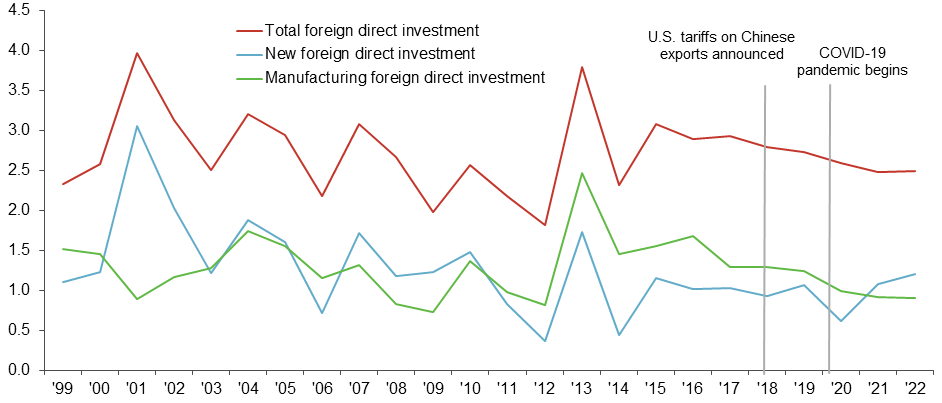
    But at the same time, however, there hasn’t been a surge in foreign direct investment (FDI) as recorded by official data. FDI has been broadly flat in 2015-2022 at between 2 and 3 percentage points of GDP. There are various possible explanations for this. One might be that there are big time lags in implementing nearshoring-linked investment decisions, or that other factors, such as the business climate or the effects of the pandemic, have actually held back investment flows. The US share of FDI flowing into Mexico has also remained roughly constant, while FDI from China has risen sharply (from a very low base). One reason why Chinese companies are moving into Mexico is that under USMCA rules it provides low-tariff access to the US market and avoids any punitive US tariffs on products manufactured in mainland China.

    Foreign direct investment in Mexico little changed in recent years
    Share of total GDP (percent)
    Source: Secretaría de Economía (Secretariat of the Economy)

    Is Mexico missing opportunities? Nearshoring can be seen as an opportunity created by global economic forces, but its success – how far the process actually goes - will remain dependent on host countries creating a supportive business environment. In this context, and despite the positive Tesla example, it can be argued that Mexico is not doing enough to increase foreign investment and maximise the nearshoring dividend.

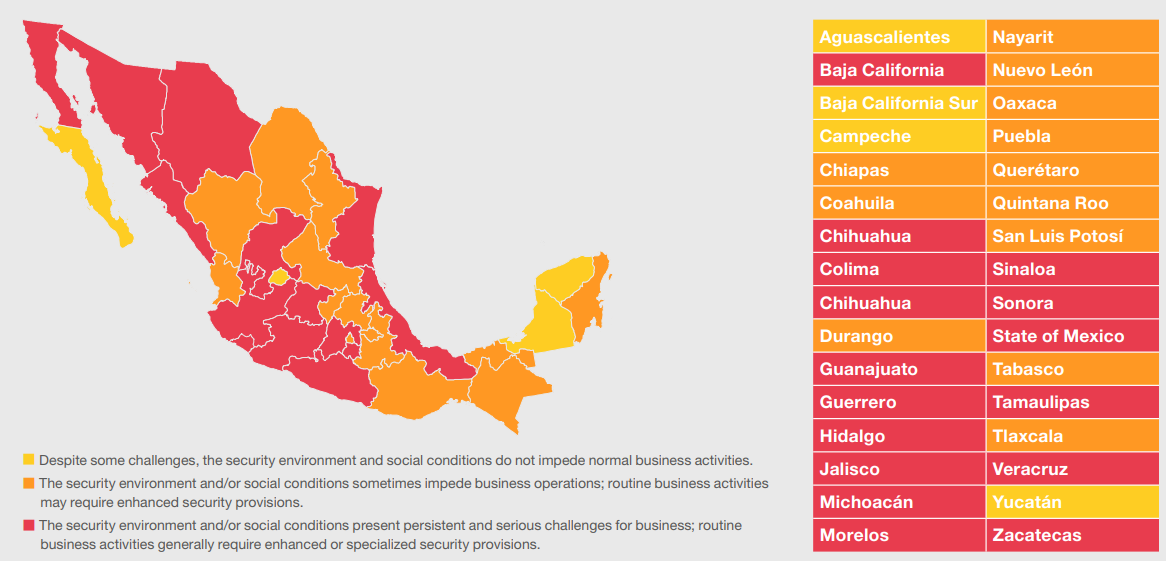
    One major problem is posed by issues of crime and security. Since 2006, when Mexico deployed its military forces to lead in the ‘war against drugs’, levels of violence in the country have been high, as powerful criminal cartels fight between themselves and with the security forces to control drug-trafficking routes into the United States. The country has two major criminal organisations, the Sinaloa cartel and the Jalisco New Generation cartel (CJNG), as well as a multitude of medium and smaller sized groups. Although present in most states these groups are particularly active in northern Mexico near the US border.

    A rough indicator of overall levels of violence is given by the homicide rate, measured as the number of annual homicides per 100,000 inhabitants. The national homicide rate in Mexico in 2022 was 25.2 per 100,000, placing it as the fifth most violent country in Latin America, behind Venezuela (40.4), Honduras (35.8), Colombia (26.1), and Ecuador (25.9). For context, the World Health Organisation considers homicide rates of above 10 per 100,000 to have reached epidemic proportions. A number of other countries that may benefit from nearshoring are significantly less violent than Mexico. They include Brazil (19 deaths per 100,000), Costa Rica (12.2), the Dominican Republic (11.9), and Argentina (around 4.6). Despite some small reductions in the homicide rate there is a widespread perception that the López Obrador government lacks an effective plan to improve citizen security. On most projections Mexico is unlikely to become safer in the next 2-3 years.  

    Mexico’s cartels have shown themselves to be highly adaptable and resilient. Apart from what could be called their core business of drug trafficking they have diversified into people trafficking, extortion, fuel theft, and cargo theft among other activities. Some of these have the potential to directly and negatively impact foreign companies involved in nearshoring. Cargo theft for example is a concern, with road insecurity worsening in some regions such as the centre-west, the Bajío (centre), and the northern border area. Last year there were 3,361 reported vehicle thefts, of which nearly half were heavy trucks and cargo transport, according to ANERPV, the National Association of Vehicle Tracking and Protective Companies. The data gathered relates only to vehicles with onboard tracking systems meaning it under-reports the true extent of road cargo theft. ANERPV president David Román has spoken of increased robberies in industrial parks designed to house nearshoring production, particularly in states such as Estado de Mexico (Edomex), Puebla, Guanajuato, and Jalisco.

    Another problematic area is energy supply. From the start of his six-year term in office in 2018, López Obrador has followed a policy of energy nationalism and favoured fossil fuels. Reversing many of his predecessor’s pro-market energy reforms, López Obrador sought to strengthen the role of the heavily indebted state oil company Pemex, and to increase the market share of state-owned power company Comisión Federal de Electridad (CFE). Both companies are widely seen as inefficient and have faced allegations of corruption. To expand their role, the government unilaterally paused renewable energy power supply contracts allocated by auction under the previous administration, creating significant uncertainty and holding up billions of dollars’ worth of private sector investment.

    The new authorities also sought to change the rules for dispatching electricity supply to the national grid, in a way which gave diesel oil and gas-fired generators priority over renewable energy generators such as wind and solar plants. In another move designed to boost CFE, rules allowing companies to self-generate electricity at their existing industrial facilities were withdrawn, forcing them instead to rely on CFE supply. Some of these moves have been challenged in the courts, but for investors the situation remains uncertain. In addition, both the US and Canada have registered a formal dispute within USMCA rules, alleging that Mexico is discriminating against foreign investors in the energy sector.

    Nevertheless, as a result of US diplomacy the López Obrador government has more recently softened its hostility to renewable energy.  At the COP27 climate summit in Egypt (November 2022) Mexico presented a plan to boost solar, wind, and hydroelectric generating capacity, as well as committing to reduce greenhouse gas emissions by 35% by 2030 (up from the 22% previously promised). At the same time the authorities announced plans for an energy hub in the northern state of Sonora, where five large solar plants are due to be built at a cost of US$1.6bn. There is a suggestion that the government now wants to focus its energy development plans geographically, with fossil fuel-burning generators leading in the south of the county and renewables at the forefront in the north.  

    The Sonora plan is also designed to attract electric vehicle (EV) manufacturers. In February 2023 the government unveiled construction of a 2,000-hectare solar park in Puerto Peñasco in Sonora. The plant will be owned by CFE and is not expected to start operating until after 2027. Sonora governor Alfonso Durazo said that when completed it would be the largest solar farm in Latin America and the seventh largest in world.

    Despite this modest shift in the direction of clean energy, international companies looking to move production facilities to northern Mexico still face uncertainty over the reliability and availability of renewable power. The possibility of electricity shortages and associated power cuts cannot be entirely ruled out. The country experienced power outages in 2021 and 2022 amid concern that electricity demand was exceeding capacity. Meeting zero carbon goals has become a significant ESG (economic, social, and governance) target for many international companies, so they will have concerns about how this can be achieved in Mexico. Also of concern will be the growing scarcity of fresh water in areas of northern Mexico and the southern United States.

    Security threat levels in Mexico (December 2022)
    Source: Control Risks  

    Concerns over crime, corruption and energy are likely to remain in place under the current and the next government (a new president will be elected next year, with a six-year term 2024-2030). However, companies that have operated in Mexico for a number of years have learnt how to use local knowledge to manage and mitigate many of the associated risks. Cartel violence varies from state to state and there are both high risk areas but also significant pockets of safety. Road freight routes can be varied. Private security services can be used to protect local installations and provide advice and intelligence. Research by INEGI, the national statistics institute, suggests that crime and insecurity create an additional cost to the Mexican economy equivalent to 0.7 percentage points of GDP. While the operating environment has room for improvement, for many companies considering nearshoring in Mexico, the cost-benefit analysis is likely to remain favourable.

  • Case study 2: Brazil

    Patrick de Courcy 16 May 2023 Hits: 1686

    As far as the available evidence is concerned, Brazil is likely to be the ‘number 2’ destination for nearshoring investments in Latin America in the next 5-10 years. As we have seen, the IDB estimates the that the potential expansion of exports across Latin America resulting from nearshoring is of the order of US$64.1bn in goods (excluding exports of services). The biggest share of that expansion will come from Mexico, with US$35.3bn or 55% of the total. Brazil comes in second place with US$7.84bn or 12.2%, followed by Argentina in third place with US$3.9bn (6.1%) and Colombia in fourth with US$2.6bn (4.0%).

    However, the pattern of nearshoring in Brazil is likely to be very different when it is compared to Mexico. It is worth considering some of the key contrasts between the two economies.

    Size matters: Brazil’s population and economy is significantly larger than Mexico’s. According to the World Bank data the total Latin America and Caribbean (LAC) population in 2021 was 654.9mn. Brazil was the top country in the region by population size with 214.3m inhabitants or 32.7% of the total. This means that one in every three Latin Americans lives in Brazil. Mexico followed in second place with a population of 126.7m (19.3% of the LAC total). One in every five Latin Americans therefore is a Mexican. As far as the economic output is concerned nominal LAC GDP in 2021 stood at US$5.454trn. Brazil was also the top economy with a GDP of US$1.608trn or a 29.5% of the regional total. Mexico followed with US$1.272trn or 23.3% of the regional total. Further down the ranking came Argentina in third position and Colombia in fourth. Together, Brazil and Mexico account for more than half the Latin American economy.

    Put crudely, Brazil on its own has a larger consumer market and economy than Mexico and therefore might be expected to attract a larger share of inward foreign direct investment (FDI). International companies might favour Brazil both as an investment destination to access the sizeable domestic market, and for nearshoring/export purposes. However, that is far from the whole story. Brazil can be seen as a gateway, offering preferential access to the Mercosur common market (population c 270m), and the rest of South America. However, Mexico is arguably a more attractive gateway offering preferential access to the larger and significantly wealthier USMCA market (population nearly 500m).

    Geography matters. Mexico’s location – as the only Latin American country sharing a long land border with the United States – is a unique advantage and a trump card in the race to capture nearshoring investments. As we have seen, geographic contiguity radically reduces the cost of transporting goods to the United States. Exports from Brazil, in contrast, need to physically be taken across oceans to get to the country’s main markets, whether they be China, the US, or Europe. An additional consideration is that Brazil is a vast country with limited domestic infrastructure. Although São Paulo is the top manufacturing region, operations are also spread across Paraná, Minas Gerais, Rio de Janeiro, Rio Grande do Sul, and Espírito Santo. There is no single well-connected manufacturing hub comparable to Mexico’s industrial corridor of US-connected northern states.  

    The net result is that Brazil has additional transport costs which are significant and tend to limit its exports to profitable agro-industrial and mining commodities, and to some niche products where, despite extra transport costs, the country has a clear competitive advantage. They make it harder for Brazil to move beyond commodities into manufacturing, thereby incorporating greater value-added products in international supply chains. 

    Pre-existing trade performance is relevant. Globalisation has always been something of a two-edged sword. Latin American countries benefit from the removal of tariff and non-tariff barriers, gaining much wider access to export markets around the world. But the more challenging quid pro quo is that they must also open up their domestic economies to competition from other countries. In a worst-case scenario, domestic manufacturing could be swamped, losing market share to a surge in more cheaply priced foreign imports. A critical issue then becomes how the opening up is managed, whether it is abrupt or gradually phased in, and whether businesses focused on the domestic market are given time and the practical support needed to become more competitive in wider regional and global markets. This is where there is a sharp contrast between Mexico and Brazil.

    First with Nafta (1994) and then with USMCA (2020), Mexico has had nearly three decades to develop its ability to compete within one of the world’s largest free trade areas. This has involved both job losses and job gains. To survive, companies operating in Mexico have had to ruthlessly pursue competitive advantage. The costs and benefits of Nafta/USMCA are still debated, but it is clear that Mexico has become much more closely integrated with the North American market. In contrast, Brazil’s opening up experience has been much more limited. Admittedly Brazil was a founder member of the Mercosur common market (1991), but it was the dominant player in what remains a smaller and less dynamic regional market formed with Argentina, Paraguay, and Uruguay. To date Mercosur membership has failed to leverage significant pressures to reduce ‘Brazil cost’ – the costs associated with poor quality infrastructure and red-tape. In addition, Mercosur retains a very high common external tariff, up to 35% ad valorem, and, apart from progress in some limited areas such as automobile industry integration, it has failed to significantly reduce internal trade barriers. Crudely, Mercosur has offered little incentive for Brazil to become more competitive.

    Partly because of the policies followed over the last three decades, Brazil therefore remains a largely inward-looking economy. In 2020/2021 Brazil’s total trade (exports plus imports) as a proportion of GDP was 39.2%. In contrast, Mexico’s trade-to-GDP ratio stood at 83.6%. In other words, as an economy, Mexico is twice as open as Brazil. Also over the last 30 years the pathway of manufacturing value added seems to have diverged in the two countries. In 1990, according to World Bank data, Brazilian manufacturing represented 23% of the country’s GDP, while the figure for Mexico was 19%. By 2020 the positions had swapped around completely. Brazilian manufacturing had dropped to only 10% of GDP, while Mexican manufacturing stayed more or less static at 18% of GDP. Brazilian business leaders have lamented this state of affairs, noting that the country’s export commodities boom seems to have been largely extractive and to have gone hand-in-hand with a failure to achieve greater value added in global supply chains. Some business groups identify one of Brazil’s major problems as de-industrialisation.

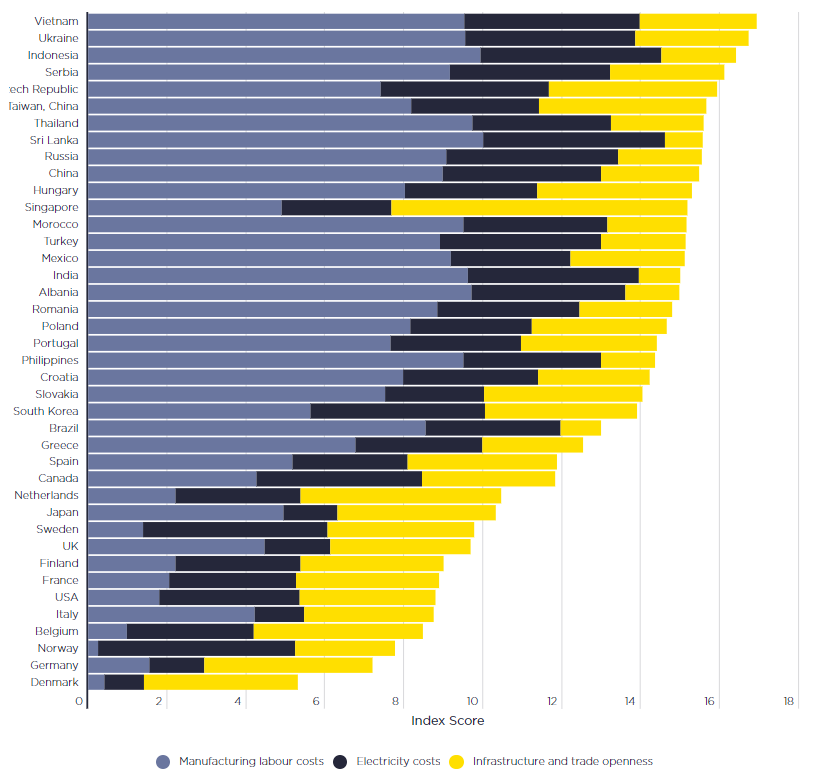
    It also needs to be stated that Brazil and other Lain American nearshore destinations have to date lagged behind other countries and regions. The Savills Nearshoring Index scores countries by the competitiveness of their manufacturing wages and electricity costs, along with their infrastructure and trade openness. Of a total of 40 destinations the most competitive tend to be Asian and European. Brazil comes in at 25th position, lagging behind the only other Latin American jurisdiction in the table, Mexico in 15th position.

    Savills Nearshoring Index
    Manufacturing nearshoring potential of countries that are, or are in close proximity to, major consumer markets

    Source: Savills Research

    Semi-conductors: an opportunity for Brazil nearshoring? There is reason to believe that amid increased super-power rivalry Brazil may be able to attract significant nearshoring investment in semi-conductors (also known as chips). The background is that the US wants to reduce its dependence on Asian chip manufacturers and resolve post-pandemic global chip shortages which have caused bottlenecks in automobile, mobile phone, and other IT device production. The CHIPS Act passed by the US Congress offers subsidies of up to US$39bn to local companies that increase their chip fabrication capacity. Similar legislation tabled in the European Parliament offers funding of up to EUR43bn (US$46.6bn). Parts of the manufacturing process could be conducted through investment in nearshoring fabrication plants. Chinese chip manufacturers on the other hand, are also interested in overseas chip production, and may be similarly prepared to invest.

    In early April 2023 the Brazilian government awarded a US$19m loan to HT Micron, a South Korea-owned chip manufacturer based in Rio Grande do Sul state, to help it develop a UFS-based multi-chip package (uMCP) and to phase out its embedded multichip package (eMCP). uMCPs are newer technology: they take up less space in smartphones and tablets and offer increased data transfer speeds.  HT Micron supplies chips to mobile phone, computer, and smart TV manufacturers, such as Samsung, Lenovo, and LG. Aloizio Mercadante, head of BNDES, the state-owned National Development Bank that provided the loan, said there could be investment opportunities in Brazil for “the encapsulation phase of microchips or in the manufacture of components that use semi-conductors for the automotive sector”. He also noted that during President Lula’s January visit to the White House, officials had said they were “intensively seeking” semi-conductor investment opportunities.

    As the largest economy in Latin America, with a well-developed auto industry, Brazil is potentially attractive to semi-conductor producers. However, the sheer cost of the latest technology chip fabrication plants (fabs) could be a disincentive. Intel expects its two new fabs in Arizona to require capital spending of around US$15bn each. The company, along with other western–aligned electronics manufacturers such as TSMC (Taiwan semi-conductor) and Samsung, would need convincing that Brazil could be a competitive location for nearshoring all or part of such a costly long-term investment.

    Industry analysts have expressed worries over poor infrastructure and political instability. The Brazilian Association of the Semiconductor Industry (ABISEMI) says that existing local chip manufacturers have annual sales of over US$700m with a third coming from the sale of memory boards. There are now around 14 local companies in the semi-conductor sector employing 2,500 people. Tax and other incentives introduced in the 1990s largely explain the growth in the local industry. Despite this, the country still imports around 90% of the chips it uses in cars, mobile phones, and other electronic devices. Existing plants in Brazil tend to be focused on low value-added activity within the chip industry.

    A study by consultancy KPMG said a major problem is the lack of skilled workers, which would require a decades-long training programme integrated with national universities. According to KPMG specialist Marcio Kanamuru, “We have something of a perfect storm of growing demand and the opportunity to reindustrialise the country in a relevant way, creating a pool of talent, demanding things in return with regard to sharing technology and knowledge. But we are seeing this train leave the station without taking any concrete measures.”   

    Despite Washington’s suggestion that Brazil-China collaboration in microelectronics would not be welcome, Brazilian officials have also considered looking at the alternative possibility of partnering with China to build local chip capacity. Beijing might be willing to offer a package deal including infrastructure development and generous financing support. However, China does not have access to the latest US technology, such as extreme ultraviolet (EUV) lithography and its immediate predecessors.

    Companies that try to supply the technology to China face the possibility of US sanctions. Under Lula the government has signalled that it will try to pursue economic self-interest and not ‘take sides’ in the US-China rivalry. The clearest statement of this position came from Lula’s top foreign policy adviser, Celso Amorim, who said “If the US wants to, they can propose bigger and better conditions [for a fab plant], and that’s it, we will choose theirs,” adding: “We have no preference for a Chinese semiconductor factory, but if they offer good conditions, I don’t see why we would refuse.” Brazil is already using 5G technology supplied by China’s Huawei. 

    EU Mercosur deal: first step to nearshoring? Almost 20 years of on-off negotiations on a free trade agreement (FTA) between Mercosur and the European Union culminated in mid-2019 when the two sides finally reached agreement on a single text. However, almost immediately the prospect of the deal being ratified by the national legislatures of the two trade blocks was put on hold. At the time Brazil was in the early stages of the far-right presidency of Jair Bolsonaro (2019-2023), and his climate-sceptic position, favouring uncontrolled economic development of the Amazon and rapid deforestation, went down badly in Europe, particularly with President Emmanuel Macron of France. The Brazilian president also made it known he favoured an FTA with the US over one with the EU (no significant progress was made on that front, in any case). France and other EU members in turn refused to ratify the Mercosur agreement until environmental protection guarantees were strengthened.

    Since Lula took office as president once again in January 2023, prospects that the EU-Mercosur agreement may finally come into law have improved. In April Márcio Elias, executive secretary for the ministry of development, industry, trade, and services, said that the Lula administration was seeking for the agreement to be fully ratified before the end of the year. He said that EU calls for stronger environmental and labour protections had been met. Lula has traditionally been critical of unrestricted globalisation, but he appears supportive of the FTA with the EU, casting it as an opportunity for Brazil to become a global leader in renewable energy and green hydrogen.

    Some EU members, such as Austria, remain opposed to ratifying the agreement. But the important point is that an FTA of this type can be seen as a necessary prior step to attracting a wave of nearshoring investments. Most importantly, the agreement provides a kind of road map for Brazil to gradually integrate with EU supply chains and become more internationally competitive. If eventually approved, the FTA will create a market of around 700m people, representing close to 25% of global GDP.

    At the heart of the FTA is a process of mutual tariff reductions affecting merchandise trade between the two blocks. Nearly 100% of bilaterally traded EU products and 90% of Mercosur products will come under the FTA. In 2021 Mercosur exported EUR32.9bn (US$36.1bn) of products to the EU, primarily agricultural and livestock but including some manufactures. It imported EUR33.9bn (US$37.7bn) worth of European goods, mainly manufactures and agri-food products. Under the terms of the agreement tariff reductions are to be phased in over 5 to 15 years. European exporters will benefit from reductions in existing Mercosur tariffs levied on cars (currently 35% ad valorem), machinery (14%-20%) chemicals (up to 18%), and pharmaceuticals (up to 14%). Mercosur tariffs on European-made chocolate, confectionery, wines, and cheese will also be slashed. Overall, it is calculated that EU exporters will save EUR4bn (US$4.4bn) in reduced tariff payments. Mercosur on the other hand, will benefit from the reduction over five years of EU tariffs levied on just over 80% of currently traded agricultural goods. Most of the remainder will come under a preferential quota system. Brazilian exporters of orange juice, instant coffee, sugar, poultry, and fruit will benefit. Brazilian beef exporters will get a 99,000-tonne annual quota on sales to the EU, on which a 7.5% tariff will be payable.  

    The FTA is primarily about merchandise trade. There are also various commitments to ease barriers to e-commerce and trade in services. Mercosur suppliers will be able to participate in EU public auctions and procurement processes. While the agreement provides a relatively long adjustment period, Brazilian industrialists remain concerned over increased competition from imports. The FTA offers a gradualist approach, but it will still be difficult for local industrialists to shake off a long history of protectionism. The government will also be under pressure to carry out tax and fiscal reforms that will reduce the ‘Brazil cost’ and allow companies to compete more effectively.

  • Nearshoring elsewhere in Latin America

    Patrick de Courcy 16 May 2023 Hits: 1954

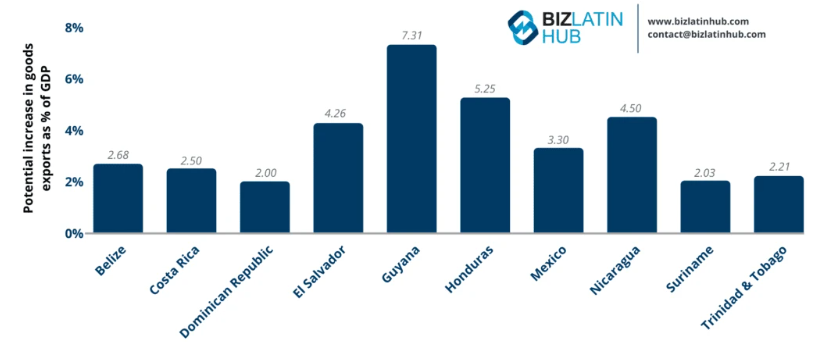
    While nearshoring will be a significant trend in Mexico and Brazil it will also be present to varying degrees in the rest of the region. It is worth noting that although some countries will be at the lower end of the ranking in terms potential gross nearshoring investment value, they are higher up when investment is expressed as a proportion of their GDP. In fact, the biggest potential beneficiaries from nearshoring relative to GDP include Guyana (benefits equivalent to 7.3% of GDP), Honduras (5.3%), Nicaragua (4.5%), and Mexico (3.3%). 

    Nearshoring in Latin America: biggest potential beneficiaries

    Source: IDB/World Bank

    Proximity to the home base will be one of many factors in play. Geographic proximity to the US will loom large for Mexico and Central American countries. But as we have seen, there are various other types of proximity. Brazil may be able to benefit from being closer to the European Union in terms of achieving a free trade agreement, giving it improved market access, and despite remaining physically in a different hemisphere and on the other side of the Atlantic Ocean. Other countries are looking at time-zone closeness along with knowledge of English as a business language or various other cultural factors. It is also worth noting that some companies are speaking of closeness in the form of ‘friend-shoring’, referring to national security considerations and shared rule-based democratic or liberal values. The concept is therefore likely to play out in different ways by country and by economic sector.

    In Argentina, Martin Rappallini of business lobby Unión Industrial Argentina (UIA) says that there are nearshoring opportunities in energy, minerals, agri-business, and IT sectors. Andy Vior of the Buenos Aires IT hub (PoloIT) says the country has a wealth of highly trained software engineers able to work remotely at highly competitive rates. Given widespread knowledge of English, Argentina also has hopes of attracting investments in call centres offering CRM (customer relations management) and BPO (business process outsourcing). It may help that the time zone difference between Buenos Aires and New York is only 1-2 hours.

    Other analysts are more cautious, pointing to the country’s high inflation rate and continuing policy uncertainty (politics remains highly polarised on left-right lines, with presidential elections due in October). Some analysts suggest that Argentina may in fact in some cases be relegated to a kind of second nearshoring tier, receiving inward foreign investment essentially because of its proximity to Brazil. In this perspective Argentina-based automobile plants or a recently launched assembly line making Whirlpool washing machines are primarily focused on serving the Brazilian market rather than the more distant US market. Trade specialist María Victoria Bruno says nearshoring will be led by Mexico and Central America where trade and regional value chains are ‘better oiled’. She fears that Argentina may lag behind, noting for example that neighbouring Chile has done much more to open up its economy to foreign investment.

    In Colombia, according to a report by newspaper La República, the country attracted 60 companies with total nearshoring investments of some US$1.07bn in 2020-2022. Among them were enterprises involved in agribusiness, chemical production, life sciences, and engineering. Also involved were call centres providing BPO services. In total, a further 105 companies told investment promotion agency ProColombia that they were actively considering nearshoring investments. “Colombia has stood out in the region for maintaining political stability and solid institutions. In addition, its strategic location in the middle of the Americas positions our country as the best point for the regional supply of goods and services throughout Latin America, offering companies competitive logistics,” Flavia Santoro, president of ProColombia, said.

    Colombia also benefits from a favourable location. It does not share a land border with the US as Mexico does, but it has multiple short daily flights into US cities, as well as major Atlantic and Pacific ports enabling it to act as a maritime cargo hub. While Colombia shares Mexico’s problem of high levels of violence and has experienced a decades-long guerrilla insurgency, it has maintained broadly market-friendly macro-economic stability, with the US State Department noting its legal and regulatory systems are “transparent and consistent with international norms” including “a comprehensive legal framework for business and foreign direct investment”.

    Less positive from Colombia’s point of view is that, like Brazil, it remains a largely inward-focused economy, with relatively less experience in aggressively expanding its external trade volumes. In fact, Colombian trade as a proportion of GDP is 41%, meaning it too is about half as open as the Mexican economy is. Professor Andrés Velasco, of the London School of Economics (LSE) and a former finance minister of Chile (2006-2010), told the Financial Times in a 2020 interview that the country “uniquely positioned to benefit from nearshoring in the Americas is Mexico. If you are making car parts in China, you can make them in Mexico instead. But it is difficult to go from zero to 20. Colombia is near zero right now in manufacturing.”

    In Central America Costa Rica seems particularly well positioned to benefit from the nearshoring trend. This is in part because it already has an open economy, with strong democratic traditions and a highly skilled labour force. Roughly 40% of Costa Rican exports of goods and 65% of exports of services go to the United States under preferential tariff arrangements. The country has also attracted investment in manufacturing and IT products and services designed for the US market. More than two decades ago, in 1997, US based Intel opened a local subsidiary to design, prototype, and test integrated circuits and related software, as well as providing back-office services to the rest of the global company, including in areas such as finance, human resources, procurement, and sales marketing support. More recently Boston Consulting Group (BCG) has opened an office in San José which will employ 400 staff remotely serving the consultancy’s US-based customers. Local staff will include IT professionals and data scientists.

    In 2021 Azofras, an agency that represents Costa Rica’s free trade zones, said it was aware of 103 nearshoring projects underway. Roughly a third of them were led by companies new to the country. Local economists say the process accelerated due to the combined impact of US-China trade tensions in 2018-2019 and the Covid-19 pandemic in 2020-2021. Investments have gone into sectors such as textiles and medical devices, led by companies seeking to service their US, but also European and Asian home markets. The country’s free trade zones, which offer tax breaks to companies that set up operations within them, are also seen as helping develop the nearshoring wave.  Another plus factor has been the trained work force. Federico Campos, a consultant for Deloitte says: “The country’s human capital is one of its great competitive advantages, since for many years bilingual personnel have been trained in the four basic areas: science, mathematics, engineering, and technology.”

    Other Central American and Caribbean countries located near to the US are also poised to benefit from increased nearshoring. The wealthier and more stable include Panama and the Dominican Republic. The so-called Northern triangle republics (El Salvador, Honduras, and Guatemala) are on the other hand somewhat handicapped by political instability, crime, and corruption, but the current US administration is eager to support their economies and raise living standards not least as a way of diminishing undocumented migration back into the US itself. These countries have attracted investment in textile and finished garment industries, and in automobile components such as electric wiring harnesses. Overall, in the northern triangle nearshoring is seen as a potential solution to problems of inequality, poverty, violence, and emigration. There is however something of a chicken and egg situation, since those same problems can also act as disincentives to new inward investment flows.