All Categories

Subcategories

  • TRACKING TRENDS

    Abbi Dicker 05 March 2026 Hits: 1009

    BRAZIL | Primary surplus down in January. Brazil’s central bank (BCB) reported on 27 February that the public sector posted a primary surplus of R$103.7bn (US$19.9bn) in January 2026. This marks a decrease from the monthly surplus of R$104.1bn registered in the same month last year.

    In January this year, the central government registered a primary surplus of R$87.3bn and the surplus of regional governments totalled R$21.3bn, while state-owned companies posted a monthly deficit of R$4.9bn.

    The annual public sector deficit in the 12 months through January 2026 totalled R$55.4bn (0.43% of GDP). The nominal result of the public sector, which includes the primary result and debt interest payments, showed a surplus of R$40.1bn in January. The annual nominal deficit reached R$1.09tn (8.49% of GDP), up from the annual deficit of R$1.06tn (8.34% of GDP) registered for 2025.

    BRAZIL | Tax-take up in yearly terms. The Receita Federal do Brasil (RFB), the federal tax authority, released new figures on 24 February showing that the government’s tax revenue in January totalled R$325.75bn (US$63.26bn). This monthly result marks a year-on-year increase of 8.16% in nominal terms compared with the tax-take of R$301.16bn registered for January last year, and a 3.56% increase in real terms.

    The RFB has highlighted significant increases in revenue from federal levies such as the taxes on financial operations (IOF), a tax on various types of transactions, including credit, insurance, and foreign exchange. Monthly IOF revenue in January totalled R$8.0bn, up 49.05% year-on-year. 

    BRAZIL | Slower growth for 2025. The national statistics institute (Ibge) reported on 3 March that Brazil’s annual growth rate for 2025 was 2.3%, which is down from the 3.4% growth registered for 2024. The 2025 result is also Brazil’s lowest annual growth figure in the past five years. Regarding the sector breakdown, agriculture posted a significant annual growth rate of 11.7%, while industry registered 1.4% and the services sector grew by 1.8%.

    Economic growth in 2025 was impacted by a variety of factors, but the main issue highlighted by analysts cited in the media is the country’s high interest rates, with the benchmark interest rate (Selic) set at 15.0%, although the central bank (BCB) is expected to reduce the rate in its next meeting which will run from 17-18 March.

    BRAZIL | Mid-month inflation accelerates in monthly terms. The national statistics institute (Ibge) released new figures on 27 February for its mid-month consumer price index (Ipca-15), which showed a monthly inflation rate of 0.84% in mid-February, while annual inflation stood at 4.1%.

    Compared with the figures for mid-January, the latest monthly results show an acceleration from the monthly inflation rate of 0.2% but a slowdown compared with the annual inflation rate of 4.5% registered for the 12 months through mid-January.

    Slow growth outlook

    The GDP growth rate for 2026 is expected to be even lower than the 2.3% growth registered for 2025. On 2 March the central bank (BCB) released the latest edition of its Focus bulletin, a weekly survey containing the projections of private sector economists, which showed a growth forecast of 1.82% for this year. The bulletin also showed an annual inflation forecast of 3.91%.

  • REGION: Two or even three-speed growth expected

    Patrick de Courcy 17 September 2026 Hits: 71

    The United Nations Economic Commission for Latin America and the Caribbean (Eclac) and the World Bank have underlined the different rates of growth between those Caribbean countries exporting energy and those bringing in tourists.

    In its annual survey of Latin America and the Caribbean (LAC), which was released on 20 August, Eclac predicts a modest overall performance for LAC, with growth of 2.2% in 2026 and 2.5% in 2027. If these numbers are correct, the region will have averaged 2.3% growth per year over the last five years, not enough for a sustainable increase in per capita income, the closing of development gaps, or the expansion of policy spaces. While global headwinds have been at work this year, Eclac highlights ongoing structural factors, such as low levels of investment and high and persistent labour informality.

    According to the survey, there has been “marked heterogeneity” at the sub-regional level. Growth in Central America this year will be only 1.6% (dragged down by the economic and energy crises in Cuba and Haiti, which Eclac includes). Growth in the Caribbean, on the other hand, looks much more impressive at 5.6% in 2026 and 7.9% in 2027. However, that is largely due to Guyana’s oil boom. If Guyana is taken out of the picture, average GDP growth in the Caribbean comes out at 1.1% in 2026 and 2.2% in 2027. Eclac points out that high levels of debt, a worry for all of Latin America, are particularly pronounced in the Caribbean, where the average debt-to-GDP ratio stands at 73%.

    In its latest post on its Caribbean webpage, the World Bank talks of an “increasing divergence” between “resource-rich producers” and “tourism-dependent economies”. It adds that the latter are experiencing moderate growth due to high import and energy costs. The discussion around a two-speed Caribbean is not new. Some economists have even spoken of three speeds: one, the oil exporters like Guyana and Suriname; two, the large, diversified tourism economies like the Dominican Republic; and three, the small tourism-dependent economies like St Lucia or Dominica.

    The World Bank also speaks of underlying structural challenges. Growth has been slow and public debt remains high, although it forecasts Caribbean GDP growth of 4.4% in 2026 and 7.3% in 2027. Natural disasters are frequent and capable of erasing an entire year of economic output, and electricity costs are the highest in the region due to dependence on imported oil. To tackle these problems, the World Bank recommends policies to promote private-sector investment and jobs. Job creation, the World Bank says, should focus on sectors such as tourism, agriculture, and the creative industries. Disaster resilience should also be strengthened.

    El Niño weather pattern already affecting the Caribbean

    According to the World Meteorological Organisation (WMO), there will be drier-than-normal conditions this year and into next. The weather will be hotter, increasing the risk of drought and wildfires. Interestingly, this El Niño cycle may reduce hurricane risk due to increased vertical wind shear over the tropical Atlantic.

    The overall El Niño impact on tourism will likely be mixed. If there are fewer hurricanes, that will be positive for airlines, hotels, and tour operators. On the other hand, increased drought and wildfires may cause water shortages and put pressure on infrastructure, creating particular difficulties for the smaller islands with limited access to freshwater.

  • Costa Rica and Nicaragua in road rage

    LatinNews 12 December 2011 Hits: 4200

    Development: On 11 December the Nicaraguan government led by President Daniel Ortega submitted a letter of complaint to Costa Rica about a road construction project near their common border.

    Significance: Nicaragua reminded Costa Rica that it had committed to share the results of an environmental impact assessment (EIA) for the road project. The border row that began in October 2010 when Costa Rica accused Nicaragua of violating its sovereignty by invading Calero Island has been reignited by Costa Rica’s decision to build a 120km road running parallel to the San Juan River. Nicaragua denounced the road as “a crime against nature” and called for bilateral talks on the margins of the 38th presidential summit of the Central American Integration System (Sica) in El Salvador on Friday (16 December).

    Costa Rica’s foreign minister, Enrique Castillo, responded that the project is based on a “sovereign decision”, adding that Nicaragua should “withdraw the Sandinista youths from Calero Island”.

    Key points:

    • The  road will cost ¢7bn (US$13.89m) and will run parallel to the San Juan River, on Costa Rican territory, in order to join border towns in the cantons of Los Chiles, San Carlos and Sarapiquí. These communities have never been connected to each other by land; instead, its inhabitants were forced to navigate on the San Juan River – which belongs to Nicaragua, but to which Costa Rica has navigation rights.

    • Nicaragua wants Costa Rica to shares the EIA results. Costa Rica argues that Nicaragua should be the one disclosing its findings on the alleged environmental damages being caused by the construction works.

    • Nicaragua has also sent letters explaining its position to several international organisations including: the Central American environmental and development commission (CCAD); Sica; the United Nations Environment Programme (Unep); and the United Nations Educational, Scientific and Cultural Organization (Unesco).

  • RASTREANDO TENDENCIAS

    LatinNews 13 February 2012 Hits: 793

    MEXICO | Ex gobernadores de Tamaulipas. El 5 de febrero, Enrique Peña Nieto, el candidato presidencial del Partido Revolucionario Institucional (PRI), asumió la gran apuesta política de defender a los tres ex gobernadores de Tamaulipas del PRI bajo investigación por el gobierno federal por supuestos vínculos con gangsters [IL-12-05]. Peña Nieto ha desafiado al gobierno federal que produzca la evidencia que posee para sus investigaciones o que se calle.

    MEXICO | PRD. La alianza de izquierda, Movimiento Progresista, liderada por el Partido de la Revolución Democrática (PRD) ha encontrado grandes problemas en su intento por imponer a María Elena Orantes, desertora del Partido Revolucionario Institucional (PRI) como su candidata para la gobernación de Chiapas. Yassir Vázquez, quien esperaba la nominación hasta la deserción de Orantes del PRI, que a su vez fue provocada por su descontento ante la alianza del PRI con el Partido Nueva Alianza, se ha retirado de las negociaciones para llegar a una solución.

  • POINTERS

    LatinNews 06 August 2012 Hits: 1905

    MEXICO | ‘Commando raid’ in Michoacán. Late-July headlines drew attention to an unprecedented large-scale ‘commando attack’ on a town in Michoacán, which prompted a substantial mobilisation of security forces across the surrounding area. Beyond the headlines, though, little is certain about the episode and what it might mean for the broader pattern of violence.

    On 21 July a large group of gunmen staged an attack on the town of Vista Hermosa, first firing with assault rifles on a service station, then on the town hall. In the latter, the director of the municipal police, José Luis Flores Martínez, was shot dead, as was a passerby. They later shot up and torched a police vehicle and a private car. Upon hearing of the raid, several police units from La Barca, in the contiguous state of Jalisco, crossed the boundary to confront the attackers. Three of them were killed.

    Eyewitness accounts have put the number of attackers between 50 and 80. The state and municipal authorities have been vague about this, saying that the only hard evidence they have is a large number of bullet casings. Officials and media have speculated that the attack may have been connected with the arrest, days earlier, of Juan García García (‘el R’), presented alternatively as the leader of ‘a criminal gang’ or the jefe de plaza (marketplace boss) in the localities of La Piedad and Yurécuaro. His gang has also been linked alternatively with two Drug Trafficking Organisations (DTOs), La Familia and Jalisco-Nueva Generación.

    No explanation has been offered as to why Vista Hermosa should have been targeted. One police source noted that, apart from the reported large numbers of gunmen involved, the attack had all the characteristics of a intimidatory drive-by shooting rather than a planned ‘hit’ on specific human targets: the fatalities appear to have been accidental.

    MEXICO | Car bombs. Two earlier incidents, both in Tamaulipas, involving explosive devices placed in parked cars, also attracted headlines without throwing any light on their significance. The first, on 30 June, was detonated in front of the town hall in Nuevo Laredo; seven civilians were injured, 11 cars destroyed and considerable structural damage was caused. The second, on 3 July, was set off in front of the home of Tamaulipas’s state secretary of public security, Rafael Lomeli Martínez, in the country residential area of Fraccionamiento Campestre in Valle Hermoso; two police officers on guard duty were killed, four others injured. No criminal group claimed responsibility for either attack; the police are hoping to identify the attackers from the ‘signature’ of the explosive devices used.

    MEXICO-US | More drones to detect drug shipments by sea. Following a series of media reports in late June, the US Department of Homeland Security (DHS) confirmed in mid-July that it is using unmanned aircraft (UAVs) to search for shipments of drugs in Caribbean waters in the hope of improving interception rates. The UAVs employed, known as the Guardians (a maritime version of the Predators already being used by the DHS along and across the Mexican border), can stay aloft for longer that the 10 hours maximum of the radar-equipped P-3 fixed-wing aircraft. This can almost double the present area of coverage to 2,000km, allowing surveillance of an area that covers the Bahamas, the Dominican Republic, Puerto Rico, other Caribbean islands and international waters in the Gulf of Mexico. As with the land border, the Mexicans may allow coverage of Mexican waters as well.

    The Guardians are equipped with search radar and an electro-optical/infrared sensor. The latter will help track the go-fast boats that usually travel at night, and the combination of equipment is expected to improve the tracking of semi-submersibles. Since 2011 the interception rate of reported semi-submersibles has been of only 21%.

  • TRINIDAD Y TOBAGO: Renuncia el ministro de seguridad

    LatinNews 29 April 2013 Hits: 743

    El controversial ministro de seguridad de Trinidad y Tobago, Jack Warner, finalmente ha renunciado a la luz de un informe condenatorio difundido el 19 de abril por la Confederación de Norte, Centroamérica y el Caribe de Asociaciones de Fútbol (Concacaf) –que él encabezó entre 1990 y el 2011.

    El informe del comité de integridad de la Concacaf halló que Warner había cometido fraude contra la Concacaf y el cuerpo que gobierna el fútbol mundial, Fifa (donde él también sirvió como vicepresidente); cometió fraude y malversó fondos de la Federación de Fútbol de Australia (FFA); infringió sus deberes fiduciarios ante Concacaf; violó los estatutos de Concacaf; y violó el código de ética de la Fifa.

    Las dudas relacionadas con las supuestas prácticas corruptas de Warner se remontan hasta antes de que fuera designado al gobierno de coalición del People’s Partnership (PP), que asumió el poder en mayo del 2010, por la Primera Ministra Kamla Persad-Bissessar. Warner ha estado en el cargo desde junio del 2012 habiendo sido promovido del ministerio de obras públicas.

    Warner alcanzó notoriedad en el 2011 cuando fue forzado a renunciar de Concacaf, Fifa, y la Caribbean Football Union (CFU) (donde él también sirvió como presidente por muchos años) debido a uno de los escándalos mencionados en el último informe –alegatos que Mohamed bin Hammam, anteriormente presidente de la Confederación Asiática de Fútbol, había intentado sobornar a funcionarios durante la campaña de Hammam por la presidencia de Fifa en el 2011, y que Warner fue un “cómplice” en esta corrupción.

    Luego del escándalo, Warner retuvo su posición como titular de obras publicas & infraestructuras, pero fue forzado a dimitir de su otra cartera, de transporte. Pese al escándalo él ha permanecido altamente popular dentro del United National Congress (UNC), el partido más grande en la coalición gobernante que lo reeligió como su presidente el pasado marzo.

    Desde entonces, Warner ha sido reemplazado por el ministro de obras publicas & infraestructuras, Emmanuel George, cuya cartera ha sido tomada por el ministro de gobierno local, Suruj Rambachan.

  • Risk pointers

    LatinNews 13 February 2014 Hits: 414

    *** Netanyahu to Latin America.  Israel’s Prime Minister Binyamin Netanyahu is planning to visit Mexico and Colombia in April, in a rare Israeli excursion into Latin America.  This will follow on from a visit next week to Jerusalem by Peru’s President Humala.

    Israel appears particularly interested in boosting economic ties with the Pacific Alliance which links Colombia, Mexico, Peru, and Chile.  But there is also a political/security dimension.  As the Jerusalem Post put it this week: “The Pacific Alliance countries are important as a wedge in Latin America against Iranian influence.”  In December, Israel’s Defence Minister Moshe Yaalon warned about Iranian terrorist bases in Cuba, Venezuela, Nicaragua, and Bolivia.

    *** Support for UKIP slipping.  With European Union parliamentary elections due in May, concerns that the anti-EU UK Independence Party (UKIP) might push the ruling Conservative Party into third place are receding slightly.  An opinion poll carried out between 7-9 February showed UKIP on 20% (up from 16.5% in 2009), with the Labour Party on 35% and the Conservatives on 25%.

    If this weakening of support for UKIP is confirmed, there will be relief in Brussels, as well as at Conservative Party headquarters.  But this trend, if confirmed, will also be important for the Scotland independence referendum in September.  Scotland, generally, is more pro-EU than England, and a surge of English support for UKIP in the May EU elections would only help the Scottish Nationalists.  It is important to note that UKIP is really a misnomer – the party is really the English National party.

    *** Greek opposition gaining ground.  The Greek opposition party SYRIZA (Coalition of the Radical Left) is now ahead of the ruling New Democracy (ND) party according to an opinion poll conducted from 6-10 February.  The latest GPO poll shows SYRIZA with 21.4% support, ND on 20.2%, the ultra-right Golden Dawn on 7.2%, the Greek Communist Party on 6.1%, the former ruling Panhellenic Socialist Movement (Pasok) on 5.6%, Independent Greeks on 4.4%, and the Democratic left on 3.8%.

    However, in answer to the question on who would be the best prime minister, current ND prime minister Antonis Samaras comes out on top with 42.8% support, followed by SYRIZA leader Alexis Tsipras on 30%.  Some 26% answered “none of the above”.

  • Pointers

    LatinNews 23 February 2015 Hits: 2315

    - Peru’s recently replaced interior minister, Daniel Urresti, has registered as a member of the ruling left-wing Partido Nacionalista Peruano, having been tipped as a possible presidential candidate in 2016.

    - Colombia has delayed US$2.4bn in planned budget expenditure, amounting to 3% of the 2015 national budget, on lower forecast oil revenues.

  • TRACKING TRENDS

    LatinNews 12 March 2015 Hits: 1222

    MEXICO | Inflation rate hits eight-year low. Mexico registered the lowest rate of inflation since May 2006 last February. According to the national statistics institute (Inegi), year-on-year inflation in February was 3%, much lower than the 4.23% recorded in February 2014. The inflation rate was 3.07% in January, and happens to be bang on the central bank (Banxico)’s official target.

    In its monthly report Inegi said that the consumer price index had risen by 0.19% in February, primarily due to a rise in prices related to mobile phones and various foodstuffs, such as beef and potatoes. Inegi estimates that the underlying rate of inflation, which does not take into account the price of highly volatile goods, currently stands at just 0.34%. The increase in the underlying inflation rate was driven by a 0.59% jump in the prices of non-foodstuffs, which reflect the inflationary pressures resulting from the depreciation of the Peso.

    The Peso has so far depreciated by 4.8% against the US dollar this year, but this has not yet translated into an inflationary risk. Indeed, Inegi’s results show that the annual rate of underlying inflation stood at 2.40% in February, slightly up month-on-month but still lower than the 2.98% recorded in February 2014.

    MEXICO | Foreign investment. On 10 March the Dutch brewer, Heineken International, announced plans to invest US$474m in a new plant in the state of Chihuahua. The plant, which is slated to produce 5m hectolitres of beer a year, will be Heineken’s seventh in Mexico. Construction of the plant will create 2,000 temporary jobs and, once it is completed, it will provide 500 permanent jobs.

    Heineken’s announcement came hot on the heels of another major investment by a multinational firm. On 6 March the German car manufacturer, Volkswagen, announced investment of US$1bn to upgrade its vehicle manufacturing plant in Puebla state. The upgrade will allow the plant to start producing the new Tiguan sport utility vehicle. It will create 19,000 new jobs.

    “More and more global companies are deciding to invest in our country,” President Enrique Peña Nieto said at an event at the presidential residence, Los Pinos. “We want investments like these to keep happening in Mexico”.

    • Profepa fines Grupo México

    On 2 March Mexico’s federal environmental agency (Profepa) announced that the local mining firm, Buenavista del Cobre, would have to pay M$23m (US$1.5m) in fines for the environmental damage that the mine waste spill at its copper mine near Cananea in Sonora state produced on the Sonora and Bacanuchi rivers in August last year. The spill at the Buenavista del Cobre mine contaminated local drinking water supplies, putting thousands of people in Sonora at risk, and was adjudged the worst environmental accident in Mexico’s mining sector in decades. In a statement Profeco said that it had found 55 irregularities at the mine and that fines were independent from the M$2bn trust fund that the firm has set up to pay for the clean-up costs.

  • BOLIVIA: Morales va en busca de inversiones

    LatinNews 06 November 2015 Hits: 234

    El Presidente de Bolivia, Evo Morales, encabezó la semana pasada una delegación de alto nivel que viajó a EU como parte de esfuerzos por atraer la inversión extranjera. Mientras que los últimos pronósticos sugieren que Bolivia está en curso de lograr una de las más altas tasas de crecimiento económico en la región, la búsqueda de inversión del gobierno boliviano se produce en medio de más evidencia del impacto que producido en la economía boliviana la caída de los precios internacionales de las materias primas (de las que Bolivia es altamente dependiente, en particular los hidrocarburos y los minerales); las exportaciones han caído por más del 30% en los primeros nueve meses del 2015, comparado con el mismo periodo del año anterior.

    Junto con sus ministros de economía (Luis Arce) y de planeamiento (René Orellana), el Presidente Morales habló el 26 de octubre en un evento organizado por el Financial Times, al que asistieron 130 altos representantes empresariales. Los tres se apresuraron en pregonar los positivos pronósticos de crecimiento para Bolivia; la Comisión Económica para América Latina y El Caribe (Cepal) de la ONU, por ejemplo, espera que el PIB de Bolivia crecerá un 4,4% este año –bien por encima de la contracción del 0,3% pronosticada para América Latina en su conjunto. Los representantes del gobierno del Movimiento al Socialismo (MAS) también pudieron señalar a la última evaluación (del 15 de octubre) de la agencia internacional de rating de créditos, Moody´s, la cual reafirmó que el rating de los bonos soberanos de Bolivia en ‘Ba3’, reflejaba “un fuerte crecimiento económico que es conducido por la alta inversión del sector público, las prudentes políticas económicas, y un significativo amortiguador en sus reservas externas”. Moody’s señaló que “los amortiguadores fiscales y externos deberían permitir a Bolivia manejar la caída en los precios de la energía desde una posición de relativa fortaleza. El nivel de la deuda pública es bajo con relación a sus pares [de la región] y su asequibilidad es alta”.

    Sin embargo, estos positivos pronósticos se producen a pesar de que las últimas cifras del Instituto Nacional de Estadísticas (INE) de Bolivia muestran que las exportaciones del país en los primeros nueve meses del 2015 llegaron a US$6,9mm, cayendo de US$10,1mm durante el mismo periodo del año pasado. Los hidrocarburos (que representan el 45,8% de las exportaciones de Bolivia), alcanzaron los US$3,1mm, cayendo de los US$5,2mm registrados en el mismo periodo del 2014, mientras que los minerales (que representan el 19,1% de las exportaciones de Bolivia) llegaron a US$1,3mm, cayendo de US$1,5mm el año pasado.

    Energía nuclear

    El Presidente Evo Morales anunció el 29 de octubre planes para construir un complejo de energía nuclear de US$300m, incluyendo un reactor de investigación, con tecnología rusa y con ayuda de Argentina. Morales le dijo a los periodistas que el proyecto, cuya construcción se espera que tome cuatro años, y que estará localizado en El Alto, departamento de La Paz, consiste en tres componentes: un ciclotrón para investigaciones radio-farmacéuticas; una planta de irradiación gamma; y un reactor de investigación.

    El anuncio del proyecto, que es parte de los esfuerzos del gobierno del Movimiento al Socialismo (MAS) para diversificar la producción de energía, relacionado con el plan nacional a largo plazo para el 2025, vino después de la firma de un Memorándum de Entendimiento (MDE) entre el ministro de hidrocarburos & energía de Bolivia, Luis Alberto Sánchez, y Sergei Kirienko, el director general de la corporación de energía atómica estatal de Rusia (Rosatom) (ver abajo).

    El Presidente Morales había sugerido en octubre del 2013 que Bolivia tenía planes para desarrollar la energía atómica en cooperación con Argentina y Francia, aunque no proveyó más detalles específicos. El año anterior, think-tanks locales como el Programa de Investigación Estratégica en Bolivia (Pieb) citaron a expertos locales como confirmando la existencia de reservas de uranio en dos regiones de Bolivia –en el área montañosa de la Cordillera Los Frailes (entre los departamentos de Oruro y Potosí) y en el departamento de Santa Cruz. El informe del Pieb citó al experto boliviano, Marco Montoya, como afirmando que existen al menos 140.000 toneladas (t) de uranio en la Cordillera Los Frailes, pero no especificó una cifra para Santa Cruz.

    • Memorándum de Entendimiento con Rusia

    De acuerdo con un comunicado de prensa difundido por Rosatom de Rusia, el Memorando de Entendimiento (MDE) con Bolivia, incluye (entre otras cosas): “el uso de radio-isótopos y tecnologías de radiación y su aplicación en la industria, medicina, agricultura y otros campos; proveyendo entrenamiento y educación al personal en varios campos de uso pacífico de la energía nuclear; asistencia en la creación y desarrollo de infraestructura para la administración y regulación del programa nuclear de Bolivia; la potencial construcción de un centro de ciencia y tecnología nuclear con la necesaria infraestructura para el uso en la ciencia, medicina, industria y agricultura sobre la base del reactor de investigación, ciclotrón, la instalación de radiación gamma, un complejo de laboratorios nucleares, la radiación y la seguridad física; la celebración de consultas sobre la posibilidad de la construcción de centrales nucleares de diseño ruso en Bolivia”.


  • EL SALVADOR: Key pension reform gets green light

    LatinNews 11 October 2017 Hits: 214

    It was a sign of the significance that the government led by President Salvador Sánchez Cerén attaches to pension reform that when an associated bill finally passed through the legislative assembly with cross-party support in late September, after 18 months of paralysis, the finance minister, Carlos Cáceres, embraced deputies from all the different parties to express his gratitude and praised “everyone [for] reaching an agreement [with which] the public is the winner”.

    “The reform to the pension system is not perfect,” President Sánchez Cerén said, while wasting no time at all in promulgating the law, but he thanked the legislative assembly for taking “an important step towards an integral reform”. The ruling left-wing Frente Farabundo Martí para la Liberación Nacional (FMLN) was rather less impressed, interpreting the eventual cross-party accord as less a consensual accord than it was having to cede to the proposal of the right-wing Alianza Republicana Nacionalista (Arena), Gran Alianza por la Unidad Nacional (Gana), Partido de Concertación Nacional (PCN), and Partido Demócrata Cristiano (PDC), which in turn was based on the proposal of the association of private pension fund providers (Asafondos).

    The archbishop of San Salvador, José Luis Escobar Alas, expressed his own reservations about the pension reform. Alas said the reform failed to “benefit workers” who will henceforth have to contribute 15% of their salary, up from 13% currently, to pension fund providers (AFPs).

    For Sánchez Cerén and Cáceres the most important thing to come out of the reform was more time. The agreed restructuring will grant the government more time to repay US$91m owed to the AFPs, extending the terms of sovereign coupons from 25 to 30 years, and avoid a damaging default. The government’s obligations to AFPs total some US$5.7bn, which equates to around 14% of GDP. The rating agency Standard & Poor’s reacted to the reform on 3 October by reversing El Salvador’s sovereign credit rating from ‘SD’, or selective default, to ‘CCC+’.

    Under the pension reform, 8.1% of the 15% contribution will go into individual savings accounts, which are administered by the AFPs; and 5% will go into a collective fund, or so-called ‘solidarity guarantee account’ (1% of this will serve to cancel retirement pensions in the public system, abandoned in 1998, held by more than 160,000 people) which will guarantee a lifetime pension to workers. Upon retirement, pensioners will see their individual savings divided into 20 years. Should they live beyond this they will continue to receive a pension through the collective fund. Retirement age stays at 55 for women and 60 for men.

    The remaining 1.9% of contributions will go towards the administration of the pension funds by the AFPs. This is down from 2.2% but Alas was not alone in saying that the pension reform should have squeezed this figure down further. Because of the contributions they will have to make to the ‘solidarity guarantee account’, workers will see the contributions going into their individual savings account falling from 10.8% to 8.1%. Alas called for political parties to “reconsider”, and cut AFP commissions instead. Having struggled for 18 months to stitch together an accord which all parties were prepared, however grudgingly, to approve, his words are likely to fall on deaf ears though.

    • Homicides up

    El Salvador recorded its two most violent days of the year on 23 and 27 September with 40 and 34 homicides respectively. Indeed, the daily average of homicides since 21 September has jumped to over 28, which is triple the average for the rest of the year up until that point. The government and the national police force (PNC) attributed the increase to inter-gang violence and score-settling, although the majority of those killed were not members of mara gangs.

  • Region: Latin American Women stand up for their rights – and security

    LatinNews 27 March 2018 Hits: 1105

    Millions of Latin Americans marched for International Women’s Day on 8 March. The protests took on a new urgency this year, in light of global anti-harassment campaigns such as #MeToo and #TimesUp. Aside from sexual discrimination, gender-based violence remains a pressing security concern across Latin America, which still has some way to go in combatting high rates of femicides.

    International Women’s day is a global initiative backed by United Nations’ Women. It is intended to celebrate women’s economic, political and social achievements. But it also serves as a painful reminder of the challenges many women still face before full gender parity can be achieved.

    The challenges faced by Latin American women vary greatly across the region. But some common trends: are inequality and gender-based discrimination in the workplace despite improvements to the education system; and high rates of pregnancy and violence holding women back.

    Although girls stay in school for longer, many of those who enter the workplace find their academic achievements are not always valued. In Latin America, labour participation is still just 51% according to a report published by the World Bank for International Women’s Day. Moreover, women are more likely to work in the informal sector than their male counterparts, meaning their jobs are not necessarily stable.

    Childbirth is another factor which can hold back a woman’s career, particularly for teenage mothers. The Latin American region has some of the highest pregnancy rates for women aged between 15 and 19 below Sub-Saharan Africa, according to the World Bank. Giving birth so young can make women more dependent on their partners if they are forced to drop out of school, increasing the risk of poverty.

    But by far the most troubling statistic relates to gender-based violence. According to UN Women, 14 of the 25 countries with the highest femicide rates are in Latin America and an estimated one in every three women over the age of 15 has experienced some form of sexual abuse.

    For all these reasons and more, Latin American women had plenty of reasons to protest on International Women’s Day. We take a look at the biggest regional protests and what changes women, legislators, politicians, and civil society groups are pushing for.

    In Argentina, millions of women ditched their day jobs and refused to do chores to draw attention to their value both at work and in the home. Instead, they marched as part of the global #8M movement (after the date, 8 March). Protests were highly politicised, with some demonstrators campaigning in favour of a bill to decriminalise abortion in the first 14 weeks of pregnancy, which is currently pending in congress. Currently it is only legal in cases of rape or if the mother’s life is in danger. Pro-choice campaigners argue that although abortion is not ideal, investing more in sex education and contraceptives could be a more effective way to prevent against unwanted pregnancies. Another main theme of this year’s protests was the #NiUnaMenos march. Described by organisers as a “collective cry against machista violence”, it aims to reduce impunity against femicide.

    In Brazil, women’s protests took place in over 50 cities. Some of the biggest were held in the southern city of São Paulo, where women with slogans reading “women without fear of fighting” campaigned against femicides, machismo, and the current government led by President Michel Temer, who is notorious for his gauche comments about women. After last year complementing women for their economic skills because they were able to “compare prices at the supermarket”, this year, he once again missed the point of International Women’s Day by praising his much-young wife Marcela in what he called a “homage to all Brazilian women”.

    Meanwhile, in congress, female legislators pushed through a series of measures to improve gender rights for International Women’s Day. These included proposals to combat violence against women by increasing the penalties for rape, punishing sexual harassment on public transport, and incentivising women to stay in school for longer, among others. Currently, only 11% of legislators are women, even though 52% of the Brazilians are female, meaning women’s issues tend to take a backseat on the other 364 days of the year.

    In Chile, one of Latin America’s most developed economies, the focus was more on closing the gender pay gap, getting more women into management, and combatting discrimination against those who take maternity leave.

    Former president Michelle Bachelet took part and gave a speech to celebrate women’s achievements alongside transsexual actress Daniela Vega, who starred in Chilean film ‘Fantastic Woman’, which recently won an Oscar for the best foreign-language film.

    Bachelet made the most of the opportunity to outline her government’s achievements in improving gender equality, including: the creation of a ministry for women and gender equality, a National Plan to Combat Gender-Based violence, an increase in women on leadership committees in state-owned companies from 5.3% to 42% during her term in office, and the decriminalisation of abortion.

    However, she made it clear the fight is not over. “My message today is that we cannot take a step back, we have to keep fighting,” she said. She described gender-based violence as a widespread problem which “is generalised and knows no borders…which is why people are saying they have had enough”.

    She called on all governments and members of the international community to keep fighting so that violence against women stops being “generalised” and starts being “unacceptable”. Without equal rights for men and women, “there can be no peace or progress”, she concluded.

    In Colombia, women’s protests were backed by the main unions including the Confederación de Trabajadores de Colombia (CTC), Central Unitaria de Trabajadores de Colombia (CUT), and Confederación General de Trabajadores (CGT).

    Among the more unusual demonstrations, feminists in Colombia’s third-largest city, Cali, campaigned for the more stringent plastic surgery regulations, to put dodgy practitioners out of business. Botched operations can become major health risks. Young women with low self-esteem are especially susceptible to undergoing treatment without first fully investigating the qualifications of a medical professional.

    Ecuador’s president Lenín Moreno launched the ‘sé tú sin violencia’ initiative to raise awareness about different types of gender-based violence and try to lift the lid on a taboo topics like domestic abuse. During the launch event, justice minister Rosana Alvarado pointed out that one in four women are the victims of sexual violence. This places the emphasis on women’s security in private settings like the home – not just in the public sphere.

    In Guatemala, around 100 people marched from Sumpango town in the Guatemalan department of Sacatepéquez to the capital, Guatemala City, to commemorate the 41 girls who died during a fire at a shelter run by the social welfare ministry on 8 March 2017. An investigation into the tragedy by the Guatemalan Human Rights Ombudsman’s Office found a pattern of human rights violations at the institution including physical abuse and the possibility of a child sex trafficking network.

    In Honduras, women affiliated with the #NosotrosParamos movement stood up for women’s freedom and right to live. Hundreds protested for justice following the violent assassination of indigenous rights activist Berta Cárceres, who was killed two years ago. She led an environmental campaign against a project to build a hydro-electric dam in the Gualcarque River belonging to the Lenca indigenous group in the department of Santa Barbara. However, Cárceres’ murder on 2 March 2016 shocked the country. It followed a series of intimidation attempts including sexual harassment and false criminal charges. This month, a ninth person was arrested in connection with her murder.

    Mexico is another country where machista violence poses a major security threat. In Mexico City, thousands of women gathered under the Angel of Independence statue in the Paseo de Reforma to denounce “institutional discrimination against women” and “government inaction to prevent femicides”.

    Activist Maria Salguero, who has created an online map to track femicides across the country, claims that in Mexico City’s justice system under-reports such cases by willingly misclassifying femicides in other categories such as suicide. According to federal deputy Beatriz Rojas, 576 women were killed in Mexico City between 2013 and 2017 but the police only formally opened investigations in 36% of these cases.

    Over in Peru, demonstrators in Lima marched under the banner #TodasXJusticia, in a country where there are 10 femicides each month according to data from the ministry for women and vulnerable populations. Some held up anti-harassment banners which read: “in the streets, I want to feel safe and not brave”.

    Uruguay’s progressive reputation preceded it for women’s day. President Tabaré Vázquez took part in the international ‘Win-Win’ initiative to support women in business in conjunction with the European Union, UN Women and the International Labour Organisation. There, 17 Uruguayan companies joined the worldwide network of over 1800 companies to adhere to the UN’s principles for the empowerment of women. Uruguay’s senate also inaugurated a new training centre for future female politicians. Courses will be available around the country to provide political training, advice about getting a job, and teaching of leadership skills.

    As elsewhere, some Uruguayan women joined in with the general strike for the #8M movement. A minority threw paint and rocks at churches such as the Iglesia de Cordón, to campaign against what they see as patriarchal values. A study by market researcher CID-Gallup published in 2012 found Uruguay was the sixth-least religious country in the world; providing a sharp social contrast with the country’s more Catholic neighbours.

    Elsewhere in Latin America, the women’s day protests were more muted, particularly in countries with poorer populations like Venezuela. This has sparked criticism from those who claim feminism is becoming too much of a white, middle-class movement, without taking the needs of poorer women into account. Currently, the protests mostly centre on food shortages. But a minority of Venezuelan women did join in, such as those from non-governmental organisation Red Naranja, affiliated with the political opposition, from women whose husbands sons or brothers have been jailed by the government led by president Nicolás Maduro.

    • Gender parity in Paraguay

    “The biggest inequalities in society come from the difference between men and women. That is resolved when women begin to participate in public life and politics,” said IMF managing director Christine Lagarde during a trip to Asunción in March. Paraguay’s senate subsequently approved a law to establish a 50% gender quota for electoral positions, which now passes to the chamber of deputies.

    • Brazil’s twisted legal system

    Until November 2017, Brazilians who killed their wives could claim state benefits. But prosecutor general and attorney general Raquel Dodge and Grace Mendoça finally overturned the legal loophole at the end of last year. The ruling comes 26 years after Brazil outlawed the tradition of ‘honour’ killings committed by husbands against unfaithful wives.

    • Femicides in Mexico

    There are an average of 7.5 femicides per day in Mexico according to a joint report by UN women and the Mexican government published in December 2017 based on statistics from the previous year. Unlike homicides, which are mostly carried out using firearms, femicides tend to involve crueller methods – like stabbing or strangling – providing evidence of misogyny. Human rights defenders have called to an end to the impunity, since few of these cases ever make it to court.

  • COLOMBIA: Slow progress in protest talks

    LatinNews 12 December 2019 Hits: 982

    When President Iván Duque announced on 2 December that his government would enter direct negotiations with representatives of the Comité Nacional del Paro grouping of striking civil society organisations, it seemed that an end was in sight for the public protests that have been taking place across Colombia since 21 November, costing five lives and trillions of pesos. Since then, government representatives have met with protest leaders on three occasions, most recently on 10 December, and the two parties are still yet to agree on what they should even be discussing.

    The Comité demand detailed negotiations based on their 13-point agenda, while President Duque insists on a vaguely-defined ‘exploratory committee’ in parallel with his broader ‘national conversation’, seemingly hoping to play for time and dilute protesters’ demands. Diverse groups ranging from trade unions and students to indigenous communities and environmentalists have all taken to the streets, each with their own priorities and agendas.

    The laborious negotiation process, however, has done little to slow the momentum of the protests. International Human Rights Day on 10 December provided the latest opportunity for mobilisation, with a ‘cacerolazo’ (pots-and-pans protest) outside the national congress in Bogotá, and a rally at the national centre for historical memory, the government entity tasked with maintaining a historical record of the human rights abuses committed during Colombia’s internal armed conflict. Luisa Fernanda Quindío, of Colombia’s main teachers’ union (Fecode), said the goal of the mobilisations was to draw attention to the resurgence of violence across the country, as the government seeks “to deny the existence of the armed conflict and therefore of the victims”.

    Protests by indigenous communities have also continued, both in Bogotá and across the country, where they have successfully blocked the Pan-American highway on several occasions. They are not represented by the Comité, and although the Organización Nacional Indígena de Colombia (Onic) indigenous organisation has voiced its own demands, Duque is yet to acknowledge these and the diversity within the protest movement. Indigenous demonstrations have emphasised the need to prevent violence against community leaders – Alberto Brunori, the representative from the United Nations Office of the High Commissioner for Human Rights (OHCHR) in Colombia, revealed on 10 December that at least 86 human rights defenders have been killed in the country this year, many of them indigenous.

    The growing prominence of social concerns has been an ongoing trend throughout these protests. What started as a union strike in response to a package of economic reforms proposed by the government has been amplified into a full-scale social movement in demand of various social and economic concessions and against state violence, triggered by the revelation of the deaths of eight minors in Caquetá department during an armed forces bombing raid in August.

    The role of the national police’s anti-riot unit (Esmad) during the protests has also been under scrutiny, with the Comité blaming these units for the escalation of violence, and in particular for the death of 18-year-old student Dilan Cruz on 23 November, hit on the head by a tear gas canister [WR-19-47]. After a few days of more peaceful protest, Esmad were at the centre of attention once again on 10 December, clashing with protesters outside the Universidad Nacional in Bogotá. A video has been circulating of two protesters being taken into private vehicles after being arrested by Esmad officers.

    Getting Esmad off the streets has been one of the Comité’s more prominent demands. The events of 10 December have further boosted support for this proposition, as opposition senator Iván Cepeda, of the left-wing Polo Democrático Alternativo (PDA), censured Esmad’s actions on Twitter. However, government negotiators have refused to engage with this issue, and Angelino Garzón, a former trade union leader who has returned from his role as Colombia’s ambassador to Costa Rica to mediate negotiations between the government and the Comité, gave an insight into Duque’s stance on this issue when he said that withdrawing Esmad risked “facilitating the fall of the government”.

    Duque has been slow to offer any concessions, insistently defending both his economic policies and the security forces. But the pressure continues to grow, including from within his own government - a document sent from the labour ministry on 9 December drew national media attention for its mention of a commitment to the Organisation for Economic Co-operation and Development (OECD) to “critically and independently examine” the role of Esmad and its “use of excessive force”.

    Duque has been more proactive in proposing economic reforms to try to address some of the sources of discontent, but his proposed solutions are unlikely to appease protesters. On 7 December Duque presented his proposal for tackling unemployment: offering tax breaks for business that can show a 15% increase in direct employment. The noise of the cacerolazo outside congress on 10 December made clear the protesters’ thoughts on this proposal, and the others included in the latest tax reform bill that the government has sent to congress. Duque insists his proposed economic reforms will eliminate poverty by driving economic growth, but the Comité has repeatedly spoken out against this package of reforms.

    The negotiations will continue, but so too will the protests. Political pressure is mounting as Duque’s allies advocate concessions, and the economic cost is growing as well – on 6 December, the government announced the opening of a Col$130bn (US$37.9m) credit line for small and medium businesses affected by the protests. But delaying tactics will not be enough to resolve this crisis. Responding to the demands of the protesters would require a wholesale transformation of many of Duque’s key policies - but if he refuses to do so, a further escalation could be on the horizon.

    Warning

    Speaking at the public event on 10 December, Prosecutor General Fernando Carrillo warned President Duque that the current protests are not a “passing crisis”, but “an extraordinary moment in the social transformation of Colombia”, and should be seen as an opportunity rather than a threat. Carrillo called on Duque to listen to the protesters and to make “the social reforms that the country needs”. Duque, who was present at the event, appeared to respond to Carrillo when he said that “this is no place for presidential vanities, nor individual leaderships, nor emerging presidential candidacies”. The president insisted that his job is to listen to everybody, not just the protesters, and to oversee a national dialogue “without ultimatums or demands”.

  • Falling crime rates

    LatinNews 15 January 2020 Hits: 1305

    The Bolsonaro government can therefore not credibly claim success where its public security legislative agenda is concerned. Federal initiatives to help fight crime through means other than legislation have been limited also, consisting principally of increased recourse to the Força Nacional de Segurança Pública (FNSP) national guard when met with a security crisis at state level, and of a small pilot project designed by Moro and which focuses resources on a mere five cities of middling size (although it aims to be scaled up if successful). 

    However, Bolsonaro and his government have benefited from an overall improvement of the public security situation in the country, measured through a fall in homicide rates and other indicators of criminality. According to the justice ministry’s end-of-year balance, willful homicides fell by 22% in January-August 2019 compared with the previous year. Other occurrences of lethal violence also fell, while incidences of rape fell by 10.5%, cargo theft by 22.9%, and vehicle theft by 11.1%.  

    With new data every month confirming this improvement, Bolsonaro has been able to claim this positive trend as his own success. Moro points to efforts by local governments and the federal forces, citing record drug seizures and the transfer and isolation of imprisoned drug gang leaders, as contributing to the fall in homicides.

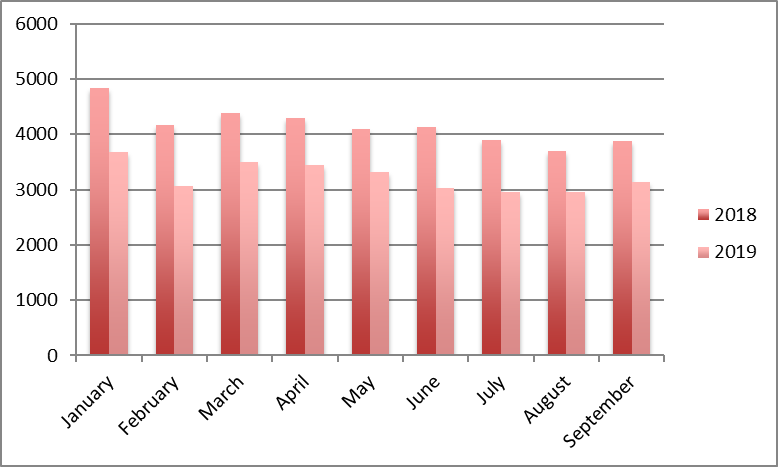
    Homicides in Brazil January to September 2018-19

    Source: G1, Monitor da Violência

    Public security experts argue that the current government has in reality done very little towards driving this trend. Bruno Paes Manso, a researcher at the USP’s Núcleo de Estudos da Violência research centre (NEV-USP), explains that the fall in homicides began under the Temer government, in 2018, after the ‘annus horribilis’ of 2017, and is due to circumstantial factors linked to criminal dynamics much more than to structural changes implemented by the federal government. “In the case of the Bolsonaro government, perhaps its greatest achievement is to have not done anything,” Paes Manso told LatinNews in October. At the time, neither Bolsonaro’s gun decrees nor Moro’s anti-crime package had seen any success.

    The ‘fight crime with violence’ rhetoric favoured by Bolsonaro is even seen as having worsened certain forms of violence. Going against the trend of falling homicides, police brutality is on the rise. Deaths at the hands of the police increased 4% in the first six months of the year, according to the ‘Monitor da Violência’, an independent data gathering initiative published by news site G1, driven by sharp surges in certain states such as Pará and Rio de Janeiro. Paes Manso notes that police violence is the seed of ‘milícias’, violent paramilitary groups which now rival drug trafficking organisations (DTOs) for the control of underprivileged neighbourhoods in these two states in particular. An environment that encourages use of force by the police therefore also foments these relatively new criminal dynamics – adding yet another dimension to Brazil’s public security challenge.

  • BOLIVIA: Uncertainty prevails as election draws close

    LatinNews 01 October 2020 Hits: 3567

    One thing that Bolivia’s protracted election campaign has unequivocally demonstrated is that a shared opposition to the previous Movimiento al Socialismo (MAS) government is not as powerful a force for unity as some in the country had hoped. Demonstrated first by the repeated failure of the array of anti-MAS presidential candidates to consolidate an alliance, interim president Jeanine Áñez’s recent withdrawal from the contest [WR-20-38] has exposed similar fragilities within her own governing coalition. With a divisive election on the horizon, and a deadly pandemic still in full flow, a crumbling government is the last thing Bolivia needs.

    Áñez renouncing her presidential candidacy ought to have put the interim government in a stronger position to oversee what is likely to be a highly contentious electoral process. Instead, many of those close to Áñez have quickly drifted away, while others have rushed to push through their own policy priorities before a new administration takes office at the end of the year. This schism was brought into full view on 28 September, as the economy minister, Óscar Ortiz, reported that he had been sacked for disagreeing with a presidential decree he felt to be “unconstitutional”, returning ownership of the electricity company Empresa de Luz y Fuerza Eléctrica de Cochabamba (Elfec) – privatised by the MAS in 2010 – to its former shareholders.

    A long-time colleague of Áñez as senators for the right-wing party Demócratas, Ortiz is by no means ideologically opposed to such a privatisation. He attributed his opposition on this occasion to his “respect for the laws and interests of the country”, but it perhaps owed more to tensions with the interior minister, Arturo Murillo, who Ortiz claims is “concentrating power in his own hands”, with Áñez left as a lame duck. The implication is that Murillo, formerly a senator for Cochabamba, where Elfec is based, has a vested interest in this privatisation. Murillo retaliated with a thinly-veiled allegation of hypocrisy, alluding to Ortiz and Demócratas’ economic interests in Santa Cruz department when he said that “unfortunately there are people who defend their own regions tooth and nail, but when others defend their regions, they are opposed”.

    • Arturo Murillo

    The perception that Arturo Murillo has benefitted from a shift in power within the government was furthered by the news on 29 September that he had travelled to the US, for meetings with the secretary general of the Organization of American States (OAS), Luis Almagro, and with US State Department officials. A foreign ministry statement reported that Murillo had gone instead of the foreign minister, Karen Longaric “due to the importance of these meetings for the country”; Murillo offered few details on the content of these meetings, saying only that he had discussed electoral preparations with Almagro, and “co-ordinated state security issues with the White House”.

    There has never been a shortage of strong personalities in Áñez’s cabinet, appointed in November 2019 to appease the broad coalition that had forced out the MAS to put her in power [WR-19-45]. As well as Murillo, the defence minister, Fernando López (aligned with far-right presidential candidate Luis Fernando Camacho), has shown himself to be something of a strongman, and raised concerns last week by referring to the armed forces as “part of the democratic logic” of Bolivia. It comes as a surprise, however, that Áñez’s Demócratas colleagues have been the first to jump ship; the labour minister, Óscar Mercado, and the productive development minister, José Abel Martínez, resigned shortly after Ortiz’s statement, and the party’s national executive committee had distanced itself from her administration by the end of the day.

    Áñez sought to recover the situation by insisting that her decree had merely created a technical commission to analyse the return of Elfec shares, and by quickly appointing three new ministers. But the damage was already done. MAS-aligned senate president Eva Copa claimed that the government is “falling apart”, attributing this “crisis” to “misrule, infighting, private economic interests, and corruption”. If there is to be any possibility of a peaceful transition of power following October’s vote, Bolivia needs the interim government to keep its head down until then, rather than continuing to push a political agenda; the key question may be whether Áñez retains enough authority within her own cabinet to enforce such behaviour.

    Electoral tensions

    The MAS could soon be facing a crisis of its own, if Bolivia’s electoral tribunal (TSE) rules on 5 September to disqualify the party from participating in the election, following an appeal by Demócratas senator Carmen Eva Gonzales, after MAS presidential nominee Luis Arce allegedly discussed internal polling results during a televised interview in July. A ruling against the MAS - leading in the polls, and hopeful of a first-round victory - is highly unlikely, but all eyes will be on this hearing nonetheless, given the scale of discontent that such an exclusion would incite among the party’s supporters.

    The first poll since Áñez’s withdrawal from the contest, published by pollsters Ciesmori on 30 September, suggested the field remains highly fragmented. Arce and the MAS retain their lead, with 42.2% of valid voting intentions, but without the 10% lead needed to secure a first-round victory, as Carlos Mesa of Comunidad Ciudadana (CC) sits on 34.1%. Much of Áñez’s support seems to have gone to her erstwhile ally Camacho, on 17.5%; if a second round of voting is required, much will depend on whether his supporters turn out to vote for Mesa.

  • BRAZIL: Election day approaches

    LatinNews 12 November 2020 Hits: 876

    Brazilians will go to the polls on 15 November to elect a total of over 5,500 mayors and some 57,000 municipal councillors across the country. Held every four years, halfway through the presidential term, municipal elections in Brazil are usually taken as a popularity gauge of the federal government in Brasília. The latest opinion polls show that neither candidates supported by President Jair Bolsonaro nor those from his left-wing rival, the struggling Partido dos Trabalhadores (PT), look set to claim any big victories in the country’s state capitals – where most of the mayoral elections are in any case expected to go to a run-off, due on 29 November.

    President Bolsonaro, not currently affiliated with any political party, had originally said he would not weigh in on the municipal election campaigns. Perhaps swayed by his own relatively high popularity levels, he began to express his support for certain candidates as the campaign kicked off in September [WR-20-39], such as Celso Russomanno (Republicanos) in São Paulo, while railing against those he opposed, such as Manuela D’Ávila, a former vice presidential candidate from the Partido Comunista do Brasil (PCdoB) who currently leads voting intentions in Porto Alegre, Rio Grande do Sul.

    This week he went a step further, announcing on 9 November that he would be holding a series of Facebook Live ‘specials’ to promote different candidates ahead of the vote (this has prompted a background debate as to whether this strategy is legally permissible – the president is allowed to express his support for candidates, but cannot use the state apparatus to do so).Bolsonaro has also recently upped his verbal attacks against the political left in general as well as multiplying the kind of provocative comments that delight his base and shock everyone else, most likely with the aim of mobilising his supporters in order to try and secure a victory for right-wing candidates aligned with ‘bolsonarismo’.  

    • Scaremongering

    “We won’t accept communism or socialism in our country,” President Bolsonaro said on 9 November while defending some right-wing candidates in this week’s election. Ten days earlier, he had taken a swipe at his peer in Argentina, Alberto Fernández, and the economic crisis there, saying “this is what happens when you vote for communist parties. The line that Argentina has taken is the same as the PT”. Painting the left as a communist threat that would send Brazil down the same route as crisis-ridden Venezuela was a frequent political ploy of Bolsonaro’s during his own campaign for president in 2018.

    The first mayoral candidate to receive exposure through Bolsonaro’s live videos was Patrícia Domingos, a policewoman who goes by the election name ‘Delegada Patrícia’ and is running for the right-wing Podemos party in Recife, in the north-eastern state of Pernambuco. As of 9 November, Domingos was polling fourth in Recife’s mayoral race, where João Campos, a young federal deputy representing the leftist Partido Socialista Brasileiro (PSB), leads with 33% of voting intentions. Bolsonaro is also calling upon his supporters to vote for certain municipal councillor candidates, including his son Carlos Bolsonaro who is seeking to keep his seat in Rio de Janeiro’s municipal council.

    But there are signs that Bolsonaro’s backing may not prove to be advantageous for candidates. According to data compiled by news site G1, Bolsonaro’s rejection levels currently exceed his support levels in half of the country’s 26 state capitals. In a few cities, candidates who are either explicitly aligned with Bolsonaro or have received the president’s public backing have lost their lead over their rivals in recent weeks.

    This has been particularly visible in São Paulo, where Russomanno – who was leading voting intentions when Bolsonaro first endorsed him – has sunk to third place with 12%, and may not even make it through to the expected run-off. The incumbent Bruno Covas, from the Partido da Social Democracia Brasileira (PSDB), has risen to the top of the polls with 32% of voting intentions, and could now face Guilherme Boulos, a former presidential candidate from the left-wing Partido Socialismo e Liberdade (PSOL) who is in a technical tie with Russomanno on 13%, in the run-off.  

    No comeback in sight for the PT

    The PT performed poorly in the 2016 municipal elections, losing São Paulo to the PSDB in the first round and electing a mayor in just one state capital, Rio Branco, in the northern state of Acre. The discredited party does not look set to reclaim much ground this year, although it could see its candidate go through to the run-off in Recife and Vitória (Espírito Santo). Parties from the right and centre-right, which performed well four years ago, look well-positioned to remain dominant across the country’s state capitals, with Democratas (DEM) likely to increase its representation.

    There is talk within the PT of the party’s candidate in São Paulo, Jilmar Tatto, giving his support to Boulos to guarantee that the PSOL candidate makes it to a run-off against Covas. In return, the PT would ask the PSOL to back its candidate in Rio de Janeiro, Benedita da Silva.

    However, with 9% of voting intentions, Silva’s chances of making the run-off in Rio are slim even with the support of the PSOL (whose candidate Renata Souza is polling below 3%). An expected second round in Rio would probably pit twice-former mayor Eduardo Paes (2009-2017), who represents the DEM, against the unpopular incumbent Marcelo Crivella (Republicanos), whom Bolsonaro reluctantly backs.

    CoronaVac

    Chinese firm Sinovac’s CoronaVac vaccine against the coronavirus (Covid-19), being trialled in Brazil and developed by the São Paulo-based Instituto Butantan, fell foul of politics this week – not for the first time [WR-20-43]. On 9 November, the sanitary regulator Anvisa ordered the suspension of CoronaVac trials due to a “serious adverse event”. The Instituto Butantan reacted with surprise, noting that the death of a volunteer was unrelated to the vaccine trial (the death was separately reported to be a suicide). President Bolsonaro framed the suspension of the trials as a political victory for him over São Paulo state governor João Doria, prompting criticism and concern that Anvisa’s order might have been political. Anvisa then authorised the CoronaVac trials to re-start on 11 November. 

    Prosecutors close in on Flávio

    Around two years after an investigation was first launched, on 3 November Senator Flávio Bolsonaro – President Bolsonaro’s eldest son – was charged with embezzlement, money laundering, and leading a criminal organisation, in relation to a ghost employee salary kickback scheme run in his parliamentary office during his time as a deputy in the Rio de Janeiro state legislature (Alerj).

    The charges have yet to be accepted by Rio’s justice tribunal (TJ-RJ) but, if they are, prosecutors have reportedly recommended that Flávio be suspended from his position in the senate and fined R$6m (US$1.1m). The supreme court (STF) is separately yet to rule on whether this case can be taken on by a first instance court, rather than an appeals court like the TJ-RJ, depending on whether Flávio is deemed to benefit from partial immunity or not.

  • NICARAGUA: New electoral reform proposal met with rejection

    LatinNews 22 April 2021 Hits: 4541

    Electoral reform has long been a demand of Nicaragua’s political opposition, and the international community, ahead of the 7 November general elections in which President Daniel Ortega is seeking a further term. The legislative bill recently unveiled by the ruling Frente Sandinista de Liberación Nacional (FSLN), however, would seem to have fallen short of satisfying these calls.

    The FSLN unveiled its proposal before the 92-member unicameral legislature, which it controls, on 12 April. While it includes changes aimed at strengthening gender parity in electoral institutions and lists of candidates, these have been slammed as cosmetic by opposition groupings and 10 pre-presidential opposition candidates who signed a joint statement on 19 April rejecting the bill.

    Instead, the opposition complains that the proposed reform is a further attempt to limit its participation in the election, building on recently approved laws which have drawn democracy-related concerns. These include the foreign agents’ law and a law prohibiting anyone who has “led or financed a coup d’état, fomented terrorist acts, or incited foreign interference” from running in elections - claims levelled by the Ortega government at the opposition [WR-21-01]. Specific concerns include the fact that the proposed reform fails to guarantee electoral observation, limits foreign financing for candidates and parties, and transfers responsibility for authorising permits for campaign marches from the supreme electoral council (CSE), as is currently the case, to the national police (PNN). In March 2020 the US Treasury Department sanctioned the PNN for its role in “serious human rights abuse in Nicaragua” - a reference to the crackdown which began in April 2018 by the Ortega government on its opponents, whom it accuses of trying to carry out a coup.

    The opposition also highlighted the significant gap between the proposal and demands for comprehensive electoral reform as outlined by the Organization of American States (OAS) in an October 2020 resolution. This, in turn, was in line with a commitment to electoral reform made by the FSLN in 2017 as part of a Memorandum of Understanding (MoU) signed with the OAS. The October 2020 resolution was clear that “concrete electoral reform commitments, in particular modernisation and restructuring of the [CSE], be in place before the state convokes general elections, or no later than May 2021”. In its report on the November 2017 municipal elections, the OAS also found that “Nicaragua’s electoral system would benefit from a comprehensive electoral reform”.

    US response

    A bipartisan group of US Representatives issued a statement on 16 April warning that the proposed electoral reforms “show contempt for the modest requests made by the international community”. It calls on the international community to unite in “asserting that the disqualification of any opposition candidate by Ortega and his accomplices, restrictions on the participation of any opposition parties, or the failure to grant full access to international observers for the entirety of the electoral process would be crossing a red line”. This follows the introduction last month by US Senator Bob Menendez of new bipartisan legislation known as the RENACER ACT to “strategically align” the US’s “diplomatic tools, including targeted sanctions, to advance democratic elections in Nicaragua in November 2021”.

    CSE candidacies

    The national legislature last week approved the creation of a special committee tasked with analysing candidacies for the seven-member CSE along with three alternates. Government critics have long claimed that the CSE has been stacked with FSLN supporters and, as with Nicaragua’s other democratic institutions, lacks independence. The candidates are due to replace judges whose five-year terms have expired but who have continued in their posts in the absence of new appointments.

    Indicative of existing concerns regarding the current CSE, its acting head, Lumberto Campbell, was sanctioned by the US Treasury Department in November 2019 over the body’s role in “undemocratic tactics to ensure that President Ortega and his allies win elections, including ordering government employees to vote for Ortega and other FSLN candidates”. His predecessor, Roberto Rivas (2000-2018), was sanctioned by the US in 2017 because, among other offences, he allegedly “perpetrated electoral fraud undermining Nicaragua’s electoral institutions.” Rivas resigned in May 2018.

  • BOLIVIA: Cocaine ‘mega-labs’ point to increasing narco activity

    LatinNews 04 June 2021 Hits: 4369

    Five cocaine ‘mega-laboratories’ were discovered in Bolivia in May, together capable of producing over 940kg of cocaine per day. The finding has raised questions over the government’s drug policies, and point to Bolivia’s increasing clout in the international drugs trade.

    The successful raiding of a cocaine mega-laboratory in Isiboro Sécure national park and indigenous territory (Tipnis) in Beni department on 21 May should have been a good news story for the government, demonstrating concrete progress against drug trafficking. The fact that it was the fifth such cocaine factory to be discovered in just 12 days, however, painted a different picture – one of a country realising the scale of drug production within its borders. The most recently discovered mega-laboratory, which the interior ministry estimated to have a daily production capacity of over 100kg of cocaine, followed the 10 May discovery of two others in Noel Kempff Mercado national park (Santa Cruz department) with a combined estimated daily output of 240kg, and a further two in Cochabamba department on 14 May, which, combined, were believed to be capable of producing over 600kg per day.

    Despite Interior Minister Eduardo del Castillo’s claims that the raids showed that “we’re not a government of words but a government of deeds”, they are emblematic of Bolivia’s growing reputation as a drug producing nation, which the government has sought to blame on the administration of former interim president Jeanine Áñez (2019-2020). Citing figures from the United Nations (UN) Office on Drugs and Crime (UNODC), on 1 April Del Castillo said the current government’s “inheritance” from Áñez was a 38.5% increase in coca cultivation during her presidency, reaching a total of 32,000 hectares in 2020.

    However, there are signs that the increase in drug production began before the Áñez era, and that criminal organisations are adapting to capitalise on the government’s development of new trade routes. The UN International Narcotics Control Board (INCB)’s annual report, published in March, notes that increasing numbers of cocaine laboratories have been found in remote parts of the country since 2018. That is around the time when shipping began to significantly increase on the Paraguay-Paraná watershed, where a canal network connects Bolivia’s eastern border with the Atlantic Ocean via the Paraguay River. In January 2021, the specialist website Insight Crime released a report detailing how the growth in legal international trade along this route has created a new drug trafficking corridor out of Bolivia, reducing traffickers’ dependence on land and air routes by enabling them to smuggle contraband in shipping containers. Insight Crime also warned that, should this trend continue, it will also provide cocaine producers in Peru with a more direct route to European drug markets, further increasing the quantity of cocaine smuggled through Bolivia.

    Following the UNODC’s 13 May presentation on drug eradication in Bolivia, which reported that the destruction of seized drugs had declined by 14% in 2020, Del Castillo accused the UN agency of disrespecting Bolivia’s sovereignty by calling for reduced quotas for legal coca production. Nonetheless, international concern at increasing drug production in Bolivia looks set to continue. Policing and counter-narcotics operations were among the issues highlighted by the governments of Bolivia and Chile when they announced on 7 May that they would begin a dialogue to improve diplomatic relations, which have remained severed since 1978. With Chile experiencing its own uptick in drug trafficking activity [SSR-20-07], pressure from Santiago may follow, in addition to that already being exerted by the US, the European Union, and the UN.

    Bolivia’s ‘fat cat’ of drug trafficking extradited

    The extradition to Brazil of the alleged Bolivian drug kingpin Jesús Einar Lima Lobo on 5 May dealt a severe blow to the Lima Lobo drug trafficking organisation, a family clan that operates along Bolivia’s north-eastern border with Brazil. Announcing his extradition, Del Castillo referred to Lima Lobo as one of the “fat cats” of international drug trafficking, accusing him of shipping drugs to criminal counterparts in Brazil and Colombia. Arrested in Santa Cruz department in October 2019, Lima Lobo’s extradition was authorised in December that year but not executed. On 7 May 2021, Del Castillo announced the launch of an investigation into whether the extradition was deliberately delayed by the Áñez government.

  • ARGENTINA: Signs of recovery – but will they last?

    LatinNews 16 July 2021 Hits: 2181

    After a bruising three years of falling activity levels there are early signs that Argentina’s economy is bottoming out. But the recovery is very fragile.

    According to Argentina’s national statistics institute (Indec), GDP in the first quarter of this year was up by 2.5% year-on-year, and by 2.6% quarter-on-quarter. These modest signs of growth came after four successive quarters of contraction. With the coronavirus (Covid-19) pandemic coming on top of deep structural imbalances, GDP crashed by 9.9% last year. Aided by a low basis of comparison and the reopening of the economy at the beginning of this year, construction activity soared 21.3% in the first quarter, with manufacturing up by 11.4%. However, hotels and restaurants, still affected by pandemic restrictions, plunged by 35.5%. The monthly economic activity index (Emae) for April also indicated strong growth of 28.3% year-on-year, although it was down 1.2% compared with March. Unemployment fell to 10.2%, down from 11% in the fourth quarter.  

    Growth in consumption was modest, and exports only edged up marginally (despite strong international soya prices). Among other positive signs, tax collection rose 69% year-on-year in June, ahead of the inflation rate (estimated at 49.3%). The economy ministry says tax receipts in the first half of this year have come back up to pre-pandemic levels. The ministry has become more optimistic about growth. The 2021 budget was built on the hypothesis that the economy would expand by 5.5%, but that prediction has since been raised to 7%.

    That said, there are various clouds on the horizon. One is a new surge in Covid-19 infections which has forced the government to impose new and controversial international travel restrictions. It is feared that the new wave of infections could once more derail the economy. In second place, business sentiment has been weakened by a decision on 24 June by investment index provider MSCI to downgrade Argentina from ‘emerging market’ to ‘standalone’ status. MSCI said the change reflected the negative impact of continuing capital and exchange controls in the country. The change will take effect in November and is expected to lead investors to withdraw as much as US$610m from the three remaining companies in the MSCI Argentina Index (these are Globant, Adecoagro, and state-owned oil company, YPF).

  • BRAZIL: Fixing gig economy is mega difficult

    Patrick de Courcy 09 November 2023 Hits: 2207

    During his election campaign last year, Brazil’s President Luiz Inácio Lula da Silva had rattled investors with talk about undoing the labour market liberalisation undertaken by his party’s archenemy, centre-right former president Michel Temer (2016-2019).

    Too many workers are getting sub-par pay and don’t have contracts that extend them the appropriate legal benefits, like health and pension coverage, Lula had argued. But in an effort to portray a more centrist image and allay concerns from business, he later backtracked and said he would no longer seek to scrap the 2017 law that gave workers and employers more freedom to negotiate their own contracts. Instead he would seek to reach an accord with certain industries offering low-paying part-time jobs, the so-called gig economy, and particularly transportation and food delivery apps such as Uber, iFood, and others.

    But after nearly a year in office, he has struggled to even reach a limited agreement between government, labour unions, and app companies. Labour Minister Luiz Marinho said in October that there was resistance particularly by food delivery apps but that the government would send a bill to congress even without a previous accord.

    However, it’s not always only the entrepreneurs who don’t want to be bound by stricter regulations. In some cases, gig workers don’t either. “Workers today don’t want to be formal employees,” said Eduardo Lima de Souza, president of AMASP, an association of courier workers in São Paulo. What unions ask for is better pay and working conditions.

    Judges not politicians

    Like in the US, this battle in Brazil is being fought not only in congress but in the courts as well. But it’s so far been a bit of a free-for-all in the courts, with sentences going in all directions without setting a clear precedent. In October, a regional labour court ordered food delivery company Rappi to hire all couriers who for at least six months made only occasional deliveries between 2017 and 2023. Rappi, which was fined 1% of its 2022 revenue, will appeal. Uber too was told that it must register all drivers as formal workers, which of course means paying social security contributions and respecting tomes of labour rules and regulations, many of them sensible, others utterly outdated and unrealistic. 

    But upper courts tend to have a different view. Supreme Court Justice Alexandre de Moraes recently annulled a ruling by a regional labour court in favour of an app driver, saying that the legal status of such drivers is primarily a commercial relationship, not a labour one. That could mean that any attempts to extend existing labour laws to the gig economy may fail.

    • Not just Brazil

    Brazil isn’t the only country grappling with the issue of how to give gig economy workers better labour conditions. The US government in October 2022 proposed landmark legislation that would strengthen benefits such as federal minimum wage and collective bargaining rights for gig economy workers.

    While Lula may not have made much progress in formalising contracts for the country’s 1.5m app workers, he created just as many formal jobs the traditional way, through economic growth. Unemployment fell to 7.7% in September, the lowest level since the first quarter of 2015.

    Giggers work more

    A recent survey by the national statistics agency IBGE showed that 1.5m workers are active in the country’s gig economy, equivalent to 1.7% of the private sector workforce. Of those, the vast majority (more than 80%) were male and most had mid-level education. Gig workers laboured 46 hours per week on average, compared with 39.6 hours in the rest of the private sector. Only 36% of them contributed to retirement, versus 61% for all other private sector workers, the IBGE study showed.