
All Categories

Subcategories

  • New leadership of the armed forces

    Ira Lee 29 February 2024 Hits: 1068

    Argentina’s armed forces has undergone a major shake-up following new decrees published on 2 January by the government led by President Javier Milei which replaced the commanding officers of the army, navy, and air force. Defence Minister Luis Petri has denied the changes represent an attempt to purge the armed forces of personnel with loyalties to the previous government, insisting that this was part of the Milei administration’s efforts to modernise the country’s military.

    Brigadier General Xavier Julián Isaac was appointed chief of the armed forces’ joint chiefs of staff, the country’s most senior military official, having been promoted from head of the air force. Brigadier Major Fernando Luis Mengo took over Isaac’s previous post. The new head of the navy is Rear Admiral Carlos María Allievi and the leadership of the army has been assumed by Brigadier General Carlos Alberto Presti.

    Local media described this reshuffle as the most drastic overhaul of the military’s top brass in the past two decades. The army and the navy saw the most significant changes. National daily Clarín reported that the appointment of Presti automatically obliges all generals older than him to retire, with 22 of the army’s 55 generals stepping down as a result; the appointment of Allievi resulted in seven navy admirals being forced into retirement. The last time the army experienced a shake-up on a similar scale was in 2003, when former president Néstor Kirchner (2003-2007) appointed Roberto Bendini as the commander of the army, forcing 19 older generals into retirement.

    Local human rights groups, such as Asamblea Permanente por los Derechos Humanos (APDH), published a joint statement on 3 January expressing concern over Presti’s appointment, on the grounds that his father, Roque Presti, was allegedly a notorious torturer during Argentina’s military dictatorship (1976-1983) and died without standing trial for human rights violations. The NGOs stated that this comes amid the “climate of denialism” regarding the legacy of the regime’s atrocities. They also accused Vice President Victoria Villarruel, who previously worked as a lawyer defending soldiers accused of human rights abuses during the dictatorship, of imposing this denialist stance.

    On the campaign trail last year Milei had also suggested that the military regime was engaged in a “war” in which the state committed “excesses”, downplaying the genocide and crimes against humanity charges for which many members of the military junta have been imprisoned, and sought to shift attention onto the violence committed by left-wing guerrilla groups, such as the Montoneros.  

    On 10 January national daily El Cronista reported that the leadership changes were just the “tip of the iceberg” of Milei and Petri’s plans to “modernise” the armed forces. The newspaper cited internal documents outlining government plans regarding defence, such as plans to complete the purchase of 24 units of the F-16 supersonic fighter jets from the US, which are currently in the possession of Denmark, as well as units of the Lockheed P-3 Orion anti-submarine aircraft which were first developed for the US Navy.

    In line with Milei’s efforts to strengthen defence cooperation with the US, his government reportedly plans to halt negotiations for equipment acquisitions from China, which began under his predecessor Alberto Fernández (2019-2023) who had previously sought to purchase military aircraft from Beijing.

    Defence and foreign policy realignments

    According to government sources and documents cited by national daily El Cronista, Argentina’s defence ministry plans to shore up the military presence in the country’s northern regions. President Milei is reportedly concerned over the Bolivian government’s close alignment with Iran. In August last year, Argentina and Iran were two of the six countries invited to join the BRICS group of developing economies (Brazil, Russia, India, China, South Africa). However, Milei has since turned down the invitation for Argentina to join the bloc.
  • VENEZUELA: Maduro’s candidacy confirmed as opposition flounders

    Patrick de Courcy 21 March 2024 Hits: 3126

    Venezuela’s President Nicolás Maduro has been officially declared the candidate of the ruling Partido Socialista Unido de Venezuela (PSUV) in the 28 July election, in which he will seek a further six years in power. Meanwhile, with just days to go until the registration deadline, the opposition coalition Plataforma Unitaria Democrática (PUD) has not even confirmed who its candidate will be.

    Victory would put President Maduro on course to become the longest serving president in the country’s history. With elections not due again until 2030, he would be well on his way to enjoying 18 years in office, exceeding the record set a century ago by Juan Vicente Gómez (1908-1913; 1922-1929; 1931-1935). Given the dire state of Venezuela’s democratic institutions and the uncertainty hanging over the opposition’s participation, this is a highly plausible outcome. “Whatever they do, whatever they say, they have not been able to get rid of us, and nor will they,” Maduro declared as he accepted the PSUV’s nomination.

    The opposition PUD now has just a matter of days to register its candidate before the 25 March deadline set by the national electoral council (CNE). There is at this point no chance that the authorities will overturn the disqualification of María Corina Machado, the candidate for the right-wing Vente Venezuela (VV) who cruised to victory in the PUD primary election in October last year. As the registration deadline rapidly approaches, the PUD has given no public indication on how it intends to proceed. Despite growing pressure, Machado has not stood aside for a replacement candidate. “They won’t remove us from this electoral path,” she declared in a video message on 17 March.

    The opposition’s lead negotiator in previous talks with the government, Gerardo Blyde, said on 15 March that Machado “will decide with the PUD what the strategy and tactics will be in this process”. That could imply that Blyde, like opposition heavyweight Henrique Capriles Radonski, is leaning on Machado to move aside. More broadly, Blyde accused the Maduro administration of totally ignoring the commitments it made in the October Barbados Agreement which resulted in the easing of US sanctions – not least regarding promises of electoral observation, which the government had previously said would include a team being sent from the European Union. Blyde said that “so far, no formal invitations have been sent out to the international observers…this is clearly aimed at ensuring that they can’t come in time to carry out all the stages of observation”.

    Meanwhile, the Venezuelan authorities continue to tighten the screws on Machado with a string of arrests targeting her campaign organisers. VV’s national coordinator, Henry Alviárez, was arrested on 20 March in relation to a supposed plot to destabilise the country in the run-up to the election – the same pretext which has been used to justify the arrest of at least five Machado allies since January. One of those, Joe Villamizar – a VV coordinator in the northern state of Aragua – was arrested the day before Alviárez.

    A further potential obstacle for the opposition surfaced on 18 March, when Luis Ratti – a self-styled ‘opposition-aligned’ independent – announced that he had submitted a legal challenge with the supreme court against the PUD’s participation in the election. Ratti, who is regarded by most of the opposition as a stooge for the Maduro administration, said that the PUD should not be able to register a candidate as it is a coalition, rather than a party. He claimed that this violates a ban on membership of more than one political organisation.

    ‘The most violent form of repression’

    Marta Vilañas, the chair of the United Nations Independent International Fact-Finding Mission on Venezuela, told the UN Human Rights Council on 20 March that “we are witnessing a reactivation of the most violent form of repression by the authorities”. Drawing attention to the mounting arrests of opposition figures, Vilañas highlighted “patterns of human rights violations against real or perceived opponents of the government, including human rights defenders who dare to criticise, denounce, or protest against government decisions or policies”.

  • TRACKING TRENDS

    LatinNews 17 May 2012 Hits: 2675

    VENEZUELA-ECUADOR| Promoting integration projects. Ecuador’s foreign minister, Ricardo Patiño, met his Venezuelan counterpart, Nicolás Maduro, in Caracas on 14 May to sign various cooperation agreements aimed at increasing bilateral trade by as much as 20%. Maduro explained that the agreements mostly cover the areas of energy, customs and tax cooperation which will reinforce those previously undersigned by the two countries in 2007. In particular Maduro said that both countries had reached a mutual assistance and cooperation customs agreement which is expected to facilitate trade between the two countries in order to hit ambitious trade targets.
        Meanwhile Patiño highlighted an agreement to establish a “great national cocoa company” that will allow both countries to pool their production. According to Patiño, the two countries decided on this “international association” taking into consideration that together Ecuador and Venezuela export over 60% of the world’s Fino de Aroma flavoured cocoa.
        Nevertheless, the most important agreement appears to be a strategic alliance between Venezuela’s state owned oil company, Pdvsa, and its Ecuadorean counterpart Petroecuador. Under the agreement, Pdvsa will undertake to ensure the supply of crude oil to a new refinery to be built on Ecuador’s Pacific coast. According to Maduro, this is “fundamental” to consolidate the project’s development, by allowing for the establishment of global financial agreements for its construction and to “ensure the participation of other important international partners”.
        More ambitiously both ministers also expressed their desire to discuss, once again, the construction of a “southern gas pipe” energy integration project between Venezuela, Colombia and Ecuador. “With the sister republic of Colombia we are working on this southern gas pipe project...” Maduro said. He pointed out that the issue would be discussed at the next South American energy council meeting to be held in Caracas on 18 May.

    COLOMBIA | Negative FTA impact. Just a day before the Colombia-US free trade agreement came into effect, a group of international NGOs published a report, on 14 May, exposing some of the negative effects it may bring for Colombian farmers. The “Impact of the US-Colombia FTA on the small farm economy in Colombia”, developed by NGOs led by Oxfam, found that 70% of Colombia’s 1.36m small farmers will be negatively affected by the agreement as their incomes stand to decrease by as much as 16%.
        The report claims that “the agreement was negotiated unequally and asymmetrically”, allowing the US to maintain its “protectionist policies”. According to the report, Colombia has offered to remove tariffs immediately on imports valued at US$830m while the US only offered to remove tariffs on imports which are currently valued at US$776m.
        However, over in Ecuador, business groups have expressed concerns that Colombia’s latest FTA could harm Ecuador’s domestic economy by further “isolating” it from primary markets. The president of Quito’s chamber of commerce, Blasco Peñaherrera, lamented the fact that Ecuador was looking increasingly isolated within the Andean region given that now both Colombia and Peru have FTAs in place with the US, the main economic partner of the three countries. As a result, Peñaherrera said that Ecuadorean exports such as flowers, fish, vegetables and wood will lose competitiveness as they will have to pay tariffs to enter the US while Colombian and Peruvian products will not.

    COLOMBIA | Important banking sector acquisition. On 14 May the Colombian owned bank, GNB Sudameris, announced that it had concluded the acquisition of British banking giant HSBC’s operations in Colombia, Peru, Uruguay and Paraguay for US$400m. The deal means that GNB Sudameris will now be in charge of 62 branches across the four countries with assets worth US$4.4bn, adding to the bank’s current US$6bn. GNB Sudameris president, Jaime Gilinski, said that “this transaction is the most important in the bank’s history as it significantly expands the group’s presence in South America, which will allow us to promote our regional growth”.

    • Newmont to make Conga decision

    On 15 May the president of Minas Buenaventura, Roque Benavides, revealed that US firm Newmont, its majority partner in the US$4.8bn Conga gold and copper mining project in Peru, is to make a decision on whether to go ahead with it in less than a month. Benavides explained that Conga is a “difficult project” and that a team of engineers and employees from Newmont and Buenaventura was evaluating the recommendations made by the review of Conga’s Environmental Impact Assessment report ordered by the Peruvian government. Benavides said they were evaluating the pros and cons and the costs of the project before reaching a decision.

  • Risk pointers

    LatinNews 24 October 2012 Hits: 137

    *** Russian warning on Syrian chemical weapons.  An “authoritative” Syrian government source has told the Russian military news agency Interfax-AVN that Syrian rebels may use chemical weapons in order to precipitate a Western intervention in Syria.  The source told Interfax: “According to information available, there is a possibility of a provocation with the use of a liquid toxic substance...Immediately after the incident, which will possibly be explained by careless handling of toxic weapons, the rebels will announce that they supposedly obtained the toxic weapons from the depot of government troops.  This kind of interpretation of events will create a reason for Western countries to announce that the depot of Syria weapons are supposedly guarded inadequately and create a pretext for foreign armed forces to intervene in events in Syria.”

    The interesting point that the “authoritative source” did not answer was how the rebels were to get hold of these weapons – in other words, are they in fact poorly guarded?

    *** More signs of PKK escalation.  Reports from Turkey indicate that the Kurdistan Workers’ Party (PKK) as stepped up its attacks on schools in the southeast over recent weeks.  Last week for instance, more than 20 schools were attacked with Molotov cocktails and six students kidnapped.

    Kurdish journalist Umit Firat explains the tactic this way: "Even going to school is seen as going against the PKK.  Now they are saying Kurds shouldn't send their children to school, that those who do are traitors.  In this way, it is trying to rupture the link the Kurds have to the state system, to make them dependent on it [the PKK].”

    *** Struggle for control of Arab state media.  Last week, on 17 October, the National Union of Tunisian Journalists (SNJT) called a general strike in protest against the policies of the Islamist Ennahda Movement government.  The participation rate was as high as 90%.  The SNJT wants an end to the government’s appointment of the heads of state-owned media organizations.

    The Tunisian government’s view is that the state-owned media has become a tool of the opposition, with one Ennahda MP even accusing the SNJT of “receiving instructions and orders” from the French embassy.  The government is threatening to issue a list of journalists who gained material benefits from close collaboration with the ousted Ben Ali regime.

    The row in Tunisia mirrors a similar struggle in Egypt, where a few months ago Egyptian journalists protested against the appointment of the heads of state-owned media by the Muslim Brotherhood-dominated upper house (the Shura Council).  On 21 October, Egyptian journalists were protesting again, this time against the firing of the editor of the state-owned Al-Junhuriyah daily, Jamal Abd-al-Rahim.

  • PANAMA: Finalmente entra en vigencia acuerdo con EU

    LatinNews 12 November 2012 Hits: 405

    La larga espera ha terminado. El Acuerdo de Promoción del Comercio (APC) de Panamá con EU, firmado por el ex presidente de EU, George W. Bush en junio del 2007 y ratificado por el congreso de Panamá el mismo año, finalmente entró en vigencia el 31 de octubre.

    El acuerdo comercial, que fue retenido por el Congreso de EU debido a preocupaciones  acerca de la protección laboral y transparencia fiscal, verá el 100% de los productos industriales y pesqueros de Panamá, además de textiles y artículos artesanales, ingresar a EU libres de tarifas.

    Alrededor del 86% de los bienes de consumo e industriales de EU, tales como automóviles y equipos eléctricos, entrarán a Panamá sin pagar tarifas. Ricardo Quijano, ministro de comercio e industria de Panamá, dijo que esto efectivamente elevaría el poder de compra de los consumidores, pues los precios bajarían.

    El sector agrícola, tal como sus pares en Centroamérica después de la firma del tratado de libre comercio República Dominicana-Centroamérica-EU (Cafta-DR) en el 2004, está preocupado acerca de la fuerza de la competencia que ahora tendrá que enfrentar. La Asociación Nacional de Benefactores y Exportadores de Café, en particular, emitió una declaración expresando preocupación acerca de la reducción de tarifas sobre el café instantáneo. La asociación teme que el resultado de esto será que los productores nacionales ya no podrán proveer para el mercado nacional.

    • Clinton

    La Secretaria de Estado de EU, Hillary Clinton, emitió una declaración celebrando la firma del tratado de promoción del Comercio con Panamá, y felicitando al país por el 109no aniversario de su independencia de Colombia en 1903 (con el apoyo de EU).

  • TRACKING TRENDS

    LatinNews 20 December 2012 Hits: 1846

    COLOMBIA | Ecopetrol finds partner for Caribbean exploration efforts. On 13 December Colombia’s state-owned oil firm, Ecopetrol, announced that it had signed an association agreement with US oil firm, Anadarko Petroleum Corporation, to exploit three deep-water exploration and exploitation concession blocs in the Caribbean Sea.

    Back in 2006 Colombia’s national hydrocarbons agency (ANH) awarded Ecopetrol exploration and exploitation concessions for the 481,000 hectares (ha) Fuerte Norte and the 330,000ha Fuerte Sur blocs. However, Ecopetrol has failed to act on its concessions as it has concentrated on developing its more accessible onshore assets first.

    Anadarko, the US’s second-largest independent oil and natural gas producer, approached ANH looking to secure an exploration concession for a 220,000ha bloc known as ‘Purple Angel’ in Colombia’s Caribbean territorial waters. The ANH awarded Anadarko the Purple Angel concession on 7 December. Ecopetrol then approached Anadarko, which has a well-established track record of developing deep-water oil wells in the Gulf of Mexico, with a proposal to develop all three blocs jointly.

    An Ecopetrol statement explained that the two firms had agreed to a deal under which Anadarko takes over the operation of all three blocs in a 50-50 joint venture, although it failed to provide any information of the financial details of the agreement. The statement adds that while there are already two and three dimensional seismic maps for Fuerte Norte and Fuerte Sur, such preliminary exploration work will now be carried out at the Purple Angel bloc.

    Ecopetrol is currently Latin America’s fourth largest oil producer behind Venezuela’s Pdvsa, Mexico’s Pemex and Brazil’s Petrobras, with a production of approximately 780,000 barrels per day (bbl/day). However, given that Colombia’s oil reserves are estimated at 2.2bn barrels, the government has set a production target of 1m bbl/day for Ecopetrol, which it hopes to achieve in the next five years.

    ECUADOR | Large deficit for 2013. On 12 December Ecuador’s finance minister, Patricio Rivera, revealed that the administration of President Rafael Correa is projecting a US$6bn fiscal deficit next year, for which the government has already secured financing. According to Rivera the majority of the financing will be by way of conditional loans that have already been awarded to the country, while “an important sum” is already freely available given that Ecuador has barely used the US$2bn credit line it secured from the Chinese government in June this year.

    The negotiation of the Chinese credit, which the government said would be used to finance its infrastructure projects, was controversial because of concerns that the Correa government appears to have become increasingly dependent on Chinese loans, which often comes with a high interest rate (of 6.9%) and, some argue, in exchange for increased Chinese government influence on Ecuadorean policy.

    However, President Correa rejects all this: he argues that the Chinese loans are granted without special conditions and do not represent any sort of risk to Ecuador’s sovereignty. After securing the latest line of Chinese credit, Correa claimed that it would allow its government to carry out an ambitious investment plan to build hydroelectric plants, roads and make improvements to the health and education sectors, with the aim of concluding many of these in 2013, which just happens to be an electoral year. The fact that Rivera admitted that the credit line has been left largely unused raised speculation that it will now be used to rack up campaign spending.

    VENEZUELA | INE reports inflation-beating food price increases. On 18 December Venezuela’s national statistics institute (INE) reported that in November food prices increased by 2.69%, higher than the general inflation rate of 2.30%. Despite the fact that the government of President Hugo Chávez has introduced price controls on a range of basic products, including foodstuffs, since 2003 and that in April this year it promulgated a new ‘law on just costs and prices’ that underpinned the price control measures, increases in food prices have not fallen in line with official inflation as intended by the government. This creates a problem for the general population given that, as the INE points out, the price of the 50 items included in the basic food basket currently stands at BF1,989.09 (US$463), while the current minimum wage in Venezuela is BF2,047.00 (US$476).

    • Gastronomic award goes to Peru

    On 12 December Peru’s foreign trade and tourism minister, Luis Silva, announced that the country had been awarded the first ever World Travel Awards (WTA) ‘World’s best gastronomic destination’ award at a ceremony in New Delhi. Silva celebrated the award pointing out that it would be “extremely positive” for the country’s economy given that Peruvian gastronomy is closely linked to the tourism sector, both of which in recent years have emerged as important sources of jobs and revenue. It is estimated that Peru’s gastronomic sector is now a US$1.5bn business employing some 300,000 people in the country, and many more when the various international food fairs held in the country are taken into account.

  • BRAZIL: Relations suffer another setback

    LatinNews 06 June 2013 Hits: 2152

    Florencio Randazzo, the Argentine transport minister, announced on 4 June that the government was expropriating a cargo railway concession from Brazil’s América Latina Logística (ALL) and a tourist train concession, citing non-compliance with contractual agreements. ALL said on 6 June that it would “take all legal measures” in response to the move.

    In a press conference, Randazzo said ALL was guilty of “grave” violations including a failure to invest and the accumulation of fines worth 30% of the concession. “If the government has to take over more railways we are willing to do so. We want to reduce our freight costs,” Randazzo stated.

    On the legal side, the Buenos Aires government believes it has an ‘open and shut’ case. Randazzo is on record as saying, “if they are unhappy let them go to the courts. They failed to meet the targets and they have to go”. The issue is whether ALL will feel that taking the legal route to seek compensation is worth it.

    ALL will lose its cargo licence for routes between Mendoza and Rosario and between Misiones and Buenos Aires; while a local company, Sociedad Comercial del Plata (SCP) will lose its concession to operate a passenger train (Tren de la Costa) in the suburban north of Buenos Aires, along with an associated amusement park.

    The official reason for the termination of the concessions might be non-compliance with contractual agreements, but it is possible that the government of President Cristina Fernández, with difficult congressional elections ahead in October, is seeking to play a populist card. Ever since a catastrophic passenger train accident in the Once neighbourhood in February 2012, which left 51 people dead, private train operators have been unpopular.

    The question is whether this new tough line on railway companies will do anything to boost the government’s flailing popularity. But, certainly, it will heighten investor concerns over Argentina, and may also further pressure relations with Brazil.

    Based in Curitiba, ALL is one of Latin America’s largest commercial train operators. It did not immediately comment on the Argentine government decision, apart from saying that it had not yet been formally notified of the revoked licenses.

    In a 4 June regulatory note to the São Paulo stock exchange, ALL noted that its Argentine operations accounted for 6.5% of net revenue, but did not contribute to Earnings before interest, taxes, depreciation and amortization (Ebitda). Pointedly, it noted that “Argentina’s ALL unit has lost representation in the company’s earnings while demanding disproportionate attention from its administration”.

    Brazilian companies are finding it increasingly difficult to operate in Argentina, and some form of political response can be expected from the administration of President Dilma Rousseff. In March, the Brazilian mining giant, Vale, withdrew from a potash-mining project in Argentina citing inflation, the exchange rate, and demands from provincial administrations as pushing up costs. Thousands of workers lost their jobs as a result of this decision. Former president Lula da Silva (2003-2010) is reportedly in talks with Vale over its pull out. Petrobras, the state-owned Brazilian oil company, re-confirmed this week that it is considering selling off some more of its assets in Argentina.

    In April, President Fernández met Rousseff in Buenos Aires. Despite the usual bonhomie after the meeting, negotiators present said the mood between the two was extremely tense. Brazil has requested that the Argentine domestic trade minister, Guillermo Moreno, be banned from future bilateral meetings because of his aggressive negotiating style. At the end of May, Cristóbal López, an Argentine businessman close to Fernández, had his bid to buy 51% of Petrobras’ Argentine holdings rebuffed over concerns at Vale about his ties to the Argentine government.

    * The situation concerning the Tren De La Costa concession appears somewhat different. SCP is part of Argentina’s Soldati group, which currently faces bankruptcy proceedings. Unable to run the passenger service profitably, sources say SCP had already been talking to transport ministry officials in May about ‘voluntarily’ giving up the concession. However, the firm was taken by surprise by the decision to end the concession to run the amusement park, Parque de la Costa, as well.

    • Rousseff sanctions four new federal universities

    President Dilma Rousseff has approved legislation to create four new federal universities in the North and North East of the country under the Programa de Apoio a Planos de Reestruturação e Expansão das Universidades Federais Brasileiras (Reuni).

    The new institutions will be located in Cariri, in Ceará (Universidade Federal do Cariri [UFCA]), in Pará (Universidade Federal do Sul e Sudeste do Pará [Unifesspa]), with the other two in Bahia (Universidade Federal do Oeste [Ufob]) and Universidade Federal do Sul da Bahia [Ufesba]).

    The aim is that by 2018 the universities will be able to take in 38,000 students and employ 1,700 professors, spread over 145 graduate courses. According to the government, between 2003 and 2010 14 new federal universities and 126 campuses and academic units were built under the Reuni scheme, although critics say that some of the schemes were unnecessarily delayed by poor planning.

    • New inflation index
      On 31 May, the Buenos Aires city mayor, Mauricio Macri, launched a new price index to be “permanently audited by the civil society” in Argentina’s capital. Macri criticised the official statistics agency, Indec, which puts inflation at just over 10%. Most independent analysts put the figure at closer to 25%. In February the IMF told Argentina to address this data “inaccuracy”.
    • Maracanã success
      On 2 June officials in Rio de Janeiro breathed a sigh of relief after the revamped Maracanã football stadium passed its first test with flying colours, despite ongoing construction work outside the stadium that nearly stopped the first scheduled game against England. The stadium, with a total capacity of 79,000, is being overhauled at an estimated cost of R$1.2bn (US$560m) ahead of the 2013 Confederations Cup, the 2014 World Cup and the 2016 Summer Olympics. It was due for completion in December last year.
    • African debt<
      The UAE-based Khaleej Times described the decision by Brazil, announced last week (26 May), to write off sovereign debts owed to it by African nations, totalling some US$900m, as demonstrating “genuine leadership and state of the art diplomacy”. A total of 12 countries will benefit, including Congo, Tanzania, Zambia, Ivory Coast, Gabon, Guinea, Guinea Bissau, Mauritania, Senegal and Sudan.
  • COLOMBIA: Santos busca aprovechar momento especial

    LatinNews 11 July 2014 Hits: 753

    “Colombia exhibió buen fútbol ante el mundo”, dijo el Presidente Juan Manuel Santos el 5 de julio, en su primera aparición en la radio y la televisión nacional desde su reelección tres semanas atrás. Vistiendo la camiseta del equipo nacional de fútbol, Santos pidió a la federación colombiana de fútbol que confirme en su puesto al entrenador de la selección nacional, el argentino Néstor Pekerman. La popularidad de Santos se ha disparado desde su reelección el 15 de junio, en línea con el apoyo del público a las conversaciones de paz con la Fuerzas Armadas Revolucionarias de Colombia (Farc), y él es un político lo suficientemente astuto como para darse cuenta de que esto puede atribuirse en no menor medida al histórico desempeño que ha tenido la selección Colombiana en la Copa Mundial de la Fifa en Brasil. Santos está interesado en aprovechar este entusiasmo la para obtener réditos.

    El rating de aprobación de Santos alcanzó el 70%, de acuerdo con una encuesta conducida por C&M y El Tiempo entre el 2 y el 4 de julio, elevándose de sólo un 44% en mayo, mientras que la aprobación por las conversaciones de paz con las Farc llegó al 81%, y la confianza en que un acuerdo de paz seria logrado subió del 42% en mayo al 64%. Además, el 67% de los entrevistados dijo que el país estaba en el camino correcto; solamente un 30% (cayendo 28 puntos porcentuales), dijo que estaba en el camino equivocado.

    Santos está muy consciente de que esta oleada de apoyo no está basada solamente en su promesa de poner fin el conflicto armado del país, lo que le valió una estrecha victoria electoral el 15 de junio. Es también un reflejo del orgullo nacional generado por el histórico desempeño de la selección nacional de fútbol. Tal respaldo es transitorio, pero Santos sabrá que mientras más rápido el equipo negociador del gobierno pueda concluir las conversaciones en Cuba, será más probable que él pueda aprovechar la ventaja de esta ventana de oportunidad para obtener un fuerte respaldo público para el resultante acuerdo de paz con las Farc.

    Más de 150.000 personas salieron en Bogotá para darle la bienvenida al equipo nacional, que también fue saludado por Santos. Las Naciones Unidas (ONU) se aseguró de que quienes asistieron al primer de los cuatro foros regionales de las víctimas, en Villavicencio, la capital del departamento de Meta, pudieran ver el partido de cuartos de final contra Brasil, que resultó en una muy reñida y estrecha derrota de 2-1 para Colombia, en el centro de convenciones. Unas 500 víctimas y sus familiares asistieron al foro para discutir  eventuales compensaciones para aquellos quienes han sufrido como consecuencia del conflicto armado interno, y para presentar sus opiniones sobre el proceso de paz.

    Caída de Uribe

    Otros dos sondeos de opinión conducidos a fines de junio, por Gallup y Datexto, produjeron similares (si bien no tan optimistas) hallazgos. Una encuesta dio un resultado especialmente gratificante para Santos, mostrando que el rating de desaprobación de su principal adversario, el ex presidente Álvaro Uribe (2002-2010), llegó al 49%, sobrepasando su rating de aprobación (45%) por la primera vez. Esto ocurre en momentos en que Uribe se prepara a ocupar una banca en el senado y se prepara para tratar de forjar un bloque opositor a la administración de Santos.

    La caída en el apoyo a Uribe también coincide con la condena de su aliado más cercano, su ex ministro de agricultura Andrés Felipe Arias (2005-2009), quien fue hallado culpable por la corte suprema de malversar subsidios del Estado para agricultores pobres (ver abajo). Arias, apodado ‘Uribito’ por la prensa local por su inquebrantable apoyo y defensa de Uribe y sus políticas, así como también por su similitud en su apariencia y hábitos, fue condenado de haber canalizado subsidios estatales del programa Agro Ingreso Seguro (AIS), destinados para beneficiar a unas 380 familias de agricultores pobres, hacia acaudalados políticos de peso pesado e incluso a ex paramilitares.

    • ‘Uribito’

    La corte suprema dictaminó que Andrés Felipe Arias había “actuado con total conocimiento de la ilegalidad de su conducta”. Arias actualmente se encuentra de vacaciones en el exterior con su familia –y podría optar por no retornar hasta después de ser anunciada la extensión de su condena más tarde en este mes. El ex presidente Uribe defendió firmemente a su ex acólito, diciendo que no había evidencia contra él y afirmando que el caso había sido politizado.

  • CUBA: Compensation talks get underway

    LatinNews 10 December 2015 Hits: 1266

    US and Cuban officials have held an initial round of talks on competing compensation claims for economic losses suffered on both sides since the Cuban Revolution and the imposition of the US trade embargo on Cuba. These negotiations will be a critical element in the bilateral efforts to restore full diplomatic relations between the two countries. The process will take years, extending well beyond the end of President Barack Obama’s term in January 2017, and is expected to require legal and regulatory changes in both countries. Despite the years of emotive rhetoric from Cuban-Americans, the US government is quite clear that this issue is at its core a legal-technical matter and will not hinder the diplomatic rapprochement process, but rather complement it.

    Speaking anonymously, a US State Department official briefed journalists in a conference call after the 8 December session that the talks were “respectful and professional”, saying that both sides had presented their claims and respective arguments. The official stressed that the meeting was merely a preliminary step in what will be a long and complex process. He said the two sides would meet again in the Spring. The State Department believes that the certified claims should easily be addressed, either through compensation or other ways of providing value, he emphasised.

    On the US side, there are 5,913 US individuals and companies whose claims against the Cuban government for property confiscated after the 1959 Revolution have been certified by the US Foreign Claims Settlement Commission. The claims, originally valued at US$1.9bn, are now estimated at US$7bn-US$8bn, with interest, and are publicly available from the US Justice Department at: http://www.justice.gov/sites/default/files/fcsc/pages/attachments/2014/12/18/cuban_basic_claimant_info_value.pdf. The corporate claims include the likes of Coca-Cola, Colgate-Palmolive, Exxon Mobil and Texaco. The largest, reportedly, is held by Office Depot, and is estimated at US$1bn. Some of the companies seized by the Cuban government no longer exist, and in other cases claims have been handed down through generations.

    On the Cuban side, the Havana government says it has counterclaims worth US$121bn for damages related to the US embargo. Both sides also claim damages for the deaths of US nationals and Cubans in acts of violence in the decades after the Revolution.

    Despite the history, and the sizeable sums involved, once the two governments agree to a mutually acceptable framework mechanism, the settlements will be thrashed out by lawyers. There is precedent – Nicaragua and the US have recently finalised a similar process that lasted several years. The US Foreign Claims Settlement Commission has previously worked with claims relating to the Holocaust, Vietnam, Albania and Guam.

    In a new (December 2015) report for the US Brookings Institution, Richard Feinberg, a former US National Security Council and US Treasury official, suggests a two-tier approach, with the roughly 5,000 individual claims cleared via direct financial compensation in one tier. In a second tier, the remaining corporate claims, originally valued at US$1.7bn, could be resolved through “a menu of options”, including business development rights that could contemplate the return of some of the companies to Cuban with agreed capital and technology investments, he posits, suggesting that the “the trauma of property seizures in the twentieth century could be transformed into an economic opportunity now”.

    • Paris Club deal due

    Cuba and 15 Paris Club members are expected to sign a deal shortly to restructure/forgive US$16bn in debt outstanding since the Havana government defaulted on its obligations in 1986. Diplomatic sources say that Cuba has agreed to pay the principal of about US$5bn in exchange for forgiveness of US$11bn in service charges, interest and penalties. “Negotiations are now more about how much time they need to pay it and how much of the money will be reinvested in Cuba,” one source told Reuters.

  • BRAZIL: Real strengthens, inflation still troubling

    LatinNews 30 June 2016 Hits: 2864

    The Brazilian currency, the real, closed at its highest level against the US dollar for 11 months on 29 June, closing at R$3.22 to the US dollar. Analysts believe the signals given by the new central bank governor, Ilan Goldfajn, that the bank does not intend to intervene in the forex market, nor that it intends to alter interest rates soon, were responsible for the strengthening of the Brazilian currency. Another possible reason for the real’s strong performance was the expectation that globally, central banks may adopt stimulus measures to cope with the fallout from the referendum vote in the United Kingdom (UK) to leave the European Union (EU).

    Speaking on 28 June, Goldfajn reiterated that the real was freely floating. Previously, the central bank had intervened to keep the currency low to boost exports. Analysts also noted the fact that interest rates in the US and Europe may fall in the wake of the so-called Brexit vote means that Brazil’s high interest rates become a good opportunity for investors once again.

    Inflation

    Currently, the central bank is working with two projections. The first is that if it maintains the benchmark interest rate (Selic) at 14.25% and the real stabilises at R$3.45 to the US dollar, inflation will fall to 6.9% by the end of this year, and to 4.7% in 2017. If the bank decides to cut the Selic, inflation will remain at 7% this year, and will be 5.5% in 2017.

    Goldfajn did not completely shut the door on this possibility. “Should uncertainty fall, the country-risk diminish and confidence return I have no doubt that the central bank’s predictions will come down,” he said.

    The central bank national monetary council (CNM), comprising the finance minister Henrique Meirelles, the planning minister, Dyogo Oliveira, and Goldfajn himself, is due to meet on 30 June to decide whether to stick with the 4.5% inflation target for 2017. At its peak last year, inflation reached 10.67%, its highest level for 12 years. At present, inflation remains stubbornly high. Wholesale, consumer and construction prices rose 1.69% in June after a 0.82% advance in May, according to data from the Fundação Getulio Vargas.

    • Unemployment

    Unemployment reached 11.2% in May, meaning a total of over 11m people out of work, according to the official statistics institute Ibge. From March to May 2016, 1.5m fewer people were in formal employment in comparison with the same period of 2015.

    • Goldfajn

    In his first interview since becoming the new central bank governor, Ilan Goldfajn said that the bank had no plans to reduce Brazil’s 14.25% interest rates, as it remained determined to keep the inflation target for 2017 at 4.5% (plus or minus 2%).

  • Region: Corporate Radar

    LatinNews 11 May 2018 Hits: 656

    Kroton expands again: Kroton, Brazil’s largest private education company, said in April that it had acquired a controlling stake in Somos Educação, a group focused on the pre-school, primary, and secondary education segments. The takeover transaction totalled BRL6.2bn (US$1.79bn). Of this, the lion’s share will go to Tarpon, an asset manager that held a controlling stake in the target company, with payment also likely to go to GIC, Singapore’s sovereign wealth fund, which holds a minority stake. As a result of the transaction Kroton becomes the leading company in Brazilian education with net revenues of BRL7.5bn (US$2.17bn) and a market capitalisation of nearly BRL29bn (US$8.4bn). Analysts said Kroton was particularly interested in acquiring Somos Educação’s Pitágoras learning system.

    Chevron in trouble in Venezuela: US oil company Chevron was reported to have evacuated various executives from Venezuela after two employees were arrested in connection with a contractual dispute with state oil company PDVSA. The arrests were the first since a government crackdown on PDVSA employees and contractual partners last year, in which 80 people were arrested. According to sources cited by Reuter’s news agency the two arrested executives could be charged with treason because they refused to sign an equipment supply contract. Chevron did not immediately comment although it acknowledged it was dealing with “personnel issues” in Venezuela; it said that as it sought to resolve them, oil production was continuing normally. According to opposition website Caracas Chronicles, the two executives had been arrested because they refused to sign a supply contract issued under an emergency decree which skips the competitive bidding process. Prosecutors say these decrees have been used as part of a bribery network. The implication, according to the Chronicle, was that the executives faced the prospect of years in jail “for refusing to go along with corruption”. The incident, the Chronicle said, “has to stand as one of the most aberrant and self-destructive episodes of today’s Venezuela”.

    JP Morgan on lithium options: Australian mining company Galaxy Resources said at the end of April that it had hired JP Morgan Australia to study strategic options for the development of its lithium and potassium project, known as Sal de Vida, in northern Argentina. Sal de Vida is considered one of the world’s largest undeveloped lithium deposits. Galaxy had earlier put development work on hold amid reports in the Australian media that it was in talks to sell its stake in the project to Chinese or South Korean investors. According to current estimates Sal de Vida could generate around US$354m in annual revenues by producing 25,000 tonnes of lithium carbonate and 95,000 tonnes of potassium chloride. Galaxy said that it would reveal details of a feasibility study to develop the project in May.

  • Alvarado looks to private sector to improve Costa Rica’s infrastructure competitiveness

    LatinNews 10 October 2019 Hits: 523

    Costa Rica’s government is making a big push to improve its infrastructure in order to improve its global competitiveness for trade and investment. The World Economic Forum’s global competitiveness report from 2017-2018 ranked the Central American country 62nd out of 137 countries for infrastructure competitiveness. A closer look at the figures that make up the indicator reveal that Costa Rica ranked 123rd out of 137 countries for road infrastructure and 98th for port infrastructure. With these figures in mind, President Carlos Alvarado has made infrastructure investment a central pillar for his government.

    To bridge the infrastructure gap undermining Costa Rica’s competitiveness, President Alvarado committed his government to spending C$3.4trn (approximately US$6bn) between 2019 and 2022. This figure represents approximately 8% of the country’s GDP. During a press conference on 6 May 2019, President Alvarado explained that the objective of the investment will be to create a better quality of life and energise the economy and for citizens to regain confidence that Costa Rica can succeed.

    One of the key steps taken by President Alvarado to attract private investment has been to reform the law governing public-private partnerships and prioritise the delivery of two key flagship projects: the Orotina International Airport and Highway 27, both relying on private participation both in terms of delivery and management.

    Reform of concessions law

    On 18 July 2019, the president signed into law amendments to the general law on concessions with public services in order to strengthen and stimulate public-private partnerships for infrastructure development. The reform expands the type of infrastructure that can be operated as a concession. For example, while previously maintenance of existing infrastructure could not be operated as a concession, the new law allows for this type of contract to be awarded.

    The reform will also create different channels for the Fondo Nacional de Concesiones (National Concession Fund) to be funded, notably by allowing the Fund to collect penalties and guarantees charged to concession holders and requesting refunds for studies conducted by national entities that serve private companies entering into public-private partnerships. This will allow the Fund to increase its investments in promotion activities to seek investment capital and invest in pre-investment activities such as prefeasibility studies.

    Following the signing of the amendments, President Alvarado stated that the reform demonstrates the government’s commitment to developing first-rate infrastructure in the country through innovative financing mechanisms. He added that it was time to put aside the country’s negative perception of private participation in infrastructure development and start taking a long-term view of the needs of the country in a way that incorporates technical innovation and transparency measures. The president expressed hope that the reform will allow major projects to move forward and thus close Costa Rica’s public infrastructure gap.

    The government hopes that this reform will contribute to the delivery of two key projects: the Orotina Metropolitan International Airport and the expansion of Highway 27.

    Orotina Airport

    The new international airport was first announced by President Luis Guillermo Solís (2014-2018). When Alvarado’s government came to power on 8 May 2018, the project was put on hold, pending studies demonstrating the need for a new airport. In November 2018, public works & transport minister Rodolfo Méndez Mata highlighted the fact that the current international airport Juan Santamaría was still sufficient for existing demand and significant investments of almost US$100m had been made to it, thus raising questions regarding the need for the new airport. New studies were commissioned by Alvarado’s government which concluded that to meet future demand, as the country continues to consolidate its position as a global tourism destination, a new airport is necessary

    On 19 May 2019, the government confirmed it was giving the green light for the project to move ahead. Soon after, in July, the government launched the tender process for the necessary environmental impact studies, with an allocated budget of C$650m (US$1.2m). The total cost of the project, which will enable Costa Rica to accommodate the increase in tourist arrivals, was estimated by British consulting firm Mott-MacDonald at US$2.2bn.

    Highway 27

    The expansion of Highway 27, which connects Costa Rica’s capital San José to the coastal city of Caldera (Puntarenas province), is considered a priority for the country’s development. Approximately 80km from San José, Caldera city is home to the Puntarenas port, historically Costa Rica’s most important port on the Pacific coast.

    The expansion of Highway 27 still faces hurdles before construction work can begin. In fact, according to the responsible government agency, the National Concession Council (CNC), it is likely that work on the road will begin only at the end of 2022, when President Alvarado’s term will be ending.

    The plan to expand the highway has existed since 2014, when the Spanish company Globalvia first estimated the cost of construction at US$400m. It is now unclear what the cost will be as negotiations continue between the company and the Costa Rican state. Both Globalvia and the Costa Rican government have said that the negotiations are looking at different options for financing and sequencing the work. Both parties expect that the negotiations will conclude before the end of 2019.

    Once completed, the tolled highway expansion is expected to have a major impact in reducing congestion along this road connecting San José to the Pacific coast.

    With the reform of the concession law and the country’s effort to attract private investment for infrastructure development, it is possible that Costa Rica will be able to address its competitiveness ‘Achilles heel’: deficient infrastructure. In the short term at least, Costa Rica’s central bank expects investment in infrastructure to have a positive impact on the country’s growth.

    Besides these investments and the reform of the concessions law, the Costa Rican government is seeking other means of assisting with its infrastructure development. Costa Rica was the second Central American country, after Panama, to sign a deal in support of China’s Belt and Road Initiative on September 2018. Though no public announcement of major investments have been made relating to the agreement, access to the Asian Infrastructure Investment Bank could become an important additional source of financing for the country’s infrastructure needs.

  • ECONOMIC HIGHLIGHTS

    LatinNews 19 March 2020 Hits: 1118

    BOLIVIA | Fracking. On 3 March Herland Soliz, the president of Bolivia’s state-owned oil company Yacimientos Petroliferos Fiscales Bolivianos (YPFB), insisted that “at no time did we declare that we were going to do fracking”. This came in respone to concerns about his 18 February announcement that a study had been launched into the viability of the hydrocarbon extraction technique in the Miraflores area of Chuquisaca department. 15 indigenous Guaraní communities declared a state of emergency in response to this announcement, warning of the risk of water contamination posed by fracking. Fermín Romero, president of the Chuquisaca Guaraní council, said that fracking would “threaten human life, plant life, and animal life” in the region, and promised to “fight for life”. Soliz told local daily, Los Tiempos, that his comments had been “misrepresented”, that “in no way are we going to allow, as Bolivians, the contamination of any place”, and claimed that this new study simply sought to “understand the potential” of natural gas deposits in Miraflores.

    VENEZUELA | Currency deregulation. On 27 February, Venezuela’s de facto government led by, Nicolás Maduro, announced that private companies will be allowed to issue securities in foreign currencies, the latest step in the increasing deregulation of the Venezuelan economy. An investigation by local economic analysis firm, Ecoanalítica, published on 26 February, found that over 50% of purchases in the country’s capital, Caracas, were made in foreign currency, mostly US dollars or euros, and that in the cities of San Cristóbal and Maracaibo on the Colombian border, more than 90% of purchases were made in US dollars or Colombian pesos. Maduro has acknowledged the growing role of foreign currencies as an “escape valve” for Venezuela’s economy, which continues to struggle under the weight of rampant inflation and the economic sanctions imposed by the international community. But Maduro has previously been reluctant to roll back currency controls introduced in the country to try to contain inflation.

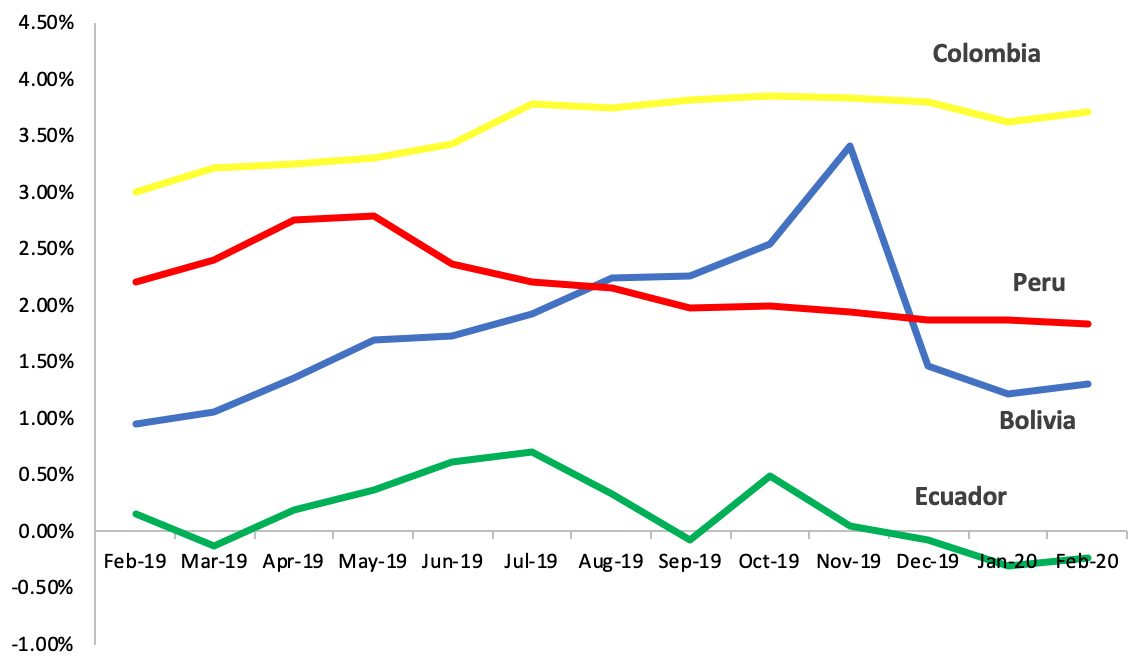
    Andean Countries: Inflation
    Monthly year-on-year figures

     Andean Countries: GDP growth (%)
    Quarterly figures are year-on-year growth
    GDP  end 2019* 2020 forecast* Q1 2019 Q2 2019 Q3 2019 Q4 2019
    Bolivia 3.0 3.0 3.9 3.4 2.3 Not yet available
    Colombia 3.2 3.5 2.8 3.0 3.3 3.4
    Ecuador -0.2 0.1 0.6 0.3 -0.1 Not yet available
    Peru 2.3 3.2 2.3 1.2 3.0 1.8
    Venezuela -25.5 -14.0 No data No data No data No data
    *Figures from the United Nations Economic Commission for Latin America & Caribbean Dec 2019
    Quarterly growth based on figures from the local central banks
  • BRAZIL: Tensions rise over electoral fraud claims

    Patrick de Courcy 05 August 2021 Hits: 4183

    President Jair Bolsonaro’s insistence that a reform to Brazil’s voting system is necessary to avoid the alleged risk of fraud in next year’s presidential election is stoking tensions. The president’s supporters have taken to the streets to demand paper ballots, while electoral authorities have launched an investigation into his baseless claims of fraud, presaging a long battle in the run up to the October 2022 elections.

    There had been hopes that President Bolsonaro might tone down his attacks on Brazil’s electronic voting system and veiled threats to cancel next year’s election following his renewed alliance with the ‘centrão’ congressional bloc, sealed with a ministerial appointment last week [WR-21-30]. But it has not been so. On the contrary, Bolsonaro has since doubled down on his claims that there is a risk of fraud in favour of his political opponents next year, frequently repeating that “there will not be an election” if printed receipts have not been introduced to guarantee a “democratic” and “clean” vote.  

    On 29 July, during the Thursday slot reserved for his weekly Facebook Live address, Bolsonaro delivered a two-hour presentation focused on the issue, which was broadcast on the public television network TV Brasil as well as his social media channels. Bolsonaro had hyped up this speech as the moment in which he would finally present proof of electoral fraud – he claims that he won the 2018 election in the first round and has also cast doubt over the results of the 2014 presidential election in which Dilma Rousseff narrowly clinched a win over Aécio Neves. Yet Bolsonaro not only failed to present any such proof but also actually admitted to possessing only “indications” of fraud. Many of the comments he and a government adviser made throughout the live address were debunked in real time by the fact-checking service of the supreme electoral court (TSE).     

    Three days later, on 1 August, ‘bolsonaristas’ took to the streets in cities across the country to express their support for the president and to demand that printed ballots be introduced to make the electronic voting machines more secure (a PEC constitutional reform to that effect is presently under discussion in congress). Bolsonaro addressed his supporters via videocall in several cities, including São Paulo and Brasília, congratulating them on fighting for “freedom and clean elections”. The following day, 18 judges who are former, current, or future presidents of the TSE issued a statement stressing that there have been no incidences of electoral fraud in Brazil since the electronic voting machines were introduced in 1996.    

    For legal and judicial experts, and indeed most politicians, the debate on the safety of Brazil’s electronic voting system is a moot one. The system was adopted precisely as a barrier against fraud. It allows for a rapid ballot count (results are delivered on the same day as an election) without the risk of human error. Different security layers are in place to protect the machines – which are not connected to the internet – from attacks.

    Electoral authorities argue that the inclusion of a printed receipt confirming each elector’s vote would be an unnecessary added cost and would increase the risk of electoral intimidation. Currently, a voter cannot check his or her ballot after it has been submitted, although the voting machines are auditable and allow for a recount if necessary.  

    Bolsonaro pays no heed to such arguments and has chosen instead to foment mistrust of the voting system with his unfounded and even conspiratorial claims. His view is shared by at least parts of the military. On 2 August, the heads of Brazil’s naval club, military club, and aeronautical club co-signed a note in which they defend the PEC 135/19 on printed ballots and cast aspersions over the TSE’s trustworthiness as an institution.

    The TSE is now pushing back against these attacks, and not just with words. On 2 August, its first day back after the mid-year recess, the TSE’s plenary voted in favour of launching an administrative investigation into allegations of electoral fraud. This means that Bolsonaro will be investigated for possible abuse of political and economic power, fraud, corruption, undue use of official channels of communication, and premature campaigning. The TSE has also asked the supreme court (STF) to include Bolsonaro’s 29 July live address in its investigation into the use of fake news by bolsonaristas, a request which was accepted on 4 August.

    Although these investigations will be slow and are unlikely to carry direct sanctions for Bolsonaro, they up the stakes. The STF’s fake news investigation has already caused political waves since it was launched in 2019. Should the TSE find Bolsonaro to be guilty of any of the wrongdoing listed above, this could provide the basis for petitions to bar his candidacy for re-election next year. The president has not backed down, however. Accusing the TSE president, Luís Roberto Barroso, of trying to impose his will, on 3 August Bolsonaro told supporters that he will “not accept intimidation” and appeared to call for more public pressure, saying he could appear at a rally in São Paulo “if that is what the people wish”. 

    Barroso

    President Bolsonaro’s attacks on Brazil’s voting system have frequently morphed into personal jabs at the current president of the supreme electoral court, Luís Roberto Barroso, who is also a supreme court justice. Barroso says that he pays no heed to these attacks but has reiterated his calls to protect Brazil’s democracy. “Incorrect things are happening in the country and we all need to be vigilant. We need institutions and civil society, both on the alert,” Barroso warned in his comments during the opening of the TSE’s session on 2 August. The following day, Bolsonaro suggested that Barroso acts in favour of former president Lula da Silva (2003-2011), his likely electoral rival next year.

  • URUGUAY: Minister recognises prison problem

    Patrick de Courcy 29 October 2021 Hits: 3288

    “Today we are violating human rights inside prisons,” Uruguay’s interior minister, Luis Alberto Heber, admitted during a congressional hearing on 28 September. He added that contributions towards finding solutions, rather than blame-throwing, are what is needed to address this fundamental flaw in the country’s penitentiary system.

    Heber was summoned to appear before congress by the left-wing opposition Frente Amplio (FA) coalition following the escape and recapture in August of a criminal from a prison in Montevideo in unclear circumstances. Heber’s case was not helped by the revelation, a few weeks later, that a first-time offender had been tortured and held hostage for 60 days by fellow inmates in the same prison, apparently without the prison staff realising. The interior minister was subjected to a 20-hour grilling in the chamber of deputies on 28 September which culminated in the opposition putting forward a motion calling for him to step down. But the ruling coalition led by the centre-right Partido Nacional (PN, Blancos) has a majority and the opposition’s motion was therefore discarded in favour of one expressing support for Heber and his “entirely satisfactory” responses.

    • Hugo Pereira

    Hugo Pereira, the leader of a local criminal organisation who was arrested during a police operation in November last year, escaped from the Santiago Vázquez prison in Montevideo on 14 August. He was captured again on 26 August, reportedly while enjoying a soft drink at a bar on a busy thoroughfare in the capital. The circumstances surrounding both his escape and his recapture remain nebulous; according to one report, Pereira simply walked out of the prison wearing a guard’s uniform – something Heber said would have been impossible without inside help.

    Uruguayan prisons have long suffered from overcrowding. According to figures cited by Heber, they are currently at 117.2% capacity, with 13,900 prisoners incarcerated. Prisons have seen the deaths of 56 inmates in 2021 so far: eight suicides, 15 homicides, and 31 fatal illnesses (just four of those from the coronavirus [Covid-19]), as well as one deadly accident and one unidentified death. “More [prisons] must be built to give dignity to inmates”, Heber said.

    While insisting that he is not seeking to blame previous administrations (the FA was in power for 15 years before President Luis Alberto Lacalle Pou took office in March 2020), Heber said that the current government has inherited a poor situation which will take time to be resolved. He echoed a comment made by the parliamentary commissioner for prisons, Juan Manuel Petit, when saying that “there is no prison policy in Uruguay”.

    Heber was, however, keen to highlight the efforts that the government has made on public security – an issue which contributed to Lacalle Pou’s election in 2019 [SSR-19-12]. “We believe the emphasis should be on what we are going to do from now on in a situation of unacceptable overcrowding,” he said. Speaking to lawmakers, he listed plans to construct new units and wings at a number of prisons, which together should create space for more than 1,500 prisoners.

    Heber also pointed to the work of a multidisciplinary technical advisory group, which was set up in July and has been dubbed the ‘prison GACH’ after the acronym for the scientific advisory group created to advise the government on its Covid-19 response. The prisons advisory group is currently working on a document containing recommendations on how to better manage the penitentiary system. Heber called for discussions on the state of prisons to be put on hold until the presentation of this document, notably resorting to this argument in the face of opposition criticism of the public security reforms contained in the government’s LUC omnibus law approved last year.

    The public security elements of the LUC have been criticised in part because experts believe they increase the burden on prisons [SSR-20-06]. The opposition has been campaigning to hold a referendum to overturn parts of the LUC, notably some of the articles covering public security issues.

  • BOLIVIA: MAS divisions deepen

    Patrick de Courcy 09 June 2022 Hits: 3866

    The cracks are getting wider in Bolivia’s Movimiento al Socialismo (MAS). The left-wing party, which achieved hegemonic status under former president Evo Morales (2006-2019) and continues to dominate national politics under President Luis Arce, is increasingly riven between factions loyal to each of those men. The latest flashpoint was Morales’ effort to secure the impeachment of Arce’s interior minister, Eduardo del Castillo, who faced a congressional grilling on 31 May. Such interventions by Morales are growing more frequent, yet Arce has so far refrained from returning fire for fear of antagonising the MAS rank and file.

    In joint public appearances over the past few months, President Arce and Morales have presented a united front. Speculation over a growing rift with Morales, who retains the presidency of the MAS, has been dismissed by the Arce administration. Yet the divisions are ever more visible. In April, Morales leaked audio recordings in which the then-director of Bolivia’s counter-narcotics agency (FELCN), José María Velasco, appeared to order agents to ignore a cocaine laboratory in the central department of Cochabamba. Two days later, Velasco was fired and placed under investigation by the attorney general’s office [WR-22-14].

    Morales has now moved against another Arce appointee, rallying loyal deputies against Del Castillo. On 31 May, Del Castillo was summoned before congress to face a grilling on high crime rates in El Alto (La Paz). He was subjected to fierce criticism by Morales loyalists, who accused him of lying about the security situation in El Alto and of overseeing allegedly irregular payments to police officers.

    His critics within the MAS then presented a motion for a vote of no confidence against Del Castillo, on which opposition parties abstained. Of the 145 deputies in attendance, 77 voted against holding a confidence vote, saving the interior minister from the possibility of impeachment.

    The opposition’s abstention led Morales to accuse Del Castillo of being a pawn of right-wing parties. “How can our interior minister be supported by the right?” Morales asked on 3 June, saying that Arce “will need to explain” the abstentions. The failure of the pro-Morales faction to unseat Del Castillo indicated that most MAS deputies remain loyal to Arce. But the dispute raises the possibility of prolonged internal strife in the MAS.

    That could spell trouble for the party if the infighting continues to escalate in the run-up to the 2025 general elections. The intervening three years will give the MAS plenty of time to resolve its differences, but Morales is widely understood to be weighing up another presidential bid. The ongoing trial of former president Jeanine Áñez (2019-2020) may have given the party’s warring factions a common narrative, but a guilty verdict for Áñez would vindicate Morales’ claims that he was removed in a coup and re-energise support for him at the expense of other MAS hopefuls for 2025.

    There is little chance of the MAS’s internal divisions being capitalised upon by the opposition any time soon. The MAS’s dominance is entrenched at the local level across most of the country, while the opposition’s only region of real dominance is the eastern department of Santa Cruz, governed by Luis Fernando Camacho of the far-right Creemos. The main centre-right opposition party, Comunidad Ciudadana (CC), lacks anything approaching the hegemony of the MAS or the local clout of Camacho.

    Del Castillo summoned again

    Eduardo del Castillo was issued another congressional summons on 8 June, after a group of deputies led by Marcelo Pedrazas (CC) raised concerns over the alleged trafficking of stolen cars by Bolivian police and border agents. The commander of Bolivia’s police, Jhonny Aguilera, admitted on 7 June that there had been “negligence” in the police’s response to the trade in stolen vehicles, which were allegedly smuggled from Chile by security officials. Del Castillo will face the next grilling on 7 July.

  • CHILE: The peso swoops and surges

    Patrick de Courcy 10 August 2022 Hits: 1892

    July was an odd month in the life of the Chilean peso. Early on, the national currency appeared to be collapsing. The price of the US dollar surged to Cl$1,051, breaking past the psychologically important 1,000-peso mark for the first time. President Gabriel Boric said the situation was “tremendously worrying”. But after the central bank (BCCh) announced a hefty US$25bn currency support package, the peso reversed direction.

    By the end of the month the currency had pushed up again, taking the cost of a dollar down to nearly Cl$900. Juan Pablo Tiznado of brokers XTB Latam suggested the peso could appreciate further to 880 a dollar in the first week of August (it closed at Cl$918/US$1 on 5 August, having dropped below the Cl$900 mark earlier in the week).

    Part of the explanation for this roller coaster ride lies in the sheer power of the BCCh’s intervention. On 13 July it announced a 75 basis-point increase in its benchmark interest rate up to 9.75%, the ninth increase so far this year. Then it announced it was deploying US$25bn to support the peso in the period running up to end-September. Of this, US$10bn was to be in the form of spot dollar sales, another US$10bn would be in exchange rate coverage instruments, and US$5bn would be in currency swaps. Marcos Casarin, chief Latin American economist at Oxford Economics, said “US$25bn in a country like Chile where GDP is not very big, is remarkable. There is no doubt that the peso is going to be an out-performer in the aftermath.”

    While the central bank intervention explains a lot, other factors were also at play. It can be argued that perceptions of the state of the world economy shifted subtly between the first and second halves of the month. In the first half all the emphasis was on high US inflation and high growth, fuelling an expected relentless process of monetary tightening by the Federal Reserve. Investors were therefore expected to seek safe havens and dump emerging economy assets. The US dollar appreciated against all major Latin American currencies. In addition, as Covid-19 hit key cities, Chinese import demand faltered, giving another reason to sell pesos: the Chilean currency suffered the consequences of a dip in the price of copper, the country’s main export.

    But by the second half of the month the picture had changed. With inflation still high, some potential signs of weakness had begun to emerge in the US, European, and Japanese economies. Those signs might tempt central banks to consider a pause in monetary tightening, reducing pressure on emerging currencies. Meanwhile the copper price began to push up again, giving the peso some new support. Financial trends in Chile may have also strengthened the Chilean currency. A drop in the value of shares in AFPs (the private pension providers) led investors to sell US dollars to move into more conservative local funds.

    Overall, the peso will still have weakened this year, but by less than at first feared. According to Francisco Castañeda of Chile’s Universidad Mayor, in the year to date the US dollar had appreciated against the peso by around 20%, but thanks to the peso’s stronger trajectory in the second half of July, the overall greenback appreciation had been reduced to 12%.

  • VENEZUELA: UN maintains pressure over human rights

    Patrick de Courcy 13 October 2022 Hits: 2735

    The United Nations Human Rights Council (HRC) voted on 7 October to extend the mandate of the International Fact-Finding Mission on Venezuela (FFMV) for a further two years. The FFMV’s extension was welcomed by human rights organisations and was one of three blows suffered by President Nicolás Maduro’s administration in the past week, which also saw Venezuela lose its much-criticised seat on the HRC and the narrow failure of an international effort to remove opposition leader Juan Guaidó’s delegate from the Organization of American States (OAS).

    The extension of the FFMV’s mandate was hardly surprising, given the continued allegations of systemic human rights violations in Venezuela – ordered, according to the FFMV’s latest report in September, by top tier officials including President Maduro himself [WR-22-38]. This was one of four reports published by the FFMV, which have variously found evidence of crimes against humanity, judicial complicity in providing impunity for human rights violations, and rights abuses in mining areas.

    The deputy Americas director at Human Rights Watch, Tamara Taraciuk Broner, said that the FFMV’s extension “is extremely important, not only to support victims’ quest for justice, but also to play an early warning role in the lead-up to the 2024 presidential elections”. In addition, by maintaining a powerful spotlight on the human rights situation in Venezuela, the FFMV’s extension is likely to complicate Maduro’s ongoing efforts to reintegrate his government in regional diplomatic circles [WR-22-40].

    • More details on opposition primaries

    On 10 October, Venezuela’s main opposition coalition, the Plataforma Unitaria Democrática (PUD), announced further details on how its primary elections will be organised ahead of the 2024 presidential vote. From 15 October, when the deadline for entries closes, the PUD will whittle down candidates to leave only “citizens of recognised prestige and moral solvency”, who will form a ‘national primary commission’. This commission will then devise further procedures for what is expected to be a popular vote to select a single PUD candidate.  

    Those efforts were served a further blow at the 52nd General Assembly of the OAS on 6 October, with the failure of an attempt to remove Guaidó’s representative to the OAS, Gustavo Tarre. Tarre was recognised by the OAS as Venezuela’s representative in 2019 during Venezuela’s presidential crisis, as part of Guaidó’s efforts to prevent Maduro from pulling Venezuela out of the regional body. The attempt last week to unseat Tarre was made in a petition by the representative of Antigua and Barbuda, and was seconded by eight countries, including Mexico and Bolivia.

    The petition garnered 19 votes, falling short of the 24 needed for Tarre to be ousted. Nevertheless, the relatively strong backing it received will have rattled Guaidó, for whom support appears to be draining in the international arena. It was backed by major regional players including Colombia, Chile, and Argentina – Chile’s vote in particular will have stung Guaidó given that, of those three countries, Chile under President Gabriel Boric has been by far the most critical of Maduro’s human rights record. Guaidó responded with a video message asking “which side would [Latin American independence hero Simón] Bolivar be on? That of Maduro, a criminal against humanity... or with the Venezuelans who persist and ask for free elections?”

    Maduro’s diplomatic efforts received another, widely expected blow on 11 October, when Venezuela lost its seat on the HRC following a vote by the UN General Assembly. The appointment of Venezuela to a three-year term in 2020 was met with fury by the Venezuelan opposition and human rights organisations, many of which portrayed Venezuela’s appointment as evidence of the need to reform the UN’s human rights apparatus. The Venezuelan bid to be re-appointed received 88 votes in favour this week, and the two available positions on the HRC for Latin American and Caribbean nations went to Chile, which received 144 votes, and Costa Rica, which received 134 votes.

  • GUATEMALA: Major setback in efforts to redress civil war impunity

    Patrick de Courcy 15 June 2023 Hits: 3480

    A “de facto amnesty”. This was the response by local human rights groups like Centro para la Acción Legal en Derechos Humanos (CALDH) to a recent ruling by a Guatemalan appeals court ordering the release of former high-ranking military officers convicted of crimes against humanity dating back to the civil war (1960-1996), in which some 250,000 civilians were killed or disappeared. The ruling is widely considered the latest sign of Guatemala’s compromised institutions, which have targeted high-profile independent judges like Miguel Angel Gálvez, who have been forced into exile over their efforts to redress civil war impunity [WR-22-46].

    Issued on 9 June, the court ruling is in line with a resolution by the discredited constitutional court (CC) and orders the release of three former military officials: former colonel Francisco Gordillo; former general Manuel Antonio Callejas y Callejas; and former general Benedicto Lucas García, the brother of former president Fernando Romeo Lucas García (1978-1982). Despite the 9 June appeals court decision, which contravenes a 24 March 2023 ruling by the Costa Rica-based Inter-American Court of Human Rights (Corte-IDH), Callejas and Lucas have not yet been released. The two men are facing trial for other cases including the genocide of Maya Ixil indigenous people, which was due to begin in January this year, but has been suspended.

    The three former military officials were sentenced in 2018, along with Hugo Ramiro Zaldaña Rojas, a former major and ex ‘S-2’ intelligence official of the chief-of-staff, to between 33 and 58 years in prison for the 1981 enforced disappearance of 14-year-old Marco Antonio Theissen and the illegal detention, torture, and rape of his sister Emma Molina Theissen. The 2018 ruling came 14 years after the Corte-IDH found the Guatemalan State responsible for Theissen’s forced disappearance. It was hailed as a breakthrough by human rights groups, as one of the first times that senior military officers have been prosecuted for serious human rights violations since the 2013 verdict of genocide against former military dictator Efraín Ríos Montt (1982-1983), although that verdict was swiftly nullified by the CC.

    The 9 June ruling has been slammed as a major setback to efforts to redress civil-war impunity by CALDH, along with other rights groups. Indeed US-based lobby group Washington Office on Latin America (Wola) has been among those to point out previously that Callejos, who was head of military intelligence under the Lucas García administration, has been identified as a founding member of the Cofradía (The Brotherhood), an organised criminal enterprise comprising former senior military officers, which spawned illegal clandestine security apparatuses (CIACs). Meanwhile, Benedicto Lucas García is a former head of the army’s high command, who is associated with the army’s notorious scorched earth counter-insurgency policy during the civil war.

    Amnesty?

    In 2019, Guatemala’s 160-member unicameral congress floated the possibility of passing legislation which proposes changes to the national reconciliation law, which prohibits granting amnesty to those who committed international crimes during the internal conflict. In June 2021, Ríos’s party, Valor, presented an initiative (which did not prosper) that would end any criminal proceedings or sentences related to crimes that took place during the internal armed conflict.

    Latest polls

    The presidential candidacy of Zury Ríos, Efraín Ríos Montt’s daughter, who is running for the ultra-right-wing Valor-Unionista coalition and is among the top three contenders ahead of the 25 June presidential election, has raised further questions about the future of efforts to tackle civil-war impunity.

    With the removal of previous frontrunner Carlos Pineda from the presidential race, the third candidate to be barred by the discredited electoral authority (TSE) on dubious grounds [WR-23-21], the latest CID Gallup survey published on 24 May shows former first lady Sandra Torres (2008-2012) of Unidad Nacional de la Esperanza (UNE) leading, with 23% of voting intentions.  

    Torres is ahead of former diplomat Edmond Mulet (Cabal) on 21%, while Ríos is third on 19%. Mulet’s candidacy has been subject to doubt after the attorney general’s office revealed back in March that it had requested the removal of his immunity from prosecution [WR-23-12].

  • CUBA: Economy minister goes

    Abbi Dicker 08 February 2024 Hits: 4634

    Cuba’s council of state, which is headed up by President Miguel Díaz-Canel, named Joaquín Alonso Vázquez, the president of the central bank (BCC), as the country’s new economy minister on 2 February. He replaces Alejandro Gil, who had been in the job since 2018. Juana Lilia Delgado Portal, a former deputy economy minister who has held various posts in the BCC, has been named as the central bank’s new president.

    Gil’s departure followed delays to the implementation of new price rises for fuel and transportation which were slated to take effect at the start of the month but postponed amid reports of a cyber-attack from abroad. The government had announced the price rises last month, with the cost of a litre of regular gasoline to rise to CUP132 (US$1.10) from CUP25 and premium gasoline, to CUP156 per litre from CUP30. The government also announced major increases in domestic airline tickets and inter-province bus fares, although public transport fares within cities will not be affected.

    The price rises were in line with an economic stabilisation plan which was presented at the end of last year by the Partido Comunista de Cuba (PCC) government as part of efforts to boost Cuba’s faltering economy (see our sister publication Economy & Business [EB-24-01] for more details). This has yet to recover from the impact of the coronavirus (Covid-19) pandemic and remains affected by US economic sanctions, and devastation wreaked by hurricanes, among other things.

    At the end of last year, Gil warned that Cuba’s GDP could shrink by 1%-2% in 2023. This was compared with previous GDP growth forecasts of 3%. Gil did forecast that the economy would recover, however, to register 2% growth in 2024.

    As well as Gil’s replacement, the PCC government announced two other ministerial changes. Alberto López, the current governor of the central province of Villa Clara, and a national legislator, is the new minister of food industry, replacing Manuel Santiago Sobrino. Eduardo Martínez Díaz, the president of Cuban pharmaceutical group Grupo Empresarial BioCubaFarma, has taken over the science, technology & environment portfolio, replacing Elba Rosa Pérez, who had been in the job for over 11 years.

    Proposals in the pipeline

    The three legislative bills so far presented but which, at the time of President Chaves’ announcement, had yet to feature on the national assembly’s agenda included plans to broaden crimes for which the judiciary can authorise phone-tapping; stiffen penalties for possession and use of illegal weapons; and to amend authorisation of electronic ankle tags. Initiatives currently being drawn up reportedly include plans to expand legal processes for minors, increase penalties for adults who involve minors in crime, and to provide judges with more scope for assigning preventative prison for suspects.