All Categories

Subcategories

  • Down the road of domestic polarisation

    Patrick de Courcy 16 November 2023 Hits: 605

    Politics in Latin America has always been rough-edged, combative, and passionate. It would therefore be a mistake to entirely blame the spread of social media and new emerging communications technologies for the observed increase in partisanship, political violence, and use of hate speech. A wide number of other deeply rooted and structural factors are clearly involved, including inequality, poverty, crime, corruption, and political systems which do not adequately represent the population. That said, it is also evident that some of the more negative aspects of political behaviour have become more harmful, precisely because there is now a bigger and more comprehensive toolkit for disinformation. In short, the new technologies may be allowing what used to be fairly small-scale and localised dirty tricks to become much more widely effective.

    It is also clear that a new generation of political strategists and campaign advisers has emerged, selling their services as masters of disinformation. A series of investigative reports by media outlets that form part of the Centro Latinoamericano de Investigación Periodística (CLIP) has offered a tantalising glimpse into the way these people work. A key figure is an Argentine consultant called Francisco Cerimodo who, as we have seen, played a big part in attempts to undermine the legitimacy of the 2022 Brazilian election. However, according to Chilean online news outlet La Bot, Cerimodo and an associated consultancy, Numen Spa, also played an active but low-profile role in Chilean politics.

    Cerimodo’s first intervention in Chile was a complete failure. He sought to influence the October 2020 referendum, when Chileans were asked whether they wanted a new constitution to be written (apruebo) or for no change to be made (rechazo). While most opinion polls were correctly predicting around 70% support for apruebo, Numen claimed that, using a supposedly much larger online sample, it had established support for apruebo was much weaker, at only 42%. In addition, it argued that if those planning to abstain could be convinced to get out and to vote, rechazo could win. Right-wing leaders of the rechazo campaign later admitted that they had funded the survey and that it was primarily used for disinformation purposes, to manipulate public opinion. Cerimodo later dismissed it as “a sampling error, serious, but still an error”.

    Cerimodo also played a part in the September 2022 referendum when voters were asked whether to approve a progressive constitution written by a constituent assembly dominated by left wingers and independents. By that time opinion in the country had genuinely shifted back towards the right and the new constitution was rejected by 62% of voters. Cerimodo was nevertheless identified as mounting dirty tricks to support the ‘No’ vote. In a published interview with Argentine newspaper La Nación he denied using disinformation but admitted to creating thousands of automatic accounts (in other words, bots) on social media to position political messages in both Chile and Argentina. He added that he had “thousands of trolls” and that he waited 3-4 months between creating and activating them, to avoid algorithms used by Big Tech companies to purge them.

    In the 2022 Chilean referendum campaign, Cerimodo promoted the unfounded scare story that the new constitution would limit property rights and prohibit private home ownership. In fact, the text of the constitutional draft recognised the right to “dignified” housing, a new right compared to the existing constitution. But the leaflet, written by an until-then unknown group called Constitutional Facilitators claimed the state would itself own housing for rental, with private ownership in effect suppressed by politicians. Fact-checking groups said this was a complete distortion. Ownership of the Constitutional Facilitators web domain was traced back to Cerimodo, although he claimed he used it for commercial hosting and support and was not involved in the content.

    A different disinformation technique appears to have been used by a Mexican citizen, César Hernández, using a company called Neurona, and a series of websites calling themselves Revolución 3.0. Hernández has been closely linked to leading members of Mexico’s ruling left-wing party, the Movimiento de Renovación Nacional (Morena) and to other left-wing groups mainly in Venezuela, Ecuador, and Bolivia. The status of this particular fake-news network is however currently somewhat unclear, with its activity and web presence dipping since 2015 when Hernández faced court investigations over alleged misuse of public funds in Spain, Bolivia, and Ecuador. In an apparent acknowledgement of this, in May 2023 Hernández told a journalist “We are Plan B now”.

    According to an investigation by Mexico’s Animal Político news portal and the anti-corruption lobby group Mexicanos Contra la Corrupción y la Impunidad (MCCI), in his hey-day Hernández controlled at least 116 web domains in different countries, of which 31 claimed to be news portals but behave in an “inauthentic manner”. These sites were often inactive, but rapidly came into play during election campaigns. Using strident headlines and vivid images they copied and pasted plagiarised news stories from other sites, selected to support left-wing causes and attack the right, while trying to appear unrelated. They also appear to have bought advertising space. Facebook owner Meta has described such activity as “coordinated inauthentic operations”. Typically, Neurona was involved in promoting Alfredo Ramírez Bedolla, the Morena governor of Michoacán state, while running negative stories about his predecessor and political opponent, Silvano Auereoles of the Partido de La Revolución Democática (PRD).

    Rossana Reguillo, director of digital research at Signa Lab at ITESO, the Jesuit University of Guadalajara, described the approach used as an attempt to create an “echo chamber”, adding: “People get trapped in these dynamics or in these portals that are characterized by the use of strident colours, words in capital letters, bold adjectives. All this undermines the health of public debate and, of course, generates levels of hatred and distrust.” In 2017 Neurona staff used trolls to create content and hashtags attacking Guillermo Lasso, then a right-wing Ecuadorean presidential candidate. These claimed he was preparing a “shock tax package” that would increase income tax by 129%. That was untrue. A proposal for higher income tax had in fact been made, but not by Lasso: it was a recommendation to all candidates proposed by the Ecuadorean Chamber of Commerce.

    Another disinformation practitioner has been identified as a Brazilian citizen, André Golabek, who operates through Venquis, a political consultancy active in various countries, and has been involved in creating troll farms to promote ‘Bolivarian’ politicians in Venezuela, as well as backing a spectrum of left-wingers in Bolivia, Panama, and the Dominican Republic. The company appears to be supporting José Gabriel Carrizo, Panama’s vice-president, who is running in the 2024 presidential race in his country. An investigation by media research group Cazadores de Fake News in 2021 found that at least 187 Twitter (later X) accounts were involved in coordinated posting and inauthentic behaviour to back specific candidates or raise associated issues in Venezuela’s regional elections held that year. The number was later increased to 357.

    Cazadores built up an infographic where each dot represented a Twitter account, and each line indicated where one account was ‘following’ another. The result was also colour-coded to represent the type of content each troll was primarily posting. The magenta cluster for example, contained largely false opposition or impostor posts, designed to embarrass anti-government candidates. The yellow cluster posted information to support government-backed candidate Jorge Arreaza in Barinas state, and the red cluster backed Héctor Rodríguez in Miranda. These accounts also contained material attacking opposition candidate Freddy Superlano in Barinas and supporting government-backed financier Alex Saab (facing money laundering charges in the US). There was also content relating to the Miss Venezuela beauty competition, perhaps for clickbait reasons.

    The Bolivarian troll farm
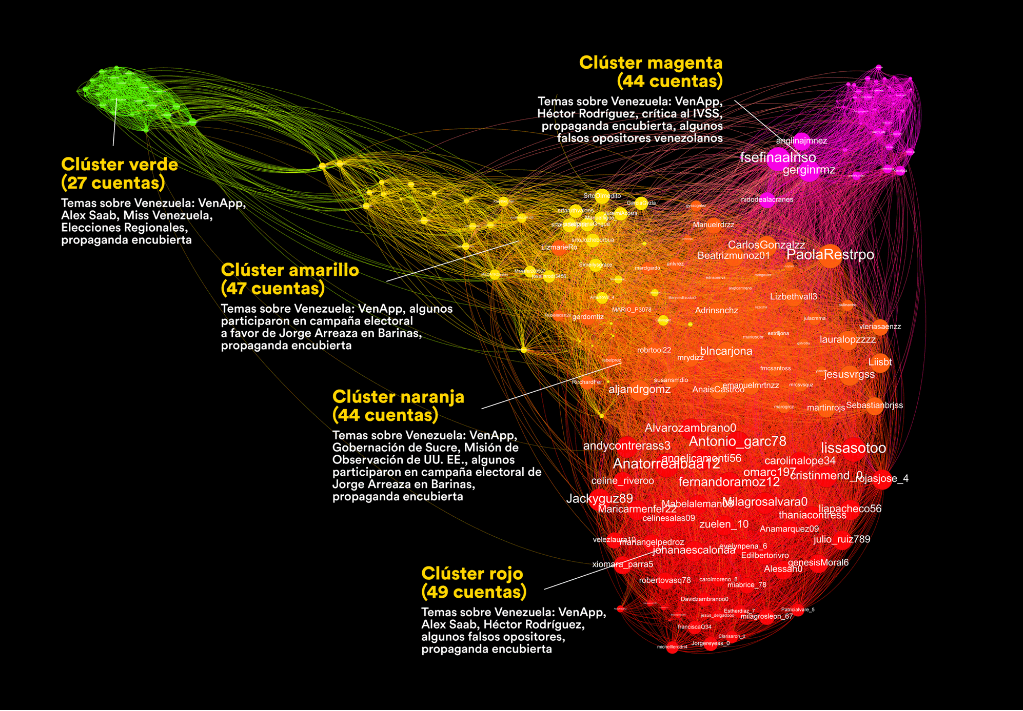
    Source: Cazadores

    Significantly the troll accounts also strongly urged followers to find and download a government app, known as VenApp. In May 2022, President Nicolás Maduro unveiled VenApp, which he said was an application built by Venezuelan computer engineers and intended to allow citizens to report public service and utility breakdowns, as well as generally increasing the efficiency of e-government. However, according to Cazadores, the app had in reality been built by companies connected to Venquis and Golabek, using programmers in Panama and the Dominican Republic.

    In Cazadores’ view, the app has the capacity to gather sensitive personal information (including identity documents numbers, geo-location coordinates, addresses, emails, and telephone numbers) all of which could be used to influence future electoral campaigning and outcomes. It comments “access to high volumes of personal data collected by VenApp could allow the Venezuelan government to microsegment the electorate, breaking it down into smaller groups to which personalised messages could be sent in future election campaigns, tailored to their interests, concerns and needs”.  This approach sounds similar the Cambridge Analytica story mentioned earlier in this report.
  • How deep is the pain?

    Patrick de Courcy 27 March 2024 Hits: 1711

    A key question looking forward is to assess the level of hardship imposed on the population at large, as a result of high inflation and a growing recession. The Milei government has from the start made clear that economic conditions are likely to get worse before they get better. That is implicit in his programme of shock measures which focus on further devaluing the peso to restore export competitiveness, cutting the fiscal deficit, and reducing the size of the state. A recession is inevitable but there is less certainty over how deep it will be, and over how long it will last. Benjamin Gedan, director of the Latin America Programme at the US based Wilson Centre, emphasizes how consequential the outcome may be. “It is a fairly traditional approach to stabilisation” he says, but he warns “that doesn’t mean it is not dramatic and high stakes…it is an act of either political courage or political suicide”.

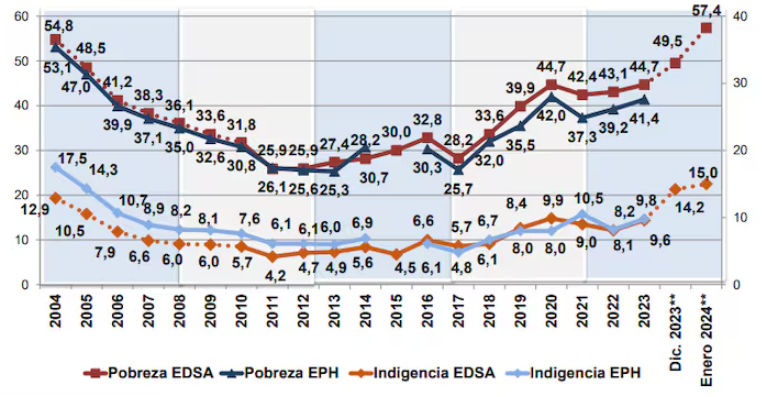
    One important measure of hardship has been produced by the Observatorio Social of the Catholic University (Universidad Católica Argentina – UCA). It estimates that in January 2024, 57.4% of the population, or 27m people, were living below the poverty line, unable to afford a basic basket of goods and services (known as Canasta Básica Total – CBT). Particularly important is the speed at which the general poverty rate has increased. In the third quarter of 2023 the poverty rate stood at 44.7%, rising to 49.5% in December 2023 and then to 57.4% in January. In other words, in a period of a few months the population living in poverty rose by 12.7 percentage points or by just under 6m people. As significant perhaps is that the current rise in poverty numbers is higher than during Argentina’s last major crisis just over two decades ago.  

    Within the total living in poverty, UCA found that 15% were living in extreme poverty or indigence. This category is defined as those people who cannot afford to purchase basic foodstuffs contained in the Canasta Básica Alimentaria (CBA). The director of the Observatorio Social, Augustín Salvia, told local media that the sharp increase in poverty rates reflected the previous government’s “four years of economic inefficiency”. He warned that “if this doesn’t work out for the government there will be a break point, things will get worse and there may be a social explosion.”  At a more anecdotal level newspapers and foreign correspondents have been writing for several months now about the spread of food banks in poor communities.   

    Poverty rates on the rise again

    Note: Pobreza = Poverty, Indigencia = Indigence/Extreme poverty, EPH = discontinued statistics series

    Source: La Nación, UC

  • The European strategy

    Abbi Dicker 16 May 2025 Hits: 2574

    Speaking in April, Henna Virkkunen, European Commission vice president for technology sovereignty, said the AI race is far from over. She presented a plan to build five gigafactories in Europe, noting “Of course, the US has the large technology companies, and China has its own vision, but in the EU, we must take advantage of our own strengths.”  Virkkunen said the commission is aiming to mobilise EUR200bn (US$227bn) in public-private partnership investment for AI. This would include spending some EUR20bn (US$22.7bn) on the five gigafactories, a term invented by Elon Musk to describe major battery production plants.

    In the EU’s vision however, the gigafactories would produce not batteries but a range of AI-related high-tech products and services. Each facility would have 100,000 latest-generation silicon chips, radically increasing computing and processing power. Investment would triple data-centre capacity in Europe. Virkkunen estimates that only 13% of European industry is using AI technology, meaning the continent has an as-yet untapped potential “to become more productive and to develop new services using applied AI”.

    The European Commission is also considering whether to amend the AI law which came into force last year. Virkkunen said Brussels remains committed to a risk-based approach to regulation but is also now considering whether bureaucracy and red tape could be further reduced, particularly in relation to AI use by small and medium-sized enterprises. The Commission, she said, was also interested in feedback on the law, to reduce any uncertainty that might be holding back technology development. Various lobby groups say there is a gap in the new law, since companies are not required to assess or mitigate generative IA models for risks, including possible violations of civil and human rights. There is also an open debate on the treatment of intellectual property (IP) and copyright in the content of learning models. Virkkunen acknowledged that there is “a balance to be found” on these issues.

  • The Competitiveness debate

    LatinNews 28 August 2018 Hits: 417

    One of the most widely accepted measures of country-level competitiveness is the Global Competitiveness Index (GCI) compiled every two years by the World Economic Forum (WEF). WEF defines competitiveness as “the set of institutions, policies, and factors that determine the level of productivity of a country”. Productivity is seen as determining the rate of return on investments in a given territory, which in turn drives growth rates. A more competitive economy is expected to be a faster-growing one. WEF compiles the GCI by assessing over 60 indicators divided up into 12 categories or ‘pillars’. These pillars are institutions, infrastructure, macroeconomic environment, health and primary education, higher education and training, goods market efficiency, labour market efficiency, financial market development, technological readiness, market size, business sophistication, and, finally, innovation. It is worth noting that under market size there is an assumption that a country with a larger market is likely to be more competitive; however, the way the GCI methodology works means it is possible for smaller countries to offset this negative factor with other positive ones.

    Of interest to the discussion is the WEF’s categorisation of three main stages of development. In the first stage of development, a country’s economic growth is assumed to be primarily factor-driven: therefore its competitiveness is assumed to depend primarily on well-functioning institutions (1st pillar), infrastructure (2nd pillar), macroeconomic management (3rd pillar) and a healthy and educated workforce (4th pillar). The next stage of growth is efficiency-driven, when productivity becomes more important. Here education and training (5th pillar), efficient goods markets (6th), well-functioning labour markets (7th), financial markets (8th), technology (9th), and market size (10th) become more important). Finally, in the third, innovation-driven stage, it is the last two pillars, business sophistication (11th) and innovation (12th) that come to the fore. Of the economies we are examining Honduras is classified as being in a transition between the first and second phases; Brazil, China, Guatemala, and Mexico are in the second, efficiency-driven stage; Argentina, Costa Rica, Panama, and Uruguay are classified as being in transition between the second and third stages; and Australia, Norway, Switzerland, and the United States are in the third, innovation-driven stage.

    One way of identifying what the ‘successful’ small counties are doing right in the field of competitiveness is to compare the highest-ranked in the GCI, Costa Rica, with the lowest-ranked among our ‘small and failing’ country group, which is El Salvador. Costa Rica is ranked 47th in the world for competitiveness, while El Salvador comes in at 109th. On the WEF’s scale of 1 to 7, Costa Rica scores 4.8. Its scores particularly well for the pillars relating to health and primary education (where it is ahead of the Latin American average), higher education and training, goods market efficiency, labour market efficiency, financial market development, and technological readiness. The three most-problematic factors for doing business are identified as inefficient government bureaucracy (23.1% of business respondents), inadequate supply of infrastructure (18.4%), and tax rates (10.4%).

    Costa Rica WEF

    In contrast, El Salvador scores only 3.8 in the general index, and well below Costa Rica on most pillars. El Salvador’s best performance is also registered in health and primary education where it is close to the Latin American average, but it lags behind for the quality of its institutions, on higher education and training, on labour market efficiency, and on innovation. The most problematic factors for doing business are identified as crime and theft (19.5% of respondents), corruption (15.9%), and inefficient government bureaucracy (11.1%).

    El Salvador WEF

    One of the big contrasts between Costa Rica and El Salvador is only partially captured in the WEF data. Put simply, this is that for a variety of historical reasons, El Salvador has been, and continues to be, a much more violent society than Costa Rica, something which has a clear economic and social cost. El Salvador has a history of greater political instability and experienced a bitter civil war for over 12 years (1979-1992). Democracy was re-established in the 1990s, but continuing poverty and inequality led to the spread of violent gangs (known as maras) dedicated to drug and people trafficking and extortion. Because of this, El Salvador, along with its two ‘Northern Triangle’ neighbours, Guatemala and Honduras, has in recent years experienced some of the highest peacetime homicide rates in the world. In 2017 El Salvador had the second-highest homicide rate in Latin America, equivalent to 60 homicides per 100,000 inhabitants. The homicide rate in Costa Rica in the same year was only 12.1 per 100,000, placing it among the more peaceful and secure countries in Latin America.

  • Conclusion: to what extent did the previous fossil fuel era end?

    Abbi Dicker 09 July 2026 Hits: 479

    In conclusion, fossil fuels never stopped being a vital part of Latin America’s energy landscape. Regional commitments to the energy transition were real and in many cases ambitious, and renewables have become a key contributor to electricity generation. Further growth is likely in this regard, as conditions in many countries are advantageous and the costs of adding new renewable capacity are lower than the equivalent thermal generation plants. But decarbonising other areas of the economy has been held back by a shortfall in investment, particularly in transmission and distribution. The domestic energy transition therefore remains incomplete, which is true around the world, not only in Latin America.

    The need for investment is only increasing, as electricity demand continues to grow and rapid urbanisation is placing additional strain on ageing infrastructure, while changing weather patterns linked to climate change are making the region’s many hydroelectric plants less reliable at the very moment they are most needed.

    At the same time, attempts to reduce the role of fossil fuels in national economies quickly collided with political and economic realities in the region. NOCs are inextricably linked to questions of national sovereignty and are key factors in the fiscal stability of many producing countries, making winding them down unpopular with voters and difficult for the public purse, particularly at a time of strained national budgets. And although investments in fossil fuels declined, they have remained above those dedicated to renewables, even as the latter have increased rapidly. 

    Changing external conditions mean that demand for oil and gas has held up, particularly in the wake of supply chain disruptions caused by Russia’s invasion of Ukraine and the US-Israel war on Iran, which have brought worries around energy security into sharp focus around the world. 

    And while some proposed new exploration has become unviable now that oil prices have plunged from the highs seen during the Iran war, much of the new capacity that is slated to come online was evaluated during the previous period of much lower prices and will remain profitable at around US$60 per barrel. 

    Combined with a geopolitical environment in which there is no external pressure to rein in fossil fuel exploitation, which is in fact being actively encouraged by the Trump administration, this has resulted in a hybrid model in which the energy transition is reconfigured, rather than stalled. 

    Producing countries that are either fiscally dependent on fossil fuel revenues, or perceive the cost of winding down production to be too high politically, continue to ramp up exports in order to extract the maximum economic benefits from their reserves before the world reaches peak oil. 

    Alfonso Blanco, director of the energy transition programme at Washington-based thinktank the Inter-American Dialogue, summarised the situation succinctly: “If I commit to stop producing [oil and gas] voluntarily, I lose the chance to monetise my reserves while others are making use of their resources. I am losing my chance for development.” This development may also include the pursuit of decarbonisation in the domestic economy, according to figures such as Brazil’s da Silva, whether to fund social programmes, develop new productive sectors or advance energy security.

    Of course, an oil price crash due to a supply glut combined with falling demand, renewed multilateral pressure on climate grounds, or a reversal in US policy under a future administration could change these calculations again. But for now, regional governments will likely continue to try and reap both the benefits of the energy transition and their vast fossil fuel reserves before the window closes.

  • Intended sanctions violations

    Patrick de Courcy 12 August 2024 Hits: 1215

    While a number of companies and individuals may be in violation of sanctions unknowingly – often because they are unaware of the connections and business dealings of their commercial partners – a separate group of actors is well informed and knowingly involved in the business of sanctions busting. In effect some of the major target countries on the OFAC list, including Russia and Iran or, in Latin America, Cuba, Venezuela, and Nicaragua, have supported a semi-clandestine network of intermediaries, traders, freight shipment companies, accountants, and others who are used to evade sanction regulations on a daily basis.

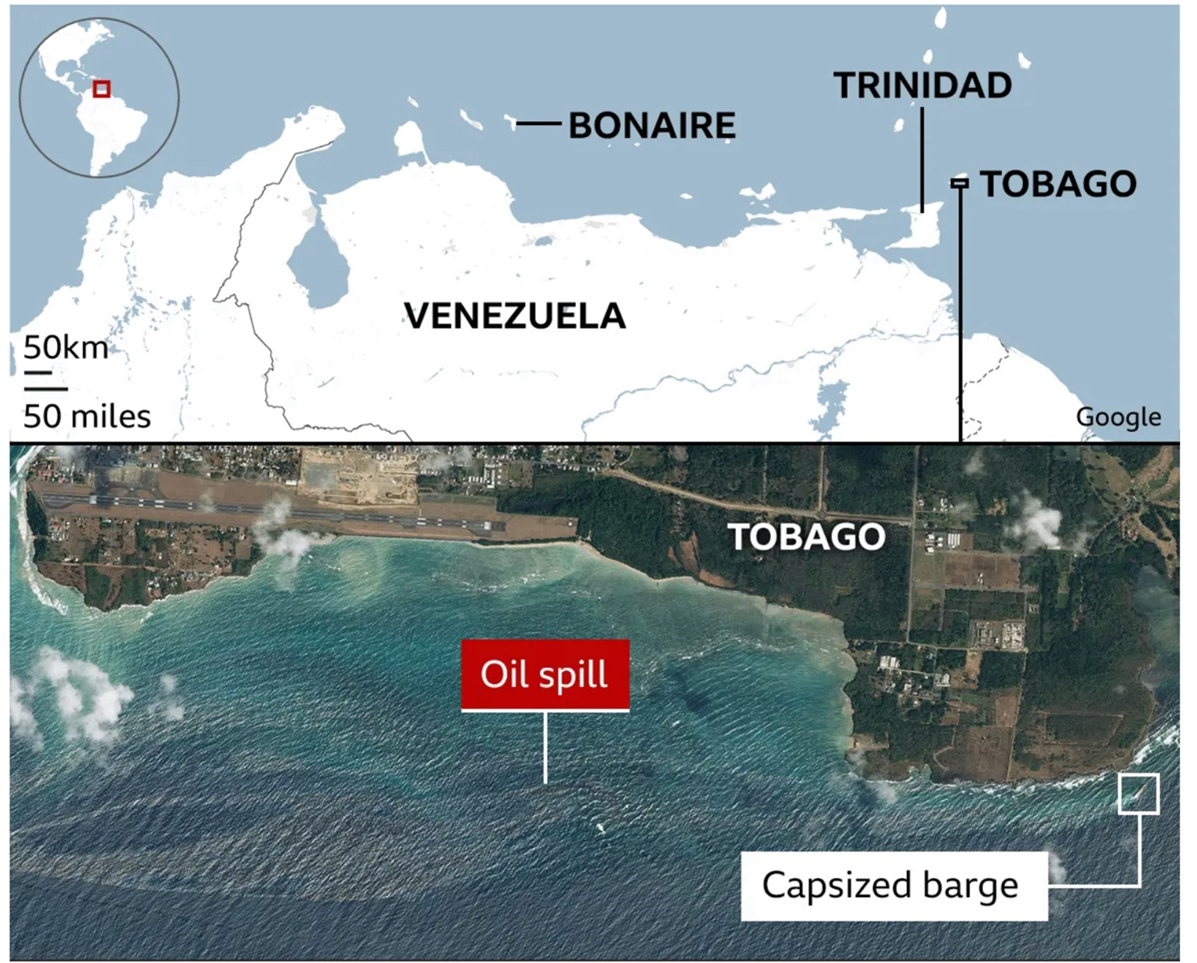
    One example of how these agents operate came to light in February 2024 when a large and damaged tanker barge appeared capsized near an idyllic beach in the island of Tobago (part of the two-island state of Trinidad and Tobago). It had run aground carrying an estimated 35,000 barrels of fuel, spilling a large oil slick which threatened the marine environment, not only in Tobago but also in a number of other neighbouring islands. The first problem facing local officials was that they had no information on where the barge had come from, exactly what it had been carrying, and who ultimately owned it. The discovery of a washed-up plastic bag containing a kilogramme worth of cocaine valued at US$75,000 suggested this was possibly a criminal venture of some type.

    Source: BBC

    The Trinidad and Tobago security ministry established that the barge had been towed by a tugboat, the Solo Creed, which was reportedly on its way from Guyana to Panama. After the barge ran aground, the tug had disappeared. Based on satellite images and marine registries Bellingcat, the Netherlands-based open-source security analysis group, said the stranded barge was probably a 60,000-barrel capacity double-hulled vessel known as the Gulfstream, with an opaque ownership structure involving a Panama-registered offshore company and an individual with business operations in Panama, Guyana, Dubai, Bahamas, and Nigeria. Satellite pictures showed the Gulfstream had been moored at various points some years earlier in the Venezuelan ports of Maracaibo, Puerto La Cruz, and Pozuelos. According to Bellingcat during some of its trips the ship had ‘gone dark’ by switching off its Automatic Identification System (AIS).

    What really happened to the Gulfstream may never be known. But a reasonable hypothesis is that the barge was carrying Venezuelan oil or fuel to avoid US sanctions against Venezuela. Ships that go dark during their passage are often described as being part of a sanctions-busting ghost fleet. The London based Financial Times reported in 2022 that the number of ships going dark had tripled since 2019. Many of these ships are old, and in a poor state of repair. According to Reuters news agency more than half Venezuela’s tankers do not meet minimum safety standards. Iran also has a significant ghost fleet estimated at around 16 ships. Since Russia invaded Ukraine and faced increased sanctions against its oil and gas sector it too is reported to have developed its own ghost fleet.

  • Outlook for Sheinbaum

    Patrick de Courcy 04 November 2024 Hits: 734

    It is too early to judge the Sheinbaum presidency, which at the time of writing has been less than a month in power. But it is clear that perhaps five or six big building blocks will help shape the new administration. They include macro-economic and fiscal management, cartel violence, government communication strategy, the energy transition, and poverty alleviation. Uncertainty over the US elections, the future of USMCA, and US-China tensions also form part of the mix. Sheinbaum’s decisions over the next few months will cast more light on the fate of the 4th Transformation.

  • 2023 mining law holds Mexico back

    Abbi Dicker 14 May 2026 Hits: 1013

    Despite significant rare earth/critical mineral resources, Mexico is seen as making a slower start in attracting foreign investment into the sector, placing it behind Brazil and Argentina. State control of lithium, along with underdeveloped mining regulations and underexplored deposits are imposing some restrictions and delays. Industry sources say the 2023 mining law amendments have created uncertainty and slowed or discouraged exploration and development of rare earths. This could cause projects to be postponed at a crucial time. The problem is accentuated because most rare earth projects are complex and can take up to ten years or more between conception and coming on stream. In terms of refining and processing, Mexico still lacks large scale separation plants, advanced refining capacity, and magnet manufacturing facilities.

    A recent report by the Inter American Development Bank (IDB) says GDP growth this year will be a modest 1.3% and suggests that developing the critical minerals sector would be one way to inject greater dynamism into the economy.  

    Mexico either produces or has development potential for 13 critical minerals including lithium, copper, graphite, rare earths, antimony, barite, bismuth, fluorite, lead, manganese, phosphate, silver, titanium, and zinc. As we have seen, demand for some of these minerals is booming. Global lithium demand is expected to grow by between 470% and 800% by 2050, depending on the pace of the energy transition and the take-up of electric vehicles. Demand for copper is likely to double.

    Lithium is a particularly promising opportunity. Mexico has lithium reserves of roughly 1.7m tonnes spread across 82 deposits in 18 states. The state of Sonora leads with 13 deposits, followed by Puebla with 12 and Oaxaca with nine. But there is a sense that Mexico may be slipping behind. “While Mexico debates state control of lithium, the global automotive industry is already securing supply contracts elsewhere, leaving the country out of the investment race for batteries and electric vehicles,” says Armando Alatorre of CIMMGM, the mine engineering college.

    Mexico’s rare earth sector is at a very early stage of development. There is little production, limited exploration, and no significant domestic refining capacity. The country is dependent on rare earth imports particularly in downstream sectors such as automobiles and electronics. At present only one private sector company, Monumental Mineral, is developing a rare earth mining project in Jemi, Coahuila state, which is said to contain magnetic rare earths such as neodymium, praseodymium, and terbium among other elements such as tantalum and niobium. The company says that to date it has surveyed only 5% of the available area.

    In a recent interview CIMMGM president Raul García says that despite the presence of plentiful rare earth ores, private sector companies are held back since under the law exploration can only be carried out by SGM the state-owned geological service. Referring to the global rare earth boom García says “We could have a slice of that pie, but SGM has not yet started the exploration of rare earths, which will be crucial for nearshoring and the supply chain of which Mexico will be a part.” He also says the mining law does not give private companies sufficient legal certainty. Unless changes are made, García says Mexico will be forced to rely on imports to meet its rare earth needs.

    That said, if these issues can be fixed, the opportunities are significant. One is nearshoring – the integration of Mexican and US production value chains. As the US seeks to reduce its dependence on China, Mexico may be increasingly seen as a rare earths strategic partner within the USMCA trade pact (formed by the US, Mexico, and Canada). Arguably this may help Mexico fill the eventual mid-stream rare earth processing capacity deficit. Mexico could position itself as a regional supplier of critical minerals and processed materials. The fact that Mexico already has a well-developed manufacturing base, including in high-tech sectors such as automobiles, aerospace, defence, and electronics, may help.

    Given its relatively low base, Mexico is not currently an upstream rare earth producer, but it could become a significant midstream or integrated player. Whether it does so or not will depend on whether it can leverage its USMCA advantages, including integrated supply chains, reduced logistics costs, and strengthened supply security. Given low levels of exploration it is also possible that there may be new discoveries going forward. That said, USMCA is being renegotiated this year, and President Trump, whose relationship with both Canada and Mexico has been tense, may seek to move further in the direction of protectionism, which could limit some of the positive effects of supply chain integration. Political risk will be a significant issue influencing investor views.

  • Conclusion: the year of uncertainty

    Patrick de Courcy 18 February 2026 Hits: 679

    Based on the ground covered in this report it is possible to reach various future-looking conclusions

    • President Donald Trump has become, and will continue to be, more interventionist and unpredictable, as he applies an updated Monroe Doctrine across the LAC region.
    • Latin American governments will continue to be threatened by US economic sanctions if they fail to meet Trump’s demands for action on migration and crime.
    • Following US military intervention in Venezuela in early 2025, further limited strikes against cartel targets in different countries remain a possibility within the next 12-24 months
    • In the last year and a half, amid anger over crime and corruption, Latin American voters have swung round to elect politicians of the populist right.
    • These new governments are likely to have initially good relations with the administration in Washington, but Trump’s transactional approach to politics and ideological differences within the right will feed into persisting uncertainty.
    • Resolving underlying issues of crime, violence, drug trafficking, and corruption is likely to require sustained long-term policy efforts, stretching beyond Trump’s time in office. It will be difficult to maintain the necessary political coalitions to keep it going.
    • Four key countries are likely to shape LAC security and political relations with the US in the next year: they are post-Maduro Venezuela, Mexico, Brazil, and Colombia.
    • A period of regional turbulence in US-LAC relations will have the unintended consequence of promoting China as a more reliable economic partner.
    • Mexico will remain under intense US pressure, likely focused on talks this year with Canada to review the functioning of the USMCA free trade agreement.
  • Intelligence Research highlights - 26 January 2007

    LatinNews 08 September 2011 Hits: 3

    INTELLIGENCE RESEARCH HIGHLIGHTS

    TO: All Strategic Intelligence Forum members

    DATE: 26 January 2007

    The Strategic Intelligence Forum is part of the Intelligence Research group, and as a member of the Strategic Intelligence Forum I am very pleased to send you from time to time a selection of reports published recently by Intelligence Research Ltd that I consider to be of particular STRATEGIC significance. Please find below my latest selection of Intelligence Research articles:

    1. INTENSIFYING SINO-SOVIET RIVALRY - China Watch Weekly Briefing, 26 January 2007

    SUMMARY: The motive for China’s anti-satellite missile test was explained succinctly by the Hong Kong newspaper Wen Wei Po on 24 January. Quoting a Chinese foreign ministry spokesman, the paper said that "what is really worrying is the US hegemonic attempt to singly dominate outer space". The paper accused the US of "cherishing the hegemonic mentality of allowing itself to burn down houses while forbidding others even to light lamps". This is, indeed, the crux of the matter...

    Link to full article: http://www.asiaint.com/arl/arl12861.asp

    2. MEXICO: GOVERNMENT EXTRADITES DRUG BARONS TO US - Latin American Weekly Report, 25 January 2007

    SUMMARY: The government extradited 15 drug gangsters to the US on 19 and 20 January. The move was heavily applauded in the US, first by officials leading the war on drugs and then by President George W Bush himself, who rewarded President Felipe Calderón Hinojosa with a congratulatory 15 minute telephone call. The Mexican government itself fears that the initiative may be costly in the short term as the drug gangs retaliate...

    Link to full article: http://www.latinnews.com/lwr/LWR12831.asp?instance=8

    NOTE: Links to these - and other - reports can also be found in the Strategic Intelligence Monitoring Centre, which you may access on a 24/7 basis by going to www.stratintforum.com, logging in as a member, and selecting the Strategic Intelligence Monitoring Centre option.

    With best regards

    JKC de Courcy
    Chairman
    Strategic Intelligence Forum

    P.S. You may sign up for a free evaluation of any Intelligence Research Ltd services by visiting the following websites, or you may contact our Business Development Director: [email protected].

    www.intelligenceresearch.com
    www.stratintforum.com
    www.asiaint.com
    www.latinnews.com

  • Brazil faces labour trouble at Camaçarí

    Abbi Dicker 11 July 2025 Hits: 1789

    One of the big issues (which as explained below also applies in Mexico) is whether, where, and when the new generation of EV manufacturers will build local plants in Latin America. The decision is complex not least because trade and tariff policies have been in flux as the Trump administration in the United States moves to take a much more protectionist stance. Trying to revive car production in the United States has been at the centre of Trump’s MAGA ‘Make America Great Again’ agenda. Despite initial enthusiasm for building new car production assembly plants, some of the companies have put them on hold as they seek greater clarity on official policies.

    In July 2023 the Brazilian government strongly welcomed a decision by BYD to purchase and rebuild a disused Ford plant in Camaçarí, Bahía state, in the northeast of the country. According to the initial announcements, the Chinese company would build electric buses and truck chassis, electric cars, and hybrids at the location. It had paid the state government BRL287.8m (US$58m) for 4.6m square metres of land at the site. BYD said it intended to invest BRL3bn (US$620m) in 26 production units within three new factories. The complex was expected to be completed by early 2025 with capacity to build 150,000 units per year in the first phase, later rising to 300,000.

    It would start out producing a range of models including the all-electric BYD Dolphin, the Song Plus, the Yuan Plus (also known as the Atto 3), and the Dolphin Mini (also known in some markets as the Seagull). Included in the facilities was a processing plant for lithium iron phosphate battery materials. Local officials said the new plant would create 5,000-to-10,000 jobs in an area of the country that had still not recovered from the closure of the Ford plant.

    For the government of President Luiz Inácio Lula da Silva the proposal appeared to tick all the boxes. It would create jobs in a traditionally poor part of the country. It would bring urban renewal to a previously rust belt town. It would create industrial jobs while supporting the government’s transition to greener, more sustainable energy.

    And then, on Christmas eve 2024, something went badly wrong. The Brazilian labour ministry said it had rescued 163 Chinese workers from slave-like conditions at Camaçarí. They were employed by Jinjiang, a civil engineering contractor used by BYD to build its factories. Investigations showed living conditions on the site in makeshift barracks were extremely poor, the company had retained workers’ passports, and made them subject to fines for swearing, quarrelling, or not wearing a shirt. Lawyers said these behaviours were “textbook red flags of forced labour”.

    Both Jinjiang and BYD sought to deny or deflect the claims. Jinjiang said “the claim that Jinjiang employees were ‘enslaved’ and ‘rescued’ is totally off base”. BYD vice president Alexandre Baldy said his company had no knowledge of conditions imposed by Jinjiang. With an official investigation now under way and Brazil’s automobile unions also involved, work at Camaçarí has been delayed and the date for the facility to become operational has been set back significantly. In May this year the company said it had updated its schedule so that by December 2026 the facility would be “fully functional with the expectation of generating 10,000 jobs”. In June the company presented what it said was the first all-electric Dolphin Mini built in Brazil. Stella Li, BYD chief executive for Latin America, said that “only 15 months since the beginning of work, we are able to present as an experimental project, the first car to come off the production line, a key moment for the future of sustainable mobility across Latin America”.

  • Apocalyptic power struggle in Iran - SIR 30 November 2006

    LatinNews 06 September 2011 Hits: 3

    The international focus on Iran’s nuclear programme and its alleged activities in neighbouring Iraq is diverting attention from a crucial power struggle inside the country. Ahead of two elections scheduled for mid-December, an SIR special correspondent in the region explains what is really happening inside Iranian politics.

    The two polls – one for municipal councils and the second for the powerful assembly that oversees the regime and its military – are shaping up to be a trial of strength between Iran’s hardline President Mahmoud Ahmadinejad and the Islamic Republic’s conservative supreme leader, Ayatollah Ali Khamenei. The municipal election scheduled for 15 December is being seen as a litmus test of popular support for Ahmadinejad, particularly within the conservative camp which has become increasingly divided since the former Revolutionary Guard’s unexpected victory in the 2005 presidential elections.

    On the same day as the local polls there will be elections for the Assembly of Experts, an 86-member body of senior clerics whose task is to monitor the supreme leader and to choose his successor. This contest will be the more crucial of the two tests.

    Khamenei and his allies, including former president Ali Akbar Rafsanjani, currently control the assembly, whose membership is selected every eight years. However, Ahmadinejad is pushing hard to seize control of this key centre of authority in a power struggle that is set to intensify.

    Ahmadinejad’s chosen candidate to head the assembly is Ayatollah Mohammad Taghi Mesbah-Yazdi, the president’s spiritual guide and the leader of an extreme Islamic society known as the Hojjatieh. According to Iranian insiders, this group has been steadily gaining influence for several years and is increasingly seen as a threat to the conservative camp led by Khamenei.

    The Hojjatieh – an emerging power

    The president relied heavily on support from the Hojjatieh when he won the presidential election in June 2005. Since then he has appointed members of the society to key positions in government, the diplomatic service, and the military in order to consolidate his - and the society’s - grip on the centres of power in Iran.

    Mesbah-Yazdi, Hojjatieh’s chief ideologue, founded the ultra-conservative Haqqani seminary whose list of alumni reads like a who’s who of hardline Islamic fundamentalists. Many of the clerics who graduated from his establishment now hold senior government positions. They include the Iranian Intelligence Minister, Hojatoleslam Gholam-Hussein Mohseni-Ezhei, who has played a key role in crushing dissidents, and the current Interior Minister Hojatoleslam Mustafa Pour-Mohammadi. Both of these hardliners are alleged to have masterminded the assassination of dozens of Iranian dissidents and intellectuals in the 1990s. First Vice-President Parviz Davoudi is another Haqqani alumnus.

    The Hojjatieh was founded in 1953 by Sheikh Mahmoud Halabi, a preacher from the holy city of Mashhad in northeastern Iran. Its core belief is that true Islamic government must await the return of the Hidden Imam, or Mahdi, the 12th descendant of the Prophet Mohammed. That meant it opposed even Ayatollah Ruhollah Khomeini’s concept of Islamic government, velayat-e faqih (the Guardianship of the Supreme Jurist).

    The society maintains that a functioning Islamic government actually delays the return of the Mahdi, who according to Shia beliefs went into hiding as a child 1,300 years ago. Members also believe that causing chaos will accelerate his reappearance. The Hojjatieh opposes religious involvement in political affairs, although it has set that precept aside when it suits its purpose to subvert the political establishment, as it now seems to be doing.

    Planning for an apocalypse?

    If Mezbah-Yazdi succeeds in taking over the Assembly of Experts, he could promote the Hojjatieh concept of the apocalypse needed to bring the return of the Mahdi and the dawn of a New Islamic world. This frightening vision is apparently shared by Ahmadinejad who has taken a tough line on Iran’s drive to become a nuclear power.

    Relatively inactive during the reign of Shah Mohammed Raza Pahlavi, the Hojjatieh enjoyed a revival during the 1979 Islamic revolution. The society temporarily set aside its opposition to Khomeini’s rule because it feared a communist takeover.

    However, Khomeini became increasingly intolerant of the society and its secretive ways, and on 12 July 1983 he ordered it disbanded. It went through the motions, but many of its members simply joined the conservative Islamic Coalition Association and kept their infrastructure intact clandestinely.

    For several years, Iranian conservatives have been warning that the Hojjatieh was quietly infiltrating the centres of power. According to such diverse political figures as former president Mohammad Khatami, a leading reformist, and Ayatollah Mohammad-Reza Tavassoli, Khamenei’s former chief of staff (and no ideological liberal), the Hojjatieh pulled off a "silent coup" by getting their man, Ahmadinejad, elected in 2005.

    It is worth noting that the new president’s first list of cabinet nominees included Hojjatieh members and old comrades from his days as a commander of the elite Islamic Revolutionary Guards Corps (IRGC). Although Khamenei, through parliament, was able to block the appointment of some of Ahmadinejad’s associates, the cabinet that emerged remains arguably the most militant since the early days of Khomeini’s rule. At least 17 of the 21 nominees had held senior positions in the IRGC or in the intelligence community.

    The conservatives strike back

    Soon after the presidential election, Tavassoli delivered a broadside against the Hojjatieh at a meeting of the Expediency Council, a powerful body that adjudicates in legislative disputes between parliament and the Council of Guardians. According to Mohammad-Ali Abtahi, a cleric who was Khatami’s deputy for legislative affairs until he resigned in October 2004, Tavassoli "voiced alarm that the leaders of the Hojjatieh group were now practically in control of the executive branch of the government and the Revolutionary Guards, and that the new president-elect was under their domination".

    Although conservatives controlled every centre of power in Iran for the first time in a decade, in the opaque world of Iranian politics in which the various factions are constantly vying with each other for dominance, Khamenei saw Ahmadinejad and his associates as a potential threat to his authority and Iran’s political equilibrium at a particularly delicate moment in the republic’s dealings with the West.

    The new administration’s uncompromising position in the nuclear stand-off with the US, along with its populist economic policies, violent rhetoric, and lack of experience in foreign affairs, are causing alarm within the political establishment, especially among the old guard who spearheaded the Islamic revolution with Khomeini. In some respects this confrontation is as much a generational clash as anything else. Ahmadinejad, widely seen as an incorruptible man of the people, campaigned on a populist platform for economic and social justice and against rampant corruption in the clerical and ideological establishment.

    The supreme leader’s strategy

    Khamenei has sought to outflank Amhadinejad and curb what many Iranian leaders see as his impulsive tendencies. In late 2005, the supreme leader turned to his old revolutionary comrade, and sometime political rival, Rafsanjani in a bid to counter the young president’s self-proclaimed "second revolution".

    Khamenei also amended Iran’s power structure by giving the Expediency Council, a non-elected political arbitration body chaired by the pragmatic Rafsanjani, sweeping new authority to supervise parliament, the judiciary, and the executive. This move created, in effect, a parallel supreme authority.

    Mesbah-Yazdi, who has long advocated so-called "martyrdom operations" to combat the enemies of Islam, is the new president’s ideological mentor and a Shia marja’a-e taqlid (object of emulation). His hand was seen in Ahmadinejad’s meteoric rise in Iranian politics, from provincial governor to high-profile mayor of Tehran, both appointed posts, to president in just two years.

    Before the June 2005 elections this firebrand cleric issued a fatwa – religious decree – instructing all the members of the Basij, an Islamic paramilitary force popularly known as "the army of 20 million" that supports the IRGC, to vote for Ahmadinejad. No doubt similar pressure will be exerted by the Hojjatieh’s cadres during the December polls.

    At the same time, General Yadollah Javani, chief of staff of the IRGC - whose officer corps largely supports Ahmadinejad - has been publicly exhorting his forces to back the president’s candidates in the forthcoming elections. In contrast, the government-controlled media has been denouncing Rafsanjani’s candidate in the assembly election, Mesbah-Yazdi’s main rival, as a pro-Western stooge.

    The outcome of December’s elections will prove crucial for Iran’s foreign policy. A victory for the Hojjatieh would undermine current diplomatic moves, thus propelling the Islamic Republic towards a direct confrontation with the West.

  • A world of competing energies

    LatinNews 11 June 2021 Hits: 1958

    Predicting the exact shape of the energy transition in Latin America is difficult, as so many factors of uncertainty are involved. For the big fossil fuel reliant countries in particular it is hard to pinpoint a ‘peak oil’ moment after which returns on investment in hydrocarbons may begin to become less attractive. What can be said with more certainty, however, is that the world, including Latin America and the Caribbean, has now entered a possibly unique period marked by the co-existence of multiple energy sources. For the next two to three decades, the period running between 2020 and 2050, the energy matrix is going to shift, but in ways that are not yet fully known. This creates both opportunities and risks. The opportunities include the chance to achieve a lower cost, cleaner, energy matrix and to avert the most harmful aspects of climate change. The risks include opting for unproven technologies which fail to deliver hoped-for benefits, as well as the conservative option of remaining locked into a fossil-fuel heavy mix of energy sources which will ultimately trigger financial losses and global warming effects.

  • An army of hipster influencers

    Patrick de Courcy 16 November 2023 Hits: 541

    Something remarkable happened in mid 2023. In a compilation of regional opinion polls carried out by Argentina-based think tank Directorio Legislativo, El Salvador’s authoritarian hipster president, Nayib Bukele, emerged as the most popular Latin American leader with a remarkable 91% approval rating, ahead of Mexico’s Andrés Manuel López Obrador, who had 64% approval, and Brazil’s Luiz Inácio Lula da Silva, with 56%.

    Bukele, who took office in 2019, is credited with successfully cracking down on the criminal gangs that had been tormenting the country’s population, using a draconian state of emergency and mass arrests. Over 70,000 people, equivalent to 2% of the adult population, have been incarcerated without trial. The president has been able to do this because he controls a large majority in the legislature and has a compliant supreme court. Opposition parties, human rights organisations, and the US government among others have complained over a reduction in civil liberties and a loss of democratic freedoms, but they have been largely ignored. Although there is a constitutional ban on consecutive re-election, Bukele has already declared his candidature in the 2024 presidential race.

    What is clear at this stage is that the Salvadoran president, who has a background in political marketing, has relied on an ambitious and far-reaching programme of disinformation to help build his image. Bukele has attacked traditional and critical media outlets while at the same time building up an army of influencers and trolls to promote his image and achievements. Such has been the success of this approach that bukelismo is widely admired across Latin America, for its hard-line crackdown on criminal activity. Roberto Dubon, a communications strategist for the FMLN, Bukele’s former political party, told the Associated Press: “A news organisation doing an investigation can’t compare to the sounding board that these influencers have because they flood your social media with the government’s narrative. What you have is an apparatus to spread their propaganda.”

    The government has hired former journalists to produce slick online videos celebrating military successes against the gangs. A study of 56 pro-Bukele YouTube accounts conducted by Universidad Francisco Gavidia and media research group Factum found that they collectively had more followers than the country’s current population (6.3m) and earn significant revenue through advertising. In a single day last May these channels pumped out nearly 32 hours of pro-Bukele content, mirroring government language; 90% of the videos analysed contained false or misleading information. One account, Noticias Cuscatlecas, was said to earn as much as US$400,000 annually posting videos of violent attacks by alleged street gang members.

    Significantly, in April 2023 the president of congress, Ernesto Castro, announced that he was officially accrediting YouTubers and other social media influencers to “inform with objectivity”. AP spoke with a TikTok influencer who said that apart from covering the legislature for the government, he had been invited to other official events including the Caribbean Games. This contrasts with the persecution of critical media outlets such as El Faro which has been accused of tax evasion and which, for security reasons, has had to move many of its journalists to neighbouring Costa Rica.

    A report by Reuters news agency in late 2022 said it had spoken to three former contractors who had formed part of troll farms run by the Salvadoran government and tasked with manipulating the public debate. The job included online promotion of Bukele and his allies while filing spurious complaints against anti-Bukele bloggers in an attempt to get them closed down by social media platforms hosting their content.

    The government has also used other techniques to restrict information and strengthen its public narrative, for example by withdrawing previously available data on missing persons and the discovery of mass graves, both considered indicators of gang activity. It has also poached staff from the private media sector to work for government-owned outlets. In 2020 around 30 journalists on the independent La Prensa Gráfica resigned and left en masse to work for a new, pro-government newspaper called Diario El Salvador. Sources said they had been offered up to three times their previous monthly salaries.

    Reuters also said it had obtained a copy of an internal US State Department report, written in February 2022, which said the government was paying influencers and “likely bot farms” to tweet pro-government messages “tens of thousands of times” on a given topic to create the appearance of authentic grass-roots support. Bukele’s strategy was to “flood El Salvador with propaganda, demonise the institutions charged with debunking that propaganda – the free press and civil society – and dominate public narratives and repress dissent”.

  • What do Milei’s first 100 days tell us?

    Patrick de Courcy 27 March 2024 Hits: 1899

    In many senses the new president’s first 100 days are inconclusive. He has had some hits and some misses. His popularity ratings have dropped back a little but broadly speaking those who voted for him at the end of last year are continuing to support him so far this year. Milei’s political honeymoon period has been broadly predictable. In an attempt to focus more sharply on the options that lie ahead and, by way of conclusion, we will now discuss three possible scenarios for the rest of the Milei presidency. These are not hard and fast predictions, but a speculative exercise to tease out some of the ongoing issues. 

  • Latin America faces regulatory challenges

    Abbi Dicker 16 May 2025 Hits: 2419

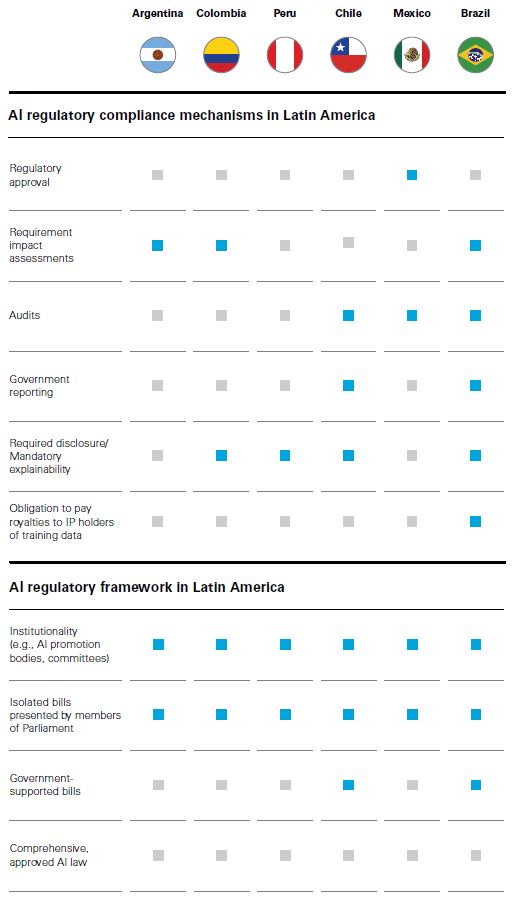
    A wide range of regulatory and legislative approaches to AI are being discussed in the LAC countries. Some are modelled on the EU’s Artificial Intelligence Act, which came into effect in August 2024 but which itself may be amended (see above). Some countries, such as Brazil and Chile, already have detailed proposals for legislation. Mexico and Argentina are a little further behind. Most of the largest jurisdictions in the region are following a “risk-based approach” meaning that they prohibit unacceptably risky AI applications, while setting out safeguards for higher risk ones, such as specific regulatory approval or additional disclosure requirements. However, some countries such as Argentina are actively discussing a “regulation light” model designed to attract investment.

    A recent paper by Brookings, a US-based think tank, has been critical of some of the regulation proposed for AI in Latin America, noting “In general, bills tend to be quite vague, fail to provide actionable measures or a clear definition of AI, or grant the executive branch with excessive powers to define when and how regulations should apply.”

    Public opinion, however, seems to be clearly in favour of regulation. A poll conducted by Ipsos and lobby group Luminate revealed that 55% of Latin American respondents believe AI should be regulated. Some 40% believe AI can influence electoral outputs while 37% believe the technology could increase inequality. The poll also revealed that 59% say they know how to operate AI applications, and 46% say they use AI tools in everyday life. Respondents also appear to be wary of AI’s effects. 54% said they opposed the use of AI in courts of justice; 51% are against AI systems drafting the text of laws and regulations; and 50% oppose AI systems being used to determine eligibility for social security payments nationwide

    White & Case LLP. Latin America Focus: 2024 – AI Regulation. 12 December, 2024.

  • Doing business

    LatinNews 28 August 2018 Hits: 379

    One measure of how well an economy is likely to perform is the Doing Business survey carried out regularly by the World Bank. As the title suggests, the Doing Business (DB) index measures the ease of carrying out 10 business tasks in each country. These are: starting a business, dealing with construction permits, getting electricity, registering property, getting credit, protecting investors, paying taxes, trading across frontiers, enforcing contracts, and resolving insolvency. Each of these is measured in standard units (for example days or number of stages in an application procedure) and given a value that allows countries to be ranked. The World Bank also measures what it calls the “distance to frontier” – the distance between each economy and the highest performance in each category.

    The Doing Business survey has often persuaded governments to try and improve their procedures so as to support business efficiency and attract new investment. The World Bank keeps track of a number of these reforms. In the 2018 edition of Doing Business it noted that El Salvador had adopted four reforms in the preceding year, including improving the reliability of electricity supplies, and creating an online platform to make it easier to pay taxes. Other countries carrying out reforms in the preceding year included Jamaica, the Dominican Republic, Brazil, and Mexico. Latin America’s best-ranked countries for the ease of doing business are Mexico (49th in the world), followed by Peru (58th), and Colombia (59th).

    Among the ‘small and successful’ country group we are examining, the best ranking was achieved by Costa Rica (62nd in the world) followed by Panama (70th) and Uruguay (90th). For comparison the ‘small and failing’ country group performed less well on average. Guatemala was ranked 88th, followed by El Salvador (95th) and Honduras (105th). For the purposes of comparison it is worth looking at the best performer among the ‘small and successful’ group, which was Costa Rica, and the worst performer from the ‘small and failing’ group which was Honduras.

    Costa Rica - Doing Business

    Honduras - Doing Business

    To give a sense of the business impact of these different procedures it is worth looking at an example – paying taxes. In Costa Rica taxes must be paid on average ten times year, and the process of filing the necessary information and paperwork takes companies around 151 hours every year. In Honduras on the other hand an average of 48 payments have to be made every year, taking up 224 hours of administrative effort.

  • Message to corporates: it is getting more complicated

    Patrick de Courcy 12 August 2024 Hits: 1015

    The reality for companies operating in Latin America and the Caribbean is that due diligence and compliance with sanctions is getting much more complicated than it was in the past. There are many more sanctions, longer lists of specially designated entities, and greater number of secondary sanctions with potentially overlapping jurisdictions. An example is the already-mentioned US announcement of sanctions against Russia immediately after the Russian invasion of Ukraine. In close cooperation with the EU, G7 countries, and Australia, Washington designated over 400 individuals and entities including Russian elites, 300 members of the Duma (Russian parliament), and defence companies. The targeting countries also formed what has been called the ‘price cap coalition’ to limit the price of Russian crude oil exports to no more than US$60 a barrel.

    There were also spin-off sanctions targeting persons evading US sanctions on Iranian oil, Iranians engaged in cyber-attacks, and members of Iran’s ballistic missiles programme. In the crypto-currency world there were sanctions targeting Hydra, a darknet company, Garantex, a virtual currency market, and currency mixers Blender.io and Tornado Cash.

  • Bolivia moves away from state-led industrialisation

    Abbi Dicker 14 May 2026 Hits: 752

    Among regional countries Bolivia presents one of the sharpest contrasts between a potential critical minerals/REE boom on the one hand, and almost non-existent current mine production levels on the other. Since 2010 exploration has gathered pace. Deposits have been discovered in Cochabamba, Potosí and Santa Cruz, with particularly attractive finds in Cerro Manomó and Rincón del Tigre in eastern Bolivia. Metals and minerals detected include rubidium, cesium, tantalum, tungsten, and REEs. However geological service SERGEOMIN talks about the looser concept of “resources” but still feels unable to give a hard number for proven commercial “reserves”.

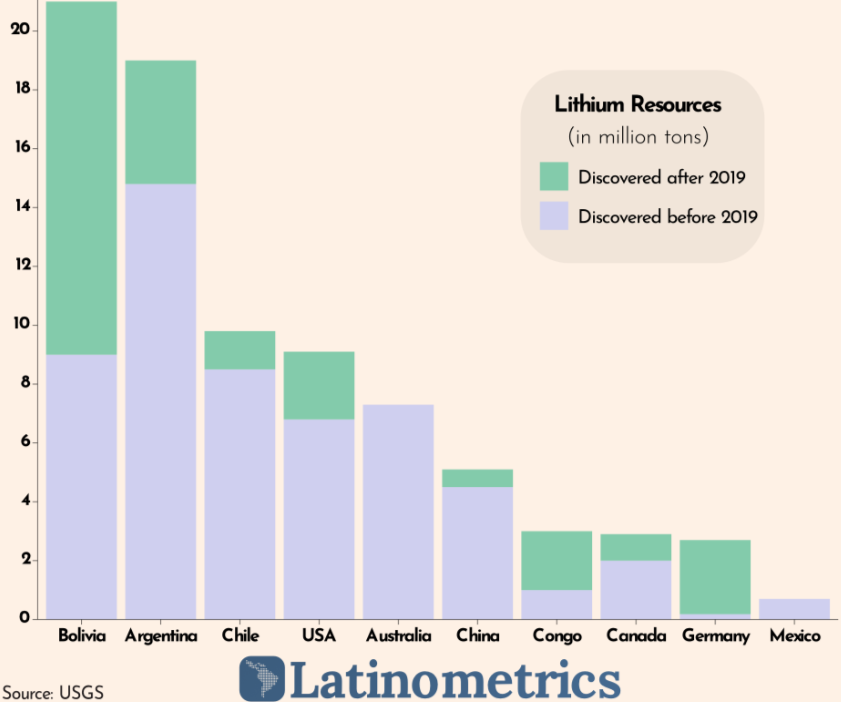
    During the roughly two decades of left-wing rule which ended last year, Bolivian governments sought to develop partnerships with like-minded countries and state-owned mining companies. They favoured state-led industrialisation, hoping for example to host lithium-ion battery manufacturing. In 2023 the administration selected CATL-CMOC of China for an investment of over US1bn in direct liquid extraction (DLE) of lithium and possible battery production. A similar agreement was signed with the Russian company, Uranium One. (Bolivia is considered to hold the world’s largest lithium resources at 21m tonnes). However, little progress has been made, with the contracts subject to litigation over environmental impact and the new, more market-friendly government looking elsewhere for investment in new mining projects.

    Luis Losada Siom-Ricart, of business risk consultancy Aperio Intelligence says that the new government is “likely to audit, revise, and potentially renegotiate these contracts” as well as seeking to create a more business-friendly working environment. It will also seek to attract other international mining firms, specially from North America and Europe.  

    Bolivia is sitting on a “White Gold” mine

    Although political instability and the lack of lithium/rare earth expertise and processing capacity have restricted Bolivia’s ability to develop the sector, some analysts remain optimistic. Specialist website Rare Earth Exchanges says Bolivia has taken a number of necessary early steps including mapping resources and setting up regulatory institutions, adding that “if it can pair its mineral wealth with investor-friendly frameworks, modern processing technology and durable community agreements, it could emerge within 10-15 years as a meaningful supplier of rare earths and critical materials”.

  • Dolphin leading the charge in Mexico

    Abbi Dicker 11 July 2025 Hits: 1845

    In December 2024, a few weeks before Donald Trump was set to start his second presidential term, Jack Ewing, a New York Times journalist, met Estéban Alegría, a salesman at a recently established BYD dealership in the low-income suburb of Iztapalapa in Mexico City. Alegría was full of enthusiasm for the Dolphin Mini, one of the latest models imported from Chinese manufacturer BYD. The four-door compact car was selling in Mexico for the peso equivalent US$18,000, around US$10,000 less than the cheapest EV on sale in the US. Customers were desperate to get their hands on it. Alegría said his modest dealership was selling the cars as fast as they arrived from China. Ewing gave his take on the story by commenting: “Behind a crumbling brick wall in a working-class neighbourhood of Mexico City lurks a seemingly innocuous car lot. But it could be a sign of a potentially grave threat to the North American auto industry.”

    The article argued that Chinese EVs are taking Mexico by storm and rapidly changing customer perceptions. Advertisements for Chinese cars are everywhere, including football stadiums and main highways. Prices, partly due to Chinese government subsidies, are highly competitive. The cars come with innovative technology – including rotating touch screens. They also boast more advanced autonomous driving and entertainment options as standard. Dealers say they also have better mechanical quality. Chinese-made cars now have a 9% share of new sales, up from virtually zero five years previously.

    Incumbent players admit the Chinese are doing exceptionally well. Guillermo Rosales Zárate of the Mexican Association of Automobile distributors told the NYT “they gained market share when other brands didn’t have inventory and there were long waits to get cars in Mexico”. The story is also about protectionism. Cheaper Chinese EVs could be a major threat, as Ewing suggested, to the incumbent North American automakers. In fact, the Chinese ‘wave’ was at the time being held back by a 100% US import tariff and by a 20% Mexican import tariff.

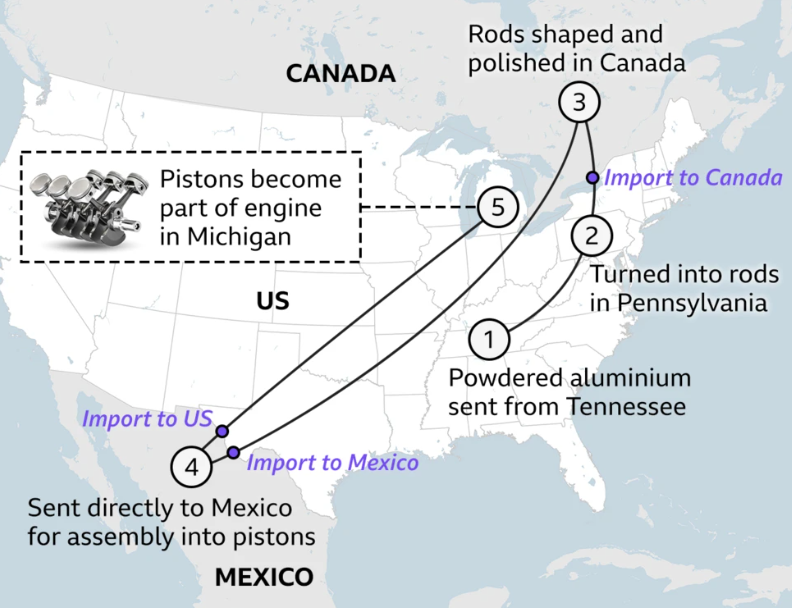
    The free trade agreement between the US, Mexico, and Canada, known as USMCA, provided a gigantic tariff-free zone across North America, allowing Mexican auto plants privileged access to the US market. However, as we shall see, through its tariff policies the second Trump presidency sought to reduce that access and to prevent China using the USMCA as a back door into the US market.

    Many car industry supply chains cross borders

    Source: BBC