All Categories

Subcategories

  • Intelligence Research highlights - 19 January 2007

    LatinNews 08 September 2011 Hits: 7

    INTELLIGENCE RESEARCH HIGHLIGHTS

    TO: All Strategic Intelligence Forum members

    DATE: 19 January 2007

    The Strategic Intelligence Forum is part of the Intelligence Research group, and as a member of the Strategic Intelligence Forum I am very pleased to send you from time to time a selection of reports published recently by Intelligence Research Ltd that I consider to be of particular STRATEGIC significance. Please find below my latest selection of Intelligence Research articles:

    1. CHINA'S MILITARY PLANS - AsiaInt Political & Strategic Review, January 2007

    SUMMARY: There appears to be a gap between China’s stated military intentions and its actual deployments. The country’s 2006 defence white paper, released in late December, said China "will not engage in any arms race or pose a military threat to any other country" but, "committed to peace, development, and cooperation, China pursues a road of peaceful development and endeavours". Such words are clearly designed to assuage foreign concerns, particularly those of the US, but what constitutes Chinese national defence is poorly identified and has previously been subject to some liberal definitions...

    Link to full article: http://www.asiaint.com/arl/arl12631.asp

    2. INDONESIA'S LAW ON TERROR - AsiaInt Political & Strategic Review, January 2007

    SUMMARY: Following the acquittal of Abu Bakar Bashir by Indonesia’s Supreme Court, doubts have resurfaced regarding Indonesia’s capacity to clamp down on Islamist terrorism. Former president Megawati Sukarnoputri and current president Susilo Bambang Yudhoyono have been praised by Western powers for committing to the war on terrorism. But the failure to find a long-term conviction in this cause célèbre case and uphold guilty verdicts against Bashir, allegedly the spiritual leader of Jemaah Islamiah (JI), demands a closer look at Indonesia’s anti-terror legislation...

    Link to full article: http://www.asiaint.com/arl/arl12638.asp

    NOTE: Links to these - and other - reports can also be found in the Strategic Intelligence Monitoring Centre, which you may access on a 24/7 basis by going to www.stratintforum.com, logging in as a member, and selecting the Strategic Intelligence Monitoring Centre option.

    With best regards

    JKC de Courcy
    Chairman
    Strategic Intelligence Forum

    P.S. You may sign up for a free evaluation of any Intelligence Research Ltd services by visiting the following websites, or you may contact our Business Development Director: [email protected].

    www.intelligenceresearch.com
    www.stratintforum.com
    www.asiaint.com
    www.latinnews.com

  • Moscow's role in failed Georgia coup - SIR 14 September 2006

    LatinNews 06 September 2011 Hits: 3

    Amid rising tensions between Russia and Georgia, the arrest last week of 29 people during the investigation of an alleged plot to launch a coup d’etat against the Georgian government has highlighted the Kremlin’s continuing interference in the independent states that broke free from the old Soviet Union. In fact, according to Strategic Intelligence Review’s intelligence sources in the region, the current crackdown follows several years of destabilising activities by one of Moscow’s proxies: Lt-Gen Igor Giorgadze, former head of Georgia’s intelligence service.

    Our analysis of the situation includes the following key points:

    · The Kremlin remains determined to destabilise the pro-Western government of Georgia

    · For the past decade Moscow has supported and financed pro-Russian Georgian political parties, but there is mounting evidence that this is being stepped up as tensions between Russia and Georgia escalate

    · As Russia’s proxy, Giorgadze has recently stepped up his demands for a second, pro-Russian revolution aimed at ousting the present Western-orientated administration of President Mikhail Saakashvili

    · Russia’s recent embargo on the importation of Georgian wine and mineral water is adding economic pressure

    · Having succeeded in manoeuvring a pro-Russian candidate into the premiership of Ukraine, Moscow has longer-term ambitions to reverse Georgia’s current pro-Western, pro-NATO policies.

    A former Soviet KGB colonel, in 1993 Giorgadze was appointed as minister of state security and head of the State Security Service in post-Soviet Georgia. However, while in power, he sought to rebuild close links with his Russian intelligence and security counterparts.

    In August 1995 Giorgadze was implicated in what was alleged to be a Russian-backed plot to assassinate the then president of Georgia, former Soviet foreign minister Eduard Shevardnadze (who had himself come to power in 1992 following a coup d’etat against Georgian President Zviad Gamsakhurdia). Facing treason charges, Giorgadze fled to Russia where he has remained. He has been protected and groomed by Kremlin hardliners as a dependable pro-Moscow challenger to any Georgian administration that is determined to preserve the country’s independence.

    Whilst in exile, Giorgadze formed openly pro-Russian political parties. The first, Samshoblo (the All-Georgian Patriotic Alliance), actively campaigned for the ousting of Shevardnadze, a politician who was loathed in the Kremlin because of his role in the disintegration of the Soviet Union.

    After Russian President Vladimir Putin came to power in 1999, Giorgadze’s cause received a major boost, and from mid-2002 onwards he and his supporters were active in undermining Shevardnadze’s administration. One of Moscow’s key charges against Shevardnadze was that the government in Tbilisi was providing shelter for Chechen separatists opposed to Moscow’s military campaign in Chechnya.

    The national crisis which followed the Georgian parliamentary elections in November 2003 could have provided Giorgadze and his Russian backers with an opportunity to seize power from the embattled president, and there were fears that Moscow might even intervene in order to restore order. However, the so-called Rose Revolution which finally ousted Shevardnadze also backfired spectacularly on the Kremlin since the new government of Mikhail Saakashvili, who was elected as president in 2004, has been firmly pro-Western in its policies. Saakashvili has also incurred the Kremlin’s displeasure by his renewed efforts to deal with the Russian-backed separatist region of South Ossetia.

    Clashes within the past week between Georgian police and South Ossetian separatists have followed a recent attack against an Mi-8 helicopter carrying Georgian defence minister Irakli Okruashvili after he overflew territory claimed by the separatist regime headquartered in the town of Tskhinvali. The subsequent armed clashes on the ground this week have left several dead, including three members of the rebel South Ossetian police force.

    Economic pressure is also being applied. Earlier this year Moscow restricted imports of Georgian wine and mineral water citing concerns over "sanitary" quality and the alleged presence of pesticides. The Georgian government has denounced the move as being politically motivated and designed to undermine the country’s economy.

    Presidential ambitions
    As tensions between Moscow and Tbilisi have been rising, Giorgadze has become more vocal in his calls for the overthrow of Saakasvili’s administration. In May he called a press conference in Moscow to outline the political programme of his latest pro-Moscow vehicle, Samartlianoba (Justice Party), a movement that appears to enjoy little, if any real support in Georgia. Perhaps predictably, the key policies of his party are opposition to Georgia’s links with Nato and a call for much closer ties with Russia, including greater political and economic integration – effectively establishing a puppet regime allied to Moscow.

    Meanwhile, in early July, Giorgadze gave a controversial interview to Moscow News in which he predicted another "revolution" in Georgia. When asked by the interviewer whether he had ambitions to seek the Georgian presidency, Giorgadze observed that: "I will be [president] only in the case, when such is the will of the people."

    In fact, given that he is considered to be a fugitive from justice, Giorgadze has twice been blocked from trying to stand as a candidate for the presidency in the elections held in 2000 and 2004.

    Russia’s sphere of influence
    Moscow’s support for Giorgadze is clear from the Kremlin’s repeated rejections over the past decade of Tbilisi’s demands, backed by Interpol warrants, for the former intelligence chief’s extradition on treason charges. The Russian strategy is based on the conviction that Georgia is within Russia’s sphere of influence. Post-independence moves towards the West by both Shevardnadze and Saakashvili – particularly closer ties with Washington – are regarded as a threat to Russia’s regional interests.

    Concerned over the activities of Samartlianoba, a party whose leader is wanted on charges of treason and who is calling for the overthrow of the democratically-elected government, Saakashvili has moved to neutralise Giorgadze’s supporters inside Georgia. Leaders of allied parties, including the Conservative-Monarchist Party, were also arrested. Of the 29 initially detained following last week’s police raid, 13 have so far been charged under Article 315 of the country’s criminal code – "plotting against the state and overthrowing the government". Georgian interior ministry sources have also claimed that they have uncovered evidence of a plot to bomb the main offices of the ruling United National Movement.

    Commenting on the arrests, Saakashvili accused Moscow of backing the group. "Certain forces in Russia decided that this autumn is the last time when it is still possible to stop the process of Georgia’s formation," Saakashvili observed. In response, Russian presidential aide Sergei Prikhodko denied these claims. "I, of course, know of no Russian plans to overthrow the Georgian leadership." AS.

  • How to regulate social media

    Patrick de Courcy 16 November 2023 Hits: 552

    The developments covered in this report concerning fake news and misinformation clearly point to a potential dystopian Latin American future, where distortion and manipulation erode democratic values and debase public debate. Rather than seeking to understand and address real-world problems afflicting citizens such as inequality, poverty, the lack of employment opportunities, crime, and corruption, politicians and governments will focus on manipulating perceptions and spinning stories to create a favourable impression. In short, authoritarian leaders of both left and right will use disinformation to confuse and distract a pliable electorate and keep themselves in power.

    At least part of the answer as to how this risk should be addressed is to consider wider regulation of social media. However, this too is complex and controversial, and in the eyes of some analysts could even make matters worse by eroding another public good, the right to freedom of expression. Some of these difficulties are illustrated by the debate over fake news regulation in Brazil.

    In April/May 2023 an updated version of Brazil’s so-called ‘fake news bill’ (PL 2630/20) was submitted to congress and was almost immediately criticised by the Big Tech companies, prompting in turn the announcement on 12 May of an investigation by the supreme court into the behaviours of Google and Telegram for campaigning against it. At the beginning of May in a prominent link on its Brazil home page Google had stated “The Fake News Bill could increase the confusion about what is true or false”. Messaging app Telegram likewise stated publicly that the fake news bill would “kill the modern internet” and “create a system of permanent vigilance, similar to countries with anti-democratic regimes”.

    The draft law contained a number of component parts.

    • It would oblige Big Tech companies to monitor and delete accounts and posts considered harmful or linked to criminal activities.
    • App providers would be liable for damages caused by third party providers if they had been paid to boost the reach of specific posts.
    • Big Tech platforms would have a duty of care requiring companies to actively combat the spread of content that violates the rights of minors, incites criminal activity, or spreads disinformation about health issues (this was considered a response to disinformation during the Covid-19 pandemic).
    • Platforms must be transparent about content moderation and to publicly explain their reasons for taking down content.
    • Members of congress would retain immunity for their online speech.
    • The companies would also be subject to external oversight to assess systemic risk, and would have to submit regular reports to a watchdog body (however the bill did not give details about how the watchdog body would function or what powers it would have).
    • The Big Tech companies would also be required to pay for news content that they post.

    Partly because of resistance to the bill, members of the governing coalition in congress subsequently agreed to break it down into separate pieces of legislation due to be voted on independently of each other. Levels of controversy have remained high, however. The proposal that news content be paid for is supported by those who believe that this would encourage the spread of professional, accurate news. On the other hand, critics say it could perpetuate the role of dominant mainstream providers such the Globo News group. Giving members of congress immunity for their social media posts is strongly resisted by those who accuse them of being a key source of disinformation.

    Among those opposing social media regulations in general are Frente Digital, a congressional caucus dedicated to expanding the digital economy (led by a member of Republicanos, the right-wing political party). Another opponent is the Frente Parlamentar Evangélica, which represents conservative evangelicals including Christian networks on radio and social media.

    The leader of the Frente, Eli Borges, is a member of the far-right Partido Liberal (PL) who has previously argued that the fake news bill could limit freedom of religious expression. However, there are also indications that the general public does support the idea of regulation. A poll by DataSenado released in June 2023 revealed that 72% of respondents were worried about the quantity of disinformation on social media. 80% said Brazil needed a law to target fake news, and 91% agreed with the statement that social media greatly shape peoples’ opinions.

    The dilemma over how to regulate social media while preserving and protecting freedom of expression is of course not limited to Brazil. In Chile, for example, the InterAmerican Press Society (SIP, in its Spanish-language acronym) said in July 2023 that the creation of an anti-disinformation committee of congress constituted a “warning light” for freedom of information. This prompted President Gabriel Boric to try and reassure critics, stating that the commission “will not try to define what is true and what is false” and that it would not recommend “punitive measures”.

  • Scenario 1 A social explosion?

    Patrick de Courcy 27 March 2024 Hits: 1840

    On 18 October 2019 a group of Chilean students began a protest demonstration against higher metro fares in Santiago. In a matter of hours, it set the country alight. The population came out on the streets to protest over a wide range of economic and social issues. Over the next six months there were widespread arson attacks, incidents of looting, mass peaceful protests, and violent clashes that left a total of 36 people dead. It is not an exaggeration to say that this was the most significant political crisis in Chile since the restoration of democracy nearly 30 years earlier. It is also the case that the upheaval was almost entirely unpredicted.

    Under the presidency of Javier Milei could there be an Argentine version of Chile’s social explosion? There are many reasons for saying “yes” but also numerous reasons to suggest that such a dark outcome will have a low probability of materialising. One of the main reasons for believing that it could happen is simply that it has happened before. In the summer of 2001/2002 Argentina suffered an economic meltdown with the forced ending of a peso-dollar exchange rate peg, a major devaluation, an inflationary surge, and a default on the country’s foreign debt. Riots and looting broke out in the country’s main cities. Here too there were deaths – some 39 were killed in the surge of nationwide unrest. The elected centre-right president, Fernando de la Rua, was forced to resign and had to be evacuated from a besieged government house by helicopter. It was during these protests, over 20 years ago, that citizens turned against the political class chanting “que se vayan todos” (‘All of them must go’)

    The reason why there is a low probability of a new social explosion at this stage is that Milei has a recently given democratic mandate. His supporters know he promised to cut back the state. He has declared himself to be an enemy of the political ‘caste’. His opponents disagree with the details of his austerity policy but cannot ignore its democratic provenance. There are existing democratic checks and balances to restrain Milei’s more extreme economic policies, not least an opposition dominated congress. The trade union opposition has held one general strike in the first 100 days, but participation rates were limited (labour leaders are not the most popular public figures as they face long standing corruption allegations). It is also true that in the wake of electoral defeat, leadership of Argentina’s centre-left forces remains fragmented.

    That said, in the coming months risks of a social explosion may increase. Perhaps the biggest point of danger concerns the sheer size of the cuts in living standards that the new austerity regime requires. The UCA poverty rate measure mentioned above shows that the proportion of the population living in poverty has gone back up to what it was in the years immediately following the 2001-2002 crisis. That alone should be a danger sign. The fact that the fiscal deficit was eliminated in the first two months of the year, but only by slashing state pensions by a massive 39.5% in real terms, and by reducing transfers to the provinces by 65%, suggests the policy will be hard to sustain. As austerity is intensified, Milei’s image will become less favourable. His aggressive ‘outsider’ and anti-establishment persona worked exceptionally well to win the elections but may be essentially counter-productive when it comes to running the country. A lack of empathy at a time of unprecedented hardship, a reluctance to negotiate political deals with potential allies, and a lack of political experience could all create political instability.

  • Brazil: pushing new legislation

    Abbi Dicker 16 May 2025 Hits: 2431

    Brazil’s AI regulation effort, Bill 2,338/2023, has been working its way through congress. It aims to promote secure systems for the benefit of individuals, democracy and technological development. It says that developers, distributors, and users (which it collectively calls ‘AI agents’) have obligations linked to the risk-classification of the systems they are using. The riskiest systems will be banned completely, with high-risk ones subject to monitoring and extra safeguards. All AI systems must be conducted under conditions of transparency, reliability, safety, and fairness. Developers of high-risk AI products must prepare “impact reports” on how they affect individuals’ fundamental rights.

    Unlike the EU Act, Brazil’s draft legislation imposes some additional obligations on AI agents including a requirement to use energy efficiently, and an obligation to publicly identify all content that is AI-generated. The bill also creates an umbrella AI National Regulation and Governance System to coordinate regulatory bodies. Sitting under that umbrella will be the Brazilian Data Protection Authority, and an AI Authority with power to issue warnings, impose fines, publicly disclose violations, and prohibit the use of certain databases. With a view to fostering innovation the bill also allows for the creation of a regulatory sandbox where new and experimental programmes can be tested. These regulatory innovations come with a background of strong government support for AI development. In July 2024 the government pledged US$4.07bn to boost technology development and competitiveness in the sector as part of a 2024-2028 AI plan. Also significant is the Brazilian Digital Transformation Strategy (E-Digital) launched in 2018. The current version which covers 2022-2026, sets out priorities in infrastructure, research and development, and trust in the digital environment.

  • Corruption

    LatinNews 28 August 2018 Hits: 439

    Having low levels of corruption is clearly important for a successful economy: without that, resources are used inefficiently and development priorities are distorted. One widely used measure of corruption is the annual Corruption Perceptions Index (CPI) published by anti-corruption lobby group Transparency International (TI). The latest was published in early 2018.

    As in previous years, the report gives each of 180 countries a perceived public sector corruption score ranging from zero (very corrupt) to 100 (very clean). Globally TI is fairly gloomy about the progress that is being made. It says that the majority of countries are “moving too slowly in their efforts” to reduce corruption. Over two-thirds of the countries surveyed scored below 50: the global average was a score of 43. In 2017 the world’s least corrupt countries included New Zealand (with a score of 89) and Denmark (with a score of 88). The most corrupt were identified as Syria (scoring 14), Yemen (12), and Somalia (9).

    In Latin America and the Caribbean TI says that despite “great strides” in the battle against corruption, including high-profile investigations and pro-active civil society campaigns on the issue, most countries continue to score poorly. There were new anti-corruption laws in Chile, the Bahamas, Guyana, and Jamaica. Major anti-corruption investigations continued in Brazil, Ecuador, Peru, Guatemala, and Panama. Yet most of these countries still lacked what TI calls “overarching policies” to address the historic and structural causes of corruption. As a whole the Americas scored 44, just above the global average, but that included high scoring countries like Canada (ranked 8th globally) and the United States (16th). As might be expected the countries in the “small and successful” group scored well, led by Uruguay (23rd in the world), Costa Rica (38th), and noticeably lower down, Panama (96th). The ‘small and failing’ group performed less well, led by El Salvador (112th), Honduras (135th), and Guatemala (143rd).

    Corruption

  • Nicaragua embargo: recent timeline

    Patrick de Courcy 12 August 2024 Hits: 1083

    In contrast to the comprehensive, country-focused approach that the US has taken in applying sanctions against Cuba and Venezuela, in the case of Nicaragua, ruled by left-wing autocrat Daniel Ortega (1979-1990 and 2007 to the present), the Washington administration has largely focused on sanctioning individuals and entities.

    • April 2018: Nationwide anti-government protests force the government to withdraw changes in tax and social security legislation. Protests spread in spite of violent government attempts to quell them. As a result of the violence, it is claimed that over 500 protestors lost their lives. The UN accuses the government of committing extrajudicial killings, torture, and arbitrary detentions.
    • December 2017-July 2018: The US imposes sanctions against four senior officials in the Nicaraguan government for human rights violations under the terms of the Global Magnitsky Act. They include the national police commissioner, the secretary of the mayor’s office in Managua, and the president of oil company Petronic, all accused of human rights violations and corruption.
    • November 2018. President Donald Trump signs Executive Order (EO) 13851, creating an independent pathway to sanction Nicaragua-specific human rights violations.
    • December 2018. A new law, the Nicaragua Human Rights and Anticorruption Act (2018), is approved in the US Congress, imposing targeted sanctions for human rights violations by designated government officials, as well as seeking to restrict lending to Nicaragua by international financial institutions.
    • January 2020: The InterAmerican Commission on Human Rights (IACHR) estimates that 88,000 Nicaraguans have fled the country because of the violence and political unrest.
    • November 2021: US Congress approves a new law, the Reinforcing Nicaragua’s Adherence to Conditions for Electoral Reform Act (known as the RENACER Act). The stated objective of the law is to give the US the necessary tools “towards the realisation of free, fair and transparent elections in Nicaragua” and to re-affirm “the commitment of the United States to protect the fundamental freedoms and human rights of the people of Nicaragua”.
    • Among other things RENACER gives the US president power to exclude Nicaragua from the Dominican Republic–Central American Free Trade Agreement (DR-CAFTA).
    • January 2022: As Daniel Ortega and his wife, Vice President Rosario Murillo, start a new term in office after what OFAC describes as another round of “fraudulent national elections”, the US sanctioning agency says it is designating a further six officials for individual sanctions. The six include the minister of defence, the head of the telecommunications agency, and the head of the state-owned mining company.

    Washington’s focus on targeted, rather than comprehensive sanctions against Nicaragua may give it some further flexibility and limit the economic hardship encountered by the bulk of the population. But the existing sanctions provisions have an important adverse impact on the overall economy. Regulations instruct US Treasury officials to block loans to Nicaragua from the World Bank, the Inter-American Development Bank (IADB), the International Monetary Fund (IMF), and other financial institutions. Largely because of government repression of the protests, and political uncertainty, GDP fell by 3.4% in 2018, not returning to positive growth until 2021 (+10.3%), the year after the Covid-19 pandemic. Difficulties in accessing external finance are likely to constrain future growth. Meanwhile the Ortega-Murillo dictatorship shows no sign of easing its tight political grip on the country.

  • Corporate moves in critical minerals and REEs

    Abbi Dicker 14 May 2026 Hits: 1361
    • Vale, Brazil’s largest mining company, has announced conditional interest in critical minerals and raw earths. The company says it faces weakening demand for its core iron ore offering and is “repositioning” towards metals needed for the energy transition including copper, nickel, lithium, and rare earths. The company has a US$14bn investment programme for the 2025-2030 period and aims in that time to achieve 20%+ growth in mineral resources. It says it will focus on nickel (for electric vehicles), copper (for electrification), and cobalt (as a by-product).

    Vale is not for the moment prioritising lithium or rare earths but is investing indirectly. Along with investment bank BNDES it holds a 25% stake in Brazil’s Strategic Minerals Investment Fund which is focused on lithium and REEs. Vale is broadly aligning itself with Brazilian government policy for rare earths which favours increasing production, building domestic processing capacity, and reducing reliance on imports. Although plans are at an early stage, Vale could play an important role in building integrated supply chains and closely linking mining to refining operations. Company officials say they want to avoid a short-term rush into rare earths. A longer term and somewhat more cautious approach is required they say, because rare earths involve complex metallurgy, very high capital expenditure, and long timelines.

    • UK-Australian mining company Rio Tinto has also been performing something of a strategic pivot, moving away from diamonds to expand investment in copper and borrowing US1.2bn to support its lithium project in Argentina. The total cost of the Rincón lithium development is put at US$2.5bn. In April this year the company said it was seeking a full-scale realignment of its portfolio towards materials essential for the energy transition.

    A central role in the change of focus is the Rincón mine in northern Argentina, which is expected to produce 60,000 tonnes per year of battery grade lithium carbonate. An initial 200 tonnes consignment has already been shipped to Shanghai. In 2024 Rio Tinto had invested US$6.7bn to acquire another miner active in Argentina, Arcadium Lithium.

    • In Chile Canada’s Aclara Resources has formed a partnership with local Chilean steel conglomerate CAP to develop the Penco Module near Concepción in the south of the country, which from 2027 is set to produce 811 tonnes per annum of rare earth oxides. Initial investment is estimated at US$158m. This project will focus on dysprosium and terbium, with a leaching process that uses recycled water. The companies claim it will not produce any tailings at all (wastewater) and have committed to reforest the 600 hectares of mining area. Tailings have been highly controversial in Latin America since man-made reservoirs containing them have collapsed causing flooding and landslides.

    In March 2026 Aclara, a subsidiary of Hochschild Mining, opened its rare earths separation unit in Virginia, USA; it is also working on another at Port Vinton, Louisiana, due for completion in 2027. The company says it will import rare earth from Brazil and Chile, using them to produce its first separated light rare earth oxides in May, and heavy rare earths oxides in August. Aclara chair Eduardo Hochsild said that separation was especially significant since “Aclara has the heavy rare earth ionic clay deposits to supply the process, delivering a sustainable and reliable source of these critical materials to the Western Hemisphere.”

    • In March 2025 Brazilian Rare Earths (BRE) announced positive rare earth drill results at its Pelé project in Bahía state, 60kms southwest of its Monte Alto project in the same state. Monte Alto is an early-stage hard rock discovery with exceptionally high ore grades. BRE is also exploring a third site, Sulista. The Pelé site contains rare earths, niobium, scandium, tantalum and uranium.
    • Australian mining company Viridis, in partnership with investment funds Régia Capital and ORE Investments is developing a project called Colossus in Poços de Caldas, Minas Gerais state, in Brazil. The project is described as mining what are among “the highest-grade IAC (ionic absorption clay) projects in the globe”. Project reserves are estimated at 201m tonnes.
    • Sociedad Química y Minera de Chile (SQM) is one of the world’s leading lithium producers. Set up in 1968, with headquarters in Santiago, it operates mainly in northern Chile where it extracts lithium from brine deposits in the Atacama desert. In the Salar de Atacama there are high concentrations of brine and dry weather conditions that allow for evaporation-based extraction. SQM refines the extracted material into lithium carbonate and lithium hydroxide, essential for electric vehicle (EV) batteries. The company has been increasing production due to booming global demand but has also been criticised for generating harmful environmental impacts such as water depletion and contamination.
    • China Non-Ferrous Metal Mining Group acquired the Brazilian-owned Taboca Mining in 2024, for BRL2bn (US$396m) gaining access to rare earth assets. Taboca mines uranium, tin, cassiterite, niobium, and tantalum in the Amazon region.
    • Australian-owned Meteoric Resources owns the Caldeira deposit in Minas Gerais, Brazil, which is considered one of the world’s largest ionic clay deposits. A pre-feasibility study concluded in 2025 put the pre-tax, net present value of Caldeira at US$3.3bn. In April 2026 Meteoric said it was raising US$30m in additional funding for its US$450m investment in rare earths in Brazil. The company said it was completing a feasibility study, running a pilot plant, carrying out additional drilling, and carrying out environmental impact studies.
  • The view from Aguascalientes

    Abbi Dicker 11 July 2025 Hits: 1898

    Speaking in June in the state of Aguascalientes, Erika Muñoz Vidrio, president of manufacturing lobby CANACINTRA, recognised that local industrialists and automobile executives were worried by an uncertain trade and tariff environment and by the surge in competition from Chinese-made vehicles. “It’s not just tariffs”, she said, “it is a global issue, and we see new brands coming out of Asia which are competing with established brands and are positioning themselves among the top sellers; these are innovative vehicles with high technology and the impact of that on sales is making itself felt”. She said local assembly plants had not yet had to reduce output or cut staff, but she felt there was a risk of that happening if the tariffs issue wasn’t stabilised and if top Mexico-based car brands suffered significant loss of market share.

    Muñoz said that some of the new Chinese marques were competing with Nissan models considered to be among the market leaders in Aguascalientes. Data from INEGI, the Mexican government’s statistics institute, showed that the nationwide best-selling models in Mexico in 2024 were the Nissan Vera, followed in second place by the Nissan NP300, the Chevrolet Aveo in third place, and the Kia K3 in fourth place. The Chinese-made MG5 had risen rapidly to take sixth place.

  • Intelligence Research highlights - 12 January 2007

    LatinNews 08 September 2011 Hits: 3

    INTELLIGENCE RESEARCH HIGHLIGHTS

    TO: All Strategic Intelligence Forum members

    DATE: 12 January 2007

    The Strategic Intelligence Forum is part of the Intelligence Research group, and as a member of the Strategic Intelligence Forum I am very pleased to send you from time to time a selection of reports published recently by Intelligence Research Ltd that I consider to be of particular STRATEGIC significance. Please find below my latest selection of Intelligence Research articles:

    1. CHINA'S ECONOMY: LOOKING AHEAD TO 2007 - China Watch Monthly Review, January 2007

    SUMMARY: It's prediction time again...

    Link to full article: http://www.asiaint.com/arl/arl12570.asp

    2. VENEZUELA: 21ST CENTURY SOCIALISM - Latin American Regional Report: Andean Group, January 2007

    SUMMARY: With an oath adapted from Simon Bolivar himself, President Hugo Chavez's 27 cabinet ministers were sworn in on 8 January promising “not to rest arms or soul in the construction of a Venezuelan path towards socialism”. Socialism was the key word during the ceremony, which preceded by two days Chavez's own inauguration and finally set out, in a clearer fashion, some of the president's plans for his next period in office. In the end, Chavez's definition of "21st Century Socialism" was far more radical than most analysts expected...

    Link to full article: http://www.latinnews.com/lra/LRA12573.asp?instance=4

    NOTE: Links to these - and other - reports can also be found in the Strategic Intelligence Monitoring Centre, which you may access on a 24/7 basis by going to www.stratintforum.com, logging in as a member, and selecting the Strategic Intelligence Monitoring Centre option.

    With best regards

    JKC de Courcy
    Chairman
    Strategic Intelligence Forum

    P.S. You may sign up for a free evaluation of any Intelligence Research Ltd services by visiting the following websites, or you may contact our Business Development Director: [email protected].

    www.intelligenceresearch.com
    www.stratintforum.com
    www.asiaint.com
    www.latinnews.com

  • Maturing US attitudes towards China's rise - 10 August 2006

    LatinNews 06 September 2011 Hits: 3

    Just over a year ago, in July 2005, we issued a Special Bulletin on US-China relations. Reviewing testimony to the US-China Economic and Security Review Commission, we concluded that the overriding impression was of US fear of China. The testimony given last week to the same commission on "China’s role in the world" gives a very different impression of US-China relations and reveals a significant maturing of US attitudes.

    At the July 2005 hearings, we were particularly struck by the testimony of Dr Marvin C Ott, Professor of National Security Policy at the National War College, who argued with regard to China in Southeast Asia that Chinese foreign policy was being driven by geopolitical ambition and nationalism and that it was intent on establishing a "pre-eminent sphere of influence" in the region. He said: "There is a strategic contest (a Great Game) underway and one player has developed a sophisticated strategy and has already collected a number of chips; the other player does not have a strategy and acts like it is unaware the game has started. So far the US is losing the game."

    Last week’s testimony on China’s policy in Southeast Asia, given by Karl D Jackson of the School of Advanced International Studies at John Hopkins University, was far less alarmist. His view is that Southeast Asia is accommodating the rise of China with little problem and that "rather than being drawn totally into China’s economic and security orbit, Southeast Asian nations continue to maintain balanced economic relationships with non-Chinese markets while continuing to play a sophisticated diplomatic game that hedges the rise of China with the continued presence of the United States, the on-going importance of Japan, and the rise of India."

    Jackson admits that China is now treating Southeast Asia "seriously" and that the US faces a much more skilled and competitive Chinese diplomatic corps than in the past, but this just means that "a healthy US policy should adjust itself to increased competition". In Jackson’s view, the desire of Southeast Asian nations to maintain their independence will ensure that they will continue to hedge between the main centres of power. The idea of Southeast Asia inexorably becoming part of a new Chinese hegemony is dismissed.

    Robert Sutter, of the School of Foreign Service Georgetown University, adopted the same line of argument, pointing to the degree to which the many independent-minded countries of Asia hedge in reaction to China’s rise. He said: "These governments work quietly among themselves and with the United States to ensure that their independence and freedom of action will not be negatively affected as China rises in prominence in the region. Such actions reinforce US leadership in Asia as China rises."

    On Northeast Asia, Rear Admiral Michael McDevitt took at equally relaxed view, saying that China’s relations with its neighbours are dictated by "its grand strategic objective of preserving peace and stability in its ‘near abroad’ so that economic development can proceed". He argued that China is acting in "a discrete and benign way" in its pursuit of this objective, and he said "it is a fact that Chinese power (economic and military) and the lure of the China market has underwritten a decade and a half of very adroit diplomacy aimed at eliminating points of tension and disputes with its contiguous neighbours".

    Even on the Shanghai Cooperation Organization (SCO), which many see as a major challenge to the US, McDevitt was relaxed, saying: "The SCO is a multilateral manifestation of Beijing’s single-minded strategy aimed at ensuring good relations with its neighbours." And he ruled out any future confrontation between Russia and China over natural resources or China’s need for lebensraum on the grounds that it would be "counter to Beijing’s desire for a peaceful neighbourhood" and because "changing international norms and Russia’s massive nuclear arsenal make it very unlikely that a weakened Russia will suffer the same fate as China in the 19th century".

    On North Korea, McDevitt was also understanding, arguing that China is sincere in its desire to end Pyongyang’s nuclear programme, but "it is not concerned enough to apply serious economic pressure that could cause the Kim regime to collapse…Its goal is to maintain a reasonably stable situation."

    Closer to home, the two testimonies on Chinese influence on Latin America continued this far more relaxed approach to China’s rise. Last year the commission heard Al Sanatoli of the Asia-America Initiative argue that "Chinese geo-strategic practices of asymmetrical warfare…have been steadily and effectively growing during the past decade in Latin America." He added: "Chinese tactics are being used to gain political and economic influence, as well as military alliances and bases for cyber-electronic warfare. These developments are a critical challenge to the United States in a vulnerable resource-rich area on our doorstep that we have too often taken for granted."

    Last week, Cynthia Watson of the National War College put an entirely different viewpoint, saying: "I do not believe China currently poses a significant threat to the United States in Latin America." She argued that China’s relationship with the US was too important to Beijing to risk by upsetting Washington in Latin America, and she said that - in any case - the Chinese were well within their rights to view Latin America as coming within their global interests and that it was "acting as any great power would act".

    Not even China’s relations with Venezuela’s President Hugo Chavez seem to cause serious concern any longer. William Ratliff of the Hoover Institution first of all dismissed Chavez as an example of "that cyclical Latin American phenomenon of the macho anti-American caudillo who is far more remarkable for his crude punchy personality and popularity (with some) than for his progressive politics". He then argued that China’s interest in Venezuela is economic rather than political and that it is "more put off than enthusiastic about Chavez political campaigns which could result in turmoil in the region or conflict with the United States". He also pointed out that Hugo Chavez’s attitude towards the United States preceded any relationship with China "and is in no way a result of that relationship".

    Underlining this apparent shift in perceptions from seeing the rise of China as an inevitable threat towards seeing it as something natural that needs dealing with in a grown up way, Dr Ernest J Wilson III, from the University of Maryland, made the point that China is behaving no differently to any other nation in using all the tools of statecraft to advance its multiple interests, including its interest in obtaining natural resources and energy. As he pointed out: "All governments tend to pay more attention to resource-rich countries than to resource-poor ones."

    The view of the US administration towards China was put by Thomas J Christensen, Deputy Assistant Secretary for East Asian and Pacific Affairs, and this also showed a shift in attitude over recent months. He said that he believed the prospects were "good" for China playing "a more positive role in the global system", and he said that there was evidence that the more China becomes a major part of the global system, "the more its interests align with those of other major stakeholders, including the US".

    On North Korea, Christensen had particular praise for China, saying: "In the past few weeks we have seen China take unprecedented actions to express concerns to North Korea over its provocative missile launches." And he praised China’s support for UNSC Resolution 1696 requiring Iran to suspend its uranium enrichment programme. He also had some mildly positive things to say about China’s contributions on Iraq and Afghanistan and even on Myanmar and Sudan.

    However, criticism of China’s energy policy was implicit in Christensen’s comment that: "We are encouraging China to realize that the best way for it to pursue its energy security is to help strengthen global markets not to seek preferential equity deals with irresponsible and, ultimately, unstable regimes."

    He was critical of China’s performance on human rights, trade, and non-proliferation. And he again reiterated US concerns about China’s military modernization - although he accepted that military modernization was in part "a natural consequence of China’s growing economic means and the comparatively outdated nature of its armed forces".

    He also opened his remarks with a false dichotomy which spelled out perfectly a difficulty that is likely to continue to plague US-China relations. He asked: "Will China use its rising influence in ways that are compatible with US interests, or will it seek to advance interests that undermine the global system and the peace and prosperity it has provided for so many around the world?"

    Clearly China, and many others (including many European powers), would argue that it is possible to pursue policies that are not necessarily "compatible with" US interests but which do not automatically undermine global peace and prosperity. Differing views on how best to resolve the current crisis in Lebanon would be an obvious example - as, indeed, would be the wider question of the war on terrorism.

    For China, this is more than a quibble, because as Christensen said: "We need to maintain strong US regional capabilities in case China does not eventually move down a path consistent with our interests."

    Christensen also emphasized the importance - to the US - of China moving towards a liberal democracy. He said: "We…urge China to move more quickly toward strengthening respect for human rights and religious freedom, as well as introduce democracy to its system."

    For China, there are two problems with Christensen’s analysis. The first is that the US administration defines its concept of being a responsible global stakeholder as being synonymous with acting in accordance with US interests. The second is that the US wants to go further than this. Turning China into a responsible global stakeholder (as defined by the US) is not the only objective. Transforming China’s political system is a parallel objective.

    Nevertheless, Christensen’s remarks were broadly positive, particularly given previous administration criticisms of China’s military build-up and its policies towards North Korea.

    The one testimony that was unequivocally critical of China concerned its policy towards Sudan. Eric Reeves argued: "There is in Africa no more destructive bilateral relationship than that between China and Sudan…Beijing’s relentless military, commercial, and diplomatic support of the National Islamic Front regime has done much to ensure that Sudan remains controlled by a vicious cabal of genocidaires."

    This was powerful - and undoubtedly accurate - testimony. But it didn’t do much to undermine the thrust of the other testimony: namely that China’s rise is normal and need not be overly threatening provided the US is careful and diligent in its diplomatic reactions.

    There were, however, two extremely important caveats to this general rule. The first - a point we have made many times - concerns Taiwan. It remains all too easy to see how this issue, which is of visceral importance to Beijing and is hardly less important to Washington, could escalate towards conflict. And it was noteworthy that Christensen ended his remarks with some warning comments on Taiwan. He said: "We…note the rapidly growing capabilities arrayed against Taiwan that risk disrupting the status quo. We respond to those increases in accordance with our obligations under the Taiwan Relations Act."

    The second is Japan. In his generally measured testimony, Admiral McDevitt looked in some depth at Sino-Japanese relations, and he made the very important point that there is a unique historic circumstance in Northeast Asia today. It is the first time in history that a powerful Japan and a powerful China are facing one another, and this unique circumstance is compounded by fundamental sources of friction, including competition for regional leadership, growing nationalism in both societies, territorial disputes, Taiwan, military modernization in both countries, perceptions of threat in both capitals, and the growing competition over potential energy resources in areas close to both countries, especially in the East China Sea and Siberia.

    This is serious enough in its own right, but it also causes problems for the US because it has no option but to lean towards Tokyo - a fact which, McDevitt points out, "contributes to [Beijing’s] views that Washington is ‘complicit’ in Japan’s more assertive policies". We agree both caveats. The direction of US-China relations is more likely to be dictated by how Tokyo-Beijing relations evolve and by policy decisions in Taipei than by real or perceived Chinese incursions into traditional US spheres of influence. JdeC.

  • Fake news is worryingly resilient

    Patrick de Courcy 16 November 2023 Hits: 526

    By way of conclusion, it is useful to point out that a number of factors are at work to limit the damage done by disinformation. Although they are economic competitors with rival business models, new and old media can work together to buttress freedom of information. It is noteworthy that some of the exposés of the dark world of disinformation specialists mentioned in this report have been achieved by collaboration between online and traditional media. Some advances can also be made by increasing what has been called ‘information literacy’, raising awareness within the general public of the need to verify online sources of information. The spread of fact-checking websites is also viewed as positive. A benign outcome, combining the minimum necessary regulation of social media with the maximum protection for freedom of expression, is not impossible.   

    However, it has to be said that, with a rapidly expanding toolkit of technologies, the balance of probabilities is that in the next wave of Latin American presidential elections, including in 2024 El Salvador, Panama, the Dominican Republic, Mexico, Venezuela, and Uruguay, disinformation techniques will play an unfortunately large role.

  • Scenarios 2 Milei triumphant?

    Patrick de Courcy 27 March 2024 Hits: 1710

    A radically different scenario, in which Mile emerges triumphant, can also not be ruled out at this stage. What would success for Milei look like? A key initial component would be an initial stabilisation of the economy. The first converts to ‘Mileiconomics’ would be the financial markets, investors, and the business community. To some extent short term indicators are already generating localised optimism – but within a fairly narrow demographic segment. As we have seen the monthly inflation rate is beginning to come down and may hit single figures during the second quarter of 2024 or even earlier. The fiscal deficit has been eliminated, foreign currency reserves are growing, and the gap between the official and free market exchange rates has narrowed, showing increased confidence.

    The ‘Milei triumphant’ scenario suggests that these comparably small technical economic wins will kick-start a wider sense of optimism that will spread from the financial markets outwards to influence progressively wider segments of society. A sharp reduction in inflation, if achieved, will influence both middle- and working-class sentiment. In fact, the new government already has an implicit game plan for the next two years. This involves acknowledging the need for a painful sacrifice – embodied in financial stabilisation and a sharp recession this year – but positioning the country for a strong economic recovery in 2025, a year which will be marked by mid-term elections in October. A successful outcome in the mid-terms would involve changing the balance of forces inside congress to make major structural reforms possible.

    To work, the optimistic scenario would require a lot of other things to happen, some of which will be difficult to achieve, or which lie beyond the government’s control. First, global economic conditions, Chinese demand for Argentine soya exports, and commodity prices need to be supportive. Second, good weather is needed, also to assist a recovery in agricultural exports. Third, Milei needs to be able to deliver a sustained rather than a short-lived recovery. This is important because Argentina’s last free market president, Mauricio Macri (2015-2019), proved unable to eliminate the country’s damaging stop-go economic cycle. At the outset of his government Argentina was the darling of the capital markets, but by 2018 the peso was again subject to relentless speculative attacks. Fourth, looking forward, the Milei administration needs to resolve questions of timing and intensity. Much of the economic pain would need to be concentrated in 2024, with the green shoots of recovery coming through into force during 2025.

    The pain would also need to need to be politically calibrated so that not all lobby groups are hit at the same time. In the first 100 days, for example, it seems that the main losers have been state-funded pensioners and provincial administrations. Continuing with such drastic funding cuts for these two groups without some form of relief would be politically unwise. Likewise, to be successful Milei will need to offer some concessions to the pro-dialogue opposition. Continuing to attack these potential allies as members of the corrupt political class will simply make cross-party agreements on reform more difficult to achieve. The government will also need to avoid mistakes derived from political inexperience, such as its poor handling of the controversy around the president’s nominal salary.

  • Mexico: slow development

    Abbi Dicker 16 May 2025 Hits: 2414

    As the second largest Latin American economy, sharing a border with a technology powerhouse to the north, it might be expected that Mexico would be a leader in the regional AI race. However, development has been rather slow, suggesting that the government of President Claudia Sheinbaum is not prioritising AI. There has been significant discussion, but no major government-backed AI laws or regulations are in force.

    The most relevant privately backed bill was submitted by a member of congress in April 2024. It states that AI tools must protect human rights and asserts that both Mexican and foreign based developers are subject to its provisions. Although it follows the EU risk-based approach, it is thought to be somewhat more restrictive. It defines three levels of risk - unacceptable, high, and low – and goes on to say regulatory permits must be secured before any new products are launched in Mexico. The bill requires LLM developers to clear all rights held by intellectual property owners ahead of the training stage.

    Interest in the issues posed by AI remains high, however. In April this year the Mexican Supreme Court upheld a law passed by the state of Zacatecas, designed to protect children from digital violence, including that perpetrated by means of artificial intelligence. The state government had challenged the law, saying that it lacked a clear definition of artificial intelligence. Justice Margarita Ríos Farjat said AI presented serious risks since “on the one hand it can be used to generate and distribute highly realistic child abuse content, while on the other it can be used by delinquents to manipulate and mislead”. Earlier in the year the supreme court had also upheld a law in Sinaloa state introducing sentences of up to six years for the use of AI to create sexual content.

  • Conclusion

    LatinNews 28 August 2018 Hits: 375

    The basic conclusion of this report is that it is legitimate to talk about Costa Rica, Panama, and Uruguay as a group of small Latin American countries that have outperformed their peers in the region. As the table below shows, they can make a legitimate claim to being more competitive, more democratic, less corrupt, and easier places to do business. As we saw at the beginning of this report, they are also high-scorers in the human development index (HDI) and on the available data, have chalked up the highest rates of growth in GNI per capita. On all these criteria they outperform two other groups of their peers, those we have called the ‘small and failing’ (exemplified by El Salvador, Guatemala and Honduras) and those we have tagged as being ‘big and struggling’ (Argentina, Brazil, and Mexico).

    Latin America's small and successful country group does well in the tables
    Most Competitive Most Democratic Least Corrupt Easiest for Business
    GCI Overall Ranking EIU Democracy Index Transparency International CPI Index World Bank Doing Business
    Country rank out of 137 Country rank out of 167 Country Rank out of 180 Country Rank out of 190
    Swizerland 1 Norway 1 Norway 3 Norway 6
    United States 2 Australia 8 Switzerland 3 United States 8
    Norway 11 Switzerland  9 Australia  13 Australia 15
    Australia 21 Uruguay 18 United States 16 Switzerland 31
    China 27 United States 21 Uruguay 23 Mexico 47
    India 40 Costa Rica 23 Costa Rica 38 Costa Rica 62
    Costa Rica 47 India 42 China 77 Panama 70
    Panama 50 Panama 45 India 81 China 78
    Mexico 51 Argentina 48 Argentina 85 Guatemala 88
    Uruguay 76 Brazil 49 Brazil 96 Uruguay 90
    Brazil 80 El Salvador 65 Panama 96 El Salvador 95
    Guatemala 84 Mexico 66 El Salvador 112 Honduras 105
    Argentina 92 Guatemala 80 Honduras 135 Argentina 116
    Honduras 96 Honduras  82 Mexico 135 Brazil 123
    El Salvador 109 China 138 Guatemala 143 India 130
    Source: World Economic Forum, EIU, Transparency International, World Bank

    However, it is also important to make a number of qualifications. Firstly, there seems to be no standard recipe for success. We have assessed a whole range of factors but it is difficult to weight them in order of importance or to separate the one, or two, or three that are to be considered ‘critical’. Intangible, cultural factors and attitudes may also be important. The general proposition is that competitive, democratic, non-corrupt, and business friendly countries are likely to do better than others, and that small countries can benefit from that approach. But there are plenty of examples where countries that miss out on some of those attributes are still successful in economic terms. China performs poorly on corruption, but still has an impressive growth record. Countries like Singapore and the UAE have also grown strongly despite a strong authoritarian streak in their political systems.

    The second point is that relative success or failure is a fairly long-term thing. The factors that have boosted performance in Costa Rica, Panama, and Uruguay can all be traced back to things that have happened at least 10 years ago, and often much longer than that. This is particularly the case when discussing attracting new industries, infrastructure investment, education, and training where the benefits take a long time to materialise. The third and final point is that ‘nothing is forever’. Each of the three countries we have focused on face challenges amid their current success. To remain successful they will need to adapt continually: on the plus side, as small countries, they may be more acutely aware of that never-ending need than their larger neighbours.

  • Keeping up with the changes

    Patrick de Courcy 12 August 2024 Hits: 1352

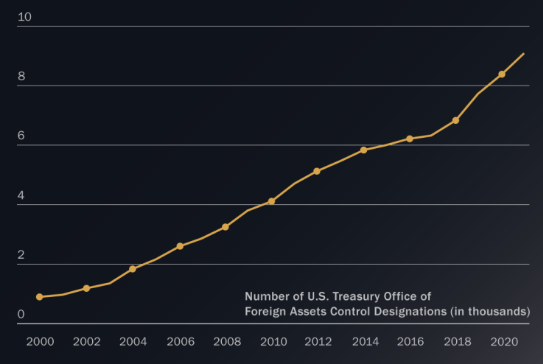
    One important conclusion about the way sanctions are working in the LAC region is that companies need to keep abreast of what can often be fast-moving changes to sanction coverage, definition, and enforcement. One example of what can be at stake came in May 2022 when Banco Popular de Puerto Rico (BPPR) said it had paid US$255,938 to OFAC to settle a sanctions violation case. OFAC said BPPR failed to adequately implement the new Venezuela-related sanctions introduced in August 2019 (see Venezuela timeline). As a result, the bank provided account services to two relatively low-level Venezuelan government employees. It supported 337 transactions over a 14-month period, moving a total of US$852,126. This was done despite the bank having earlier acknowledged the changes, which were contained in EO13884 and which among other things seek to block all Venezuelan government property and related assets under US jurisdiction.

    U.S. Treasury Sanctions Designations Shot Up After the Year 2000

    Source: International Crisis Group using U.S. Treasury Office data. Further detail here.

    OFAC itself has recommended that companies should adopt a “risk-based approach to sanctions compliance”. It says such an approach should be based on five key components: first, management commitment; second, risk assessment; third, internal controls; fourth, testing and auditing; and fifth, staff training. Other advisers also warn of OFAC’s relatively aggressive approach to secondary sanctions. Essentially all transactions between third parties may be seen as a violation of US sanctions if they involve a touchpoint or nexus connecting them in some way to entities under US jurisdiction. Typically, this might be the use of US bank accounts or other payments systems.

  • Rare earths and the environment

    Abbi Dicker 14 May 2026 Hits: 1050

    While rare earths are used for technologies – such as renewable wind and solar energy – that are expected to help reduce global carbon emissions, their mining, extraction, and processing can also be quite ‘dirty’ and have harmful side-effects; governments must strike a balance between the two.

    Many rare earths are extracted through open pit mining, in which the ore is crushed and ground, and then chemically treated with acids or alkalis to dissolve the REEs, using solvents. The process requires intensive use of water. There are risks that local communities may suffer water scarcity, chemical leaks, contamination, and harmful air pollution. However, Francisco Valdir Silveira, of Bazil’s geological survey (SGB), told Dialogue Earth, an environmental lobby group, that “if environmental and sustainability protocols are followed, the impacts will be much less and can be recovered in a short period of time. There are ways to prevent them.”

    Some specialists favour in-situ leaching, where injecting solutions into clay deposits reduces soil and solid waste making large-scale excavation unnecessary. Trials of this approach are underway in Brazil, but it applies only to some kinds of deposits and may cause unwanted side-effects such as soil acidification.

    The Chinese Academy of Sciences has recommended an electrokinetic technique where electric currents are used to mobilise and recover rare earths, reducing chemical waste. It is claimed that it can reduce chemical agents by as much as 80%. However, the process still requires large volumes of water and there are other issues to resolve before it can become commercially viable.

  • Mexico debates tariffs on Chinese imports

    Abbi Dicker 11 July 2025 Hits: 1743

    Mexico-based automobile plants are worried by the surge in Chinese imports. In the first four months of this year 19.1% of all cars sold in Mexico were imported from China. Jorge Guajardo, a consultant for DGA Group and former Mexican ambassador to China, says current Mexican regulations, which permit companies with assembly plants in Mexico to import full vehicles and auto-parts duty free, are being abused as a back door route to bring in Chinese-made vehicles. He says this loophole could be closed with an “aggressive” 70% automobile import tariff. Guajardo argues that Chinese cars are an example of unfair competition since the manufacturing process is heavily subsidised by the Beijing government.

    But Eduardo Solís of Carfax Mx says local industry regulations have worked well. He points out that Mexico-based assembly plants can only import duty free when they meet certain investment and export targets, which most Chinese companies do not. Solís says Mexico’s car industry follows an essentially export-led business model, which is deeply integrated with the US market and has been highly successful. He says Mexico is now the world’s fourth largest car exporter, and nearly 80% of national production is exported. In his view it would be best to leave Mexican automobile import tariffs stable at 20%, particularly since there is so much ongoing uncertainty over where US tariffs are heading.

  • The 'resurrection' of the Russian secret services - 4 January 2007

    LatinNews 08 September 2011 Hits: 3

    SPECIAL BULLETIN

    TO: All Strategic Intelligence Forum members

    FROM: JKC de Courcy, Chairman, Strategic Intelligence Forum

    DATE: 4 January 2007

    SUBJECT: The 'resurrection' of the Russian secret services

    On 6 December, the editor of Strategic Intelligence Review, Alex Standish, gave a speech at the European Union parliament on the subject of the Russian secret services.  The following is a full text of this important speech:

    FULL TEXT OF SPEECH:

    The ‘resurrection’ of the Russian secret services

    Members of the European Parliament, ladies and gentlemen, it is both an honour and a pleasure to be invited to speak today. In particular, I should like to thank Prof. Schöpflin and his staff for organising this opportunity for a discussion about a subject which has become, in many circles today, a political taboo.

    Who could have imagined, when the subject of this session was announced, that we would be meeting in the shadow of the controversy unleashed by the recent tragic death of Alex ander Litvinenko – and amid widespread international media speculation that the former KGB officer was assassinated and, if so, by whom?

    When I received the invitation to participate in this debate, I must admit that the title caught my eye. The term ‘Afterlife’ suggests that there has been a death. But, as I will explain today, my view is that the ‘old’ Soviet-era Committee for State Security (the KGB) never died.

    True, it has changed – in some outward respects at least – beyond recognition. In fact, the Russian secret services resemble an organism that has mutated, shrivelled in the powerful glare of democracy; but then regrouped, expanded and re-generated. Like some horrendous monster from a second-rate horror movie it has returned from the grave to haunt us.

    Despite there being a time when many – both within and outside Russia – had genuinely believed that the power of the KGB and its associated structures had been fatally wounded, we are now confronted with the realisation that behind the changes of name; behind the façade of a modern democratically accountable state service, many of the values, aims, objectives and practices of the old Soviet-era have been resurrected – or perhaps more accurately, revitalised and refinanced, and in some instances, former KGB agents re-recruited.

    But how could it have been otherwise? What did we really expect? After all, for decades, the KGB and its allied intelligence and security services had performed the assigned role of the watchdog of the Soviet state. Alert to dissent and treachery within; monitoring and acting against the Kremlin’s enemies abroad, there can be no doubt that the KGB played a major role in sustaining the Soviet empire for generations.

    Back in July 2000, I wrote my first editorial on the then-recently inaugurated President of Russia, Vladimir Putin. I entitled this article What is Putin’s game?

    I took the title from a reference by Putin himself, contained in a document he published in December 1999 entitled Russia at the Turn of the Millennium, to the role of the Russian state authorities going beyond simply “establishing the rules of the game” for the economy.

    In my editorial, I highlighted what I believed would be the new president’s key priorities. These included:

    • New foreign policy priorities – which I warned would force the West to step up its own intelligence operations in response
    • The launch of a new counter-terrorism strategy (this was, of course, long before the events of 9/11)
    • A re-centralisation of power away from elected regional governors
    • An anti-corruption crackdown aimed at the leading oligarchs, particularly those behind media empires
    • A new economic policy focusing on “a strong state”

    I concluded the article, by making the following observation:

    It remains to be seen whether Putin will be able to play his game with equal success on all fronts. It is certain that he is a much more skilful operator than his ailing predecessor, but in confronting Russia ’s wide range of problems, the new president may have to use all the tricks he learned as a career officer in the Soviet KGB.

    Even with the benefit of hindsight, I do not believe that I would revise the key points that I made in 2000. Of course, although one might have suspected it, given Mr Putin’s KGB pedigree, it was still too early to speculate publicly about his personal nostalgia for the Soviet Union and its empire of captive nations. In fact, we had to wait until his April 2005 State of the Nation address before Vladimir Vladimirovich finally permitted the mask to slip when he shared with Russia , and the world, his conviction that the collapse of the Soviet Union was “the greatest geopolitical catastrophe” of the 20th century.

    Staggering as that admission might seem to many of us here – and to the millions of victims of Soviet oppression – I think that President Putin was telling us the truth. He does genuinely believe that the disintegration of the old USSR was a tragedy, a disaster and – indeed – to use his own words “a catastrophe”.

    I don’t think that we should underestimate the importance of that defining moment in Putin’s presidency. His State of the Nation address reveals a world-view that is markedly different from his pronouncements at the beginning of his rise to power. Back in December 1999, writing of Communism he referred to “the outrageous price our country and its people had to pay for that social experiment.” He added that Communism was “a blind alley, far away from the mainstream of civilisation.”

    Again, back in 2000, he was still keen to portray himself as a modest, even simple, civil servant. I’m reminded of a summary he is supposed to have given of his life and career to the authors of the shamelessly hagiographic portrait of the new president, published in English under the title of First Person. According to Putin:

    In fact, I have had a very simple life. Everything is an open book.

    I finished school and went to university.

    I graduated from university and went to the KGB.

    I finished the KGB and went back to university.

    After university, I went to work for Sobchak.

    From Sobchak, to Moscow , and to the General Department.

    Then to the Presidential Administration.

    From there to the FSB.

    Then I was appointed Prime Minister.

    Now I’m Acting President. That’s it!

    A masterpiece of under-statement. In fact, First Person was part of Putin’s own election campaign material. Recruited into the KGB from university in 1975, Putin spent the first decade of his career in the Soviet Union , followed by five years based in East Germany . He only resigned from the security service in the summer of 1991 – that is following a 16-year career – but was then appointed to head the ‘new’ Russian security service, the FSB, from July 1998 until August 1999.

    So, why is Putin’s career as a KGB officer so significant in understanding the resurrection of Russia ’s secret services? The answer lies in the fact that Russia ’s president was a loyal Soviet official throughout the first 16-years of his working life. There is no evidence of any dissidence, any act which might suggest an independence of mind, no doubt of the rightness of his professional duty. To give him due credit, in the course of the interviews on which First Person was based, Putin admitted this:

    For better or worse, I was never a dissident.

    Indeed he was not… In fact, his career in the KGB progressed steadily, if unspectacularly. Describing his own activities whilst working in the Soviet KGB based in the German Democratic Republic, Putin provides a neat summary of the role of any foreign intelligence service:

    The usual intelligence activities: recruiting sources of information, obtaining information, analyzing it, and sending it to Moscow . I looked for information about political parties, the tendencies inside these parties, their leaders. I examined today’s leaders and the possible leaders of tomorrow and the promotion of people to certain posts in the government. It was important to know who was doing what and how, what was going on in the Foreign Ministry of a particular country, how they were constructing their policy on certain issues and in various areas of the world, and how our partners would react in disarmament talks. Of course, in order to obtain such information, you need sources. So recruitment of sources, procurement of information, and assessment and analysis were big parts of the job. It was very routine work.

    In many ways, Vladimir Vladimirovich was the ideal Soviet secret service man. Unhesitatingly loyal to the Soviet Union , hardworking and with a distinctly conventional personal life, he had no moral qualms about his professional activities, whether these involved suppressing dissident activities in Leningrad or in persuading foreign citizens to betray their own countries.

    In fact, very different from the late Aleksandr Zinovyev’s concept of the Homo Sovieticus – the Soviet Man. In Putin we see no evidence of the indifference and resigned, if often resentful, acceptance of Soviet norms, corruption and injustices. He was a true KGB man who appears to have thrived in the foreign service.

    Perhaps that is why the collapse of the Soviet Union came as such a bitter blow. For Putin this would have appeared as the “greatest geopolitical catastrophe”. Everything to which he had devoted his professional life was falling apart before his eyes.

    The mutation of the KGB

    One of the early victims of the post-Soviet era was the KGB. From its foundation as the Cheka by Lenin in 1917, the Soviet security apparatus had a variety of names, but two key functions – the defence of the Soviet state and the promotion of its interests abroad. And it carried out these tasks with singular loyalty.

    Its range of activities included espionage abroad and counter-espionage. It was also responsible for the elimination of ‘anti-Soviet’ individuals; for monitoring and suppressing dissent and ‘ideological subversion’ (a specific task for the infamous Fifth Directorate of the KGB), as well as protecting Soviet leaders and institutions. Its frontier police maintained the security of the Soviet borders, while the so-called Service A prepared and disseminated disinformation.

    The influence of the KGB was arguably at its height under its longest serving Chairman, Yuri Andropov, who headed the service from 1967 until 1982 when he succeeded Leonid Brezhnev as General Secretary of the CPSU, a post he held until his death in 1984.

    Then, in the aftermath of the August coup d’etat against Mikhail Gorbachev in 1991, during which KGB Chairman Vladimir Kryuchkov played a leading role, the organisation was apparently dissolved, ceasing to exist on 6 November 1991 .

    If there was a point at which the Russian security service is supposed to have died… this was it. However, as we now know, what really happened was a largely cosmetic restructuring. Most of the KGB’s assets and functions were transferred to renamed agencies. The Foreign Intelligence Service (SVR) was created officially in October 1991 and has taken over the role and activities previously assigned to the KGB’s First Directorate.

    Meanwhile, the Russian Federal Security Service (FSB) is responsible for domestic security, counter-intelligence and counter-terrorism, as well as combating organised crime and the narcotics trade. These functions were formerly carried out by the KGB’s Second, Third, Fifth and Seventh Directorates. Between 1991 and 1995, the service was known as the FSK (Federal Counter-intelligence Service). In July 1998, Putin became the head of the FSB.

    Of course, no-one seriously expects any modern state to simply dissolve its intelligence and security services. The key issue is the extent to which the operations of such agencies are regulated and accountable within a legislative framework.

    And the obvious question that follows is to what extent do the SVR and the FSB carry out legitimate activities, to what extent are they used by the Kremlin to further Russia’s agenda at home and abroad and whether they represent a real and present danger to foreign countries, particularly European Union and NATO member states?

    Putin’s objectives

    At the beginning of this presentation, I focused on Vladimir Putin’s own career as a KGB officer. I believe that this is highly relevant to achieving an insight into the role of the Russian security and intelligence services since his election as president in 2000. If we examine the state of Russia on the eve of Putin’s rise to power, we can better understand his role and significance in the resurrection of the security services.

    We cannot ignore the fact that the Yeltsin era was a period of severe upheaval, involving economic and social dislocation. Russia was faced with the reality of having lost an empire, without having found an alternative role. With the economy in turmoil, the standard of living for many ordinary Russians was in serious decline.

    The Russian security services were also facing a major crisis, both of identity and of funding. For example, during 1991, the SVR is known to have deployed just one officer in London, based at the Russian embassy – perhaps the lowest level of Russian intelligence service representation in Great Britain since diplomatic relations were restored after the British government finally recognised the Soviet Union in 1924. In contrast, within three years of Putin’s election as president, this number had risen to at least 33 and an even higher number is being quoted today by intelligence analysts.

    Rebuilding Russia ’s international influence – and its foreign intelligence service – has been a major strategic objective for President Putin. Indeed, I would argue that in almost every aspect of Russia ’s relations with those states still within the CIS, with former Soviet republics and with those countries which were formerly part of either the Warsaw Pact or COMECON, the revamped intelligence services are playing a major role.

    For example, there has been evidence of Russian intelligence service activity during every recent parliamentary and/or presidential election in countries which Moscow considers to be within its own sphere of influence: Ukraine was perhaps the most blatant case, but Russian ‘election advisers’ and ‘campaign workers’ are being deployed (and bankrolled) via the Russian intelligence services.

    However, more traditional areas of intelligence service activity are not being neglected under Putin. Disinformation campaigns and the dissemination of propaganda is again being undertaken. Other activities including stirring up domestic discontent and fuelling of ethnic divisions in states perceived to be too pro-Western.

    Moreover, the Russian intelligence services have been particularly active in infiltrating the intelligence and security agencies of new member states of both the EU and NATO. In late 2002 and early 2003, I played a supporting role in highlighting the risks associated with continuing to have Vladimir Mitro, a Soviet-trained intelligence officer, in post as director of Slovakia ’s intelligence service, the SIS. Mitro had been recruited by the former Czechoslovak communist regime and received his training during the 1970s when Czechoslovakia was undergoing a period of Moscow-imposed ‘normalisation’ following the Soviet invasion that crushed the Prague Spring in 1968.

    In common with several post-communist intelligence services, Slovakia ’s continued to recruit extensively from among former members of the Communist-era secret police, the StB – which was, of course, completely controlled during the Soviet-era by the KGB. Mitro was only the most blatant case of a former Communist secret police officer being installed as the head of the intelligence service in a state that was a member both of NATO and of the European Union. After a three month long battle fought both in the international and domestic media, Mr Mitro resigned in March 2003.

    Why is this case – and others like it – so crucial? The key issue is that individuals who served within the Communist intelligence agencies did so with the assent of Moscow . Loyalty to their own nations was secondary to the requirement for loyalty to the Soviet Union . And to ensure that this was the case, the KGB ‘insurance policy’ was to collect potentially compromising material – known colloquially in Russian intelligence circles as ‘kompromat’ – which might be useful in ensuring an individual’s continued loyalty to Moscow . Needless to say, those files remain available to the FSB and the SVR.

    For that reason, the continued employment, or re-employment – of former members of Communist secret police services greatly increases the risk of such an individual being pressured. In my opinion, it is a risk too great for any independent state to take. Of course, this problem is not limited to former secret policemen. Similarly, some politicians may be vulnerable to pressure being exerted from Moscow .

    Another cause for mounting concern is the often close ties which are believed to exist between the Russian intelligence services and organised crime groups, both in Russia and abroad. These links, by their very nature, are difficult to quantify. However, it is known that after the KGB was officially disbanded in 1991, a number of former officers sought alternative routes to influence, in addition to amassing personal wealth.

    Moreover, Russian criminals active abroad in the diaspora are well placed to provide information to Putin’s intelligence service. Such ties can also provide invaluable access to fresh kompromat and as a means of applying pressure through blackmail. And if anyone doubts just how useful such links can be, one only has to point to the criminal enclave that is Moldova ’s breakaway region of Transdniester to see evidence of how Russian support for Tiraspol is being used as a political strategy.

    The results of Moscow ’s political patronage of this rogue regime are evident. As the European Parliament's delegation to Moldova observed in 2002, Transdniester is “a black hole in which illegal trade in arms, the trafficking in human beings and the laundering of criminal finance was carried on”.

    History and perceptions

    One of Vladimir Putin’s principal achievements in respect of his country’s security services is that he has made significant progress in his aim of re-interpreting (indeed, re-writing) the history of the KGB. According to the ‘Putin version’ of events, the KGB was a patriotic, loyal organisation which defended the Soviet Union against its enemies, internal and external. As an intrinsic and loyal member of the KGB himself, it is hardly likely that Putin could admit any other interpretation.

    It is important to note that in his December 1999 analysis of Russia ’s position on the eve of the Millennium mentioned earlier, he criticised the economic failures of the Communist system, but never the actual security organs of state ultimately responsible for the enforcement of the “social experiment” that he acknowledges failed. In particular, there is no room for criticism of the KGB or its methods. This would not be acceptable in Putin’s version of Soviet history.

    Amid the continuing rise of Russian nationalism – a sentiment that is being shamelessly manipulated for domestic consumption – the FSB is portrayed as an honourable service, dedicated to protecting Russia from its enemies. This portrayal is almost identical to the propaganda used during the Soviet era to justify the activities of the NKVD and later the KGB. Naturally, Putin’s version of history omits the crucial fact that the vast majority of the KGB’s victims were ordinary Russian citizens.

    Recent targets include foreign organisations based in Russia and Russian NGOs with foreign links. As is well known, independent broadcast media in Russia is effectively gone. Even academics and journalists – favoured targets for the old KGB - are being prosecuted for ‘treason’ or espionage, or else they are killed. Of course, there are many theories as to the motives behind the deaths of Litvinenko and Anna Politkovskaya. I don’t propose to add to the current speculation. Perhaps it is enough to observe that I am not optimistic those responsible will ever be identified or brought to justice.

    Conclusions

    I should like to conclude with a brief summary of my views. I think that it is difficult to speak of an ‘afterlife’ of the Communist secret police. Although there has been some change of personnel and a very successful re-branding of the KGB, I believe that the essential characteristics of the modern Russian intelligence and security services remain the same. Under a president with the biography of Vladimir Putin, I do not see how it could have been any different.

    The real challenge for both the West and those states within the so-called ‘near abroad’ is to have the political vision to refocus on the danger posed by the massive increase in Russian intelligence service activity within their borders. The war against terrorism is one of the greatest gifts the West has offered Putin. Not only has it enabled him to justify repressive policies within the Russian Federation , but it has led Western governments to reorient their own intelligence services towards the threat – a genuine threat – posed by Islamic extremism. This in turn, has led to a substantial cut in resources and personnel away from counter-espionage.

    In the warm glow of the expected ‘peace dividend’ when the Soviet Union disintegrated, there was an optimistic conviction that Russia no longer posed a significant threat to the West. Counter-espionage budgets were cut, intelligence services were downsized and experienced Soviet analysis retired or laid off. Even when Putin – and the entourage in the shadows behind him – came to power, there was much wishful thinking and the hope that Vladimir Vladimirovich was a man with whom we could do business.

    That honeymoon period is now long over and in its place we have greater realism about Russia and its strategic objective of regaining Great Power status. We also need to recognise that the Russian intelligence services are a key component of the Kremlin’s broader strategy and are increasingly active in subversion, espionage, the recruitment of a fresh generation of intelligence assets and the re-activation of older agents. Propaganda, disinformation, the manipulation of the media, stirring up of ethnic and nationalist tensions and the gathering of kompromat for the purposes of blackmail are all potent tools in the hands of the SVR and the FSB. Democracies, east and west, ignore these threats at their peril.

    Thank you

    Alex Standish
    Editor, Strategic Intelligence Review
    6 December 2006

  • Iran's lack of judgement most alarming part of latest crisis - 20 July 2006

    LatinNews 06 September 2011 Hits: 5

    The most alarming part of the latest Middle East crisis is what it says about the nature of the present regime in Tehran. The most important aspect is what is to be done with Lebanon once the fighting stops.

    Of all the participants in the crisis, Israel’s position is the easiest to fathom. It wishes to force the Palestinians to into a ceasefire that holds, while it resumes its unilateral withdrawal from Palestinian territories. It wants to destroy the power of Hezbollah in Lebanon and force the Lebanese government and army to take responsibility for security in south Lebanon and along the border with Israel (even though Lebanon’s army is 50% Hezbollah, Israel believes that the fact that they are in Lebanese Army uniforms limits their ability to act independently of official Lebanese policy). It wants to prevent any return of Syrian power to Lebanon and to keep Damascus isolated. And it wants the major powers to take the toughest possible line with Iran over its nuclear programme.

    For the most part it is achieving these goals, albeit at some reputational cost. For a start, Hezbollah’s strength is being seriously degraded. It is thought that about 30% of Hezbollah’s operational capabilities and about 50% of its rockets (in particular the Fajr rocket launchers) has been destroyed. Nor is that the end of it. The full IDF plan for reducing Hezbollah has not yet been completed. It is still going after some 600 Hezbollah storage bunkers, and it is still attempting to decapitate the organization.

    Israeli sources say that the IDF is targeting the 12 most senior members of the group, who are thought to be hiding in bunkers in the Dahiya quarter of southern Beirut. These targets include Secretary General Hassan Nasrallah, Ibrahim Akil, and Imad Mughniye.

    There have even been some diplomatic gains for Israel, with the G-8’s statement on the crisis being seen as a significant achievement as it provided support for Israel’s basic position that Hezbollah and Hamas should stop launching attacks on Israel and return the abducted soldiers. It also called on the Lebanese government to implement UN Security Council Resolution 1559, which calls for Beirut to disarm Hezbollah.

    As one of the Haaretz newspaper’s columnists put it: "It took nearly 40 years for Israel to be seen in a just war…a global diplomatic bonanza. This is the second time since 1948 that Israel has been defending its territory rather than occupied territory, or, as in 1956, engaging in a fraudulent conspiracy to safeguard the interests of the West in the region. This time it’s classic: blows of justice aimed at an organization that is ignoring an agreement over an international border, and is running rampant under the protection of its government and those who pull its strings from Damascus and Tehran."

    There has also been very strong domestic support (86%) for Ehud Olmert’s government and the drive to destroy Hezbollah’s power.

    On the other hand, the belief in the West and elsewhere that Israel tends to react to attacks with disproportionate force has been strengthened. And Hezbollah’s success in attacking targets deep inside Israel, and even an Israeli naval ship, has dented its image of military invulnerability. Furthermore, everyone living north of the Haifa to Afula line, that is 20% of the Israeli population, is having their lives hugely disrupted.

    The Arab position is more complex. Arab public opinion is strongly behind Hezbollah and Hamas, but the principal Sunni Arab powers of Saudi Arabia, Jordan, and Egypt are opposed to any increase in Iranian power and influence in the Arab world, and they particularly do not want the confrontation between Israel and Hezbollah to distract the major powers from the need to curb Iran’s nuclear ambitions.

    Saudi Arabia has come out with a surprisingly public criticism of Hezbollah, despite (or perhaps because) of the fact that Arab public opinion is rallying behind Hezbollah and Hamas. Arab public opinion knows that these non-state actors are doing what their governments (with the very marginal exception of Saddam Hussein) have singularly failed to do since 1973: inflict military pain on Israel.

    Saudi clerics have been deployed to counter public support for Hezbollah, with leading hardline cleric Nasser al-Omar saying: "We should not raise our hand in respect to just anyone who fights the Israeli-American forces. Hezbollah is not fighting on behalf of Sunni Muslims in Palestine or elsewhere, it is a tool in the hands of the Iranian Revolutionary Guard let loose to realise an Iranian agenda."

    Syria is a separate case. It is close to Hezbollah and has allowed Iran to use Syria as a conduit for arms supplies to Hezbollah. But Bashar Assad has lost control of the process. His father Hafez used Hezbollah to try to force Israel into negotiations over the Golan Heights. Bashar is just being used by Hezbollah and Iran. This weakness alarms Israel and could lead to a review of policies towards Damascus. Regime change will be climbing up the agenda again.

    Which brings us to Iran. There has been much speculation over the degree to which Iran intended to precipitate the current crisis. There has also been almost opposite speculation that Iran intentionally sparked the crisis to divert attention from its nuclear programme by precipitating a clash on the Lebanon-Israel border. This latter suggestion seems unlikely, as the one certain result of all this has been to reinforce in Western and Israeli minds just how dangerous the current regime in Tehran is.

    Our view is that the crisis is further proof that Iran under President Ahmadinejad is a far less predictable - therefore far more dangerous - proposition than under any previous leader of revolutionary Iran since the death of Ayatollah Khomeini. The surprisingly pragmatic statecraft that has often characterized Iranian foreign policy has been replaced by something much less predictable.

    Iran’s strategic position has been immeasurably strengthened by the fall of Saddam Hussein, and the sensible and pragmatic policy would be to consolidate those gains. Instead it has precipitated a crisis, which far from strengthening its position could lead to the near destruction of Hezbollah, the increasing isolation of Syria (its only Arab ally outside of Iraq), a hardening of Western (and of course Israeli) opinion against its nuclear programme, and the open animosity of the main Sunni Arab powers.

    The only gain to Iran will be increased support on the Arab street, but that is not something that can be easily banked, and does not in any case outweigh the other losses.

    It would seem, therefore, that Iran has done Israel a considerable favour. It has damaged its own international standing even further, and it has provided a justification for attacking Hezbollah that is satisfactory to almost all the leaders that count (except for France’s President Chirac).

    But the problem, as ever, is the aftermath. When Israel withdrew its forces from southern Lebanon in 2000, the Lebanese government was unable to reassert its authority and allowed Hezbollah to establish a state-within-a-state. It will be the same this time around unless there is a concerted international effort (based on Saudi Arabian money and Western military force) to bolster the Lebanese state.

    The nightmare scenario, for Israel, is that the Hezbollah leadership survives the onslaught intact and emerges from its bunkers bloodied but unbowed. Hezbollah’s rank-and-file will certainly survive as, like all guerrilla armies faced by overwhelming conventional force, it has just melted away to avoid a confrontation it cannot win. And although its arsenal will have been seriously depleted, if Hezbollah still controls southern Lebanon more or less unmolested by the Lebanese state, it can rebuild with the help of Syria and Iran. In the meantime its reputation as the only organization capable of taking on the Israeli state and surviving will have been enhanced throughout the Arab world - and so, too, to the horror of Riyadh, Cairo, and Amman, will Tehran’s reputation. JdeC.

    NOTE: The crisis in Lebanon has not come out of the blue. As the following chronology shows, it is the end result of six months rising tensions.

    - 25 January: Hamas wins Palestinian parliamentary elections

    - 30 January: Hamas rejects the call from the Mideast Quartet for it to renounce violence and recognize Israel.

    - 19 February: Israel halts its monthly transfer of millions of dollars to the Palestinian Authority ahead of the formation of a Hamas-led government.

    - 29 March: Hamas Prime Minister Ismail Haniyeh takes office.

    - 10 April: Hamas says that it considers Israel’s severing of contacts with the Palestinian government to be "a declaration of war". The EU severs political contacts.

    - 9 June: Hamas’s armed wing calls off its 16-month truce following the killing of seven family members on a Gaza beach by Israeli shells.

    - 25 June: Militants from Gaza launch a raid into Israel and capture Corporal Gilad Shalit.

    - 28 June: Israeli forces push back into Gaza.

    - 29 June: Israeli troops in the West Bank arrest a third of the Palestinian cabinet and more than 20 Hamas parliamentarians.

    - 3 July: Israeli forces move into northern Gaza. Three days later the offensive is intensified after Hamas fires a rocket at the Israeli city of Ashkelon for the first time.

    - 8 July: Prime Minister Haniyeh calls for a ceasefire with Israel. Israel says that Hamas must first free Corporal Shalit.

    - 12 July: Hezbollah guerrillas capture two Israeli soldiers and kill up to eight in an attack across the Lebanese border.

    - 13 July: Israeli aircraft bomb runways at Beirut airport, and the navy blockades Lebanese ports.

    - 14 July: Israeli warplanes attack the Beirut-Damascus highway. The air and sea blockade is intensified.

    - 15 July: An Israeli missile in southern Lebanon kills 20, including 15 children.

    - 16 July: Hezbollah rockets kill eight in the Israeli city of Haifa, bringing to 12 the number of Israelis killed.

    - Israel attacks Beirut’s Shi’ite southern suburbs.

    - Over 110 people have been killed in the five-day offensive.