Introduction
Over the last ten years the going has got tougher for the main Latin American and Caribbean economies (LAC). In this report we will outline some of those difficulties and make the case for why one particular sector, agribusiness, may be able to play a key role in reversing a generalised trend towards slower growth.
The essential story of the last 10-15 years is that the region had a good period, followed by a less good one. The LAC economies enjoyed the benefits of a major commodities boom, which helped boost export revenues, lift economic growth rates, reduce poverty, and expand the size of the middle classes. Various trends in the world economy seemed to come together in a way that benefited Latin America. Globalisation and free trade appeared to be in the ascendancy. The Chinese economy grew at an accelerated pace, feeding global demand for raw materials. Latin America was able to generate record export earnings from its traditional primary commodities, among them soya, wheat, coffee, sugar, copper, iron ore, and zinc.
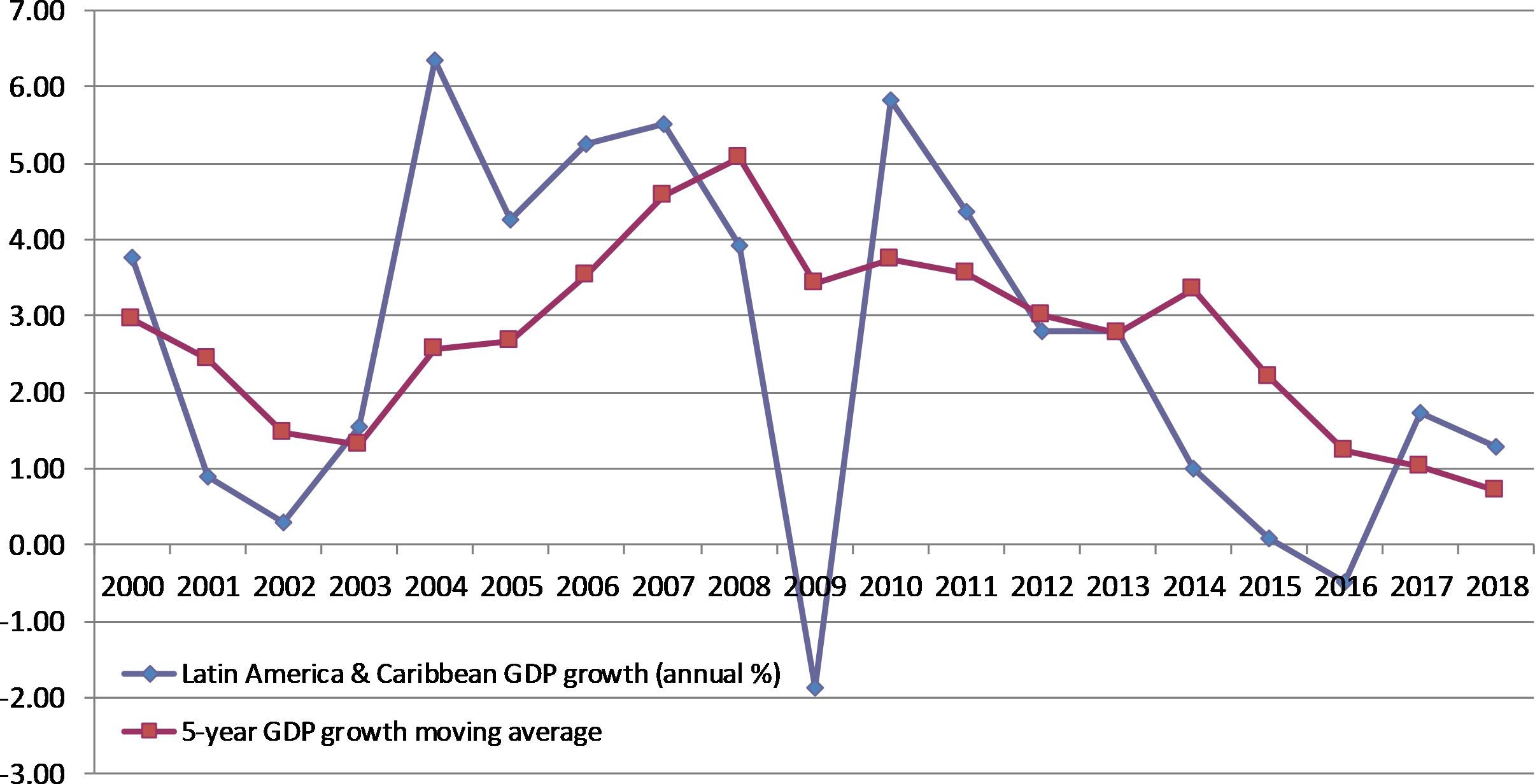
The thrill is gone: regional growth loses impetus
Annual % change in GDP
Source: World Bank
The commodities boom or super-cycle lasted around 10 years and ran out of steam by 2013. So, if we look back over the last ten years, we have very roughly two distinct and separate five-year periods. The five years running to 2012 were still marked by the boom. Despite the global financial crisis of 2008/09, these were good years for LAC. The moving five-year average GDP growth rate stood at 5.1% in 2008. Although it then trended down, it was still a respectable 3.0% in 2012, pushing up again a little to 3.4% by 2014. After that, however, it became clear that the boom had definitely played itself out. The five-year average LAC growth rate dropped sharply to only 1.2% in 2016, and to 1.0% in 2017. For 2018 it is likely to remain around 1.0%. So, the second five-year period has been troubled. Because of population growth this rate of GDP expansion equates to stagnant or even falling per-capita incomes. The low growth of recent years has seen poverty and inequality begin to creep up again.
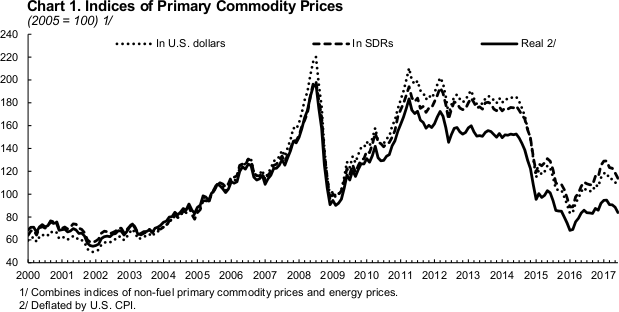
There was clearly a strong correlation between commodity prices and LAC economic growth. The chart below shows the evolution of the main commodity price indices compiled by the IMF. In broad terms it has a similar shape to the LAC GDP chart: a strong rise since the turn of the century, a sharp dip during the 2008-2009 crisis, a new peak in 2011-2014, and then a pronounced decline. A very important point is that there is a consensus among economists: the commodities boom was a one-off, and is not going to return with anything like the same intensity. In other words, the outlook for commodity prices is for modest recovery at best. Latin America will have to learn to live without those windfall export revenues.
Source: IMF
The situation now is indeed very different to the commodity boom years. The Chinese economy is still growing, but more slowly than before. Within China there has been a rebalancing: domestic consumption is now playing a bigger role leading growth than investment in export-oriented businesses – one result is that the composition of Chinese import demand is now less raw materials-intensive than it was before. The US also continues to grow, but the rise of protectionist sentiment under the Donald Trump presidency has created widespread uncertainty – not least for Mexico, which depends critically on trade with its northern neighbour. There is a possibility of a worsening US-China trade war which could be intensely disruptive to the global economy. More generally, investors have been pulling away from emerging markets. Argentina suffered a financial and exchange rate crisis for much of 2018. The rise of populist leaders in Brazil and Mexico could be disruptive for multilateral trade deals.
The new situation casts a harsh light on traditional thinking about economic development in Latin America. Although there are many variants, it has long been argued that over a period of many decades the Latin American economies have been in the process of transitioning from natural resource-led growth (led by exports of largely unprocessed agricultural and mining commodities) to an industrial phase, where growth is led by the manufacturing industry, and finally to one where the tertiary sector – the development of a wide range of services, begins to come to the fore. Debates have raged over the role of protectionism versus free trade in this process, and about the various ways that countries may be checked or blocked in their direction of travel. Some analysts have noted that other parts of the world, particularly the Asian economies, have gone further than Latin America in their transition process, particularly by competing more effectively in the globalised economy and creating more integrated value-added chains in manufacturing. Economists have focused on the ‘middle income trap’, a set of circumstances where structural imbalances, and, in particular, large fiscal and current account deficits, prevent economies like Brazil from achieving more sustainable growth and development.
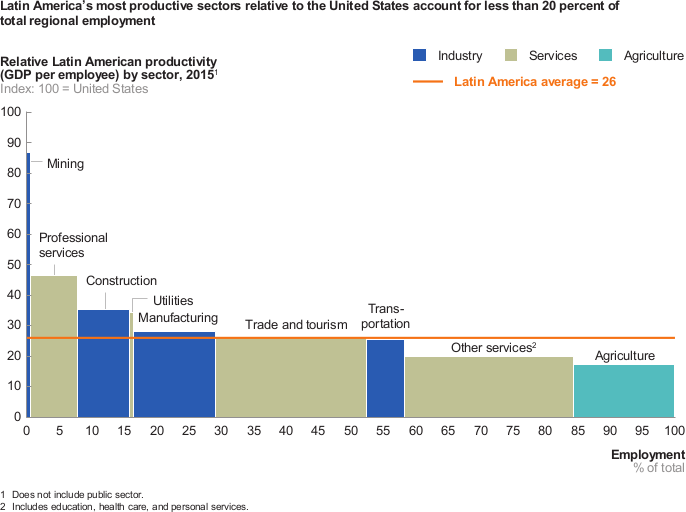
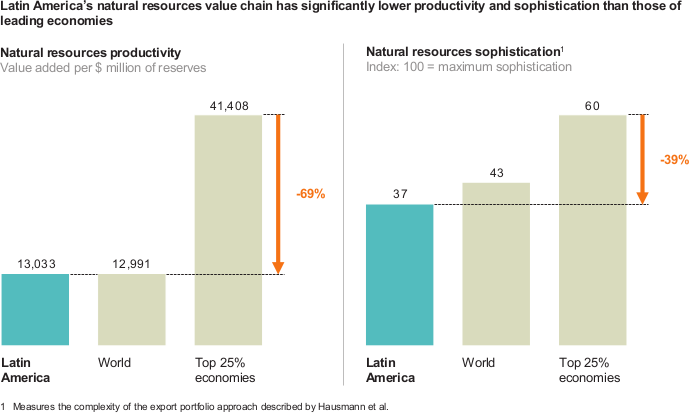
What has become clear is that to navigate the more hostile waters of the world economy, Latin American countries will have to find a way of lifting their productivity and increasing their share of value added. From this perspective reliance on commodity exports is clearly not enough for two key reasons. First, prices will remain comparatively low and, as in the past, will remain subject to periods of intense volatility. Second, exporting unprocessed raw materials means that Latin America gets only a small slice of the value added. There is therefore a strong argument for increased diversification into manufacturing and services, both of which capture more value for the producing country. Yet this can only be done in a sustainable manner if the country has a real competitive advantage. Experience shows that subsidising uncompetitive manufacturing industries is not a viable or sustainable policy. Latin America can point to some successful experiences in developing competitive manufacturing, such as Mexico’s automobile sector (which unfortunately attracted the protectionist attentions of US president Donald Trump) or Brazil’s aviation sector. But at a macro-level, it is proving difficult for manufacturing to increase its share of GDP and its contribution to development. In fact, some analysts argue that the China-led commodities boom in some ways ‘de-industrialised’ countries like Brazil, which saw a fall in manufacturing’s share of GDP.
The hypothesis we want to investigate in this paper is whether the development of agro-industry and agro-industrial products can in some way combine the best of both worlds for the LAC region – combining a natural comparative advantage in agriculture, livestock, and fisheries (a product of fertile land, long standing farming skills, plentiful water resources, and favourable weather) with the higher levels of value added and productivity often associated with the manufacturing sector. First, however, we propose a quick detour to Shanghai.