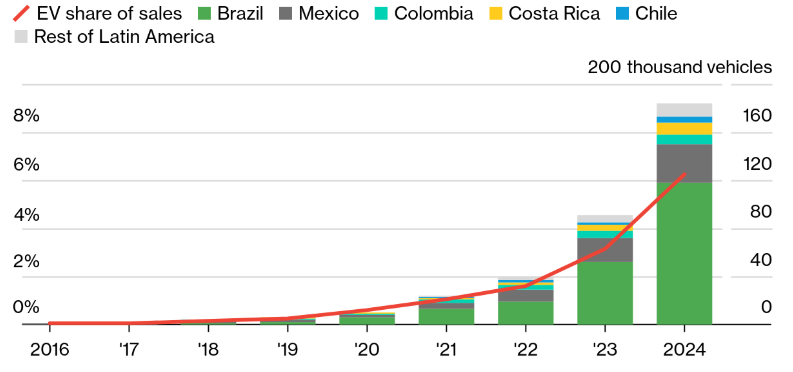
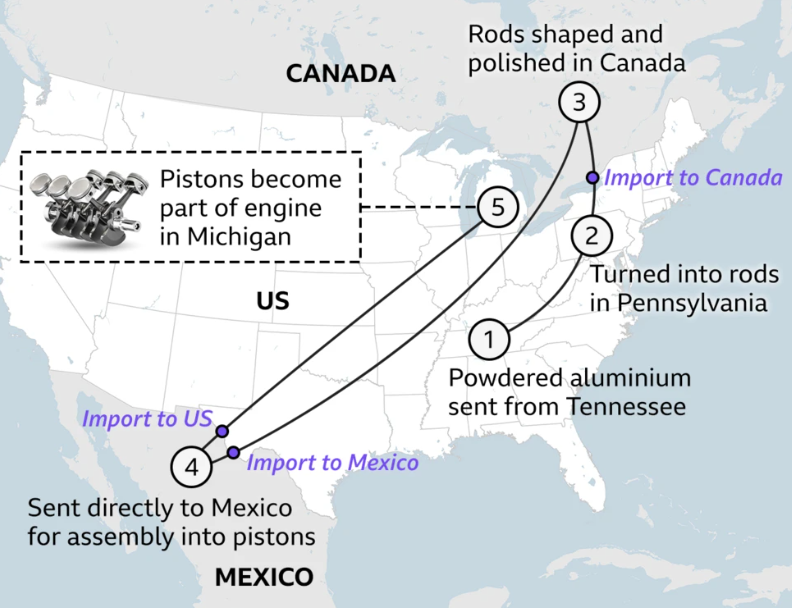
The focus of this report is on China’s battle for market shares and technology in the electric vehicle (EV) segment, which could be described as a ‘downstream’ part of the automobile industry. But it is important to note the rising EV sales may also have transformative effects on parts of the ‘upstream’ – such as the mining of key Latin American metals like lithium and copper, which are essential components of modern EVs. In fact, the electric vehicle boom could trigger some significant changes in the Latin American mining industry.
Lithium is a key component of EV batteries. Bolivia is reported to hold the world’s largest lithium reserves at 23m tons, followed by Argentina (22m tons), and Chile (11m tons). Taken together these three counties are known as the lithium triangle. For their part Bolivian governments have sought to nationalise lithium and granted monopoly development rights to the state lithium company YLB. In early 2019 the government said it had reached an agreement with China’s Xinjiang TBEA group to extract lithium from two salt flats but a coup d'etat and change of government meant the plans came to nothing. In mid 2023 a new announcement was made, this time involving a US$1.4bn joint venture with CATL of China to develop lithium extraction from the Uyuni and Coipasa salt flats. Further lithium plans are unlikely to be announced until after Bolivian general elections due in August.
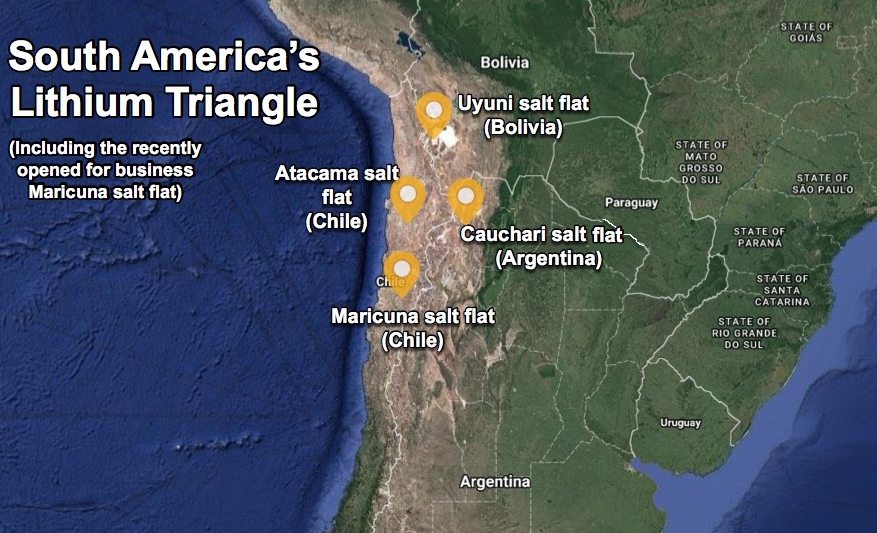
Source: Mining.com
Argentina has pursued business-friendly lithium mining policies. This has led to new investment and increased production, making the country the fourth largest lithium producer in the world (after Australia, Chile, and China). Mines in three provinces (Jujuy, Salta, and Catamarca) are responsible for around 5% of world lithium output. Existing laws allow companies to negotiate mining contracts directly with provincial authorities. Regional royalties are capped at not more than 3%. There are currently 49 new lithium mining projects under development, of which seven are led by Chinese companies.
Chile accounts for around one-third of global lithium production and is the second largest global producer. Eighty-nine per cent of China’s imports of lithium carbonate are sourced from Chile. A new National Lithium Strategy enables significant state control but also allows private companies to operate on a licensing basis. There are currently two companies mining lithium in Chile, locally owned SQM (in which China’s Tianqi Lithium has a 22% stake) and US-based Albermale. There have been reports of a project in which China’s BYD would invest US$290m combining lithium mining, refining, and cathode production. However, industry sources have recently suggested it is on hold. This too is an election year in Chile which means lithium policy could be reconsidered. However, governments of both the left and the right have a history of good economic relations with China.
Away from the lithium triangle there have also been developments in Mexico where lithium reserves are estimated at around 1.7m tons. In 2022 the government created a state-owned lithium company, known as LitioMx which was given exclusive responsibility for exploration, production, and refining. The move triggered a legal dispute since the state of Sonora had earlier given production rights to Bacanora Lithium, later purchased by Ganfeng. In June of last year Ganfeng initiated an arbitration case against Mexico, which is ongoing. Like her predecessor, Mexican President Claudia Sheinbaum is eager to see higher value-added activity in Mexico, ideally moving from mining and refining to full lithium-battery industrial production.
The copper content of EV production is much greater than in internal combustion vehicles since electric vehicles contain large amounts of copper both in the batteries and in internal cabling. Partly because of this, in 2023 the US government declared copper to be a critical mineral. Latin America produces around 40% of the world’s copper. The key copper mining countries are Chile, Peru, and Mexico. In 2022 Chile exported US$22.8bn worth of copper ore, of which US$15.6bn or 68% went to China. In the same year 71% of Peru’s copper shipments went to China. Chinese companies such as MMG, Guoxin, and Citic are active in Peruvian mining.
US-China geopolitical rivalry may also affect refining. The global processing of critical minerals is already concentrated within China with some experts claiming it refines 90% of the world’s rare earth minerals and 60-70% of lithium and cobalt. A Chinese decision in 2023 to introduce export controls on graphite, germanium and gallium has increased US concern that its national security could be affected by key mineral shortages. As we shall see below, the definition of what is local content in the composition of batteries and other EV components may be critical in determining access to the US and tariff levels.
While many Latin American governments aspire to attract lithium-ion battery production to their countries, few have succeeded, and Chinese EV companies do not seem eager to prioritise reshoring this activity. BYD has a plant in Manaus in the Brazilian Amazon which started production in 2022 and appears to be mainly focused on battery pack assembly, rather than manufacture, serving the company’s bus factory in Campinas, São Paulo state. Plans for full BYD battery production in 2025 are associated with a proposal to build a major BYD assembly plant in Camaçari, but as we shall see this project is delayed. Industry analysts say EV battery construction in Brazil will almost certainly be intended to meet domestic demand, since the US is boosting its own domestic battery production and seeking to shut out Chinese competition.
Other plans to start battery production in Latin America seem to be general declarations of intent rather than firm ready-to-go projects. In early 2023 Chinese EV manufacturer Chery announced a large project in Argentina, apparently to include battery manufacture. No further announcements were made, and it is assumed that the plan is not progressing. CATL, another Chinese EV maker, said in 2022 that it had plans for a battery plant in Mexico that could potentially serve a Tesla factory in Texas. The situation changed when the Joe Biden administration introduced the Inflation Reduction Act (IRA) with major incentives to encourage domestic battery production in the US. CATL has subsequently pivoted to sign a licensing agreement with Ford to manufacture ion phosphate batteries in Michigan.

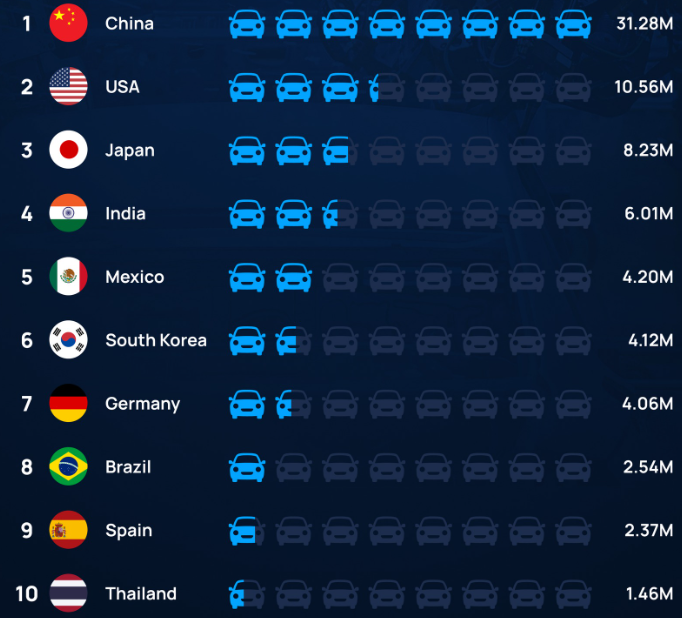
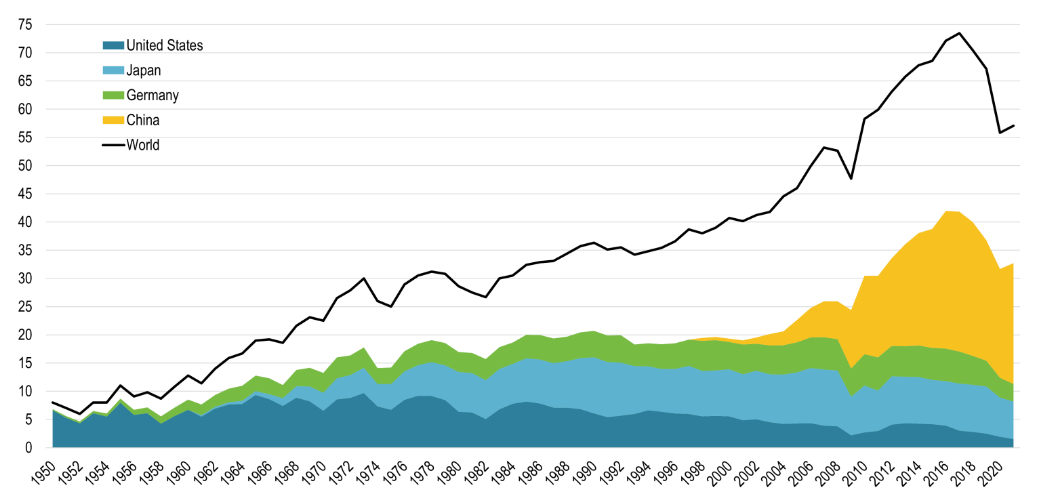 Source: International Organization of Motor Vehicle Manufacturers
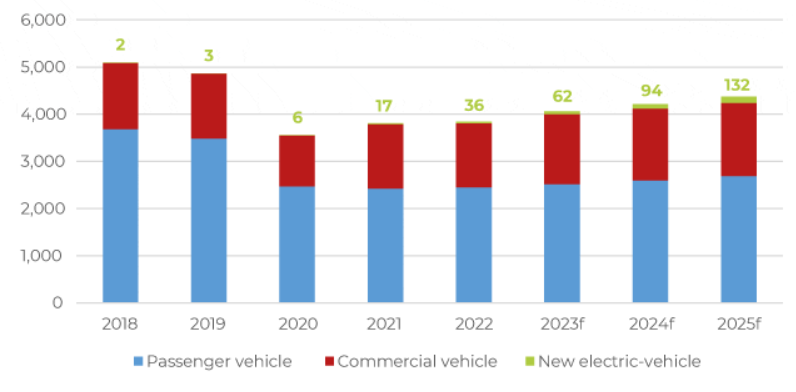 Source: Americas Market Intelligence