
All Categories

Subcategories

  • NICARAGUA: Changes to military code approved

    Abbi Dicker 09 May 2025 Hits: 3664

    In late March Nicaragua’s 92-member unicameral legislature, which like all institutions is controlled by President Daniel Ortega’s Frente Sandinista de Liberación Nacional (FSLN), approved changes to the country’s military code. Among other things the changes introduce a military reserve. They also effectively consolidate the stranglehold on power of Ortega and First Lady Rosario Murillo, now a co-president following the recently implemented sweeping constitutional reform package [SSR-25-01]: both co-presidents are named as heads of the armed forces.

    Approved by the legislature on 25 March, one of the changes to the military code which has most alarmed Ortega critics is a provision which creates a “patriotic military reserve” force within the Nicaraguan military. This will comprise, on a voluntary basis, officers, officials, non-commissioned officers, and lower ranking soldiers and sailors who have retired or been discharged from the army, along with any citizen wishing to participate in the armed defence of the nation.

    A report published on 26 March by Nicaraguan investigative news outlet Confidencial cites anonymous analysts as saying that the purpose of the new military reserve was “intimidation”. It cites them as comparing the new force with the newly-created voluntary police force, which is considered little more than an institutionalised version of the paramilitary shock groups that played a key role in the helping the police suppress dissent as part of the government crackdown which began in 2018 [SSR-25-03]. One analyst cited by Confidencial said that in practical terms the military reserve makes no sense since “the tasks of the army are not about maintaining internal order, but have to do with the defence of sovereignty and the national territory.” The same analyst also noted that “there is no medium-term threat on the horizon of a military conflict in which Nicaragua would participate.”

    The other change drawing major alarm was that giving Murillo control of the armed forces, along with Ortega. This not only reaffirms the military’s subordination to the executive, enshrining what was already a de-facto arrangement, but, in particular, consolidates the grip on power of Murillo who, through the constitutional reform package, was promoted from vice president to co-president. Prominent dissidents such as former Sandinista guerrilla  Dora María Téllez, who was among the 222 political prisoners deported to the US in February 2023 [SSR-23-04], discern in the constitutional changes and figure of the ‘co-president’, Murillo’s “ambition for total power”, as Téllez explained in an interview with Confidencial’s director, exiled journalist Carlos Chamorro, in November 2024, when the constitutional reform package was first unveiled. Murillo’s promotion to co-president is also understood as being part of efforts by the presidential couple to ensure a line of family succession to Ortega, who is 79, with Murillo, 73, and one of the couple’s sons, Laureano Ortega, both widely tipped as successors.

    Landmark report published

    On 3 April the United Nations-appointed panel of human rights experts on Nicaragua (GHREN) released a 234-page report which, for the first time, identifies 54 government, military officials and FSLN members as responsible for the alleged grave human rights violations and other crimes associated with the brutal crackdown on dissent which began in 2018. As well as the presidential couple, those named include current army commander General Julio César Avilés, who has been in the post since 2010 in breach of the military code; and Francisco Díaz, who has served as police chief since 2018. Téllez was cited by local media as describing the GHREN report as “the first big step towards justice”. 

    Avilés

    General Julio César Avilés’ continuance in the post of army chief flouts the country’s 1994 military code which set out five-year terms for heads of the military. In 2020 he was blacklisted by the US government for his role as commander-in-chief of the army which, according to the US, “provided support to the police and paramilitary gangs that carried out crimes against the Nicaraguan people, including attacks on protesters during the unrest that began in April 2018”. An earlier report by the United Nations-appointed panel of human rights experts on Nicaragua (GHREN), published in February, concluded for the first time that the Nicaraguan army – despite its denials – had participated in the 2018 crackdown [SSR-25-04].
  • The global advance of EVs

    Abbi Dicker 11 July 2025 Hits: 1883

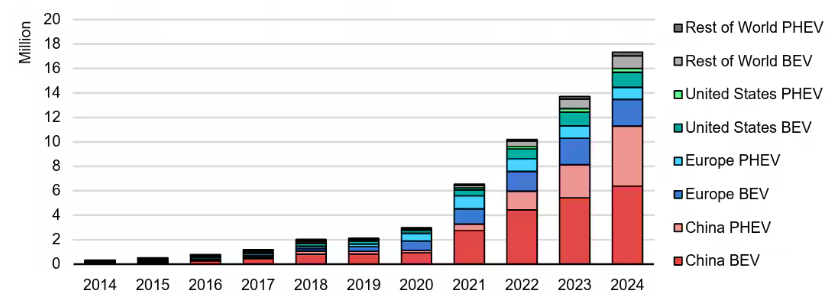
    Global electric vehicle (EV) car sales totalled 17m in 2024, showing a blistering pace of growth on the preceding year. EVs made up almost half of total car sales; one in every ten Chinese cars on the road is now electric. Europe, on the other hand, saw something of a flattening-out of EV sales growth as various incentive schemes and subsidies began to be phased out. Despite ups and downs, EVs still held on to their market share at around 20%. In the US EV sales grew by 10%.

    The EV wave is spreading to new territories. Some analysts have argued that because of overcapacity in China, EVs are now being exported at historically low prices to other regions. Asia and Latin America saw sales surge by a combined total of 60% year-on-year to nearly 600,000 units in 2024. There has also been notable growth in Africa (mainly in Morocco and Egypt) but also in Thailand and other emerging economies.

    Global EV sales are expected to reach a total of 20m this year, or more than one-quarter of all cars sold worldwide. Confirming the strong pace of demand, sales in the first three months of this year were up by 35%. Chinese sales will be helped by a scrappage incentive scheme for trading-in fossil fuel cars as well as affordable pricing policies.

    In Southeast Asia where two and three-wheeled vehicles are popular, they are expected to electrify more rapidly than four-wheel cars. In Europe the 2025 EU emissions reduction target should also help EV sales. The position in the United States is less positive, however, because of the Trump presidency’s enthusiasm for fossil fuels and criticism of his predecessor’s Green New Deal incentives.

    A report by the International Energy Agency (IEA) notes that there are several risks to EV uptake on the horizon. They include policy uncertainty over protectionism and import tariffs, particularly in the United States. There is also a possibility that oil prices may fall, reducing the speed at which consumers switch to electric powered vehicles.  The report notes that “Higher tariffs might increase the price of cars, including electric cars, and their components; lower GDP growth could dampen car sales; and lower oil prices affect the fuel cost savings from the use of electric cars”.

    It suggests however, that on aggregate they look to pose risks for overall car sales volumes, more than specifically for the EV share of them. According to its calculations, even if international oil prices were to fall to US$40 per barrel there would be “significant fuel cost savings in all major EV markets when charging at home”.

    Looking forward, IEA expects China to continue being the world’s EV manufacturing hub, responsible for more than 75% of global production. Global trade in EVs will continue to grow (it was up by 20% in 2024). Chinese exports are diversifying as Chinese automakers expand sales in Brazil, Mexico, and South Asia. An important point is that battery prices are expected to continue trending down, albeit with some exceptions. Last year Chinese battery prices fell by around 30%, compared to a 10-15% reduction in Europe and the US. Public charging infrastructure continues to grow, but at a lower rate in the US and the UK.

    Global electric car sales, 2014-2014

    Notes: BEV = battery electric vehicle; PHEV = plug-in hybrid vehicle. Includes passenger cars only

    Source: IEA

  • BRAZIL: Lula launches international Amazonian police hub

    Patrick de Courcy 02 October 2025 Hits: 1037

    President Luiz Inácio Lula da Silva has attended the inauguration event of a new police base in the city of Manaus, the Centro de Cooperação Policial Internacional da Amazônia (CCPI Amazônia). Officially launched on 9 September, the CCPI will be run by Brazilian law enforcement institutions, such as the federal police (PF), and will serve as a base from which federal and state authorities can coordinate operations and share intelligence. Questions remain over how effective this new base will be, but the establishment of the police centre could represent a step in the right direction towards boosting interstate and international coordination in efforts to fight crime in the Amazon.  

    In 2023 Lula and other South American leaders pledged to set up a police hub in the Amazon region where Brazilian police and authorities from other countries could collaborate on investigations and share information. This objective was included in the ‘Belém Declaration’ signed at the August 2023 summit of the Amazon Treaty Cooperation Organization (OTCA), an intergovernmental group comprising Bolivia, Brazil, Colombia, Ecuador, Guyana, Peru, Suriname, and Venezuela. In June this year, the CCPI became operational, but it was not until 9 September that Lula held the official event to inaugurate the base.

    “One of the perverse consequences of globalisation is the interconnection of criminal groups across national borders,” Lula said. “We are dealing with true multinational corporations of crime.” Lula stated that this is why he is seeking to promote a transnational solution and involve groups such as OTCA and Interpol. The CCPI launch event was attended by Colombia’s President Gustavo Petro and Ecuador’s Vice President María José Pinto. Attending by videolink was Valdecy Urquiza, the Brazilian PF officer who is the current secretary general of Interpol. The financing for the base comes from Brazil’s Amazon Fund, a mechanism for investments in rainforest conservation initiatives which takes international donations.

    From the Amazon Fund, R$36.7m (US$6.8m) was invested for the establishment of the CCPI, which will be managed by federal government. The plan is for the base to serve as a hub for the PF, the federal highway police (PRF), and other organisations such as the police forces of the nine Brazilian states that span the Amazon rainforest biome and police from other Southern American countries. The priorities of the base in Manaus will be to tackle crimes such as drug trafficking, arms trafficking, illegal fishing, mining, and logging, among other organised criminal activities.

    However, a new police base is unlikely to be a silver bullet. Putting more boots on the ground and providing more equipment for gathering intelligence signal an increased effort to tackle organised crime, but there are other issues that need to be resolved for transnational police operations to be effective, such as questions of jurisdiction, chain of command, and aligning different procedures and protocols used by different police forces. The CCPI also seems to focus more on providing the infrastructure for money laundering investigations or drug seizure operations, but it is unclear whether the centre will engage in any form of community policing or other crime prevention initiatives that involve building trust with local communities or providing education and welfare programmes to reduce the risk of young people being recruited by gangs. 

    Environmentally risky projects

    Lula’s visit to Brazil’s northern state of Amazonas appeared to emphasise federal support for infrastructure in the Amazon region rather than focusing on boosting his green credentials. On 9 September, the same day that Lula inaugurated the police centre to tackle gangs in the Amazon and environmental crimes, the president expressed support for initiatives that have faced criticism from environmental groups: the BR-319 highway to connect the states of Amazonas and Rondônia, and the controversial proposal by state oil firm Petrobras to explore oil near the mouth of the Amazon River.

  • ARGENTINA: Milei sets low expectation for midterms

    Abbi Dicker 23 October 2025 Hits: 712

    Having suffered a devastating blow in last month’s provincial legislative elections in Buenos Aires, Argentina’s President Javier Milei set a low bar for his ruling far-right La Libertad Avanza (LLA) in the mid-term federal congressional elections on 26 October and said he would reshuffle his cabinet regardless of the result.

    Asked what he would consider a good result, President Milei said in an interview with TV Pública’s Guillermo Andino on 21 October, “One that guarantees me a third of the [lower] chamber [of congress], which is a defensive wall”. Milei was referring to the minimum number of legislators needed to defend presidential vetoes against attempts by the opposition to overturn them, something he has repeatedly struggled with in 2025.

    The latest opinion polls actually show a tight race in an election that will renew half the seats in the lower chamber and one-third of the seats in the senate. Averaged out, the latest national polls give LLA an advantage over the opposition Peronist of nearly five percentage points, according to a report in the Spanish daily elPeriódico published on 21 October. But the numbers from each of the pollsters vary considerably. CB Consultora puts LLA ahead of the Peronist opposition Fuerza Patria coalition with 40.8% against 35.4%. Opina Argentina has LLA trailing by two percentage points. All of them show a high percentage of undecided voters – up to 20% in a Universidad de San Andrés poll.

    Data published by think tank Equilibra this week explains part of the frustration many Argentines have experienced with the Milei administration in recent months, and the accompanying slump in Milei’s approval ratings. Following draconian austerity measures early in Milei’s term, purchasing power recovered starting in March 2024 but then ran out of steam a year later as inflation ticked up and the job market cooled. “The stagnation or decline in real income and formal employment pose an electoral risk for the government,” the Equilibra report said. “Society accepted the adjustment hoping for improvement, but when that doesn’t come, it becomes discontent. The elections on 26 October will determine the outcome.”

    Tepid growth

    Indeed, this was supposed to be the year of economic recovery, but GDP projections have fallen from 5.2% in May to 3.5% in the latest central bank survey in October. The economy grew only 0.3% in August over the previous month, Argentina’s national statistics agency (Indec) reported on 22 October. That is not exactly a number Milei can campaign with. A string of corruption scandals, which included LLA candidate José Luis Espert having to give up his candidacy as a deputy for Buenos Aires province in early October over bribery allegations, have added to a growing perception that Milei’s party may be more of the same rather than the radical change it was meant to portray.

    Indicative of the diminishing trust in the administration, investors have been selling off Argentine assets. Even after US Treasury Secretary Scott Bessent said that the US government was working with private banks and other lending institutions to offer Argentina an additional US$20bn in financial aid, the peso this week fell to its lowest level on record against the US dollar. President Donald Trump too had renewed his support for Milei at the weekend, saying the US could buy Argentine beef to help overcome a domestic shortage. “If we buy some beef – I’m not talking about that much – from Argentina, it would help Argentina, which we consider a very good country, a very good ally,” Trump said.

    Even though he has dampened public expectations for what his party can achieve on 26 October, Milei held out hope he will still be able to push his reform agenda. “With our allies, we can reach 100 votes in the lower chamber, and it’s also possible to achieve a quorum. So, we’re going to begin a parliamentary dynamic that will allow us to implement reforms,” Milei told TV Pública.

    Regardless of the outcome, the president will put together a new government after the election. “Facing the second phase, I’m going to reshuffle the cabinet to achieve the goals of the second-generation reforms. On the evening of the 26th, I’ll see what kind of structure I need to achieve these objectives,” Milei said. Foreign Minister Gerardo Werthein tendered his resignation on 22 October with effect from the day after the elections. The current ministers of national security, defence, and communications are also likely to be replaced as they are expected to win legislative posts in the election.

    Foreign investment

    In an attempt to paint a brighter outlook, President Milei trumpeted recent foreign investment pledges exceeding US$50bn, including a massive data centre under consideration by OpenAI, and a liquefied gas project with Italy’s ENI.

  • ECUADOR: Italy lends its mafia-fighting experience

    Abbi Dicker 04 June 2026 Hits: 766

    An ‘anti-mafia bill’ that was submitted to Ecuador’s congress on 1 June was drafted with input from the Italian authorities, based on their country’s decades-long campaign against powerful organised crime groups. Italy’s expertise has been sought by President Daniel Noboa’s administration for some time, and is being shared in a context of ideological affinity between Noboa and Italy’s Prime Minister Giorgia Meloni.

    The bill, which was unveiled by the national assembly’s vice president, Mishel Mancheno of the ruling centre-right Acción Democrática Nacional (ADN), contains three central pillars. It sets out reforms to the penal code to facilitate the charging with organised crime offences of suspects at all levels of the criminal hierarchy, from the material authors of crimes to facilitators, financiers, recruiters, drivers, and collaborators. The objective is to bring sweeping legal cases against large groups of suspected gang members, rather than targeting them one by one.

    The legislation also aims to crack down on corruption in the judiciary. It would require judges to provide far more detailed explanations if they decide not to sentence organised crime suspects to pre-trial detention. It would also strike off lawyers who have been convicted of organised crime offences, bribery, money laundering, and other crimes. Mancheno clarified that this will not apply to normal legal defence work, but instead to lawyers who actively work to further the goals of organised crime groups. Finally, the bill would alter the law governing the appropriation of wealth to facilitate the recovery of ill-gotten gains.

    Speaking at the unveiling of the bill, Italy’s ambassador to Ecuador, Giovanni Davoli, said that “Italian experts offered their advice based on the experience that we’ve had in our country”. He said that “we have the mafia in common” and that the bill “aims to offer tools to help officials become more efficient in the war against this enemy”.

    Italy’s hard-won expertise in tackling mafia groups has been sought by Ecuador for over two years. Davoli announced back in July 2024 that the Italian embassy in Quito was offering a training programme to Ecuadorean law enforcement, with a special emphasis on tackling kidnapping and extortion. In November last year, President Noboa received the head of the Italian anti-mafia prosecutor’s office, Giovanni Melillo, at the presidential palace. The meeting came after Noboa travelled to Rome last July where he and Prime Minister Meloni discussed how to “fight transnational organised crime and drug trafficking… within the framework of collaboration with the European Union”, according to a statement from the Italian government.

    Interior Minister John Reimberg said that the anti-mafia bill is “one of the most important security reforms in recent years” as it will help to tackle not only “visible crime”, but also those who “sustain and finance these organisations”. Reimberg added that the measures concerning the judiciary would end the “revolving door” that has seen high-profile suspects captured by the authorities only to be released by judges a short while later.

    • Judicial corruption

    Extensive judicial corruption was uncovered by the ‘Metástasis’ investigation, which was first announced to the public in October 2023 during the administration of former president Guillermo Lasso (2021-2023). The criminal uprising that occurred in January 2024, shortly after Daniel Noboa took office [WR-24-01], was widely viewed as a pushback against the probe.

    Judge blocks elimination of another left-wing party

    A judge on Ecuador’s electoral disputes tribunal (TCE), Ivonne Coloma, on 3 June blocked an attempt by the national electoral council (CNE) to cancel the status of the minor left-wing party Unidad Popular (UP). The CNE had justified the removal of UP from the register of political parties on the grounds that its membership had fallen beneath the minimum threshold, which the party denied. 

    Coloma’s intervention comes as Ecuador’s left-wing movement claims that it is facing systematic persecution from the judiciary, which it says is aligned with President Noboa. The main left-wing opposition party, Revolución Ciudadana (RC), was handed a nine-month suspension in March that could leave it unable to participate in November’s local elections [WR-26-10].

  • TRACKING TRENDS

    LatinNews 19 September 2011 Hits: 713

    MEXICO | The elite’s origins. Immediately after the Mexican Revolution all Mexican presidents were revolutionary generals. That changed in 1946 when Miguel Alemán Valdés, the son of a general, became modern Mexico’s first civilian president. From him until President Carlos Salinas (who took office in 1988), all Mexican presidents were law graduates from the Universidad Nacional Autónoma de México (Unam). Salinas was an Unam economics graduate. His successor, Ernesto Zedillo (1994 to 2000), was a graduate from the Politécnico, while the first Partido Acción Nacional (PAN) president, Vicente Fox (2000 to 2006) was a mature graduate in marketing from the Universidad Iberoamericana. The current president, Felipe Calderón Hinojosa, is a graduate from the Escuela Libre de Derecho. What is interesting is that Calderón has made a habit of appointing economics graduates from the Instituto Tecnológico Autónomo de México (Itam), most of whom have also got second degrees from US universities, to his cabinet. Both of his new cabinet appointees, Meade and Chertorivski, are Itam economics graduates. So is the governor of the Banco de México, Agustín Carstens. The Itam has long specialised in public policy. Rival economics schools such as the Instituto Tecnológico de Monterrey which focuses on training businessmen, and the Unam, which is still more than slightly Marxist, are now less influential politically.

    MEXICO | Industrial production. Industrial output was up 3.2%, year-on-year in July, the official statistics agency, Inegi reported. This was less than independent economists had expected: they had penciled in growth of 3.8%. Manufacturing and construction both did well in July, rising by 4.8% and 4.1% respectively. Mining did poorly, falling 3.2% thanks to a 4.3% drop in non-oil activity and a 3% drop in oil production. The government is warning that it will revise its GDP growth forecast for 2011, down from its current level of 4.3%.

  • Venezuela’s AG targets López again

    LatinNews 26 October 2011 Hits: 835

    Development: On 21 October the attorney general (AG), Luisa Ortega Díaz, stated that her office is continuing to investigate two separate corruption allegations involving the opposition leader and 2012 presidential aspirant, Leopoldo López.

    Significance: Ortega Díaz firmly denied that her office had dusted down the case in response to a 1 September ruling by the Inter American Court of Human Rights (CorteIDH) ordering the Venezuelan authorities to allow López to seek elected office, if he so wishes, in 2012. On 17 October Venezuela’s supreme court replied that López was free to run for public office, but that technically he may not hold any such office until 2014 due to a standing legal sanction against him. The AG has never pursued the cases, possibly for lack of concrete evidence. López, who has always maintained his innocence and argued that the allegations were trumped up for political reasons, said on 21 October that he is not afraid of a trial in a court of law. However, any trial would inevitably drag on until after the 7 October 2012 presidential vote, potentially casting further doubts as to the feasibility of López’s candidacy.

    Key points:

    • In 2008 the attorney general’s office said it would examine two separate cases of alleged corruption against López during his time as mayor of the Caracas district of Chacao (2000-2008).

    • The first involved alleged donations from the state oil company Petróleos de Venezuela (Pdvsa) to a then civic organisation, Primero Justicia, which was led by López between 1998 and 2001. The donation was controversial because his mother, a Pdvsa employee at the time, signed the check.

    • The second centred on allegations that López illegally diverted Chacao district funds under his control. However, López was never tried in a court of law or charged with any criminal act. In June 2008 the comptroller general’s office issued administrative sanctions against López on the basis of the official corruption investigations and barred him from seeking elected office for six years (until 2014).

  • PERU : Humala confronts challenge of illegal miners

    LatinNews 22 March 2012 Hits: 4650

    Illegal miners are damaging the environment and encouraging the presence of mafias and gold barons involved in organised crime in Peru’s south-eastern region of Madre de Dios. This was the response of the interior minister, Daniel Lozada, when he was dragged before congress last week after three people were killed, more than 40 injured and 60 arrests made as miners in Madre de Dios clashed with the police. Rewind two years and very similar protests elicited an all-but-identical response from then-president Alan García (2006-2011). The administration of President Ollanta Humala brokered an accord with the largest group of informal miners in the area, Fedemin, this week but questions are starting to be raised over how far either Humala’s style or substance really differ from that of García.

    Some 5,000 protesting informal and illegal miners clashed with the police in the regional capital Puerto Maldonado on 14 March for several hours damaging government offices and businesses. They were protesting out of fear that a new law that will compel them to formalise their situation, adhere to environmental regulations and pay tax could see them lose their jobs. The government deployed 1,000 soldiers to the area to assist the police in dealing with the protesters, accompanied with tough rhetoric.

    The prime minister, Oscar Valdés, said that “organised crime”, including money laundering, people trafficking and drug-trafficking, was behind the protests in Madre de Dios, arguing that these interests were present in the district authorities and even in congress. Much of this recalled the remarks of Garcí­a after a decree prohibiting unregulated gold panning and dredging of rivers triggered protests that resulted in six deaths in April 2010. This decree was ostensibly to reduce contamination and, perhaps more pertinently, to tax informal gold mining which the government calculated generated PEN$1.6bn (US$560m) a year. García said the decree was necessary to regulate a “savage form of mining”, which went untaxed and was “a type of slavery which generates other forms of servitude such as prostitution, people-trafficking and child labour.”

    Humala’s environment minister, Manuel Pulgar Vidal, said the government had struck a deal with Luis Otsuka, the head of Fedemin, on 19 March under which thousands of “informal” miners will be “formalised” over the course of the next year: this means they will be regulated and pay taxes, but keep their livelihoods. Fedemin is the biggest informal mining federation in Madre de Dios but there are others that are not signed up to this accord and, more significantly, thousands of “illegal” miners who are working in the Tambopata-Candamo nature reserve in Madre de Dios and other protected areas. Pulgar Vidal says the government will be tougher with “illegal” miners.

    García said in 2010 that mercury contamination associated with small scale gold mining and processing represented a major environmental concern, despoiling Madre de Dios, one of the most important biodiversity reserves in the world but also the main informal mining area in Peru, producing an estimated 16 tonnes of gold a year. Informal miners are not opposed to formalisation of their trade per se, but they are suspicious that Humala, like García before him, might be masquerading as environmentally conscious, and what he really wants is to formalise the sector so that he can sideline them in favour of large private mining companies (see sidebar). The main difference is that García was never popular in the southern regions whereas this was Humala’s stronghold. Some of these supporters are growing impatient and disillusioned with Humala, however, suggesting that protests and conflicts could intensify in the coming months.

    • Conga

    Informal miners are concerned that the government favours large private mining companies. They cite the government’s apparent support of the controversial Conga mining project in the northern region of Cajamarca, despite criticism of the US-based giant Newmont Mining Corporation, which would operate Conga and runs nearby Yanacocha (the second biggest gold mine in the world). Marco Arana, a former priest and presidential candidate, complains that there are high levels of mercury pollution there and that the assumption that large private mining companies are cleaner than small scale gold mining is mistaken.

  • In Brief – Peru

    LatinNews 02 May 2012 Hits: 975

    Peru | Coca plantations on the rise. On 1 May the president of Peru’s national coffee association, César Rivas Peña, said that despite the government’s coca eradication programme, his organisation has seen an increase in coca plantations in areas where coffee is traditionally grown. According to Rivas Peña, “while in 2000 it was estimated that dry coca leaf yields were 1,500 kilos per hectare, in 2010 we have seen a yield of 2,500 kilos, which represents a vertiginous 66% increase in 10 years”.  Rivas Peña said that according to his calculations, between 2006 and 2010 there has been a 19% increase in coca plantations in the areas of Selva Central, Puno, La Convención, and the Apurímac river valley, which are traditional coffee growing areas. All these are within the Valley of the Apurímac and Ene Rivers (Vrae), where narco-trafficking groups are believed to operate freely. (It is also the site of the latest mass kidnapping.) Importantly, Rivas Peña blamed the increase on the government’s lack of support for coffee and cocoa producers, who are now suffering because of low international prices. “Coffee is now sold at PEN6.50 per kilo, while production costs are PEN8.50”, Rivas Peña maintained, adding that, “we have gone from the euphoria of good prices to an uncertain situation in which illegal economic activity expands”.

  • BRAZIL: Protectionism not working yet

    LatinNews 12 June 2012 Hits: 674

    Industrial production (IP) contracted for the eighth straight month in April, falling 0.2% month-on-month and 2.9% year-on-year in April, according to figures released by the national statistics institute (Ibge) on 31 May. According to new study by the Getulio Vargas Foundation, industrial sector growth averaged just 0.85% a year between 2008 and 2011, at a time when overall annual GDP growth averaged 3.25%.

    Critics argue that the government’s recent efforts to stimulate local consumption and shield local manufacturers will be self-defeating. They insist that, rather than trying to prop up demand, the government needs to prioritise the supply side by tackling those structural reforms required to reduce Brazil’s expensive business operating environment.

    According to the World Trade Organization (WTO), Brazil implemented more import barriers (17 in all) than any other country in the four years since the global financial crisis struck in 2008, higher even than Argentina (14). The Brazilian government insists that growth is rebounding from a weak first quarter and, supported by its latest stimulus measures, will accelerate in the second half.

    André Macedo of the Ibge said that the industrial slump was due to the combined impact of: a higher penetration of imported goods; high accumulated stock levels; reduced domestic demand; higher levels of non-performing or delinquent loans; and difficulties in accessing external markets (because of the combination of a strong Real and tighter external demand).

    The output of durable goods fell 10.3% year-on-year in January-April 2012, dragged down by a 14.9% downturn in the automotive sector. Macedo pointed to auto firms’ high stock levels, which were 36% higher in April 2012 than in April 2011. Total auto sector production fell 10.1% in the first four months, with new sales down 3.4%, led by passenger cars (-5.8%), according to Brazil’s national association of automotive manufacturers (Anfavea).

    Mercedes Benz recently laid off 1,500 contracted workers from its truck plant in São Bernardo do Campo, São Paulo. Coinciding with the latest IP results, Jaguar Land Rover followed Germany’s BMW in announcing the suspension of its plans to build a new manufacturing plant in Brazil. The CEO of Jaguar Land Rover, Ralf Speth, cited regulatory uncertainty as one of the reasons for the delay. “There is no clarity in terms of policy in Brazil right now”, Speth noted.

    M&A activity booms

    Foreign Direct Investment (FDI) totalled US$19.1bn in the first four months of 2012, compared with US$23.0bn in the same period of 2011. FDI inflows hit a record US$67bn last year. The government expects inflows of US$50bn this year.

    Despite cooler financial market sentiment, M&A activity is booming as foreign companies continue to chase a slice of Brazil’s lucrative domestic consumer market. In May alone, the following companies were active: the US firm General Mills; the UK’s Diageo; FedEx (US); Thomas H. Lee Partners (US); the Carlyle Group (US); General Electric (US); and Germany’s Siemens. Locally, Cosan and Camil merged; BTG Pactual acquired 40% of the retail giant Leader; and the local airline Azul acquired its rival Trip.

    According to the IE Business School, M&A activity in the region was up 14% year-on-year in the first quarter of 2012, led by Brazil with 218 operations, and followed some way behind by Chile (44) and Mexico (34).

    • Manufacturing trade deficit widens

    The trade deficit on manufactured goods was US$30.7bn in the first four months of this year, up from US$26.6bn in the same period of 2011. According to the Brazilian association of industrial machinery and equipment manufacturers (Abimaq), only 28% of the industrial machinery used in Brazil is domestically manufactured.

    • Repsol strikes big in Brazil

    Spain’s Repsol on 24 May announced that an offshore bloc (BM-C-33, including the Seat, Gávea and Pão de Açúcar discoveries) in the Campos basin off the coast of Brazil contains at least 1.2bn barrels of oil equivalent. Repsol operates the well in partnership with China's Sinopec (with a combined 35% share), while Norway's Statoil and Brazil's Petrobras have stakes of 35% and 30% each. In a press release, Repsol said the total estimated resources in the bloc amount to over 700m barrels of light crude and 3 trillion cubic feet of gas (equivalent to 545m barrels of oil), which could allow peak production of 300,000 barrels per day, on analyst estimates. The find is one of the biggest in the world this year.

  • COLOMBIA: Scandal soars as Interbolsa plummets

    LatinNews 05 December 2012 Hits: 1355

    The biggest stockbroker in Colombia faced a liquidity crisis in November that forced its takeover by the financial regulator/superintendence (SF). A week later, the regulatory announced Interbolsa’s liquidation. An intricate and ethically questionable series of practices also came to light, prompting several criminal investigations.

    Interbolsa operated for 22 years and was the largest stock operator in Colombia, controlling 27% of the local stock market (BVC). At its peak it controlled 21% of the trade in company stocks, 22% of the public debt market and 41% of the private debt market.

    The scandal broke after Interbolsa failed to pay a Col$20bn (US$10.93m) intra-day loan to Banco Bilbao Vizcaya Argentaria (BBVA), citing “a temporary liquidity restriction”.

    Local market players have been quick to question the company’s objectiveness in making certain investments, including its heavy participation in the ‘Fabricato Repos’ scheme. Fabricato is a textile company. (Repurchase Agreements [Repos] are a form of short-term borrowing whereby InterBolsa would sell stocks and securities that would be repurchased overnight.)

    The Fabricato Repos scheme was initially successfully, with the value of Fabricato stocks, 80% of which are traded in Repos, tripling from Col$30 to Col$90 a share. However, the market gradually began to doubt whether Fabricato was actually worth that much and trading in its shares was halted in early November, amid fears that the price was being artificially inflated. After trying to return their money to fearful investors, InterBolsa was left cashless and the government was forced to intervene as the company’s shares plummeted on the BVC.

    While InterBolsa had assets worth Col$139.47bn (US$76.25m) and a solvency of 21.72%, well above the 9% required by the Colombian regulator, it was excessively exposed to Repos, which may have reached as much as Col$600tn – of which half (Col$292tn) was in Fabricato Repos – or four times the company’s assets.

    Observers were particularly critical of the fact that since early 2011 Interbolsa’s brokerage arm, as well as its financial investment advisory unit, insisted with remarkable obstinacy in its technical reports that Fabricato’s profitability margins would continue growing, despite the fact that the company’s numbers simply didn’t add up. The company posted losses worth Col$5.6bn (US$3.06m) in 2011 and to 1 November 2012 it had lost Col$33.6bn (US$18.49m).

    Investigators trying to unravel the complex transactions that led to the collapse to Interbolsa are also investigating the role played by foreign funds. There is a particular focus on the Premium Capital Appreciation Fund based in Curaçao and the links between the different companies that made up Grupo Interbolsa S.A., including its subsidiaries in Panama and Brazil; and the mechanisms used to invest and allocate funds between the different businesses in the group. The story of Interbolsa’s rapid growth and sudden collapse is the story of a complex financial system intertwined with a murky judicial framework, in which individuals associated with Colombian and foreign companies moved around large amounts of money. Even if not actually illegal, the activities certainly give the impression that something unethical was taking place.

    • Narco links

    During a congressional debate in relation to Interbolsa’s collapse, Deputy Simón Gaviria, the leader of the Partido Liberal (PL), said the company went under due to a conflict of interests and the company’s abuse of investors’ trust. Gaviria alleged that the company was also closely linked to Proyectar Valores, whose former commercial manager, Carlos Leyton Sinisterra, has been arrested in relation to US money laundering investigations. Leyton is allegedly linked to one of Colombia’s most infamous drug kingpins,  ‘El Loco’ (Daniel Barrera Barrera). Gaviria said he would provide the Colombian prosecution with information that indicates Interbolsa may have knowingly laundered narco-trafficking proceeds and he asked that Leyton be allowed to testify in the Interbolsa case prior to his US extradition.

  • RASTREANDO TENDENCIAS

    LatinNews 11 February 2013 Hits: 722

    VENEZUELA | Inversión de Telefónica de España. El 5 de febrero, el gigante español de las telecomunicaciones, Telefónica, anunció que planea hacer una inversión de US$790m este año en Venezuela en momentos en que se prepara para lanzar su servicio de telefonía móvil de cuarta generación (4G) en el país en un esfuerzo por consolidarse como el principal proveedor. El anuncio fue hecho por el presidente de Telefónica Venezuela, Pedro Cortez, quien dijo que la rama del servicio de telefonía móvil de Telefónica, Movistar, se había convertido en el proveedor líder de servicios orientados a los teléfonos inteligentes en el país. Según Cortez, Venezuela tiene “una de las mayores si no la mayor penetración de teléfonos inteligentes en las Américas”, señalando que dos de cada diez teléfonos móviles en el país son teléfonos inteligentes. Y agregó que el año pasado 1m de venezolanos ha adquirido un teléfono inteligente con Movistar, un incremento del 30% sobre el año anterior, lo que significa que actualmente el 55% de los teléfonos inteligentes o 3,2m de clientes tienen contratos con Movistar.

    Cortez dijo que ahora Telefónica tiene una participación del 33% en todo el mercadop de servicios de telefonía móvil de Venezuela y que la planeada introducción de la tecnología 4G sería una vía para consolidar su posición. Explicó que la inversión consistirá de dos áreas principales: el establecimiento de la nueva red que permitirá una transmisión de datos más rápida; y el desarrollo de la infraestructura de transmisión que permitirá a la compañía proveer la nueva tecnología a sus clientes. En este sentido, Cortez reveló que Telefónica actualmente está esperando escuchar la respuesta de la Comisión Nacional de Telecomunicaciones de Venezuela (Conatel), acerca de su pedido para que le asigne nuevas frecuencias de ondas de radio, indicando que algo dentro del espectro de 20 megahertz sería el requerimiento mínimo para que funcione el sistema.

    ECUADOR | Récord de inversión pública. La inversión del sector público en Ecuador en el 2012 llegó a US$6,3mm, un nuevo récord, de acuerdo con la Secretaría Nacional de Planeamiento y Desarrollo (Senplades). El titular de Senplades, Fander Falconí, dijo que la inversión del sector público en Ecuador se ha sextuplicado en los últimos seis años, haciendo de Ecuador el país en América latina con “los más grandes niveles de inversión como porcentaje del PIB”, seguido de Bolivia, Panamá y México. Según Falconí, la relación de inversión pública/PIB de Ecuador en el 2011 fue del 14%, mientras que en el 2012 se elevó al 15,3% y se espera que crezca al 16,6% para fines de este año.

    Falconí destacó que el Estado Ecuatoriano  ha mostrado que tiene la voluntad política para “canalizar estas inversiones públicas para que se conviertan en un motor para el crecimiento”. Señaló que la mayor parte de la inversión apunta a proyectos estratégicos tales como la “construcción de infraestructura productiva y capacidades humanas”, que en el pasado “no recibían la consideración” de los gobiernos ecuatorianos que hundían la mayor parte de sus fondos en el pago de la deuda externa.

    Después de que el Presidente Rafael Correa asumió el poder en el 2007, el gobierno ecuatoriano condujo una auditoría general de su onerosa deuda internacional y decidió suspender los pagos de ciertas obligaciones que fueron consideradas “ilegítimas”. A medida que Ecuador se prepara para celebrar elecciones generales el 17 de febrero, en las cuales Correa está buscando la reelección, la presentación de la cifra por Falconí luce como una defensa de la administración de la economía del gobierno de Correa. Falconí agregó que los planes de inversión pública del gobierno han ayudado a reducir las cifras de pobreza en el país. Dijo que la mayor parte del gasto público estaba “orientado” hacia áreas sociales, lo que permitió al país reducir la pobreza de 36,7% en el 2007, a 23,5% en el 2012, mientras que la pobreza extrema cayó del 16,5% al 9,4% en el mismo periodo.

    COLOMBIA | Acercándose  a la meta de desempleo. La tasa general de desempleo en el 2012 fue del 10,4%, de acuerdo con el departamento nacional de estadísticas de Colombia (Dane). El director del Dane, Jorge Bustamante, dijo que la cifra es 0,4 puntos porcentuales menor que en el 2011, convirtiéndola en la tasa más baja de los últimos 11 años.

    El Presidente Juan Manuel Santos ha dicho que uno de sus objetivos es llevar el obstinadamente elevado desempleo de Colombia a un solo dígito antes del fin de su actual mandato de cuatro años en el 2014. A pesar del hecho de que la economía colombiana ha evidenciado un fuerte crecimiento económico en años recientes, este objetivo ha eludido al gobierno. Sin embargo, Bustamante también reveló que la cifra de desempleo nacional para el mes de diciembre fue del 9,6%, llevándola a un solo dígito por primera vez desde que Santos asumió el poder en el 2010. Esto fue saludado por Santos, quien a través de Twitter celebró que “Hemos cerrado el año con una tasa de desempleo de un solo dígito [...] esto significa que el gobierno ha creado más de 2m de empleos”.

    • Bolivia rechaza propuesta de inversión

    El gobierno boliviano ha formalmente rechazado la propuesta de inversión de US$36m, presentada por las firmas españolas Abertis y Aena para su subsidiaria local, Servicios de Aeropuertos Bolivianos (Sabsa) –el principal operador de aeropuerto del país. En enero, el gobierno boliviano había advertido a las firmas españolas que no estaba satisfecho con el nivel de inversión en Sabsa y que estaba considerando asumir el control de la compañía, a menos que se produzcan cambios. Abertis y Aena presentaron sus propuestas con la esperanza de evitar esto. Sin embargo el ministro de obras públicas, Vladimir Sánchez, dijo después de analizar el plan que, “no estamos contentos; la inversión proyectada es muy baja”. Según Sánchez, el gobierno anunciará su decisión final sobre Sabsa para finales de este mes.

  • BRAZIL: Starting to turn the corner on inflation?

    LatinNews 08 August 2013 Hits: 1498

    There was a sharp dip in inflation in July, according to figures released by the national statistics institute (Ibge) on 7 August. Prices as measured by the benchmark Ipca index rose 0.03% in July, down from a 0.26% increase from June to May. On a 12-month basis, inflation slipped to 6.27% from 6.70%, bringing it in line with the central bank’s target band of 4.5% plus or minus two percentage points. President Dilma Rousseff, mindful of next year’s election, welcomed the news enthusiastically; her finance minister Guido Mantega, was somewhat more cautious.

    Some of the drop could be attributed to government fiat. Following the nationwide protests in June transportation costs have been cut; earlier in the year the government decreed cuts in electricity rates and water tariffs. Some analysts fret that in places where the market continues to set the price, inflation has continued to rise. The fear is that at some point the government will either have to increase subsidies or allow consumer prices to rise, stoking inflation once again. However, not all of the decline in July could be attributed to state intervention. Food prices dropped for the first time in two years; the price of clothing also fell.

    Rousseff declared inflation “under control”. In a radio interview on 7 August she said, “In May it was down, in June it was down, July is 0.03%. So I am very content to say that, in reference to inflation, this government’s commitment to stability is being demonstrated in practice. The housewife who goes to the supermarket today will see a reduction in the basic basket of goods.”

    Mantega was more circumspect, welcoming the decline but warning that prices could rise in coming months on seasonal factors. Asked whether annual inflation was going to end the year lower than the 5.8% registered in 2012, he sounded less than certain. “I don’t know,” he said. “It probably will.” A few days before July’s inflation figures came out, the central bank president, Alexandre Tombini gave a speech to business executives outlining his goal to bring inflation under 2012’s result. The central bank has raised interest rates at its last three rate-setting meetings, and its key rate now stands at 8.5%. At least one or two more rate hikes are widely expected.

    Real continues to fall

    Despite hefty intervention in the markets by the central bank, the Real has lost close to 11% of its value against the dollar over the past three months, more than any major emerging market currency. On 6 August Tombini insisted that proper management of monetary policy will limit the impact a cheaper Real has on inflation. Some analysts interpreted this as a signal the central bank was moving towards a longer cycle of interest rate increases.

    The weakening currency has led the government to cut tariffs on more than 100 imported products, including basic materials such as steel. The depreciation has also taken its toll on some of Brazil’s major companies, such as Gol, the low-cost airline, and the mining giant, Vale. The Rio-based company said its profits had declined 84% from a year earlier to US$424m, as a weaker Real, as well as lower commodity prices, took their toll. The company said currency movements hit results to the tune of US$1.96bn, as the dollar strengthened against the Real during the quarter. Vale argued, however, that in the long term a weaker Real could be good for business. Most of the projects in the company’s pipeline are located in Brazil. A weaker Real will generate savings on capital expenditures as long as more than half of a project’s costs are denominated in Brazilian currency.

    The encouraging inflation data published on 6 August failed to boost the Real. Demand for dollars remained high over signs that the US Federal Reserve may begin to wind down its stimulus programme, possibly as early as next month.

    • Positive indicator

    Life expectancy in Brazil has increased by 11.24 years from 1980 (62.52 years) to 2010 (73.76 years). The result was included in the Brazil, Greater Regions and Federal Units – 2010 Mortality Figures published by Ibge. This puts Brazil in 91st place in the United Nations life expectancy ranking.

  • Venezuela’s Maduro lifts minimum wage 10% to combat “criminal inflation”

    LatinNews 07 January 2014 Hits: 1544

    Development: On 6 January Venezuela’s President Nicolás Maduro announced a 10% increase in the minimum urban wage, also applicable to urban pensions, and gave notice of a new ‘organic law for the economic ordering’ of the country.

    Significance: The president praised the fact that the minimum wage has now risen an accumulated 59% since May 2013, “above the criminal and induced inflation of 56% last year”. He said the new ‘ley ordenadora de la economía’, due “in coming days”, would privilege “creative work” and an economy that functions in favour of citizens. The opposition and the private sector will read into that more official intervention and controls. The big question is whether the law will also include a new devaluation and/or further adjustments to the managed exchange rate system, perhaps to introduce a multi-tiered system with several exchange rates for imports.

    Key points:

    • Declaring that the latest minimum wage adjustment “puts us in position” (vis-a-vis inflation), Maduro vowed: “We are going to continue advancing against inflation. I call on the country to slow down consumption. We must have rational consumption”.
    • The president continues to insist that inflation is being manufactured by unscrupulous price-gouging wholesalers and retailers, which the government accuses of marking up prices according to the (illegal) parallel exchange rate. According to websites that publish the rate, on 6 January it was trading at BF64.4/US$1, still over ten times the official rate of BF6.3/US$1. Most private economists suggest a devaluation to about BF11/US$1 may be on the cards.  While the government says it expects inflation to fall to about 25%-28% this year, local private consultancies suggest it will end the year at 75%.
    • Notably, Maduro also addressed the question of fuel price adjustments, though he stressed that there was “no rush” and that any increase was not to cover internal funding needs but rather to help strengthen the key oil sector.  He also noted that any adjustment in fuel prices should not affect the inflation index – it is difficult to see how that would happen without some form of continued direct or indirect official subsidy.
  • ARGENTINA: El curioso caso de la Presidenta desaparecida

    LatinNews 24 January 2014 Hits: 1063

    La usualmente activa cuenta de Twitter @CFK de la Presidenta de Argentina, Cristina Fernández, ha estado en el silencio por 40 días. Después de 32 días fuera de la vista del público la Presidenta Fernández reapareció finalmente en una ceremonia en la sede del gobierno, la Casa Rosada, el 22 de enero. Sin embargo, su prolongada ausencia, y su nada característico silencio, durante las huelgas de policías, saqueos, cortes de la corriente eléctrica, la disparada del dólar, y las negociaciones de la deuda que han dominado los titulares de los diarios de Argentina durante el pasado mes, han llevado a muchos a especular que Fernández puede estar en el gobierno, pero no en el poder.

    El jefe de gabinete, Jorge Capitanich, cuyas conferencias de prensa han ocupado el lugar de los comentarios de Fernández, ha tenido que reasegurar a los medios de comunicación argentinos y a los políticos de la oposición que Fernández “continúa gobernando el país con absoluta dedicación”. Él también criticó a aquellos que cuestionan si, dado el reposo médico que la Presidenta requirió después de la reciente cirugía del cerebro a la que Fernández fue sometida, ella estaba en condiciones para realizar sus tareas.

    Sin embargo, durante su ausencia el mismo Capitanich ha perdido el hilo, a medida que las políticas anunciadas por él han sido subsecuentemente contradichas por funcionarios cercanos a Axel Kicillof, el ministro de economía. Kicillof, quien recientemente ha retornado de Francia, donde él estaba intentando renegociar la deuda de Argentina con el Club de París, parece tener la última palabra en lo relacionado con políticas del gobierno. Otras figuras influyentes, tales como el hijo de Fernández, Máximo, y su secretario legal, Carlos Zannini, son menos prominentes.

    Mientras algunos ministros, como el ministro del interior & transporte, Florencio Randazzo, hablan abiertamente acerca de un postulación a la Casa Rosada para el 2015, aunque “solamente con la aprobación y el apoyo de la Presidenta”, Kicillof ha permanecido sabiamente en silencio sobre la cuestión. Sin embargo, él ha dejado que otros hablen de sus perspectivas de convertirse en el candidato de los Kirchneristas leales.

    Devaluación del peso

    Es discutible si un ministro de economía que preside sobre una economía en medio de serias dificultades tiene posibilidades de convertirse en presidente. En el último intento de frenar el flujo de dólares que salen del país, la oficina fiscal (Afip) ha expandido los controles sobre las compras online. Ahora el límite de gastos libre de impuestos de bienes adquiridos fuera de Argentina es de sólo US$25; cualquier cantidad mayor a esta estará sujeta a un impuesto del 50%. Todos los bienes también deberán ser recogidos de las oficinas de aduanas, en vez de ser entregados en el domicilio de los clientes. Capitanich defendió la medida como una manera de alentar la producción argentina.

    Mientras, el gobierno está tomando crecientemente drásticos pasos para reducir la brecha entre el valor oficial del dólar y el del mercado negro, conocido como el dólar ‘blue’. La brecha entre las dos tasas era de alrededor del 50% a fines del 2013; en enero de este año, la diferencia se ha ampliado a alrededor del 65%. Una brecha tan amplia entre las dos tasas provoca temores del público de una violenta devaluación del peso.

    El 22 de enero, el gobierno permitió un agudo reajuste, con la tasa oficial cayendo un 3,4% en un día, a Arg$7,125/US$1, la mayor caída en 12 años. Sin embargo, el dólar ‘blue’ continuó descendiendo: para el final del día estaba en Arg$12,10 para la compra y Arg$12,15 para la venta. Un día antes, las reservas en moneda extranjera del banco central cayeron a una nueva baja de US$29,5mm en medio de continuadas intervenciones en los mercados de divisas.

    El Club de París

    Kicillof volvió de París el 21 de enero “optimista” sobre la posibilidad de que Argentina reprograme su deuda con los acreedores del Club de París. Argentina dejo de cumplir con sus servicios de la deuda con el grupo a fines del 2001, y ahora la deuda llega a US$9mm. Aunque los detalles del acuerdo son incompletos, los medios de Argentina afirmaron que el Club exigirá que Argentina “normalice” sus relaciones con el Fondo Monetario Internacional (FMI). La semana pasada, la agencia oficial de estadísticas, Indec, difundió sus últimos datos de la inflación bajo la vieja y desacreditada metodología. Desde ahora en adelante, tendrá que cumplir con los métodos del FMI. Indec afirma que la inflación fue del 10,8%; un grupo de legisladores de la oposición dijo que estaba cerca del 28,3%.

    • Argentina tiene la más alta relación impuesto-PIB en la región

    Argentina tiene la más alta relación impuesto-PIB en América Latina, reveló la Comisión Económica para América Latina y el Caribe (Cepal) en un informe publicado en conjunto con la Organización para la Cooperación y el Desarrollo Económico (OCDE). El informe, ‘Estadísticas Impositivas en América Latina, 1990-2012’, ubica la toma fiscal en Argentina en un 37,3% del PIB, delante de Brasil, la más grande economía de la región, que generó ingresos fiscales del 36,3% de su PIB en el 2012.

  • PARAGUAY: Missing cocaine fuels ‘narcopolitics’ concerns

    LatinNews 05 February 2015 Hits: 1565

    The case of the 252kgs of cocaine that went missing from a police station in Pedro Juan Caballero (PJC), the capital of Paraguay’s north-eastern Amambay border department, has once again raised questions about the extent to which drug trafficking organisations (DTOs) have infiltrated local institutions. Last year’s murder of journalist Pablo Medina [WR-14-45] had sparked serious concerns about the prevalence of ‘narcopolitics’ - the apparent close links that drug traffickers had managed to forge with local politicians including national legislators. The latest case exposes the serious risks that these links represent both for Paraguay and its neighbours.

    The case began on 10 January when anti-narcotics police in Amambay seized a sizable cocaine consignment in an operation carried out at the Zanja Pytá district of PJC. The police said that after tracking a group of suspected drug traffickers it had discovered that these used light aircraft to fly over the area and drop cocaine shipments (presumed to be coming in from Bolivia) in a clearing 30km away from a main road for these to be picked up by their associates. Although the operation led to no arrests, the authorities pointed out that it was the biggest drug bust of 2015 so far and that the estimated value of the consignment was US$1m.

    The drugs were taken to the PJC police station, but did not remain there long. By 18 January the authorities discovered that the cocaine had vanished. The acting prosecutor in the original case, Juan Carlos Blanco, immediately suspected an inside job. Blanco brought in the 17 police officers that stood guard at the police station over the 16-18 January weekend for questioning. By 23 January Blanco presented charges against three for the robbery of the cocaine, after another confessed that his colleagues had taken the drugs and delivered them to a group of men. The witness said that he tried to stop his comrades but that they put a gun to his head and threatened to kill him if he told on them. The witness also revealed that he believed that the drugs had been delivered to a local drug kingpin, Clemencio ‘Gringo’ González Giménez, in exchange for cash.

    Blanco then revealed that he was also investigating the potential involvement of two local departmental legislators, José Bogado and César Quevedo, respectively of the nationally ruling Asociación Nacional Republicana-Partido Colorado (ANR-PC) and the main opposition Partido Liberal Radical Auténtico (PLRA), in the case. According to Blanco the two have close links to González Giménez, who despite facing several drug trafficking charges has repeatedly managed to avoid prosecution thanks to the “political support” he enjoys in Amambay. Both men denied any such links but they were placed under preventive detention.

    Political recriminations

    The accusations levelled against Bogado and Quevedo have led to mutual recriminations between politicians from the two main parties about the other’s involvement in drug trafficking. This prompted Interior Minister Francisco de Vargas to remark that in his view the incident was part of a “counteroffensive” launched by politicians with drug trafficking links (narcopoliticos) operating in the border areas with Brazil following the investigations into the narcopolitics allegations. De Vargas said that the objective was to discredit and undermine the departmental and national authorities, including the police.

    PLRA Senator Robert Acevedo shot down De Vargas’s view in a 25 January interview. Acevedo, a former Amambay governor and current head of the senate anti-drugs commission, said the incident only confirmed the level of influence that drug traffickers had attained in Amambay. Acevedo blamed this on the inability of local and national authorities to tackle the spread of organised crime. He accused the incumbent PLRA governor of Amambay, Pedro González Ramírez (no relation), of being involved with drug trafficking himself. González Ramírez is a close political ally of Quevedo. Governor González responded by accusing Acevedo of links to González Giménez.

    Meanwhile the local press linked González Giménez to prominent ANR-PC party member, Zuni Castiñeira. Castiñeira has admitted meeting González Giménez after pictures of the pair circulated in the local press, but she denies being involved in any business activity with him. This has not stopped speculation that given Castiñeira’s position within the ANR-PC, González Giménez may have influential friends within the party.

    Beyond the various accusations being bandied about, what is clear is that the influence of drug traffickers is spreading across Paraguay’s border areas, already considered a major regional drug trafficking conduit (see sidebar). With municipal elections in November the concern is more narcopoliticos could be elected, making Paraguay’s borders even more porous for drug trafficking. The threat this represents was highlighted by the case of Virgilio Portillo, the incumbent PLRA mayor of Yby Pytã, in the border department of Canindeyú. After Portillo’s brother, Enrique, was arrested in the possession of 156kg of marihuana on 16 January, the local press recalled that Virgilio had also been arrested by the police in the possession of eight tonnes of marihuana back in 2008. However, this did not prevent him standing for election for the newly created municipality in 2013. After the press requested a copy of Virgilio’s case file from the attorney general’s office, it was discovered that it had gone missing. The attorney general’s office has launched a full investigation and suspended three prosecutors that handled Virgilio’s case for “serious administrative misconduct”. Virgilio remains free and in his post.

    • A safe drug trafficking route

    On 15 January the head of Paraguay’s anti-drugs agency (Senad), Luis Rojas, said that in recent years Senad has seen a significant increase in drug trafficking activity in Paraguay, to the point that it is now recognised as the main drug trafficking route in the Southern Cone. Rojas explained that this was due to the fact that a lack of effective air traffic and border controls and the “terrible corruption problems” in the local judiciary and law enforcement systems made Paraguay “the safest and cheapest drug trafficking route”. Rojas went on to say that the more recent phenomenon of the rise of narcopolitics only made fighting drug traffickers in Paraguay more challenging.

    • Another case

    On 10 January Patricio Estigarribia, a Partido Liberal Radical Auténtico (PLRA) councillor for the town of Villa Ygatymi in Canindeyú department, was arrested in possession of one tonne of marihuana. A statement by the national anti-drugs agency (Senad) said that agents arrested Estigarribia during a raid on his home located in the Tacuati area of Yby Pytã district.

  • VENEZUELA: Las tensiones con Guyana se cocinan a fuego lento

    LatinNews 24 July 2015 Hits: 941

    Raphael Trotman, el ministro de gobierno de Guyana, le dijo a Bloomberg que el último hallazgo de petróleo en aguas del Atlántico afuera de las costas de Guyana hecho por la empresa petrolera de EU, ExxonMobil, lo que ha renovado los reclamos territoriales de larga data de Venezuela contra su pequeño vecino, podrían contener petróleo y gas natural con valor de más de 12 veces el PIB de Guyana de US$3.2mm. “Un hallazgo de esta magnitud para un país como el nuestro, que se encuentra en el extremo inferior de la escala de países de este hemisferio, podría ser transformacional”, dijo Trotman. “Desde mi sensación, luego de hablar con expertos externos de Exxon, tiene que ser algo en exceso de 700 millones de barriles”, dijo. Trotman agregó que el yacimiento de Liza-1 bien podría comenzar a bombear el valioso petróleo crudo ligero dulce (del tipo de petróleo que no se encuentra en Venezuela) dentro de  cinco años. De acuerdo con Bloomberg, la perspectiva es que podría tener un valor aproximado de US$40mm a los actuales precios internacionales del crudo.

    Guyana, al parecer, está sentada sobre una pequeña fortuna, y el Presidente David Granger se ha embarcado en una misión diplomática para construir apoyo internacional para el país en su disputa con Venezuela. Ya habiendo recibido un renovado y fuerte respaldo de la Comunidad Caribeña (Caricom), la cual aunque es un cliente del petróleo venezolano se ha manifestado muy claramente acerca de su antiguo apoyo por la integrtidad territorial de Guyana, Granger estuvo el 16 y 17 de julio en la cumbre de jefes de estado del Mercado Común del Sur (Mercosur) en Brasília, donde él denunció la “agresión” de Venezuela. De acuerdo con informes de la prensa conservadora brasilera, el Presidente de Venezuela, Nicolás Maduro, estaba tan disgustado que se negó a asistir al almuerzo subsiguiente ofrecido por su par de Brasil, Dilma Rousseff, y en cambio regreso inmediatamente a Caracas. Al asumir la presidencia pro-témpore del Mercosur, el Presidente de Paraguay, Horacio Cartes, dijo que él trataría de mediar –la Unión de Naciones Suramericanas (Unasur) ya ha hecho un llamado al diálogo en una declaración cuidadosamente redactada que parecía no querer lanzar ninguna crítica a Caracas.

    La próxima visita de Granger fue a EU el 22 de julio, donde fue acompañado por su ministro de defensa, Mark Phillips, y donde asistió a una conferencia sobre defensa y seguridad en el hemisferio occidental y según se informó, se reunió con representantes del Departamento de Estado de EU. El secretario general de las Naciones Unidas, Ban Ki-moon, también se ha ofrecido para mediar en la disputa Guyana-Venezuela.

    • Carnets de identidad en el Esequibo

    El ministro de Estado de Guyana, Joe Harmon, ha dicho que Guyana “resistirá resueltamente” los supuestos planes de Venezuela para emitir cédulas de identificación (venezolanas) a unos 200.000 residentes del Esequibo, la región que se encuentra en el centro de la disputa territorial de Venezuela con Guyana. Harmon hizo sus comentarios después de que salieran informes en la prensa local de que el titular de la ‘oficina para el rescate del Esequibo’ de Venezuela, el retirado Coronel de ejército Pompeyo Torrealba Rivero, había anunciado tal plan, junto con una nueva campaña para ‘educar’ a los residentes del Esequibo de que ellos son parte de Venezuela.


  • Harris highlights St Kitts & Nevis’s economic success but warns on resilience

    LatinNews 06 November 2019 Hits: 417

    On 8 October, St Kitts & Nevis prime minister, Dr Timothy Harris, gave the feature address at the National Consultation on the Economy at which he highlighted his administration’s undoubted economic successes. Amongst other things, he said: “We note that the largest number of jobs created in our economy occurred under a Team Unity administration.” However, later in October, he was in Washington DC for the Small States Forum (SSF) where he argued that financial help for small islands facing natural disasters should not be curtailed because of their relative economic success.

    Harris told the National Consultation audience that the economy would grow 3.7% in 2019, according to the financial secretary, and that this marked the fifth straight year of growth. He also reported a fiscal surplus for the first eight months of 2019. And he highlighted in particular the 26,000 jobs created between January and June 2019. Tourism has been a strong driver of the economy, with cruise passenger arrivals up 7% in 2018 and visitor arrivals up 5.7%.

    Not unnaturally, the prime minister compared the economic record of his government favourably with that of his predecessor. He said: “For the period 2010 to 2014, the economic growth averaged just about 1% with negative growth of 3.8%, 1.9%, and 1.0% in 2010 2011, and 2012 respectively.” Team Unity, under Harris’s leadership ousted the Saint Kitts and Nevis Labour Party, led by Denzil Douglas, in February 2015. Team Unity is an alliance of the Concerned Citizens' Movement, the People's Action Movement, and the People's Labour Party.

    In other good news, it was reported in late October that SKN had attained the Eastern Caribbean Currency Union (ECCB) target of a 60% debt-to-GDP ratio as early as March 2016, considerably earlier than the December 2018 date previously reported. To put this achievement in context, it means that SKN was the first independent state within the ECCU to meet this target, and it met it 14 years ahead of the 2030 target date. As of June 2019, the country’s debt-to-GDP ratio was 55.5%. In June 2014, the ratio had been 85%.

    There are, however, some downsides to all this good news. At a meeting with International Monetary Fund (IMF) officials in Washington DC on 19 October he highlighted the dangers of using GDP as an indicator when assessing whether or not a country needed emergency funding to overcome a natural disaster. Harris argued that this was unfair on Small Island States. He was in Washington for the Small States Forum.

    Judging by the remarks of United Nations Secretary General António Guterres to the SSF, Prime Minister Harris’s point is well received. Guterres told the forum: “For small states, recovery and reconstruction bills, including the cost of restoring people’s livelihoods, can total more than 100 per cent of Gross Domestic Product. Successive storms can trap small island states in particular in an accelerating cycle of disaster and debt. Small states cannot be expected to pay for climate disasters alone.” 

  • ECUADOR: Austerity agenda drives renewed protests

    LatinNews 28 May 2020 Hits: 3885

    On 24 May, the third anniversary of his inauguration, Ecuador’s President Lenín Moreno outlined the agenda for his final year in office. At present, however, it is by no means certain that he will even see out the next 12 months. According to local pollster Cedatos/Gallup, Moreno’s approval rating is currently at 19%, well below the 66% recorded three years earlier. Interior Minister María Paula Romo attributed this deteriorating popularity to the “natural wear and tear” of governance, but the resurgence of public protests – triggered by the latest round of austerity measures, announced last week [WR-20-20] – suggests that the threat to Moreno’s authority is more immediate, and more significant, than Romo was willing to let on.

    Eager to change tone from the language of austerity that has characterised recent pronouncements, President Moreno sought to highlight spending commitments instead. These offerings did little to appease the government’s critics, still reeling from the US$4bn worth of cuts announced on 19 May, and attention was instead centred on the unveiling of a new emergency tax decree. This risks undermining the executive’s short-lived armistice with congress, which agreed to pass the recent emergency laws only following the retraction of plans to increase tax contributions. The new decree will demand that high-earning companies and individuals pay taxes in advance, rather than an increased rate, but the perception of duplicity will exacerbate tensions nonetheless.

    • Policy pillars

    President Moreno’s plans for the year centred on the four “pillars” of health, food, employment, and dollarisation. He reiterated a previous commitment to boost emergency health spending by US$769m, and outlined details of a campaign to guarantee food security for 8m beneficiaries, nearly half of the population. Plans for tackling unemployment have been less well-received, with Moreno suggesting that the salary cuts imposed last week for all public employees could be mirrored in the private sector. The commitment to “protect dollarisation” seemed intended to reassure creditors, promising “fiscal discipline” to avoid rampant inflation.

    A more immediate concern for Moreno, however, is the wave of demonstrations held across the country since last week, most significantly on 25 May, when thousands of people took to the streets of over 50 towns and cities, concerned not by tax hikes but by spending cuts. Among the crowds were medical workers protesting redundancies and shortages of protective equipment; public sector employees denouncing salary cuts and privatisation plans; and university staff and students, objecting to proposed reductions in the education budget. The most substantial protests were held in Quito, starting outside the social security institute (IESS) and marching on the capital’s historic centre, culminating in clashes with security forces, before the crowds were dispersed with tear gas.

    Attendances were limited somewhat by lingering fears of the coronavirus (Covid-19). Protesters acknowledged the health risks, with their homemade protective equipment unlikely to negate the spread of disease, but maintained that the significance of the government’s proposals made direct action necessary. The umbrella indigenous organisation Confederación de Nacionalidades Indígenas del Ecuador (Conaie), which played a key role in last October’s protests over the previous round of austerity proposals, have so far been entirely absent from the demonstrations. Conaie president Jaime Vargas noted that Ecuador’s indigenous communities are still in self-imposed isolation until 31 May, and remain highly wary regarding the spread of Covid-19, but he insisted that preparations are underway to “return with force” if Moreno fails to take action by then.

    This latest attempt to force through the government’s long-standing austerity agenda is a calculated risk. The threat of disease will disincentivise public demonstrations, and the state of emergency could be used to justify renewed repression of protests. But if Moreno has once again miscalculated the level of discontent, and protesters return to the streets regardless, the threat of a second peak of the outbreak will substantially undermine his negotiating position, and deepen the economic crisis.

  • ECONOMIC HIGHLIGHTS

    LatinNews 19 June 2020 Hits: 1346

    BRAZIL| First international bond issuance of 2020. Brazil returned to the international bond market this June for the first time since November 2019. The Brazilian treasury announced on 3 June that it had issued five-year and 10-year US dollar-denominated bonds on the international market. This was part of its objective “to promote liquidity of the sovereign yield curve in dollars, provide a benchmark for the corporate sector, and meet maturing foreign currency debt”. The bonds raised a total US$3.5bn, with the five-year bonds maturing in June 2025 collecting US$1.25bn and offering a 3% yield, while the debt maturing in June 2030, offering a 4% yield, raised US$2.25bn.

    PARAGUAY| Preparing the post-pandemic economy. On 5 June, Paraguay’s President Mario Abdo Benítez reviewed and approved in general terms a plan for economic reactivation presented by the finance ministry’s national economic team (EEN). The US$2bn initiative to kickstart Paraguay’s economy in the wake of the coronavirus (Covid-19) pandemic includes infrastructure projects, the formalisation of informal labour, support for small and medium-sized enterprises (SMEs), incentives for cross-border trade, and the creation of a new public development bank. According to deputy economy minister and executive secretary of the EEN, Humberto Colmán, the plan will focus on three large infrastructure works financed by private-public partnerships (PPP) in particular, notably the construction of new roads and of a new industrial shipping canal, the ‘hidrovía Paraguay-Paraná’. After reviewing the plan, President Abdo Benítez requested that priority be given to a reform to the state, which implies the streamlining of public expenditure and the digitalisation of state services to citizens. The finance ministry specified that this economic reactivation plan will not be financed by new debt, but by existing resources factored into the budget, with the possibility of securing congressional approval to issue bonds on the domestic market.

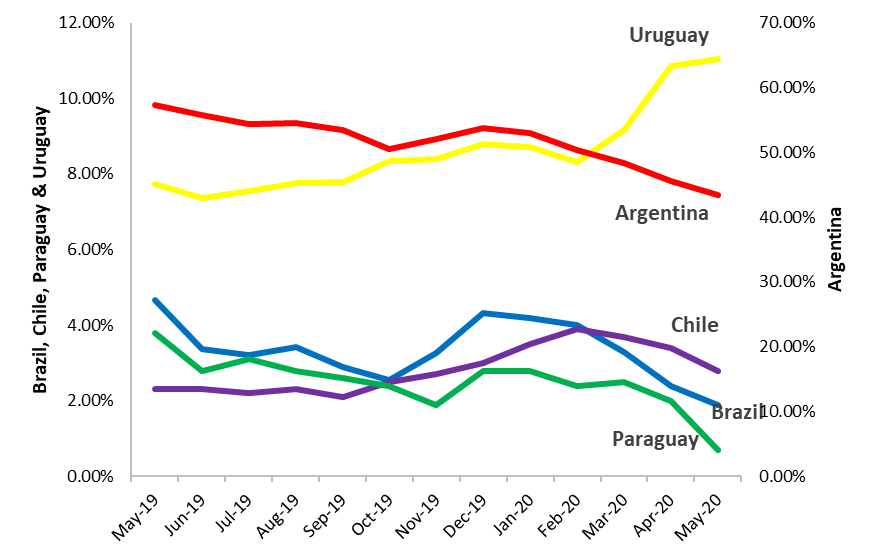
    Brazil & Southern Cone: Inflation
    Monthly year-on-year figures

    Brazil & Southern Cone: GDP growth (%)
    Quarterly figures are year-on-year growth
    Country End 2019  2020 forecast * Q2 2019 Q3 2019 Q4 2019 Q1 2020
    Argentina -2.2 -6.5 0.0 -1.7 -1.1 not yet available
    Brazil 1.1 -5.2 1.1 1.2 1.7 0.9
    Chile 1.1 -4.0 1.9 3.3 -2.1 0.4
    Paraguay 0.0 -1.5 -3.0 2.8 3.5 not yet available
    Uruguay 0.2 -4.0 0.1 0.9 0.2 not yet available
    *Figures from the United Nations Economic Commission for Latin America & Caribbean Apr 2020
    End 2019 and quarterly growth based on figures from the local central banks