All Categories

Subcategories

  • MEXICO: Airport uncertainty could undermine efforts to boost tourism

    Patrick de Courcy 15 October 2021 Hits: 2372

    On 22 September Mexico’s tourism minister Miguel Torruco launched a campaign in the US to promote Mexico as a key tourist destination for travellers there. The launch took place in the city of Los Angeles, but the delegation is also planning to visit Chicago, New York, Houston, and San Antonio, which altogether account for 40% of US tourists that visit Mexico. The Mexican government is promoting specific developments such as the Islas Marías (an archipelago of four islands belonging to Mexico), the 132 Pueblos Mágicos (an initiative to promote various towns that offer visitors special experiences due to their natural beauty, cultural richness, and traditions), and of course the Tren Maya railway, the government’s flagship infrastructure project which will link the Yucatán peninsula with the rest of south-eastern Mexico. The campaign is also targeting population of Mexican descent, inviting them to visit the land of their forebearers.

    The US accounts for the majority of foreign tourists that enter Mexico. Between January and August, 8.3m tourists flew into Mexico of which some 6.5m arrived from the US.

    The campaign has been launched as the government has maintained 22 March 2022 as the date for the start of operations at the 'Felipe Ángeles' international airport (AIFA), which is currently under construction in Zumpango municipality, Estado de Mexico (Edomex). The defence ministry (Sedena), which is building the AIFA, has said that physical infrastructure will be ready by the end of the current year.

    However, as of 27 September, no airline had confirmed that they would have operations at the AIFA. Although the government has said that there will be incentives for the airlines to move there, according to local press reports, the industry has not been given sufficient information to ensure that they will be able to carry out operations safely and profitably in the new airport. According to local law firm Santamarina & Steta, a key source of concern is the lack of certification confirming that the new airport would be able to operate simultaneously with the existing airport in Mexico City (AICM), which is issued by the likes of the International Civil Aviation Organisation (ICAO), the aviation arm of the United Nations.

    Although the federal transport ministry (SCT) is already working on redesigning the air space around Mexico City (CDMX) to allow both airports to operate simultaneously - alongside the airports in Toluca, Puebla, and Cuernavaca - it is far from finished. The redesign is essential because of the area’s geographical characteristics and the saturation of the air space. Without the relevant certifications, airlines will be reluctant to move to the AIFA.

    In addition, Mexico has yet to recover its Category 1 certification from the US Federal Aviation Administration (FAA). The country was downgraded in May to Category 2 because FAA considered that Mexico’s federal civil aviation agency (Afac), the national aviation authority, does not have the “necessary requirements to oversee the country’s air carriers in accordance with minimum international safety standards” which are set by the ICAO. According to the FAA, Mexico’s civil aviation authority is not performing appropriately in several areas, which include airport and airways facilities management.

  • ECONOMIC HIGHLIGHTS

    Patrick de Courcy 13 September 2023 Hits: 1674

    PERU | Green investment plan. On 22 August, Peru’s environment ministry unveiled a ‘road map for green finance’, which it says will drive investment of US$2bn in environmental projects by 2025. The roadmap is intended to enable financial entities to channel investments into green projects. Environment Minister Albina Ruiz said that it will boost cooperation between the government, the private sector, and the international community with the goal of “supporting projects that protect the environment and/or mitigate a negative impact”.

    PERU | 2024 budget. Peru’s Prime Minister Alberto Otárola and Finance Minister Alex Contreras submitted the draft 2024 national budget to congress on 6 September, outlining proposed spending of PEN241bn (US$65.04bn) – a 12% increase on the 2023 budget. Contreras said that 36% of spending would be delegated to local and regional governments, which he said is “the highest level since decentralisation began”. The finance ministry highlighted increased social spending on water and sanitation (PEN6.4bn, +7% year-on-year), health (PEN29.47bn, +9%), education (PEN46.50bn, +11%), and social protection (PEN9.31bn, +19%).

    VENEZUELA | Inflation climbs. The Observatorio Venezolano de Finanzas (OVF), an independent economic think tank, calculated on 5 September that monthly inflation in Venezuela reached 13.6% in August, bringing annual inflation to 422%. This was up from the OVF’s estimate of 7.2% monthly inflation in July, when it put the annual rate at 439%. The OVF stated that the monthly rise in August was the steepest recorded this year and that Venezuela is experiencing “a very pronounced acceleration of price increases”. According to the think tank, the steepest monthly price rises in August were for communications (+26.7%), renting (+10%), transport (+9.9%), education (+9.4%), and food (+8%).

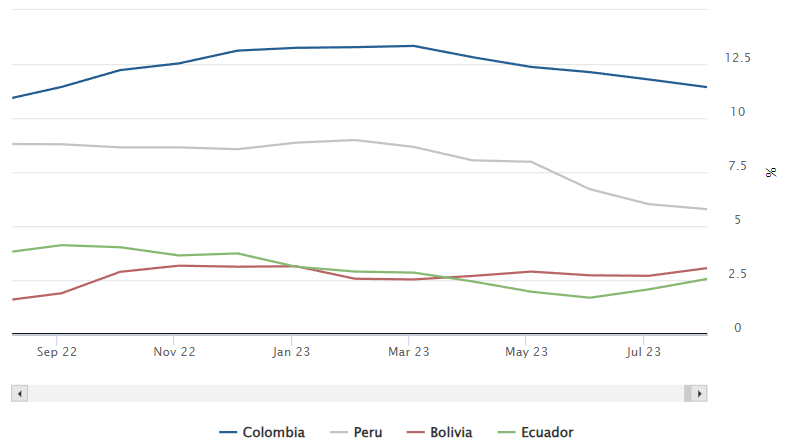
    Andean countries: inflation rate
    Percentage variation (year-on-year)

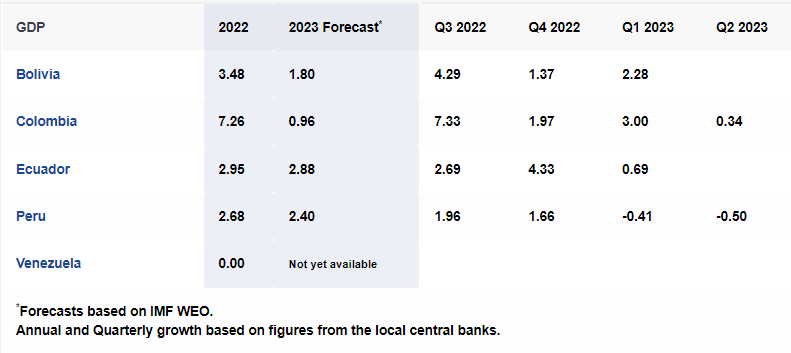
    Andean countries: GDP growth (%)
    Quarterly figures are year-on-year growth

  • BRAZIL: Government losing hold over conservative allies

    Patrick de Courcy 17 April 2025 Hits: 3852

    Just over half of the 513 members of Brazil’s lower chamber of congress have signed an official request to fast-track the review of a bill that proposes pardoning the far-right rioters who stormed the seats of government on 8 January 2023. The main backer of this bill is the right-wing Partido Liberal (PL), the party of former president Jair Bolsonaro (2019-2023), but aside from the 90 PL deputies who signed the request, over a hundred of the signatures came from lawmakers affiliated with centre-right parties such as União Brasil (União) and Progressistas (PP), which hold cabinet ministries in the left-of-centre government of President Luiz Inácio Lula da Silva.

    On 14 April the PL’s leader in the lower chamber, Sóstenes Cavalcante, submitted the fast-track request. If the motion is approved, the 8 January rioter amnesty bill will skip congressional committees and go straight to a vote in the full chamber. The centre-right president of the lower chamber, Hugo Motta (Republicanos), has been reluctant to rush the review of this controversial bill, and he is reportedly planning to hold talks with leading figures from the parties in the legislative chamber before deciding whether to accept the fast-track request.

    In addition to those of Cavalcante and the PL’s Luciano Zucco, the leader of the opposition in the lower chamber, the request has 262 signatures. It received support from 90 of the PL’s 92 deputies; 40 of União’s 59 deputies; 35 of the PP’s 48 deputies; and 28 of Republicanos’ 45 deputies. It was not only lawmakers from these conservative parties that backed the request but also members of parties with more centrist leanings, such as the Partido Social Democrático (PSD) and Movimento Democrático Brasileiro (MDB).

    The PSD, MDB, PP, União, and Republicanos all have seats in President Lula’s cabinet. In exchange for support in congress, Lula has appointed cabinet ministers affiliated with these centrist and centre-right parties, part of the group known as the ‘centrão’. This loose collection of clientelistic parties often lends support to governments in exchange for political perks, regardless of whether the government is led by a left-wing or right-wing president. However, the centrão parties can be fickle in their loyalties, as shown by their backing for this rioter amnesty bill which is a legislative priority for the opposition PL.    

    Lula himself has refrained from commenting this week about the amnesty bill, but his minister for institutional relations, Gleisi Hoffmann, has spoken out to criticise the perceived betrayal. On 15 April national broadcaster CNN Brasil cited Hoffmann as saying that it is “absurd” for parties that form part of the government to support a bill like this. The minister, who used to be the national party president of Lula’s left-wing Partido dos Trabalhadores (PT), affirmed that the government is not going to punish its fickle centre-right allies; rather it is going to emphasise to its allies the “political, juridical, and institutional” impacts of the proposal to pardon far-right rioters who stormed the capital and called for a military intervention to reverse Lula’s 2022 election victory over Bolsonaro.

    The loyalty of its allies is likely to remain in question in the coming months. Lula is reportedly under pressure to enact a cabinet reshuffle, as some centrão parties such as the PSD have been demanding control of larger ministries. To decide which parties should be awarded which ministries, Lula and Hoffmann will need to consider more than just the legislative voting record of each party’s lawmakers, but also which parties will be the most useful and reliable allies in next year’s presidential and congressional election campaigns.

    Hoffmann comments on rioters

    The minister for institutional relations, Gleisi Hoffmann, stoked controversy when she suggested in an interview on 10 April that it was “defensible from the point of view of some lawmakers” to discuss softer punishments for the 8 January rioters. Her comments were seized upon by the press to suggest that she might be adopting a more conciliatory stance and would be willing to negotiate with right-wing opposition figures who are seeking pardons for the rioters. The following day, Hoffmann clarified that she does not support pardons and that it is the prerogative of the supreme court to decide the sentences for convicted criminals.

  • ARGENTINA: Military leader assumes civilian government post

    Abbi Dicker 08 January 2026 Hits: 1525

    Lieutenant General Carlos Alberto Presti, who had been serving as the chief of the general staff of Argentina’s army, took office as the new defence minister on 10 December, replacing Luis Petri, who won a seat in the lower chamber of congress in the October 2025 midterm elections. The decision by President Javier Milei to appoint an army general to the role of defence minister has garnered controversy and broken with political tradition. Since the end of Argentina’s military dictatorship (1976-1983), the position of defence minister had been held by civilians, a tradition that sought to separate the armed forces from political decision-making and prevent them from exercising influence over government. 

    “For the first time since the return to democracy, a person with an impeccable military career, who has the highest rank in his service, will head the ministry responsible for national defence and the armed forces,” Milei’s office stated on 22 November, ahead of Presti’s assumption of the role, adding that the decision was a move to “end the demonisation” of military personnel.

    The announcement fuelled criticism from human rights groups such as Abuelas de Plaza de Mayo, which released a statement on 25 November describing the appointment as a “provocation”, saying that the move “confirms a plan to destroy democratic consensus”. The Abuelas group highlighted that Presti is the son of Roque Carlos Presti, a military officer who was accused of committing crimes against humanity during the dictatorship era but died before he could be taken to trial for his alleged crimes.

    The statement also framed the decision amid the Milei administration’s “plan to twist the collective history of Memory, Truth, and Justice”. It stated that since taking office in December 2023, the Milei government has obstructed search efforts of the families of those who were disappeared during the dictatorship and that the defence ministry has been reluctant to disclose historical records.

    The Abuelas highlighted other indications that the Milei government was seeking to promote a revisionist narrative about the dictatorship period. On 14 November Alberto Baños, who served as the government’s undersecretary for human rights until 4 December, gave a presentation at the United Nations Committee against Torture in Switzerland and sought to dispute the figure of 30,000 disappeared persons during Argentina’s dictatorship. He also sought to emphasise the victims killed by left-wing guerrilla groups.

    In addition to rights groups, Peronist opposition figures slammed the decision to appoint Presti as defence minister. On 24 November federal deputy Agustín Rossi, who served as defence minister under former Peronist presidents Cristina Fernández (2007-2015) and Alberto Fernández (2019-2023), wrote on X that the decision marked a “democratic setback and deprofessionalisation of the armed forces”.

    In December, Petri was cited in the national press as defending his successor, insisting that “there is no incompatibility” in the appointment and suggesting the Kirchneristas, the main left-wing populist faction of the Peronist movement associated with former presidents Cristina Fernández and her late husband Néstor Kirchner (2003-2007), prefer to appoint members of the Montoneros guerrilla group to government posts. National daily Clarín highlighted this as an indirect jab at former defence minister Nilda Garré (2005-2010), who had faced accusations of having ties to the Montoneros, which she denied.

    New security minister

    On 2 December Alejandra Monteoliva was sworn in as the new minister for public security. Just as Petri was replaced after winning a seat in congress, Monteoliva takes over from Patricia Bullrich, who won a senate seat in the October midterms. Monteoliva had served as Bullrich’s deputy at the security ministry, so her appointment is expected to mark a continuation of her predecessor’s work, which the president’s office described in a statement in November as the fight against “narco-terrorism and organised crime” and to “uphold law and order on the streets”.

  • TRACKING TRENDS

    Abbi Dicker 15 October 2026 Hits: 292

    BRAZIL | Inflation breaches target range again. The national statistics institute (Ibge) reported on 9 October that the monthly inflation rate for September stood at 0.82%, while annual inflation rose to 4.58%. Inflation has risen sharply compared with August, when a monthly deflation rate of 0.32% was registered and annual inflation stood at 4.22%. The 4.58% annual rate for September is above the upper limit of the official target range, which is 3.0% +/-1.5%.

    Of the nine categories of products and services measured by the Ibge, housing saw the greatest monthly price increase (+2.31%). This was mainly driven by a monthly rise in household electricity bills (+7.98%) in September. According to private sector economists surveyed by the central bank, Brazil’s inflation is expected to rise even more in the coming months. The analysts’ latest projections show an annual inflation forecast of 5.22% for 2026.

    BRAZIL | Motorcycle production up year-on-year, down in monthly terms. The national association for manufacturers of motorcycles and bicycles (Abraciclo) has released the monthly production figures for September, showing a total of 186,758 units. This is down by 8.5% compared with August, but up by 10.4% compared with September last year. In a press release, Abraciclo highlighted that the latest result is the highest production figure on record for the month of September.

  • Chile government now under pressure from Right

    LatinNews 26 September 2011 Hits: 1166

    Development: On 25 September the education minister, Felipe Bulnes, criticised the hard-line taken by an influential mayor, Cristián Labbé, on the four months of protests over proposed education reforms.

    Significance: Labbé, the mayor of the prosperous Santiago suburb of Providencia, hails from the Unión Demócrata Independiente (UDI), the senior and more right-wing partner in the alliance that brought Sebastián Piñera to the presidency in 2010. Labbé warned that he would expel from school all those pupils that failed to accept the government’s scheme to allow them to make up the interrupted school year. His announcement echoes the unhappiness on the Right with the government’s decision to negotiate with school and university students.

    Key points:

    • Labbé would effectively end pupils’ chances of moving on to higher education by kicking them out of school. Bulnes, a member of Piñera’s Renovación Nacional, said that he did not like Labbé’s move, though he understood the mayor’s frustration. A school in Providencia (Liceo José Victorino Lastarria) has been one of the main sites for battles between the police and protesting students.

    • It is not clear whether Labbé actually has the power to expel students. Members of the left-wing Concertación, which ruled Chile from 1990 to 2010, accused Labbé of believing that General Augusto Pinochet’s dictatorship (1973-1990) was still in power.

    • Labbé claimed that 85% of the school children in Providencia have signed up to the government programme “Salvemos el Año Escolar”. Labbé argues that there would no room for the additional students, since by law no classroom can hold more than 45 pupils.

    • Bulnes is trying to coax the students, especially university students, back into negotiations with the government. He said that he had halted the education reform bill in congress so that the results of any talks with the students could be included immediately in the draft legislation.

  • In Brief - Colombia

    LatinNews 10 August 2012 Hits: 1454

    POLITICS | Communists expelled from PDA. On 9 August the national executive committee of the Polo Democrático Alternativo (PDA), the main left-wing political grouping in Colombia, expelled the Partido Comunista (PCC) from the coalition. The PDA expelled the PCC on the grounds of “double militancy” following the PCC’s participation in the Marcha Patriótica last April, in contravention of the decision adopted by the coalition as a whole. With the ejection of the PCC, the PDA loses another two members from its bloc in congress: Gloria Inés Ramírez in the senate and Hernando Hernández Tapasco in the chamber of representatives. (The PDA had already lost three members – Camilo Romero, Luis Carlos Avellaneda and Jorge Guevara – who have joined the Movimiento Progresista founded by the also PDA-dissident mayor of Bogotá, Gustavo Petro.)

    POLITICS | Petro undergoes second emergency surgery. On 9 August the secretary of health of the Bogotá city administration, Guillermo Alfonso Jaramillo, announced that Mayor Gustavo Petro would have to undergo a second emergency operation to release pressure in the brain caused by a subdural haematoma. Petro had already undergone the same emergency procedure on 17 June. According to the medical statement released yesterday night, Petro “is recovering satisfactorily” and will remain under “strict medical observation”. He is expected to be discharged on Monday (13 August).

  • BRAZIL: PSDB unites behind Neves

    LatinNews 23 May 2013 Hits: 1692

    Over the weekend, the Partido da Social Democracia Brasileira (PSDB) elected Senator Aécio Neves as party president for 2013-2015. His victory, by a landslide, opens the way for his candidacy in the 2014 presidential election. Given President Dilma Rousseff is already in campaign mode, and remains highly popular, the PSDB has its work cut out, but the early election of Neves, and his backing by prominent party leaders, gives the party a good opportunity to communicate its political message in plenty of time.

    At the convention held in Brasília, Neves received the backing of 521 of the 535 delegates including the main leaders of the party. Former president Fernando Henrique Cardoso, a longtime supporter of Neves, called on members to “leave aside personal interests” and close ranks behind the new president. Neves’ main rivals, such as José Serra, the former governor of São Paulo and twice-defeated presidential candidate, and Geraldo Alckmin, the São Paulo governor who lost to Lula da Silva in 2006, offered their support and that of the São Paulo party machine.

    Neves was a member of the federal chamber of deputies from 1987 to 2002; he was president of the chamber in 2001/2002 and governor of Minas Gerais, the second largest electoral constituency in Brazil, from 2003 to 2010. His grandfather, Tancredo Neves, was elected president in 1985, just after the military dictatorship, but died before taking office.

    In his victory speech Neves criticised President Rousseff and the ruling Partido dos Trabalhadores (PT). He accused them of putting the state at “the service of their power project” and attacked the ruling coalition for its shortcomings in education, health, law and order and the economy. “It won’t be easy: I’m not deceiving myself, we are not facing a political party, but rather a party that has captured the state and inverted the logics of democracy, with the state at the service of the party and of its power and domination project,” he said.

    Two opposition parties, the PSDB-aligned Democratas (DEM) and the Partido Popular Socialista (PPS) hailed Neves’ election as PSDB president. The respective DEM and PPS presidents, José Agripino Maia and Roberto Freire, sent congratulatory notes stressing the need for a united opposition front in the 2014 elections. Unlike other traditional PSDB leaders, such as Serra, Neves is believed to be more politically pragmatic and would consider closer alliances with the DEM and even the PPS.

    • Brazil fortifies its borders

    Brazil is dispatching 25,000 soldiers to patrol its borders ahead of the Confederations Cup in June, itself a dry-run for next year’s World Cup. In recent years Brazil has stepped up its monitoring of the borders under a plan called Operation Ágata. The latest operation is the seventh of its type, and the largest, with double the number of troops deployed since the last exercise, in July 2012.

    Logistically, securing Brazil’s border is challenging: five times as long as the boundary between the US and Mexico, it adjoins 10 countries – including the world’s largest three drug producers – and snakes for more than half of its 16,886km through dense rainforest. In its attempt to lock down the borders, the army will be using aircraft and roadblocks. The navy will be manning river patrol boats and helicopters, while the air force will have fighter planes, radar aircraft, Israeli-made UAVs (drones), and helicopters ready to be deployed.

        In a statement issued by the ministry of defence, it described the purpose of the operation as fighting drug-trafficking, smuggling, weapons trafficking, environmental crimes, vehicle smuggling and illegal immigration.

       Last week, the federal police said it had uncovered a Bangladesh-based human trafficking ring that had smuggled people into Brazil to work illegally in construction under slave-like conditions.

    • Current account deficit up

    A large bill for imported fuel and a fall in the price of commodities has led Brazil to accumulate a trade deficit of US$6.15bn in the first four months of 2013, a sharp contrast to the US$3.299bn surplus recorded in the same period last year. Adding to the current account deficit, companies operating in Brazil repatriated US$2.5bn in profits and dividends to their headquarters abroad, 5.1% more than in April 2012. The central bank has forecast a current account deficit of US$67bn in 2013.

  • POINTERS

    LatinNews 30 October 2013 Hits: 738

    PANAMA | ‘Big deal behind Korean ship’s cargo’. The hidden cargo of the North Korean container ship Chong Chon Gang, arrested in Panama last July [SSR-13-07] was not, as the Cuban government had claimed, obsolete military equipment being sent to North Korea to be repaired and then returned, but relatively new hardware. One of the two Mig-21s was found to have been flown until recently and 10 of the 15 jet engines were in prime condition and the guidance system for anti-aircraft missile defence was certainly not obsolete. The Panamanian authorities say that ‘friends’ abroad had informed them that this shipment was part of a big arms deal negotiated last June in Havana by General Kim Kyok Sik, a former defence minister who served as chief of staff of the Korean People’s Army until August.

    The Chong Chon Gang, now repaired, is to be released once North Korea pays the US$1m fine imposed by the Panamanian government for endangering the Canal by carrying undeclared weapons. Most of the crew is to be released, but the captain and first officer could be charged with arms trafficking. The cargo has been examined by a United Nations (UN) inspection team, and the UN Security Council is awaiting an explanation from the Cuban government for what appears to have been a breach of the arms embargo imposed on North Korea.

    CARIBBEAN | Old sea drug route reactivated. In another of the periodic shifts of the drugs trade, use of the Caribbean route appears to have rebounded (it had been scaled down in favour of coastal transport close to Central America and aerial shipments to that area. Now the US Drug Enforcement Administration (DEA) is estimating that the flow of cocaine through the Dominican Republic, the biggest transhipment point in the Caribbean has risen to about 27 tonnes in the first half of this year, 23% more than in the same period of 2012.

    There have been seizures off the coasts of Puerto Rico and the US Virgin Islands of up to one tonne, which have been read as denoting increased confidence in the route and the capability to handle large volumes. On 1 October the US Federal Bureau of Investigations (FBI) arrested 27 members of a Puerto Rico gang that channelled sizable quantities of drugs from the Dominican Republic to the US.

    The DEA has calculated that in January-June about 14% of all US-bound cocaine was transiting through the Caribbean, twice as much as a year earlier — at a time when it estimates that the overall flow to the US had decreased.

    DOMINICAN REPUBLIC | Law reverses citizenship. Under a late September ruling by the Dominican Republic’s constitutional court, people born to illegal immigrants since 1929 could find themselves stripped of their citizenship, to which, until the reform of the constitution in 2010, they had been entitled by right of birth in the country.

    Those most affected are those born to Haitian immigrants, who do not hold Haitian citizenship. A law passed in 2004 made provision for a mechanism to apply for legal citizenship, but this has not been implemented. The court has given the electoral board a year to purge the electoral lists of people who under the recent ruling are no longer considered citizens.

  • Brazil: Inflation and interest rates head south

    LatinNews 08 March 2017 Hits: 492

    Brazilian inflation is falling, and the central bank (BCB)’s main policy rate, the Selic, seems to be following it on the way down. Retail inflation peaked at an annual rate of 10.7% in January 2016, and one year later, by January 2017, had fallen to 5.4%. The BCB has reacted. The latest 75bps Selic cut, announced on 20 February, took it down to 12.25%.

    Marcelo Carvalho, chief Latin American economist at BNP Paribas, says that to hold back inflation the Selic has traditionally been held at around five percentage points higher than retail price growth, although the current gap is more like seven points. “In terms of real interest rates, there is a lot of room for cuts,” he says, arguing that inflation could slow to as little as 4% by the end of this year. If that happens, in order to boost an economic recovery the Selic might in turn need to be cut to 8% by year-end, he says.

    Other analysts have slightly different numbers (many are forecasting an end-year Selic of 9%), but agree that the trend has to be downward. Minutes from BCB’s latest monetary policy committee meeting indicated that further cuts will depend on inflationary expectations and the performance of the economy. The context is that two years plus of deep recession have sharply reduced inflationary pressures. The BCB’s measure of core inflation (excluding energy and volatile food items) has already plunged to 5.6%. At this rate of reduction, actual inflation is expected to come close to the BCB’s target of 4.5% by the end of this year. There is speculation that by the middle of this year the authorities will consider lowering the target rate for future years.

    The good news is that lower rates will contribute to the hoped-for recovery. The not-so good news is that the transmission mechanism is not terribly efficient. Brazil is widely seen as having structurally higher interest rates than many other emerging markets, because the country has a lower savings rate and other entrenched imbalances, including its large and persistent fiscal deficit. Should the government led by President Michel Temer get more reforms approved in Congress (such as pension reform), reductions in the ‘equilibrium’ Selic rate could move lower.

    In the meantime, however, questions are being asked about the banking system, which so far has been slow to pass on the benefits of a lower Selic to borrowers. The spread charged on top of Selic to a range of customers is hefty. In December, for example, when the Selic stood at 13.0%, banks were charging a massive 59.2% annual interest rate on consumer lending, and 16.9% on corporate loans. The justification for this is that the banks remain cautious over poor loan quality. While acknowledging that non-performing loans now account for 5.7% of total lending, critics argue that this does still not justify such large spreads.

    One official closely monitoring rates is the BCB’s president, Ilan Goldfjan. He was recently asked in an interview with Euromoney whether high commercial bank profitability – returns on equity rates that have remained consistently high through the recession at round 20% – was a good or a bad thing. His careful answer was, “It is good to have liquid banks, that can provide credit as part of the recovery and that can be resilient within a recession. So that part is good. The part we are working on is having banking spreads fall.” Achieving that, he acknowledged, meant looking at things like the current levels of taxes and statutory reserves, but “also, a requirement for a little bit of competition enhancement”.

  • ARGENTINA: Fernández provides some clues

    LatinNews 28 November 2019 Hits: 3986

    One month on from his victory in the first round of Argentina’s presidential elections and Alberto Fernández is still keeping his cards close to his chest. Fernández plans to announce his full cabinet on 6 December, just four days before he succeeds President Mauricio Macri. Speculation abounds about the shape of Fernández’s future economic team, and his economic plan of governance, but he dropped two big hints this week. He named a moderate Peronist as the future head of the national statistics institute (Indec), which lost its reputation as the purveyor of reliable economic data under former president Cristina Fernández (2007-2015), now the vice-president-elect. He also suggested that his government would not seek the remaining tranche of Argentina’s US$57bn credit agreement with the International Monetary Fund (IMF) to avoid becoming engorged with debt.

    During a television interview on 26 November, President-elect Fernández revealed that Marco Lavagna would be the future head of Indec. Lavagna is an economist and federal deputy for the moderate Peronist Frente Renovador (FR) faction led by Sergio Massa, which forms part of the incoming Frente de Todos coalition. He is also the son of Roberto Lavagna, a former economy minister whose offer of a ‘third way’ was rejected by voters in October’s polarised presidential contest as he trailed in a distant third.

    The choice of Marco Lavagna was designed to send out a strong message that the autonomy of Indec would be respected and it would not revert to past practice under Cristina Fernández’s administrations and massage inflation and poverty figures. For good measure, Lavagna said his overriding priority would be to enforce Indec’s reputation for “quality, reliability, and technical rigour” as well as “national and international recognition”.

    One of President Macri’s main arguments during his failed re-election campaign was that his government had regained Argentina’s international standing as a reliable partner through restoring the credibility of the country’s institutions, such as Indec, which in the final two years of Cristina’s tenure released data which her government cited to claim that poverty had fallen into single digits, the lowest point since the return to democracy in 1983 and beneath the poverty rate in Germany.

    Macri sought to persuade voters that the truth, however painful, was always preferable to lies. The appointment of Marco Lavagna implies that Alberto Fernández is also persuaded of the merits of this argument, as well as lending credence to speculation that his economic team will be comprised of moderate Peronists rather than Kirchneristas.

    Whoever Fernández appoints to key economic posts might need to reckon without the outstanding US$11bn of the US$57bn Stand-By Arrangement (SBA) with the IMF to try and revive the ailing economy. In an interview with the Buenos Aires radio station Radio Con Vos on 26 November, Fernández said that further indebtedness was “not the solution” for Argentina. He said his government would concentrate on repaying what has already been borrowed not borrow even more because then “you have a bigger problem”.

    However, in a telephone conversation with the new managing director of the IMF, Kristalina Georgieva, on 19 November, Fernández said that while his government would meet its debt commitments, it would not be prepared to impose a fiscal adjustment on the long-suffering Argentina people. This would be political suicide for Fernández who insisted during his campaign that he would never implement a so-called paquetazo.

    Instead, Fernández favours ‘re-profiling’ Argentina’s debt to the IMF, and other creditors, by means of a “sustainable” plan (he provided no details), which would enable his government to concentrate on stimulating economic growth while at the same time maintaining social welfare programmes. The outgoing treasury minister, Hernán Lacunza, said this week that some US$28bn of debt payments would fall due in 2020.

    Cabinet picks

    Amid the silence over the composition of his future cabinet, President-elect Fernández is being lobbied by certain groups. Argentina’s powerful farming groups, fearful that a heavy export tax could be slapped on grains exports as it was under Kirchnerista governments, are advocating the appointment of Gabriel Delgado as secretary for agriculture. Delgado held the position between 2013 and 2015 and farming groups are keen for him to reprise the role. Delagdo is part of the technical team advising Fernández.

    Economic contraction

    In a measure of the scale of the challenge facing President-elect Fernández, the national statistics institute (Indec) released figures this week showing that Argentina’s economic activity fell for the ninth successive month this year in September, declining by 2.1% year-on-year. Construction activity fell by 6.5% and manufacturing by 5%. One of the few bright spots was the 11.8% expansion recorded by the agriculture and livestock sector.

  • Latin America

    Patrick de Courcy 21 December 2022 Hits: 231

    Like the thinly-populated Atlantic coast of Newfoundland, large tracts of LAC are also well-placed to generate ample renewable energy. Those that are close to ports are then also ideal for producing hydrogen.

    LAC is one of three regions in the world considered to have the largest potential to produce and export hydrogen. The others are Australia and the Middle East. There are also good conditions heading further east but a hydrogen hub with all the required infrastructure in the Himalayas, for example, may not yet be economically feasible and is too distant from a port or major consumer.

    The combination of sunshine and wind, ample space, and proximity to ports makes much of the Atlantic coast from northeastern Brazil down to southern Patagonia apt for hydrogen production at costs between $2.75 to $1.75 per kg/H2. Similarly in parts of the central Andes, and in particular in the Atacama desert with its proximity to the port city of Antofagasta, those costs fall to $1.5 and less per kg/H2.

    “Countries are beginning to address diversification efforts in electricity systems, and are working to create more enabling policy and regulatory environments,” says Irena. “In this context, recent auctions in Argentina, Brazil, Mexico, Chile, and Peru have helped to accelerate the deployment of thousands of megawatts of wind and solar energy in the region.”

    Indeed, the lowest production costs are in southern Patagonia (Argentina and Chile) and the Atacama region (including parts of Argentina, Bolivia, Chile, and Peru), as well as north-western Mexico and north-eastern Brazil, among many others. In the long term, Latin America could have a land area of over 800,000 km2 in which the LCOH via electrolysis is under USD 1/kg H2 using a hybrid energy supply.

    LAC also has the advantage that it already has a large percentage of renewables in its energy matrix. For example, renewables, including hydroenergy, account for 43% in Chile, 63% in Colombia, 80% in Brazil, 97% in Uruguay, 98% in Costa Rica and Uruguay, and 100% in Paraguay. That compares to 15% in the US, 17.5% in France, or 32.5% in Australia, or 0.3% in the United Arab Emirates. That may come in handy if customers prefer to buy from nations that are not only selling green energy abroad but also using it at home. 

    While there are several big projects under way in Brazil and Chile, and a few on the drawing board elsewhere, the extent to which the hydrogen wave will take off will depend on issues ranging from proper regulations to certifications of origin, infrastructure and in some cases opposition from indigenous groups and even environmental activists.

    Domestic v export markets

    Also, to what extent hydrogen will turn into another export item like coffee or copper, or bring broader benefits to local economies by decarbonising heavy industry and transport, for example, and creating spill-over effects will depend on national strategies, incentives, and distribution channels. These could help reduce emissions where direct electrification can’t be used, such as long-distance transport, or in processing sectors where hydrogen is used such as steel or high-temperature applications such as cement.

    In some cases, geography plays a role. In Brazil much of the country’s industry is concentrated along the eastern seaboard, relatively close to where hydrogen hubs are developing around seaports. There it makes sense and would be relatively easy to produce and deploy hydrogen. On the contrary, fuelling buses or trucks in the vast interior or north, thousands of kilometres from ports is probably less efficient.

    Similarly in Chile, a narrow coastal country, the generation of hydrogen in the centre and north will be relatively close not only to ports but also to the biggest potential consumers of hydrogen, a mining industry whose trucks and tractors currently consume much of the country’s diesel. Having said that, it wouldn’t be unthinkable to develop a system of hydrogen fuel pumps along the Amazonas, Paraná, La Plata, or other of the most trafficked rivers. In smaller, less industrialised countries it may be easier to introduce networks of refuelling stations for transport.

    The bottom line is that manufacturing areas, ideally close to sea ports, provide ideal locations for hydrogen hubs with diverse potential revenue streams that can reduce investment risk.

    “Successful cases of commercial-scale (several MW) green hydrogen project development have demonstrated the importance of developing complete ecosystems (such as ‘hydrogen valleys’) to have demand redundancy, while reducing technical and financial risks,” wrote Julián González Martínez and Fernando Cubillos, climate change and energy consultants, respectively, at IDB Invest. “Therefore, projects to be developed during the market maturity stage (2022-2030) should seek to integrate various buyers of the hydrogen produced in the planning and structuring phases.”

    Given current backlogs in procuring electrolysers and some other key components, there may be a good case to develop a regional industry. That would require coordination within regional fora such as the Mercosur customs union or the Andean community, for instance. Even within each country the successful deployment of hydrogen requires considerable coordination between policymakers, regulators, industry, and environmentalists. Deploying a fleet of urban buses or refurbishing an iron plant without a long-term supply of hydrogen and adequate regulations, for example, can be counterproductive.

    Finance

    Another big challenge is finance. From transmission lines linking renewable energy production to storage facilities and export terminals, putting the infrastructure in place is capital-intensive. Given the current budgetary constraints in much of LAC, financing large-scale public investments into hydrogen may be a tall order. Some state-owned companies such as Petrobras in Brazil, Pemex in Mexico, or Codelco in Chile may be able to co-finance part of the infrastructure or participate through technology-sharing agreements, especially when it comes to CCUS projects.

    Some regional and multinational financing opportunities are becoming available. In November 2022, the Inter-American Development Bank (IDB) announced a partnership with the Green Climate Fund (GCF) to create a US$450m fund to promote electric mobility and green hydrogen in Latin America and the Caribbean. More may follow.

    The IDB Invest and IFC in 2022 co-financed a 50 MW photovoltaic farm with green hydrogen and lithium-ion battery storage in Barbados that will feed electricity into the grid. The Renewstable Barbados project was developed by Hydrogène de France (HDF) and fuel distributor Rubis. With the IDB conditioning all new investments to be consistent with the Paris Agreement from 1 January, 2023, it expects green hydrogen projects to make up a larger share of its portfolio going forward.

    Brazil’s state development bank BNDES in July 2022 launched a R$300m (US$56m) line of credit to help develop pilot projects for hydrogen production and research. “Subsequently, the bank will expand its financing lines, including support for large plants capable of exporting hydrogen,” the BNDES said.

    Despite a number of multilateral and state financing mechanisms, most of the proposed hydrogen projects will be financed through private capital, which means creating a proper investment climate with clear rules of the game, macroeconomic stability, as well as competitive fiscal incentives.

    Certification and standards

    The bulk of the hydrogen projects currently underway are for the export market. But even that requires more than just the physical infrastructure, such as pipelines and ports. Customers will demand certifications that guarantee origin, low-carbon production, and perhaps safety standards.

    Europe as one of the biggest emerging hydrogen markets, and Germany in particular, have been at the forefront of the standards and certification process, accounting for nearly half of the dozen or so different international standards. CertifHy is one of the initiatives forging a continent-wide green and low carbon hydrogen certification process. It is financed by the Clean Hydrogen Partnership and undertaken by a consortium led by HINICIO that includes the Association of Issuing Bodies (AIB), GREXEL, Ludwig Bölkow System Technik (LBST), CEA, and TÜV SÜD. The initiative started in 2014 and, following a series of tests and pilot phases, led to one of the first non-governmental Guarantee of Origin schemes for Hydrogen in the world.

    Other efforts are under way to try and coordinate and harmonise global certification and standards, such as those by the International Partnership for Hydrogen and Fuel Cells in the Economy.

    Carbon pricing

    But perhaps the biggest determining factor in creating domestic demand for hydrogen and sustainable energy more broadly is the cost of continuing to use fossil fuels, and that often depends on political pressure at home or global market pressure from abroad. Only a handful of LAC countries have adopted carbon pricing initiatives, such as a carbon tax or an emissions trading system (ETS). Argentina, Colombia, and Chile have implemented a carbon tax, as has Mexico, which has also been experimenting with an ETS pilot project since 2020. New governments in Colombia and Brazil are studying ETS.

    The problem is that in all cases the carbon tax or the carbon emissions certificates have been too cheap to make any meaningful difference. The existing carbon pricing systems cover industries and oil refineries, so that an increase from current levels of no more than US$10 per tonne of C02 could have a real impact on investment in green hydrogen.

    In Europe there was a similar situation until massive climate protests in 2019 forced the European Union to increase the carbon price, apply to sectors such as transport and construction, and adopt more ambitious zero-emissions targets. Part of that may spill over on LAC countries as the EU is adopting a carbon tariff on imported goods that are out of line with zero-emissions targets.

    Chile is aiming to overhaul its carbon tax and proposing to implement in parallel an ETS or tradable performance standard which acts in a similar way as an incentive to reduce emissions.

    Hydrogen production

    Currently, LAC produces 4.1m tonnes of hydrogen per year, almost all of it made from natural gas, using the steam reform technology. Trinidad and Tobago produces approximately 1.8m tonnes, followed by Mexico, Brazil, and Argentina with between 350,000 and 700,000 tonnes each. Chile and Colombia account for approximately 7% of the market each.

    Of the 2.5m tonnes of pure hydrogen, 1.2m goes to ammonia production and 1.3m tonnes is used in oil refining. Ammonia, in turn, is often made into fertilisers or explosives. The remaining 1.6m tonnes demand is for mixed hydrogen in the production of methanol (1.2m) and in direct reduction of iron, DRI (0.4m).

    Except for three pilot projects in Chile, Argentina, and Costa Rica, LAC currently produces no green hydrogen.

    In Cusco, for nearly six decades a 25 MW electrolyser has been producing ammonium nitrate, which is used as an explosive in the mining industry and as a fertiliser in agriculture. To power the electrolyser it uses grid power, which is nearly 40% fossil.

    Blue hydrogen

    Existing grey hydrogen plants can be retrofitted with CCUS, the process in which carbon is captured and then stored in underground reservoirs or used as a feedstock in other industrial or chemical processes. Whether CCUS can be used depends to a large extent on transport and storage facilities and their related costs. Even where blue hydrogen can be produced at a competitive cost, the downside is that carbon is not really eliminated but simply stored, sometimes in products that have a limited lifecycle.

    Oil-giant Petrobras in Brazil currently operates the only commercial CCUS project in Latin America and one of the largest in the world. In 2011 Petrobras started separating carbon dioxide from associated natural gas and reinjecting it back into the wells in the offshore Tupi oil fields. By 2025 an estimated 40m tonnes of carbon dioxide will have been stored in rock formations several kilometres below the sea bed. That experience could go a long way to help decarbonise hydrogen production in Brazil and more importantly in countries such as Colombia and Trinidad and Tobago.

    According to a comparative study produced by Hinicio, a global hydrogen consultancy, Chile, Colombia, and Brazil lead efforts toward developing a hydrogen economy, with Argentina and Costa Rica dropping in the ranking. Yet all countries surveyed advanced in the index, which reflects “the willingness of governments to implement the first regulations and incentives for zero and low-emission hydrogen, and the interest shown by various private actors to develop projects at a national level”.

    Hydrogen demand

    Barring a few pilot projects here and there, such as such a green city bus fleet, the most likely scenario is that the biggest demand for hydrogen in LAC in the near-term will continue to come from existing, not new users. That has mostly to do with the before-mentioned challenges in rolling out appropriate regulations, infrastructure, and creating incentives to move aways from fossil fuels.

    The International Energy Agency (IEA) sees hydrogen demand jumping to 6.2m tonnes by the end of the decade, as existing ammonia plants that were temporarily not operating come back on line in Mexico and Brazil. In that baseline scenario, all the additional hydrogen demand comes from existing uses in oil refining and industry. In a more optimistic scenario, total demand would increase to 6.8m tonnes, driven mainly by new applications in industry and transport that seek to meet ambitious energy and climate targets. That case assumes the rapid deployment of necessary infrastructure, such as hydrogen refuelling stations.

    “Despite the significant potential for hydrogen to decarbonise several sectors in the long term, new uses of hydrogen in the region are likely to remain modest to 2030, and existing uses will continue to dominate regional hydrogen demand,” the IEA study says.

  • BOLIVIA: Infighting begins to destabilise the MAS

    Patrick de Courcy 03 March 2023 Hits: 5062

    Bolivia’s left-wing Movimiento al Socialismo (MAS), which has ruled the country with near hegemonic status for much of the past 17 years, is now at a crossroads. Since returning the party to government in 2020, President Luis Arce has struggled to step out from the shadow of former president Evo Morales (2006-2019). Amid a growing rift between Arce and his predecessor, all the signs now indicate that Morales is preparing a return to the presidency in the 2025 general elections. With primaries to select a MAS candidate due to be held in 2024, this year will be pivotal in determining whether Morales can rebuild the party in his own image. The extent of the rift could also pose wider electoral problems for the MAS by tarnishing the image of both men, although the opposition is poorly placed to capitalise on the MAS divisions.

    When he took office in November 2020, Arce was widely viewed as a technocrat who would continue the MAS’s focus on social welfare and economic development while dropping Morales’ confrontational rhetoric. His rise to the presidency was seen by many as a passing of the torch – Morales would retain his position as MAS leader, while Arce would work to undo some of the polarisation that had deepened in Bolivia following the disputed 2019 election.

    Morales’ decision to stand in that election, despite losing a referendum to extend presidential term limits, marked a turning point – Morales appeared to view himself as the embodiment of the MAS, ignoring clear signs that the Bolivian people were growing tired of his presidency. His candidacy, made possible by a highly questioned court ruling, culminated with a mutiny by the security forces in response to claims of vote rigging, and Morales seeking asylum in Mexico.

    • Term limits

    The sun had appeared to be setting on Morales’ presidency in February 2016, when he lost a referendum proposing changes to the 2009 constitution to lift limits on presidential re-election by 51.30%-48.70%. However, in November 2017 the constitutional court accepted an appeal from the MAS which argued, among other things, that the 1969 American Convention on Human Rights (also known as the Pact of San José) affirms the right of all citizens to be elected.

    Arce’s election seemed to restore stability in the MAS, which stormed back to power after a year in which Bolivia was governed by the deeply unpopular interim president Jeanine Áñez (2019-2020). But Morales’ influence, and his desire for revenge on those he claimed had toppled him in a coup, quickly pervaded the new government. Áñez’s arrest in March 2021 on a string of charges, including terrorism, sedition, and illegally assuming the presidency, was the first clear sign that the Arce administration was not going to offer the moderate rule that had been widely expected of it.

    Accused by conservatives of leading a politicised crackdown on its rivals, the government dug in; Áñez was sentenced to 10 years in prison, while another leading opposition figure, Luis Fernando Camacho – the governor of the opposition stronghold of Santa Cruz – was arrested in December 2022, again in relation to a terrorism investigation.

    Morales was key to this turn of events, which has seen the Arce administration framed in increasingly authoritarian terms by its critics. Pushed by a hardline faction within the MAS, Arce has thrown red meat to Morales supporters in what many believe to be an attempt to stave off an attempt by the former president to run on the MAS ticket in 2025. This was clearest in the arrest of Camacho, which showed to Morales’ wing of the party that Arce could be just as confrontational in dealing with Bolivia’s traditional elites as his predecessor was, if not more so.

    Yet the arrest of Camacho and Áñez has not deterred an increasingly vocal segment of the MAS from engaging in friendly fire with the government. Morales himself has moved against key officials in the Arce administration, including Interior Minister Eduardo del Castillo, who he has accused of working on behalf of the US government, and the former director of Bolivia’s counter-narcotics agency (FELCN), José María Velasco, who accused of involvement in drug trafficking [SSR-22-06]. In November, Morales warned of a “treasonous” attempt to divide the MAS in a string of tweets about Arce and Vice President David Choquehuanca.

    Those tensions again resurfaced on 14 February this year, when MAS deputy Héctor Arce (no relation) accused Arce’s son, Marcelo Arce, of benefitting financially as an “intermediary” in “shadowy negotiations” between the government and foreign companies seeking to enter Bolivia’s lithium mining sector. Morales swiftly threw his weight behind Héctor Arce, tweeting that the deputy was facing “threats from officials in the interior ministry and harassment from political operators” and claiming that his safety was at risk. President Arce responded to the allegations by saying that “personal ambitions are showing their most perverse side”.

    Whilst the divisions in the MAS have so far largely been confined to the increasingly hostile rhetoric of the Arce and Morales factions, a vote in November showed how the fracture in the party is seeping into the legislative arena. The government’s decision to postpone last year’s national census had provoked outrage in the opposition stronghold of Santa Cruz, given that the census results would determine the number of congressional seats assigned to each department in the 2025 elections. After 36 days of protests, Arce backed down, presenting a bill to hold the election in 2024. This drew intense pushback from the Morales wing of the party, which accused Arce of pandering to the right. The Morales faction voted against the government, which was forced to rely on opposition votes despite the MAS’s sizeable majority in congress.

    Despite the growing cracks in the MAS, the opposition is ill-positioned to make a breakthrough in the 2025 elections. Outside of Santa Cruz, it lacks the grassroots structures needed to seriously challenge the MAS, and the opposition remains divided between a hard-right faction led by Camacho, and a more traditional conservative bloc led by former president Carlos Mesa (2003-2005). The MAS’s prospects will be further buoyed by the resilience of Bolivia’s economy, in particular its inflation rate which is among the lowest in the region, running at an annual rate of just 3.1% in January.

    Nevertheless, the opposition will be hoping that the civil war in the MAS will turn enough voters off the party to force a coalition government. That remains a highly ambitious goal, but there are clear signs that the MAS’s lustre is waning – the party lost its supermajority in congress in the 2019 elections, and after the political turmoil of the past four years it is possible that a significant portion of the electorate could be open to a change of government. 

    CPSC promises trouble ahead

    Rómulo Calvo, the president of the opposition-affiliated business lobby Comité pro Santa Cruz (CPSC), said on 22 February that he would meet with the supreme electoral court (TSE) to discuss “beginning the impeachment process” against President Arce, saying that the government had not responded to the CPSC’s ultimatum on 25 January to free 180 “political prisoners” within 30 days. Whilst Calvo’s personal impeachment quest would be doomed to failure even with the backing of the opposition in congress, the CPSC is certainly capable of causing a significant headache for the Arce administration by whipping up another round of unrest in Santa Cruz.

  • COSTA RICA: Government launches cybersecurity strategy

    Patrick de Courcy 01 December 2023 Hits: 2236

    President Rodrigo Chaves and his minister of science, innovation, technology and telecommunications (MICITT), Paula Bogantes, have unveiled Costa Rica’s new national cybersecurity strategy for 2023-2027. The issue of cybersecurity has remained a key priority for the government following a wave of massive cyberattacks last year.

    According to MICITT, the strategy, which was unveiled on 13 November, has five fundamental pillars: protection of infrastructure and cyber resilience; governance and coordination; legal and regulatory frameworks; education, training and awareness; and cooperation and alliances. The launch of the strategy follows recent agreements announced with foreign partners, such as a US$9.8m US-funded three-year collaborative security initiative unveiled in August between the US and Costa Rica to strengthen Costa Rica’s cyber defences.

    According to a 22 August press release by the US Southern Command (Southcom), the initiative, which includes state-of-the-art equipment, specialised training, and logistics aid, will help Costa Rica’s public security ministry establish a cybersecurity operations centre by 2026. It cites Southcom’s commander Gen. Laura Richardson as saying that later this year, the US government will assign a full-time strategic advisor to assist the Costa Rican government with bolstering its national cybersecurity policies and strategies.

    The announcement of the strategy comes as the Chaves government has faced pressure to address the issue following massive cyberattacks which made headlines in April and May 2022 and affected almost 30 public institutions, including MICITT, the ministries of finance and labour & social security (MTSS), and the social security institute (CCSS). The attacks were attributed to the Russia-based cybercrime group Conti, which demanded a US$10m ransom in exchange for not releasing the information stolen from the finance ministry. This led the government to shut down the computer systems used to file tax returns and for the control and management of imports and exports, causing losses to the productive sector in the order of US$30m per day according to a European Union (EU)-funded publication.

    GCI

    The most recent Global Cybersecurity Index (GCI), published in 2020 by the International Telecommunication Union (ITU), showed Costa Rica scored 67.75 on the GCI which measures cybersecurity preparedness of member states based on the analysis of five pillars: legal, technical, organisational, capacity development, and cooperation. This was above Panama (34.11), El Salvador (13.3), Guatemala (13.13), Nicaragua (9), and Honduras (2.2). The same report also showed Costa Rica was the only Central American country that had improved its position since the previous global ranking in 2018 (from 115th to 76th). Costa Rica and Panama are the only countries in Central America to have signed up to the 2001 Budapest Convention on Cybercrime, an international treaty seeking to address internet and computer crime by harmonising national laws, improving investigative techniques, and increasing cooperation among nations.

    Tensions with China over 5G

    In August President Chaves issued a decree which aims to regulate 5G mobile network development and outlaws firms from countries that have not signed up to the 2001 Budapest Convention on Cybercrime. The decree however has caused tensions with China (with which Costa Rica became the first Central American country to forge diplomatic ties, in 2007), as it means that firms like China’s Huawei cannot compete with other 5G providers in Costa Rica. On 18 October President Chaves was compelled to say that the decree “has nothing to do with China” and “has to do with the fact that we Costa Ricans have to make sure that we are not brought to our knees” in terms of cybersecurity. He was also cited as emphasising that his government aims to ensure Costa Rica operates within the standards of the EU, US, and Organisation for Economic Co-operation and Development (OECD). China was also angered by comments made on 11 October by Bogantes, who told legislators that China represents a risk for cybersecurity while her deputy minister, Hubert Vargas, reportedly described China as “totalitarian”. On 13 October China’s embassy in Costa Rica issued a statement describing the comments as “irresponsible” and “unfounded” and warning that they “gravely affect the confidence and expectations of Chinese companies to carry out economic-trade activities in Costa Rica” as well as “undermining good progress in the development of bilateral relations”.

  • MEXICO: Corruption credentials under scrutiny

    Abbi Dicker 07 March 2025 Hits: 4928

    The latest Corruption Perceptions Index (CPI), released by global anti-corruption NGO Transparency International (TI) on 11 February, described Mexico as being on a “downward swing”. Indeed, Mexico’s score fell in the 2024 report for the first time since 2018, when former president Andrés Manuel López Obrador (2018-2024) took office. The score indicates that, despite initial optimism, the NGO is not convinced by the progress that López Obrador made against corruption during his six years in office. President Claudia Sheinbaum, a close ally and protégée of López Obrador, has dismissed the report’s findings and defended her predecessor’s anti-corruption legacy.

    Mexico scored 26 out of 100 in the 2024 CPI, on a scale where 0 means ‘highly corrupt’ and 100 ‘very clean’. This is the lowest score Mexico has received from the NGO since the index began in 2012. It represented a five-point decline compared to last year’s score of 31 and was the biggest annual decrease it has sustained on the index. It was also the first drop Mexico has seen since the 2018 index, after improvements from 2018-2020 (from 28 to 31) and stagnation from 2020-2023 [SSR-23-03].

    With this score, Mexico has fallen in the global rankings, moving from 126th to 140th out of 180 countries. It now moves behind Bolivia, which scored 28, as well as moving further behind Peru (31), Ecuador (32), Panama (33), and Brazil (34) in Latin America. Mexico remains ahead of Guatemala (25), Paraguay (24), Honduras (22), Nicaragua (14), and Venezuela (10), but is far below the regional average of 42.

    In its report, TI criticises Mexico’s judiciary, which it said had “failed to take action against corruption cases” such as that involving Brazilian construction and engineering firm Odebrecht, which has spanned countries across Latin America, and that involving the government’s flagship food security body Segalmex [SSR-23-05]. While the government will argue that its judicial reform aims to combat corruption within the judiciary, the reform itself has come under fire as a perceived effort to weaken the independence of the judiciary and stack it with government allies. The NGO also questioned López Obrador’s legacy, noting that he had failed to make good on campaign promises to tackle corruption and return stolen assets to the people.

    Responding to the report in a press conference on 12 February, Sheinbaum said: “The perception of the people is different”. She went on to ask how it had been possible to double the tax take between 2018 and 2024, complete strategic infrastructure projects, roll out wellbeing programmes, and lift 9m people out of poverty, all without enacting a fiscal reform. The answer, she said, was by ending privileges and eradicating corruption, which freed up the resources needed for these efforts. She said there had been “a change in regime, from the regime of corruption and privileges to a regime of honesty and public service”.

    One of Sheinbaum’s early actions as president was to announce the creation of a ministry of anti-corruption and good governance [SSR-24-11]. Her government has also pledged to reform the national fund for workers’ housing (Infonavit), a federal government fund that provides housing-related mortgage services for workers, which has been implicated in acts of corruption and other irregularities. Scrutiny will remain high on Sheinbaum’s anti-corruption efforts in light of the TI report, as corruption remains a major public concern.

    Corruption

    In a survey conducted by the Brazilian pollster AtlasIntel, which was published on 11 February, 58% of respondents said that it was ‘very probable’ or ‘probable’ that there would be revelations about major fraud or corruption schemes in the next six months. Respondents also identified an increase in attacks or murders related to criminal groups as a major risk in the next six months, with 50% saying this was ‘very probable’ or ‘probable’. Despite these concerns, the poll showed Sheinbaum’s approval rating at 61.6%, up from 60.3% in December but down from 66.7% at the start of her presidency in October 2024.

  • GUATEMALA: Porras targets key Arévalo support base

    Sarah Sheldon 23 June 2025 Hits: 769

    In late April Guatemala’s discredited attorney general María Consuelo Porras ordered the arrest of deputy energy & mining minister Luis Pacheco, a former leader of indigenous organisation 48 Cantones de Totonicapán (48 Cantones), and 48 Cantones’ former treasurer Héctor Chaclán on charges including terrorism. Widely slammed as spurious, the charges are considered a reprisal for the crucial role played by indigenous groups in the mass protests against Porras’ unsuccessful efforts to reverse the August 2023 presidential victory of anti-corruption outsider Bernardo Arévalo. As president, Arévalo continues to wrestle with his pledge to dismantle the ‘pacto de corruptos’ network of institutional corruption, with which Porras is aligned. However, institutions such as the United Nations (UN) highlight progress in his efforts to establish dialogue with the long-marginalised indigenous sector which, at some 44% of the population, is the biggest in Central America.

    On 23 April Pacheco and Chaclán were arrested on charges including illicit association, terrorism, and obstruction of justice in relation to the 2023 protests. In a 29 April statement, US-based NGO Human Rights Watch (HRW) noted that the case was under judicial seal, which it describes as a manoeuvre “often used by prosecutors in Guatemala to avoid public scrutiny over politically motivated prosecutions”.

    In their condemnation of the arrests, which occured in the context of Porras’ broader efforts to target Arévalo and his allies [SSR-25-02], HRW and institutions such as the Inter-American Commission on Human Rights (IACHR) have been quick to underline the significance of the role played by the indigenous sector in defending Arévalo’s electoral victory. For instance, a 26 April IACHR statement expressing alarm regarding the “arbitrary criminalisation of indigenous authorities”, highlights that Pacheco and Chaclán “peacefully led large-scale demonstrations in 2023 to defend the popular will expressed during the presidential elections”.

    Meanwhile the indigenous sector’s widespread backing for Arévalo no doubt stemmed from the fact that it discerned in a prospective Arévalo-led government its best prospect for addressing the rampant inequality which it faces. Such assumptions have not proven in vain. Indeed, in its latest annual report released on 28 April, international NGO Amnesty International (AI) notes that “for the first time in many years”, the Guatemalan government under Arévalo, who took office in January 2024, “established a direct dialogue” with several indigenous authorities and “committed to promoting a comprehensive development agenda that took their needs into account”.

    Similarly, a report by the UN Office of the High Commissioner for Human Rights (OHCHR) on the human rights situation in Guatemala, released in January 2025, “welcomes the government’s commitment to the rule of law, democracy and the human rights agenda”. It cites as a key example the fact that indigenous authorities have “had the opportunity each month to engage in direct dialogue with the government and have signed several agreements at the territorial level with the president…as a means of addressing their overriding needs and concerns”.

    According to the OHCHR, on 7 February 2024, less than a month after Arévalo took office, the government signed an agrarian agreement with four campesino (peasant farmer – often indigenous) organisations with the aim of “addressing agrarian conflicts, strengthening the existing institutional framework for gaining access to land through the market, drafting a proposal for a new institutional framework for the agrarian sector and strengthening the campesino economy”.

    Other signs of progress noted by the OHCHR in its report include the fact that in July 2024 a working group led by the presidential commission on peace and human rights was reactivated to follow up on the 2021 judgment of the Inter-American Court of Human Rights (Corte-IDH) in the case Maya Kaqchikel Indigenous Peoples of Sumpango et al. vs. Guatemala. In 2021 the Corte-IDH had found Guatemala “internationally responsible for the violation of the rights to freedom of expression, equality before the law and participation in the cultural life of indigenous peoples” in relation to the case and ordered the State to make various reparations.

    Yet the enormity of the challenge in redressing decades of inequality and neglect persists. In its latest annual report, released on 17 April, international NGO International Work Group for Indigenous Affairs (IWGIA) notes that poverty affects 75% of indigenous and 36% of non-indigenous people in Guatemala, while chronic malnutrition affects 58% of indigenous people compared to 38% of non-indigenous people.

    AI and the OHCHR also warn that in many parts of the country, indigenous leaders continue to face criminalisation for defending territory and indigenous rights. They highlight ongoing agrarian conflicts, a major issue facing indigenous groups, whose rights to ancestral land have long been violated. Meanwhile impunity persists regarding the country’s 1960-1996 civil war in which some 250,000 civilians were killed or disappeared, around 80% of whom were indigenous. Examples of these setbacks include a November 2024 court ruling acquitting eight former military officials accused over the so-called ‘Creompaz case’ [SSR-25-02] – disappearances that took place from 1981-1988 in the Zona Militar 21 de Cobán, in the northern department of Alta Verapaz, which is currently known as the Comando Regional de Operaciones de Mantenimiento de Paz.

    Evictions

    In its report on Guatemala, the United Nations High Commissioner for Human Rights (OHCHR) documented two evictions, two threats of eviction and two extrajudicial evictions between January and November 2024. According to the same report, the authorities requested a total of 111 eviction orders. According to information gathered by the OHCHR, the evictions and attempted evictions affected the rights of 524 families, including their rights of access to comprehensive healthcare, water, and food.

  • BRAZIL: De Freitas denies presidential ambitions

    Patrick de Courcy 02 October 2025 Hits: 1241

    São Paulo’s governor Tarcísio de Freitas is often listed in opinion polls as one of the strongest potential options to run as the main right-wing candidate in the October 2026 presidential election. However, he has frequently downplayed the media speculation that he could be the political heir of former president Jair Bolsonaro (2019-2023). On 29 September, just over a year before the first-round vote, De Freitas visited Bolsonaro and reaffirmed that he would seek re-election as governor of São Paulo rather than seek the Planalto presidential palace. Following the governor’s recent insistence that he will not run for president, some media reports suggest that his political backers in centre-right parties might need to find backup options to support in 2026.

    Bolsonaro has been under house arrest since 4 August. After being convicted by the supreme court (STF) on 11 September for plotting a military coup to stay in power after losing the 2022 election [WR-25-37], Bolsonaro will remain under house arrest while he waits for the outcome of the appeals process. On 29 September De Freitas travelled to Brasília to visit his political mentor in his residence. The São Paulo governor described this as a “courtesy visit”, saying that he was just visiting a friend and trying to dismiss the media speculation that he is trying to win Bolsonaro’s favour and receive an endorsement for a potential presidential bid.

    However, De Freitas’ actions and rhetoric in recent months appear to contradict this frequent denial of higher political ambitions. In September, De Freitas made multiple trips to Brasília and held meetings with prominent federal lawmakers to discuss the main legislative priority of the far right, a bill to pardon the thousands of Bolsonaro supporters who ransacked the seats of government on 8 January 2023. Bolsonaristas reportedly hope that the bill can be amended to include provisions that might pardon Bolsonaro himself or significantly reduce his prison sentence. If De Freitas only cared about boosting his popularity in the state of São Paulo and strengthening a re-election bid, then it might not make sense for him to be weighing in so heavily on an issue under review in the federal congress.

    The governor has also been exhibiting a greater affinity in recent months with the populist energy of the far-right ‘Bolsonarismo’ movement. At a far-right rally in São Paulo on 7 September [WR-25-36], De Freitas criticised STF justice Alexandre de Moraes, the presiding judge of the Bolsonaro coup plot case, accusing the justice of “tyranny”.

    Before September, De Freitas was not the most vocal critic of Brazil’s political and judicial institutions. His public persona was considered more measured and professional, rather than being provocative and confrontational. But the 7 September rally appeared to be a moment when De Freitas changed tack and channelled Bolsonaro’s populist rhetoric, railing against the authorities which the far right believes are carrying out ‘lawfare’.

    According to reports in national newspapers such as Folha de S Paulo, De Freitas is currently committed to seeking another term as São Paulo’s governor. But some of his allies have been cited by Folha as saying that things could change, not ruling out a possible change of heart in the coming months.

    The hard deadline for De Freitas will be April 2026. According to Brazil’s electoral rules, a governor seeking to run for president must step down at least six months before the election. If Bolsonaro has not anointed De Freitas to be his political heir by April, then it is likely that the governor will stick to running for re-election in São Paulo, which would be the safer move. Polls in recent months indicate that De Freitas would be the frontrunner if he ran for another term as governor, but if he ran for president, it is still uncertain whether he could defeat President Luiz Inácio Lula da Silva if he were to seek re-election.

    One year away from the election, it appears that the Brazilian left is united behind Lula as its main candidate. Lula has not given any indication that he might groom a political heir ahead of the 2026 election, and currently he is not expected to have a credible challenger on the left. The Brazilian right, meanwhile, remains fractured between centre-right and far-right segments.

    Political pundits often cite De Freitas’ name as one of the best options to unite moderate conservatives and radical right-wing Bolsonaristas, given that he is personally close to Bolsonaro and also has the backing of powerbrokers in the so-called ‘centrão’, the loose grouping of broadly right-of-centre parties that are known to be flexible in their political loyalties.

    If not De Freitas, some media reports suggest that the centre-right governor of Paraná state, Carlos Massa Ratinho Júnior of the Partido Social Democrático (PSD), would be the next best option for the centrão to back as its presidential candidate to challenge Lula. However, Ratinho Júnior does not have close ties to the Bolsonarismo movement, and he is not very well known outside of his home state. The Paraná governor has met Bolsonaro a few times this year, but in recent weeks he has not launched a vocal defence of Bolsonarista priorities, such as the 8 January amnesty bill, in the same way that De Freitas has.

    Eduardo for the senate

    According to national daily O Globo, former president Jair Bolsonaro is currently reluctant to endorse a potential presidential bid for his third son, federal deputy Eduardo Bolsonaro. During a meeting with São Paulo’s governor Tarcísio de Freitas on 29 September, Jair Bolsonaro reportedly said that he wanted Eduardo to run for one of the senate seats for the state of São Paulo in next year’s congressional elections.

  • TRACKING TRENDS

    Patrick de Courcy 19 February 2026 Hits: 797

    COLOMBIA | Imports outstrip exports. Colombia’s trade deficit hit an all-time low, however, according to the figures released by the national statistics institute (Dane) on 17 February.

    Imports surged by 10.3% to US$66.58bn in 2025 on the previous year driven by domestic consumption, while exports grew by just 1.3% to US$50.20bn over the same period, amounting to a trade deficit of US$16.38bn, up from US$10.81bn in 2024. An increase in gold exports, coffee, and palm oil helped them to surpass US$50bn for the first time in two years, but sharp declines in oil exports (down by 5.3% year-on-year) and coal exports (down by 20.3%) meant overall growth in exports was minimal.

    The growing trade deficit is “disturbing”, according to the president of the national export agency (Analdex), Javier Díaz. He said it was impacting economic growth and reducing the capital available for investing in the country’s development. Colombia’s economy expanded by 2.6% in 2025, according to figures released by Dane a day earlier, driven by trade (4.6%), public administration, defence, education, and health (which expanded by 4.5%). Mining and quarrying contracted by 6.2%, meanwhile, and construction by 2.8% year on year.

    The economy expanded by 2.3% in the final quarter of 2025 year on year, down on the 3.6% in the third quarter.

    PERU | Growth exceeds expectations. Peru’s economy expanded by 3.44% year-on-year in 2025, according to figures released by the national statistics institute (Inei) on 15 February, surpassing the central bank’s growth projection of 3.3%.

    The Inei said growth had been driven by the construction sector, which increased by 12.01%, and the trade sector, which grew by 4.89%. The mining and hydrocarbons sector, however, contracted by 2.18%, due to lower extraction of molybdenum (-19.1%), copper (-2.7%), gold (-3.2%), and silver (-2.7%). This was partially offset by increased production of zinc (17.2%), iron (14%), tin (22.1%), and lead (1.5%).

  • GUATEMALA: First ever prison census

    Abbi Dicker 01 April 2026 Hits: 1274

    On 10 February Guatemala’s interior ministry (Mingob) announced that it had completed its first ever census of its prison system. The move is in line with efforts by the left-of-centre government led by President Bernardo Arévalo to address the prison crisis. This was most recently exposed in January with a wave of gang violence and prison riots which left at least 11 police (PNC) officials dead, compelling the Arévalo government to declare a 30-day state of siege [SSR-26-02].

    The plan to carry out the census was first announced in October 2025, among other measures, following the escape of 20 members of the Barrio 18 (M-18) gang, one of the country’s two main gangs, from high security prison Fraijanes II on the outskirts of Guatemala City. The October jailbreak, which followed a series of prison riots in July and August involving inmates from M-18 and the country’s other main gang, Mara Salvatrucha (MS-13), forced the departure of interior minister Francisco Jiménez (2024-2025), two deputy security ministers, and the director of the prison service, Ludin Godínez, among others [SSR-25-12].

    According to Mingob, the census unveiled on 10 February produced a “solid and reliable database on the identity of 23,837 incarcerated individuals” – a figure which included “2,545 active terrorists” from M-18 and MS-13. The country’s deputy security minister, Estuardo Roberto Solórzano, was cited by state news agency Agencia Guatemalteca de Noticias (AGN) in an 11 March report as describing it as “a key step forward in strengthening prison intelligence and security measures within prison facilities.”

    The census is part of wider plans to modernise Guatemala’s prisons. During a summons before the 160-member unicameral legislature on 20 February, Interior Minister Marco Antonio Villeda explained that the country’s 24 prisons are designed to hold just 6,000 people, but currently hold around 23,000 inmates. Meanwhile on 2 March President Arévalo revealed plans to begin constructing a new maximum-security prison in Morales municipality, Izabal department. He also highlighted plans to build a new prison in Masagua municipality, Escuintla department, with the media reporting that the new prisons would have the capacity to house 2,000 and 3,000 prisoners respectively, as part of a push to tackle prison overcrowding.

    Equipment

    Among the equipment that Guatemala plans to purchase from the US, following the apparent lifting of the ban on acquiring US military equipment, Defence Minister Henry Sáenz highlighted Colt 5.56 M4 rifles, adding that the country is also considering the purchase of aircraft, ammunition, and specialised equipment for night operations. He put the figure available for these purchases at some Q400m (US$52m).

    Strengthening ties with the US

    On 9 March Guatemala’s Defence Minister Henry Sáenz announced Guatemala would now be able to buy weaponry and military equipment from the US. He said that this represents an effective lifting of the prohibition on acquiring US military equipment imposed on Guatemala in 1978 by the government of former US president Jimmy Carter (1977-1981).

    The ban had been imposed due to human rights violations committed during the civil war (1960-1996) by Guatemala’s armed forces, which were subsequently found by a United Nations commission for historical clarification (CEH) to have committed 93% of all human rights violations during this period along with other state agents.

    Describing the US decision as “historic”. Sáenz was cited by AGN in a 9 March report as saying that it was the fruit of “trust and strategic cooperation” between the two countries, which will permit purchases to be made under the “government to government” modality. He claimed that it reflected efforts by the Arévalo administration to tackle drug trafficking and other transnational threats.

    In a 10 March report, however, Salvadorean investigative outlet El Faro questioned the extent to which these restrictions had been in place, pointing out that from 2018-2021 the US donated equipment to Guatemala despite “reports of misuse including intimidation of US embassy staff”.

    Among other examples, it states that in 2022 the US administration under former president Joe Biden (2021-2025) used a Defence Department programme to “skirt State Department military aid restrictions on Guatemala”, allowing the donation of 95 vehicles to the Guatemalan army to support border security efforts, valued at US$4.4m according to an October 2022 statement by US-based lobby group Washington Office on Latin America (Wola).

    Sáenz’s announcement comes amid other signs of strong bilateral ties, largely due to Arévalo’s concerted efforts to appease Trump in areas such as migration [SSR-25-03], while its decision announced on 10 February to end participation in the Cuban doctors programme, which provides essential revenue to Havana [WR-26-08], was also no doubt looked upon favourably by Washington, which is applying unprecedented pressure on Cuba.

    Along with El Salvador, Ecuador and Argentina, Guatemala, which is also modernising its port infrastructure with US cooperation [EB-25-06], was included in a list of countries for which Trump said reciprocal tariffs would be removed [WR-26-06], although this is since subject to uncertainty following a 20 February US supreme court ruling which invalidated part of his comprehensive tariff framework.

  • POLITICS & SECURITY: Rio assassination alarms the judiciary

    LatinNews 19 September 2011 Hits: 698

    The assassination in mid August of a Rio judge, famed for her tough stance against the city’s militia groups, has sent shivers through the judiciary.

    Patricia Lourival Acioli, aged 47 and a mother to three children, was shot 21 times by masked gunmen on motorbikes as she pulled up outside her home in the municipality of Piratininga, Niterói, on 12 August. Lourival Acioli was well known for her aggressive criminal sentencing, in particular against militia members. Comprising former and off-duty police and fire officers, in recent years the militias have rivalled Rio’s drug gangs for criminal violence, drug running and extortion in the city’s favelas. Earlier this year, her name was discovered on a ‘death list’ confiscated from a jailed militia leader.  Her family said she had been receiving death threats for five years.

    According to the daily O Globo, Lourival Acioli had sentenced more than 60 military police officers in her local jurisdiction of São Gonçalo over the past ten years. On 16 August the daily reported that two days before the murder, a civil police officer from the anti-drugs unit (Dcod) had warned the federal police of an assassination plot against the judge. A week before her death, Lourival Acioli herself had apparently informed the military police central command that she had been threatened by officers stationed at São Gonçalo (7º BPM) and Niterói (12º BPM).

    Brazil’s justice minister, José Eduardo Cardozo, asked the federal police (PF) to investigate after receiving a request from the chief justice of the federal supreme court, Cezar Peluso. “Cowardly crimes against magistrates are an attack on the independence of the judiciary, the state and Brazilian democracy", Peluso declared in a statement. Gilmar Mendes, Peluso’s predecessor, agreed: “I believe it is extremely serious. Certainly this suggests that organized crime is becoming much more daring. We should really be very concerned”.

    The incident prompted questions as to why the judge apparently had no security detail. Manoel Alberto Rebêlo dos Santos, the president of Rio de Janeiro’s court of justice, said that Lourival Acioli had dispensed with court-mandated police security in 2007. Her family countered that the judge did not trust the military police officer assigned to protect her.

    According to the national council of justice (CNJ), there are at least 100 magistrates living under varying degrees of threat in Brazil, of which 69 have had their lives threatened and 13 are subject to ‘situations of risk’.  Paraná is the worst affected state, with 30 judges under threat, followed by Rio de Janeiro with 13 and Bahía with 10.

    José Carlos Machado, the secretary general of Brazil’s association of federal judges (Ajufe), called on the government to do more to protect the judiciary. “The Brazilian state has to get organised, just like the criminals have organised”, he stated, calling for specific legislative measures to provide judicial security. “If Brazil wants to attain first world status it needs to respect the judiciary as a state power”, he stated.

    Governor Sérgio Cabral, who insisted to Justice Minister Carodozo that Rio’s local civil police could handle the investigation, has led an aggressive security crackdown on the city’s criminal culture in preparation for the 2014 FIFA World Cup and the 2016 Olympics. Despite reform efforts, including improved pay, police corruption remains endemic. In February, Rio’s latest civil police chief resigned following yet another major corruption scandal in the force. The city’s secretary of public security, José Mariano Beltrame, replaced him with Marta Rocha, the city’s first female chief of police.

    • Amnesty weighs in
      On 16 August, Amnesty International said that the assassination of Judge Lourival Acioli underlines “the profound problems with police corruption and the spread of organised crime.” “The death of a judge who was simply doing her job is an attack on the state of law and the judicial system in Brazil”, stated Patrick Wilcken, the NGO’s Brazil representative. He called for a thorough investigation and warned that “the police, municipal and state authorities have closed their eyes” to the illegal activities that sustain organized crime and police corruption in Rio. He cited the militias’ continued operation of transport, gas and electricity service networks “with impunity”.