All Categories

Subcategories

  • Deeply disenchanted voters

    LatinNews 10 September 2018 Hits: 496

    That the three Northern Triangle republics have formally democratic systems, despite their flaws and shortcomings, has to be seen as a positive. Yet one sign of the malaise they are suffering is that their voters are showing disenchantment with what this formally democratic system is actually delivering, and indeed, with the benefits of democracy itself.

    In this they share the views of voters across the wider Latin American region. The broad picture presented by the 2017 Latinobarómetro public opinion survey is that there are deep concerns over the strength and performance of Latin American government institutions. The survey showed that across 18 countries in the region support for democracy has dipped to 53% of respondents, down from 61% in 2010. On average, only a third are happy with how democracy is working, three quarters think decisions are taken mainly for the benefit of the rich and powerful, and 62% think there has been no progress in the battle against corruption. Marta Lagos, Latinobarómetro director, said “There is no indicator telling us that democracy is improving. It is doing badly in many countries in the region”.

    A similar message was contained in a USAID report, ‘The Political Culture of Democracy in the Americas 2016/17’ which also used Latinobarómetro survey data. It draws four sobering conclusions for the region as a whole, which may be particularly relevant for the Northern Triangle. First, support for democracy was lower in 2016/17 than in previous years; in fact within each country support appeared to be lowest among the younger, the less educated, and the less wealthy. Second, a significant portion of the population (around 40%) would support a coup d’état by the executive power, including the shutdown of the legislature, if that offered a way of reducing crime or corruption. Third, trust in political parties has slumped to the lowest level since the Latinobarómetro surveys started over 20 years ago. And fourth, partisan affiliation – party membership – fell by a substantial 10 percentage points in 2016/17 – an indication perhaps that political volatility might be on the increase.

    Going into the detail for the Northern Triangle countries reveals what can best be described as a degree of exasperation among voters. When asked whether democracy is the most preferable form of government, support has fallen from highs of 50%-80% in the late 1990s down to a narrow band of only 34%-36% in 2017. On the slightly different question of whether voters are satisfied with democracy, the average positive response in Latin America in 2017 was 30%; in the Northern Triangle it was lower: 29% in Honduras were satisfied; in Guatemala 26% were satisfied; and in El Salvador only 15% pronounced themselves as satisfied.

    Mixed feelings about democracy
    % support for democracy as the best system of government

    Mixed feelings aboiut democracy

    % agreeing with the statement "Democracy is preferable over any other form of goverenment".

    Source: Latinobarómetro Database

    On average, Latin American governments had 36% approval rates in 2017. The Honduran government scored better with 47% approval, followed by Guatemala with 38% and El Salvador much further down with only a 17% approval rate. The survey also picked up low levels of confidence in key institutions such as political parties, the legislature, and the courts. Confidence in the elected legislatures was extremely low (19% in El Salvador, 17% in Guatemala, and 14% in Honduras). In contrast confidence in the Catholic Church was high (78% in Honduras, 76% in Guatemala, and 62% in El Salvador).

    An earlier survey, conducted by CID-Gallup for the US-based Atlantic Council in August-September 2016 in the three Northern Triangle countries, produced similar results. That survey found that nearly nine out of ten respondents believed there was “a lot” of corruption in their country. Over 75% of the people in all three countries had “little to no” confidence in the police. In El Salvador over seven out of every ten respondents did not have confidence in judges, the military, the tax authority, or the attorney general. Similar results were obtained in Guatemala and Honduras. The two top concerns for respondents across the three countries were first, crime and violence, and second, the cost of basic goods.

  • Can crime levels be rolled back?

    LatinNews 07 December 2018 Hits: 138

    One troubling feature of Brazilian society over the last decade has been the sustained increase in crime. A significant proportion of the electorate feels threatened and unsafe on the streets and in their own homes. The data show that in terms of the homicide rate, Brazil is a violent country in a violent region of the world. Latin America and the Caribbean (LAC) is home to 8% of the world’s population but accounts for 33% of the world’s homicides. In 2016 there were just under 160,000 murders in the region as a whole, equivalent to about 21.5 per 100,000 inhabitants (this is three times the global average of seven per 100,000). The highest homicide rates were recorded in countries like El Salvador, Jamaica, and Venezuela, but in absolute numbers the greatest number of homicides occurred in just four countries: Brazil, Colombia, Mexico, and Venezuela.

    Taken together these four countries accounted for one out of every four homicides committed anywhere in the world. Most murders take place in cities. No fewer than 25 of the world’s 50 most murderous cities are located in Brazil (led by Marabá, Grande São Luis, Ananindeua, and Serra). In LAC most victims are male, and aged between 15 and 29. In Brazil there are also regional and racial dimensions. Victims are more likely to be poor, from the northeast, and black. Half the region’s murders involve the use of firearms.

    Brazil: Number of homicides
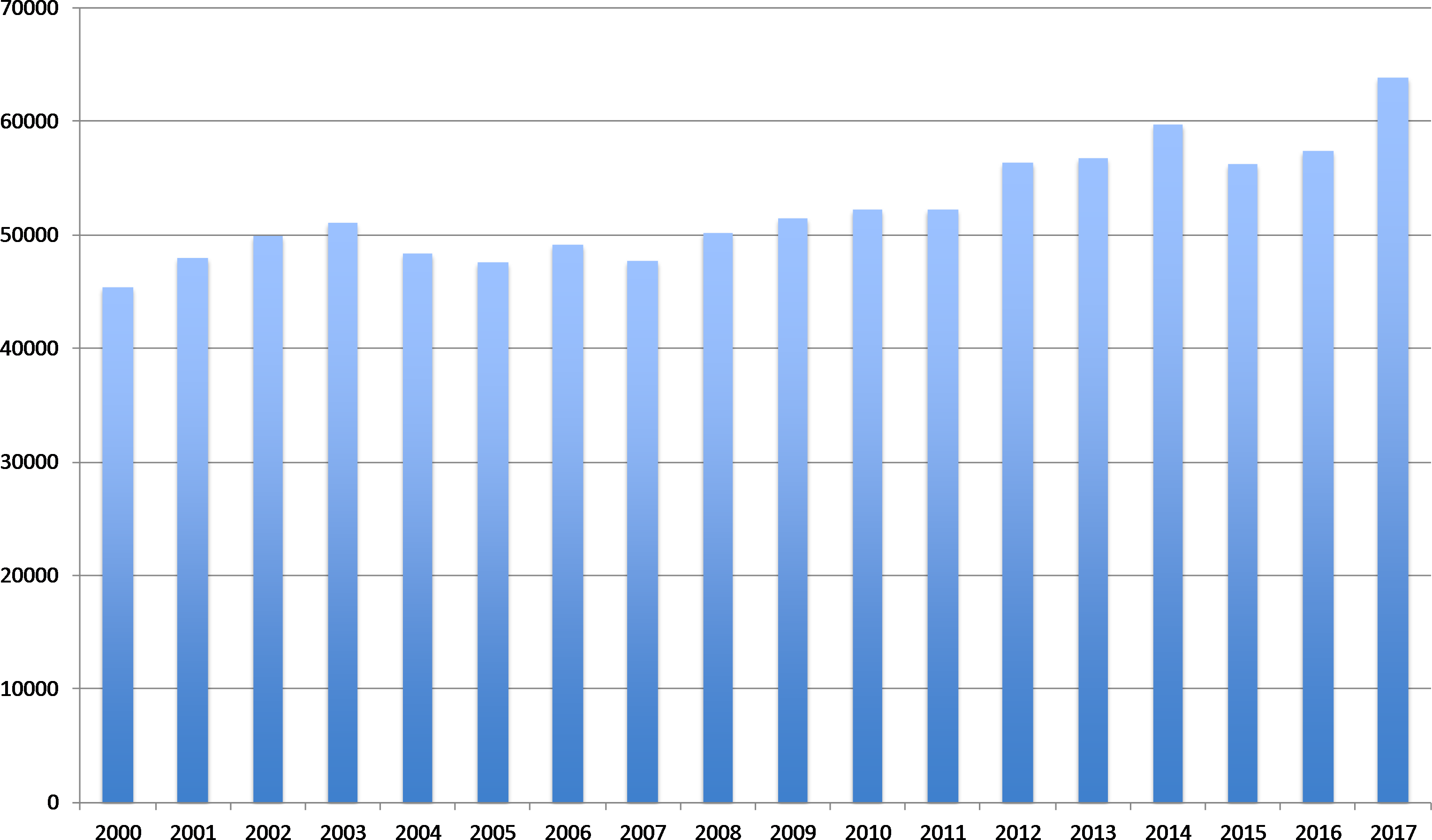
    Homicides in Brazil

    Source: Instituto Igarapé, Reuters

    The number of homicides in Brazil in 2016 was 57,395, equivalent to a homicide rate of 27.8 per 100,000. The total increased to 63,880 in 2017 or 30.8 per 100,000, four times the global average. The 2016 total ranked Brazil as number 13 of the world’s top 20 countries by homicide rate. The number of people killed as a result of police action in Brazil is also high, at around 5,000 per annum. Murderers frequently go completely unpunished. Studies show that only six out of every 100 murder investigations lead to a conviction. Police tend to be reactive and do not adequately prioritise the resource-intensive investigation of serious crime. Despite the large number of homicides, only 11% of the prison population is charged with that crime. Data on crime clear-up rates is lacking in 21 of the country’s 27 states.

    There were nearly 50,000 reported rapes in 2016. A woman is murdered somewhere in the country every two hours. The prison population is over 700,000. With intense overcrowding (occupancy rates at around 200% of prison capacity) there is a shortfall of at least 350,000 prison places. Prisons are not reducing re-offending rates: on the contrary, the country’s main criminal organisations were created and gained strength inside the prison system, from where they continue to get most of their recruits. The economic cost of crime more than doubled in between 1996 and 2015 to reach an estimated BRL285bn (US$75.4bn) or 4.4% of gross national income. Opinion polls show that violence and crime are considered one of the four top problems facing the country. In a December 2017 according to an Ibope survey, 38% of respondents highlighted crime as the top problem.

    Ilona Szabo, executive director of think tank Instituto Igarapé, says that crime is traditionally seen purely as a police matter, but there is now an increased understanding that it is linked to all aspects of the country’s development and has an incredibly high social and economic cost. Renato Sérgio de Lima, director of lobby group Fórum Brasileiro de Segurança Pública (FBSP), says that one of the tasks facing the next government will be to review and update the overall public security framework. “The 1988 constitution sets out fundamental principles. The law on the military police was written earlier, in 1983. The law on the civilian police dates back to the time of Empire. The criminal justice system was set up in the 1940s. So a first task for a new government must be to do some housekeeping, make sure public security regulations are updated and made consistent, to find a way of articulating the way the country’s 1,300 public security institutions should work together,” he said.

    A significant proportion of middle-class voters believe they should have expanded rights to own and carry firearms for self-protection. Bolsonaro successfully tapped into that sentiment during the election campaign. But a number of security experts believe greater gun ownership is not necessarily an answer to the problem, and could make it worse. Ivan Marques, director of NGO Sou da Paz, notes that 70% of violent deaths in Brazil involve the use of firearms, way above the global average of around 40%. In his view this means that more effective regulation and control of gun ownership is required. He says there is a positive correlation between the number of guns in circulation and the number of homicides. The FPSB’s Sergio de Lima agrees. In what could be taken as an indirect reference to Bolsonaro, who during the campaign advocated lifting all restrictions on gun ownership, he criticised “candidates who make a big issue of the right to own weapons, as if it were banned in Brazil, which it isn’t: they are trying to surf a wave of panic among the population”.

    Predicting the future is always difficult. What is clear, however, is that if present trends continue unchanged, the problem of crime is set to intensify. The number of homicides per 100,000 members of the population has been increasing. Demographic factors may in the long term begin to push it back down (simply because most of the killers and their victims are young men, and as the population ages, young men will form a smaller group within the total). However, that factor is unlikely to have much impact over the next ten years.

    It can be argued that there are two radically different approaches to the problem of crime. One is the hard-line or ‘iron-fist’ (mano dura) approach. This emphasises repressive policing, punitive justice, and tough incarceration. The paradox is that this approach is highly popular with voters in Latin America, even though the evidence for its effectiveness is at best mixed. Some aspects of a hard line on law and order can be counter-productive (for example tough sentencing can lead to overcrowded jails which become criminal recruiting grounds). President-elect Bolsonaro appears to be continuing a long tradition of ‘get tough’ policies, the only difference being that he has expressed them in more extreme terms (such as defending a police shoot-to-kill policy) and that, because of a real and perceived surge in crime, the electorate has been more than usually receptive to his approach.

    The other approach to crime has become known as ‘citizen security’ and is supported by many academics and NGOs. Rio-based think tank the Igarapé Institute says that although rather loosely defined, citizen security approaches “include a range of ideas and practices designed to prevent and reduce violence, promote public security and access to justice, strengthen social cohesion and reinforce the mutual rights and obligations of states and citizens”. This approach suggests there is no simple response to rising crime, but that action needs to be evidence-based and multi-faceted. It notes evidence across the region that some citizen security approaches have successfully helped reduce homicide rates. For example, a succession of comprehensive and sustained social and urban citizen security measures in the Colombian city of Medellín helped reduce the homicide rate from 266 per 100,000 in 1991 to 30 per 100,000 by 2015. There were also significant reductions in the Brazilian cities of São Paulo and Rio de Janeiro (although the latter witnessed a new deterioration in 2017 and 2018), and in the Mexican city of Ciudad Juarez.

    An FPSB report published in 2018 has no less than 35 recommendations in seven policy areas. The first of the seven programme areas creates an efficient public security system. Recommendations under this heading include creating a permanent ministry for public security; increasing funding; improving training in public security; and creating a properly integrated national security system (Sistema Único de Segurança Pública – SUSP). The second programme area is to build state-level law enforcement and regulatory agencies to tackle organised crime. The third is to increase police effectiveness and efficiency, at both state and federal level; this too involves action against corruption. A major reform of Brazil’s prison system is identified as the fourth programme area, to include action to regain control of prisons from criminal groups, strengthen prison management, and allocate prison places in a “more rational and human manner”. The fifth programme area involves violence-reduction and crime prevention programmes, particularly among the 123 municipal ‘hot spots’ which accounted for 50% of the national homicide rate in 2016. The sixth programme area is described as a reconsideration of policies on drugs to include decriminalisation of consumption and increased medical and education programmes to discourage drug use. Finally, the seventh programme area concerns gun control: here recommendations include continuing the ban on public carrying of weapons while improving police records and control of gun permits.

    If – and the issue is still the subject of much debate – the ‘citizen security’ approach is ultimately more effective than the ‘iron fist’ the problem is that it is less popular with the voters. The idea of ‘getting tough’ is a simpler, more instinctive message, and one that comes more naturally to politicians on the campaign trail. Even if ‘get tough’ policies do not at first succeed, and violence continues to increase, many voters may conclude not that the policy was wrong, but simply that it was not executed properly or was not tough enough. Many Latin American countries have found themselves caught up in this logic.

    This then points to a potential worst-case scenario for the next 10 years: that Brazil under Bolsonaro and his successors will follow hard-line anti-crime policies which satisfy the demands of voters even though they fail to stop, and may even contribute, to rising violence. In other words, the country might follow recent experience in the Philippines under President Rodrigo Duterte.

    Duterte took office in June 2016 advocating a ‘war’ on drug traffickers and explicitly defending shoot-to-kill and extra-judicial executions by police. Between mid-2016 and late 2018 the homicide rate rose sharply to total around 23,518. This surge in violence does not seem to have affected Duterte’s standing in the opinion polls: in June 2018 his approval rating stood at 65%, down from 76% in September 2016, but still substantial. Other polls suggest that nearly eight out of ten Filipinos support the state-led killing spree. The reasons for this are complex, but seem to resonate with the situation in Brazil. Jayeel Cornelio, a sociologist at Ateneo de Manila University, says some surveys show people welcome the war on drugs, while feeling unease over the death toll: “People are worried but they welcome it, because paradoxically it makes them feel safer in their communities,” he said, adding “It is not so much that Duterte has changed traditional Filipino values. On the contrary, the time was ripe for him to become president because many Filipinos were already disillusioned with previous regimes marred by corruption, inefficiency and a perceived preference for the elite.”

    Filipino political analyst Richard Heydarian describes both Bolsonaro and Duterte as exponents of a wave of “emerging market populism” which has benefited from electoral anger and disillusion. He says, “When people feel let down by the traditional political class and begin to doubt values of democracy and human rights to the point they want to try something different, it is reasonable that they are willing to take two to three years to test their choice.”

  • NICARAGUA: Fighting poverty or buying votes

    LatinNews 10 April 2019 Hits: 827

    Since 19 April 2018, Nicaragua’s President Daniel Ortega and the ruling Frente Sandinista de Liberación Nacional (FSLN) have faced growing international scrutiny due to the State’s repressive crackdown on anti-government demonstrations, sparking domestic unrest and international condemnation. For some this came as a surprise given previously glowing reports from institutions like the International Monetary Fund (IMF) regarding the state of Nicaragua’s economy and resultant efforts to address poverty. Here we consider these efforts more closely.

    On 11 January 2019, the Organization of American States (OAS) invoked the Inter-American Democratic Charter, which means the body is now in the process of formally assessing the state of democracy in Nicaragua. Major human rights organisations, too, including Amnesty International, Human Rights Watch, and the Inter-American Commission on Human Rights, have denounced the “serious human rights violations” of the Nicaraguan state, which include killing, torturing, and imprisoning hundreds of protesters, journalists, and opposition activists. In one of the latest blows to Ortega’s government, supreme court judge Rafael Solís, a long-term ally of Ortega and the FSLN, announced his resignation, also in January, warning that Nicaragua is now closer to a new civil war than ever before.

    For many international observers, the government crackdown on the opposition came as an unwelcome surprise since, before chaos broke out in April 2018, Nicaragua appeared to be moving in the right direction. Some lone voices might have complained that Ortega, a former left-wing guerrilla leader who returned to power after winning the 2006 elections, was slowly dismantling Nicaragua’s democratic institutions to cement his hold on the country. However, most commentators focused on Ortega’s exemplary economic performance and anti-poverty efforts.

    Up until 19 April 2018, it was certainly easy to point out that under the FSLN government, tourism was booming and the economy growing. According to a concluding statement dated 6 February by the IMF following a staff visit to Nicaragua the country’s economic performance in 2017 was above expectations. The IMF also predicted that GDP would grow above potential in 2018, to reach 4.7%. Back in 2015, the Nicaraguan government had highlighted the contribution of the rapidly growing tourism industry to the country’s economic growth, suggesting that it generated around 82,000 jobs (3.3% of total employment) and contributed around 4% to the country’s GDP.

    Addressing poverty

    Positive evaluations of the FSLN government often stress that Ortega’s social and economic policies had drastically improved the lives of the poor, particularly in the country’s rural and coastal regions. In 2007, the FSLN government launched an ambitious project to fight poverty and malnutrition, called the Zero Hunger Programme. As part of this initiative, which was partly funded by the European Union, thousands of Nicaraguan women living in extreme poverty received government aid in the form of cows, sheep, hens, seeds, and construction materials. In addition, the Nicaraguan state set up training sessions so that poor campesinos would become more self-sufficient.

    Overall, the FSLN’s anti-poverty efforts seemed to have had a positive impact on the Nicaraguan population. According to a Standard of Living Survey published in June 2016 by the Nicaraguan government’s national institute of development information (INIDE), for instance, general poverty between 2014 and 2016 fell from 26.6% to 24.9%. Extreme poverty, which according to the World Bank means that people are deprived of basic human needs such as clean water, health care and shelter also fell from 8.3% to 6.9% according to INIDE.

    However, poverty is an extremely complex and difficult to measure phenomenon and a 2018 report by independent Nicaraguan research institution (Fundación International para el Desafío Económico Global, Fideg) shows that, despite claims to the contrary, poverty remains still deeply entrenched in Nicaraguan society. According to the Fideg report, between 2009 and 2017, poverty only declined from 44.7% to 41.1%. While this is of course an improvement, it is striking that despite the substantial economic growth, at least 40% of the Nicaraguan population continues to live below the poverty line.

    What is more, the results of the FIDEG report contradict the numbers of the Nicaraguan government, which paint a much rosier picture. Because of these contradictions, Nicaraguan newspapers claim, the FSLN government actually tried to prevent the FIDEG researchers from publishing their results. Moreover, the FIDEG report also demonstrates that, while general poverty somewhat declined in the period 2016-2017, extreme poverty in Nicaraguan cities, most notably the capital Managua, almost doubled (from 1.7% in 2016 to 3.3% in 2017).

    By taking a closer look at the policies of Ortega’s government since his return to power in 2007, it becomes clear that reducing long-term poverty might not have been his administration’s priority. Rather, some argue that it appears that Ortega and the FSLN used anti-poverty measures and rhetoric as a means of mobilising voters and consolidating FSLN power. The Zero Hunger Programme is an excellent example of this strategy. By directly providing rural families with much-needed goods, from a cow, to free medicine, to pencils, to grains, the FSLN connected with the Nicaraguan population at a personal and emotional level but failed to make a long-term impact on the country’s more structural problems. Indeed, despite all the public attention given to food security, a Dutch embassy report on Zero Hunger concluded in 2009, found that the FSLN government “lacks a coherent policy” to fight inequality and poverty.

    Another example is the Ortega administration’s Plan Techo, a nation-wide programme that provided thousands of poor Nicaraguan families with ten free sheets of zinc to replace or repair their houses. According to an October 2011 survey by a Nicaraguan consultancy firm M&R Consultores, this was the most highly appreciated project by the Sandinista government, even though it did not solve any structural problems with regards to poverty.

    So, why did so many international observers fail to notice the growing tensions and inequalities within the Nicaraguan society? Firstly, positive assessments of Ortega’s government were mostly based on the assumption that economic growth and anti-poverty campaigns matter more than press freedom, pluralism, and other democratic values. Optimistic predictions by the IMF and the World Bank were often cited, but these overlooked the allegations of growing corruption and increasingly authoritarian attitude of Ortega and his FSLN allies.

    Similarly, but for wholly different reasons, activists and politicians in Europe and the US ignored the decline of Nicaraguan democracy, as having viewed the FSLN government in the light of Ortega’s past as a left-wing guerrilla and socialist leader, who fought against a corrupt dictatorship and US-sponsored counterrevolutionary forces in the 1970s and 80s. From their perspective, accusations against Ortega and the FSLN were “counterrevolutionary” or part of a US-funded campaign to undermine socialist governments in Latin America. Yet the decision announced in January 2019 by the Socialist International group of world socialist and labour parties to expel the FSLN from its ranks, suggests that the tables are turning in this respect.

  • REGION: MercadoLibre surges to number one

    LatinNews 16 September 2020 Hits: 843

    Although stock market prices – and therefore company valuations – have been volatile, during the course of August Argentina-born e-commerce group, Mercado Libre, pushed past more traditional competitors in mining and gas to become Latin America’s largest company by market capitalisation.

    First founded in 1999 MercadoLibre is a home-grown e-commerce giant that has benefited from a surge in online shopping as a result of the coronavirus (Covid-19) pandemic. It now employs nearly 10,000 staff and is active in 19 Latin American countries. At various points during August its market capitalisation rose to touch US$60bn, making it the region’s most valuable company ahead of the likes of Brazilian mining giant Vale, state-owned oil company Petrobras, banking group Itaú (both also Brazil-based), Walmart’s Mexican subsidiary, and regional mobile telephony group, América Móvil.

    MercadoLibre’s financial results for the second quarter showed revenue rising 61% year-on-year to US$878.4m, with net income multiplying by a factor of 3.5 to reach US$55.9m. In a statement the company said that “the pandemic generated significant changes in consumer behaviour, which translated into a new milestone in the penetration of e-commerce and online payments in the region”.  

    In keeping with what has become a tech entrepreneur cliché, MercadoLibre was initially launched operating from a Buenos Aires garage by Marcos Galperín, a chess and rugby playing enthusiast who had studied at Wharton Business School in the US and worked at Argentina’s state-owned oil company YPF. Galperín’s initial idea was to build a local version of E-Bay. He has also been dubbed the ‘Jeff Bezos of the pampas’, after the founder and CEO of e-commerce behemoth Amazon. MercadoLibre can now claim to be the top online commerce platform in Latin America and the seventh largest in the world. It now offers six main e-services (with sub-brands such as Mercado Pago, Mercado Shops, and Mercado Envíos) that cover buying, selling, logistics, and money transfers. Its largest single market is now Brazil, representing 51% of total sales, with Argentina in second place on 32%. The company is also investing US$420m this year in Mexico, its fastest growing market. It is building a new distribution centre in Mexico’s Jalisco state.

    According to Forbes, Galperín now has a private fortune of around U$4bn, making him Argentina’s wealthiest businessman. Partly to escape political pressures at home, and like various other Argentine tech entrepreneurs, Galperín and his family live across the River Plate in Carrasco, an upmarket neighbourhood of Montevideo, the capital of Uruguay. His public support for former centre-right Argentine president, Mauricio Macri (2015-2019), has earned him some enemies. Developing the logistics side of the business in Argentina has led him into conflict with Hugo Moyano, the leader of the truck drivers’ union, while across the region traditional banks have been hostile to MercadoLibre’s growing market share in e-payments.

  • BOLIVIA: Arce pushes ahead with policy priorities

    LatinNews 10 December 2020 Hits: 730

    Bolivia’s minister of the presidency, Marianela Prada, lamented on 7 December that President Luis Arce’s government had inherited a “bankrupt state”, a country “going through one of the deepest economic crises in our history”. Prada recognised the role played by the coronavirus (Covid-19) pandemic in bringing about this state of affairs but was also keen to demonstrate the responsibility of interim president Jeanine Áñez’s administration, which she suggested had contributed to the country’s economic decline by prioritising “pettiness and the hatred of opponents” over economic responsibility.

    Such claims have been repeated widely by members of President Arce’s government in the month since his inauguration. Economy Minister Marcelo Montenegro doubled down on Prada’s comments by condemning the “economic mismanagement” of the interim government as having “accelerated the decline”, and Arce himself took a swipe at Áñez when he told the United Nations General Assembly last week that he would return Bolivia to “the path of stability and economic growth”, based on “the socio-economic model…that was stolen from us in November 2019” [WR-19-45].

    Called upon to diagnose exactly how the interim government had contributed to this crisis, Montenegro cited underinvestment in public services and state-owned companies as a key failing, noting that, as of October, just US$1.1bn (25.2%) of the US$4.4bn earmarked for this purpose in 2020 had been spent. Áñez was quick to hit back, calling on Prada and Montenegro to “stop complaining and start working” – but accusations of the deliberate underfunding of state-owned companies (allegedly as part of a strategy of privatisation) have since been echoed by Fátima Pacheco, the new general manager of public services regulator Sedem.

    As well as restoring this emphasis on public investment, the Arce administration has sought to make rapid progress towards other economic policy priorities; the flagship B$1,000 (US$145) ‘hunger subsidy’ for vulnerable populations was reportedly collected by over 400,000 people within a week of its launch at the start of December, while the ‘wealth tax’ on fortunes exceeding B$30m (US$4.4m) was approved by the chamber of deputies on 9 December, and referred to the senate for confirmation.

    • Wealth tax

    The tax on “large fortunes”, if approved by the senate, will reportedly only apply to around 150 Bolivians, but it is intended to raise in excess of B$100m each year. Economy Minister Marcelo Montenegro voiced optimism that the richest in society will be “willing to contribute” at this time of national emergency, but he noted that measures had been taken to prevent the evasion of this tax; for instance, he confirmed that it will apply to Bolivian citizens with assets stored abroad, and to non-citizens with assets stored in Bolivia.

    Local election preparations

    The Bolivian public will soon have an opportunity to express a verdict on Arce’s early actions, with local elections scheduled for 7 March 2021 [WR-20-47]. While concerns about the legitimacy of the electoral system have died down since the unrest that followed Arce’s election back in October, this tension has by no means dissipated completely, and the new government is facing calls to start a process of reform before the country returns to the polls next year.

    Miroslav Jenča, the UN assistant secretary-general for political affairs, met a number of Bolivian political actors and organisations during a visit last week and urged the country to take advantage of an “enormous historical opportunity to strengthen democracy, to find solutions through dialogue”. Jenča noted that the UN will maintain an advisory presence in Bolivia in the coming months, and that election monitoring and institutional strengthening are among the mission’s main priorities.

    A report published on 7 December by civil society coalition Observa Bolivia, with the backing of the European Union (EU), praised October’s general election as “a return to institutional normality”, but it issued a number of recommendations for further reform. In particular, the report highlighted several ambiguities in electoral regulations that should be addressed, for instance regarding the registration of candidates and the prohibition of ‘government propaganda’. It also called for more to be done to tackle campaign violence, a serious problem in the weeks before the vote.

    As well as electing new departmental, regional, and municipal authorities, Bolivians may also be called upon to participate in a constitutional referendum on 7 March. Deliberations are underway between the ministry of justice, a panel of legal experts, and opposition parties in the legislature, to try and reach a consensus on a programme of judicial reform, particularly regarding the process of appointing judges. The need for such a reform is widely recognised, but there is less consensus as to the details of what these changes should look like – to be included on the ballot in March, a proposal will need to be finalised by 20 December.

  • TRINIDAD & TOBAGO: Budgeting for a slow recovery

    Patrick de Courcy 15 October 2021 Hits: 2461

    Trinidad & Tobago has been suffering from years of slow or negative growth which has now been compounded by the effects of the coronavirus (Covid-19) pandemic even though Trinidad is not one of the Caribbean’s severely tourist-dependent countries. In the 12 years from 2009-2020, the country has recorded no less than eight years of negative growth. Only in four out of the last 12 years has it shown growth, and the best of those years was as far back as 2010 when the economy bounced back with a 3.5% expansion after the 2009 contraction of -4.8%. Since 2015, when the economy grew by 1.5%, the results have been consistently dire, with 2016’s contraction of -5.6% followed by -3.0% in 2017, 0.1% in 2018, and -1.2% in 2019. Then the Covid-19 pandemic struck, leading to a contraction of -7.8% in 2020. This was the background against which Finance Minister Colm Imbert presented his 2021/22 budget to parliament on 3 October.

    The last Article IV Consultation with the International Monetary Fund (IMF) was in 2018, with the report completed in August, so comfortably before the impact of Covid-19. The IMF reported that the country was slowly recovering from a deep recession and should return to positive growth from 2018. It also reported that “good progress has been made in fiscal consolidation through spending cuts, but public debt continued to rise, approaching the government’s soft target of 65% of GDP”.

    The IMF reported: “Gradual recovery in the non-energy sector should help stabilise growth at 1.5% over 2018-2023, with inflation projected to rise along with non-energy sector recovery to 3.8%. The fiscal deficit is projected to narrow to an average 4% of GDP over the medium term as energy revenues rise, non-energy revenues recover, and the efficiency of transfers and subsidies improve.” But then Covid-19 struck, the economy suffered further sharp contractions, and the debt-to-GDP ratio soared to 85%.

    The budget presented by Imbert on 3 October reflected this dire setback to the economy. He said the economy’s decline would “decelerate…to 1.4% in 2021 and look forward to a strong recovery in 2022”. In the meantime, though, the TT$55.43bn (US$7.86bn) 2021/2022 budget projects revenue of TT$43.33bn (US$6.50bn) to give a deficit of TT$9.09bn (US$1.36bn), or 5.8% of GDP. The slightly better news, however, was that the budget was based on an oil price of US$65 per barrel and a gas price of US$3.75 per MMBtu whereas on budget day the actual prices were, respectively, US$75 and US$5.80.

    The opposition leader, Kamla Persad-Bissessar, responded to the budget by arguing, with some justification, that the country’s economic difficulties could not be laid entirely at the door of the pandemic. She said the main problem was the ruling People’s National Movement (PNM) and Prime Minister Keith Rowley – “Covid did not crash the economy, it is the PNM led by Rowley who crashed the economy” – and she argued that the government had no new ideas other than to reintroduce the “dreaded property tax”. In his budget presentation, Imbert had said that the resumption of the property tax was “long overdue” and could become “a significant revenue item for local government in the years ahead”.

    In the face of such difficulties, talk of calling in the IMF is never far away, but the government is adamant that this won’t happen. Imbert pointed out that the country last entered an IMF programme in 1988 and that it had had “a severe adverse impact on the social fabric of Trinidad & Tobago”.

    Imbert on the IMF

    He added: “In the classic IMF model…once you enter an IMF programme you must reduce government spending to match government revenue. This inflexible one-size-fits-all policy has led to serious unrest in countries that had no choice…We see no need to seek any…form of assistance [other than surveillance, technical assistance, and capacity advice] from the IMF at this time or in the near future.”

  • BOLIVIA: Coca production ticks up

    Abbi Dicker 07 March 2025 Hits: 4848

    The land area dedicated to coca cultivation in Bolivia increased by 4% in 2023, according to a report published on 18 February by the United Nations Office on Drugs and Crime (UNODC). This brought the total area dedicated to coca crops to 31,000 hectares (ha), up from 29,900 ha in 2022 and exceeding the 22,000 ha limit that is permitted under Bolivian law for traditional use.

    Coca cultivation in 2023 was predominantly concentrated in the Yungas region, north of the capital La Paz, which accounted for 59% of coca harvesting at 18,439 ha – a yearly increase of 2%. This was followed by the Chapare region of Cochabamba department, also known as the Trópico de Cochabamba, which accounted for 39% of the cultivated area at 12,125 ha – up 6% year-on-year. Northern La Paz department, the other area highlighted by the UNODC, accounted for just 2% of national coca cultivation at 486 ha, although this area saw a steeper year-on-year increase in coca harvesting of 20%.

    The UNODC report suggests that the authorities have stepped up their efforts to crack down on illicit coca crops and cocaine production. Citing figures provided by the Bolivian government, the UNODC highlighted a 13% year-on-year increase in coca leaf seizures, with 372 tonnes (t) impounded. Cocaine seizures saw a sharp increase of 109% compared with 2022, at 21.34 t. The seizure of cocaine base rose by 14% to 11.59 t, while the eradication or negotiated replacement of coca crops increased slightly by 0.4%, to total 10,302 ha.

    Responding to the UNODC report, Interior Minister Eduardo del Castillo said that it showed that coca production remained “stable”. He added that President Luis Arce’s government had already been aware of these figures since 2023 and that they had been used to inform the government’s coca strategy for 2024. This marked a more measured response from Del Castillo, who in previous years has disputed the UNODC’s estimates on coca production and questioned the methodology used in its reports [SSR-23-02].

    However, the deputy minister for controlled substances, Jaime Mamani, expressed concern about the growth of coca cultivation in protected areas, which was not detailed in the UNODC report. Speaking on 19 February, Mamani said that coca farmers had obstructed eradication and monitoring efforts in protected areas such as the Isiboro Secoré national park and indigenous territory (Tipnis), which spans the departments of Beni and Cochabamba.  “We urge coca growers to allow the continuation of crop rationalisation [negotiated crop substitutions], to improve the image of the country and to comply with international commitments,” he said.

    The 22,000 ha limit on legal coca cultivation continues to be contentious, and has previously caused disputes between the country’s two coca unions – Asociación Departamental de Productores de Coca de los Yungas de La Paz (Adepcoca), and the Seis Federaciones del Trópico de Cochabamba (SFTC). The permitted coca limit was raised to its current level in 2017 under former president Evo Morales (2006-2019), having previously stood at 12,000 ha since 1988.

    Given that Morales is the president of the SFTC, and remained so during his 13-year presidency, Adepcoca argues that coca eradication efforts have been lax in the SFTC’s stronghold in Cochabamba department, while production quotas have been more vigorously enforced in the Yungas and La Paz department, where Adepcoca runs the coca trade.

    Morales changes party

    Former president Evo Morales (2006-2019) announced on 20 February that he was leaving the ruling left-wing Movimiento al Socialismo (MAS), which he led from 1997-2024 before being pushed aside amid a power struggle between his faction of the party and a rival faction loyal to President Arce [SSR-24-08]. Morales announced that he will represent the small left-wing Frente Para la Victoria (FPV) in the August presidential election, despite currently being barred due to presidential term limits.

  • TRACKING TRENDS

    Patrick de Courcy 19 February 2026 Hits: 1063

    MEXICO | Pemex issues bonds on local markets. Mexico’s state-run oil company Petróleos Mexicanos (Pemex) returned to the local debt markets on 13 February after several years away, issuing bonds worth M$31.5bn (US$1.84bn). The bond placement consisted of M$5.5bn in notes maturing in 2036; M$17bn in notes due 2034; and M$9bn in notes maturing 2031. In a statement, Pemex said that the resources will be used to pay financial liabilities maturing in 2026, without increasing its debt balances.

  • TRACKING TRENDS

    LatinNews 10 November 2011 Hits: 934

    BOLIVIA-CHILE-PERU | Access to the sea. President Evo Morales has called on the Navy to be “ready, trained and organised” for the time when Bolivia regains its sovereign access to the Pacific. In a speech commemorating the 185th anniversary of the creation of the Navy, Morales said this “will happen at any moment”. The defence minister, Rubén Saavedra, meanwhile, reiterated the Morales administration’s threat to take Chile to the International Court of Justice at The Hague over the matter. The president of Chile’s foreign affairs committee of the lower chamber of congress, Jorge Tarud, said Chile would not “talk under threats”, adding that turning to The Hague was a sign of Morales’s falling popularity amid internal problems. He said Chile would be happy to discuss Bolivia’s access to the Pacific if it dropped its threats “but let this be very clear, without sovereignty”. 
    In a related development, a Bolivian congressional delegation visited Lima this week to request the ratification of an agreement signed between Morales and Peru’s former president Alan García (2006-2011) in October 2010 to allow Bolivia to base a navy training school at Ilo port [WR-10-42].

  • TRACKING TRENDS

    LatinNews 16 February 2012 Hits: 3426

    EL SALVADOR | Trade deficit. El Salvador’s trade deficit grew 20.3% in 2011 compared with the previous year, closing at US$4.8bn, according to a recent report by the Central Bank (BCR). Exports grew 18% to US$5.3bn with traditional products such as coffee (US$464m), sugar (US$132m) and shrimp (US$800,000) accounting for some 11% of the total. Imports grew 19% to US$10.1bn, driven in part by a 26% rise in oil imports which reached US$1.7bn.

  • GUATEMALA: Remittances up

    LatinNews 12 June 2012 Hits: 635

    Remittances inflows rose 12.8% year-on-year in April 2012 to reach US$418.9m. Altogether in the first four months of 2012, remittances reached US$1.48bn, up 9.9% on the same period of 2011.

    Guatemala’s central bank (Banguat) expects remittances to rise 4% overall in 2012 on the record US$4.38bn registered in 2011.

    Inflation: Inflation in April was 4.3% year-on-year, down 1.49 percentage points from 5.79% in April 2011. The monthly variation was 0.37%. The annual target band for 2012 is between 3.5% and 5.5%, set by the Banguat’s monetary board. Accumulated inflation to 30 April was 1.3% - the lowest such rate for the period in the last three years.

    Tax take: Guatemala’s tax take in the first four months of 2012 rose 6.7% year-on-year to reach Q$11,750m (US$1.5bn). The increase was attributed to the improved collection of indirect taxes (10.6%) – mainly VAT on imports (+12%), taxes on paper and stamps (72%) and customs taxes, which increased 11%.  Meanwhile direct tax revenues fell 0.5% as a result of a 2.3% drop in revenues from personal income tax. Miguel Gutiérrez, the head of the tax authority (SAT) recently told reporters that the SAT estimated a 32.8% VAT evasion rate in 2011, equivalent to some Q$12.6bn (US$1.6bn).

  • POINTERS

    LatinNews 02 July 2012 Hits: 2827

    GUATEMALA-US | Pérez Molina shifts gear on drugs. On 21 June Gil Kerlikowske, director of the White House’s  Office of National Drug Control Policy (ONDCP), dropped in on Guatemalan president Otto Pérez Molina to explain the new US ‘third way’ policy on drugs, which involves a ‘paradigm shift’ from viewing drug addiction as a moral crime to viewing it as a treatable disease. This puts emphasis on health and prevention initiatives designed to reduce the consumption and availability of drugs in the US. [The other two ‘ways’ are the ‘war on drugs’ pursued over the past 40 years and the ‘decriminalisation’ which Pérez Molina and others want debated.]

    Immediately after their meeting Pérez Molina announced that this month (July) Guatemala and the US would conduct a combined operation aimed at ‘reducing the percentage of drugs transiting through Guatemala.’ He said that his government would continue to insist on decriminalisation and the promotion of new ways to deal with drugs, but that until these are agreed, Guatemala remained committed to ‘acting firmly and with determination against drug trafficking’ in coordination with the US and with other Central American countries. ‘While the discussion progresses,’ he said, ‘we will try to make [anti-drug efforts] more efficient.

    HONDURAS-US | DEA involved in drug-bust killing. A suspected drug trafficker was shot dead on 23 June during an anti-drug operation in the department of Gracias a Dios which led to the seizure of 360 kilos of cocaine. The very next day the US embassy announced that the fatal shot had been fired, in self-defence, by one of the Drug Enforcement Administration (DEA) agents accompanying the Honduran police. This comes a month-and-a-half after another operation accompanied by DEA agents in which four people were killed in the same area [SSR-12-05]. On that occasion the US authorities said that none of the DEA agents had fired their weapons.

    After this latest episode security minister Pompeyo Bonilla announced that the government would continue with the operations, with the assistance of ‘DEA officials who are specialists in drug trafficking’.

    HONDURAS | Surveying the gangs. A report released on 7 June which surveyed 14 cities in Honduras revealed the existence of five street gangs with a joint membership of 4,728, aged between 11 and 22. The largest two are the Mara Salvatrucha (with 2,104 members) and La 18 (2,047). The other three, with 577 between them, are identified as Mara 61, Gangster and West Side.

    The report, Situación de maras y pandillas en Honduras, conducted with the support of UN Children’s Fund (Unicef), was presented by the government’s Programa Nacional de Prevención, Rehabilitación y Reinserción Social (PNPRRS). This programme’s director, Felipe Morales, said that the wave of criminal violence Honduras is now experiencing is largely attributable to these gangs. ‘The criminal activities of the maras,’ he said, ‘are not confined to the collection of taxes and  simple robbery from the population; they have specialised in such activities as drug trafficking, money laundering, kidnapping, car theft, contract killing, extortion and gunrunning.’ [The report is available at www.unicef.org/ ]

  • URUGUAY: Tension provokes political rupture

    LatinNews 09 August 2012 Hits: 3555

    One of the region’s standout examples of cross-party political cooperation is unravelling. Tension between the government of President José Mujica and the right-wing opposition Partido Colorado (PC; Colorados), exacerbated by Paraguay’s suspension from the Southern Common Market (Mercosur) and Venezuela’s back-door admittance to the bloc, prompted members of the PC to resign en masse this week from management positions in state companies, autonomous entities, decentralised services and other state institutions they were invited to take after Mujica came to power in 2010.

    Mujica made a concerted effort to reach out to the opposition after taking office by offering management positions in the telecommunications company Antel, the electricity company UTE, the Banco República, the commission regulating the telecoms market and others. Eight members of the main faction in the PC, Vamos Uruguay, of party leader Senator Pedro Bordaberry, formally resigned in protest at Mujica’s governance. First Lady Senator Lucía Topolansky, more radical than her husband, had suggested they should leave their posts because of mounting strain with the government in recent months. In late July Mujica angrily told the press that there was no way they would resign because they would not voluntarily enter the ranks of the unemployed.

    Mujica had won plaudits for his decision to offer some 60 management positions to the opposition in 2010 (always ensuring the ruling Frente Amplio maintained a majority on the directorates) as a sign of his commitment to seeking political consensus and his moderation. It is important to note that members of the other faction in the PC, Proba, and the other opposition parties Partido Nacional (PN, Blancos) and Partido Independiente, remain in their positions.

  • COSTA RICA: De nuevo, Nicaragua es denunciada en la ONU

    LatinNews 08 October 2012 Hits: 498

    Costa Riva ha denunciado una vez más a Nicaragua por ignorar una resolución de la Corte Mundial con relación al área disputada, cercana a la cuenca baja del Río San Juan. El canciller, Enrique Castillo, dijo en la reciente 67ma Asamblea General de la ONU que su país, solamente puede contar para su defensa con el respeto por la ley internacional.

    Castillo dijo que Nicaragua había continuado enviando personal al área disputada, a pesar de la resolución de marzo del 2011 de la Corte Internacional de Justicia (CIJ) prohibiendo a ambos países de hacerlo hasta que haya dictaminado sobre la sustancia de la disputa. Costa Rica ha acusado repetidamente a Nicaragua de acciones provocativas en el área de la cuenca baja del Río San Juan.

    Nicaragua por su parte, ha acusado a Costa Rica ante la Corte Centroamericana de Justicia por sus planes de construir una carretera a lo largo del lado costarricense del río (no en el área en disputa). Costa Rica no reconoce la jurisdicción de la corte centroamericana.

    En agosto, Carlos Argüello, representante de Nicaragua ante la CIJ, dijo que Costa Rica y Colombia están intentando “apropiarse” de cualquier posibilidad de un canal interoceánico a través de Nicaragua. Dijo que esto es lo que realmente está detrás de los juicios que Nicaragua está peleando contra ambos países en la CIJ. Costa Rica, afirma él, quiere “apropiarse” del Río San Juan, que pertenece a Nicaragua y que es una de las posibles rutas del canal.

  • In Brief - Peru; Venezuela

    LatinNews 31 October 2012 Hits: 1309

    POLITICS | Fujimori fudges it again. On 30 October the imprisoned former president, Alberto Fujimori (1990-2000), said he would “adhere to” the humanitarian pardon request, submitted to the authorities by his family on his behalf, via a document with his signature to be presented today (31 October). Fujimori’s refusal to sign the actual request, which he claims is not “required” from a legal perspective, is the latest twist in the current wrangling triggered by the formal petition made by Fujimori’s four children on 10 October to grant the former leader a humanitarian pardon. Previously, Justice Minister Eda Rivas told reporters that that Fujimori must sign the pardon request because, to be pardoned, “one must recognise that crimes have been committed”.

    POLITICS | PSUV allies refuse to take orders. It’s not only the opposition that has complaints about the heavy handed tactics of the ruling Partido Unido Socialista de Venezuela (PSUV) ahead of the 16 December regional elections; local PSUV allies remain up in arms in as many as eight states over the PSUV’s last minute ‘imposition’ of gubernatorial candidates, typically selected by President Chávez himself in order to cement his tight centralised control over the country’s political scene. Florencio Porras, who has refused to step aside in his bid for state governor of Mérida (a post he has held before) despite Chávez’s strong support for the official PSUV candidate, Alexis Ramírez, yesterday noted that “they [the local PSUV-istas] brought the helping hand of Pdvsa [the state oil company] and all the force of the State” to intimidate him. Alexis’s campaign chief is the head of the state oil company Petróleos de Venezuela (Pdvsa) and oil minister, Rafael Ramírez. Porras has become something of a poster boy for the dissenters in the Polo Patriótico umbrella electoral alliance comprising the PSUV and smaller left-wing parties.

    POLITICS | New defence minister declares unconditional support for Chávez.  Admiral Diego Molero Bellavia took office as Venezuela’s new defence minister on 30 October, replacing Henry Rangel Silva, who has stepped aside to compete in the scheduled 16 December regional elections. Molero Bellavia, who has relinquished command of the Venezuelan navy to order to assume his new ministerial post, echoed his predecessor, also a military man (former head of the armed forces), in declaring his loyalty to the radical left-wing political project led by President Hugo Chávez. “Our loyalty and commitment to our president and commander in chief Hugo Chávez Frías knows no conditions”. Molero Bellavia cites Che Guevara as an inspiration and has defended socialism as a better way of life than capitalism. Opponents of President Chávez have accused him of heavily politicising the Venezuelan armed forces, now known as the ‘Bolivarian’ forces.

  • Differing interpretations of Iranian talks

    LatinNews 06 March 2013 Hits: 597

    In the latest nuclear talks with Iran, which ended in Kazakhstan’s capital Almaty on 27 February, the Western powers demanded as before that Iran cease enriching uranium to 20% and that it give up its existing stockpiles.  In return for progress towards these goals, they promised to enable Iran to participate once again in the international gold trade and that some other sanctions would be lifted.  The talks ended with an agreement to resume in early April.  One doveish interpretation of Iran’s response is alarming Israel.

    Israel’s own response has been predictably negative.  On 3 March, Israel’s Prime Minister Binyamin Netanyahu said: “I was briefed over the weekend on the major powers’ talks with Iran on the nuclear issue.  The American representative briefed National Security Adviser Yaakov Amidor on these talks.  My impression from these talks is that the only thing that was achieved was to stall for time which Iran intends to continue enriching nuclear material for an atomic bomb, and it is indeed continuing towards this goal.”  The following day, Netanyahu told the American Israel Public Affairs Committee (Aipac) by video link: “Words alone will not stop Iran.  Sanctions alone will not stop Iran.  Sanctions must be coupled with a clear and credible military threat if diplomacy and sanctions fail.”

    Netanyahu will have been encouraged that US Vice-President Joseph Biden also supported the possibility of military action when he told Aipac: “We are not looking for war. We are looking to and are ready to negotiate peacefully, but all options, including military force, are on the table.”

    Biden added, however, that the important thing is to exhaust all other options before resorting to military action, and Netanyahu, we are told, is now resigned to having to wait at least until the completion of the next round of talks.  However, he will be on high alert for any signs that Western prevarication could go beyond that, and he will be alarmed by one interpretation that has gained some momentum in Europe.  It is being said that the widespread presentation in Iran of the Almaty talks as a success may be intended to prepare the population for an eventual compromise deal.

    To support this contention, it is pointed out that senior Iranian officials were quick to call the talks “positive” and to say that the West was moving from a strategy of “pressure and negotiation” to one of “negotiation and cooperation”.  On 1 March, Foreign Minister Ali Akbar Salehi went as far as to say “the nuclear issue will be solved in the foreseeable future”, and a similar positive spin was put on the talks at Friday prayers by Imams who are known to be close to supreme leader Ayatollah Ali Khamenei – and he is the one who will make the final decision.

    This is no doubt all true, but where Israel would differ is in making the considerable jump to assuming that this means that Iran is preparing the population for compromise.  For those who have made that jump, this is another argument to support the idea that nothing should be done ahead of Iran’s presidential election in June.  For Israel, on the other hand, Iran’s tactics are all about gaining time and getting its nuclear programme beyond the point at which it can be stopped or seriously delayed by Israeli military action.

  • RASTREANDO TENDENCIAS

    LatinNews 25 March 2013 Hits: 709

    BRASIL-ARGENTINA | Petrobrás revisa plan de inversión de cinco años. La compañía petrolera estatal de Brasil, Petrobrás, difundió el 16 de marzo su revisado plan de negocios 2013-2017. El plan prevé inversiones de US$236,7mm para el periodo. Esto a medida que la compañía busca incrementar su producción de petróleo crudo de los actuales 2m barriles por día (bpd) a 3m bpd para el 2017, y 4,2m bpd para el 2020. Sin embargo, la cifra de inversión es solamente un 0,8% mayor que el monto citado en el plan de negocios previo 2012-2016.

    Los resultados financieros de Petrobrás el año pasado fueron decepcionantes y la compañía se ha visto forzada a revisar sus inversiones para poder revertir esto. Petrobrás reveló que aproximadamente US$147,5mm, o el 62% de la cifra total de inversión, será destinado para los esfuerzos de exploración y producción. Por otro lado, US$64,8mm (o el 27%) han sido destinados para la inversión en refinerías, transporte y distribución; US$9,9mm (4%) se gastará en gas y otras fuentes de energía; y US$2,9mm (1%) se invertirá en la producción de biocombustibles.

    La inversión general en refinerías, transporte y distribución es menor de los US$77,4mm presentados en el previo plan de negocios, lo que la compañía explicó señalando que ya han tenido lugar algunas inversiones en esta área. En contraste, la cifra de inversión para exploración y producción se incrementó de US$131,6mm en el plan de negocios anterior. La mayoría de esto (el 68%) será destinado para el desarrollo de los vastos depósitos pre-salinos de la costa de Brasil en un esfuerzo por incrementar la producción de petróleo en el área, del 7% actualmente, al 35% para el 2017. De hecho, esto parece representar el principal cambio en el nuevo plan -la concentración de inversiones en el desarrollo de proyectos en Brasil a expensas de proyectos en otras partes. Sólo el 2% del total (US$5,1mm) será destinados a proyectos en el exterior.

    Días después de que el plan fuera difundido, el 19 de marzo, la directora ejecutiva (CEO) de Petrobrás, María das Graças Foster, proveyó algunos detalles más de los planes de desinversión de la compañía, particularmente aquellos que afectan los activos en el exterior. Foster explicó que el plan de negocios anterior planteaba la venta de las refinerías de Petrobrás en Japón y Pasadena, California; sus concesiones de exploración y explotación en el Golfo de México y Tanzania; y sus activos de producción en Argentina -todo esto en un esfuerzo por reunir unos US$14,8mm. Sin embargo, Foster dijo que el nuevo plan ha desechado la idea de desprenderse de la refinería en Pasadena. Foster agregó que la compañía estaba negociando actualmente la venta de sus activos en Argentina, lo que ella describió como "un proceso complicado".

    Los activos de Petrobrás en Argentina incluyen una refinería en Bahía Blanca, un número de gasoductos, activos de producción de electricidad, y una participación en una red de distribución que comparte con la firma local, Refinor. Aunque varias firmas petroleras argentinas, tales como Oil Combustibles, Tecpetrol, e incluso la ahora controlada por el estado, YPF, previamente habían expresado su interés en adquirir estos activos, no está claro si la desinversión de Petrobrás en Argentina ha sido vista de manera positiva o negativa por el gobierno argentino, que ya está poco feliz por la decisión del gigante minero de Brasil, Vale, de suspender el proyecto de potasa de Río Colorado [IL-13-10].

    CHILE | El gobierno pronostica un brillante futuro. El 14 de marzo el gobierno del Presidente Sebastián Piñera anunció que espera que la economía del país experimente un sólido crecimiento este año, a pesar de la adversa situación económica externa perpetuada por la crisis europea y los niveles generalmente débiles de la actividad económica global. En un seminario organizado por la Sociedad de Fomento Fabril de Chile (Sofofa), el ministro de finanzas, Felipe Larraín, anunció que los economistas están pronosticando un crecimiento del PIB del 5% para el 2013. Larraín dijo que el pronóstico positivo se apoya en el saludable nivel de inflación del país, la baja tasa de desempleo y el crecimiento de los salarios reales, todo lo cual provee una sólida base para una futura expansión económica.

    Pocos días más tarde, el 18 de marzo, el banco central de Chile publicó la revisión del desempeño económico de Chile en el 2012. El PIB general creció por un fuerte 5,6%, conducido por un crecimiento en el consumo interno del 7.1%. Esto debido a que el ingreso bruto nacional disponible se incrementó un 4,6%. Por otro lado, el índice mensual de la actividad económica elaborado por el banco (Imacec), reportó un crecimiento del 6,7% en enero del 2013, comparado con enero del 2012, destacando la fuerza de la demanda interna en Chile. Sin embargo, Larraín ha advertido que los actores de la economía chilena deben permanecer conscientes de la complicada situación global y que es muy probable que el país no continúe experimentando tales altas tasas de crecimiento en lo que resta del año.

    • El Mercosur pone los ojos en Sica

    El canciller de Uruguay, Luis Almagro, dijo el 18 de marzo que "Uruguay y el [Mercado Común del Sur] Mercosur tienen un especial interés en desarrollar estrechos lazos con el Sica [Sistema de Integración Centroamericano]". Actualmente, Uruguay retiene la presidencia pro-témpore del Mercosur hasta julio de este año, cuando está programado que pasará a Venezuela. El comentario de Almagro fue hecho durante su visita a El Salvador como parte de una gira centroamericana que comenzó en Guatemala y que está programada que continúe la semana próxima en Nicaragua. Según Almagro, el desarrollo de lazos económicos más estrechos entre el Mercosur y Sica "no pueden ser pospuestos por más tiempo, pues es parte de una estrategia más general de integración latinoamericana". Y dijo que él esperaba que las negociaciones comiencen a tener lugar este año.

  • TRACKING TRENDS

    LatinNews 23 May 2013 Hits: 2472

    GUATEMALA | Ríos Montt conviction overturned. Guatemala’s constitutional court (CC) has overturned the historic conviction and sentencing of former dictator, Efraín Ríos Montt (1982-1983) for genocide and crimes against humanity perpetrated during the 1960-1996 civil war. On 20 May the CC ruled by three to two to overturn the 10 May decision and ordered the trial to be set back to where it was on 19 April (when it was suspended for procedural issues) [WR-13-18], on the grounds that various legal challenges presented by the defence awaited resolution.

     The ruling is based in part on a constitutional challenge (amparo) by the defence team at the very end of the trial which claimed that the trial court had failed to remedy a due process violation from the start of the trial on 19 March – the expulsion of Ríos Montt’s attorney, Francisco García Gudiel. García Gudiel was expelled after the latter sought the recusal of the presiding judge, Jasmín Barrios, and her associate judge Pablo Xitumul on the grounds that there was personal “enmity” between himself and Barrios and “amity” between Xitumul and Ríos Montt’s former head of intelligence, (ret.) General José Mauricio Rodríguez, who was on trial on the same charges but acquitted as part of the 10 May ruling.

       The defence team also claims there are 12 interim legal challenges awaiting resolution, with several others filed since 10 May – once again prompting the prosecution to accuse the defence of seeking to stall the case through employing all legal manoeuvres possible.   

        The CC’s latest decision, which has raised major doubts over the future of the trial, took place amid continued signs of polarisation within the country. While President Otto Pérez Molina, a former head of military intelligence (D-2), has pledged to respect the final verdict, upon the completion of the appellate process, on 19 May García Gudiel said that 45,000 Ríos Montt supporters were willing to “paralyse” the country in the event of an unfavourable ruling by the CC against the former general.

  • CUBA: Can you trust your cigar?

    LatinNews 10 October 2013 Hits: 3281

    The high-quality Cuban cigar you may be about to smoke may be, well… not exactly Cuban. The authorities in Havana have become concerned that their cigars are being pirated.

    According to Opciones, a Cuban business magazine, a number of ‘false Cuban cigars’ were recently confiscated by police at a range of retail outlets in San José, Costa Rica. As the producer and exporter of what are often described as the best cigars in the world, Cuba has strong business reasons to want to protect this particular brand. Opciones was therefore eager to point out that genuine Cuban cigars have a Denominación de Origen Protegida (DOP), rather like the appellation d’origine controlee (AOC) used in France to protect wines, cheeses, butters and other agricultural products. This appears on cigar boxes as a stylised tobacco leaf with the wording ‘Habanos – Denominación de Origen Protegida’. The concept translates as a ‘controlled designation of origin’, which can be enforced in national law and has trademark and branding implications.

    In Cuba’s case a cigar DOP certifies that the cigar weighs more than 3 grammes, has been manufactured or hand-rolled on the island under the industry’s quality standards and has been made using black Cuban tobacco leaves from specific regions (some of which have their own regional DOPs). Since 1889 the Spanish Crown and then the independent republic of Cuba have also issued a special trademark and seal attached to cigar boxes. The latest version introduced in 2009 also has a unique bar code, and according to Opciones various other ‘secret codes’ which identify the factory and the date of production.

    Habanos SA has the exclusive worldwide distribution rights for Cuban cigars. The company is 50% owned by Cubatabaco, a government enterprise, and Altadis, a Spanish company that is in turn a subsidiary of the UK’s Imperial Tobacco Group plc. Altadis also produces cigars in the US, the Dominican Republic and Honduras. Habanos markets the whole range of Cuban cigar brands, including names such as Cohiba, Montecristo, Romeo y Julieta and Partagás.

    Some of these were originally produced by private companies that were then expropriated after the 1959 Revolution. Some of the original owners and managers, taking tobacco seeds with them, started up anew in exile, so for example there are still rival Romeo y Julieta and Montecristo cigars in production in the Dominican Republic.

    There are also small ‘boutique’ cigar producers in Miami, using Cuban-trained torcedores (hand rollers). Because of the US economic embargo on Cuba, first imposed in 1962, it remains illegal for US residents to purchase Cuban cigars wherever they are in the world. The US is the largest cigar-consuming market in the world, with cigar imports from the Dominican Republic, Nicaragua and Honduras totalling nearly US$600m a year, according to the US Department of Agriculture. It is believed that a very significant number of Cuban cigars are smuggled into the US. It may also, of course, be the biggest market for ‘false Cuban’ cigars.

  • VENEZUELA: Starting to shoot down suspect aircraft

    LatinNews 30 October 2013 Hits: 875

    Venezuela has put into effect the regulations to implement a shootdown law approved 17 months ago. Within days a stream of announced shootdowns began to appear in the media, but most of these turned out to be the result of confusion with the previous practice of destroying suspected drug-carrying airplanes on the ground.

    On 2 October President Nicolás Maduro announced that the regulations for the implementation of Venezuela’s shootdown law (Ley de Control para la Defensa Integral del Espacio Aéreo) had been approved. He went on to issue a warning: ‘Let the international drugs trade know that from today any aircraft entering Venezuela will be ordered to land peacefully or else will be shot down by our Sukhois, by our F-16s and by the entire Venezuelan military aviation [...] I will start applying that law immediately [...] in coordination with our military forces.’

    The law, first proposed by the late President Hugo Chávez (1999-2013) in 2011, was approved by the national assembly in May last year. It provides for ‘actions of interception, persuasion and disabling’ of aircraft in breach of aerial circulation norms.

    Twelve days later General Vladimir Padrino López, head of the strategic operational command of the armed forces announced that military aviation (AMB) F-16s had destroyed two aircraft. He did so in a Tweet that said, ‘Integral aerospace defence @ceofanb detects and immobilises two incursor aircraft associated drug trafficking to south Apure state. We will vanquish!’ The next day he posted a photo accompanied by the following text: ‘One of the 2 incursor aircraft immobilised by combat formation F-16 last night south Apure. The struggle is frontal!’

    Most immediate press accounts took it for granted that he had announced an aerial interception and shootdown. A retired air force general, Manuel Andara Clavier suggested that the photo was a montage since showed an aircraft destroyed on the ground, not in flight, and no other evidence.

    On 20 October Alejandro Keleris reported that another aircraft presumably intending to load drugs had been detected by the navy’s operational command and had been immobilised by the army on a clandestine airstrip in the south of Apure. Once again the media announced this as a shootdown.

    The following day General Padrino announced that military aviation had disabled an aircraft while flying over Puerto Ayacucho, capital of Amazonas, at midnight on 19 October, and a second one in the same area on 21 October.

    Only at this point did it become evident that these had been the first two actual shootdowns since Maduro’s announcement. The previous ones had been interpreted as such due to a misreading of official legalese, which distinguishes between disabling (attacking an aircraft in flight) and immobilising (destroying an aircraft on the ground). It is not known if any of the latter were forced down by the air force, but most cases appear to have been incoming flights.

    The authorities announced that with the three incidents in October, since the beginning of the year there had been 13 ‘immobilisations’, that is, destructions of aircraft on the ground. Padrino said that since the beginning of the year the national guard (GNB) had seized 33 tonnes of diverse drugs. He did not say what (in any) proportion of this was associated with the interception of aircraft.