
All Categories

Subcategories

  • ECUADOR: All to play for with half of voters undecided

    LatinNews 03 November 2016 Hits: 776

    Not since Ecuador’s return to democracy in 1978 have so many voters been so unsure about who to back in presidential elections in the country. With under four months to go until the elections, 52% of 2,200 respondents to a survey carried out by the national pollster Cedatos between 5 and 15 October in 23 of the country’s 24 provinces, excepting Galápagos, said they were undecided about who to vote for, and this is down from as much as 63% in September.

    The uncertainty reflects the vacuum left by President Rafael Correa who is stepping aside after 10 years at the helm, making him the longest-serving head of state in Ecuador’s history. Just before the Cedatos survey was conducted, the ruling Alianza País (AP) selected former vice-president Lenín Moreno as the party’s presidential candidate [WR-16-39], which will provide some greater clarity.

    Moreno topped the Cedatos poll with 37% support, followed by Guillermo Lasso, the former banker and leader of Movimiento Creo (Creando Oportunidades), on 20%; Cynthia Viteri of Partido Social Cristiano-Madera de Guerrero (PSC-MG), who is backed by Jaime Nebot, the long-serving mayor of Guayaquil, Ecuador’s second city and business hub, on 10%; and retired General Paco Moncayo, who is running for the Acuerdo Nacional por el Cambio, a coalition of left-wing parties hostile to the Correa administration, including Pachakutik, the political arm of the country’s largest indigenous organisation Conaie, on 7%.

    With so many undecided voters, there is significant scope for these respective levels of support to fluctuate in the weeks ahead, although it is worth pointing out that 46% of respondents expressed little or no interest in the elections. Despite the fact that 63% of respondents felt the country was on the wrong path and 73% that economic policies were “incorrect”, Moreno appears to be establishing a healthy early advantage. As things stand Moreno would be forced to contest a second round on 2 April, however, when the coalitions behind Lasso and Viteri would be natural allies.

    On 30 October Lasso’s new coalition, Alianza por el Cambio, held a national convention for the first time in Guayaquil. This comprises Creo; Sociedad Unida Mas Acción (Suma), the party led by the mayor of Quito, Mauricio Rodas; Juntos Podemos, the party of the prefect (governor) of the province of Azuay, Paúl Carrasco; and various provincial parties.

    What happened to opposition unity?

    The decision by Rodas and Carrasco to throw their weight behind the coalition backing Lasso suggests that they feel he is the best bet to defeat the AP. Carrasco, Rodas and Nebot had forged a triple alliance to oppose the Correa administration in early 2015, and Carrasco was the driving force behind the launch of an informal opposition coalition, Frente por la Unidad, modelled (even in name) on Venezuela’s Mesa de la Unidad Democrática (MUD). Correa presciently predicted at the time that “when it comes to choosing candidates it will break apart” – and so it did. While Rodas and Carrasco are backing Lasso, Nebot is supporting Viteri.

    Leftist kingmakers

    If the final results next February are consistent with the latest Cedatos poll then Moncayo’s Acuerdo Nacional por el Cambio could play a decisive role. But Pachakutik in particular will be deeply sceptical of an alliance with any incoming government, having felt betrayed by former president Lucio Gutiérrez, a retired colonel who it helped bring to power in 2003 (and then to topple in 2005) and then Correa in 2007.

    Another important ally for Lasso, Viteri, or even Moncayo, to court should one of them force Moreno to a second round next April, would be Ramiro González, the leader of the left-wing party Avanza. González, who served as industries and productivity minister in Correa’s cabinet until last April, formed Avanza shortly before the 2014 municipal elections, when it won an impressive haul of 37 out of 221 municipalities (second only to the AP’s 68).
  • Mexico: AMLO’s challenge - reducing the homicide numbers

    LatinNews 19 November 2018 Hits: 466

    There could not have been a crueller, more dramatic way of highlighting Mexico’s problem with an out-of-control murder rate. On 8 November the Chamber of Deputies had to suspend its session after Carmen Medel, a member of congress for the left wing Movimiento de Renovación Nacional (Morena) collapsed – she had just received a telephone call telling her that her 22-year-old daughter Valeria, a medical student, had been shot dead.

    The killing of Valeria Medel was almost routine. According to Miguel Ángel Yunes, governor of her home state of Veracruz, Valeria was the victim of mistaken identity. As part of a struggle between rival drug gangs a hit had been put out on a young woman linked to a gang leader, believed to be his wife or girlfriend, known to use a local gym. Valeria used the same gym in Ciudad Mendoza in Veracruz, and as result was mistakenly shot dead with nine bullets. In many ways the case was typical of everyday life in Mexico. With a record high murder count about 90 Mexican families are being told about the violent death of one of their members every day. Politicians are not exempt. Since Mexico’s general elections on 1 July, 34 politicians and 19 members of their families have been killed. In another sense, however, Valeria’s case was unusual. Around 98% of all homicides in Mexico are never solved – an incredibly high impunity rate. But governor Yunes said Valeria’s killer had in fact been tracked down within 24 hours: the body of a gunman known as ‘El Richy’ was discovered later the same day in an abandoned station wagon. Police say he was the killer.

    The big issue is what incoming president and Morena leader Andrés Manuel López Obrador (AMLO) will do to reduce the homicide rate. Although the problem had been discussed for months leading up to and after last July’s general election AMLO had yet to formally present his security policy (an announcement was expected as this issue went to press). The president-elect’s team has, however, already mapped out a series of long-term policies to help pacify the country. These have included legalising marijuana and possibly opium poppy cultivation; offering an amnesty to lower-level members of the drug cartels; and targeting economic development projects on the impoverished south of the country, so as to give young males the chance of employment as an alternative to a life of crime.

    • Security policy up in the air

    On 14 November AMLO presented the new comprehensive ‘national peace and security plan 2018-2024’ that his government wants to implement when it assumes office on 1 December. A notable point is that under this plan the armed forces are due to continue to play a significant public security role. However, just a day later on 15 November, the supreme court (SCJN) ruled that the Ley de Seguridad Interna, the internal security law promulgated by the current government in December 2017, is unconstitutional. The law sought to provide a legal framework to regularise the role of the Mexican armed forces in maintaining public security. But if that law must now be scrapped, López Obrador’s plan might also have to be abandoned.

    It is only more recently that the AMLO team has begun talking about immediate, shorter-term measures. AMLO himself has said that there is a plan to divide the country into 265 regional sections. Each will get a special coordination force led by members of the federal police, the army, and the navy. High-crime sections will get a 600-strong coordinating force; medium-crime sections will get 450; and low-crime sections will get 300 members of the coordinating force. These forces will help to clean up municipal and state corporations, although much of the responsibility will rest with state governors. AMLO said the plan to “regionalise” the country for law enforcement purposes was based on his experience when mayor of Mexico City (2000-2005) when 70 security units were set up under a single unified command. The president-elect said that overall, 70% of the new government’s security policy would be “preventive” – tackling the root causes of violence through economic growth, job creation, education opportunities and well-being – with the remaining 30% being “coercive”, involving the deployment of law enforcement personnel.

    Alejandro Hope, a security analyst, questioned the new approach. He pointed out that if the average regional section gets the deployment of 450 “security elements” then a total of 119,250 will be required across the country; however the staff available to the ministry of defence (Secretaría de Defensa Nacional – SEDENA) is less than half that – 52,807. Delivering the plan would therefore have major budget recruitment and training implications. He also calculated that under the plan there would be less than one security element per 100,000 inhabitants: in other words, “It is not something that will change the security equation very much.”

    AMLO’s plans also came under close scrutiny from David Ramírez-de-Garay and Maximilan Holst of think tank México Evalúa. They noted that AMLO’s pick for the ministry of public security, Alfonso Durazo, has been discussing overall performance targets for the department. He had at first suggested that Mexico should aim to reduce violence within three years to the OECD average. That would imply cutting the homicide rate to under 4 per 100,000 inhabitants, down from 20.5 per 100,000 last year. Durazo later proposed a different target – to cut the total number of homicides by between 30% and 50% over the next three years. Of the two the 30%-50% reduction is seen as the most realistic, but also extremely ambitious.

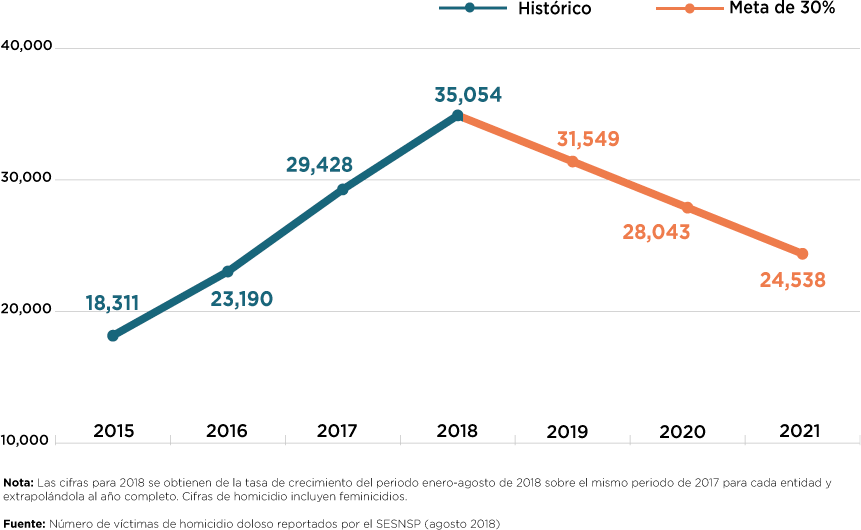
    Both specialists investigate what success would mean. They point out that 2018 is already well on its way to establishing a new record for homicides – they were up by 19.3% in the first seven months, suggesting that for the year as a whole they will total another all-time record of 35,054. If that is the base year, meeting the three-year, 30% reduction target will require a 10% reduction in 2019, an 11% fall in 2020, and a 12.5% fall in 2021. That looks like a major stretch; if it is achieved, and taking into account population growth, it means the homicide rate will come down to 19.2 per 100,000 inhabitants by 2021, still almost five times the OECD rate.

    What a 3-year 30% homicide reduction target might look like

    Homicide reduction

    They also note that the numbers approach may gloss over the need for very specific policy decisions. Should the government prioritise the most violent states and municipalities, or should it target those where violence is rising, but not yet at critical level? They suggest that homicide reduction needs four elements: policing, a better criminal justice system, crime prevention, and the reinsertion of offenders into society. Here too there are policy decisions on the balance of those four elements and the distribution of spending between them. Within policing alone there is also a balance to be achieved between reactive and pro-active anti-crime efforts. The México Evalúa analysts welcome the new government’s decision to prioritise the issue of security but warn that any ambitious objective requires tackling complex issues; urgency and improvisation in these matters, they say, are “bad advisers”.

  • Business pledges to push up investment

    LatinNews 21 June 2019 Hits: 800

    The Consejo Coordinador Empresarial (CCE), one of Mexico’s main private-sector lobby groups, has signalled a more collaborative approach to the López Obrador government with a promise to boost investment levels.

    Relations between López Obrador and business lobbies such as CCE have at times been hostile. But on 13 June, CCE head Carlos Salazar said his organisation had struck an agreement with the president. CCE companies were committing to raising their investment levels in the next two years from 17.5% to 20.0% of GDP. In return López Obrador had signed an investment pact. Salazar said the president would “personally be clearing the way for projects, helping them to be viable…the president repeatedly spoke about offering us guarantees of confidence and certainty”.

    How major public and private projects are managed has been a bone of contention between business groups and the new president. López Obrador has frequently accused business leaders of taking part in rigged tenders and corrupt practices under the previous government. Business in turn has reacted angrily to López Obrador’s decision to cancel the US$13bn Mexico City airport project and to bypass competitive tenders for other projects, such as the proposed new Dos Bocas refinery in Tampico. However, it seems these differences are, for the moment, being put to one side. A group of 60 companies in the Consejo Mexicano de Negocios (CMN) said it would invest around US$31bn in new projects in 2019 and 2020. CMN president Antonio del Valle Perochena made a point of saying that investors continue to require the rule of law, predictability, and certainty to be successful. “Mexico is an attractive country for investment, there are hundreds of projects, on the door but for this to materialise we need to create an enabling environment for it, a commitment of state and an effective mechanism to implement the projects,” he said.

    Mixed signals in oil and gas

    From the perspective of international oil companies (IOCs) there has been a mix of good and bad news over the last month. The bad news came on 14 June when oil and gas regulator Comisión Nacional de Hidrocarburos (CNH) announced the cancellation of an auction round due on 9 October to pick joint venture partners for Pemex, the state-owned oil company, in seven offshore areas facing the states of Veracruz, Tabasco and Chiapas. These “farmouts”, originally planned as part of the previous government’s wide-ranging energy reforms, were supposed to bring international capital and know-how to bear to help Pemex reverse nearly 15 years of dwindling output. Their cancellation, coming after two earlier postponements, reflects the new government’s lack of enthusiasm for energy sector liberalisation and its belief that, with sufficient official support, Pemex should be able to overcome its heavy debt burden and boost production under its own steam. Since taking office last December, the López Obrador government has now cancelled all the licensing and farm-out rounds that had been due as a result of the 2013-2014 energy reforms. Some analysts noted however that Pemex might still choose to bring in foreign expertise through service contracts, rather than through the farm-outs mechanism.

    More positive news for the industry was the announcement by CNH that Shell, the Anglo-Dutch oil major, is set to invest up to US$1.4bn in nine deep-water areas in the Perdido Fold and Salina basins in the Gulf of Mexico. These investments come as a result of earlier licensing rounds under terms of the previous administration’s energy reforms. Shell won the exploration and production rights to these areas in early 2018. In separate announcements in the same week. the CNH gave a green light first to exploration plans for five areas worth up to US$1.32bn, and then to the plans for an additional four areas worth up to US$1.06bn. According to CNH member Sergio Pimentel, the blocks will not begin producing oil and gas until 2026 at the earliest.

  • ECONOMIC HIGHLIGHTS

    LatinNews 15 July 2020 Hits: 2139

    COLOMBIA | Interest rates. On 30 June, Colombia’s central bank (Banrep) reduced its benchmark interest rate by 25 basis points, from 2.75% to 2.5%, as part of its efforts to mitigate the impact of the coronavirus (Covid-19) pandemic. This is the fourth consecutive month in which interest rates have been cut, down from 4.25% in March, and the downward trend is unlikely to stop here, with two members of Banrep’s seven-person board reportedly having voted for interest rates to be cut by 50 basis points rather than 25. Banrep manager, Juan José Echavarría, warned that “the uncertainty is enormous”, recognising that “at some point we will have to stop […] but that will be determined by the economy”.

    VENEZUELA | Going for gold. On 2 July, the United Kingdom’s High Court of Justice ruled that Venezuela’s opposition leader, Juan Guaidó, should be recognised as the country’s interim president, on the basis that the British government has declared him as such, regardless of the functional continuation of diplomatic relations with Venezuela’s de facto government led by Nicolás Maduro. This ruling gives Guaidó a significant upper hand in the ongoing case to determine ownership of some US$1bn of Venezuelan central bank (BCV) gold held by the Bank of England. The broader case is expected to last several months, but this early decision could prove significant, and the Maduro government has already launched an appeal.

    BOLIVIA | Economy minister. On 7 July, Bolivia’s economy minister José Luis Parada resigned, citing “personal issues”. Interim president Jeanine Áñez named Óscar Ortiz as his successor – Ortiz had previously served as the minister of productive development, with José Abel Martínez now replacing him in this role. Growing criticisms of the interim government’s economic strategy likely played a part in Parada’s departure – in a poll published yesterday by the Centro Estratégico Latinoamericano de Geopolítica (Celag), 65.2% of respondents voiced disapproval of the administration’s economic management.

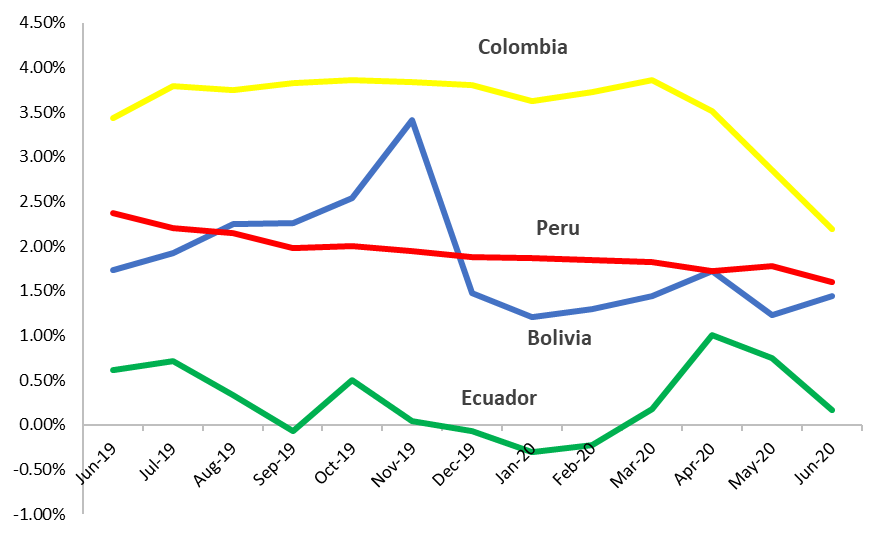
    Andean Countries: Inflation
    Monthly year-on-year figures

    Andean Countries: GDP growth (%)
    Quarterly figures are year-on-year growth
    GDP  End 2019 2020 forecast* Q2 2019 Q3 2019 Q4 2019 Q1 2020
    Bolivia 2.2 -3.0 2.6 2.2 1.1 Not yet available
    Colombia 3.3 -2.6 3.3 3.5 3.4 1.1
    Ecuador 0.1 -6.5 0.5 -0.3 -1.0 -2.4
    Peru 2.2 -4.0 1.2 3.2 1.8 -3.4
    Venezuela -25.5 -18.0 No data No data No data No data
    *Figures from the United Nations Economic Commission for Latin America & Caribbean Apr 2020
    End 2019 and quarterly growth based on figures from the local central banks


  • MEXICO: Audit report shows widespread irregularities in public accounts

    LatinNews 16 March 2021 Hits: 2036

    On 20 February Mexico’s federal audit office (ASF), which is attached to the federal chamber of deputies, published its analysis of public expenses carried out during 2019. It indicates numerous irregularities in most of the government’s priority programmes, which have yet to be clarified by the ministries and government agencies responsible for them. No charges for misuse of funds or embezzlement will be filed until the relevant entities responsible for each programme have addressed the ASF’s queries.

    Among more general irregularities, local online publication Animal Político highlighted over M$1.5bn (US$72.3m) found in accounts of priority government infrastructure and social development initiatives during the first year of the administration led by President Andrés Manuel López Obrador. More generally the auditors found that some programmes are at high risk of not being viable, are opaque regarding contracts, have serious design shortcomings, or started construction before having all the necessary social and environmental impact assessments and permits.

    Regarding the Tren Maya railway project, for instance, the ASF found that the ambitious project has a high risk of not being profitable, that consultations with the local indigenous population were not carried out properly, and that the awarding of contracts for construction works was lacking in transparency. It also highlighted M$156m that needed to be accounted for.

    Similarly, construction on the Dos Bocas refinery, which is a key element of the government’s energy policy, was found to have started before having all the necessary environmental permits, which is why the plot where it is being built is susceptible to flooding and erosion. The environmental impact study was also done after construction work started. In addition, the study lacks mitigation measures to offset any adverse effects on the environment. The ASF also ascertained that there is a significant risk that the works will not be finalised in 2022 as planned, which could undermine its profitability in the medium term.  Irregularities regarding expenses amounted to M$75m.

    Regarding the construction of the Santa Lucía airport, which is to be renamed the Felipe Angeles airport, the ASF concluded that the defence ministry (Sedena), failed to carry out sufficient estimates to determine its viability. The technical feasibility study was only carried out seven months after the works commenced. Importantly, the Sedena did not deliver all the information the ASF requested, arguing that it was a matter of “national security”.

    President López Obrador’s social initiatives did not fare any better. The ASF recorded irregularities in the Jóvenes Construyendo el Futuro youth employment programme that add up to more than M$126m. These include placement centres that were inexistent companies or firms registered without their knowledge. Similarly, some registered beneficiaries were found to be already receiving support to study (which is not allowed) or to be deceased.

    The Becas para el Bienestar Benito Juárez scheme, which is designed to reduce drop-out levels among vulnerable sectors of the population of all ages through four different schemes covering basic education, upper secondary education, and higher education, was found to have irregularities of some M$263.7m. It also included deceased persons as beneficiaries, duplicated benefits, missing paperwork, and unclaimed benefits missing from the accounts. Regarding the Sembrando Vida (‘sowing life’) reforestation plan, which provides support for smallholders of land to improve its productivity, the ASF found over M$1.83bn that needed to be clarified, as well as unclear accounts and payments to unregistered beneficiaries. There are also problems with monitoring and coordination among different entities to avoid overlaps of similar programmes.

    Naim
    As part of its analysis, the ASF also audited the cancellation of the new Mexico City international airport (Naim) in Texcoco, Estado de México, which was already under construction. The ASF determined that the decision cost M$331.96bn, three times what the government had promised.

    Two days after the ASF’s analysis was released, President López Obrador refuted its conclusions regarding the cost of the NAIM’s cancellation, arguing that it was excessive and that it was a politically motivated claim. The ASF backed down and said that there had been some methodological errors in the estimates, and the correct amount was lower, which cast doubts about its independence and about the credibility of the whole exercise.

  • HAITI: Judge named to head up Moïse murder case

    Patrick de Courcy 12 August 2021 Hits: 2025

    Mathieu Chanlatte has been named as the judge in charge of the multinational investigation into the 7 July assassination of President Jovenel Moïse (2017-2021) which, over a month on, has yielded little progress. The appointment of Chanlatte to oversee the case, which will provide a big test for Haiti’s judiciary and expose it to significant scrutiny, has met with scepticism from some.

    Two days before Chanlatte’s appointment was announced on 9 August, the dean of Port-au-Prince’s court of first instance, Bernard Saint-Vil, revealed some of the challenges posed in filling the post, telling reporters that he was finding it difficult to appoint a judge who would agree to investigate the “explosive” case. Two justices of the peace involved in the investigation, Carl Henri Destin and Clement Noël, have reported death threats and gone into hiding, while on 12 July, Haiti’s national clerk association (ANAGH) revealed that two court clerks involved in the case, Marcelin Valentin and Waky Philostène, had received serious death threats and requests to tamper with their report.

    More generally a statement by Haiti’s human rights ombudsman’s office (OPC) published in the local press on 1 August underlined the challenges involved in bringing the perpetrators to justice. It warned that “the judicial system is held hostage by certain sectors and weakened by a disciplinary body…that protects dishonest and corrupt judges but persecutes…those who are honest”. It said that in the past two decades there had not been a criminal trial in significant murder cases, while 32 high-profile killings dating back to 1991 – including those of lawyers, academics, journalists, and former government officials – have yet to be resolved.

    Meanwhile, Chanlatte’s appointment has raised eyebrows. In an article published by national daily Le Nouvelliste on 9 August, Pierre Espérance, the director of leading NGO Réseau National de Défense des Droits Humains (RNDDH), said that Chanlatte is “among the slowest of judges in the justice system who fails to complete his investigations” and it was “shocking” that he had been entrusted with the case. The same article notes that Chanlatte was put in charge of (and failed to act on) key political cases including one which made headlines in 2018 implicating First Lady Martine Moïse and the director general of the national identification office (ONI), Jude Jacques Élibert, among others. The case related to alleged corruption involving a contract with German firm Dermalog for the manufacture of new biometric identity cards.

    El Tiempo report

    On 11 August Colombian daily El Tiempo published a report claiming to have obtained access to the conclusions of a preliminary report by Haiti’s police (PNd’H) into President Moïse’s assassination. According to El Tiempo, those involved, including the 18 Colombian mercenaries, knew their objective was to kill the president for which they would receive US$18m as payment. The report also names Joseph Félix Badio, who was dismissed from a post at the Haitian government’s anti-corruption unit (ULCC) in May and is currently at large, as the man in charge of operations on the night, including delivery of weapons, bulletproof vests, and vehicles. The report cited by El Tiempo also alleges that the companies responsible for recruiting the Colombian ex-military were US-based security firm CTU Security and financial services company Worldwide Capital.

    Investigation fails to yield progress

    Judge Chanlatte’s appointment comes as the investigation into Jovenel Moïse’s murder appears to have stalled. On 9 August Marie-Michelle Verrier, the spokesperson for Haiti’s police (PNd’H), said the case had been transferred from the judicial police (CDPJ) to the judiciary and so far 44 individuals had been arrested, including 18 Colombians, four Haitian Americans, and 20 Haitian nationals. Meanwhile, the local authorities’ treatment of the Colombians is proving a strain on bilateral relations. In a letter dated 30 July, Colombia’s foreign minister Marta Lucía Ramírez urged the Haitian government to comply with human rights obligations in relation to the detention of its nationals. The letter cites concerns raised by Colombia’s embassy in Port-au-Prince that the detainees had not “received any kind of legal assistance” and that some were being denied necessary medical care. Ramírez reiterated Colombia’s willingness to cooperate in investigations but urged that due process must be respected at the same time.

  • NICARAGUA: New report highlights extent of NGO closures

    Sarah Sheldon 23 January 2023 Hits: 1472

    In early December, various human rights groups presented a report titled ‘Expediente ONG Nicaragua’ detailing the impact of the actions by the government led by President Daniel Ortega in shutting down NGOs in Nicaragua, in line with its dismantling of democratic institutions and stifling of dissent. Here we review its findings.

    The report was presented in Costa Rica on 6 December by Colectivo de Derechos Humanos Nicaragua Nunca Más (CDHNN+, a human rights group founded by Nicaraguans living in exile in Costa Rica), Fundación del Río (a local environmental NGO), and Fundación Popol Nah (an NGO promoting democracy and citizen participation). Between 2007, when President Ortega took office, and November 2022, the Frente Sandinista de Liberación Nacional (FSLN) government closed down 3,142 organisations out of 7,227 which it declared to be active in 2018, according to Fundación del Río director Amaru Ruiz. Ruiz points out that as a result over 42% of civic space that existed prior to 2018 has been restricted as a result.

    The Ortega government has previously justified the closures of NGOs and similar institutions on the grounds that these failed to comply with their administrative duties and regulations related to money laundering and terrorist financing. This has been made possible through recent legislation such as the much-criticised foreign agents law, approved in October 2020, which requires organisations and individuals that receive money from foreign governments and institutions to register as ‘foreign agents’ with the interior ministry [SSR-20-11].

    According to the ‘Expediente ONG Nicaragua’ report, of the 3,142 organisations shut down, 1,614 were Nicaraguan NGOs (of which 1,578 closed in 2022) while 328 were international NGOs (of which 322 closed last year). The report highlights that in addition to these, 287 religious associations had been shut down (of which 285 closed in 2022) along with 157 women’s organisations (155 closed in 2022), 82 cultural associations (of which 81 were shut in 2022), 60 medical associations (with 47 shut in 2022) and 54 independent media (29 shut down in 2022). Meanwhile eight private universities were closed, of which seven were shut in 2022, along with international universities (all shut in 2022) and six political parties (two closed in 2008, three in 2021 and one in 2022).

    The report also highlights that 41 of the organisations which were shut down had their assets confiscated and offices raided. Lawyer Carlos Guadamuz of CDHNN+ explained that the confiscation of nine (unnamed) NGOs generated nearly US$4m for the Nicaraguan government. The report also highlights that 50,000 people annually are losing access to basic services due to the closures.

    Electoral anomalies

    CDHNN+, Fundación del Río and Fundación Popol Nah also highlight that the government’s suppression of freedom of association is combined with explicit violation of democratic electoral processes. It cites local citizens’ group Urnas Abiertas, which deployed over 1,700 independent observers in the recent 6 November municipal elections, as saying that it identified 5,821 election anomalies. These include coercion in voting, indication of electoral fraud, and presence of voters from different electoral regions at the polls. In the election the FSLN won all 153 of the country’s municipalities, up from the 137 it won in the previous municipal election in 2017.

    Gov’t in contempt of Corte-IDH

    On 29 November, the Inter-American Court of Human Rights (Corte-IDH) declared the Nicaraguan government in contempt of court for ignoring its rulings on political prisoners. The Corte-IDH is an arm of the Organization of American States (OAS), from which the Ortega government announced its withdrawal in November 2021. This followed the OAS’s condemnation of the election that month which produced a re-election victory for Ortega but was widely disregarded as a sham. According to a Corte-IDH statement, the Ortega government has failed to observe rulings issued in 2021 (24 June, 9 September, 4 and 22 November) and 2022 (25 May and 4 October) regarding the fate of 46 detained Nicaraguans. Corte-IDH, which highlights that the Nicaraguan government failed to send representatives to its last session on the issue on 9 November, considers them political prisoners. Human rights groups tally at least 219 political prisoners in Nicaragua.

  • BRAZIL: Far-right galvanised on Independence Day

    Abbi Dicker 12 September 2024 Hits: 1892

    Thousands of supporters and allies of far-right former president Jair Bolsonaro (2019-2023) joined him on Brazil’s Independence Day (7 September) for a demonstration on the Avenida Paulista, one of the main roads of São Paulo. Among the rallying cries of the Bolsonarista crowd was impeachment of supreme court (STF) justice Alexandre de Moraes, who ordered the suspension of social media platform X (formerly Twitter) the previous week. At the rally Bolsonaro also backed calls to grant amnesty to the radical right-wing rioters convicted for participating in the attack on the seats of government in Brasília on 8 January 2023. 

    While President Luiz Inácio Lula da Silva attended the government’s official Independence Day parade in Brasília and appeared alongside STF justices, including De Moraes, Bolsonaro’s event in São Paulo was attended by prominent figures of the Brazilian right. The conservative governor of São Paulo state, Tarcísio de Freitas, and the centre-right mayor of São Paulo city, Ricardo Nunes, stood next to Bolsonaro on a float (‘trio elétrico’) on Paulista.

    Bolsonaro did not directly call for De Moraes to be impeached, but he did describe the judge as a “dictator” who has “done more harm to Brazil than [Lula]”. The tone of Bolsonaro’s speech on 7 September was bolder than the speech he made during the last major far-right rally on Paulista in February. Earlier this year, Bolsonaro came under increased legal pressure, as police seized his passport in relation to an investigation into an alleged conspiracy to launch a military coup and reverse Bolsonaro’s 2022 election defeat. But since February, the former president has become more willing to criticise De Moraes.

    The far-right ‘Bolsonarismo’ movement has been galvanised amid the controversial social media ban ordered by De Moraes, but also due to the progress of legislation in the national congress which could take legal pressure off Bolsonaro and his supporters who stormed the capital on 8 January last year. In the coming months, the senate is due to review a bill proposing changes to the ‘Lei da Ficha Limpa’ (clean record law). The law was promulgated in 2010 and set a punishment of an eight-year ban from running for office for individuals found guilty of a criminal offence or certain non-criminal infractions, including electoral offences.

    Last year the superior electoral court (TSE) banned Bolsonaro from running in elections for eight years. The court found him guilty of abusing his platform as president in 2022 to spread unfounded claims about the electoral process. However, if legislators from Bolsonaro’s right-wing Partido Liberal (PL) are successful in their efforts to amend the Lei da Ficha Limpa, they might pave the way for Bolsonaro to make a political comeback in 2026. The bill to update the law was expected to be reviewed in early September, but the senate decided to postpone the vote until after the October municipal elections.

    Another major right-wing proposal in congress is a bill seeking to pardon convicted 8 January rioters. On 11 September the constitution and justice committee (CCJ) of the lower chamber of congress was due to vote on the bill, but the vote is now expected to take place in October. PL deputy Caroline de Toni, who chairs the CCJ, expressed regret that support for this amnesty bill was being used as a bargaining chip in the negotiations between political parties to rally support for candidates running for the presidency of the lower chamber of congress next February. The leading candidates are from centrist and conservative parties, which are weighing up whether to push for far-right support by backing the bill or appease the left-of-centre governing coalition by voting against it.

    São Paulo knife-edge vote

    Two of the leading candidates in the São Paulo mayoral election next month, Ricardo Nunes and Pablo Marçal, attended the Bolsonarista rally on Avenida Paulista on 7 September. Former president Bolsonaro is endorsing the re-election bid of Nunes, but Marçal is polling well among far-right voters, thus splitting the right-wing vote. According to the latest figures released by national pollster Datafolha, Nunes, Marçal, and the left-wing frontrunner Guilherme Boulos, are all within a few percentage points of one another.

  • URUGUAY: Outcome of crucial referendum in the balance

    Abbi Dicker 03 October 2024 Hits: 1756

    The result of the presidential and congressional elections this month could prove to be less significant, and have less bearing on Uruguay’s future, than the outcome of a concurrent referendum.

    Uruguay’s electoral campaign is heating up ahead of the first round of presidential elections and congressional elections on 27 October. The first round is unlikely to be decisive, requiring a second round on 24 November. Yamandú Orsi, the presidential candidate for the opposition left-wing Frente Amplio (FA) coalition, is in pole position heading into the first round.

    Although pollsters suggest Orsi will win most votes, he is not expected to clear the 50% threshold to avoid a run-off. At this stage the right-leaning parties within the ruling coalition fielding their own candidates in the first round will rally behind the candidate that makes it through to the run-off. This looks set to be Álvaro Delgado, the presidential candidate for the centre-right Partido Nacional (PN, Blancos), the party of President Luis Alberto Lacalle Pou. As in recent years, the congressional elections are likely to be very tight, with a wafer-thin majority being the most the eventual victor could hope to achieve.

    Given how closely contested the elections are likely to be it might be expected that the ballot count will attract the full attention of onlookers. Instead, for many, the vote tally in one of two referendums being staged on the same day is likely to attract as much if not more attention, certainly abroad. One of these referendums would allow police to execute search warrants in homes at night. Proposed by the Lacalle Pou administration, it would mark a significant change, if approved, given that they are currently outlawed in the constitution even with a court-ordered warrant. But it is the second referendum, which could produce the more seismic change. This was proposed by the umbrella trade union Plenario Intersindical de Trabajadores-Convención Nacional de Trabajadores (PIT-CNT) and, if approved, it would have a major impact on the country’s finances.

    The referendum sponsored by the PIT-CNT would entail a big pension reform, necessitating a significant increase in government spending. It proposes eliminating private pension funds and undoing legislation pushed through congress last year that would steadily increase the retirement age from 60 to 65. The US$24bn administered by private pension funds has provided a source of financing as well as financial stability for the Uruguayan peso, helping to contain inflation.

    It is no surprise that the government and the five-party ruling coalition is fiercely opposed to the proposal, which Delgado claimed would be sure to send country risk “through the roof the next day”. More of a surprise is that many within the FA, which is traditionally allied to the PIT-CNT, are also very uneasy about the proposal. Orsi has distanced himself from it, alarmed by the associated economic costs. Former (FA) president José Mujica (2010-2015), who has been convalescing after an operation to treat oesophageal cancer, condemned the proposal in an interview with the weekly magazine Búsqueda last week, saying it would cause “chaos”. He said it was not right to enshrine any social security reform in the constitution as labour arrangements changed with time.

    Delgado hammered Orsi and Gabriel Oddone, his recent pick for economy & finance minister, for downplaying the importance of the referendum. Delgado said that neither Orsi nor Oddone were being “firm enough about the collapse that this referendum would produce”. Delgado said there would be no money to reduce poverty or improve education if it were approved, and he decried the FA’s ambivalence as “dangerous and irresponsible”.

    Oddone has in fact gone on record as describing the constitutional reform initiative as “inexpedient, unnecessary, and unjust”, but he also said the FA would not dictate to supporters how to vote. This is in no small part because there are divisions within the FA: two parties within the coalition, the Partido Comunista de Uruguay (PCU) and Partido Socialista (PS), support the proposed reform. Oddone said it was irresponsible of the ruling coalition to condemn it so emphatically, saying that if he were an investor or fund manager hearing the economic team talking about “serious risk” he would advise clients to pull out. Oddone said it was necessary to point out the risks to the public but in a sufficiently measured way to show that if it were approved it would still be possible to govern. He said the scaremongering had contributed to some capital flight and a slump in the peso.

    Oddone said the reform would be “a self-inflicted mistake but not the end of the world”. He said the FA was working on a ‘Plan B’ as its spending proposals would not be “viable” if the referendum was approved. The FA has proposed boosting social welfare programmes, especially for the 300,000 people in the informal sector, increasing the minimum wage, with inflation-adjusted salaries, and combating child poverty.

    Social welfare plans

    In an interview with the national daily El País on 25 September, Gabriel Oddone ducked the question of precisely how an FA government would fund the pension reform if it were approved and what it would mean for its other social welfare plans. He did stress the importance, however, of preserving macroeconomic stability and prioritising fiscal stability to avoid “ending up like Argentina with lots of praiseworthy objectives”.

  • In Brief - Cuba & Honduras

    LatinNews 27 March 2012 Hits: 1157

    Cuba | Pope calls for renewal.  In Santiago de Cuba on 26 March, Pope Benedict XVI called on Cubans to reinvigorate their faith so that they may “strive to build a renewed and open society, a better society, one more worthy of humanity”. He also rejected the excesses of capitalism. Upon arrival at the airport in the same city, the Pope stated that he carried in his heart “the just and legitimate desires of all Cubans, wherever they are, their sufferings and joys, their worries and most noble desires and in particular of young people and children, of ill people and workers, of prisoners and their families, as well as the poor and needy”. The Pope will not meet Cuban political dissidents on his two-day visit.

    Honduras | Former coup general registers for 2013. On 26 March the national electoral council formally registered the Partido Alianza Patriótica (PAP) as a new political party. The PAP, set up by retired military officials, will field the former head of the army, General (rtd.)  Romeo Vásquez Velásquez, as its presidential candidate in the next scheduled November 2013 general election. Vásquez was at the helm of the military when it followed supreme court orders to remove the former president Manuel Zelaya (2006-2009) from office in June 2009. Upon his retirement in 2010, Vásquez was appointed (and remains) head of the national telecoms company, Hondutel. He had announced his political ambitions in mid 2011.

  • ARGENTINA: Peronists face off

    LatinNews 03 May 2012 Hits: 2604

    They all belong to the same party and they even used to back the same faction within the party - the ruling Frente para la Victoria (FPV) led by President Cristina Fernández and her late husband and predecessor, Néstor Kirchner (2003-2007). However, for the first time since 2003 the Peronists were divided when it came to holding rallies to commemorate International Workers’ Day on 1 May. In one corner stood Hugo Moyano, the secretary general of the general confederation of labour (CGT) who has fallen out with the president and fears that the Casa Rosada will force him out of the top union seat in the 12 July CGT general election; in the other stood the youth and social movements that fervently back President Fernández, which wanted to use the event to demonstrate that they have enough power to ‘dominate the streets’, as they put it.

    Both rallies (Moyano’s on 26 April and Fernández’s on 27 April) attracted thousands of militants, but the latter was much larger than the former, giving ‘the kids’ of La Cámpora, the youth movement founded and effectively led by the President’s son, Máximo Kirchner, hope that they could challenge the old Buenos Aires Peronist barons and come out on top. 

    In addition to La Cámpora, the rally was organised by the Corriente de Liberación Nacional (Kolina), which answers to the president’s sister-in-law and social development minister, Alicia Kirchner, as well as numerous other small parties.

    Several of the organisers are directly linked to the Partido Justicialista (PJ, Peronists) and, more importantly, to the Kirchner couple; however, a not insignificant number are part of what is locally called ‘the transversal movement’. The transversal movement is the generic term coined by Kirchner to describe all parties and social movements that lent him support after winning the 2003 election with the lowest percentage of the vote in Argentina’s history. Their backing was crucial to securing governability back then; it would also be key in the near future if President Fernández were to confront the traditional Peronist structure.

    Fernández purposely played to her audience and said that the most important accomplishment of the past nine years was “the incorporation of the youth to politics...it is the best thing we have done because it is sowing [the] future...We are not eternal and we have already proved in a drastic way that life can be snuffed out. Precisely, during adolescence and youth, ideas are formed; and you are the true guardians of this project. You are lucky to live in a full-fledged democracy and I know you will defend it tooth and nail”.

    In addition to the CGT, however, the rally in Buenos Aires was intended to challenge the old Peronist structure in general, but the president is not ready to do away with the party quite yet. In fact, she appears to be preparing its formal takeover. Reportedly, Fernández has called a meeting of the PJ’s council for Friday (4 May) in the province of Chaco; although she doesn’t have an official role in the party’s leadership, she is its de facto head.

    The current term of the PJ’s leadership, which is officially presided over by Buenos Aires Governor Daniel Scioli, is due to expire on 14 June but Fernández wants the internal election to be pushed back to early 2013. The idea is that she would take over formally ahead of the mid-term elections, both to give the outfit a boost and to control the preparation of the lists of candidates.

    • An unlikely re-election opponent

    This week Hebe de Bonafini, the leader of the Madres de Plaza de Mayo, came out against a possible second re-election of President Cristina Fernández. She said: “I don’t think Cristina should go on, although I do want to see a continuation of this national and popular project. But I don’t think she should go on [being president]...I adore Cristina, I love her madly, I am almost her friend, but this is my opinion”. The Madres celebrated the 35 anniversary of their foundation on Monday 30 April.

  • TRACKING TRENDS

    LatinNews 30 August 2012 Hits: 2174

    COLOMBIA | Energy connection plans with Panama indefinitely suspended.  The Colombia-Panama electricity interconnection society (ICP) has announced that it has indefinitely suspended the tender process open to energy generating firms interested in participating in the proposed bilateral energy integration process due to the fact that certain conditions necessary for the project’s viability have not been met. The US$500m interconnection project is promoted by the governments of Colombia and Panama which created the ICP, comprised of Colombia’s public-private Interconexión S.A. (ISA) and Panama’s state-owned electricity transmission company, Etesa.

        The project is the first step in the more ambitious plan of integrating Colombia’s energy grid to the whole of Central America, which the authorities believe will translate into better energy provision and lower prices for all the parties involved. However, the project appears to have run into some snags and this is the second time that the ICP has had to postpone the tender process which was originally scheduled to take place on 16 August.

        The ICP has not specified what some of the problems are that it has encountered, and in a public statement limited itself to saying that “despite the efforts of all the actors involved, it has not been possible to get some of the conditions… related to the financial, technical and socio-environmental aspects” of the project. Nevertheless, the statement adds that the ICP will “continue seeking to guarantee that all of the project’s viability conditions are met and to reduce the uncertainties for participants”. With the suspension of the tender process it is expected that Etesa will now also cancel a parallel tender process to find long-term energy providers which was also scheduled to take place this month.     

    PERU | Country risk rating falls. According to Peru’s central bank (BCRP), Peru’s country risk rating has fallen from 216 basis points in August 2011, to 134 basis points in August 2012. The country risk, which measures the difference in interest rates offered by US Treasury bonds and Peru’s sovereign bonds, is a measure of investor confidence in a country’s national finances, as it reflects the level of belief that investors have in that country being able to repay the money they are loaning it. Moreover the country risk also sets the interest rate minimum at which companies and individuals are able to borrow money from the local and international markets. Thus the fact that Peru’s risk rating is now lower also creates a better environment for domestic investment in the country.

        In a statement the BCRP said that the reduction in Peru’s borrowing “reflects the fact that despite the international turmoil, there are lower perceptions of risk in our economy, which continues to exhibit solid macroeconomic fundamentals, growth close to its potential, low inflation, a stable financial system, a good level of foreign reserves and a solid fiscal position”. Peru’s country risk rating is now well below the overall region which fell by 83 basis points since December last year and now stands at 372 (21 August).

    VENEZUELA| Chávez’s forecasts. Venezuela’s President Hugo Chávez has forecast that the domestic economy will grow by 6% in the second half of the year and that it should maintain a growth rate of no less than 7% in the next couple of years. Official figures showed that the Venezuelan economy grew by 5.6% in the first half of the year, compared with the same period last year driven by an important expansion in the construction sector; and Chávez said that in his opinion the economy “will behave the same in the second half”. “We are going to end up close to 6%,” he said. Chávez pointed out that the growth so far was higher than the 5% forecast in this year’s budget, but pointed out that “we can grow at a rate of no less than 7% a year in the next six years, because that is the way to become an economic power”. Chávez said his government would continue with its plans to promote the agricultural, agro-industrial and industrial sectors and “national production in all possible areas” to achieve this. Chávez, who is on the campaign trail seeking a third re-election in October, recently called on Venezuelan businessmen to work with his government to “continue lifting the national economy”.

    • Pacific Alliance

    On 28 August Colombia’s foreign ministry announced that minister, María Angela Holguín, will attend a meeting of foreign relations and tourism ministers of the four Pacific Alliance countries (Colombia, Chile, Mexico and Peru), to be held in Mexico City on 29 August, to sign a tourism cooperation agreement between the four bloc members. According to  the Colombian ministry, the agreement was the result of the bloc’s VII high-level meeting last week in Puerto Varas, Chile, where there were “advancements in the areas of trade and integration, services and investments, immigration and cooperation, as well as other institutional matters”.


  • POINTERS

    LatinNews 03 September 2013 Hits: 3247

    BRAZIL | Rio police chief replaced. When the chief of Rio de Janeiro state’s military police, Colonel Eric Ribeiro da Costa Filho, announced that he was granting an amnesty to 450 officers in his force who had been found guilty of  rule infractions ‘of lesser offensive potential’ since 2011, there was uproar in a city still shaken, not only by the excesses committed by the military police in the repression of demonstrations during June but also by the widely reported ‘Amarildo case’ — the disappearance of Amarildo de Souza, a bricklayer from the Rocinha favela who was last seen being taken away from his home on 14 July by officers of the local police pacification unit (UPP).

    On 5 August Ribeiro was dismissed from his post. to be replaced the following day by a 20-year veteran, Colonel José Menezes, who promptly announced that he was rescinding the amnesty.

    Days later a well respected observer of the local security scene, Robert Muggah — research director of the Rio-Based Instituto Igarapé and principal of SecDev, a consultancy focused on countries and regions at risk from violence and insecurity — came out with a defence of Rio’s UPP experiment, launched in 2008, which had been the target of much criticism in recent weeks.

    Among his observations was the fact that Rio’s homicide rate had fallen from 42 per 100,000 in 2005 to 26 at present; that opinion surveys show that the UPPs are welcomed in the communities where they have been established, and that more than 8,000 UPP police, out of a force of 10,000, have been trained in human rights and community policing. He wrote, ‘A common complaint now heard in some areas is “when will the UPP be installed in my community?”.’

    One important caveat: ‘Although initially anticipated in the erstwhile UPP Social initiative, tangible investments in social and economic services have yet to materialise. The UPP project is therefore at the risk of becoming a form of prolonged occupation. There is also a danger that it ends prematurely owing to a lack of institutional continuity.’

    BRAZIL | Securing telecom & internet systems. Communications minister Paulo Bernardo told a congressional committee on 14 August that the Brazilian government was taking steps to safeguard its communications systems from spying by acquiring its own satellite and digital networks. He made it clear that this was a response to what he described as the ‘strong concentration’ of  online traffic in the hands of US firms, and the vulnerability revealed by the documents leaked by Edward Snowden and published locally by O Globo (SSR-13-07).

    Bernardo said the government had already set in motion the process of selecting companies to be charged with setting up a geostationary defence and strategic communications satellite.

    PARAGUAY | Shakeup in Concepción police. On 27 August interior minister Francisco de Vargas announced that all national police comisarios (station chiefs) and police NCOs in the northeastern department of  Concepción, one of the stomping grounds of the EPP guerrillas, were being replaced and posted elsewhere. He said this decision had become ‘a matter of urgency’ after the seizure of 1.8 tonnes of cocaine in the area on 23 August had revealed the involvement of police officers in local drug trafficking.

    De Vargas said that there had been an early intention to reshuffle the upper echelons of the police throughout the country, and that this would proceed gradually. ‘There have been other changes already,’ he told the media. ‘There are many command positions across the country that are calling for attention.’

  • POLITICS: Municipals: a big test

    LatinNews 21 November 2013 Hits: 1578

    The ruling Partido Unido Socialista de Venezuela (PSUV) swept the 16 December 2012 regional elections, winning 20 of the 23 states, up from 17 in 2008, and consolidating its almost total grip on power in Venezuela less than two months after the late president Hugo Chávez (1999-2013) was re-elected with a thumping 11 percentage point margin for a fourth consecutive term. He died just three months later, on 5 March 2013, and his handpicked successor Nicolás Maduro was barely elected to replace him in April in an election still being contested before international instances by the Venezuelan opposition, which alleged fraud. This year’s municipals, on 8 December next, represent a big test for the Bolivarian Revolution.

    The PSUV also swept the last municipal elections (23 November 2008, held consecutively with state elections), winning 267 (81%) of the 335 municipal governments. This was an improvement on 2004, when parties supporting Chávez won 226 municipalities. In all five states won by opposition candidates, the PSUV won control of the majority of the municipalities. The PSUV also won the most important of the five municipalities in the metropolitan district of Caracas - Libertador, the capital city proper - as well as 18 state capitals.

    However the opposition won the mayoralty of Greater Caracas with Antonio Ledezma. In addition, it also won four of the five municipalities in Caracas: previously it controlled only the three wealthiest - Chacao, Baruta, and El Hatillo. In a very symbolic blow to Chávez, it added Sucre. Sucre was a Chavista stronghold: it includes the Petare slum, home to nearly one-third of the capital's residents. Here, Jesse Chacón, a close associate of Chávez, was turfed out of office by a young opposition leader, Carlos Ocariz, who capitalised on Chacón's unpopularity and by promising to reduce violent crime.

    Sucre apart, the opposition suffered a reverse in the 2008 municipal elections. It only managed to win 57 municipalities, down from 85 in 2004: Acción Democrática won the most, 19, with Copei taking nine. As expected, Manuel Rosales, who Chávez threatened to have thrown in jail during the electoral campaign, won in Maracaibo, the state capital of Zulia and second most populous city in Venezuela.

    Dissident Chavista parties were annihilated in 2008. They lost the three states they held and failed to make an impression in a six further states they contested. Podemos, which in 2004 had won 52 municipalities and two states - Aragua and Sucre, was left with just two municipalities. Patria para Todos fared little better, winning four municipalities.

    In true form, Chávez later undercut the opposition’s gains. First (on 30 April 2009), the national assembly passed a Capital District Law transferring most functions, funding and personnel from the metropolitan mayor of Caracas to a new ‘Capital District’, headed by Jaqueline Faría, a loyalist handpicked by Chávez. Ledezma was helpless to contest the decision, which was given legal sanction by the Chavista-dominant judiciary. Chávez supporters described the move as an act of justice for Libertador. Manuel Rosales was also run out of town after he was charged with corruption (also in April 2009). He fled to Peru, where he was granted political asylum and was replaced in his post by his wife, Eveling Trejo de Rosales.

    The map in Venezuela is thus almost totally red, but that conceals some real differences at the local level, both between the ruling PSUV and its allies and also within the party itself. These differences threatened to rear their ugly heads ahead of the December 2012 state elections. Again, the ailing Chávez intervened, directly replacing some weaker official candidates with nominees handpicked by himself and the PSUV leadership, often imposing these over the heads of local party bases. They included former cabinet ministers and several military associates of the president. They all won – testament to the top down power of the PSUV, which successfully demanded nothing less than 100% unity in the face of the recurrence of Chávez’s cancer and his return to Cuba for further treatment on 10 December – just days before the regional polls.

    • Turnout

    The turnout in the December 2012 regional elections was just 54%, compared with 81% in the October presidential elections. The opposition MUD won 44% of the national vote, to 56% for the PSUV, almost identical to its performance in October. In absolute terms, it won 3.83m votes nationwide, compared with 4.85m for the PSUV, a difference of about 1m; in October Capriles took 6.5m votes to 8.1m for Chávez. In the regional elections in 2008, the MUD won fractionally more votes (3.93m); the PSUV 600,000 fewer. In the April 2013 presidential election, turnout was 79% of 18.8m registered voters. Maduro got about 7.5m votes and Capriles 7.3m; Maduro’s winning margin was roughly 234,000 votes.

  • Region: Why the MILA needs a political boost

    LatinNews 12 January 2017 Hits: 1044

    Not all good ideas take off immediately. One idea – the creation of a single integrated capital market across the four Pacific Alliance countries (Chile, Peru, Colombia and Mexico), and known as the Mercado Integrado Latino Americano (MILA), ticks a lot of important boxes. It may be exactly what is needed as the region tries to get the best out of its limited investment resources at a time of global uncertainty. But it has made a slow start. A new report by the Inter-American Development Bank (IDB) and the US-based Wilson Center says that governments must now get the technical details right and give MILA a political boost.

    Although the benefits of globalisation and free trade are being questioned in many quarters, the Pacific Alliance (PA) and MILA still attract enthusiasm. The case for the PA is strong. Its four founder members are committed to “open regionalism” and seek to achieve the free circulation of goods, services, capital and people. They pursue closer trading relations with Asia and have attracted the interest of other countries in the region (including the Mercosur bloc, formed by Argentina, Brazil, Paraguay and Uruguay). They achieved average annual GDP growth of 2.6% in 2014-2016, a relatively modest number in itself, but more impressive if we consider that it came after the end of the commodities boom, amid global headwinds, and was nevertheless double the rate achieved by the rest of Latin America. The PA countries represent 40% of regional GDP and 55% of the region’s total trade. They have eliminated 98% of intra-regional trade tariffs.

    The more specific case for MILA is also strong. Since the global crisis of 2008-2009, capital inflows into Latin America have slowed down and become more volatile. Global investors are likely to remain nervous and somewhat risk averse. The UK’s Brexit vote (to leave the European Union), the advent of the Donald Trump administration in the US and the prospect of a US Federal Reserve monetary tightening cycle, along with tighter Basel 3 bank regulations and the ‘de-risking’ phenomenon, all point to a tendency to pull funds back into safe havens and away from emerging economies. In this environment, Latin American countries will need to invest as efficiently as possible to improve their productivity and competitiveness. The so-called multilatinas – regionally based international companies – need to raise equity and other capital to compete more effectively. A major priority, through public private partnerships (PPPs) and other mechanisms, is to improve the region’s rather obsolete infrastructure – everything from large transport and logistics projects through to education, telecommunications, and broadband connectivity.

    Pacific Alliance/MILA: Comparative data (2014/15)
      Brazil Chile Colombia Peru Mexico Pacific Alliance (PA) Latin America & Caribbean (LAC) PA as % of LAC
    Stock market capitalisation (US$bn) 843.9 236.6 153.2 121.2 831.8 1342.8 - -
    Value of domesticd debt securities (US$bn) 1977.2 131.6 84.7 25.4 596.8 838.5 - -
    Avge daily traded volume 2937 116 100 15 681 912 - -
    Listed domestic companies 356 230 70 208 139 647 1254 51.60%
    GDP market prices (US$bn) 1774.7 240.2 292.1 192.1 1144.3 1868.7 5148 36.30%
    GDP per capita (US$) 8539 13384 6056 6122 9009 8133 - -
    Population (m) 207.8 17.9 48.2 31.4 127 224.6 633 35.50%
    Inflation rate 9 4.3 5 3.6 2.7 3.4 2.9 -
    Unemployment rate 6.8 6.4 10.1 4.2 4.9 5.8 6.6 -
    Imports, goods & services (US$bn) 254.2 72.8 70.8 45.3 428.7 617.6 1320.9 46.80%
    Credit rating, sovereign risk, foreign currency: S&P BB AA- BBB BBB+ BBB+ - - -
    Number of exchanges 1 3 1 1 1 6 - -
                     
    Source: Wilson Centre/IDB

    The priority, therefore, will be to maximise investment flows – both domestic and extra-regional – and to allocate them as efficiently as possible to the projects and activities that offer the best returns. MILA can claim to be a major step in the right direction to achieve this. Over a few years it has managed to create a partially integrated platform linking the stock exchanges of its four member countries. Through MILA, companies can now list in all four exchanges. Securities approved in one exchange can be traded across all of them, with standardised prospectus information. Brokers in one exchange can gain access to the other three. The Colombian, Chilean and Peruvian exchanges (but not yet Mexico) offer access to a single trading screen. And MILA is not small. By market capitalisation, it is the world’s second largest emerging market stock exchange after China. By annual turnover, it is the fifth largest, after China, South Korea, Brazil and Singapore.

    Yet Guillermo Perry and Diego Auvert, authors of the report, entitled ‘Financial integration in the Pacific Alliance’, point out that MILA hasn’t yet lived up to its promise. To date there have been no MILA-wide initial public offers (IPOs). There has only been secondary trading on the MILA platform, representing less than 1% of the total turnover of the flour bourses. The report warns that “the initial enthusiasm seems to be fading away”. Perry and Auvert list a series of technical- and awareness-building steps that would help get MILA back on track.

    • First, they suggest that the four exchanges should create a ‘VIP’ or ‘signature’ market within MILA, listing corporates with high governance standards, so as to attract the attention of international investors.
    • Secondly, there should be a passport system (rather like the one operating in the European Union) allowing fund managers to create and trade investment products simultaneously across all four exchanges.
    • Thirdly, to reduce transaction costs, brokers and traders should be able to access markets remotely (reducing the costly need for correspondent broker relationships).
    • For the same reason, there should be further harmonisation of issuance, clearing, settlement and operational procedures.
    • Importantly, the report calls for PA pension funds (and at a later date for insurance companies) to be given “local status” within each jurisdiction. The move implies that pensions would become fully “portable” within the PA, which would be consistent with the principle of freedom of movement.
    • Perhaps the most challenging recommendation is that the four countries should harmonise the tax treatment of financial products, including investment portfolios, pensions, and pension funds. Differing tax treatment of MILA investments across the four countries is seen as a major disincentive to use of the platform.

    Perry and Auvert say that ultimately, there should be full harmonisation and the creation of a single stock exchange, which would deliver significant economies of scale in terms of liquidity and opportunities for risk diversification. Achieving that would require political will and agreement “on a broad and ambitious vision for regional financial regulation”.

  • COLOMBIA: Security debate continues to dominate agenda

    LatinNews 29 October 2020 Hits: 3719

    The pressure on Colombia’s defence minister Carlos Holmes Trujillo shows no signs of letting up, as he was this week caught up in another controversy linked to congressional efforts to summon him for a vote of censure. The chances of such a vote passing are very slim, yet Trujillo’s fierce resistance to all efforts to hold him to account have turned this into a protracted struggle, only drawing more attention to the security failings he stands accused of causing [WR-20-39].

    The most recent controversy came on 22 October, when the senate was due to debate the motion of censure, only for Senator Ernesto Macías, of the ruling right-wing Centro Democrático (CD), to propose a vote to call off the debate – accepted by the senate president, Arturo Char (of centre-right Cambio Radical [CR], an ally of CD), and approved by a majority of senators. The vote of censure never stood much chance of passing, but the attempt to prevent Trujillo from even facing scrutiny was condemned as “unconstitutional” by opposition legislators.

    Jorge Robledo, the senator for the left-wing Polo Democrático Alternativo (PDA) that proposed the motion, claimed that “Char broke the law when he put an illegal proposal up for a vote”. Robledo is now leading a group of legislators seeking a judicial ruling to overturn this vote, demanding an opportunity to “show that the minister is unworthy for that position, because he has lied, cheated, and violated the law”. Far from papering over this scandal, the decision to block the debate has only added to the controversy, and ensured Trujillo will remain in the limelight for another few weeks, at least.

    Seeking a distraction

    Perhaps in response to this problem, or to the growing criticisms of government security policy more broadly [WR-20-42], President Iván Duque’s administration turned to a familiar tactic – to announce, with considerable fanfare, the killing or arrest of a high-profile combatant, to demonstrate the effectiveness of Duque’s hard-line security strategy. The subject, on this occasion, was Andrés Vanegas Londoño (‘Uriel’), of the Ejército de Liberación Nacional (ELN), likely chosen not for his military significance to the guerrilla group, but to his high public profile, often speaking through social media and giving interviews to the press.

    Duque travelled to Quibdó (the capital of Chocó, the north-western department in which Uriel was based) to make the announcement, accompanied by Trujillo, as well as the attorney general, Francisco Barbosa, and the military commander-in-chief, General Luis Fernando Navarro – a remarkably high-ranking delegation. Duque described Uriel as “one of the most visible figures of that terrorist organisation…a dangerous criminal, responsible for crimes such as kidnapping, murder of social leaders, harassment of population, murder of soldiers and policemen, and the recruitment of minors”.

    Trujillo added that “we will continue to fight terrorist groups with all the legitimate force of the state, because Colombians have the right to live in peace”. Civil society critics maintained that Trujillo continues to miss the point – they are not opposed to the government’s efforts to tackle illegal armed groups, but rather to the choice of confrontation over conciliation as a strategy for doing so, which many claim only serves to escalate the conflict, putting Colombians at risk. The ELN’s overtures for a ceasefire in order to return to peace talks, abandoned in 2018, have been repeatedly spurned by Duque’s government, which maintains that the group must demobilise entirely before any such dialogue can even begin.

    Peace prospects

    Hopes for a peace agreement with the ELN similar to that reached with the Fuerzas Armadas Revolucionarias de Colombia (Farc) in 2016 faced a significant setback when President Duque came to power in 2018, as he immediately suspended these talks, demanding the ELN’s full demobilisation as a vital precondition. They received a further blow in January 2019, when the ELN responded with a car bomb attack that killed 22 cadets at a police academy in Bogotá. The ELN has repeatedly called for a bilateral ceasefire, most recently on 10 October, but the government has held firm in its demand for prior demobilisation.

  • COLOMBIA: New evidence reignites legal scandal

    LatinNews 19 November 2020 Hits: 1091

    Gustavo Gallardo, the defence lawyer for Seuxis Pausias Hernández (‘Jesús Santrich’) – a former Fuerzas Armadas Revolucionarias de Colombia (Farc) guerrilla leader, who returned to combat in 2019 [WR-19-35] – has condemned the latest attempt to implicate his client in a long-running drug trafficking case as a “crude set-up”.

    Santrich is far from the only high-profile figure embroiled in this scandal, which returned to prominence earlier this month when national newspaper El Espectador published an exposé based on more than 24,000 audio recordings linked to the case. While some of the recordings seem to demonstrate Santrich’s involvement in a plot to smuggle 10 tonnes of cocaine to the US – the crime for which he was facing investigation when he fled Colombia to remobilise, but dismissed by Gallardo as having been faked – more shocking were those which apparently proved the involvement of former attorney general Néstor Humberto Martínez, as well as the US Drug Enforcement Administration (DEA), in an attempt to entrap Santrich.

    The audio recordings reveal a complex web of investigations and operations, with multiple actors and organisations (including Colombia’s attorney general’s office and the DEA, but also Mexican drug trafficking organisations and associates of Santrich) variously working together and impersonating one another. Martínez’s role in the case had long drawn suspicion, and this played a major part in his resignation as attorney general in May 2019 as it became apparent that there was insufficient evidence to prosecute Santrich. Until the recordings are verified and assessed, it will remain unclear whether either Martínez or the DEA were acting illegally in this investigation – but the damage done to Colombia’s peace process is unquestionable.

    Another political figure involved in this scandal is former Partido Liberal (PL) senator Piedad Córdoba, who is also seemingly incriminated in drug trafficking by the recordings. She has similarly claimed that this audio was faked, and she pledged on 17 November to file a criminal complaint against Martínez: “that man should be in jail, and I’m going to report him,” she said.

    The previous week, a group of current senators summoned Martínez’s successor, Francisco Barbosa, to explain the office’s role in this case. Senator Roy Barreras, of the centre-right Partido de la U (PU), claimed that the recordings “prove that the attorney general’s office and the DEA took part in undercover entrapment operations to discredit the peace process”.

    Hurricane Iota

    Central America bore the brunt of Hurricane Iota, the second storm to sweep the region in the space of two weeks, but the Colombian island of Providencia, in the Caribbean Sea, was also devastated by the hurricane on 16 November. President Iván Duque visited the island in the aftermath, reporting that 98% of its infrastructure had been destroyed, and describing the storm as “the most serious hurricane event that Colombia has ever experienced”. Duque pledged to fund an immediate reconstruction effort, which he claimed will be completed within 100 days.

  • REGION: Mixed picture for press freedom in Southern Cone

    Patrick de Courcy 25 November 2021 Hits: 3487

    The Inter American Press Association (Iapa), a press freedom watchdog based in Miami, held its 77th General Assembly from 19-22 October during which it presented the results of the 2021 Chapultepec Index, a measurement of press freedom which is now in its second year, and which the Iapa produces with Venezuela’s Universidad Católica Andrés Bello. The latest Chapultepec Index reveals a mixed picture for press freedom in the Brazil & Southern Cone sub-region, with some of the countries listed as having ‘full freedom of expression’, while freedom of expression is considered ‘highly restricted’ in others.

    According to the Iapa, the Chapultepec Index is based on the institutional actions of state powers in the area of freedom of expression. Four differently weighted variables are taken into account to calculate the score of 22 Latin American countries: a society that is informed and free to express itself (with a maximum possible score of 23); the practice of journalism (maximum score of 10); violence and impunity (42); and control of the media (25). A country with full freedom of expression can in theory score 100, but in practice the best-ranked country – Uruguay – has a score of 84.10. The average is 55.61 points. Across Latin America, the Iapa denounces a “bleak picture of violations of freedom of expression and press freedom”.

    Brazil is the worst-ranked country of its sub-region with a score of 31.60, and indeed the worst-ranked of all the countries that can be considered democratic. It is followed only by Nicaragua, Cuba, and Venezuela, countries which are listed as being ‘without freedom of expression’. In Brazil, freedom of expression is considered ‘highly restricted’, with notably poor scores in the category on a free and informed society, and on violence and impunity. During its general assembly, Iapa highlighted President Jair Bolsonaro’s increasingly “aggressive attitude” against the press, and his attempts to squeeze the media financially. “President Jair Bolsonaro’s systematic attacks and the attempts to weaken the press economically indicate that, in Brazil, the government is looking to adopt a model similar to that of Venezuela, the Philippines, Turkey, or other regimes that do not coexist well with the freedom of the press”, Marcelo Rech, the president of Brazil’s national association of newspapers (ANJ), was reported as saying.

    Argentina, ranked 14th out of 22 with a score of 53.27 (‘partially restricted’ freedom of expression), was singled out for seeing the worst drop in the index of any other country – it slid 12 places compared with the 2020 edition. Iapa notably expressed growing concern with judicial action against journalists in the country – a practice known as ‘lawfare’ [SSR-21-07]. Paraguay, with a score of 69.22 (above the regional average), is ranked eighth, with ‘low restrictions’ to freedom of expression. Nevertheless, in the concluding comments of its general assembly, the Iapa noted an “alarming” criminalisation of journalism via judicial complaints in the country.

    Uruguay and Chile stand out as the only countries in their sub-region, and in Latin America, where there is full freedom of expression, ranked first and second in the Chapultepec Index (Chile has a score of 82.06). But even there, there are points of concern; Uruguay and Chile do not achieve a ‘full freedom’ score in the violence and impunity category, with the Iapa noting that “these [countries] were not exempt from episodes of attacks against communicators and the media”. Marking the International Day to End Impunity for Crimes against Journalists on 2 November, Iapa president Jorge Canahuati noted that impunity aggravates violence against journalists and censorship. “The lack of justice has an inhibiting effect on the exercise of press freedom”, he said.  

  • GUATEMALA: Giammattei’s security claims raise eyebrows

    Sarah Sheldon 21 March 2022 Hits: 1211

    In January President Alejandro Giammattei marked the mid-way point of his four-year mandate. In his balance sheet he highlighted various security achievements. However, these have been subject to question. Meanwhile the resignation of interior minister Gendri Reyes, announced on 25 January, already his third interior minister since taking office, along with Giammattei’s choice of a replacement, have further renewed concerns about the direction of citizen security under his government.

    In his balance sheet on 14 January President Giammattei trumpeted various security achievements. He said that Q12.9m (US$1.68m) had been seized in illicit activities and over Q2bn worth of drugs and Q628m worth of goods confiscated in anti-drug trafficking operations. He claimed that the homicide rate declined by 4.4% to 16 per 100,000 inhabitants compared with 2019, the year prior to the coronavirus (Covid-19) pandemic. However, this achievement was challenged by human rights groups, such as Grupo Apoyo Mutuo (GAM), which tallied 4,071 homicides in Guatemala in 2021, an increase of 17.25% on 2020, bringing the murder rate to 27 per 100,000 inhabitants.

    Better ties with the US?

    In his balance sheet President Giammattei also heralded strengthened relations with the US administration led by President Joe Biden with regard to security, combating transnational crime, narcotrafficking, and other issues. He cited the “historic” number (57) of arrests, trials, and extraditions of people linked to narcotrafficking in 2021. However, these claims similarly raised eyebrows given that the Biden administration has been vocal in its criticism of the Guatemalan government’s backsliding in anti-corruption efforts, at times backing this up with action. One example was the US decision last year to sanction the head of the attorney general’s office (AG), María Consuela Porras, for obstructing investigations into corruption following her dismissal of high-profile anti-corruption prosecutor Juan Francisco Sandoval, the former head of the attorney general’s special anti-corruption unit (Feci) [SSR-21-09].

    Porras has not only kept her job but has been accused of targeting other figures associated with the fight against corruption (see sidebar). One example is Erika Aifán, an internationally lauded judge in the high-risk criminal court. Since the start of 2022, the AG has announced four requests (at the time of writing) to strip Aifán of her immunity from prosecution for alleged abuse of authority, dereliction of duty, and malfeasance – a move which has already drawn a response from the US. Meanwhile on 9 February Guatemala’s supreme court (CSJ) announced that it had stripped Pablo Xitumul, another well respected high-risk court judge, of his immunity from prosecution. The CSJ’s move against him relates to a traffic-related incident dating back to 2019 (see sidebar). Xitumul has previously described threats to lift his immunity as retribution for his work.

    New security minister

    The resignation of interior minister Reyes on 25 January and appointment of his replacement has also sparked concerns about the direction of citizen security in Guatemala. Reyes had been in the post since November 2020, taking over from Oliverio García Rodas, who resigned over differences with Giammattei over the president’s vetoing of the interior ministry’s decision to allow Planned Parenthood, a US-based reproductive healthcare and family planning NGO, to establish operations in the country. García in turn was named to replace retired General Édgar Godoy, a former deputy chief of the presidential guard (1993-1995) and founder of the far-right lobby group Fundación Contra el Terrorismo (FCT), who stepped aside for health reasons in June 2020.

    The departure of Reyes was not ill-received by human rights groups like Unidad de Protección a Defensores de los Derechos Humanos (Udefegua). These have accused him of responsibility for excessive police (PNC) force against protesters who took to the streets in November 2020 in opposition to congress’s approval of the controversial state budget, on which it was forced to backtrack.

    However, Reyes’ replacement, David Napoléon Barrientos Girón, the former deputy chief of staff of disgraced former President Otto Pérez Molina (Partido Patriota, 2012-2015), has also provoked alarm among sectors like Asamblea Social y Popular de Guatemala (ASP), a collective of social organisations. In a statement dated 26 January, which accused Reyes of a leadership based on “violence, criminalisation, repression against indigenous people, human rights defenders” and others, ASP warned that Barrientos could well continue down this path. It flagged up his military background and previous posts. These also include his past as commander of the notorious Kaibiles special forces in Puerto Barrios city, Izabal department, a background which again reflects the military’s continued influence in citizen security efforts – as evidenced by Giammattei’s deployment of it in response to disputes, including one over a nickel mine in El Estor municipality, Izabal, which is rejected by indigenous groups [SSR-21-12].

    • Homicides across the region

    In 2021 homicides increased across Central America, with the apparent exception of El Salvador. Costa Rica registered 588 homicides in 2021, equivalent to 11.5 per 100,000 inhabitants, up from 570 homicides in 2020 (11.2 per 100,000). El Salvador’s police claims that the country registered 1,140 homicides in 2021, down from 1,341 in 2020, equivalent to 17.6 per 100,00 inhabitants. Yet doubts persist as to these claims of progress given question marks raised by ongoing reports of disappearances [SSR-21-12].

    Honduras registered 3,651 homicides in 2021 (equivalent to a rate of 38.6 per 100,000 inhabitants), up from 3,599 in 2020 although less than the 4,094 in 2019. As regards Nicaragua, specialist website Insight Crime, which describes official data as “unreliable or non-existent”, cites security expert Elvira Cuadra, who tracks murders in Nicaragua through media reports and other independent sources, as tallying 189 people killed in the first six months of 2021. On Insight Crime’s calculations, this puts the country on track for a homicide rate of 5.7 per 100,00 in 2021. Finally, Panama also registered an increase in homicides in 2021 – to reach 554 (12.8 per 100,000 inhabitants), up 11% on 2020.

    • Other anti-corruption figures targeted

    On 10 February Leidy Indira Santizo Rodas, a lawyer who previously represented the now defunct United Nations-backed International Commission against Impunity in Guatemala (Cicig), and Eva Xiomara Sosa, a former Feci prosecutor, were arrested. On 16 February, the press reported that a further two Feci prosecutors had been arrested, with arrest warrants out for another two.

    • itumul

    According to a 10 February statement by a string of human rights groups including the US-based Washington Office on Latin America (Wola) rejecting the move against Xitumul, the complaint was filed against the judge by a police inspector during a vehicle inspection incident. Despite the existence of documentary evidence showing the police officer used “excessive force”, the latter filed a criminal complaint against Xitumul which received “full support” from the interior ministry. Xitumul was one of the judges who in 2013 convicted former dictator Efraín Ríos Montt (1982-1983) of genocide (a conviction that was subsequently overturned). Among other key verdicts, he also sentenced former Vice President Roxana Baldetti (2012-2015) in October 2018 to 15 years in prison for corruption.

  • PANAMA: Seeking to address transparency concerns

    Sarah Sheldon 22 June 2023 Hits: 716

    In early May, a Panamanian government delegation led by Economy & Finance (MEF) Minister Héctor Alexander held meetings with directors and officials from Belgium, the European Commission, and Germany as part of efforts to reiterate Panama’s commitment to transparency in the fight against money laundering. It is the latest sign of efforts by the government led by President Laurentino Cortizo to remove Panama from the grey list of countries that are not doing enough to combat money laundering, drawn up by the Financial Action Task Force (FATF) of the Organisation for Economic Cooperation and Development (OECD). However, the shelving of a proposed asset forfeiture bill by Panama’s legislature on 27 April raises questions about the authorities’ commitment to tackling corruption.

    According to a 3 May MEF press release, the Panamanian delegation met with a string of officials including Belgium’s finance minister, Vincent Van Peteghem, and the director general of the European investment bank (BEI) Kim Jørgensen, among others. Panama has come under considerable pressure in recent years to address transparency in its financial system, particularly in the aftermath of the April 2016 ‘Panama Papers’ scandal – when over 11m confidential documents were leaked from the offices of the now defunct Panama-based offshore law firm Mossack Fonseca. Specifically, the Cortizo government is feeling the heat from the FATF which, in February this year, urged Panama to fully address outstanding issues in its action plan, pointing out all timelines had expired in January 2021. With strategic deficiencies identified as the need to ensure “adequate verification of up-to-date beneficial ownership information by obliged entities and timely access by competent authorities”, the FATF was clear that if the action plan was not completed by June 2023, Panama faces enhanced due diligence of transactions.

    With Cortizo recently underlining efforts to remove Panama from the FATF’s ‘grey list’, the fight against corruption was dealt a blow in late April after Panama’s legislature ended up shelving an asset forfeiture bill, due to insufficient quorum. The latest initiative had been presented to congress in April 2021 and would create legal mechanisms to confiscate assets obtained through illegal activities, such as drug trafficking, corruption, and organised crime – all considered key to fighting corruption. Previous versions of the bill had been submitted in 2014 by former attorney general Ana Belfón (2012-2014), and in 2015 by Belfón’s successor Kenia Porcell (2014-2020).

    Government efforts

    In an interview published on 16 April, Cortizo told the UK’s Financial Times (FT) that Panama expects to be removed soon from the FATF’s ‘grey list’. He said that Panama was completing work on a beneficial registry of company ownership, one of the last outstanding tasks assigned by the FATF and an “enormous effort” had been made.