The release of Ecuador’s fiscal statistics for the first quarter of 2022 evidenced two divergent trends. Public investment plunged to just US$67m in Q1, at the same time as state revenues went in the opposite direction, hitting significant highs. The investment statistics were generally received poorly, coming amid growing discontent with the state of public infrastructure and accusations that the government is doing too little to tackle rising crime. President Guillermo Lasso’s government has since indicated that planned investment spending will increase this year, and his proposals for increased spending have been backed by Ecuador’s main creditor, the International Monetary Fund (IMF). In addition to serving a political purpose, targeted greater public investment could also bolster economic growth which is expected to slow down somewhat this year.
According to figures released by the finance ministry, public investment amounted to just US$67m during the first quarter of 2022. This figure represents a significant reduction on the same period in 2021, when public investment totalled US$380m. In response to strong criticism of these figures among opposition legislators and the media, the government scrambled to explain the decrease. It cited both a change in methodology, given that public investment no longer includes certain recurring expenditures, such as payrolls, and the fact that public investment tends to be lower during the first quarter of the year.
Even factoring in the revised methodology, which experts estimate would shave off around 50% of the public investment total for 2022, the difference between the first quarters of 2022 and 2021 remains significant. A less generous explanation for the collapse in public investment in the first three months of the year is that the government, specifically the finance ministry, has been inefficient in dispensing and signing off on financing for public investment schemes. Proponents of this theory highlight that the US$67m spent constitutes less than 3.6 % of the US$1.87bn originally allocated for public investment in 2022 – an amount which seems extraordinarily low regardless of the government’s claims that the bulk of spending will come later in the year.
Whatever the reason behind the dramatic fall in public investment in the first quarter, lower government spending is generating clear political costs for the Lasso administration. The government is committed to achieving fiscal sustainability – the main objective of the agreement struck with the IMF in September 2021 – and has made significant progress toward this goal, reducing the deficit to 3.5% of GDP last year. However, it faces increasing public demands to relax its tight fiscal policy.
Over the last few months, discontent with the state of public infrastructure, particularly the country’s roads and educational institutions, has increased. Exemplifying the mounting backlash to the Lasso administration’s economic policy, Ecuador’s powerful indigenous organisation, the Confederación de Nacionalidades Indígenas del Ecuador (Conaie), launched an “indefinite” wave of protests on 13 June. With similar protest action by Conaie having forced Lasso to water down plans to liberalise fuel prices in October 2021, and having nearly toppled former president Lenín Moreno (2017-2021) in 2020, the latest mobilisations could have real impacts on the government’s economic agenda.
According to polls, however, the growing list of public concerns is topped by a major violent crime surge, which is turning into one of the most serious crime waves in Ecuador’s modern history. The deteriorating security situation has revealed the country’s security and police forces to be woefully unprepared, in part due to a lack of investment in technology and equipment. All of this has fed a narrative that the government is out of touch with the problems faced by the population.
This sentiment is accentuated by the fact that public investment has been on a downward trend for several years, as a result of fiscal adjustment policies mandated by the IMF. Thus, while total public investment totalled US$4.7bn in 2017, it fell consecutively in 2018 and 2019, when it reached US$2bn. The coronavirus (Covid-19) pandemic interrupted this trend, with increased state spending on health infrastructure and social support programmes causing public investment to increase to US$2.8bn in 2020, and US$3.3bn in 2021. Nonetheless, these increases have not compensated for the wide-ranging cuts of previous years, given that they were largely destined towards the emergency pandemic response.
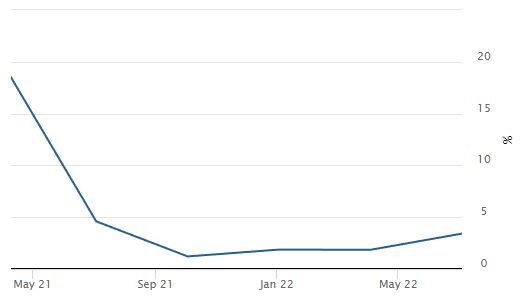
In recent months, mounting pressure to restore government spending has become even more acute as high oil prices and tax collection have boosted state revenues. Indeed, in the first quarter of 2022, government revenues grew by around 25% year-on-year, generating a fiscal surplus. That surplus was primarily due to increased tax collection following the fiscal reform approved in November 2021, with the tax haul amounting to approximately US$4.5bn – an increase of 29% on Q1 2021. Meanwhile, oil revenue in the first quarter of this year totalled around US$670m, a threefold increase on the same period last year.
The combination of years of dwindling investment and a healthy surplus in the treasury has made it much harder for the government to defend spending cuts. Pressure to up spending has led to a certain shift in policy direction in recent weeks. Notably, the IMF publicly stated in late April that high oil revenues have given Ecuador some fiscal room for “investments that spur on growth”. Following these comments, the finance ministry confirmed that the government was in talks with the IMF to increase public spending targets.
These talks appear to have been successful, and they were followed by a government announcement in early June that public investment planned for this year would increase by 7%, from the initial US$1.87bn to US$2bn. Of this US$2bn, the areas which will receive the most investment are road infrastructure (US$314m), hospitals (US$295m), and security (US$213m).
As well as being politically astute, the limited increase in public investment should also bring with it some economic benefits. After unexpectedly high GDP growth of 4.2% in 2021, most banks expect economic growth to slow somewhat this year, with Ecuador’s central bank (BCE) predicting 2.8% growth. According to the BCE, this owes principally to the Russia-Ukraine war, given that Russia is a key destination for Ecuadorean banana and shrimp products [EB-22-04].
There are other worrying signs on the horizon, including a stronger US dollar which poses a threat to the competitiveness of Ecuador’s exports, and rising inflation. Both of these could further impact growth. In this context, and in the absence of a significant increase in foreign direct investment (FDI), more public investment could help to prop up growth in 2022 to a certain extent, as the IMF recently indicated.
It is doubtful, however, whether the 7% increase in public investment in 2022 will be sufficient to address widespread accusations that the state has been largely ‘absent’ under Lasso and Moreno. As long as high oil prices and tax revenues continue to generate budget surpluses, Ecuadoreans will likely demand to see this income distributed more widely in the form of public investment and social security. The Lasso government’s key challenge, therefore, will be balancing these demands with its promise to balance the books.