
All Categories

Subcategories

  • RASTREANDO TENDENCIAS

    LatinNews 22 September 2013 Hits: 432

    REGION | Paraguay se ‘des-Mercosurisa’. El 16 de septiembre el Presidente de Paraguay, Horacio Cartes, y su contraparte de Chile, Sebastián Piñera, firmaron un nuevo acuerdo que apunta a impulsar el comercio y la inversión bilateral. El acuerdo fue firmado durante la visita oficial de dos días de Cartes a Chile, su segunda visita de Estado desde que asumió el poder el mes pasado. Esto es beneficioso para Cartes, quien está concentrado en reconstruir las relaciones de Paraguay con sus vecinos regionales, que fueron cortadas después del juicio político en junio del 2012 del ex presidente, Fernando Lugo (2008-2012).

    Que Cartes haya sellado un acuerdo con Piñera después de que su visita de Estado inaugural a Argentina la semana pasada no produjera resultados concretos, sugiere que bajo Cartes, Paraguay seguirá moviéndose fuera de la órbita del Mercado Común del Sur (Mercosur), del cual fue temporalmente suspendido políticamente después del juicio a Lugo, y se acercará al grupo rival de la Alianza del Pacífico, del cual Chile es un importante miembro. Desde que los gobiernos de tendencia de Izquierda se consolidaron en el Mercosur, el bloque comercial se ha vuelto crecientemente politizado y ha perdido su orientación económica. En contraste, la Alianza del Pacífico (compuesta por Chile, Perú, Colombia, y México) ha probado ser más pragmática y enfocada, lo que le ha permitido emerger rápidamente como un viable proyecto de integración económica regional alternativo al Mercosur.

    Durante la suspensión temporal de Paraguay del Mercosur, el gobierno interino liderado por el ex presidente, Federico Franco (2012-2013), solicitó y obtuvo el estatus de observador en la Alianza del Pacífico (el primer paso para convertirse en miembro). Esto provocó la especulación de que Paraguay se estaba preparando para retirarse por completo del Mercosur. Cartes, quien a diferencia de Lugo no está identificado con la Izquierda, enfatizó que mientras su gobierno buscará reconstruir las relaciones con el Mercosur, también está interesado en explorar otras opciones para así reducir su dependencia del Mercosur, o como lo ha expresado Cartes “para des-Mercosurizar las relaciones exteriores de Paraguay”. Esto ha sido tomado como significando que bajo Cartes el Paraguay buscará modificar las normas del Mercosur, para permitir a sus miembros individualmente puedan negociar acuerdos comerciales con terceros países y no tener que hacerlo como bloque, lo que a menudo complica las negociaciones.

    Mientras Cartes aceptó la invitación personal de la Presidenta de Argentina, Cristina Fernández, para hacer de la Argentina (el segundo mayor socio comercial de Paraguay) su primera visita oficial en el exterior, para poder discutir las relaciones bilaterales y la rehabilitación plena de Paraguay en el Mercosur, él intencionalmente eligió a Chile (el séptimo mayor socio comercial de Paraguay, cuarto en la región) como su segundo destino, antes de un viaje a Brasil (el principal socio comercial de Paraguay), programado para fin de mes (él tiene anotado otro viaje a Uruguay para octubre). En una conferencia de prensa conjunta Piñera dijo que bajo el nuevo acuerdo Chile ayudaría a Paraguay a aprovechar por completo una provisión chilena de 1968 que permite que las importaciones y exportaciones paraguayas utilicen el puerto chileno de Antofagasta sin pagar tarifas o derechos. Paraguay nunca ha tomado la ventaja total de esta provisión, en parte debido al hecho de que la mayor parte de los bienes destinados para/o viniendo de Paraguay tienden a pasar por el puerto chileno de Iquique, localizado a 419kms al norte de Antofagasta y que disfruta de mejores conexiones con Paraguay. De hecho, los líderes explicaron que ellos habían acordado convocar una comisión bilateral de integración física en los próximos tres meses, que tendrá la tarea de llevar adelante un estudio para determinar la situación actual de las conexiones físicas entre los dos países y para determinar los pasos necesarios para mejorar la conectividad.

    Piñera dijo que el nuevo acuerdo podría “cuadruplicar” el comercio bilateral, de US$700m actualmente, y también ayudar a Paraguay a incrementar sus exportaciones no solamente a Chile, sino también a la región Asia-Pacífico. Por su lado, Cartes reconoció que Paraguay tiene un retraso de décadas en el desarrollo de su infraestructura, pero señaló que esto significa que hay un “enorme potencial” para desarrollar puertos, aeropuertos y carreteras que “podrían atraer la inversión chilena”. Teniendo presente su próxima visita a Brasília, Cartes agregó que el nuevo acuerdo beneficiaría no solamente a Paraguay sino también a “otros países, tales como Brasil, que podría aprovechar la ventaja de un acceso mejorado al pacífico vía Paraguay”.

    Cartes y Piñera también expresaron un interés en promover una mayor integración energética entre los dos países. Significativamente, Paraguay, que comparte grandes represas hidroeléctricas con Brasil y con Argentina, es un exportador neto de energía mientras que Chile es un importador neto de energía. La idea de Paraguay de poder vender parte de su superávit de energía a Chile ha estado rondando por cierto tiempo. Sin embargo, esto ha estado estancado por la falta de infraestructura apropiada y por el hecho de que tanto Brasil como Argentina (que actualmente compran la mayor parte del superávit de energía de Paraguay) han bloqueado indirectamente los intentos de Paraguay para vender su porción de la energía producida en las represas bilaterales a Chile rehusándose a proveer su red de energía para suministrar la energía.

    • Proteccionismo argentino

    El 18 de septiembre el ministro de desarrollo, industria & comercio de Brasil, Fernando Pimentel, le dijo a la cámara de diputados de Brasil que Argentina ha “intensificado” sus medidas proteccionistas, “afectando las exportaciones de Brasil”. Durante su presentación de las últimas (decepcionantes) cifras de exportación al congreso, Pimentel dijo que “Estamos experimentando una difícil situación estacional con nuestros hermanos argentinos. Las medidas proteccionistas se han intensificado allá, y hay retrasos en la aprobación de las licencias de importación para productos brasileros […] esto tiene que ver con la necesidad de Argentina de obtener una balanza comercial más robusta. Como nosotros somos sus principales socios comerciales y la balanza de comercio [bilateral] es favorable a Brasil, nosotros terminamos siendo los más afectados”. Pimentel se quejó que “cada año es la misma historia”.
  • TRACKING TRENDS

    LatinNews 24 April 2014 Hits: 1900

    MEXICO | Building more gas pipelines. On 22 April the state-owned electricity company (CFE), announced that in coordination with the energy ministry it will launch a public tender process for the construction of five new gas pipelines across the country, a US$2.25bn investment project, in the next few days. The announcement was made by CFE general director, Sergio Ochoa, during an energy & gas forum in Mexico City. According to Ochoa, the pipelines will form a new network linking the central state of Durango to the northern states of Chihuahua and Sonora and to the US states of Texas and Arizona. Ochoa explained that this was part of the Mexican government’s efforts to improve Mexico’s energy integration with the US and the reliability of the country’s natural gas transportation system so as to promote the increased use of the cheap and clean-burning fuel.

    Last month, the Mexican government announced the start of the construction of a new pipeline designed to allow the state-owned oil firm, Pemex, to import larger volumes of natural gas from the US and to take full advantage of the record low natural gas prices in the US market [WR-14-13]. Significantly, Ochoa also noted that the CFE’s involvement in the tender process answered to the fact that as part of the energy sector reform approved last year the CFE will not just be in charge of electricity generation and distribution but also, for the first time, will be allowed to act as a natural gas supplier to consumers in order to turn the CFE into a more profitable business. The new gas pipeline network will provide the CFE with the infrastructure necessary to provide natural gas to a larger number of consumers in central and northern Mexico. It could also eventually allow Mexico and the CFE to export natural gas. Another declared objective of the energy reform is to increase Mexico’s national natural gas production from the current 5.7bn cubic feet per day to 10.4bn cubic feet per day by 2025, turning Mexico from a net natural gas importer to a net exporter.

    • IFT sets minimum TV auction price

    On 16 April Mexico’s newly created telecommunications sector regulator, Instituto Federal de Telecomunicaciones (IFT), announced that it had decided to establish a minimum bid of M$830m (US$63m) for any party interested in taking part in the auction of two new TV channel frequencies that is scheduled to take place next year as per the telecommunications reform approved in 2013. An IFT statement said that the minimum bid had been determined using “economic efficiency criteria, as well as entry barriers and other existing characteristics of the free-to-air TV market”. The statement added that parties interested in taking part in the auction will also be asked to provide a M$415m (US$34m) bid bond.

  • RASTREANDO TENDENCIAS

    LatinNews 06 February 2015 Hits: 892

    ARGENTINA | Fernández en China. Pese al furor que rodea la muerte del fiscal Alberto Nisman, una lesión en el tobillo, y una propensión de mantener largos vuelos a un mínimo absoluto, la Presidenta de Argentina, Cristina Fernández, dijo que “nada se le pondría en el camino” de su visita de Estado a China esta semana.

    Sucesivos jefes de estado latinoamericanos han emprendido el peregrinaje a China desde el inicio del año, buscando grandes préstamos y inversiones. Los detalles exactos de los acuerdos concretados a menudo han sido escasos en el terreno, pero todos ellos han afirmado que sus visitas fueron un resonante éxito. Fernández se reunió con el Presidente de China, Xi Jinping, con quien ella ratificó 20 acuerdos bilaterales firmados en julio, y comenzó a trabajar sobre 15 nuevos acuerdos, que incluyen la inversión china en el sector del petróleo y gas de Argentina, y la financiación para las nuevas represas hidroeléctricas y una cuarta planta nuclear de energía.

    Teniendo en cuenta la perennemente problemática situación económica de Argentina, y la urgente necesidad por el tamaño de asistencia externa que solamente China parece estar dispuesta o preparada a proveer en este momento, Fernández hizo un notablemente torpe intento de humor durante una de sus frecuentes incursiones en los medios sociales. Su tuit, en el cual crudamente imitó el acento chino al hablar español obtuvo más atención durante el viaje que cualquiera de los acuerdos que ella firmó, y sugiere que el affaire Nisman, en el mejor de los casos ha nublado su juicio.

    Aludiendo a los 1.000 miembros de una audiencia a la que ella se dirigió en una conferencia, Fernández tuiteó, sarcásticamente: “¿Serán todos de La Cámpora [la agrupación juvenil kirchnerista que suele concentrarse en las apariciones públicas de la Presidenta para darle su apoyo] y vinieron sólo por el aloz [arroz] y el petlóleo [petróleo]?”. Ella trató de componer este racialmente ofensivo tuit con una disculpa que tuiteó y que apenas puede decirse que es más diplomático: “Sorry [sic].¿Sabes qué? Es que es tanto el exceso del ridículo y el absurdo, que sólo se digiere con humor”.

    Se hicieron intentos para minimizar el tuit. El director ejecutivo de la cámara argentina-china de comercio le dijo a Bloomberg que él no “creía que los chinos estén leyendo los tuits de nuestra Presidenta todo el día”, como si los mismos no hubieran sido tomados por todos los medios internacionales como una manera de agregarle cierto picante a un informe de otra gira más de un presidente en el extranjero.

    Es improbable que China supedite su política de comercio exterior y de inversiones en un tuit. China ha mostrado una considerable flexibilidad con la inhabilidad de Venezuela de poder pagar a tiempo, por ejemplo, que es una cuestión mucho más significativa. Pero esta clase de metidas de pata, insultando al segundo mayor socio comercial de Argentina después de Brasil, planteará serias preguntas acerca del liderazgo de Fernández. Los candidatos presidenciales de la oposición buscarán explotar esto en la etapa previa a las elecciones generales del 25 de octubre, alegando que el kirchnerismo es algo que ha fracasado y que necesita urgentemente ser reemplazado, en un esfuerzo por socavar a cualquier candidato que Fernández, quien ya no puede buscar la reelección, respalde.

  • CHILE: Bachelet under attack on new fronts

    LatinNews 04 August 2016 Hits: 1786

    Chile is facing its worst political and institutional crisis, aside from the 1973 coup d’état that overthrew President Salvador Allende (1970-1973). This was the conclusion of former president Ricardo Lagos (2000-2006) who, in a recent interview with a leading national daily, La Tercera, launched an attack on the Nueva Mayoría coalition government led by President Michelle Bachelet (which includes Lagos’s own Partido por la Democracia [PPD]). This was an allusion to the credibility crisis afflicting the political and business establishment alike stemming from various corruption scandals. His attack came as Bachelet is facing fresh unrest over another unfulfilled 2013 electoral pledge –overhauling the country’s current pension system which dates back to the military dictatorship led by General Augusto Pinochet [1973-1990]).

    In the interview published on 27 July, Lagos said “there would seem to be a power vacuum”, warning that “I don’t know if the country can bear another year and a half of this crisis”. These remarks prompted a government response. The next day, the presidential spokesperson, Marcelo Díaz, said President Bachelet was addressing the “confidence crisis” afflicting Chile’s political system and many institutions. He cited as examples the implementation of a “probity agenda” – a reference to the series of anti-corruption initiatives launched last year by the Bachelet government. He claimed that this was already showing initial results, with “95% of contributions made to the [political] campaigns now [being] public – namely it is known who is the donor”. Díaz also highlighted efforts to “put into practice the constituent process” which, among other things, “seeks to construct a new constitutional and political framework” – an allusion to the process of reforming the 1980 constitution (which dates back to the Pinochet-era) in order to make it more democratic, the second phase of which began in April [WR-16-16].

    There may well be electoral motives for Lagos’s remarks amid speculation that he may seek to secure the Nueva Mayoría presidential nomination ahead of the 2017 general elections. Lagos has since qualified his comments, saying that “we all bear responsibility for finding a formula to move forwards”.

    Calls for pension overhaul

    On 24 July 100,000 people protested in Santiago demanding an overhaul of the national pension system (which is administered by private pension fund administrators [AFPs]), while 750,000 people marched nationwide, according to the ‘Coordinadora No + AFP’ (‘No More AFP’) movement. The authorities put the Santiago figure at 50,000 but failed to give details for the rest of the country.

    Overhauling the pension system has been a key pledge of the Bachelet government amid complaints that the current one offers low pension pay-outs. An executive-tabled initiative to set up a state-run AFP, to compete with its private counterparts, has been held up for two years and is now under discussion in a national congressional labour committee. When first presenting the initiative back in 2014, President Bachelet – who, during her first term in 2008, introduced new forms of State assistance (see sidebar) – maintained it would make the market more competitive. She also said it would guarantee the coverage of those not considered attractive clientele for the AFPs like independent workers; those on lower incomes; or those that work in isolated areas.

    The issue of pensions made headlines last month after the executive announced it would revisit it “with urgency” although it has since backtracked. The government says it will send down the initiative to create a state-run AFP before it leaves office in 2018, but has ruled out further changes to the pension system, suggesting that the unrest is likely to continue.

    • Additional help

    Up to 2008, two types of basic State assistance were available for the poorest Chileans – a minimum pension guarantee for those who had made contributions for at least 20 years but had failed to accumulate the minimum amount necessary to retire (which covered 23% of the most impoverished citizens), and a small non-contributory means-tested benefit worth half the minimum pension. During her first term, in March 2008, President Michelle Bachelet replaced these two forms of State assistance with new ‘solidarity pensions’ (Pensiones Solidarias) for the poorest 60% of the population not covered by private pensions. Meanwhile those who received low pensions from AFPs received a monthly top up (Aporte Previsional Solidario).

  • Cuba: Fiscal acceleration ahead of 2018 transition

    LatinNews 08 February 2017 Hits: 3143

    This year’s budget document makes for particularly interesting reading, with last year’s spending increases stepped up further. Even factoring in an expected increase in fiscal revenue, the budget deficit is projected to reach eye-watering levels. With the government relying on state-owned banks to purchase new sovereign debt, financing is unlikely to be difficult in 2017, but with a limited pool of resources in the domestic banking system, such a strategy is not feasible in the long term.

    It is a reflection of Cuba’s one-party political system that the annual budget receives comparatively little press coverage, with the process of submitting proposals and debating the package occurring right at the end of December, only a few days before the start of the 2017 financial year. Given the one-party political system, the budget bill is passed without delay or difficulty. The budget is subsequently published in the Gaceta Oficial, as well as on the homepage of the National Statistics Office (ONE), but the comparatively low-key nature of the build-up means that changes in the government’s fiscal policy stance can attract relatively little attention, particularly since the timing coincides with the period between Christmas and New Year.

    Deficit set to reach 12% of GDP

    This has been the case with the 2017 budget, but delving into the detail of the budget package unveils some surprising findings. The most prominent headline figure is the government’s projected fiscal deficit: at Ps11.5bn it is almost double the level pencilled it to the 2016 budget this time a year ago. Given the paucity of macroeconomic data, it is difficult to speculate about the size of the deficit as a percentage of GDP (nominal GDP data is available, but only up to 2015), but there have been reports that legislators estimate that the projected 2017 budget deficit will be equivalent to 12% of GDP.

    This marks a continuation of a trend that began in 2015. The deficit ballooned sharply in 2008 as external conditions deteriorated sharply, but during 2009-14 the government kept spending under control in order to reduce the deficit to manageable levels. However, in 2015 the deficit quadrupled to nearly Ps5bn on the back of a step-up in expenditure growth. The deficit widened further in 2016, to Ps5.6bn.

    The wider deficit is being driven exclusively by spending: what is notable is that income reforms have increased revenues in the past three years. According to the government’s budget document, revenue is expected to increase by a further 0.7% in 2017. Given that tax income (the main source of budget revenue) is expected to increase by 4.5% in 2017, this overall growth appears mild, but it reflects the fact that non-tax income is expected to fall by around a fifth. This is likely to reflect a continued scaling back of assistance from Venezuela, with lower oil shipments (part of which are re-exported) cutting government revenue in this area.

    Meanwhile, government expenditure is expected to rise by 11% in 2017. Capital spending is slated to increase by around Ps1bn. No details were provided on specific investment projects, but part of this is likely to reflect reconstruction costs after Hurricane Matthew hit eastern Cuba in October 2016. Current expenditure is projected to increase by a more significant Ps4bn. Health, education and social spending (including pensions) account for around half of current spending and the government expects these expenses to rise this year, as an ageing population increases the pension burden. However, other budgetary spending is also likely to rise, including the cost of subsidising basic goods.

    Spending hikes driven by political concerns

    Although there has been speculation that the increase in spending is designed to bolster underlying economic growth, after the economy contracted by 0.9%, this fiscal stimulus will have a relatively muted impact on the broader economy. This is because disposable incomes are low and private consumption accounts for a comparatively small share of total GDP. Higher government spending is therefore likely to be driven by the need to maintain social indicators (such as health provision) in the run-up to a political transition. With President Raúl Castro set to stand down next year, the country’s leadership will be keen to prioritise those areas important to public opinion, which include health and education, in order to smooth the process of shifting to the first non-Castro leader in nearly sixty years.

    The rise in public spending is also likely to reflect the fact that fiscal decentralisation and economic reforms are proceeding much more slowly than anticipated. Several years ago, it was anticipated that the government’s dominant role in terms of both revenue and expenditure would fall, as the private sector grew in size. However, this has not happened: while the number of workers in the private sector has increased, this has occurred gradually and the tax system has been slow to adapt. In a system with little experience in tax administration, it has been difficult to strike the right balance between raising revenues through income and corporate tax, while also maintaining incentives for private-sector workers. Meanwhile, the persistence of US sanctions has meant that few foreign companies have boosted investment significantly and, coupled with still-tight regulation by the Cuban government, little competition and liberalisation in key sectors is emerging. This means that the government remains responsible for the lion’s share of spending. The failure to develop competitive markets and raise income levels also makes it politically-difficult to scale back the subsidisation model.

    State-owned banks foot the bill

    Such a large projected fiscal deficit raises significant questions over financing. Although Cuba has recently settled long-standing disputes on much of its defaulted debt, some claims remain outstanding. Coupled with concerns about the political and economic backdrop and the extreme paucity of economic data, this means that Cuba is unable to tap international capital markets. The government has traditionally monetised its fiscal deficit, printing money to finance the budget shortfall, but officials have been trying to scale back monetisation in recent years because of the upward impact on inflation and the destabilising effect on the local currency.

    Although there is insufficient interest on the part of international investors, Cuba has been issuing sovereign bonds to the domestic market in recent years, with state-owned banks purchasing the issuance. This appears to be the government’s main financing strategy for 2017, with the budget document authorising the finance ministry to issue new bonds this year with a term of between one and twenty years and an average annual interest rate of 2.5%.

    However, this may set alarm bells ringing. The deficit is large and issuing sovereign debt to state-owned banks is a risky and unorthodox strategy, with the debt likely to be secured against banking deposits. There is no financial sector data available to provide an insight into the amounts of funds held in the banking system, but given that the sector is underdeveloped, there are unlikely to be significant amounts of funds available. The lack of data makes it impossible to assess how exposed these banks now are to the public sector. Given that the government is also trying to increase bank credit to the private sector, in an attempt to foster investment by budding entrepreneurs, borrowing extensively from state-owned banks will make fewer funds available to others.

    In the short term, the Cuban economy is unlikely to suffer noticeably from the sharp increase in public spending and the recourse to state-owned banks for financing, but it adds to the challenges for the first post-Castro administration. The external backdrop is already challenging, with the Venezuelan economy on the brink of collapse and the likelihood of still-difficult relations with the Trump administration in the US. Domestically, it will be difficult to continue relying on state banks for large-scale budget financing in the longer term, since they will have a limited pool of resources to draw from. Alternative sources of financing will be necessary in order to avoid politically-difficult spending cuts.

  • CHILE: Piñera tables contentious migration reform

    LatinNews 26 April 2018 Hits: 1337

    This week thousands of migrants gathered in the Víctor Jara stadium in Chile’s capital, Santiago, to begin the process of regularising their documentation. This is in line with new administrative measures announced earlier this month by President Sebastián Piñera along with a new legislative initiative aimed at updating existing laws. While human rights groups have welcomed some of the changes, others have been slammed as racist and discriminatory.

    President Piñera presented the new administrative measures and legislative package on 10 April. He justified the new rules on the grounds that there are over a million migrants in Chile of which around a third are there on an irregular basis. He added that there had been an “exponential increase” in the number of foreigners entering the country with a tourist visa who remained on an irregular basis. As well as the launch of the regularisation process, the new administrative measures include a ban on requests for a temporary work visa in Chile, which took effect as of 23 April, and three new categories of temporary visas which will take effect as of 1 August.

    The most contentious new rules, however, were those which single out Haitian nationals, allowing them only a 30-day tourist visa rather than the previous 90-day one, bar a quota of humanitarian one-year visas given to reunite families. This has led NGOs like Servicio Jesuita a Migrantes and Chile Abraza to warn that Haitians are being unfairly discriminated against. Another bone of contention has been changes which affect Venezuelan nationals. While these are permitted to request a year-long visa for humanitarian reasons – in response to the continued political and economic crisis afflicting the country – they may only be requested from the Chilean consulate in Caracas which has led critics to warn that this will make it more difficult for Venezuelans to leave.

    Also on 10 April Piñera outlined the new legislative reform package which includes six objectives and similarly has met with a mixed response. The objectives are to: 1) give just treatment to migrants who enter Chile on a legal basis; 2) combat migrant trafficking and prevent those with criminal records from entering Chile; 3) create a migration policy council tasked with formulating and updating a clear migration policy; 4) create a national migration service to implement policy; 5) establish a flexible system of migration categories; and 6) decriminalise irregular residency and simplify and expedite the deportation process for those who have violated migration law. Some aspects of the proposed reform package, which has been sent down to congress for discussion, have been welcomed – such as the creation of new institutions to address migration policy. However, NGOs have raised concerns about some provisions such as expedited ejections without “due legal process”.

    Unrest

    President Piñera, who took office last month, has encountered the first unrest of his new mandate. Last week the first nationwide protests took place by both students as well as the ‘Coordinadora Nacional No + AFP’ protest movement which is calling for an end to the mixed public-private national pension system which dates back to the dictatorship led by General Augusto Pinochet (1973-1990). The students’ protests were triggered by a ruling by Chile’s constitutional court (TC) last month striking down part of the higher education reform passed by the previous government [WR-18-13]. However, the unrest over pensions – which saw turnout of 150,000 nationwide – reflects a major electoral concern, upping the pressure on Piñera to make good promises made in his manifesto.

    • Pensions

    In his proposed US$14bn government plan for 2018-2022, which includes 745 measures and was presented at the end of October, President Piñera’s main spending priority is a programme entitled ‘positive ageing & pensions with dignity’, which is assigned US$3bn. Piñera is, however, calling for the current pension system to be retained, while his plan rather includes new subsidies to raise the pensions of the middle class, as well as incentives that would encourage workers to retire later.

  • CHILE: Piñera still looking in rear-view mirror

    LatinNews 25 October 2018 Hits: 517

    However much he keeps talking about the future, President Sebastián Piñera cannot seem to escape the past in Chile. Almost every other week a controversy surrounding the military dictatorship led by General Augusto Pinochet (1973-1990) seems to rear its head. On this occasion it was not Piñera’s own doing but he could be held indirectly responsible.

    Colonel Germán Villarroel, director of Chile’s Escuela Militar, and Colonel Miguel Krassnoff Bassa, the director of the military Escuela de Idiomas language school, were both pushed into retirement last week after the latter gave a speech paying homage to his father Brigadier General Miguel Krassnoff Marchenko, sentenced to 668 years in prison for human rights violations committed during the Pinochet dictatorship. Krassnoff Bassa extolled “the bravery, loyalty, and uprightness” of Krassnoff Marchenko, notorious for being one of the most violent torturers of Pinochet’s secret police (Dina).

    During a prize-giving ceremony at a sports competition in the Escuela Militar, the military academy, on 6 October, Miguel Krassnoff Bassa paid tribute to his father and praised the support of Villarroel, who apparently knew about the subject matter of his speech in advance. “It is super important that our parents, who gave their lives for Chile and their families, are always in your hearts,” Krassnoff Bassa said to the cadets “to remember the soldiers that are not always remembered”.

    A video of the speech was not made public until last week when a deluge of criticism forced the army to take action, shunting Villarroel and Krassnoff Bassa into retirement. General Miguel Alfonso Bellet, the army commander, said the two men had caused “very serious harm” to the institution. In a public declaration he said that the army “is and always will be respectful of judicial resolutions”. The defence minister, Alberto Espina, had described the speech as “unacceptable” and demanded an investigation to establish responsibility.

    Human rights organisations are calling for further sanctions for the two colonels. Chile’s human rights commission, and groups of relatives of the disappeared and executed politicians, the Agrupación de Familiares de Detenidos Desaparecidos (AFDD) and Agrupación de Familiares de Ejecutados Políticos (AFEP) respectively, complained that Espina pushing the two men into retirement was “weak” and that what had happened in the Escuela Militar called into question the ‘never again’ proclamation from the army several years ago.

    “The question that arises is what type of training are they getting in the military academy? Is it denial and defence of crimes against humanity? Or commitment to democratic values and respect for human rights? These questions need to be asked in a public debate,” the president of the human rights commission, Carlos Margotta, asked rhetorically, adding that sanctions commensurate with the seriousness of the incident were imperative.

    Another question surrounds the timing of Krassnoff Bassa’s remarks. While it is true that he was close to retirement, and perhaps saw this as a last opportunity to speak his mind without fear of the consequences, it is questionable whether he would have spoken at all if the left-leaning Nueva Mayoría coalition were still in power, or whether Villarroel would have given him the go-ahead. By contrast, President Piñera’s right-of-centre Chile Vamos government’s recent actions could have given the impression that it would be possible to get away with these remarks now.

    Heightened political tensions over the origins of the dictatorship and Chile’s democratic history have dogged Piñera since he returned to power for a second term. During his first term, in 2013, he upset the ultra-right by closing the Peñal Cordillera, essentially a luxury enclosure for those who committed human rights violations during the dictatorship, and transferred the inmates to Punta Peuco, a less comfortable military prison. He had also condemned civilians complicit in the military abuses as “passive accomplices”.

    Since returning to power in March this year, however, Piñera has made a discernible shift to the Right rhetorically, focusing not on human rights abuses under the dictatorship but rather the democratic abuses by the Left which he argues brought it about. In August, Piñera called for the creation of a ‘museum of democracy’, accusing the government under President Salvador Allende (1970-1973) of having “validated violence and undemocratic mechanisms” [WR-18-33]. Days earlier, his choice of culture minister, Mauricio Rojas, was compelled to resign just four days into the job after facing scathing criticism for past remarks about the museum of memory and human rights in Santiago.

    Piñera kept a studied silence for several days after Krassnoff Bassa’s remarks became public. When he eventually broke it, Piñera was critical. “I don’t think it’s appropriate that in a military complex where future officials of our country are educated homage is paid to people who violated human rights for such a long time and in such a cruel and systematic way”. He added that it was “very important in Chile to educate about the culture of respect for human rights”. But human rights activists and left-wing politicians accused him of too little too late.

    • Mapuche protest march

    Another area regarding human rights where President Piñera has come under fire is the Mapuche conflict. On 14 October thousands of demonstrators marched in Santiago in support of the Mapuche cause and to demand the release of “indigenous political prisoners”. Demonstrators carried large banners calling for the release of Mapuche activists (many imprisoned for arson attacks on lorries and churches in in the southern region of La Araucanía). The Mapuche conflict is a vexed issue which successive Chilean governments have done their level best to ignore but Piñera has taken it head on with a multifaceted development plan for La Araucanía, although he has been accused by the Mapuche of prioritising the militarisation of the region and stiffening the anti-terrorism law.

  • GUATEMALA: Arévalo popularity plumbs new depths

    Abbi Dicker 15 October 2026 Hits: 288

    Three-quarters of Guatemalans are unimpressed with President Bernardo Arévalo’s governance, according to a survey published by CID-Gallup this week. As Arévalo approaches three-quarters of his term, public disillusionment is growing, especially over public security, with voters expecting more despite the fact that Arévalo has been hamstrung by congress, where he lacks meaningful representation.

    Despite being untarnished by corruption, unlike a long line of previous heads of state in Guatemala, President Arévalo is now the worst-rated president since the restoration of democracy in 1986. His disapproval rating was as high as 78% in the nationwide CID-Gallup survey conducted in September, a mirror image of the 78% approval rating he enjoyed when he took office in 2024. His current approval rating is just 15%, with 81% of respondents viewing it as unlikely that he will solve their household problems. As many as 74% of respondents described Arévalo’s governance as ‘bad’ or ‘very bad’, and 89% felt that the country is heading in the wrong direction.

    Arévalo tried to downplay the importance of polls, arguing that they also gave him no chance of winning the presidency. On 8 October Arévalo announced major new security investments for the army, the police, and prison infrastructure in a closing address to the Encuentro Nacional de Empresarios por el Desarrollo (Enade), an annual business forum in Guatemala City. However, public patience is clearly wearing thin; widespread disillusionment remains, alongside an urgent demand for concrete results against street-level crime and violent extortion. A mere 19% of respondents to the CID-Gallup poll felt public security was being well-handled by the government.

    • Security boost

    President Arévalo said his government will supply 1,000 new patrol cars to the national police force (PNC) before the end of 2026, along with 1,000 motorcycles, 10,000 pistols, and 5m rounds of ammunition. He added that over US$5m will be assigned to procure over 14,000 weapons and other equipment for the armed forces to conduct security operations against drug trafficking groups and organised crime.

    Arévalo claimed that his administration had made notable progress against organised crime, with 36 tonnes of drugs confiscated and destroyed since the start of his term in January 2024, and a reduction in the number of extortions by 40%. However, he offered no base for comparison. Arévalo highlighted investment in signal jamming at seven high-risk prisons to prevent gang leaders from running mass extortion networks from behind bars.

    Arévalo said further progress would require strengthening inter-institutional coordination, specifically between the public security sector and the judiciary, and guaranteeing transparent and efficient investment. “No institution can confront organised crime alone,” he stressed. Arévalo implied that improvement was possible now that María Consuelo Porras, the long-serving attorney general and fulcrum of the ‘pacto de los corruptos’ network of institutional corruption, has finally been replaced. “Security cannot be guaranteed if the entities responsible for combatting crime are infiltrated by corrupt networks or respond to criminal interest,” he said.

    Many suspect that institutional corruption runs much deeper, a concern amplified by the massacre of eight civilians, including three women and a minor, in Huité municipality in the eastern department of Zacapa on 27 September. Victims’ families immediately alleged that the army was involved in the killings, which took place in four different locations. The defence minister, Henry Sáenz, ruled out army involvement in the armed attacks, stating that while some soldiers were nearby and had heard gunshots, they had only fired controlled warning shots into the air in response. However, major questions remain unanswered. Arévalo said in a press conference that the government had handed an internal report into the massacre – drawn up by a multidisciplinary committee of the defence ministry – to the attorney general’s office to investigate.

  • PARAGUAY: Forecasting another bumper soya crop

    LatinNews 27 October 2011 Hits: 1138

    Soya growers claim that they have locked in the higher international prices for soya that were available in July and August for their next crop which will be harvested after Christmas 2011. The growers claim to have sold 60% of their expected crop on the futures market.

    The statement came from César Jure, from the Cámara Paraguaya de Cereales y Oleaginosas (Capeco). He said that the next crop will weigh in at around 8m t (a bit bigger than last year’s 7.5m t) and that between 50% and 60% had been sold at an average price of US$420 a tonne. Capeco reckons that the average price for the 2011 crop was US$380 a tonne.

    At the end of September soya prices had dipped in Chicago to US$418 a tonne, but they are now back close to US$450 a tonne.

    Taiwan: Vice-President Federico Franco, travelled to Taiwan to meet key Taiwanese business leaders in mid-October. Franco pitched for more Taiwanese investment in Paraguay which is the only country in South America to recognise the Taipei regime as the legitimate government of China. Only 23 countries around the world recognise Taipei rather than Beijing as the capital of China.

    GDP: The manufacturing sector is having a miserable time. The central bank is forecasting that it will contract in 2011, and drag GDP growth down to 4% from the 4.5% the bank originally expected. The primary sector is still growing healthily (though not at the 34% rate it achieved in 2010), while the tertiary sector (services) is accelerating. The bank expects the primary sector to grow 4.2% this year and the tertiary sector to grow 5.5%, (down on the 9% it managed in 2010).  In 2010 the overall economy grew by a staggering 15%, thanks to the bumper soya crop.

    Inflation: In September monthly consumer price inflation was 0.2%, bringing the rate for the past 12 months to 9.4%.

  • ECUADOR: Electoral blow rocks leftist challenger

    LatinNews 20 September 2012 Hits: 481

    No sooner had the Left mounted its challenge to President Rafael Correa ahead of next February’s elections than it was cast into considerable doubt. Alberto Acosta, an estranged ally of Correa, was elected to run for the left-wing coalition Coordinadora Plurinacional por la Unidad de las Izquierdas after a national convention on 1 September [WR-12-35]. But, the viability of his candidacy was immediately up in the air after the national electoral tribunal (CNE) announced that it could not register two of the biggest parties within the coalition because many of the signatures they had presented for this purpose had been falsified.

    The CNE refused to register Pachakutik, the political arm of the umbrella indigenous organisation Conaie, and the Movimiento Popular Democrático (MPD), a former ally of President Correa’s with strong ties to the teachers’ unions.

    The CNE had initially registered the two parties, but that was before Correa denounced “a monstrous fraud” in late July, accusing opposition political parties of falsifying signatures en masse in the electoral registration process [WR-12-30]. After re-evaluating the applications by Pachakutik and the MPD, the CNE declared thousands of signatures presented by them to be invalid. The two parties have until just 24 September to gather thousands of additional bona fide signatures to comply with party registration requirements.

    Members of both Pachakutik and the MPD marched to the headquarters of the CNE in Quito to protest against what they claimed to be electoral fraud on 14 September. Gustavo Larrea, a former senior cabinet minister under Correa who is supporting Acosta’s presidential bid, accused the CNE of manipulating the whole process to eliminate the major threat to Correa’s (yet-to-be-confirmed) re-election bid. He called on the CNE judges to resign due to “a lack of transparency and clarity in the electoral process”.

    “Instead of going on marches, go and collect signatures,” Correa quipped back. “In addition to being shameless, you are lazy.” Correa also bemoaned the fact that Acosta, a co-founder of the ruling Alianza País (AP), had chosen to throw in his lot with “these people”, siding with “stone throwers” over “the revolutionary project”.

    As is customary, Correa took aim at the media. He said the march to the CNE headquarters, which he claimed had been “backed to the hilt by the media”, had been an abject failure. He also accused the opposition Coordinadora Plurinacional por la Unidad de las Izquierdas of seeking to discredit the CNE in order to “create chaos and conspire against democracy, the constitution and the law”.

    In the CNE’s defence, it has confirmed the registration of four parties in addition to the AP, all of which are decidedly hostile to the Correa administration: Partido Sociedad Patriótica (PSP), of former president Lucio Gutiérrez (2003-2005); Ruptura de los 25, a founding member of the AP coalition which severed links with Correa in January 2011 on the grounds that he was growing increasingly authoritarian and concentrating power in his own hands; Partido Avanza, a new party focused on youth empowerment; and Movimiento Creando Oportunidades (Creo) for which Guillermo Lasso Mendoza, until recently the president of the Banco de Guayaquil, will formally accept an invitation to run for president at an event in Portoviejo, the capital of the northern coastal province of Manabí, on 29 September.

    • Under time pressure

    Also facing exclusion from next February’s elections are one long-established and one newly established party: the Partido Roldosista Ecuatoriano (PRE) is one of Ecuador’s traditional political parties derided by President Correa as the partidocracia; Concertación is a new centrist party formed within the last year. The national electoral council (CNE) has instructed both parties that they will need to find fresh signatures by 24 September or they will not pass the registration process.

  • TRACKING TRENDS

    LatinNews 12 November 2015 Hits: 466

    BRAZIL | Petrobras strike. Oil workers went on strike on 1 November over pay and the future of Petrobras, the State-run oil company. The strike has resulted in a 13% drop in Brazil’s daily oil production. On 10 November Petrobras issued a note stating that production had fallen by 115,000 barrels a day, due to the industrial action by workers in the Campos Basin, off the coast of the city of Rio de Janeiro, where 80% of Brazil’s oil is located.

    The oil company sought to assure consumers that there was no threat to the country’s energy supplies. However, it did warn of the economic consequences of the action. “With the loss of production, the collection of taxes that go towards the federal union, the states and municipalities….will be directly affected,” it said.

    Oil workers are demanding an above-inflation pay-rise, and have rejected an offer of 8.1% by Petrobras. Inflation is currently running just under 10%. Unions are also unhappy at Petrobras’s refusal to hold talks over its disinvestment plan and its outsourcing of various tasks to other companies. Besides temporarily suspending some investments in refineries and other under-construction plants, Petrobras is also considering selling assets worth up to US$15.1bn between 2015-2016 in Brazil and abroad.

    Petrobras cancelled talks with leaders of the oil union Federação Única dos Petroleiros (FUP), which were scheduled for 10 November, to try and bring an end to the strike. The FUP released a combative statement on the same day saying that “this is the moment to intensify [the strike]”. It claimed that Petrobras was downplaying the reduction in output from refineries caused by the strike, estimating that this could amount to some 2m barrels in total so far, worth R$400m (US$106m).


    URUGUAY | Boosting foreign trade. President Tabaré Vázquez returned to Uruguay this week from a 10-day trip to France and Japan, where he signed a series of accords to boost trade and investment. There is significant scope to increase trade with Japan in particular. Uruguayan exports to Japan amounted to just US$8.8m in 2010 when Vázquez completed his first term in office, and they had only increased to US$13m by 2014. Finance Minister Danilo Astori, who made up part of the visiting delegation, sought to attract Japanese investment to Uruguay, especially in rice cultivation, technology and the service sector. Uruguay’s congress is poised to ratify an investment protection treaty signed by the two countries at the turn of the year. But Vázquez was frustrated in his hope to seal a deal with Japanese Prime Minister Shinzo Abe, who he met on 6 November, to open up the country’s market to Uruguayan meat exports. Abe said that a few remaining “technical aspects” needed to be ironed out but suggested that it was only a matter of time.

    Vázquez, a qualified oncologist, began his visit to Japan by speaking at a conference in the private Jesuit research university in Tokyo, Sophia, where he elaborated upon how politics and science could “work together” to combat problems such as cancer and smoking. He described smoking as “the most brutal pandemic that humanity has suffered”, arguing that the illnesses caused by smoking – cardiovascular and pulmonary diseases and cancer – “cause 8m deaths worldwide every year, more than the number of people who perished in the Second World War”. Vázquez stressed, however, that it was “very difficult to fight against the entrenched economic interests of the producers and vendors of cigarettes” (see sidebar).

    • Smoking

    President Tabaré Vázquez waged a crusade against smoking during his first term in office, when Uruguay became the first country in Latin America to ban smoking in enclosed public places. His government put in place legislation that required large health warnings on cigarette packets and banned the sale of those branded as “light” or “ultra light”. This led to an acrimonious legal dispute with the tobacco giant Philip Morris International (PMI), which contended that the restrictions imposed by the Uruguayan government harmed its business and violated Uruguay’s trade deal with Switzerland, where PMI is based.

  • Cuba signs over 20 agreements with China

    LatinNews 05 October 2016 Hits: 432

    Given that Cuba is grappling with a sharp economic deceleration and a liquidity crunch – related to cutbacks in assistance from Venezuela – Cuban authorities welcomed the signing of a raft of trade and investment treaties during a three-day visit by the Chinese premier. However, the agreements will provide no quick-fix for the Cuban economy. Even if the investment materialises in full, projects will proceed extremely slowly, under the ever-watchful eye of the Cuban authorities.

    The three-day visit to Cuba on 24-27 September by the Chinese premier of the state council, Li Keqiang, was symbolically important, marking the first official visit to Cuba by a Chinese premier since 1960. Li's visit came directly after another first for the Chinese premier, having previously addressed the UN's General Assembly in New York. The overseas trip reflected the fact that China is seeking a greater international role, particularly in the context of its expanded economic interests.

    Over the course of Li's visit to Cuba, the two countries signed over 20 co-operation agreements, covering diverse areas of the economy, including agricultural manufacturing, renewable energy, public transport, construction, biotech, pharmaceuticals and telecommunications. The two countries also signed memorandums of understanding (MOUs) covering technology transfer and joint collaboration on research and development (R&D) in the biotech sector.

    The bilateral agreements will deepen the diplomatic and commercial ties that have already been growing in recent years. China has emerged as an increasingly important strategic ally for Cuba, with extensive economic and military co-operation, including credit guarantees that have reduced the cost and facilitated the availability of external financing.

    Loans have also been forthcoming, with two credit lines agreed in February that funded Cuba's purchase of Chinese tractors to boost the rice harvest, together with 240 passenger train wagons. Chinese loans are also helping to fund the expansion of the cargo port in the city of Santiago de Cuba.

    China is also showing a growing interest in constructing manufacturing assembly facilities in Cuba, including for home appliances and agricultural machinery. The authorities hope that this will boost bilateral trade: China is already one of Cuba's more important trading partners, but its share of export sales (6%) and import purchases (10%) remains comparatively low, and has not changed significantly since the early 2000s.

    The trade and investment agreements come at an opportune time for Cuba, which is witnessing a sharp economic slowdown as commodity prices for Cuba's two main export goods – nickel and sugar – remain low. Assistance from Venezuela, which has provided crucial support in recent years under the auspices of the 'oil-for-doctors swap', is also drying up, reflecting the worsening economic crisis in that country.

    And even though the Cuban tourism sector continues to thrive, very low levels of investment and difficulties in accessing financing mean that the economy has few sources of foreign exchange. Piecemeal progress in unpicking US sanctions imposed under the half century-old economic embargo has stalled as the US presidential elections approach, with no sign of any moves towards removing the embargo outright until 2017, at the very earliest (the embargo is codified into US law and its removal requires an act of congress).

    This combination of factors has forced the Cuban government to adopt austerity measures, including energy rationing and import cuts. In turn, this has contributed to a sharp deceleration in economic growth, from 4% in 2015 to 1% in the first half of 2016.

    Given that the Communist government led by President Raúl Castro has put nearly one-fifth of its own investment plans on hold in an effort to rein in the fiscal deficit, the Cuban authorities will welcome the prospect of greater Chinese investment, provided that it materialises as expected. (There has been speculation that the domestic slowdown in China might prompt the Chinese authorities to reassess their extensive overseas investment plans, with the IMF warning in January that decelerating growth could have spillover effects to other economies.)

    Yet even if planned bilateral trade and investment does materialise, these latest agreements with China are unlikely to provide a quick fix for the Cuban economy, since investment projects tend to progress extremely slowly on the island, partly reflecting the desire of the Cuban authorities to proceed cautiously and with extensive oversight. In the meantime, the local economy will continue to perform weakly, with a potential lifting of US sanctions the only tangible factor that could lift growth back to 4-5% in the medium term.

  • ECUADOR: Grand plans for gold mining outlined

    LatinNews 19 December 2019 Hits: 3025

    The first shipment of gold extracted from the Fruta del Norte mine left for Europe from the port of Guayaquil on 8 December, a moment heralded as the start of a new era in Ecuador’s gold mining industry, a sector which the government hopes can be a driving force behind President Lenín Moreno’s ambitious plans for economic development.

    Gold mining has taken place in Ecuador for centuries, but extraction has previously been limited to small-scale mining concessions. In 2018, the country’s 484 existing concessions produced 284,000 ounces of gold, according to the deputy mining minister, Fernando Benalcázar. Fruta del Norte, located in the southernmost province of Zamora Chinchipe and managed by Canadian company Lundin Gold, is expected to produce 310,000 ounces of gold every year, more than doubling total national output.

    On 12 December, the minister of energy and non-renewable natural resources, José Augusto Briones, outlined his vision for the development of large-scale mining in Ecuador, and indeed for the expansion of the country’s extractive industries in general. He mentioned Fruta del Norte, where the state’s 51% stake is expected to deliver US$1.53bn by the time the mine runs dry in 2034, but Briones’s plans are far grander, as he discussed a whole range of projects that he says are “necessary to meet the country’s financial needs”.

    The Mirador mine, also in Zamora Chinchipe, saw copper, gold, and silver extraction commence earlier this year; Río Blanco, in the neighbouring province of Azuay, saw operations suspended by a court order in June 2018, but Briones says he expects it to be running again by 2021. These two mines, along with Fruta del Norte, are thought to hold as much as US$8.6bn worth of precious metals. Briones also suggests that future extraction in Llurimagua and Cascabel mines, both in the northern province of Imbabura, could have a combined value of US$6.9bn.

    The value of these projects is further amplified by the increased capacity for refining gold within Ecuador, necessary for it to be considered an international asset. Rather than exporting raw minerals and having to buy back refined gold, Ecuador can now complete the process itself. This has helped boost the country’s official gold reserves, as it was announced on 16 December that the central bank (BCE) has added US$235m worth of gold to its reserves since 2012.

    The real challenge for Ecuador’s government will be overcoming considerable domestic opposition to the development of the extractive economy; environmentalists have highlighted the potential impact of mining on climate and the environment, while indigenous communities object to the imposition of large-scale projects in their territories.

    Briones responded to this issue in his 12 December announcement, describing plans for a ‘social energy pact’ with groups opposed to extractive industries. He promised that “responsible mining” can offer a “sustainable path for the country’s development”. Details of what exactly this will mean remain scarce, but he discussed a commitment that all projects should prioritise securing the consent of local and national activists.

    The case of Río Blanco demonstrates what can happen when such interests are ignored. But the economic potential of Ecuador’s mining industry, and the first profits from Fruta del Norte, will whet the government’s appetite for further success stories. In the fraught political context of popular protests and International Monetary Fund (IMF) restructuring, any action that further alienates sections of the population, however, will need to be handled with care.

    Río Blanco

    The decision to revoke the license of Chinese firm Ecuagoldmining, the operator of the Río Blanco gold mine, in June 2018, was made in response to a campaign by residents of the El Cajas national park in which it is located, who say the project was polluting local water sources. The government has previously appealed this decision, but failed to overturn it, and it is not clear how it intends to address this situation.

  • ECONOMIC HIGHLIGHTS

    LatinNews 21 May 2021 Hits: 1613

    PERU | Gov’t predicts strong economic recovery. On 30 April Peru’s economy & finance minister, Waldo Mendoza, said the government predicts a strong recovery in 2021-2024 after a tumultuous year saw GDP fall by 11.1% in 2020 due to the coronavirus (Covid-19) pandemic. Mendoza said that GDP is expected to grow by 10% in 2021, which would be the largest annual increase since 1994, as a result of resumed economic activity following last year’s lockdowns. The minister predicted that the year-on-year growth rate will then stabilise at 4.5% for the 2022-2024 period, which Mendoza said would be sustained by internal demand, increasing copper exports, and the recovery of external demand. He also said that investment would increase in this period as construction continues on several key infrastructure projects, including a subterranean line of the Lima metro and the extension of Lima's ‘Jorge Chávez’ international airport. Mendoza also forecast a fiscal deficit of 5.4% of GDP in 2021, with public debt sitting at 35.8% of GDP.

    BOLIVIA | YPFB chief optimistic over oil revenue. On 24 April the president of Bolivia’s state-owned oil company Yacimientos Petrolíferos Fiscales Bolivianos (YPFB), Wilson Zelaya, said that he expects YPFB’s oil revenue to total US$1.9bn this year, up 35% on 2020. Zelaya said that US$788m in investment is programmed for YPFB this year. He said that the budget for YPFB this year is US$8bn and that there are plans to drill 17 new wells this year, of which 13 have already been registered.

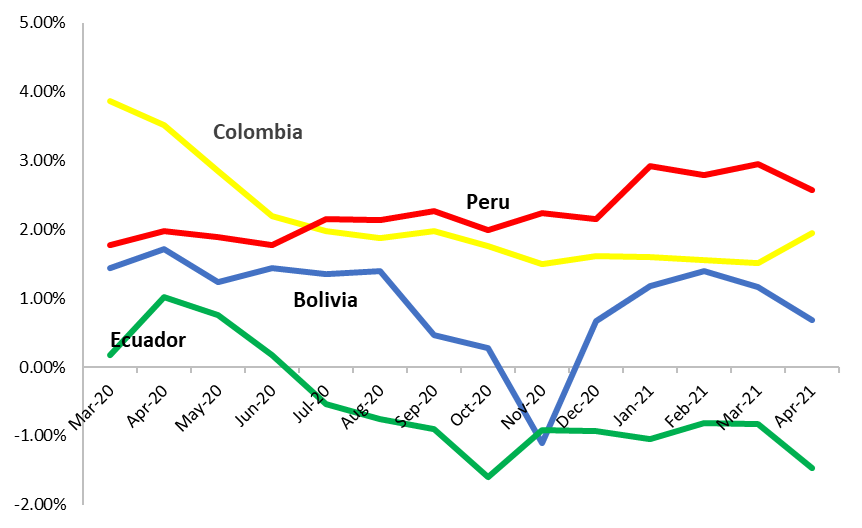
    Andean Countries: Inflation
    Monthly year-on-year figures

    Andean Countries: GDP growth (%)
    Quarterly figures are year-on-year growth
    GDP  2020 forecast* 2021 forecast* Q2 2020 Q3 2020 Q4 2020
    Bolivia -8.0 5.1 -21.7 Not yet available Not yet available 
    Colombia -7.0 5.0 -15.8 -9 -3.6
    Ecuador -9.0 1.0 -12.8 -9.1 -7.2
    Peru -12.9 9.0 -30.2 -9.4 -1.7
    Venezuela -30.0 -7.0 No data No data No data
    *Figures from the United Nations Economic Commission for Latin America & Caribbean Dec 2020
    Quarterly growth based on figures from the local central banks


  • CHILE: Presidential race kicks off

    Patrick de Courcy 23 September 2021 Hits: 4133

    The campaign for November’s presidential elections officially started on 22 September with a televised debate in which five of the seven candidates competed to portray themselves as moderate centrists.

    Opinion polls are suggesting that up to 50% of Chilean voters remain undecided: the candidates appear to have concluded that moderation is therefore a good look for this opening stage of the campaign. Gabriel Boric, the candidate of the left-wing Convergencia Social, said that if elected he hoped to end his presidency with less power than at the beginning, by decentralising power to the regions. Although selected in the primary elections for the ruling right-of-centre coalition Chile Vamos, Sebastián Sichel (Chile Podemos Más) said he thought of himself as an independent centrist.

    The debate was polite, with participants addressing the post-pandemic recovery, the pensions crisis (all candidates propose reforming the current privatised pension model) and abortion (legal abortion is supported by all candidates except Sichel and the far-right candidate José Antonio Kast of Partido Republicano).

    Opinion polls are suggesting that Boric, Sichel and Yasna Provoste, the centre-left Democracia Cristiana (DC) candidate for Nuevo Pacto Social, are leading the race for the 21 November elections, in that order. The local pollster Cadem is showing Boric on 25% support, eight percentage points ahead of Sichel, while Activa gives him 28% support, 10 points ahead of Sichel.

    It is likely that no candidate will achieve the outright majority needed, thereby triggering a second-round run-off ballot on 19 December. According to Cadem, Boric would win in a second round against Sichel, Provoste, or Kast. However, if for whatever reason Boric should fail to make the run-off, Provoste would win against Sichel.     

    Arson attack

    Chilean authorities reported this week that a couple had been seriously injured after an arson attack at their home in Carajue, Temuco, part of the southern region of La Araucanía. Pablo Uquizar, the government representative in the southern ‘macro-zone’ region, suggested the latest arson attack was carried out by the militant Mapuche group Coordinadora Arauco Malleco (CAM). The authorities claim the CAM was also involved in an armed attack last July in which a local sawmill worker was shot. The CAM issued a statement denying any involvement stating it did not target small-scale farmers because “our confrontation is with the dominant power and the interests of capital, our actions are against timber companies, our acts are acts of sabotage, resistance, and self-defence, against the extractivist and predatory forest system”.

  • GUATEMALA: OAS mission signals concern over judicial selection processes

    Abbi Dicker 08 January 2026 Hits: 1177

    A special mission of the Organization of American States (OAS) for the strengthening of democratic institutions in Guatemala recently paid a visit to the country to observe the selection processes due in 2026 in four key judicial institutions: the attorney general’s office, five-member electoral court (TSE), five-member constitutional court (CC), and comptroller general’s office (CGC). The mission’s visit was at the behest of left-of-centre reformist President Bernardo Arévalo, who took office in January 2024, but whose anti-corruption agenda has been held up by key figures such as Attorney General (AG) María Consuelo Porras, who has been blacklisted by the US, European Union, and other members of the foreign community.

    The OAS mission, which conducted its visit from 9-15 November, is a continuation of that deployed in 2024 to observe the selection processes for the supreme court (CSJ) and appellate courts. Ultimately these appointments failed to provide much relief for President Arévalo in his fight against corruption [SSR-24-11] despite theoretically providing his administration with the opportunity to preside over more transparent processes that would result in more suitable candidates.

    The TSE magistrates, CC magistrates, and AG are due to take office in March, April, and May respectively with the new comptroller general to be in post towards the end of the year. The TSE magistrates serve six-year terms, while the CC magistrates serve five-year terms, and the AG and comptroller general serve four-year terms. Only the CC is elected directly, with five institutions electing one member apiece: the executive, legislature, CSJ, bar association (Cang), and rector of San Carlos University (Usac), the country’s main public university. The TSE, AG, and CGC are appointed via shortlists presented by nominating committees which are temporary bodies comprising representatives from the judiciary, legal sector and academia. In the case of the TSE and CGC, congress makes the selection from the shortlists, while in the case of the AG, it is the president.

    In a 14 November statement, the OAS said that the mission held meetings with authorities from the three branches of government, along with the CC, Usac, private universities, students, Cang, women’s organisations and other civil society groups, among others. It highlighted that participants underscored the “central importance of the second-degree electoral processes… for the preservation of the rule of law, judicial independence, democracy, the fight against corruption”, inter alia. The OAS mission however reiterates familiar concerns regarding the misuse of criminal law, and disciplinary or administrative actions by institutions like the attorney general’s office [SSR-25-07]. It highlighted that a “recurring concern expressed to the Mission” was “the fear - among potential candidates, members of nominating commissions, lawyers, academics, human rights defenders, and other key actors – of being subjected to criminalization, smear campaigns, judicial harassment, or attacks on social media as a consequence of their participation in these processes.”

    A subsequent OAS statement issued on 3 December also expressed concerns about a governance crisis affecting Usac’s superior university council (CSU), which has a legal mandate to participate in some of the selection processes. The crisis stems from discrepancies over the latest election of CSU members. Warning that the lack of a functioning CSU could affect the legitimacy of the nominating commissions, the mission calls for a full CSU to be installed and recognised as soon as possible to ensure that the selection processes are legitimate, transparent, and reliable.

    • Governance crisis at Usac

    Usac elected a CSU for the 2022-2026 period in May 2022. Long-time CSU member, Walter Mazariegos, was elected as the university’s dean and CSU head. However, Mazariegos’ election has been denounced as fraudulent by some university officials who refuse to recognise him as dean. He was also blacklisted in 2023 by the US for undermining “democratic processes or institutions by accepting the position of rector of the public education institution in July 2022 following a fraudulent selection process”. His predecessor, Murphy Paiz Recinos, was arrested in 2021 in relation to a major scandal known as the ‘parallel commissions 2020 case’ involving allegations of interference by illicit groups in the justice system.

  • Risk pointers

    LatinNews 31 October 2012 Hits: 453

    *** Towards a Kurdish state.  Selahattin Demirtas, the leader of Turkey’s main Kurdish political party, the Peace and Democracy Party (BDP), said on 27 October at a rally in support of Kurdish hunger strikers: “A Kurdish state is being constructed in the Middle East.”  This, of course, is Ankara’s great fear and the reason it has been working assiduously to get close to the leader of Iraq’s Kurdistan Regional Government (KRG), Masoud Barzani.

    The latest danger for Ankara has been the increase in Kurdish activities in Syria.  According to Turkish sources, the Kurdistan Workers’ Party (PKK) has been allowed to move some 800 guerrillas into border posts controlled by the Syrian military.

    The PKK is said to be collaborating in northern Syria not just with the Kurdish PYD (Democratic Union Party) but also with the leftist Turkish terrorist group no known as Acilciler – the ‘Urgent Ones’.

    *** Russians losing interest in protest movement. An opinion poll carried out by the Levada Centre in October and published on 27 October reports that 75% of Russians do not intend to take part in mass rallies and that 53% are opposed to the mass rallies held since last December.

    A month ago, the respective figures were 70% and 46%.  Those saying they support mass protests has dropped from 39% in September to 30% in October.

    *** Saudi King expresses his fears.  Speaking on 26 October at a dinner to mark the feast of Eid al-Adha, Saudi Arabia’s King Abdullah bin Abdul Aziz warned the commanders and officers of the security forces protecting this year’s Muslim hajj of imminent dangers to the nation.

    He said: “No doubt you are aware of the state through which our region is passing currently.  The Ummah’s enemies are waiting in ambush for your nation.  They have no other goal but to disrupt our nation’s safety and unity, which were achieved with the struggles of King Abdul Aziz and your forefathers...”

    He added: “We are surrounded by seditions which can only be deterred by depending on Allah the Almighty and standing in the face of whoever contemplates tampering with the security, unity, and sovereignty of our country...”

  • URUGUAY: Central bank tries to net the ‘slippery fish’ of inflation

    LatinNews 31 December 2012 Hits: 1787

    Uruguay’s central bank made its largest ever US dollar purchase on 2 January, buying up US$120m in an effort to contain the country’s increasingly entrenched high inflation, famously described by President José Mujica as his “slippery eel”.

    A week earlier the bank’s monetary policy committee lifted the benchmark interest rate to 9.25%, after inflation threatened to hit double digits in the final quarter of 2012. Annual inflation was 9.03% in November, down slightly on 9.11% in October and the highest since December 2008-January 2009. It was also unexpected, following an official price agreement with supermarkets on a basic basket of 200 items and the freezing of public utilities rates.

    The government’s annual inflation target is 4%-6%,but strong domestic demand, coupled with a rising fiscal deficit, means that inflation has been above the target ceiling for years now; the last time it was below 6.0% was in January 2006 (and even then it was only barely under, at 5.94%).

    In a recent (14 December 2012) country report, the IMF forecast real GDP growth of 4.0% for 2013, up from 3.5% in 2012. However the Fund singled out inflation as a concern, and advocated more extensive policy efforts to deal with it. “Monetary policy cannot fight inflation alone, given capital inflow concerns; concerted efforts on other fronts are also necessary. In particular, fiscal policy could better support monetary policy. At the same time, recent initiatives to cut/freeze some consumer prices create distortions without addressing the root causes of inflation.

    In the view of the mission, extensive wage indexation is a key reason why price shocks feed into wages and core inflation”. It called for “prudent” wage growth. “The upcoming wage negotiation round is key given its wide coverage and its multi-year focus. The attempts to link real wage growth with sector productivity growth are welcome, even though it will be challenging in practice. Flexibility to reconsider wage agreements in case of an economic downturn will be important”. To date President Mujica has struggled to deliver on this front, although he has certainly surprised the unions with his strong stance in the face of their demands.

    Local US dollar holders raced to invest in pesos after the central bank lifted the interest rate, prompting the bank’s record intervention. Even so the peso remained firm at URU19.4/US$ in early January.

    • Lorenzo more upbeat than the IMF

    Economy Minister Fernando Lorenzo said on 17 December that the government expects economic growth of “no less than 4%” in 2012, meaning that Uruguay’s growth will be higher than the regional average of 3.2% for the eighth consecutive year

    • Investment plans

    On 14 December Vice-President Danilo Astori announced plans to implement a US$2.0bn public and private infrastructure investment programme in the next two years. Astori said the government was looking to take advantage of the current “economic bonanza” in Uruguay to find entrepreneurs interested in working with it to improve the country’s ageing infrastructure, “a pending issue for the country”.

  • RASTREANDO TENDENCIAS

    LatinNews 12 August 2013 Hits: 517

    ECUADOR | Preocupaciones del sector exportador. El 6 de Agosto la Federación Ecuatoriana de Exportadores  (Fedexpor), un lobby del sector exportador privado, pidió al gobierno liderado por el Presidente Rafael Correa que ofrezca compensaciones “efectivas e inmediatas” al sector para contrarrestar su decisión de renunciar a las reducciones arancelarias de importación de productos ecuatorianos, ofrecidas por el gobierno de EU a través del acta de promoción de comercio andino y de erradicación de las drogas (Atpdea, siglas en inglés). El pasado junio, el gobierno de Correa renunció a Atpdea acusando al gobierno de EU de utilizar el acuerdo, originalmente establecido para alentar a los países andinos a llevar adelante los esfuerzos de erradicación de la droga y el tráfico de drogas, para ejercer una “presión” política sobre Ecuador para hacer su voluntad.

    En particular en ese momento el Presidente Correa pretendía demostrar que no sería influenciado de ninguna manera por EU sobre si otorgar o no asilo político al denunciante de la agencia nacional de seguridad de EU, Edward J. Snowden, quien levantó la tapa del programa de espionaje electrónico global de EU. Aunque esto suscitó preguntas acerca de si Ecuador podría unilateralmente renunciar a los beneficios comerciales que EU ofrece como parte de un acuerdo bilateral, o si no era otra cosa más que un amague del gobierno de Correa dado que en última instancia la decisión de aplicar impuestos plenos a las importaciones hacia EU descansa con las autoridades de EU, la perspectiva de que Ecuador pierda su acuerdo preferencial con su principal socio comercial se convirtió en realidad el 31 de julio después de que el congreso de EU no votó por la renovación de Atpdea, permitiendo así que este expirara.

    Desde entonces el gobierno de Correa ha dicho que ofrecería compensación a los exportadores locales por la pérdida de ganancias que resulten por la terminación de Aptdea e incluso presentó un proyecto de ley en la Asamblea Nacional para tal efecto. Sin embargo, al parecer el sector privado permanece escéptico acerca de esto. En una declaración el presidente de Fedexpor, Felipe Rivadeneira, expresó su preocupación de que las medidas propuestas por el gobierno para compensar a los exportadores podrían terminar no siendo suficiente. En particular, Rivadeneira señaló que el proyecto de ley propuesto estipula que el nivel de compensación y los productos que estarían cubiertos serían determinados por el gobierno, y de acuerdo a su presupuesto. Según Rivadeneira, esto significa que “un mecanismo semi-automático [Aptdea] será reemplazado por medidas basadas en un amplio margen de discreción y sujeto a la aprobación previa de las autoridades”.

    En la presentación del proyecto de ley, Correa estimó que la pérdida de ganancias en general llegaría a US$24m. Sin embargo, según Rivadeneira la cifra está más cerca de los US$35m. Además, Rivadeneira también dijo que la propuesta de compensaciones del gobierno sólo representa “una solución temporaria” y que es necesario soluciones de politica a largo plazo para mejorar la competitividad, “incluido un nuevo acuerdo comercial con EU”. Las preocupaciones de Rivadeneira fueron apoyadas por los últimos datos de Fedexpor, difundidos el 7 de agosto, que mostraban que las exportaciones de Ecuador en los primeros cinco meses del año fueron de US$10,17mm, o un 4,6% menos que en el mismo periodo del año pasado. Con importaciones totalizando US$10,69mm, las cifras de Fedexpor muestran que el balance comercial general de Ecuador arroja un déficit de US$510m.

    VENEZUELA-COLOMBIA | Buscando maneras de facilitar el comercio. El 6 de agosto el ministro de finanzas de Venezuela, Nelson Merentes, celebró una reunión en Caracas con su contraparte colombiana, Mauricio Cárdenas, para discutir maneras de facilitar el comercio bilateral. El comercio entre los dos países ha sufrido desde que se rompieron las relaciones bilaterales en el 2010 en medio de la creciente animosidad entre el gobierno venezolano liderado por el ex presidente, Hugo Chávez (1999-2013), y su contraparte de Colombia, Álvaro Uribe (2002-2010). En el 2010, el comercio bilateral llegaba a US$48mm, y aunque el Presidente de Colombia, Juan Manuel Santos, ha trabajado duramente para restaurar las relaciones diplomáticas, la precaria situación económica en Venezuela ha impedido que el comercio retorne a los niveles anteriores, con el comercio bilateral llegando a solamente US$3mm el año pasado.

    Uno de los principales obstáculos para revitalizar el comercio en las dos vías es la escasez de divisas (particularmente dólares de EU) en Venezuela, que ha hecho que muchos importadores venezolanos no puedan pagar a sus socios comerciales colombianos. En este contexto, después de la reunión, Cárdenas dijo que él y Merentes habían discutido la posibilidad de llevar adelante el comercio sin tener que recurrir “exclusivamente” a los dólares y en cambio usar “nuestras propias monedas”. Cárdenas explicó que el gobierno de Santos estaba interesado en facilitar los pagos desde Venezuela “debido a que acá hay muchos productos colombianos que ahora podrían llenar los comercios y supermercados”, en alusión a la notoria escasez de productos básicos en Venezuela. Sin embargo, al ser preguntado por los periodistas si esto significa que Colombia consideraría utilizar el Sistema Unitario de Compensación Regional (Sucre), un sistema virtual de intercambio de moneda establecido por Chávez como una manera para promover e incrementar el comercio entre miembros de su proyecto de integración regional- la Alianza Bolivariana para los Pueblos de nuestra América (Alba), pero Cárdenas expresó sin rodeos que “no hemos discutido específicamente el uso del Sucre como un medio de pago alternativo, no”.

    • ExpoPerú Centroamérica

    El ministerio de comercio exterior & turismo de Perú (Mincetur) anunció que su recientemente designada ministra, Magali Silva Velarde, visitará Panamá y Costa Rica entre el 12 y 16 de agosto, para asistir al evento empresarial ExpoPerú Centroamérica. Una declaración del Mincetur expresó que el ministerio había decidido participar en el evento organizado por la agencia peruana de promoción de las exportaciones, PromPerú, en un esfuerzo por impulsar el comercio exterior. La decisión de PromPerú de realizar el evento en Panamá y Costa Rica responde al hecho de que desde que entró en vigencia el Tratado de Libre Comercio (TLC) Perú-Panamá, en mayo del año pasado, las exportaciones a Panamá se han incrementado un 57,9% en los primeros cinco meses de este año; y PromPerú espera que el TLC Perú-Costa Rica, que entró en vigencia en junio, producirá resultados positivos similares.

  • TRACKING TRENDS

    LatinNews 08 August 2014 Hits: 1962

    PANAMA | Canal expansion back on track. The Panama Canal authority (ACP) and the multinational consortium carrying out the expansion of the Panama Canal, Grupo Unidos por el Canal (GUPC), struck an accord on 1 August designed to end uncertainty about the completion of the construction work.

    The accord formalises a deal signed back in 13 March, under which the GUPC paid US$100m and the ACP advanced US$100m for the work to continue. GUPC has committed to completing the US$5.25bn expansion project, which includes a third set of locks, by December 2015. But the deal does not resolve the root cause of the dispute which led to a suspension of work last February – a cost overrun of US$1.6bn, which GUPC says it will incur. Instead, these claims will have to be resolved in accordance with legal mechanisms contained within the contract.