All Categories

Subcategories

  • EL SALVADOR: Breaking the logjam?

    LatinNews 15 February 2018 Hits: 544

    It came late, but it finally happened. On 5 January El Salvador’s legislative assembly (AL) ended months of wrangling and approved a national state budget for 2018, providing what looks like a way out of the country’s recurring dispute over government spending and borrowing. The proximity of elections may have something to do with the new, apparently more collaborative spirit.

    As the two largest parties in the AL, the ruling left wing Frente Farabundo Martí de Liberación Nacional (FMLN) and the right wing opposition Alianza Republicana Nacionalista (Arena) have had ample power to make things difficult for each other. They have not hesitated to use it. Of the 84 AL seats Arena has 35 and the FMLN has 31. This means that neither can command an outright majority, but depending on the alliances struck with smaller parties, each can obstruct the other. In recent years this has led to recurring deadlocks over government borrowing and spending (budget approval requires a special two-thirds majority). As a result, El Salvador fell into a partial debt default in April-May 2017.

    But things are looking better for 2018. Despite fears of a new deadlock, the central government spending budget for the year, totalling US$5.52bn, was finally approved with 71 out of the AL’s total of 84 votes. The two main parties cut a budget deal and smaller parties supported it. The government’s initial proposal had been for revenues equivalent to 16.9% of GDP, and for spending equivalent to 18.8%. This implied a deficit, which would need to be funded, of 1.9% of GDP or US$554m. Arena had been insisting it would not agree to any deficit that exceeded US$350m. The government offered various austerity measures to bring the deficit down to US$310m, and then added on US$40m worth of ‘sweeteners’ – budget items that had been specifically requested by Arena (including items relating to education, health, and extra funding for the electoral tribunal). As a result, the overall deficit was limited to US$350m as the opposition party had demanded.

    In terms of voting, divisions with Arena appear to have eased the way to a deal. A total of 18 Arena deputies voted in favour of the budget, six voted against, eight abstained, and three were absent. The result is that the government’s finances for the rest of this year are looking viable. The legislature authorised foreign borrowing of up to US$350m. The government can also call on a separate tranche of up to US$168m in borrowing approved last year and associated with partial pension reform. And finally, if needed, it could also issue more treasury bills (known as Letras del Tesoro Público or Letes) (see sidebar). Fitch Ratings said budget approval “should reduce short term credit risks by unlocking external financing”. Moody’s, another ratings agency, said budget approval showed the government and the opposition were able to work together.

    Politics appears to be driving these changing attitudes to the budget. With congressional elections due in March this year and presidential polls following in February 2019, both main parties have realised that budget intransigence may not be a vote winner. More seriously, each are beginning to realise that they face a threat from outside challengers – new political force and leaders. Voter disillusionment with the traditional parties is running high. Nayib Bukele, the mayor of San Salvador who was expelled from the FMLN last year, has set up his own movement (Nuevas Ideas) and is leading in many opinion polls. Johnny Wright, a dissident Arena deputy who also harbours leadership ambitions, has broken ranks to create another movement, Nuestro Tiempo. Up to 40% of survey respondents say they no longer trust the two traditional parties and are looking for alternatives.

    • Letes

    Existing Letes debt stands at US$712m; the upper authorised limit for Letes borrowing is set at US$1.3bn.

  • Problem Number 1: Crime and Violence

    LatinNews 10 September 2018 Hits: 587

    Despite some improvements in recent years, the Northern Triangle countries continue to experience some of the highest murder rates anywhere in the world outside war zones. The United Nations says that a homicide rate in excess of 10 per 100,000 inhabitants constitutes an epidemic. For at least the last 15 years all three Northern Triangle countries have experienced homicide rates that are various multiples of that – in El Salvador in 2015 the rate was 108 per 100,000, a spike related to the end of a truce in its recurring gang wars. Despite an improvement last year El Salvador was still the second-most murderous country in the region with 60 homicides per 100,000, after Venezuela (89 per 100,000). Honduras was in fourth place (42.8 per 100,000) with Guatemala in sixth (26.1 per 100,000). For comparison, Chile had a homicide rate of only 3.3 per 100,000.

    The murderous Northern Triangle
    Homicide rates per 100,000 inhabitants

    Thr murderous northern triangle

    Source: UNODC, InSight Crime

    There are multiple reasons for such extreme violence. Two of the three countries in the triangle, El Salvador and Guatemala, suffered protracted civil wars which embedded a culture of violence in their social fabric. In El Salvador the war lasted over 12 years (1979-1992) and pitted right-wing military-led or influenced governments against the leftist Farabundo Martí National Liberation Front (FMLN). The United Nations has estimated over 75,000 people died in the conflict. In Guatemala the armed conflict lasted from 1960 to 1996, and again saw military-led and influenced governments fight left-wing rebels. A particular feature of the Guatemalan conflict was acts of genocide perpetrated against Maya indigenous people and Ladinos (mestizos) by the army. Estimates of the casualties range up to around 200,000. While both civil wars came to an end through peace agreements which incorporated the rebel forces into the democratic political process – a highly positive development – the reality is that subsequent governments have failed to effectively combat poverty and social exclusion. The current flawed democracies remain far from inclusive.

    The case of El Salvador’s gangs is particularly striking. It is generally accepted that the gangs were forged in a complex cycle of displacement and migration. Many Salvadorian refugees from the civil war in the 1980s migrated, legally and illegally, to the United States. In some US cities, particularly Los Angeles, their children grew up and joined street gangs. Many of the gang leaders then returned to El Salvador (some were deported back home) from where they further developed the gangs and built them up into international criminal organisations involved in drug and people trafficking and extortion. These gangs, particularly Mara Salvatrucha (MS-13) and Barrio 18, are now the main criminal organisations in the Northern Triangle, with a strong presence not only in El Salvador but also in Guatemala and Honduras.

    On the whole, governments have responded to crime with hard-line or mano dura policies. Critics say that while these policies may deliver some short-term improvement they are often counter-productive. Allowing extreme overcrowding and harsh conditions in the prison system has meant that the gangs effectively run the jails where they can forcibly recruit more members. Mass detentions and incarceration, along with militarised policing, have become standard procedure, causing concern among human rights activists. In El Salvador killings spiralled out of control after the collapse of an inter-gang truce in 2014. Both right- and left-wing parties have competed to follow hard-line law-and-order policies, which have tended to be popular with the electorate, despite the misgivings of those who propose a more nuanced ‘citizen security’ approach, including reform of the criminal justice system.

    Other factors also help fuel violence. Most of the murderers and their victims are young men. This demographic has few alternatives to the gang life, because of high unemployment, high labour informality, and scarce educational opportunities. Low economic growth and high inequality contribute. The Northern Triangle also suffers a degree of geographic misfortune: because of its location, it is a major staging post for the trafficking of illicit drugs produced in South America up through Mexico into the United States.

  • Reducing poverty in the northeast

    LatinNews 07 December 2018 Hits: 116

    Looking forward over a 10-year time horizon, one measure of successful development will be the extent to which some of the least developed regions of the country, such as the northeast, can be included in the benefits of economic development. The northeast is made up of the states of Alagoas, Bahia, Ceará, Maranhão, Paraíba, Pernambuco, Piauí, Rio Grande do Norte, and Sergipe. It has an estimated population of 56.9m (2016), representing 27.6% of the national total. Traditionally the imbalance between the industrialised and wealthy southeast and the rural, poorer, northeast led some analysts to describe Brazil as ‘Belindia’, a composite country created by sticking together wealthy Belgium in the south and poor India in the north. The description is a long-standing and possibly over-used cliché first coined before the rise of the Indian middle class, but still captures at least part of the reality.

    Despite relative success in redistributing income during the commodities boom, Brazil remains a highly unequal society. According to research by statistics institute IBGE, over 50m Brazilians, equivalent to 25% of the population, live in poverty and earn less than the equivalent of US$5.50 a day. Yet in the northeast poverty, experienced by 43.5% of the population, is almost double the national average. Nationally, Brazil’s top 1% of households receives 23% of the country’s income. The average salary of the top 1% was 12.6 times the national average. Men occupied almost two-thirds of all jobs and were paid 22.9% more than women on average. Incomes of white workers were 30.8% higher than the national average. Black and mixed-race workers received 28.0% and 29.1% less than the national average respectively.

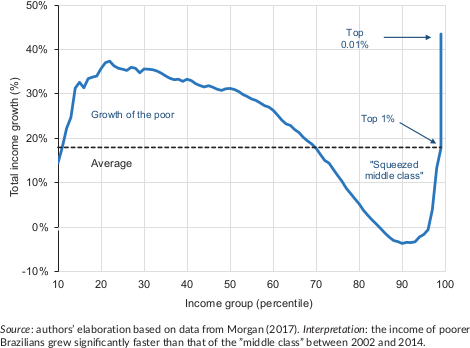
    The question of social and economic inclusion appears to be closely linked to political affiliations. A recent study by the World Inequality Lab, ‘Brazil Divided: Hindsights on the Growing Politicisation of Inequality’, argues that from 2003 onwards the left-wing governments of the Partido dos Trabalhadores (PT) focused on raising the living standards of the poor, particularly in areas like the northeast, through initiatives such a Bolsa Familia, the conditional cash transfer programme and PAC (targeted public investment in housing, infrastructure, and sanitation known as the growth acceleration programme) along with increases in the minimum wage. Income data indicate that from 1998 to 2014 the poorest 50% of the Brazilian population saw its income grow by 42%, while the super rich – the top 1% by income – also saw a similar gain. In contrast, the middle classes – those between the 70th and 99th percentile – saw their income stagnate or even in some cases fall. This, the paper argues, led to a pronounced political and regional cleavage in Brazilian society. To some extent it may explain the strong levels of middle-class dissatisfaction and vocal support for Bolsonaro as an ‘outsider’ candidate.

    Income inequality in Brazil, 2002-2014: Growth Incidence Curve

    Income inequality

    Source: World Inequality Lab: World Issue Brief

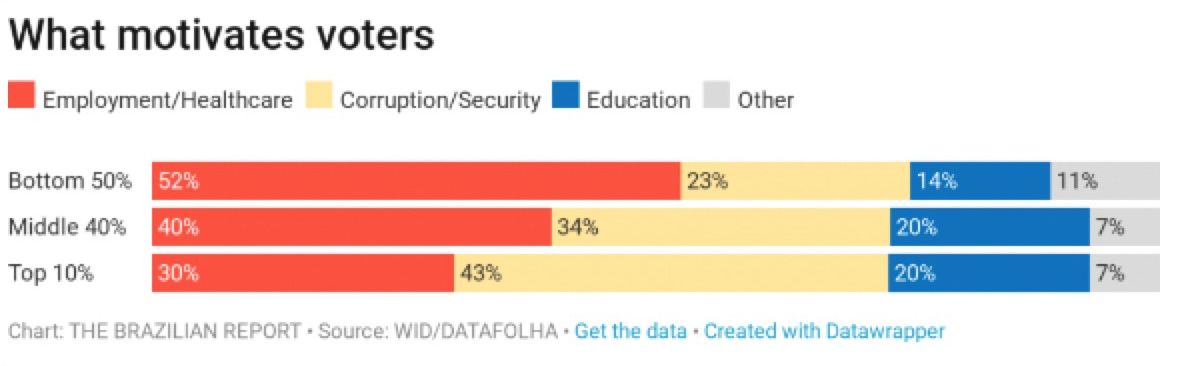
    A Datafolha opinion poll carried out in 2017 reinforces this view. It captured the different perceptions of the country’s main problems by income group. For the bottom 50% of the population the key issues of concern in the upcoming elections were identified as employment and healthcare. While those issues were also important for the middle 40% of the population by income levels, for that group issues of corruption and personal security were notably much more prominent. For the top 10% corruption and security trumped all other concerns.

    What motivates voters

    Looking forward, the question is whether this sharp polarisation will continue: the danger is that it could underpin future political deadlock and in the worst-case scenario, have a negative impact on governability.

  • HONDURAS: US policy on Central America confuses, dismays

    LatinNews 10 April 2019 Hits: 1001

    Honduras has called on its Northern Triangle neighbours, El Salvador and Guatemala, to work together on regional initiatives while the US government led by President Donald Trump deals with the ‘internal discrepancies’ in its ‘contradictory’ policy towards the region.

    The Honduran government led by the right-wing conservative President Juan Orlando Hernández is not seeing much benefit, these days, from the ‘special relationship’ between Honduras and its longstanding traditional ally to the North. For much of the last century, this special relationship was such that Honduras was the original ‘Banana Republic’, a reference to the dominance of US banana companies over the country’s economic (and political) life.

    Nowadays, however, Honduras appears largely indistinguishable from its neighbours to the White House, and indeed latterly suffered the ignominy of been lumped together, with neighbouring Guatemala and El Salvador, as “Mexican countries” by the arch conservative Fox News.

    Barely nine months ago (on 20 June 2018), President Hernández was hosted by US Vice President Mike Pence in his West Wing Office. On 22 January last, the office of the Vice President said that Pence had called Hernández “to reiterate the strong and collaborative relationship between the United States and Honduras”, and “to discuss efforts by both countries to stem the flow of illegal immigration”.

    Pence, the statement read, “commended President Hernández for the proactive and vigorous response to the most recent migrant caravans, including the arrest of several organizers, and encouraged Honduras and other Northern Triangle countries to redouble their efforts. The two leaders also discussed opportunities to work together to fight against illegal gangs and improve the security and prosperity of people in Central America and the United States.” Finally, the statement concluded, Pence “reiterated the United States’ commitment to building a closer relationship with the Hernández Administration and disavowed any efforts by opportunistic political actors to distract from our priorities”.

    Yet latest developments have left Honduras – and its neighbours – dazed and confused. Within the course of a weekend, US policy appeared to do a 180-degree turn. First off, on 28 March, the US Secretary of Homeland Security (DHS), Kirstjen Nielsen, announced a “historic” agreement between the US and the Northern Triangle to address the “root causes” of the migration crisis.

    The meeting with Nielsen was hosted in Tegucigalpa by Hernández. Also present was the Honduran security minister, Julián Pacheco, and his counterparts from El Salvador and Guatemala, Mauricio Ramírez Landaverde and Enrique Degenhart, respectively.

    A subsequent press release issued by the US embassy in Tegucigalpa noted that “a final compact would cover four distinct areas of collaboration: combating human trafficking and migrant smuggling; countering organised crime and gangs; expanding information and intelligence sharing; and strengthening border security”. 

    The US embassy press release cited Nielsen as saying: “We’ve agreed to ramp up our joint enforcement action against criminal networks and to enhance regional border security...We’ve also agreed to do more…to protect vulnerable populations – women, children, and families – to ensure that individuals legitimately fleeing persecution receive the protections they deserve as close to home as possible”.

    Notably, Nielsen’s statement omitted any mention of any specific efforts to promote prosperity, concentrating exclusively on the security angle, and on punitive measures against both traffickers and migrants themselves.

    As such, the statement said that the Memorandum of Cooperation (MOC) on border security cooperation in Central America aimed to better synchronize cooperation between the countries in order to bolster border security, prevent the formation of new migrant caravans, and address the root causes of the migration crisis through better synchronized efforts to include the following: human trafficking and smuggling; combating transnational criminal organizations and gangs; expanding information and intelligence sharing; strengthening air, land, and maritime border security.

    “America shares common cause with the countries of Central America in confronting these challenges,” the statement quoted Nielsen as saying. “We all want to enforce our laws, ensure a safe and orderly migrant flow, protect our communities, facilitate legal trade and travel, support vulnerable populations, interdict dangerous and illicit drug flow, and secure our borders”.

    In a separate statement, President Hernández, who along with his wife met separately with Nielsen, said the Trump US administration was analysing the possibility of sending Linda McMachon, the administrator of the US Small Business Administration (SBA), a US government agency, to meet Northern Triangle government officials to strengthen the small and medium-sized enterprises (SME) sector. Hernández also alluded to the importance of cooperation with the Overseas Private Investment Corporation (OPIC), the US government’s development finance institution.

    It thus came as something of a shock when – just three days later – on 31 March, Mick Mulvaney, the acting White House chief-of-staff, told the US news channel CNN that President Trump had decided to cut all aid for the Northern Triangle countries. Mulvaney’s remarks followed a threat by Trump on 28 March, when he tweeted that “Honduras, Guatemala, and El Salvador have taken our money for years, and do Nothing”.

    A US Department of State spokesperson also confirmed to CNN that “at the Secretary's instruction, we are carrying out the President's direction and ending FY 2017 and FY 2018 foreign assistance programs for the Northern Triangle”, adding that the administration would be “engaging Congress as part of this process”.

    Tensions with Mexico

    Trump’s tweet had come a day after Mexico’s interior minister, Olga Sánchez Cordero, said that the Mexican government was preparing for “the mother of all migrant caravans” to the US border, to comprise some 20,000 Central American migrants – remarks which angered the Hernández government, which called the figures “unsubstantiated” and spent most of the weekend of 30-31 March reiterating to local and foreign media that there was no caravan setting off from the country. In a terse statement, the Honduran foreign ministry accused the Mexican government of fomenting illegal migration.

    While US officials would not say exactly how much money would be affected by the directive to cut off aid for the Northern Triangle, US media cited President Trump as saying: “We were giving them $500m…we were paying them tremendous amounts of money, and we’re not paying them anymore because they haven’t done a thing for us”.

    According to figures collected by the human rights lobby group Washington Office for Latin America (Wola), the US administration had earmarked a total of US$615m in aid for the whole of Central America for 2018 (of which the bulk goes to the three Northern Triangle countries), down from US$655m in 2017.

    Of this, US$120m was for Guatemala, US$80m for Honduras and US$58m for El Salvador. The previous year, the sums were US$140m for Guatemala, US$95m for Honduras and US$73m for El Salvador. Some of this aid money will have been spent already, but now US cooperation on programs ranging from health care and sanitation to efforts to divert young children away from a life in street gangs, as well as schemes to strengthen democratic institutions and tackle corruption, are all at risk.

    President Trump’s move has angered the US Democrats who recovered control of the US House of Representatives following the November 2018 mid-term legislative elections. A letter dated 30 March by a handful of US Representatives, headed up by Eliot Engel (D-NY), Chairman of the House Committee on Foreign Affairs, states “we are extremely disappointed to learn that President Trump intends to cut off aid to the region. The President’s approach is entirely counterproductive. It will only result in more children and families being forced to make the dangerous journey north to the US-Mexico border. We will work with our colleagues in Congress to do everything in our power to push back on the President’s misguided approach to Central America”.

    Some have questioned whether President Trump will in fact be able to cut off the aid to the three countries. For example, Adam Isacson, Wola’s director for defence oversight notes that the US Constitution gives Congress “the power of the purse”. He also highlights that the Impoundment Control Act of 1974 specifically prohibits the president from withholding appropriated funds. Although he acknowledges that the White House could propose not to withhold money but transfer it to other countries, he warns that the “president would pay a huge price if the reprogramming were to happen despite congressional opposition”.

    In response to the Trump move, the Honduran foreign ministry issued a statement dated 30 March proposing that Northern Triangle countries come together themselves to evaluate regional initiatives, while the US resolves the “contradictory policies” and “internal discrepancies” between “the US government agencies and state powers” with regard to cooperation with the region.

    At the same time, however, it was keen to emphasise that Honduran bilateral relations with the US remained “solid, close and positive”, referencing the meeting between Nielsen and the presidential couple the previous week, as well as communications and phone calls between President Hernández, Pence and the US Secretary of State, John Bolton.

    On 1 April, the minister of the presidency, Ebal Díaz, said that Honduras lamented the US decision to suspend aid for Northern Triangle countries, noting that combatting migration means combatting violence and insecurity and that Honduras “has done its job”, noting that the efforts against organised crime had been recognised by US anti-drugs agencies. Díaz added that Honduras did not agree with President Trump’s assertion that Central America had done nothing, adding that it “is a shared responsibility”. He warned that the suspension of aid would affect funds destined for health and education programs, as well anti-corruption efforts, making the point that some of these are not run by the Honduran government, but by official US agencies on the ground in Honduras.

  • BRAZIL: Delta helps Gol repay loan

    LatinNews 16 September 2020 Hits: 806

    Gol Líneas Aéreas Inteligentes, one of Brazil’s top budget airlines, has managed to repay a critical US$300m loan with some help from the US carrier Delta Airlines.

    Airlines around the world are struggling to survive the impact of the coronavirus (Covid-19) pandemic. Latin America’s two largest carriers, Latam Airlines and Avianca, remain in Chapter 11 bankruptcy. Worries over Gol’s ability to ride the storm were heightened because the airline faced a 31 August deadline to repay a US$300m loan contracted with unidentified investors back in 2015. At the time US airline Delta, in a strategic alliance with Gol, acted as guarantor of the debt. The alliance ended earlier this year with Delta instead entering a joint venture with Latam, but the debt guarantee remained in place.

    On 1 September Gol said it had managed to repay the debt. A leaked Delta memo obtained by Reuters said that as part of the refinancing the US airline had worked with Gol to “replace the existing loan guarantee with a smaller loan secured with incremental collateral”. The memo also said the deal reduced Delta’s own financial exposure, while giving Gol more time to adjust to the effects of the coronavirus (Covid-19) pandemic. Separately, Gol’s chief financial officer, Richard Lark, said the company now had no significant debt maturities until 2024, reflecting “the company’s commitment to strengthening its balance sheet over the last four years”.  It had ended August with around R$5.7bn (US$1bn) in liquid assets, including R$2.1bn (US$386m) in cash and receivables.

    IATA says no take-off yet

    The International Air Transport Association (IATA) has criticised Latin American governments for delays in reopening air travel routes and accused them of suffocating the recovery with bureaucracy and red tape. Peter Cerda, IATA regional vice president for the Americas, said that six months after the start of the pandemic, 90% of airline routes remain grounded. IATA has highlighted its concerns over Argentina where Latam Argentina has ceased operations and three international carriers (Air New Zealand, Emirates, and Qatar Airways) have said they are permanently dropping the country from their destinations. 

  • COLOMBIA: Police chief under pressure

    LatinNews 10 December 2020 Hits: 811

    Speaking after a police promotion ceremony held on 8 December, Colombia’s President Iván Duque sought to showcase a successful year of fighting crime. Duque reported that the country’s homicide rate had fallen to its lowest level since 1974, and he highlighted a 30% year-on-year decline in thefts from homes and businesses. He neglected to mention, however, that the activity of illegal armed groups has gone in the opposite direction, with massacres of civilians being carried out at a level not seen in over a decade.

    While many observers have attributed this apparent paradox to the impact of the coronavirus (Covid-19) pandemic – as quarantine restrictions put a stop to everyday crime but facilitate the activities of armed groups – Duque instead chose to credit the work of his chief of police, General Óscar Atehortúa, praising “the transformation of the institution” since he took on the role in December 2018. This show of support was much-needed: with Colombia’s police force already facing calls for comprehensive reform following the killing of at least 13 protesters in September [WR-20-37], Atehortúa has increasingly come under individual pressure too, facing investigation by the prosecutor general’s office over his ties to a barrage of corruption scandals.

    Atehortúa has denounced the allegations against the police – ranging from embezzlement and procurement fraud to extortion and even collaboration with criminal groups – as part of a plot carried out against him by police inspector General William Salamanca, who Atehortúa claims is seeking to take over at the head of the force. These divisions within the institution have drawn national attention as prosecutors have proceeded with investigations, although Atehortúa has been reluctant to testify, claiming that his schedule is too busy. The prosecutor general’s office last week announced that one case of procurement fraud had been dismissed, but at the rate the other investigations are proceeding, it could be some time before this scandal fully subsides.

    • Criminal collusion

    Colombia’s state security forces have long faced allegations of collaboration with illegal armed groups, both at the individual and structural level. One of the investigations in which General Atehortúa is embroiled is based on allegations that a number of high-ranking police officers have extorted members of criminal groups, while allowing them to continue operating. Also this week, John Jairo Cárdenas, a legislator for the centre-right Partido de la U, highlighted warnings from Argelia municipality, Cauca department, that there exists “a non-aggression pact between the state security forces and the various armed groups”. Cauca is a hotspot for illegal armed groups and is the department hardest hit by civilian massacres this year. 

    While Duque has largely resisted weighing in (beyond his general praise for Atehortúa’s work), Defence Minister Carlos Holmes Trujillo – who has come under scrutiny himself lately [WR-20-39] – has made the government’s position abundantly clear, emphasising that Atehortúa is “a great chief of police, and is forging a very important operational environment”. It seems likely that Atehortúa will be able to resist pressure to resign while he maintains such high-profile support, but his continuation in the role will do little to improve the already-tarnished reputation of Colombia’s police force.

  • CARIBBEAN POINTERS

    Patrick de Courcy 15 October 2021 Hits: 2265

    *** GUTERRES PROPOSES DEBT PLAN. On 4 October, United Nations (UN) Secretary General António Guterres presented a four-point debt crisis action plan to the 15th session of the UN Conference for Trade and Development (Unctad) held in Barbados. Making his presentation, Guterres described four “glaring challenges” which he named as “debt distress, systems starved of investment, unfair trade, and a climate emergency” and said that if left unaddressed would “make any notion of prosperity for all a distant dream”.

    Of these, Guterres listed debt distress as the most pressing, calling it a “dagger through the heart of global recovery”. Ensuring extra liquidity was immediately essential, he argued, and could be provided through “a substantial re-allocation of unused SDRs [International Monetary Fund Special Drawing Rights]”.

    After that, Guterres argued, must come “an extension and expansion of the G20’s Debt Service Suspension Initiative into next year”. However, he went on to argue, that may not be enough for many countries which “will need effective debt relief involving both public and private creditors”. He called for “a comprehensive strategy around reforming the international debt architecture – including debt restructuring or reduction, especially for middle-income countries – to help them avoid deadly cycles of debt waves”.

    Separately, the UN Economic Commission for Latin America and the Caribbean (Eclac) has proposed the creation of a Caribbean Resilience Fund to alleviate 12% of the region’s total debt in a policy brief entitled “Liquidity and Debt Solutions to Invest in the SDGs [Sustainable Development Goals]: The Time to Act is Now.”


    *** TOUGH START FOR NEW BAHAMAS GOVERNMENT. The day after the general election held on 16 September, won by the Progressive Liberal Party (PLP), whose leader Philip Davis became the new prime minister, international credit ratings agency Moody’s downgraded The Bahamas from Ba2 to Ba3 with a negative outlook.

    Explaining its move, Moody’s said: “The combination of rising debt burden and a decline in revenue contributed to a further worsening of debt affordability, with the interest-to-revenue ratio increasing to 23% in FY2020/21 compared with 16% in FY2019/20.”

    The agency expects the interest-to-revenue ratio to peak in FY2021/22 “but to remain above 20% over the subsequent three years, and significantly higher than rated peers”. The debt burden is expected to remain close to 80% of GDP by the end of FY2022/23, which is “well above the Ba3-rated median of 60%”.

    Moody’s is forecasting 8% growth for The Bahamas this year, with 7% next year, which (along with the ending of pandemic-related spending) should allow for “fiscal consolidation”.


    *** BELIZE PM UPBEAT ON ECONOMIC RECOVERY. On 21 September, during Independence Day celebrations, Belize’s Prime Minister John Briceño said that agriculture was leading an “economic resurgence”, with nearly 25% growth in the second quarter, and that tourism was “not far behind”, growing by 20% in the second quarter.

    The prime minister added: “Overall, our economy is now headed in the right direction, experiencing an overall growth of 22% in the second quarter and over 6% in the first six months of the year – more than triple what our…partners like the IMF expected.”

  • Ecuador court halts Palacio punishment

    LatinNews 11 October 2011 Hits: 4318

    Development: On 10 October a court in Ecuador ruled that the sentence handed down to Emilio Palacio should delayed.

    Significance: The ruling is anyway immaterial because Palacio, a journalist at El Universo, who was convicted of criminal libel against President Rafael Correa on 21 July, has fled to Miami. The court’s ruling, however, is useful to the Correa government which was publicly criticised last week by a German parliamentary delegation. The German delegation accused the Correa government of attacking press freedom. The government’s image got separate polish when Baltasar Garzón, a prominent Spanish human rights judge, confirmed that he will monitor Ecuador’s proposed judicial reforms, during a visit at the end of November. 

    Key points:

    • Palacio hailed the victory won by his lawyers. The court ruled that the punishment (which includes three years in prison) could not be imposed until his appeal had been heard. Palacio nevertheless claimed that he would end up with a prison sentence, eventually.

    • Palacio is unlikely to serve any prison time, however, because Correa himself has ruled out applying for Palacio to be extradited from the US.

    • Separately, Ivonne Baki, the head of the commission trying to drum up support for the Yasuní-ITT project, indicated that the government was changing strategy, after the visit by the German parliamentary delegation. The Yasuní-ITT project, launched in 2007, calls for Ecuador to be paid US$3.5bn not to produce oil which lies under the Yasuní national park. Originally the Correa administration expected to raise money from other governments: now Baki said that the government would try to raise the money from NGOs and companies.

    • The government has set itself a target of raising US$100m for Yasuní by the end of this year. The fund currently stands at US$60m. President Correa is on record as saying that if the US$100m target is not reached, the government may authorise oil production from Yasuní

  • HONDURAS: Falling fuel prices bring some relief

    LatinNews 12 June 2012 Hits: 660

    Fuel prices have fallen at the country’s 420 gasoline stations for eight consecutive weeks since 16 April, according to the Comisión Administradora del Petróleo (CAP), bringing some relief to Hondurans after fuel topped HNL100 a gallon earlier in the year. As of 1 June super gasoline fell to HNL91.71 a gallon, while regular gasoline fell to HNL85.17 a gallon. Crude oil fell to a six month low on 1 June, with the West Texas Intermediate, the reference price for Honduras, dipping to US$83/barrel.

    Yet consumers argue that the CAP, which was quick to sanction 15 consecutive price increases when oil prices were on the up in late 2011 and early 2012, is much slower to reduce them, noting that gasoline prices have fallen just eight lempiras a gallon since April, while international oil prices have fallen by US$23/b in the same period.

    According to the central bank, the country’s oil import bill was US$780m in the first five months of 2012, with imports of fuel and lubricants and electrical energy up 24% year-on-year, due to higher international oil prices between January and April.

    Inflation was 5.7% year-on-year in April but should begin to fall from May on lower fuel prices.

    Economic activity rebounds

    The central bank reported that its index of general economic activity (Imae) rose 5.2% year-on-year in the first quarter. The growth was broad based, led by the financial sector (14.1%) construction (13.2%), transport and storage (8.8%), mining (7.5%), post and telecoms (6.7%), retail (5.0%), agriculture, livestock, forestry and fishing (4.2%) and manufacturing (3.6%). Real annual GDP growth was an estimated 3.7% in 2011.

    IMF: The 18-month stand-by arrangement with the IMF expired on 31 March and a follow-up deal is still being negotiated. The government hopes to have it ready in June.

    BOP: Honduras posted a current account deficit of US$1.5bn in 2011. The trade deficit was US$3.13bn, on exports of US$3.8bn and imports of US$10.34bn. Of total exports, US$3.29bn (or 86.5% of the total) comprised of basic manufacturing assembly (or maquila) goods. Within imports, 20% were made up of maquila goods for assembly and re-export, mostly to the US.

    Currency: The lempira was trading at HNL19.43/US$ on 4 June. Net international reserves amounted to US$2.86bn on 31 May.

  • RASTREANDO TENDENCIAS

    LatinNews 08 October 2012 Hits: 467

    NICARAGUA | Leve declinación económica por delante. Entre ahora y el año 2016, el crecimiento económico declinará levemente, pero aún llegará a un razonablemente saludable 4% - 4,5%, según Bayardo Arce, asesor en asuntos económicos del Presidente Daniel Ortega. El año pasado, el PIB de Nicaragua creció un 5,1%. Este año, se espera que la tasa decline a 4%, y después se incrementaría de manera constante a 4,5% para el 2016.

    Arce agregó que la inflación se mantendría este año en 8%, la misma tasa registrada en el 2011 antes de caer progresivamente al 7% para el 2016. Estas proyecciones, dijo Arce, están basadas en el crecimiento esperado en las ganancias por exportación, las remesas de expatriados, ganancias por el turismo, y la inversión extranjera directa (IED).

    COSTA RICA | Se eleva el desempleo. En el segundo trimestre de este año, el desempleo abierto en Costa Rica ha llegado al 10,2%, subiendo del 9,8% en el periodo comparable del 2011. El principal factor que condujo la tasa hacia arriba fue un incremento del 11,2% en la población en edad de trabajo, contra un estancamiento en el mercado del empleo. Hubo pérdidas de empleos en la administración pública, en algunas industrias y en el comercio, pero hubo ganancias en telecomunicaciones, empleos administrativos, construcción, transporte, servicios de salud, educación, y empleo por cuenta propia.

    De acuerdo con el instituto nacional de estadísticas, el 16% de la población ocupada está ganando menos que el salario mínimo legal.

    GUATEMALA | Pese a la violencia, la inversión crece. En la primera mitad de este año, el flujo de inversiones extranjeras directas (IED) llegó a  US$770,5, un incremento del 47,2% sobre el mismo periodo del año pasado. La IED ha estado creciendo constantemente en los últimos años: US$600m en el 2009; US$805,8m en el 2010; y US$984,6m en el 2011. Para todo este año, el Banco de Guatemala está prediciendo una entrada de US$1,5mm en IED, lo que sería un record. En enero-junio de este año dos sectores sumaron poco menos de dos tercios de la IED: las manufacturas atrajeron el 37,2% y la electricidad el 26,8%.

  • Risk pointers

    LatinNews 06 March 2013 Hits: 377

    *** A Saudi reaction to Iran nuclear talks.  The Saudi Arabian daily al-Watan responded sceptically on 28 February to the ostensibly positive outcome of the latest round of nuclear talks between Iran and the UN Security Council five permanent members plus Germany (P5+1).  The Saudi daily said that the relatively soft tone emanating from the Western powers shows that “the Western camp in the 5+1 group is facing a genuine dilemma regarding this dossier and does not want to stir matters up at this particular point in time”.

    The paper then went on to warn: “The 5+1 group’s clear failure to adopt a united position on the Iranian nuclear file, which is a threat to the entire region, reflects the entire international community’s failure to maintain peace and prevent the proliferation of banned weapons.”

    And, for good measure, it added: “The region’s issues cannot be separated from one another.  They are largely interconnected.  It simply makes no sense to separate Tehran’s nuclear programme from Iran’s clear backing for the Syrian regime and its support and financing of Lebanese Hezbollah as well as other sectarian currents and groups in Iraq.”

    *** North Korean grain imports from China dive.  According to data from the Korea International Trade Association, the volume of grain imported from China by North Korea plummeted in January.  During January, North Korea imported 2,174 tons of grain.  This was just 9.2% of the total imported in December.  The figure of 2 tons of fertilizer imported in January was 20% of the December figure.

    Kwon Tae-jin, a researcher at the Korea Rural Economic Institute said: “The biggest reason is because China has recently begun to restrict grain exports to meet growing domestic demand.”  However, he added that bilateral tension caused by the North’s rocket launch and nuclear test over the past months “may also have affected the two-way grain trade”.

    *** More Chinese incursions into Japanese waters.  On 6 March, two Chinese fishery surveillance vessels sailed into Japan’s territorial waters around the disputed Senkaku/Diaoyu Islands.  This marked the 32nd incursion into Japanese waters by Chinese ships since September, when the Japanese government bought a number of Senkaku Islands from a private owner.

    According to Japan’s coastguard, three other Chinese vessels were seen in contiguous waters, and when warned not to enter Japanese waters they responded by saying that the waters were part of Chinese sovereign territory.

  • EL SALVADOR: Stabilising public finances, or not…

    LatinNews 10 October 2013 Hits: 2199

    Presidential elections in El Salvador are scheduled for early 2014; congressional elections, for early 2015. The country's political cycle will hamper essential reforms of public finances. Further, other changes are necessary if El Salvador is to emerge from sluggish growth and rampant poverty.

    The US financial crisis of 2008-09 hit El Salvador hard. Heavily dependent on remittances from workers in, and exports to, the US, El Salvador's GDP contracted by 3.1% in 2009. However, as Chart 1 shows, this was in the context of a very long trend of growth in real GDP that has been sluggish - at just 1.4%-2.0% per annum. The government's overall fiscal deficit blew out to 5.7% of GDP in 2009. The deficit has remained at about 4.0% of GDP since then. For its part, the International Monetary Fund (IMF) is looking for deficits of 3.9% of GDP this year and of 3.8% in 2014.

    Other observers are even more pessimistic. On 16 July this year, Fitch Ratings lowered its long-term foreign and local currency sovereign ratings from BB to BB- and maintained a negative outlook. Fitch also lowered the country ceiling from BBB- to a sub-investment grade BB+, and kept the short-term foreign currency rating at B. Fitch is concerned that delays to the implementation of the Fiscal Stability Pact, on which the legislative and executive branches of El Salvador's government agreed in 2012, could result in a deficit of 4.3% this year, 'well above the 2.7% goal’.

    Chart 2 summarises the reasons that Fitch gave for the downgrading. In essence, El Salvador's government has deferred tough decisions about its budget, in a country that faces structural obstacles to growth. El Salvador's political cycle means that the fiscal reforms deemed necessary by the likes of the IMF are unlikely to be addressed properly over the next year. Fitch also argues that the political polarisation of the country discourages investment, which has (on IMF figures) stagnated at around 14% of GDP over the last five years or so.

    Rationale behind Fitch's downgrading, July 2013
    *Sustained economic underperformance relative to peers
    *Overall debt to GDP ratio of 56.7% - well above median for BB rated countries
    *Primary deficits and pension costs mean that the ratio is likely to reach 60% by 2015.
    *Fiscal deficit in 2013 likely to be 4.3% of GDP - well above 2.7% target
    *Government overly reliant on short-term Letras del Tesoro (LETES) for funding.
    *Structural weaknesses, including political polarisation that is discouraging private investment
    Source: Fitch Press Release, 16 July 2013

    World Economic Forum's 2013-2014 Global Competitiveness Report
    Selected rankings (out of 148) for El Salvador
    Overall Global Competitiveness Index 97
    Selected basic requirements:
    Institutions 130
    Infrastructure 72
    Macroeconomic environment 102
    Health and primary education 86

    Selected efficiency enhancers:
    Goods market efficiency 77
    Labour market efficiency 121
    Financial market development 101

    Selected innovation/sophistication factors:
    Business sophistication 60
    Innovation 96
    Source: World Economic Forum, Global Competitiveness Report 2013-2014.


    Chart 2 also includes selected figures from the World Economic Forum (WEF)’s Global Competitiveness Report 2013-2014. Of 148 countries assessed by the WEF, El Salvador ranked 97th overall. The WEF suggests that the most pressing problems are the weakness of the country's institutions and the inefficiency of the labour market. By contrast, the physical infrastructure and (especially) the overall sophistication of the country's businesses are relative strengths. These findings were generally supported by the WEF’s survey of local enterprises about the business operating environment in El Salvador. In contrast to other countries in the region, crime/theft and inefficient government bureaucracy are not seen as major problems. Corruption, policy instability and restrictive trade practices are more worrisome. However, the most important problem - by quite a margin - is access to financing, or the lack of it. Chart 3 shows the details.

    The government's gradually deteriorating financial position - as described by Fitch - is one reason for the private sector’s difficulties in getting the capital it needs. However, it is not the only one. The local banking sector is undersized, cautiously managed, well capitalised and strictly regulated. Overall, deposits amount to 43.2% of GDP, while credit to non-bank customers amounts to 40.1%, according to the IMF. In 2008, the corresponding figures were, respectively, 45.0% and 43.0%. In the recent past, M2 and credit have hardly grown at all, as chart 4 shows.

    El Salvador - Selected economic indicators 2012 2013
    Actual CPI Inflation in 2012 and official projection for 2013 % Jul-13 0.8 2.9
    Actual real GDP growth in 2012 and official projection for 2013 % Jun-13 1.3 1.9


    Actual balance of trade deficit in 2012 and official projection for 2013 (US$mn) Jul-13 4,931 5,113
    Months of exports covered by official foreign exchange reserves Jul-13 2.9 3.1
    Actual current account deficit in 2012 and official projection for 2013 (US$mn) Mar-13 698 1,052
    Actual remittances in 2012 and official projection for 2013 (US$mn) Jul-13 3,911 4,193


    Debt ratio % [1] End June 55.6 58.6
    Total debt outstanding (US$mn) End June 13,267 14,547
    Of which: foreign (US$mn) End June 7,177 8,069


    Year-on-Year M2 growth % End May 1.7 1.0
    Year-on-Year lending growth % End May 1.6 4.7
    Cash Reserve Ratio % End July 22.46 22.24
    Nominal GDP (US$mn) End July 23,844 24,831
    [1] Debt outstanding as percentage of GDP

    Secretaría Ejecutiva del Consejo Monetario Centroamericano, REM 168, August 2013


    Chart 4 highlights a number of other key features of El Salvador's economy. Unlike in some countries in the region, the real debt burden will not be reduced by rising consumer prices. Because the US dollar is used as the currency, the rate of inflation basically matches that of the US. The trade deficit is not covered by remittances from Salvadorean workers abroad (mainly in the US), which amount to around 17% of GDP. The central bank's foreign reserves are sufficient to cover about three months of imports.

    All these factors add to the overall fragility of an economy where poverty and inequality are rampant. Overall per capita income in 2012 was, according to the IMF, US$3,864. Real per capita incomes are lower than they were in 2008. The Gini index is comparatively high, at 47%. Some 43% of the population live below the poverty line.

    In its latest (mid-2013) Article IV consultation with the administration led by President Mauricio Funes, the IMF recommended that the government adopt five measures to stabilise the budget and, over the medium term, to reduce the public sector debt ratio to below the level of 2009 (i.e. 52% of GDP).

    The measures are: the removal of tax exemptions (which should improve the overall fiscal balance by 0.3% of GDP in 2013); the adoption of a new property tax (0.1%); keeping the nominal public sector wage bill at 2012 levels (0.3%); better control of government spending on goods and services (0.1%); and a reduction in subsidies that do not benefit low income households (0.2%). Each of these measures should have an even greater, and positive, impact on the fiscal balance in 2014.

    The IMF also argues that pension reform is essential over the medium-term. Pension payments by the government have amounted to about 2% per annum (a very sizeable portion of the overall deficit) over the last five years. This spending has been largely funded by the placement of debt with El Salvador's private pension fund: the IMF notes that as of end-2012 the debt held by these funds amounted to 10% of GDP, or about one-fifth of all public debt outstanding. The Funes government itself estimates that the unfunded liabilities pertaining to the Defined Benefit element of the pension system amount to around 70% of GDP.

    The pension system is not just unfunded. It is also unjust. About 50% of the benefits paid by the government goes to just 20% of pensioners, most of whom are in high income groups. About half of the unfunded liabilities pertain to 10% of the people enrolled in the pension system. As the IMF notes, 'effectively, present Defined Benefits provide large subsidies to a small group of the population at the expense of current and future generations of taxpayers.'

    The nature of El Salvador's economy and society in 10 years’ time will, therefore, depend on the fiscal reforms that are executed in the next year or so, and broader reforms over the next five years. The IMF's recommendations provide a useful checklist against which the government's commitment to fiscal reform can be measured in the coming months. However, El Salvador's political cycle means that it would be remarkable if all the IMF's suggestions were actually implemented.

    Over the longer term, the challenge is to boost investment, productivity and equity. A reform of public finances and pensions should help, because it would make available funding for investment: as the WEF notes, lack of finance is among the biggest worry for businesses operating in El Salvador. The IMF suggests that the country's potential annual growth rate could be lifted to around 4.0%-4.5% if the rate of domestic investment was lifted to around 25% of GDP and the average level of education extended by two years.

  • TRACKING TRENDS

    LatinNews 07 July 2016 Hits: 2790

    PERU-ECUADOR | Petroamazonas-Petroperú ink deal. In one of his final actions before resigning as president of Petroperú, Peru’s state oil company, German Velásquez signed a memorandum of understanding (MOU) on the development of oil production and transport cooperation mechanisms with José Luis Cortazar, his counterpart at Ecuador’s state-owned oil firm, Petroamazonas, during a ceremony held in Quito.

    The two presidents said that the signing of the MOU was the result of bilateral talks over energy integration first launched in 1991, specifically the possibility of linking Peru’s Norperuano pipeline to the Suroriente Ecuatoriano oil fields in Ecuador. Last year at a binational Peru-Ecuador ministerial cabinet meeting the two countries agreed to evaluate the technical, economic and legal conditions to exploit, transport, distribute and sell hydrocarbons from Ecuador’s ‘Bloque 86’ concession located in Pastaza province.

    Bloque 86 has not yet been exploited or explored and its development would provide royalties for Ecuador and revenues from the sale of oil to Peru, which could be quickly distributed along the Norperuano pipeline to coastal areas, where some of the country’s major urban centres are located. But first the Norperuano pipeline needs to be fit for purpose.

    • Mining and hydrocarbons

    Peru’s oil extraction fell by 26.95% year-on-year in May owing to the suspension of the Norperuano pipeline’s operations. This did not stop the mining and hydrocarbons sector expanding by 33.24% in May, however, its biggest increase in over 14 years, according to the national statistics institute (Inei). The mining sector grew by 36.70% thanks largely to increased extraction of copper (63.89%), gold (12.97%), and silver (32.31%).

  • URUGUAY: Government unveils new security objectives

    Abbi Dicker 01 April 2026 Hits: 1325

    Uruguay’s government led by President Yamandú Orsi is seeking to boost public support through new security initiatives. On 9 March Interior Minister Carlos Negro announced a new 10-year public security plan. This comes as violence linked to organised crime and drug trafficking is among the top concerns of the public, with homicide figures remaining high despite a slight decline in 2025.

    Following a cabinet meeting led by Orsi on 9 March, Negro held a press conference to announce that the government was drafting a new initiative to be implemented over the course of the next 10 years. He said that the plan will have seven key pillars, comprising over 79 actions and more than 100 measures. He highlighted that the plan had been discussed with various departments as well as with civil society groups and was the result of consultations that took place throughout 2025, with five rounds of meetings to discuss issues such as homicides, gender violence and violence against children and teenagers, gun crime, drug trafficking, and cybercrimes and scams. 

    The government’s increased efforts to signal that it is taking public security seriously come a year after Orsi’s inauguration in March 2025. His first year in office appears to show some encouraging data on crime. According to the government’s preliminary annual crime report released in late January, homicides in Uruguay in 2025 totalled 369, which is a 3.4% decrease compared to the murder tally of 382 registered for 2024.

    Specialist website Insight Crime has also noted that Uruguay’s crime levels have been declining in recent years. However, in its 2025 homicide round-up, it highlighted that homicide figures are still higher than they were before 2018, the year that Uruguay faced a major crime wave, with government data showing a total of 420 homicides registered that year, the highest figure in the past 10 years. The 2025 homicide figure marks an 8.2% rise compared to the 341 killings in 2020 and a 25.9% increase compared to 293 killings registered in 2015.

    Although Uruguay is considered a relatively safe country by regional standards, insecurity often ranks as the top public concern in opinion surveys. Insight Crime’s annual figures for 2025 show that Uruguay’s murder rate stood at 10.3 killings per 100,000 people, which is lower than the median homicide rate of 17.6 killings per 100,000 for the whole of Latin America and the Caribbean. However, in late February Uruguayan polling firm Equipos released the results of a survey which showed that ‘insecurity’ was still the most mentioned problem when respondents were asked to choose the biggest issues facing the country, receiving over 50% of total mentions.  

    Given the importance that the public places on crime reduction measures, a failure by the government to communicate its efforts to address the issue would weigh on President Orsi’s popularity. Around a year into Orsi’s term, polling firm Cifra released data on 2 March showing Orsi’s disapproval rating stood at 46% while his approval rating was 31%. This disapproval rating has been ticking up throughout 2025. Cifra’s figures showed that in March 2025, when Orsi first took office, his approval was at 37% and his disapproval was at only 15%. Another polling firm, Factum, also released survey results on 2 March showing that Orsi’s disapproval rating has been rising. According to Factum’s figures, public disapproval for Orsi stood at 41% for the period of January-February 2026, marking an increase from the 33% disapproval rating registered for September-October 2025 and from 22% in May-June 2025.

    Marset arrest

    Uruguayan drug kingpin Sebastián Marset, the alleged leader of a criminal organisation known as the Primer Cartel Uruguayo, was captured in Bolivia on 13 March. His arrest was celebrated by government officials in Uruguay. Interior Minister Carlos Negro described the arrest as a “severe blow to drug trafficking” in the whole region. Negro gave a press conference in which he appeared to take some credit for the operation, highlighting the data and other relevant information about Marset that Uruguayan authorities provided to the Bolivian police.

  • PARAGUAY: Conflicto sobre tierras toma un extraño giro

    LatinNews 05 March 2012 Hits: 1015

    Cuando el gobierno del Presidente Fernando Lugo prometió proveer tierra a los campesinos sin tierra conocidos como carperos en el este del Paraguay, que habían ocupado una propiedad rural [IL-12-08], pocos esperaban que las tierras estuviesen dentro de los confines de un parque nacional. Aún así, esto es precisamente lo que ha ocurrido el 26 de febrero, cuando varios miles de carperos consintieron ser trasladados por la policía nacional al parque nacional Ñacunday. El jefe de gabinete, Miguel López Perito, insistió en que la medida era solamente temporal y que el parque no sufriría daño, pero los ambientalistas reaccionaron prestamente. Todo el episodio expone la incapacidad de la administración Lugo, enfrentada a un congreso hostil y conservador, de poner en marcha la reforma agraria que ha prometido.

    WWF Paraguay, Guyra Paraguay, Fundación Moisés Bertoni y el Instituto de Derecho y Economía Ambiental, presentaron una demanda juicial el 27 de febrero protestando en contra del uso del parque nacional Ñacunday en el departamento de Alto Paraná, como una violación a la ley nacional y los acuerdos internacionales, sentando un terrible precedente. López Perito dijo que “no había otra alternativa” más que transferir  a los carperos a Ñacunday. Dijo que parte del parque nacional ya había sido dañado por los productores de soja, y que los ambientalistas no se habían quejado de eso. Que el gobierno se compare a sí mismo con los productores de soja interesados en las ganancias en su compromiso con mantener la ley no es exactamente la línea de defensa más fuerte. El hecho de que el gobierno se haya visto obligado a utilizar un parque nacional de esta manera, indirectamente fortalece lo mantenido por el líder de los carperos, Victoriano López, que el estado tiene poca tierra para repartir. López sostiene que esto se debe a que gran parte de la misma ha sido adquirida ilegalmente por grandes terratenientes (ver abajo).

    • Tierra

    Victoriano López afirma que tan sólo en el Alto Paraná, más de 543.000 hectáreas de tierra que el estado nunca vendió han sido adquiridas ilegalmente por grandes terratenientes. El instituto nacional de desarrollo rural y de la tierra (Indert) está investigando este, y otros reclamos como este, y está procurando verificar los títulos de propiedad de la tierra, pero esta es una tarea muy compleja, que se torna aún más difícil por el hecho que la credibilidad del mismo Indert es cuestionable. Un informe realizado por la comisión de verdad y justicia (CVJ) creada por ley en el 2003 para investigar los abusos de derechos humanos cometidos desde el inicio de la dictadura de Stroessner en 1954 (1954-1989), sostiene que 64% de las 8m de hectáreas distribuidas entre 1954 y 2003 fue adquirida ilegalmente.

  • CHILE: Piñera bounces back

    LatinNews 09 August 2012 Hits: 3377

    President Sebastián Piñera is making a steady but sure comeback in national opinion polls. Piñera enjoys an approval rating of 36% in the latest poll conducted by Adimark, up 10 percentage points in three months, as a series of positive data has been released, including impressive GDP figures, falling poverty, low unemployment and inflation, and the successful approval of an anti-discrimination law long mired in congress.

    Piñera has looked perplexed for much of the last 18 months as his government’s economic successes have paradoxically seen his popularity plummet. Much of this was discontentment with the whole political system, however, and not specifically the government. Small improvements in the Piñera administration’s weak political management have also meant that high GDP growth figures (6% last year and 4%-5% predicted this year), low unemployment and inflation of 6.6% and 2.7% respectively, and success at exceeding ambitious job creation targets, have cut Piñera some slack.

    It is too simplistic to deduce that Piñera’s steady recovery in popularity will benefit the parties within the ruling right-wing Coaliciόn por el Cambio in October’s municipal elections; these are, after all, fought on local issues but they are certainly not entirely dissociated, and a national government that has regained a spring in its step rather than limping from one crisis to another will clearly be more of a help than a hindrance for the Coaliciόn. The Adimark poll showed that approval for the Coalición remains on just 25% with 61% disapproval but the left-wing opposition Concertación fared even worse with 19% approval and 69% disapproval.

    • Golborne riding high

    The most popular member of the cabinet, in the Adimark poll, is the public works minister, Laurence Golborne, with 75%, which is significant ahead of presidential elections in 2013. Golborne has preserved his popularity since the rescue of the 33 miners trapped underground after the collapse of the San José copper mine beneath the Atacama desert in August 2010. President Piñera marked the second anniversary of the rescue this week by joining the miners in the northern city of Copiapό.

  • BOLIVIA: Brutal asesinato sacude la campaña electoral

    LatinNews 29 August 2014 Hits: 651

    El reciente asesinato de una mujer de 26 años en Santa Cruz, la capital de la región este del mismo nombre, ha conmocionado al país, una vez más concentrando la atención antes de las elecciones del 12 de octubre sobre lo que ha sido un punto débil del gobierno del Movimiento al Socialismo (MAS) liderado por el Presidente Evo Morales: la seguridad.

    Sophia Leticia Calvo, una ex modelo y bioquímica, fue atacada en un estacionamiento de autos el 15 de agosto por uno de los empleados del sitio, Ronald Fernández Chambi, quien se cree que la había violado antes de apuñalarle y estrangularla. Tres días más tarde, Fernández recibió una sentencia de 30 años de prisión (la pena por femicidio de acuerdo con una ley del 2013 –ver más abajo). El asesinato provocó indignación, con unas 4.000 personas reunidas en Santa Cruz el 19 de agosto, exigiendo mejor seguridad al gobierno de Morales. Claudio Providas, el representante local del Programa de las Naciones Unidas para el Desarrollo (PNUD), también emitió una declaración expresando preocupación.

    Además de concentrar la atención sobre la continuada necesidad de abordar la violencia de género, el asesinato de Calvo ha conducido a pedidos más generalizados para que el gobierno de Morales mejore la seguridad. En junio del 2014 el ex ministro del interior, Carlos Romero (quien desde entonces ha renunciado al cargo a fin de competir en las elecciones por una banca en el senado), ubicó la tasa nacional de homicidios en 12,1 por 100.000 habitantes en el 2013. Elevándose de 8,9 por 100.000 habitantes en el 2010, según cifras de la Oficina de la ONU sobre drogas y delitos (Unodc). El asesinato de Calvo también ha compelido a los diferentes partidos que compiten en las elecciones de octubre a proveer más información acerca de cómo ellos pretenden frenar el femicidio y el delito en general.

    Con relación al femicidio, la Unidad Demócrata (UD), de centro-derecha, liderada por el magnate del cemento, Samuel Doria Medina, quien actualmente está en segundo lugar en las encuestas detrás de Morales (con un 17% contra un 59% según el último sondeo de Ipsos difundido el 19 de agosto), está proponiendo cadena perpetua, y el ex presidente, Jorge Quiroga (2001-2002), del Partido Demócrata Cristiano (PDC), quien está en tercer lugar con 4%, está pidiendo  sanciones más estrictas. Mientras que la ministra de justicia, Sandra Gutiérrez, pidió la pena de muerte, el opositor de izquierda, Movimiento Sin Miedo (MSM), cuyo candidato, el ex alcalde de La Paz, Juan del Granado está en cuarto lugar, con 3%, está planteando la instalación de oficiales de policía comunitarios para frenar el delito en general.

    Aún así, los manifiestos de los partidos permanecen vagos en lo referente a seguridad. El MAS propone fortalecer aún más la policía y proveerla de mejor equipamiento –ubicando cámaras de seguridad en las ciudades capitales regionales, taxis seguros, así como también programas de educación preventiva. La UD está ofreciendo una exhaustiva política de seguridad que prevé el fortalecimiento de la policía y el servicio de prisiones. El MSM está pidiendo una policía comunitaria, y comités de seguridad ciudadana, mientras que el PDC propone fortalecer la policía y crear brigadas vecinales de vigilancia que recibirían apoyo del Estado a través de entrenamiento, equipamiento y ayuda logística.

    Derechos de género

    A pesar de la promulgación en marzo del 2013 de una ley que sanciona el delito de feminicidio con una sentencia de prisión de 30 años sin derecho a perdón, la organización, Observatorio Manuela del Centro de Información y Desarrollo de la Mujer (Cidem), advierte que el feminicidio está creciendo. Cidem reportó de 59 feminicidios en los primeros seis meses del 2014, mientras que el total para el 2013 fue de 110.

    Un informe de marzo del 2013 de la Organización Mundial de la Salud (OMS), titulado ‘La violencia contra las Mujeres en América Latina y el Caribe’, señala que el 53% de las mujeres bolivianas sondeadas afirmó haber sufrido abuso físico o sexual de manos de su pareja, la tasa más alta entre los 12 países estudiados. Los otros países incluidos en el estudio fueron Colombia, República Dominicana, Ecuador, El Salvador, Guatemala, Haití, Honduras, Jamaica, Nicaragua, Paraguay, y Perú.

    • Progreso

    Vale señalar que el gobierno del Presidente Evo Morales ha hecho algunas mejoras con relación a los derechos de género. En el índice de la brecha global de género (GGGI, siglas en inglés) del Foro Económico Mundial (WEF, siglas en inglés), difundido en octubre del 2013, que ubica los esfuerzos de los países para cerrar la brecha de género basándose en criterios económicos, políticos, de educación, y de salud, Bolivia registró el segundo porcentaje de cambio más alto de los 110 países incluidos, relativo a su resultado del 2006, mejorando un 15,9% –detrás solamente de Nicaragua (17,4%). Con relación a la representación política, las cifras más recientes del observatorio de género de la Comisión Económica para América Latina y el Caribe de la ONU (Cepal) ubica a Bolivia en segundo lugar en la subregión Andina, detrás de Ecuador, con relación a la proporción de mujeres ministras y legisladoras (30,0% y 25,4% respectivamente), aunque estos porcentajes caen al 7,0% con relación a alcaldes.

  • ARGENTINA: La segunda huelga del año deja el mismo resultado

    LatinNews 12 June 2015 Hits: 660

    En la segunda huelga general del 2015, los sindicatos opuestos al gobierno de la Presidenta  Cristina Fernández lograron parar todos los servicios del transporte en las más grandes ciudades de la Argentina, incluyendo Buenos Aires, el 9 de junio. Tres sindicatos del transporte están protestando contra la decisión del gobierno de imponer un límite del 27% a los aumentos salariales este año, alegando que la cifra no llega al 30% de inflación pronosticada para el 2015. Los sindicatos también quieren que el umbral del impuesto a las ganancias se eleve para permitir a los trabajadores pobres llevar más de su salario a casa. Aunque la huelga fue exitosa en paralizar partes de la capital, la respuesta del gobierno sugiere que un avance importante en las negociaciones es improbable.

    Representantes de la Central de Trabajadores de la Argentina (CTA) y de la Confederación General del Trabajo (CGT) erigieron bloqueos de caminos en la madrugada sobre las principales calles de la capital. Los puertos también fueron cerrados, la basura quedó sin ser recolectada y las entregas de combustible se paralizaron. Todos los vuelos internos fueron cancelados durante todo el día, así como también algunos vuelos internacionales. Esta fue la quinta huelga nacional desde el 2007. “La huelga fue contundente”, dijo Hugo Moyano, el líder de la facción disidente de la CGT en una conferencia de prensa. “La huelga será recordada como un hito histórico”, agregó Moyano. Luis Barrionuevo, líder de la CGT Azul y Blanco, afirmó que negociar con la dictadura militar era más fácil que hablar con el gobierno actual. Se prometieron más acciones si el gobierno no prestaba atención a sus demandas.

    Hasta ahora, el gobierno no ha dado la impresión de que se haya impresionado por la huelga. Aníbal Fernández, el jefe de gabinete, minimizó su impacto y dijo que la huelga “sirvió para nada”. Él repitió su antigua aseveración de que la huelga estaba diseñada para impactar sobre las próximas elecciones. “Esta es una huelga política”, dijo. Las listas de candidatos  para las Primarias Abiertas Simultáneas y Obligatorias (Paso) a ser celebradas el 9 de agosto cerrarán en poco más de una semana, el 20 de junio. Pero los sindicalistas huelguistas parecen estar faltos de opciones a medida que las elecciones se acercan.

    Mientras que los sindicalistas han estado tradicionalmente bien representados en las listas de los partidos, los lugares en las listas del Frente para la Victoria (FPV, Kirchneristas) la facción gobernante del Partido Justicialista (PJ, Peronistas), irán a funcionarios de sindicatos pro-gobierno. Con la elección presidencial crecientemente convertida en una carrera entre dos candidatos, Daniel Scioli, el probable candidato del FPV, y Mauricio Macri, el candidato de la centro-derechista Propuesta Republicana (PRO), no hay una opción creíble de Izquierda para los sindicalistas militantes.

    Sergio Massa, el candidato presidencial ubicado en tercer lugar en las encuestas, es un kirchnerista disidente convertido en líder de la facción opositora del PJ, Frente Renovador (FR). El 10 de junio, Massa reiteró su decisión de mantenerse en la carrera pese al hecho de que esta hemorrágicamente perdiendo apoyo. Un día antes Massa perdió el apoyo de Gabriel Katapodis, el alcalde de San Martín, en la provincia de Buenos Aires, quien retornó al FPV. Katapodis era uno de los fundadores del FR y uno de los más cercanos aliados de Massa, por lo tanto, su decisión de cambiar de barco es profundamente dañina para las perspectivas de Massa. Durante las últimas semanas, varios partidarios de alto perfil del FR abandonaron el partido, ya sea volviendo al FPV o uniéndose al PRO de Macri.

    La pobreza en Argentina

    Hablando durante su visita a Roma, Italia, durante el fin de semana (6-7 de junio), la Presidenta Cristina Fernández afirmó que la tasa de la pobreza en la Argentina estaba debajo del 5%. Las cifras citadas por Fernández, provienen de la desacreditada agencia oficial de estadísticas, Indec, del 2013. Si fuesen verdad, Argentina tendría una tasa de pobreza por debajo de la mayoría de los países miembros de la Organización para la Cooperación y el Desarrollo Económico (OCDE), incluidos Dinamarca, Noruega, y Gran Bretaña (ver abajo).

    • Pobreza

    Las estadísticas de la pobreza citadas por la Presidenta Fernández, fueron disputadas. La Pontificia Universidad Católica Argentina alega que la cifra es del 27,5%, mientras que el movimiento sindical ubica la tasa de pobreza entre el18% y el 29%. Incluso dentro del gobierno hay desacuerdo, con el presidente de la cámara baja del congreso, Julián Domínguez, afirmando a comienzos de este año que la cifra era del 14,9%. La Presidenta Fernández estaba hablando en un evento de la Organización de Alimentos y Agricultura de las Naciones Unidas (FAO, siglas en inglés), en Roma donde ella estaba recibiendo un premio reconociendo los logros de Argentina en reducir la desnutrición de la población a menos del 5% desde 1990.

  • PANAMA: Key judicial posts filled

    LatinNews 13 January 2016 Hits: 679

    This month, President Juan Carlos Varela swore in two new magistrates for the nine-member supreme court (CSJ) for the 2016-2025 period. The appointments come as Panama’s judiciary is under particular scrutiny following the recent discovery of a corruption ring in it, as well as ongoing efforts to bring former President Ricardo Martinelli (Cambio Democrático, 2009-2014) to justice.

    Selected from a shortlist of ten drawn up by an ad-hoc executive commission (comprising ministers of the presidency and interior, Álvaro Alemán and Milton Henríquez, respectively, and presidential advisor Francisco Sierra), the new justices are Ángela Russo Maineri de Cedeño and Cecilio Antonio Cedalise Riquelme. Russo is an attorney in private practice who teaches family law at the Universidad Católica Santa María La Antigua (Usma) while Cedalise is a labour lawyer who served as one of Panama’s negotiators for the US-Panama Trade Promotion Agreement (TPA), advises the labour development ministry and teaches labour law at several universities.

    The two, whose appointments were approved on 21 December by the 71-member unicameral legislature, replace Harley Mitchell and Nelly Cedeño – the latter is an alternate for Víctor Benavides, who was forced to step down as CSJ magistrate last year for alleged illicit enrichment and sexual crimes against minors. Benavides was the second CSJ magistrate to resign since former CSJ president, Alejandro Moncada Luna, quit in 2014, also over corruption allegations. In an unprecedented move, in March 2015 Moncada Luna received a five-year prison sentence for illicit enrichment and falsifying documents and his seat is now occupied by his alternate Abel Zamorano. President Varela has yet to confirm whether he will promote Zamorano to occupy Moncada Luna’s post, replace him with somebody else and leave Zamorano as alternate, or appoint both a new magistrate and alternate.

    While there was initial criticism of the process by which the committee drew up its shortlist, representatives from civil society groups such as Carlos Lee, a lawyer and member of the Alianza Ciudadana Pro Justicia (ACPJ) and Juan Carlos Araúz, vice president of the national bar association, hailed the “consensus” reached over the appointments and noted citizens’ participation in the process. As well as the ACPJ and the bar association, other civil society groups like Fundación para el Desarrollo de la Libertad Ciudadana, the local branch of international anti-corruption NGO Transparency International (TI), and political organization Movimiento Independiente por Panamá (Movin) closely followed the selection process, given public concerns about official corruption. These have been fuelled not just by the above-mentioned cases but also the dismantling of a corruption ring within the judiciary in November 2015 in which 13 people, including judicial officers, were arrested for crimes against public administration relating to the judiciary. The allegations include the improper negotiation of bail agreements, the withholding of arrest warrants, manipulation of hearing dates, and the bribing of jurors.

    Martinelli

    The new justices take up their posts amid efforts to bring Martinelli to justice. The former president is currently in the US where he faces a handful of corruption investigations, including charges of embezzlement, espionage, taking bribes, wire-tapping and illegally issuing pardons. On 21 December, the CSJ issued an arrest warrant for Martinelli in relation to the wire-tapping case. Meanwhile on 10 December, Panama’s electoral authorities (TSE) stripped Martinelli of the immunity from prosecution that he enjoys as CD president, to face charges of insider trading on shares of Canadian mining firm Petaquilla while he was in office.

    • CSJ president

    On 4 January, the nine-member supreme justice court (CSJ) re-elected its current president José Ayú Prado for the 2016-2017 term. An ally of former President Ricardo Martinelli (2009-2014), Ayú Prado, a former attorney general (2011-2013), received five votes from the CSJ – including from the two new justices, Ángela Russo Maineri de Cedeño and Cecilio Antonio Cedalise Riquelme. The appointment was badly received by civil society groups like Alianza Ciudadana Pro Justicia (ACPJ) given eight complaints have been filed against Ayú Prado before the legislature’s credentials committee.

  • Caribbean: Coastal flooding emerges as major threat

    LatinNews 09 June 2017 Hits: 458

    The danger of coastal flooding induced by climate change is far from theoretical for the Caribbean, according to a new study published by the Inter-American Development Bank (IDB). It says that up to 4.2m people in Small Island Developing States (SIDS) in both the Caribbean and the Pacific are living in areas prone to flooding due to rising sea levels.

    It may be of increasing relevance to know whether you live in a LECZ, the acronym for Low-Elevation Coastal Zone. The IDB defines a LECZ as any coastal area with an elevation of less than 10 metres above current sea levels. According to some projections of global warming trends (see previous article), sea levels could rise by up to 10 metres by the end of this century; and part or all of your LECZ could end up under salt water. The IDB report sets out to investigate what this might mean for small islands and what can be done in response.

    The report estimates that a total of 4.2m people, or one of every five inhabitants of small island states, are eventually at risk of flooding. One of the most extreme cases is the Bahamas, where over 80% of the population lives in low-lying coastal areas. Coasts will be eroded and there will be negative impacts on economic output, inflation, employment and government debt. Although no definitive estimate is suggested, the cost of dealing with rising sea levels in small islands by the end of this century is described as being “enormous” in relation to GDP. The IDB also cites an academic study which estimates that by 2050 the cost of dealing with rising sea levels in the Caricom countries alone will range from US$3.9bn to US$6.1bn. A further insight into potential costs is given by another study, which estimates that a 1-metre rise in sea level would damage 49%-60% of tourist resort properties across the Caribbean.

    The Caribbean is at the forefront of climate change, according to Michael G. Donovan, one of the authors of the report. He is calling for action to improve the resilience of cities in coastal zones. The IDB notes that over the last 20 years a total of US$55.6bn has flowed into the SIDS in the shape of aid and private sector funding, and that at least part of this money has involved strengthening coastal city resilience. Around US$800m in green climate funding has also taken note of the so-called ‘Blue Urban Agenda’, a programme to heighten preparedness.

    Michelle Mycoo of the University of West Indies (UWI), another of the report authors, observes that “the challenge facing SIDS government officials is investing in protection of their highly vulnerable coastal cities before the damage occurs.”

    Recommended measures include improving coastal planning, land reclamation, enforcement of building codes, ‘climate proofing’ infrastructure, mangrove reforestation and coastal monitoring. Some internationally-funded preparedness projects are already underway in Bridgetown (Barbados). Kingston (Jamaica), Nassau (Bahamas) and Port-au-Prince (Haiti). Ultimately, however, not all threats can be avoided. The report suggests a broad three-point strategy described as “protection, accommodation, and retreat” which recognises that these small islands, which themselves have a very small carbon footprint, ultimately lack the ability to halt rising sea levels caused by other countries’ larger emissions.