
All Categories

Subcategories

  • Region: Corporate Radar

    LatinNews 08 June 2018 Hits: 954

    Steemit attracts Venezuelans: Caught in an economy that is reeling from the combined blows of recession and hyperinflation, many Venezuelans are seeking out internet-based survival strategies. According to website Caracas Chronicles some are finding that dealing in crypto-currencies can earn them a better living than ‘real world’ employment in the country. It gives the example of Mario Pérez Chacín, a journalist who was earning the local currency equivalent of US$1 a month, and who was moonlighting as a taxi driver to try to supplement his income. Chacín discovered Steemit, a US-based social network that pays its users for the time they spend on it, posting comments, photographs, sharing or commenting. The users are paid in two crypto-currencies (Steem Dollar and Steem) that can be exchanged online for Bitcoin and ultimately for Venezuelan bolívares. Chacín says he began taking part on Steemit in December and by January “I could see I was earning more per week than what I earned in my former job in a month.” To earn the necessary credits he now spends extra time online at night and at weekends. According to the Caracas Chronicles Steemit cannot really provide a main source of income in countries with a stable economy, but it can be profitable for some users in poor areas in countries like India, Haiti or Venezuela. It also requires a long-term commitment to building up a popular online profile. Another Venezuelan user, Liseth Freitas, said she had used Steemit to save money and pay for an operation needed by her mother.

    Panamanian group develops residential islands: Grupo Los Pueblos, a Panamanian real-estate developer, is launching residential properties on two man-made islands off the coast of Panama City. Chief executive Alfredo Alemán says the idea could catch on elsewhere in Latin America. The opportunity for the ‘Punta Pacífica’ project came when, through a Mexican company with a Panamanian highway-building project, there was an opportunity to purchase large quantities of sand and rock to create the artificial islands. Alemán says the Panama City living environment can be “tense” with many people suffering congestion and living in 50-60 floor tower blocks. “Our marketing proposition was to create the absolute antithesis of that – a low density, seaside community development,” Alemán told América Economía. The overall project required US$80m worth of investment. One island offers 72 plots on 10.2 hectares, while the other has 66 units over 8.7 hectares. The company says it believes similar residential islands would be viable in other large coastal Latin American cities.

    Mobike hits trouble in Mexico City: Mobike, a Chinese bike-sharing company (which is also the world’s largest) began operating in part of Mexico City earlier this year but says it is encountering difficulties over bike theft. The company says subscriptions to its service have increased by as much as 70% week-on-week since it launched in February. But it is now suffering from bicycle shortages and strong competition from Mexican rivals VBike and EcoBici (the latter run by the Mexico City government). Mobike users in the Hidalgo district (where it has been initially authorised to operate) complain that it is hard to find a free bike.

    Nissan cuts back in North America: At the end of May Japanese carmaker Nissan Motor said it was looking at a 20% production cutback across its plants in North America as a result of lower sales there. The company said it had already begun cutting assembly operations in two US plants and three Mexican ones. The working week was being shortened, so far without any labour reductions. In the financial year to 31 March Nissan’s US sales were down by 9.2%. After the 2008-2009 global financial crisis, Nissan had focused on increasing its share of the US auto market, something it was able to achieve for nearly a decade until its sales fell back into negative territory last year. The company has also been affected by uncertainty over Nafta and over its ability to use Mexico as a production base from which to supply the US market. It is hoped dwindling sales will recover with the launch of the new Altima model in the (northern hemisphere) autumn.
  • ARGENTINA: Fernández extends Covid-19 lockdown measures

    LatinNews 16 April 2020 Hits: 4277

    Argentine President Alberto Fernández announced on 10 April that the coronavirus (Covid-19) lockdown, originally imposed on 20 March, would be extended until 27 April. Like other regional leaders, Fernández is trying to balance reducing deaths from the disease on the one hand, with limiting the economic damage of the lockdown on the other. The indications are that he has managed better than some of his opposite numbers elsewhere in the continent.

    President Fernández indicated that saving lives is the priority, a judgement that seems to have the full backing of public opinion. In a televised speech he said: “In the dilemma between the economy and the people, I choose the people. An economy without people makes no sense”.

    Fernández has been enjoying high approval ratings since becoming one of the first Latin American leaders to order quarantine measures. Pollster M&F had reported at the end of March that 62.5% of respondents approved of his handling of the crisis “strongly”, while a further 26.5% approved “somewhat”.  

    The details of the lockdown are, nevertheless, subject to ongoing debate. Fernández claimed that the lockdown was successfully “flattening the curve” of virus infection. On the day he was speaking Argentina had 1,975 confirmed cases of coronavirus and 82 deaths; Fernández said that models used by the government had predicted that without the lockdown, confirmed cases would have reached 45,000 by that point. Despite worries over the consequences of lifting restrictions too early, a very tentative relaxation has begun.

    As before, the lockdown applies to all major cities, particularly Buenos Aires, Rosario, Mendoza, Santa Fe, and Córdoba. However, rural areas remain outside the quarantine. Fernández authorised banks to reopen from 13 April, although they must observe strict health protocols for dealing with the public.

    There was a marginal expansion of the number of people permitted to work outside the home, with mechanics now allowed to open their garages so they can service vehicles operated by key workers. Provincial governors were invited to request authorisation to lift quarantine measures in relatively isolated rural communities where there are no cases of infection. Another change was that residents of Buenos Aires will be required to wear face masks in public places from this week. 

    It is clear at this early stage that the country went into lockdown in March with an economy in crisis and that it is likely to emerge at some point with one that is even more in crisis. In fact, emerging from lockdown may be politically more challenging for Fernández than the current status quo since tough economic choices will need to be taken.

    Early indicators are troubling. The International Monetary Fund (IMF) is now forecasting that GDP will contract by 5.7% this year, after two years of recession in 2018 and 2019. Business association Confederación Argentina de la Mediana Empresa (CAME) says retail sales in March plunged by 48.7% on year-ago levels, claiming that for each day of quarantine lost sales represent around US$156m. CAME said many of its members had ignored a government offer of emergency credit because they felt the interest rate (24%) was too high.

    • Furloughed workers

    There has been stronger interest in the offer of government help to pay the salaries of furloughed workers in Argentina. State-run oil company Yacimientos Petrolíferos Fiscales (YPF) has slashed production in some fields by 50% as demand collapses and stocks mount up.    

    Foreign debt

    Although somewhat overshadowed by the Covid-19 pandemic, Argentina remains on the verge of a full default on its foreign debt (international ratings agencies already consider it to be in selective default). On 15 April the country filed a request with the US Securities and Exchange Commission to issue over US$50bn in new debt – considered a first indication of the type of debt-swap that might emerge from negotiations with creditors.

    Argentine bonds are already trading at around 30% of face value in anticipation of a rather brutal debt write-down. A US$500m bond coupon payment falls due on 22 April, and Argentina has a 30-day grace period after that to make the payment. Although the risk of a disorderly default remains high, Fernández may be able to use worries over global financial stress caused by the Covid-19 crisis to secure a better deal before the expiry of the grace period in May.    

  • GUYANA: Budget struggle confirms political instability

    LatinNews 02 May 2012 Hits: 2363

    In last November’s general election, the ruling People’s Progressive Party/Civic (PPP/C) held on to the presidency but lost its parliamentary majority for the first time in 19 years. The final count was 32 seats for the PPP/C, 26 for A Partnership for National Unity (APNU), and seven for the Alliance for Change (AFC). This indecision on the part of the electorate has now fed through to the rejection by parliament of the new government’s first budget – the 20th consecutive budget to be presented by the PPP/C.

    The likely difficulties ahead were foreshadowed by Minister of Finance Dr Ashni Singh when he presented his budget on 30 March to the National Assembly. He said: “Mr Speaker, I am on public record as describing our country’s current position as uncharted waters...signal[ling] the need for us to collectively determine a clear passage through what will inevitably be situations uncontemplated by the architects of our extant Constitutional and legislative framework. I would exhort all of my colleagues in this Honourable House never to lose sight of the need for good sense and practical answers...” Clearly his pleadings did not sufficiently move the opposition, but then the finance minister had refused opposition requests to be involved in a pre-budget consultation exercise.

    On 25 April, the APNU/AFC opposition used its one-seat majority to slash Gy$20.8bn/US$102m from the government’s Gy$192.8bn/US$949m budget, which was 25% above 2011 expenditure. The opposition’s targets included the Government Information Agency (GINA) and the National Communications Network (NCN), both of which had their allocations reduced to just Gy$1 each. Office of the President subsidies and contributions to local organisations were cut by nearly 25%. The Office of the President’s Presidential advisory staff budget was reduced by Gy$150m/US$738,000 along with a further Gy$80m/US$393,700 from the line item ‘others’, thereby stripping President Donald Ramotar of his advisors.

    Other cuts to the Office of the President targeted its Information and Communication Technology (ICT) programme, and there was a cut of Gy$527m/US$2.6m in the budget of the Guyana Elections Commission (GECOM), which will affect plans for local government elections. A final cut of 17% was made to the proposed subsidy to the Guyana Power and Light Company.

    All of the proposed cuts were passed with the National Assembly dividing along political lines by 33-32, presaging difficult political times ahead for the government. The economic outlook remains relatively buoyant, but, as the opposition points out, the good growth performance is not boosting employment, with unemployment thought to be around 11% but at least double that rate for youths aged 15-24. The government is forecasting the economy to record a seventh year of growth in 2012, with an advance of 4.1%. Within this, though, there are some areas of concern. The mining and quarrying sector, for instance, is expected to grow by just 1.8% after a surge of 19.2% in 2011. The projected growth of 3.9% in the manufacturing sector also represents a considerable slowdown from 6.8% growth in 2011.

    The budget as presented to parliament envisaged an overall fiscal deficit of Gy$26bn/US$129m, the equivalent of 4.6% of GDP and up from 3.1% in 2011. Total public debt, however, was a relatively manageable 61.8% of GDP in 2011, projected to rise to 63.4% in 2012.

  • RASTREANDO TENDENCIAS

    LatinNews 02 September 2013 Hits: 475

    REGION | Ajustándose a un dólar más fuerte. El 22 de agosto el banco central de Brasil (BCB) anunció que estaba lanzando un programa de canje de dólares para inyectar al menos US$60mm en los mercados de divisas locales en un esfuerzo por fortalecer la debilitada moneda local, el Real. El sorpresivo anuncio se produjo después de que la Reserva Federal de EU (Fed) confirmó que planea eliminar progresivamente sus políticas de ‘Flexibilidad Cuantitativa’ (FC) para el próximo año. La movida del BCB sólo acrecentará las preocupaciones acerca del estado de la economía más grande de América Latina.

         Brasil ya está enfrentando una creciente inflación así como también una desaceleración en la actividad económica, todo lo cual está en parte atizado por un débil Real. Además, las acciones del BCB podrían provocar que otros países en la región que afrontan presiones similares sigan el ejemplo. El Real se ha depreciado un 16% contra el dólar este año, en gran medida como resultado del anuncio de la Fed, en junio, de que la FC, que ha inundado los mercados con dólares, sería eliminada progresivamente. Aunque el BCB ya ha gastado US$45mm en los mercados de divisas locales hasta ahora en este año en un intento por frenar la caída del Real, la tasa de cambio llegó a su punto más alto en cuatro años este mes y ahora está en R$2,45/US$1, por encima de la tasa de referencia de R$2,00/US$1 considerada como aceptable para las empresas y el gobierno brasilero. Una declaración del BCB dijo que el banco ahora ofrecerá US$500m en canje de dólares de lunes a jueves en el mercado local de futuros y US$1mm en los mercados de divisas spot locales los viernes hasta el fin del año.

         El objetivo de la medida es proveer “cobertura de moneda [extranjera] para todos los agentes económicos y liquidez en los mercados de cambio de monedas”. El BCB también ha dejado abierta la posibilidad de extender la medida si el valor del Real continúa cayendo. “Si halla que es apropiado, el BCB conducirá operaciones adicionales”, dice la declaración. Mientras que el BCB está primariamente preocupado con que la creciente tasa de cambio está atizando la inflación, que ya está llegando cerca del tope de su rango meta de 2,5%-6,5%, su intervención también podría ayudar a mantener los niveles de inversión en una economía que ya está fallando. Un Real más débil obstaculiza los niveles de inversión, en tanto los empresarios brasileros hallan más difícil adquirir bienes de capital relativamente más costosos. Esto impacta negativamente la actividad económica, afectando el crecimiento. De hecho después del anuncio del BCB, el ministro de finanzas, Guido Mantega, dijo a la prensa local que el “excesivo” aumento en el valor del dólar, aunque una “tendencia pasajera”, estaba afectando a la economía interna. Mantega dijo que como resultado, el gobierno una vez más revisaría hacia la baja su pronóstico de crecimiento para este año, del 3% al 2,5% cuando presente su presupuesto para el 2014.

         Esta es la sexta vez que el pronóstico oficial de crecimiento para el 2013 ha sido revisado a la baja, de su cifra original del 4%. El Real no es la única moneda que ha estado perdiendo valor frente al dólar, un fenómeno que se extiende a toda Sudamérica. Esto se está sintiendo particularmente en la vecina Argentina, donde la tasa de cambio del dólar paralelo ‘blue’ de nuevo se ha elevado a Arg$9,15/US$1, su nivel más alto en tres meses. Por otro lado, y más significativamente, la tasa oficial de cambio (fijada por el gobierno) también ha alcanzado los Arg$5,62/US$1, su nivel más alto desde el 2009 lo que representa una depreciación del 14,27% desde principios del año. Los movimientos en la tasa de cambio en Argentina no son sólo el resultado de la depreciación general de la moneda local frente al dólar, sino que en el caso de la tasa de cambio oficial, la determinación del banco central de Argentina (BCRA) de mantener estable la tasa de cambio Peso/Real, para así mantener competitivos los productos argentinos. Pero esto tiene un precio, pues el BCRA ha tenido que utilizar sus menguantes reservas internacionales. El BCRA ha tenido que gastar más de US$6mm de sus reservas internacionales y estas están ahora en su punto más bajo en tres años con US$37mm.

         En Uruguay, la tasa de cambio también ha sido afectada por la apreciación general del dólar y los efectos han sido agravados por el hecho de que el valor del peso uruguayo es afectado por lo que ocurre con sus dos vecinos. La tasa de cambio en Uruguay está actualmente en Ur$22,19/US$1, una depreciación del 14,4% desde inicios del año. Mientras que el incremento ha sido en gran medida bienvenido por el banco central (BCU), que ha señalado que esto ha ayudado a equilibrar las distorsiones en la tasas de cambio entre el peso uruguayo y el Real y el peso argentino (la tasa de cambio de Uruguay es la de más libre flotación de las tres), esto ha causando estragos en el sistema financiero local. El BCU ha dicho que la relativa depreciación de las monedas regionales ha resultado en que su indicador de la Tasa de Cambio Real (TCR), que mide el valor del peso comparado con otras monedas y que es utilizado como una medida de su competitividad, se incremente un 0,54% en los primeros siete meses del 2013. El año pasado el TCR cayó un 12,64%, su mayor caída desde junio del 2010.

    • El mejor clima de negocios

    El 21 de agosto el centro de estudios económicos de la Fundação Getúlio Vargas (FGV) de Brasil, difundió la edición de julio de su índice del clima de negocios latinoamericano, que halló que por segundo trimestre consecutivo Paraguay tiene el mejor rating. Paraguay recibió una calificación de 7,3 en el índice trimestral compilado por la FGV en colaboración con el Instituto Leibniz para la Investigación Económica de la Universidad de Munich (IFO). Aunque alentadora, la cifra fue sustancialmente menor que el 15,4 que le fue otorgado a Paraguay en abril. El menor puntaje está en línea con la tendencia regional, pues el rating del ambiente de negocios  para toda la región ha caído de su alta puntuación de 5,5 a comienzos del año, a 5,2 en abril y a 4,2 en julio. De acuerdo con la FGV, desde el inicio del año, la región ha experimentado un deterioro gradual de su actual situación económica y de sus indicadores de expectativas futuras.

  • TRACKING TRENDS

    LatinNews 17 July 2014 Hits: 986

    COLOMBIA | Budget drafted.

    The 2015 national budget proposal drafted by the government was approved by the national economic and social policy council (Conpes), a State advisory body, on 10 July. The draft budget now goes to the newly elected national congress, which opens sessions on 20 July.

    A finance ministry statement explained that the Col$167trn (US$89.82bn) draft budget is based on an estimated tax take of Col$126.2trn (US$67.55bn) for next year, up 12% on the projection for this year; and that it had been designed to guarantee Colombia’s sustained economic growth rate of the past few years, which has allowed the country to become “the third largest economy in Latin America”.

    Finance minister Mauricio Cárdenas, who has just been ratified in his post by President Juan Manuel Santos after he won re-election for a second term last month, said that the budget “reflects the government’s commitment to putting an emphasis on socioeconomic development, where job creation is a priority along with security and equality”.

    The draft budget envisions public investment close to the record level of Col$46trn (US$27.74bn) achieved last year. Cárdenas also revealed that the budget allocates Col$28trn (US$15bn) to the national defence sector, roughly the same level allocated to the sector this year, and Col$28.4trn (US$15.26bn) to the education sector, up 5.3% on this year.

    Meanwhile, the country’s science, technology and innovation promotion agency (Colciencias) saw a 0.2% increase in its budget allocation to Col$379bn (US$202m) in 2015. This was intriguing because the director of Colciencias, Paula Marcia Arias, was fired last week after publicly venting her fears about an imminent budget cut for the agency. Both Cárdenas and Santos had felt compelled to come out and deny the budget cut in the face of widespread criticism.


  • ARGENTINA: Primary successes mark start of Macri’s presidential campaign

    LatinNews 30 April 2015 Hits: 1104

    When analyzing the results of the simultaneous, mandatory and open primaries (PASO) in the city of Buenos Aires, it is worth noting that the metropolis itself has long been an island of opposition in the Peronist stronghold of Buenos Aires province. Still, the centre-right Propuesta Republicana (PRO), the party of the city’s mayor, Mauricio Macri, notched up an impressive victory on 26 April. Collectively, the party won 47.3% of the vote, with the social-democratic Energía Ciudadana Organizada (ECO) coming in second on 22.3% and the ruling Peronist Frente para la Victoria (FpV) trailing in third place with just 18.7%.

    The victory was significant for Macri in two respects. First, it follows successes for PRO candidates in other PASOs in Mendoza and Santa Fe. Secondly, Macri’s preferred candidate, Horacio Rodríguez Larreta, beat Senator Gabriela Michetti by 28.4% to 18.9%. Some political analysts put this victory down to Macri’s intervention. Michetti is a powerful politician in her own right, and her decision to stand against Larreta caused a rift with Macri; a few months ago, Larreta did not seem likely to beat her. Now Michetti has accepted the result, and promised to support “Mauricio” in his race for the presidency; thus Macri has strengthened his position within the PRO and the country at large.

    Perhaps slightly intoxicated with this suggestion, Macri gave a press conference in which he claimed the PRO could win the presidential election “in the first round”. On current trends this seems unlikely. Most opinion polls put Daniel Scoli, the governor of Buenos Aires province and the most likely FpV candidate for the presidency, in the lead, albeit narrowly, followed by Macri, with Sergio Massa, the former Kirchnerista-turned-opposition leader of the Frente Renovador (FR, dissident Peronist) tarting to slip into a more distant third.

    In a press conference on 27 April, Macri specifically ruled out any kind of alliance with Massa to defeat the government’s candidate, calling him “part of Peronism, albeit an alternative strand from the government”. The two maintained a brief electoral alliance in 2013. Macri also said that he had decided on his vice-presidential running mate, but he refused to reveal who it was. As for the successful bond sale by the government last week, Macri claimed it was based on the fact that investors were now anticipating change in October. “Many people are beginning to lend money to Argentina because there is going to be a change. Dollar flows are starting to rise, because of the expectations that our victories in these PASOs have generated”.

    Still, President Cristina Fernández, whose approval ratings hover around a respectable 40% has yet to intervene in the presidential race. On a recent visit to Russia, she declined, once again, to be drawn on a possible successor. This is making life awkward for Scioli who appears to be keeping as low a profile as possible in order to say nothing that might contradict the president and jeopardise her future support. Waiting in the wings are other possible continuity candidates, such as Florencio Randazzo, the current interior and transport minister.

    Foreign policy

    Interestingly, while Fernández has sought to avoid becoming a lame duck president by engaging in energetic diplomacy with Russia, China and even Iran and Venezuela, her three possible replacements have indicated they plan to reset Argentina’s foreign relations priorities should they win in October. Perhaps unsurprisingly for a business-orientated candidate like Macri, his advisers have indicated he wants better relations with the European Union (EU) and the US.

    So too does Massa, to the extent that both candidates have signed a document committing themselves to a radical change in foreign policy should they win power. Meanwhile an adviser to Scioli has told El País that while he would not seek such a radical break with Kirchnerista policy, he would look to restore relations with the EU and US.

    • Timmerman quits AMIA

    On 28 April the foreign minister, Hector Timerman, submitted his resignation from the AMIA Jewish association. The foreign minister accused AMIA of “obstructionist actions” aimed at hindering the investigations into the bombing of the AMIA centre in 1994. Timerman, who is Jewish, was one of those accused, along with President Cristina Fernández, of “covering up” Iranian involvement in the attack by late special prosecutor Alberto Nisman.


  • REPÚBLICA DOMINICANA: Medina destituye al jefe de policía; avanza la alianza con el PRD

    LatinNews 14 August 2015 Hits: 414

    El Presidente de la República Dominicana, Danilo Medina, ha hecho dos cambios significativos, mientras se posiciona a sí mismo para la reelección en mayo del 2016. Medina destituyó al jefe de la fuerza policial, el Mayor General Manuel Castro Castillo, en medio de un creciente delito, y designó en su reemplazo al Mayor General Nelson Peguero Paredes. Luego designó a dos miembros del Partido Revolucionario Dominicano (PRD), previamente el principal partido opositor, a posiciones oficiales. El primer cambio estaba diseñado para demostrar el compromiso de Medina con los dominicanos para abordar la inseguridad; el segundo cambio fue sorprendente, pues sugiere que Medina es serio cuando habla acerca de forjar un gobierno de unidad nacional.

    Castro Castillo fue reemplazado después de dos robos a bancos en dos semanas, en medio de la percepción del público de una deteriorada situación de seguridad, la preocupación fundamental de los votantes. El Presidente Medina instruyó a Peguero Paredes a que incremente las patrullas conjuntas para combatir el delito. Siguiendo a la creciente tendencia de una mayor participación de las fuerzas armadas en la seguridad pública en Centroamérica, Medina ordenó que haya más militares en las calles. Dijo que unos 1.800 oficiales de policía adicionales y 2.350 militares realizarían patrullajes conjuntos para reprimir el delito violento.

    Medina también designó a Aníbal García Duvergé, un miembro del PRD, como el nuevo presidente del Instituto de Desarrollo y de Crédito Cooperativo (Idecoop), y al Dr. César Mella Mejías, un respetado psiquiatra, también del PRD, como asesor de salud del gobierno. El PRD es un antiguo adversario del gobernante Partido de la Liberación Dominicana (PLD). Pero habiendo aceptado que no sería capaz de derrotar al popular Medina cuando compita por la reelección, el presidente del PRD, Miguel Vargas Maldonado, recientemente anunció que su partido se uniría a él. El PRD no esperaba obtener ningún beneficio por esto hasta después de las elecciones, por lo tanto esta es una temprana recompensa.

    • Choque judicial

    El Mayor General Manuel Castro Castillo hizo controversiales comentarios poco después de ser destituido de que la justicia estaba socavando la tarea policial al liberar a delincuentes entregados para ser procesados. Se cree que su sucesor, el Mayor General Nelson Peguero Paredes, ha reiterado estas preocupaciones cuando se reunió con el presidente de la corte suprema, Mariano Germán Mejía, el 10 de agosto.

  • ECONOMIC HIGHLIGHTS

    Patrick de Courcy 12 August 2021 Hits: 1872

    ECUADOR | Import tariff reductions. Ecuador’s deputy production & industry minister, Carla Muirragui, said on 3 August that a recent executive decree reducing import tariffs on 667 products across 81 sectors will benefit 6,381 domestic companies that employ some 560,000 people. There is scope for further expansion of the tariff reduction, which was introduced on 1 August and ordered “corrections” in import tariff rates. Muirragui said that this represents “the largest tariff reform” that Ecuador has seen in “close to 12 years” (smaller tariff reductions were introduced in 2013, 2019, 2020, and May 2021). She said that the government had considered “the demands of the productive sectors” and that more import tariff reductions could be introduced “over the next six or eight months”.

    BOLIVIA | Hydrocarbon sector investment. On 29 July, the Bolivian government and the state-owned hydrocarbons company, Yacimientos Petrolíferos Fiscales Bolivianos (YPFB), presented a plan to capture US$1.4bn in foreign direct investment (FDI) with the aim of developing 17 exploration projects in 2021 and 2022. Hydrocarbons & Energy Minister Franklin Molano said that the plan, named the Plan Nacional de Reactivación del Upstream 2021, is expected to enable the exploitation of new reserves containing 5trn cubic feet of natural gas. YPFB president, Wilson Zelaya, said that the push for foreign investment would make the hydrocarbons sector “more efficient” and would create “exploration opportunities for both YPFB and its subsidiary companies and operators in mature and closed [gas] fields”. The 17 projects outlined in the plan are located in the departments of Tarija, Chuquisaca, Santa Cruz, Cochabamba, Pando, Beni, and La Paz. 

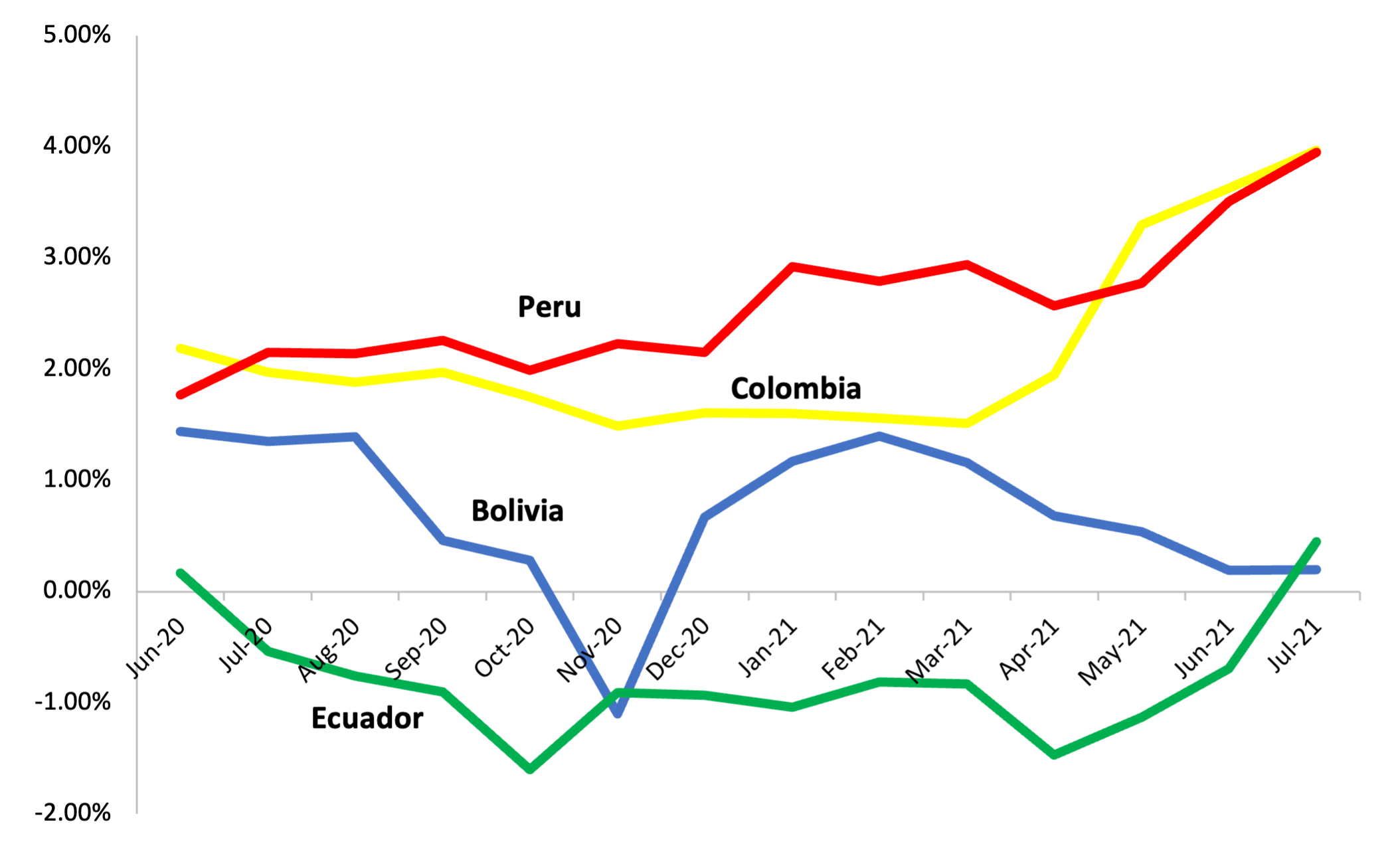
    Andean Countries: Inflation
    Monthly year-on-year figures

    Andean Countries: GDP growth (%)
    Quarterly figures are year-on-year growth
    GDP  2020* 2021 forecast** Q2 2020 Q3 2020 Q4 2020 Q1 2021
    Bolivia -8.0 5.1 -21.7 Not yet available Not yet available  Not yet available
    Colombia -6.8 5.4 -15.8 -9 -3.6 1.1
    Ecuador -7.8 3.0 -12.8 -9.1 -7.2 -5.6
    Peru -11.1 9.5 -30.2 -9.4 -1.7 3.8
    Venezuela -30.0 -4.0 No data No data No data No data
    *From local central banks **Forecasts from the United Nations Economic Commission for Latin America & Caribbean (ECLAC)
    Quarterly growth based on figures from the local central banks


  • COLOMBIA: Yellow fever outbreak triggers emergency measures

    Patrick de Courcy 17 April 2025 Hits: 3751

    Colombia’s President Gustavo Petro announced on 15 April that he will declare a sanitary and economic emergency in response to an outbreak of yellow fever that is concentrated in the central department of Tolima.

    “Once again we are faced with a virus,” President Petro said in a lengthy social media post, which stated that 32 people have been killed by the yellow fever outbreak, out of 74 confirmed cases, implying a mortality rate of over 43%. The World Health Organization (WHO) states that, although most infections from the mosquito-borne disease are not fatal, a small percentage of patients enter a more toxic stage, of whom around 50% will die.

    In response, Petro said that he “will decree an economic emergency, after decreeing a sanitary emergency”. This, he said, will boost a vaccination campaign and support the delivery of medicines and equipment to hospitals in the Eje Cafetero – Colombia’s coffee-growing region comprising the departments of Tolima, Caldas, Quindío, and Risaralda.

    • Fear of spread

    President Petro expressed concern that the Easter holiday will see large numbers of tourists descend on the Eje Cafetero, which could see infectious mosquitos spread around the country. “The mosquito travels in fruits, cars, and bodies,” Petro wrote.

    Petro also fired a criticism at the mayor of Bogotá, Carlos Fernando Galán, a critic of the government, and promoted his administration’s rejected health reform bill. The municipal government in Bogotá, Petro said, “has not wanted to organise the basic health teams that are essential for rapid vaccination”. He said that “the absence of prevention is our biggest weakness…that’s why this was our main priority in the health reform that was not approved”.

  • Risk pointers

    LatinNews 12 June 2013 Hits: 337

    *** Putin’s ballistic missile warning for US.  On 11 June, during a visit to Interfax news agency, Russia’s President Vladimir Putin warned about the dangers of using ballistic missiles with conventional warheads.  He said: “In the States there is a debate about the question of using strategic ballistic missiles in conventional mode.  Can you imagine what a threat that is?  And if such a weapon is launched from somewhere in the world’s oceans and seas?  And if missile attack warning systems detect that this missile is flying in the direction of a nuclear power, how should that power react?  It – this power – how does it know whether this missile has a nuclear warhead or a non-nuclear one?  This missile will fall right next to its borders.  Can you imagine what a threat this is?”

    *** Kremlin squeezes Dagestan ahead of Winter Olympics.  With the approach of the Winter Olympics in the Black Sea city of Sochi, Russia has been increasing security in the turbulent North Caucasus republic of Dagestan following nearly 20 years of non-interference.  A number of high-ranking officials have been sacked on the grounds that they might be connected to militants.  There has been a “sweeping purge” of officials linked to corruption scandals under a new acting head of the republic: Ramazan Abdulatipov.

    *** Islamist destabilization in Niger.  Following the French-led intervention in Mali, Niger is now said to be facing an increased threat by the dispersed Islamist militants.  France said there were around 2,000 jihadists in Mali at the time of the intervention.  Out of its seven international borders, four are exposed to infiltration by Islamists, those with Mali, Algeria, Libya, and Nigeria.  Niger, itself, has 750 troops in Mali as part of the international operation against militants.

    Until the Mali intervention in January 2013, Niger was largely unaffected by jihadist attacks.  On 23 May, however, it suffered two suicide bombings that killed 20 people, including 18 soldiers.  And on 1 June, Islamist militants attacked the main prison in the capital Niamey to help with the escape of dozens of prisoners.

    Two Islamist groups claimed responsibility for the attacks: the Signed-in-Blood Battalion and the Movement for Oneness and Jihad in West Africa (Mujao).  The Signed-in-Blood Battalion is an offshoot of Al-Qaeda in the Islamic Maghreb (AQIM), while Mujao, a mainly Mali-based Islamist group, is a breakaway group from AQIM.  Mujao said the Niger attacks were "in support of our brothers in Nigeria and to punish Niger for its cooperation with France in the war in northern Mali".

    There are an estimated 22,000 Malian refugees camping in western Niger, while another 6,000 are in the south, having fled Nigeria.

  • COSTA RICA-NICARAGUA: Influx of Nicaraguan refugees tests Costa Rica

    LatinNews 03 October 2018 Hits: 484

    Hundreds of Nicaraguans have been killed since the start of anti-government protests in the country in mid-April, the economy has ground to a halt, and tens of thousands have fled the country. Many have headed to Costa Rica, Nicaragua’s neighbour to the south, where tensions are now rising among locals.

    In late August, around 500 anti-immigrant protesters descended on a park in the centre of the capital San José, where many Nicaraguan immigrants were sleeping rough. Armed with knives, baseball bats and petrol bombs, they attacked migrants, passers-by, and police, prompting dozens of arrests.

    Costa Rica’s Public Security Minister Michael Soto said that the government believes that an “external or internal influence tried to maximize” the protest. Among Nicaraguan refugees, there is widespread belief that President Daniel Ortega has many supporters in Costa Rica, surveilling protest leaders who have fled or fomenting disruptions. Soto said that there is no “conclusive evidence” that Ortega’s government helped organise the protest or has spies on the ground pursuing protesters, “but there’s an expectation that it could occur or is occurring”.

    The riot was the most extreme example to date of rising anti-immigrant sentiment in a country that has a reputation for its competent handling of refugees. Costa Rica has long become familiar with mass migrations. In recent years, thousands of Haitians and Cubans transiting north toward the US have gathered in Costa Rica as Nicaragua blocked its border to migrants, prompting government officials to organise airlifts. Venezuelans have also migrated there in large numbers to escape their country’s economic calamity.

    Epsy Campbell Barr, Costa Rica’s foreign minister and first vice president, said the government was preparing for the political situation in Nicaragua to worsen as the year draws to a close, possibly pushing many more migrants into Costa Rica, one of the region’s most politically stable and peaceful nations. The Nicaraguan crisis is threatening to become “too big for a country with the conditions of Costa Rica”, she said told the New York Times in an interview. “Sadly,” she added, “it’s not clear when the crisis will end”.

    The current surge is just the latest in decades of Nicaraguan immigration to Costa Rica, whose Nicaraguan émigré population numbers roughly 500,000, or about a tenth of the country’s overall population. Some cross the border legally, but other use clandestine routes to avoid the Nicaraguan security forces. Thousands have applied for asylum in Costa Rica, overwhelming the government’s migration bureaucracy, while others have simply disappeared into the broader population.

    This year, more than 24,000 Nicaraguans have formally expressed a desire to apply for asylum in Costa Rica, a sharp increase over last year, when about 6,300 people from all nations sought asylum. The backlog is such that new appointments for asylum interviews are being scheduled for next spring, and the government of President Carlos Alvarado has appealed to the international community for help. United Nations (UN) agencies have agreed to provide additional office space and salaries for more migration officials to speed up the work.

    Administration officials and their allies worry that the longer the migration crisis persists, the greater the likelihood that President Alvarado’s opponents will use it as a wedge issue to turn public opinion against him, particularly as his tenure is already under pressure following the ongoing strike over tax reform (see next article). Already, some local politicians representing border areas have demanded greater financial assistance from the federal government, to tackle the influx of refugees. The Alvarado administration responded by assuring the country that it was already stepping up security measures, including developing a plan to toughen border control.

    • Ortega in Costa Rica

    The Nicaraguan community is large and well-established in Costa Rica. Many went into exile, or fled the fighting, during the guerrilla war against the Somoza dictatorship in the 1970s. Among those who fled south were Daniel Ortega, who would later become president.

  • TRACKING TRENDS

    LatinNews 20 June 2019 Hits: 1159

    BRAZIL | Construction giant on brink of bankruptcy. On 17 June, Brazilian conglomerate Odebrecht announced that it had filed for bankruptcy protection in a São Paulo court. The company’s overall debt totals more than R$98bn (US$25bn), of which it will be looking to restructure R$51bn (US$13bn). The bankruptcy protection request excludes some of Odebrecht’s major subsidiaries, including petrochemicals company Braskem (which accounts for R$14.5bn of Odebrecht’s total debt), contractor OEC, and ethanol producer Atvos (which already filed a separate bankruptcy protection request earlier in May).

                The bankruptcy protection procedure has been accepted by the courts and now gives Odebrecht six months to renegotiate its debt with its creditors, most of which are Brazilian banks (including the state-owned Banco do Brasil, Caixa Econômica Federal and development bank Bndes). The company notes that it aims to maintain its activities as normal throughout the process. In an external note, it cites “some debt maturity and judicial attacks which would bring significant losses to the company” as the reason for this move, while its internal memo speaks of the impact of the “the most serious economic crisis in decades” on its activities, as well as a lack of recognition of the company’s changed ways following past errors, leading to complications in accessing new credit and liquidity.

                 Odebrecht’s business and reputation took a hit after the company was investigated as part of the sprawling ‘Lava Jato’ corruption investigation, and in 2016 admitted to paying the equivalent of US$788m in bribes to public officials in order to secure state contracts in 12 Latin American and African countries. Odebrecht and Braskem subsequently reached a leniency agreement with US, Brazilian and Swiss authorities, agreeing to pay US$3.5bn in fines.

    • Odebrecht

    Financial difficulties have seen Odebrecht lose 130,000 jobs in five years and it has been in the process of selling off its assets. Odebrecht was expected to file for bankruptcy protection after talks with Dutch petrochemicals company LyondellBasell for the sale of its share in Braskem fell through in early June, right after Atvos had filed for bankruptcy protection in May.

  • TRACKING TRENDS

    LatinNews 10 December 2020 Hits: 569

    URUGUAY-REGION | Meat exports to China under threat? There is mounting concern in the Southern Cone, especially Uruguay, that the Chinese government could impose a temporary suspension on meat imports from the region. On 6 December the Centre for Disease Control in the city of Wuhan released a statement reporting the discovery of traces of Covid-19 in shipments of frozen beef from Uruguay and frozen pork from Brazil.

    Uruguay’s agriculture minister, Carlos María Uriarte, responded by saying that while he had no doubt the traces of Covid-19 had been detected “it is practically impossible that they originated in Uruguay” as the frozen meat was packaged in December 2019 and entered China on 2 March “all at a time when the coronavirus had not even arrived in Uruguay”.

    China accounted for 60% of Uruguay’s meat exports in 2019.

  • BOLIVIA: Áñez sentenced to 10 years for ‘coup’

    Patrick de Courcy 16 June 2022 Hits: 3796

    One year and three months after she was first placed in preventive detention, on 11 June Bolivia’s former president Jeanine Áñez (2019-2020) was sentenced to 10 years in prison for illegally assuming the presidency. The verdict triggered a storm of criticism from the political opposition and human-rights organisations, and it will only intensify the polarisation that has marred Bolivian society since Áñez assumed the presidency following the ousting of her predecessor, Evo Morales (2006-2019).

    The guilty verdict will have come as no surprise to Áñez’s supporters, who for over a year have denounced what they view as political persecution by the ruling left-wing Movimiento al Socialismo (MAS). For those who have accused President Luis Arce’s government of leaning on the judiciary to secure a guilty verdict, the only question was how long Áñez would be sentenced to spend behind bars.

    Reading out the full sentence on 15 June, judge Germán Ramos said that Áñez’s “extremely grave actions” in November 2021, when she was sworn in as interim president despite there not being a quorum in the senate, had represented a “dereliction of duty” that went “against the constitution”. He said that “the evidence presented in the trial has been sufficient to provide the court with total conviction” of Áñez’s guilt.

    However, doubts have been raised regarding the fairness of the proceedings – not least since Morales claimed on 12 June that it was government ministers and leading MAS figures, rather than the judiciary, who had decided that Áñez should face criminal charges rather than a political trial. Arguing that a political trial in congress would have merely split along party lines, Morales claimed that Áñez’s conviction in a criminal court had left “no doubt” about her guilt.

    Áñez’s legal team has long contended that she was entitled to a political trial, which would not have resulted in her receiving a prison sentence. Following her sentencing, Áñez claimed that she had been found guilty “on the orders” of Morales.

    Morales’ comments were slammed by the United Nations special rapporteur on the independence of judges and lawyers, Diego García-Sayán. García-Sayán tweeted that the “signs of possible political intervention” meant that the judiciary should consider “making necessary corrections” to the verdict. An appeal is certain, with Áñez’s legal team announcing that it would request an intervention from the Inter-American Court of Human Rights.

    The US-based NGO Human Rights Watch has also raised concerns, with its senior Americas researcher, César Muñoz, highlighting that Áñez “wasn’t allowed to attend her own trial in person, but prosecutors, attorneys, and others were”. This, he said, meant that Áñez “couldn’t confer with her lawyers during the hearings”. Muñoz also noted that the offences for which she was convicted are “very broadly defined in Bolivian law”.

    The sentence is likely to galvanise anti-government demonstrations by Áñez’s supporters and opposition groups. What is certain is that it will only inflame the fault lines in Bolivian society. It will be used as a rallying cry both by the government, which now claims that its narrative of a ‘coup’ against Morales has been vindicated, and by the opposition, which will frame the verdict as evidence of a political crackdown.

    Military and police chiefs sentenced in absentia

    In the same court session, the former commander of the armed forces, Williams Kaliman, and former police commander Yuri Calderón were also sentenced to 10 years in prison for their role in Jeanine Áñez’s rise to power. Both played an instrumental role in forcing Evo Morales from office when they called on him to resign amid a dispute over the vote count in the 2019 election. Their whereabouts are unknown.

  • ECONOMIC OVERVIEW: EL SALVADOR

    LatinNews 30 November 2011 Hits: 1694

    El Salvador commemorated 200 years since the first grito de independencia with a contemporary cry from the Roman Catholic Church to break “new chains” that are preventing “true independence” in the country. The auxiliary bishop of San Salvador, Gregorio Rosa Chávez, said that the modern chains were “structural injustice, poverty and homicidal violence which keeps sowing anguish and pain among families in El Salvador”.

    On 5 November 1811, Father José Matías Delgado tolled the bells in the church of Nuestra Señora de La Merced in San Salvador to begin the uprising against the Spanish Crown, which was the first cry for independence in the whole of Central America, leading to the sub-region’s eventual independence almost 10 years later on 15 September 1821.

    President Mauricio Funes was due to attend an official ceremony, but pulled out, sending his culture secretary, Héctor Samour, in his place. Samour, employing a healthy dose of historical revisionism, said the first cry of independence had a clear objective: economic development and social welfare for each and every Salvadorean.

    These are the twin challenges of the Funes administration, which must lift economic growth to stand any chance of addressing poverty and inequality in El Salvador. Funes announced this month that the growth forecast for 2011 had been cut to 1.4% from an already parlous 2.1% due to the recent heavy rains which claimed 34 lives. The rains resulted in nearly 60,000 people being evacuated, decimated some 10% of national territory and caused damage and losses worth an estimated US$840m. This represents 4% of GDP, which in 2010 reached US$21.79bn, according to World Bank figures. 

    The saving grace for the Funes administration is that remittances are increasing. In the first 10 months of the year, remittances totalled US$3.008bn, up 5.8% on the same period last year, according to the central bank. This is a mixed blessing, however, as the deputy minister for Salvadoreans abroad, Juan José García, pointed out in October when he fretted that El Salvador was becoming “addicted to remittances” [RC-11-11].

  • URUGUAY: IMF applauds but warns about inflation

    LatinNews 15 December 2011 Hits: 287

    The IMF lauded the country’s economic policymakers who are on course to deliver 6% GDP growth in 2011 and 4.2% in 2012, but warned them to be on their guard about inflation.

    The IMF expects that the economy will slow down as the international economy weakens and public investment slows.

    On inflation, the IMF recommends that the central bank should set out its policies on how it will cope with international shocks. The IMF argues that such a stance will “anchor” inflationary expectations. The IMF expects that inflation this year will be over 8% in 2011 and that the rate will fall to 6.9% in 2012.

    Inflation is now running well over target at about 8% a year and there is little sign of the rate coming down without a change in government policy. The question is what changes the central bank is contemplating. The IMF said that its policy of “wait and see” in the second half of 2011 was understandable but now probably needed to be adjusted, or would be when the outlook for the world economy became clearer.

    In November the consumer price index jumped 0.4%, bring the lagging 12 month rate to 8.4%. This was half a percentage point up on October’s 12 month rate and more than two percentage points above the target rate.

    The economy ministry is keeping its cards close to its chest. Officially its line is that inflation is on the point of subsiding and that this trend will crystallise in the next few months.

    The November jump in consumer prices was driven, largely, by dairy prices which increased 2% in October. Other fresh food prices dropped. Beyond this, the index covering non-tradeables jumped 0.6% in the month which puts this subsector on an annual rate of about 7%.

    The authorities’ argument is that the bumper grain harvests across the world will lead to less pressure on food prices in 2012 and that inflation will subside, naturally, to around 7% in 2012. Most businessmen, according to opinion polls, expect inflation in 2012 to be between 7% and 8%.

    The problem with persistently high inflation is that it makes the construction of a long term domestic capital market more difficult.

    The problem is that if the central bank were to jerk on its interest rate lever, it could tip the economy into a recession which would be compounded by the global international economic problems. Some economists even guess that the central bank may ignore the inflationary pressures and instead cut interest rates to give the local economy a shot in the arm. This, however, is unlikely. With annual inflation already verging on a double digit level, the risk of cutting interest rates could trigger hyper-inflation.

    On the other hand, the bank raises rates, it risks pricing exporters out of already shrinking markets because higher interest rates are likely to push the peso up against the dollar and Euro.

  • BOLIVIA: Deal on the cards with military officers

    LatinNews 15 May 2014 Hits: 2681

    President Evo Morales looks to have averted a key threat ahead of the October 2014 general elections, which he is widely tipped to win. Last week the association of armed forces sergeants and NCOs (ASCINLASS), which recently staged unprecedented protests calling for reform of the armed forces (FFAA), resulting in the dismissal of over 700 officers [WR-14-16], announced it was calling off protests after the FFAA high command agreed to dialogue.

    On 9 May the FFAA’s chief of staff, General Fernando Aramayo, told reporters that “nearly 100%” of the dismissed officers had returned to their posts. His announcement came just over a week after FFAA commander-in-chief, Admiral Víctor Baldivieso, told reporters that the military high command had agreed to dialogue with ASCINLASS and that a dialogue table had been set up to discuss an 18-point agenda.

    This represented a softening of the stance by the military leadership, which had previously maintained that ASCINLASS’s demands - which had centred on the need to address “discrimination within the FFAA” against the mainly indigenous NCOs – were not up for negotiation. Among other things, these demands call for NCOs to be allowed the same educational opportunities as their seniors; for the ranks of NCO and sergeant to be replaced with the position of “technical officer”; and health and other benefits.

    With partial agreements already reached on 16 of the 18 points (including calls for the dismissed officials to recover their posts), Baldivieso said the two pending points relate to pay, which he noted lies in the hands of the defence ministry, and the proposed reform of the ‘organic law of the armed forces’ - the protesters’ main demand. While there was arguably little risk of the revolt spreading up the ranks, given that the leadership has in the past revealed itself to be firmly aligned with the Movimiento al Socialismo (MAS) government (see sidebar), the fruitful dialogue process will be a relief for President Morales given the risk that it could have spread to other sectors.

    Revisiting the military dictatorship

    One potential point of tension with the military could stem from the announcement made by the Morales administration earlier this year of its plans to redress past injustices committed during the various military dictatorships (1964-1982).

    On 14 February, the inter-institutional council for the clarification of forced disappearances, Consejo Interinstitucional para el Esclarecimiento de Desapariciones Forzadas (Ciedef, which is presided over by the justice ministry), along with the attorney general’s office and the La Paz-based Universidad Mayor de San Andrés (UMSA), signed an agreement to coordinate joint actions to investigate forced disappearances during the 18-year period.

    At the time the deputy justice minister, Ericka Chávez, told reporters that the aim of the agreement is to identify the victims of forced disappearances during the dictatorship and promote the declassification of military archives.

    According to figures from the association of relatives of the detained and disappeared (ASOFAMD), there are some 156 cases of people reported ‘disappeared’ in the 1960s, 1970s and 1980s.

    While local human rights groups have long called on the Morales government to pass legislation which would declassify military archives spanning the dictatorship era, the military has proven less than forthcoming, maintaining that it does not possess any relevant documents that might help to clarify these disappearances.

    • Military aligned with Morales

    While the current commander-in-chief, Admiral Víctor Baldivieso has been less explicit, his predecessors have all raised eyebrows after making comments which appear to align the military with the political project of President Evo Morales, raising questions about its independence as an institution. Baldivieso’s immediate predecessor, General Edwin de la Fuente, described the FFAA as “socialist”, “anti-capitalist” and “anti-imperialist”, echoing comments made in November 2010 by then-head of the FFAA, General Antonio Cueto, and which were then repeated by his successor, General Tito Gandarillas, during his inauguration in January 2012. This co-opting of the military by the government is typical of the regional left-wing integration bloc, Alianza Bolivariana para los Pueblos de Nuestra América (Alba), established by the late Venezuelan president Hugo Chávez (1999-2013).

  • PANAMA: Workers call off strike plans

    LatinNews 09 September 2015 Hits: 62390

    A strike by workers on the project to expand the Panama Canal, planned for 12 August, was called off a day beforehand after the construction workers' union Sindicato Único de Trabajadores de Construcción y Similares (Suntracs) reached an agreement with the Grupo Unidos por el Canal (GUPC), the multinational consortium carrying out construction work on the waterway. While the agreement was a significant relief for the government of President Juan Carlos Varela and the Panama Canal Authority (ACP), there are still significant obstacles to the completion date of the canal upgrade, scheduled for April 2016.

    Suntracs demanded an 8 to 9% wage increase for the 6,000 workers. In the end, the union settled for a 5% salary rise, which was geared retroactively to cover the period from 1 July 2015. The raises will cost the GUPC between US$6-US$7m. The project, to triple the canal’s existing capacity, has already overrun its initial US$5.25bn budget, leading to disputes between the GUPC and the ACP that, coupled with other labour disputes, have pushed the work way beyond schedule. It was originally due to be completed in 2014. The Panama Canal handles around 5% of global shipping, but needs to upgrade its century-old infrastructure in the face of rival bids for market share from Egypt’s Suez Canal and, closer to home, the new Nicaraguan canal being planned by a Chinese company. The Panama Canal upgrade is now 93% complete.

    Other problems

    A day before workers called off their strike, Angélica Maytín, the head of the Panamanian government’s anti-corruption agency, requested that one of the members of the ACP board be suspended for alleged money-laundering. Nicolás Corcione, whose business group specializes in luxury beachside developments, was appointed to the ACP board by the former Panamanian president, Ricardo Martinelli (2009-2014), who also faces the prospect of legal action over alleged corruption. Corcione has been accused of laundering money on behalf of former supreme justice court (CSJ) president, Alejandro Moncada Luna, a former close Martinelli ally, who became the first former CSJ magistrate to receive a prison sentence for corruption last year.

    • Barro Blanco agreement

    On 10 August the Panamanian government reached an agreement with the Ngäbe-Buglé indigenous group to continue dialogue over the Barro Blanco hydroelectric project being carried out by the Honduran company, Genisa. While President Varela said that the government will take measures to ensure minimal impact on the 36,000 people expected to be displaced by the dam, Genisa said that it was not party to the talks. In February, the national environmental authority had ordered the temporary suspension of the project for allegedly not complying with the environmental impact assessment.

  • TRACKING TRENDS

    LatinNews 17 May 2018 Hits: 622

    BRAZIL | Airport bankruptcy. On 9 May, two days after an operating company for Viracopos, the second-biggest cargo airport in Brazil, filed for bankruptcy, the judiciary suspended the company’s financial obligations, including the payment of fines. The Viracopos consortium is made of construction companies UTC, Triunfo, and Egis (with 51%) along with the state-run company Infraero (49%). It comes as the company moves to re-restructure R$2.88bn (US$813m) of debt, according to financial daily Valor Econômico.

    The consortium was set up in 2012, but was badly hit by the subsequent recession and continued to perform below potential even after Brazil’s economy had technically recovered.

    In 2017, Viracopos airport, located in the city of Campinas, São Paulo state, received 9.3m passengers, far below the 18m operators had been expecting, according to local daily Folha de São Paulo. During the same year, they moved 199,000 tonnes of cargo, well below the 409,000 forecast.

    After being named in ‘Operation Car Wash’, UTC faced difficulties keeping up with its payments and Infraero was also implicated. This left Triunfo over-burdened to keep up with payments on behalf its partners and it too came into financial difficulties.

    BRAZIL | HSBC tax evasion scandal. Three years after ‘Swiss Leaks’ lifted the lid on tax evasion, federal police in Brazil are investigating 660 Brazilians with secret HSBC accounts in Switzerland. The list of suspects features prominent businessmen from industries such as construction, industry and finance, according to local daily O Globo. These include the president of Companhia Siderúrgica Nacional (CSN), Benjamin Steinbruch, the billionaire founder of investment bank BTG Pactual, André Esteves, and the CEO of construction company Tecnisa, Joseph Meyer Nigri. Thirteen Brazilian HSBC officials are also under investigation.

    The worldwide scandal first came to light in July 2015 when whistleblower Hervé Falcini leaked data about thousands of wealthy clients at HSBC who allegedly used the Swiss arm of the bank to hide US$222bn from tax authorities. Even though Brazilian police had access to that data at the time thanks to a cooperation agreement with French authorities, they only compiled a shortlist of names for the judiciary to investigate last November.

    BRAZIL | Electricity. Neoenergia, which is controlled by Spanish energy company Iberdrola, has said it is still interested in acquiring the shares of Brazilian electricity distributor Eletropaulo, even after Neoenergia requested arbitration against Eletropaulo on 8 May.

    Under an agreement signed in April, Neoenergia agreed to buy all the shares in Eletropaulo with a view to taking over the company. But Eletropaulo cancelled the offer having received a higher bid from rival Italian company Enel. Eletropaulo shareholders will make a final decision on the takeover before an auction scheduled for 4 June, until which time they can still receive new offers.

    URUGUAY | Boosting China trade. Uruguay has sent a trade delegation to China, its main trading partner, for an 11-day visit from 8-19 May, in a bid to increase the volume of exports from the current level of US$2.55bn a year and discuss investment opportunities. Increasing exports to China is all the more important given the economic difficulties being encountered by Argentina once again.

    • Contagion

    There is growing concern in Uruguay about the financial turmoil across the River Plate in Argentina once again. Argentina’s 2001-2002 financial debacle also hit Uruguay hard. At the height of the crisis, Uruguay’s then-president Jorge Batlle (2000-2005) was forced to fly to Argentina in tearful contrition after calling all Argentines “a bunch of thieves”. The Uruguayan peso this week fell to its lowest level against the US dollar since June 2016. The president of Uruguay’s central bank (BCU), Mario Bergara, said that “the increase of the value of the US dollar in Uruguay is 80% down to global issues and 20% down to Argentina”. He said that an increase in inflation was a concern if the currency depreciation continued but not enough to revise the annual target of 3%-7%. He said the BCU was in talks with Argentina’s central bank (BCRA), adding “we are dedicated to resolving the situation, which is urgent”.

    The Uruguayan government is confident of accomplishing its target of boosting the country’s exports to China after the agriculture and livestock minister, Enzo Benech, who is leading the trade delegation, announced this week the opening of the Chinese market to exports of live cattle and cranberries. Benech also inaugurated an agricultural attaché office in the Uruguayan embassy in Beijing, before heading on to the 2018 Shanghai International Import and Export Food & Beverages Exhibition, where Uruguay has a stall, and holding talks with China’s agriculture minister Han Changfu.

    The trade delegation has travelled across China from the north-eastern port city of Tianjin; Hangzhou, the capital of China’s eastern province of Zhejiang; Chengdu, capital of the south-western province of Sichuan; and Guangzhou, Foshan, and Shenzhen in Guangdong province.

  • The Italian Mafia in the Southern Cone

    LatinNews 05 August 2019 Hits: 901

    Two unrelated incidents recently served as a reminder of the presence of European transnational criminal organisations, specifically Italian mafias, in the Southern Cone.

    On 23 June, an Italian mafia boss escaped from a Uruguayan prison in Montevideo, where he was awaiting extradition to Italy. Rocco Morabito had been arrested in 2017 after living in hiding for over a decade in Uruguay. Around two weeks later, on 8 July, Brazilian police in São Paulo state arrested a father and son suspected of being members of the same mafia, the ’Ndrangheta from Italy’s southern Calabrian region. Nicola and Patrick Assisi fled Italy five years ago and were on the country’s list of 100 most dangerous fugitives, believed to be coordinating the ’Ndrangheta’s operations in Latin America from São Paulo, having previously passed through Portugal and Argentina.

    According to organised crime experts, the ’Ndrangheta is one of Italy’s most powerful mafias and has established itself as the dominant force in the European cocaine trade, having forged ties with Latin American drug trafficking organisations (DTOs). The ’Ndrangheta is now believed to control as much as 80% of cocaine flows to Europe.

    Last December, a joint European operation resulted in dozens of arrests of suspected ’Ndrangheta members, as well as confirming links between the Calabrian mafia and one of Brazil’s major DTOs, the São Paulo-born Primeiro Comando da Capital (PCC). At the time, Brazilian news site UOL reported that Nicola Assisi was believed to be living in São Paulo state under a false identity, acting as a “correspondent” for the mafia in South America and managing the purchase of cocaine from the PCC and Colombian DTOs.

    The Assisis’ arrest on 8 July was the result of a joint operation between Brazil’s federal police (PF) and the Italian police, and was celebrated by authorities from both countries as a successful example of international cooperation against transnational organised crime. Meanwhile, Morabito remains on the run. The credibility of Uruguay’s penitentiary system has taken a hit following his escape, and its leadership has been overhauled, as evidence points to police collusion having aided Morabito’s escape.