Argentina: The return of Peronism?
Date: October 2019
Type: General election: presidential, legislative.
Main contenders: Cabiemos coalition (Cambiemos), Propuesta Republicana (PRO), Unión Cívica Radical (UCR), Coalición Cívica para la Afirmación de una República Igualitaria (CC-ARI), Partido Justicialista (PJ, Peronists), Peronismo Federal (PF), Frente Renovador (FR).
After four years of significant economic turbulence, Argentina’s centre-right ruling Cambiemos coalition is expected to struggle in its attempt to retain the presidency this year. President Mauricio Macri, who has yet to confirm if he will be seeking re-election, had promised that his administration would fix Argentina’s macroeconomic imbalances and return the country to the path of sustainable economic growth. However, 2018 was another dismal economic year for Argentina with sky-high inflation and the domestic economy set to post negative growth. This has opened the door for the political opposition to mount a strong challenge for the presidency should it succeed in uniting behind a charismatic candidate, sparking fears that a populist Peronist leader could once again rise to power by promising a return to state largesse.
Although President Macri has not confirmed his candidacy it is widely expected that he will seek re-election. Macri is a solid candidate with opinion polls showing that he still enjoys significant public support and that he remains a strong contender for the presidency even if he is unable to win it outright in a first round – where he would need to win 45% of the valid vote or 40% and maintain a ten-percentage point difference over his nearest rival. Pointedly, barring a challenge by a prominent Cambiemos figure such as the popular governor of Buenos Aires province, María Eugenia Vidal, Macri is seen as the most likely presidential candidate for the centre-right ruling coalition. However, whether Macri is successful in retaining the presidency will very much depend on Peronism’s ability to coalesce behind a single presidential candidate.
- Vidal
Since becoming the first female to be elected governor of Argentina’s most populous province, Vidal, a member of Macri’s PRO party, has succeed in maintaining high approval ratings of around 46%. This has prompted some speculation that Vidal could seek to contest the Cambiemos presidential nomination given that her approval ratings are currently higher than Macri’s and that opinion polls have found that her candidacy would be supported by as much as 55% of respondents. But Vidal, a close ally of Macri, has repeatedly stated that she has no intention of running for the presidency in 2019 and that her objective is conclude her current gubernatorial term ending in December.
The Peronists remain deeply divided following their electoral defeat in 2015 after 13 consecutive years of rule by the Frente para la Victoria (FPV, Kirchneristas) leftist-populist party faction. Macri’s 2015 electoral victory has been partly attributed to the stagnant economy resulting from the implementation of unorthodox economic policies by successive Kirchnerista governments, but also due to Peronism’s failure to field a consensus presidential candidate, with the more moderate party factions refusing to back the candidate favoured by then-president Cristina Fernández (2007-2015), who now is a sitting senator. The party is still very much divided along these fault lines, with the more hard-line factions supportive of a new presidential bid by Fernández, who retains a considerable level of public support and who polls currently suggest would push Macri to a second-round vote (which Fernández is projected to lose).
Meanwhile, moderate Peronist party factions – such as the PF and FR – remain staunchly opposed to another presidential bid by Fernández, who is currently the subject of various corruption investigations. But the moderate PJ factions have so far failed to unite behind a single candidate or even a clear set of policies (including on the economic front). As such, various moderate Peronist leaders including Miguel Ángel Pichetto, the president of the national senate, Juan Manuel Urtubey, the governor of Salta province, Juan Schiaretti, the governor of Córdoba province, and Sergio Massa, a former national deputy and presidential candidate for the FR in 2015, have all mooted their candidacy and called for moderate factions to coalesce around their candidacies. However, so far none of the moderate Peronist presidential hopefuls has succeed in securing the support of any of their rivals.
The mandatory, simultaneous, and open party primaries (Paso) due to be held in August should help to provide a clearer picture of the situation in the PJ and whether any of the moderate pre-candidates can muster more support than Fernández to secure the PJ’s presidential nomination. Even after the Paso produce a Peronist presidential candidate, be it Fernández or a moderate, he or she will have to work hard to secure the party’s full support if they hope to win the presidency.
Cambiemos out to consolidate foothold
The federal legislative elections will see over half (130) of the seats in the 257-seat chamber of deputies come up for grabs, as well as one-third (24) of the seats in the 72-seat senate. These elections are seen as posing a big challenge for the ruling coalition, which despite Macri’s victory failed to secure a legislative majority in the 2015 polls (it has 108 seats in the lower chamber and 25 in the upper chamber). It is expected that after four difficult years it will be hard for the Cambiemos member parties – which include Macri’s right-wing PRO, the centre-left UCR, and the centrist CC-ARI – to make significant gains in either chamber.
The fact that the Macri government has been able to advance its legislative agenda without a majority by relying on the support of moderate PJ factions and the growing divisions within the Cambiemos partners over government policy could lead to a loss in voter support for the ruling coalition. The challenge for the Cambiemos members is thus first to reinforce internal unity first and then convince the electorate that giving it a stronger representation in congress is necessary.
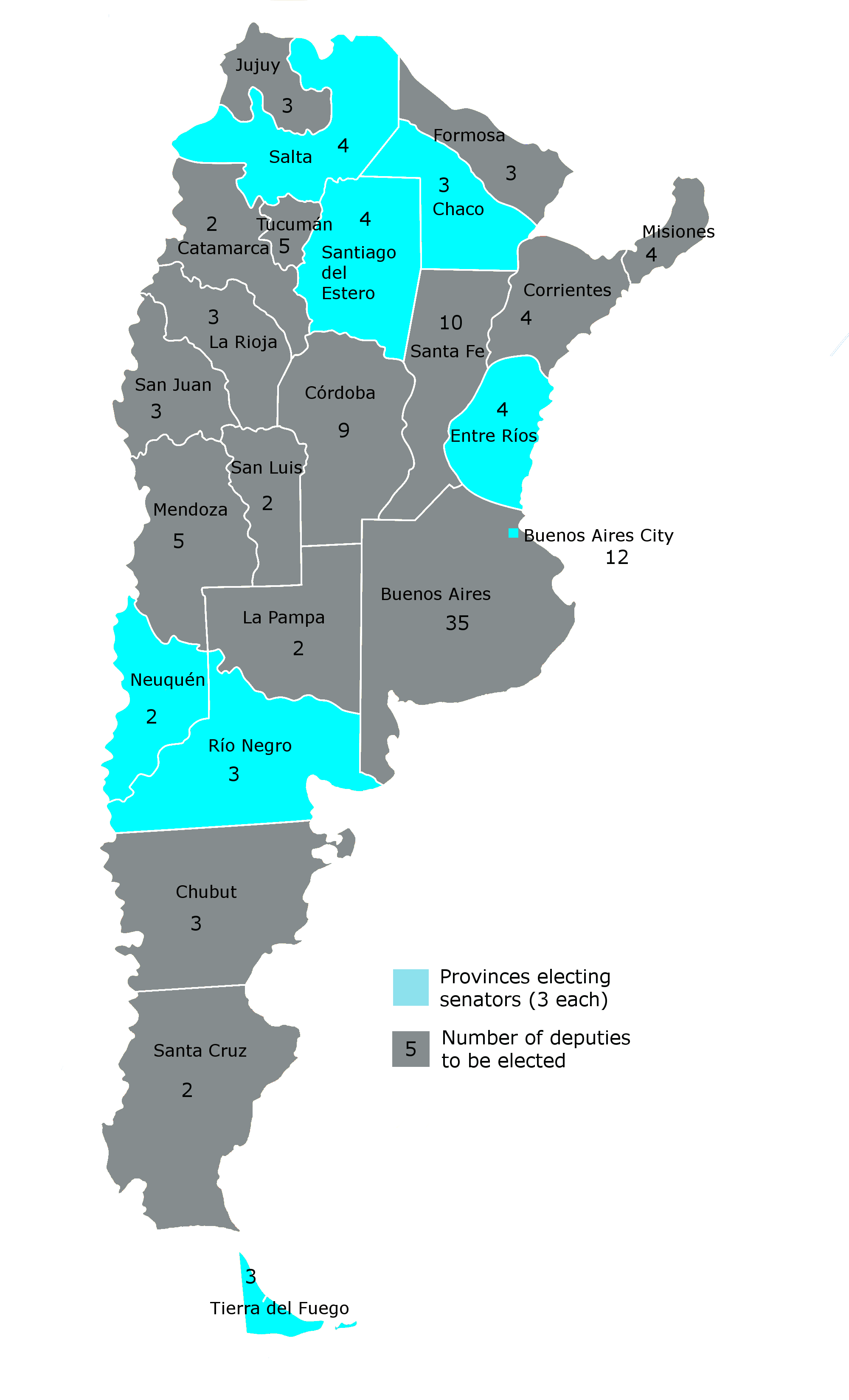
For Peronism the challenge in the legislative contest is to maintain the clear majority it has in both chambers (136 seats in the lower chamber and 44 in the upper chamber) despite the deep divisions between its radical and moderate factions. Against this backdrop, the conformation of a single legislative candidate list in each province (see map below) will prove to be key for the PJ. Should the rival factions fail to achieve this, then they would risk splitting the Peronist vote and opening the door for other parties to make gains against it. However, achieving this will be no mean feat, not least because many hard-line Peronist political figures still have high rejection rates among the general electorate, while moderate figures are increasingly viewed with distrust and seen as being allied to Macri by many Peronist voters.