All Categories

Subcategories

  • Region: Corporate Radar

    LatinNews 16 December 2015 Hits: 20

    New management at Aerolíneas Argentinas: A radical change is underway at the top of state airline Aerolíneas Argentinas. Out goes president and general manager Mariano Recalde and a group of senior managers closely identified with La Cámpora, the youth wing of the Frente Para la Victoria (FPV) faction of the Peronist party, which was voted out of office in November. His critics accused Recalde of running the loss-making airline as a political fiefdom. In comes Isela Costantini, appointed by newly elected President Mauricio Macri to bring in some private sector management expertise. Costantini was previously CEO of GM Argentina and president of ADEFA, the association of Argentine automobile manufacturers. Aerolíneas has had a troubled history, being controversially privatised in 1990 and equally controversially re-nationalised in 2008. During the election campaign, President Macri denied claims he would launch a new privatisation attempt; instead, he said, the company would remain in public ownership and efforts would be made to run it more efficiently. This job now falls to Costantini, who takes over in January. Significantly, the Brazilian born Argentina executive, listed by Forbes in 2013 as one of the world’s top 50 business women, has a reputation as a tough negotiator. She will have to establish good relations with Aerolíneas multiple and often militant trade unions.

    Odebrecht leaves Odebrecht: After six months in prison facing corruption charges linked to the “car wash” scandal centred on state oil company Petrobras, Marcelo Odebrecht has formally stepped down from his role as president and chief executive of Grupo Odebrecht, one of Brazil – and Latin America’s – largest civil engineering and construction companies. Marcelo, from the third generation of the family that founded and still controls the enterprise, also stepped down from a number of other companies in the group, including Braskem (petrochemicals) and other subsidiaries in oil and gas and real estate. The company has said it is confident that when the case comes to trial it will be cleared of any wrongdoing. But in November the federal police said it was widening its investigations to include the possible payment of bribes in construction contracts related to the 2016 Olympic Games in Rio de Janeiro. Odebrecht is reputed to be involved in half the Olympic Games construction contracts, measured by value.

  • GUATEMALA: Guatemala sees record remittances

    Sarah Sheldon 15 October 2021 Hits: 1199

    Migrants sent US$1.389bn in remittances to Guatemala in August, the highest monthly total ever recorded, providing a lifeline as the country struggles to recover from the coronavirus (Covid-19) pandemic.

    That figure means Guatemalans paid US$9.709bn in remittances over the first eight months of the year, compared to US$11.34bn for the whole of 2020, according to data collected by Guatemala’s central bank (Banguat). As a result, a new annual record should be set this year, continuing a run which has seen the total amount of remittances increase each year since 2009, when migrants sent home US$3.912bn.

    Remittances have also come to represent a large proportion of Guatemala’s GDP, at 14.6% in 2020, according to data from the World Bank (WB). In 2001 that proportion was just 3.4%, climbing steeply to reach 12.6% in 2007. This was followed by a period of decline to 9.67% in 2011, then a period of relative stability to 2014 (9.9%) before another period of steady growth. 

    When the Covid-19 pandemic hit, the WB predicted remittances would fall. However, flows have proved resilient, with the WB citing, in a May statement, “fiscal stimulus that resulted in better-than-expected economic conditions in host countries, a shift in flows from cash to digital and from informal to formal channels, and cyclical movements in oil prices and currency exchange rates”. In the US, where the overwhelming majority of Central American migrants live, the improvement in the employment situation led to an increase in remittance flows to Guatemala, as well as El Salvador and Honduras, said the WB.

    In June the Central American development bank (BCIE) published a report looking at remittances, naming them “the most important international flow to the region”. Remittances have been worth around 9% of regional GDP on average in the last 20 years, said the BCIE, and reached a total value of US$33.7bn in 2020. Their value is 2.6 times that of foreign direct investment (FDI), and 15.2 times that of official development assistance, like foreign aid. Honduras has the highest ratio of remittances to GDP at 24.1% in 2020, followed by El Salvador (24.1%), Nicaragua (14.7%), and Guatemala (14.6%), said the report.

    BCIE cites research by the WB which indicates a 10% increase in remittances is associated with a 3.5% decline in the share of people living in poverty, but it emphasises the countercyclical nature of remittances and growth. That means that when countries experience a crisis, such as the Covid-19 pandemic, remittances increase. As a result, the recent increase in remittance flows does not necessarily bode well for the health and wellbeing of Central Americans, given that the payments are likely making up for shortfalls in income due to a lack of work, or to pay medical expenses.

    BCIE also emphasises the importance of financial inclusion for migrants paying remittances and the families receiving them, as most remittances are sent through financial intermediaries. In Central America, it costs around 4%-5.5% of the total amount to send remittances, according to the bank, made up of a 2%-3% charge to cash the cheque combined with transaction and exchange rate fees. These costs can be reduced by using financial technology (fintech) and digital platforms, said the bank, but this requires migrants to have a bank account in the US. Only 15% of migrants do, said BCIE, leaving the vast majority paying onerous fees.

    This was one motivation for the recent adoption of cryptocurrency bitcoin as a national currency in El Salvador [EB-21-07]. In theory bitcoin allows quick and cheap international transfers which avoid traditional intermediaries, and migrants using the cryptocurrency could transfer money via an online wallet to recipients across international borders. BCIE president Dante Mossi believes the project is attracting regional interest. "Everyone is watching if it goes well for El Salvador and if, for example, the cost of remittances drops substantially...other countries will probably seek that advantage and adopt it," Mossi told international newswire Reuters on 30 August. “Guatemala, Honduras, and El Salvador are the countries that would have the most to gain if the adoption of bitcoin lowered the cost of sending remittances.”

    However, the discussion around remittances should also address the implications for Central American economies, wrote Sucely Donis for the Central American institute of fiscal studies (Icefi) think tank on 3 August. An increase in remittances means existing migrants were sending home more of their income than before, or that more people had emigrated from Central America, she said. The implication is that Central American markets are incapable of absorbing those entering the workforce because they aren’t competitive and don’t offer the basic conditions to attract investment that would provide jobs. “The free-market economy as we know it today, which many want and defend, appears to ‘liberate’, ‘discard’, and ‘expel’ a majority of the population,” wrote Donis, saying these are the same people whose remittances are propping up states that cannot provide conditions that allow them to stay at home.

  • Region: Little progress on corruption

    LatinNews 09 March 2018 Hits: 1304

    Anti-corruption lobby group Transparency International (TI) published its annual Corruption Perceptions Index (CPI) on 21 February. This was the 25th edition of the index, covering developments in 2017.

    As in previous years, the report gives each of 180 countries a perceived public sector corruption score ranging from zero (very corrupt) to 100 (very clean). Globally, TI is fairly gloomy about the progress that is being made. It says that the majority of countries are “moving too slowly in their efforts” to reduce corruption. Over two-thirds of the countries surveyed scored below 50; the global average was a score of 43. This year the report highlights attacks on the press and non-governmental organisations (NGOs), pointing out that countries which do least to protect these watchdog bodies also tend to have the worst rates of corruption. In 2017 the world’s least corrupt countries included New Zealand (with a score of 89) and Denmark (with a score of 88). The most corrupt were identified as Syria (scoring 14), Yemen (12) and Somalia (9).

    In Latin America and the Caribbean, TI says that despite “great strides” in the battle against corruption, including high-profile investigations and pro-active civil society campaigns on the issue, most countries continue to score poorly. There have been new anti-corruption laws in Chile, the Bahamas, Guyana, and Jamaica. Major anti-corruption investigations continue in Brazil, Ecuador, Peru, Guatemala, and Panama. Yet most of these countries still lack what TI calls “overarching policies” to address the historic and structural causes of corruption. As a whole the Americas scored 44, just above the global average, but that included high scoring countries like Canada (ranked eighth globally) and the United States (16th). The best performing countries from the Latin American and Caribbean sub-region were Uruguay (ranked 23rd globally), Barbados (25th), Chile (26th) Bahamas (28th) and Costa Rica (38th). The worst performing were Guatemala (143rd globally), Nicaragua (151st), Haiti (157th), and Venezuela (169th).

    There were some big movements in the ranking. Despite its high-profile corruption investigations such as Lava Jato, Brazil plummeted 17 positions relative to the preceding year to rank 96th, while Argentina moved up the table by 10 positions to rank 85th. This is the first time in two decades that Argentina has been perceived as less corrupt than Brazil. Mexico also dropped 12 places to 135th. Writing in newspaper El Financiero, Mexican journalist Benjamín Hill points out that the CPI is really a synthetic index, a combination of measures produced by a range of different sources (including organisations such as the World Economic Forum). As a result, it is difficult to attribute year-to-year changes to specific positive or negative events. He argues that the Mexico’s ranking “doesn’t really tell us anything that we didn’t know already: that Mexico has a big corruption problem, broadly comparable to other countries at a similar level of development”. Nor does the CPI tell policy makers what they should be doing. Despite those limitations, he notes that publication of the index remains the single annual event which best focuses attention on the issue.

    Corruption perceptions

  • HONDURAS: Current account deficit falls

    LatinNews 27 October 2011 Hits: 1160

    The current account deficit fell 13%, year-on-year in the second quarter of 2011. This is an impressive performance given the rise in international oil prices.

    The main reason for the fall in the deficit was a 32% surge in exports. In the six months to June 2011, export receipts came to US$4.4bn. Coffee exports more than doubled to US$579m in the 12 months ending in June 2011.

    The increase in coffee exports accounted for 60% of the US$976m overall increase in export revenues. The increase in coffee revenues is largely a result of higher prices (which are up 71%), but the volume of coffee exports was also up significantly (22%).

    In the 12 months to June 2010 total exports were just over US$3bn. Imports in the 12 months to June 2011 were up by 23%.

    The other big contributor to the improvement in the balance of payments was the 10% increase in remittances to US$1.4bn

    Foreign direct investment was up by 15% in the first half of 2011 at US$485m.

    Chocolate & Cocoa: In 2011 the country expects to export 40t of cocoa to Swiss chocolate manufacturers. The figure comes from the Asociación de Productores de Cacao de Honduras (Aprocacaho). Halba, the Swiss chocolatier has been buying Honduran cocoa since 2009. By the end of 2013 the cocoa industry expects to be entirely organic.

    Inflation: The consumer prices index rose by 6.8% in the 12 months to September.

  • TRACKING TRENDS

    LatinNews 14 January 2016 Hits: 647

    BRAZIL | Protests over bus fares. Bus fares in at least 18 Brazilian cities, including São Paulo and Rio de Janeiro, went up by over 10% in early January. On 8 January, thousands took to the streets in both cities to protest against the fare increases; in São Paulo there were minor clashes with the police. On 12 January there were more sizeable protests in São Paulo again, prompting an aggressive crackdown by police and dozens of arrests.
    Worryingly for both the federal and state governments, protests over bus fares marked the start to the major unrest of June 2013. With the political and economic situation much worse than two-and-a-half years ago, President Dilma Rousseff is reportedly keeping a close eye on those cities who have allowed fares to increase.

  • Venezuela: Large minimum wage hike will fuel inflation

    LatinNews 11 January 2017 Hits: 620

    The government has defended its decision to increase the minimum wage by 50% on the basis that such a large hike was necessary to respond to soaring inflation. Yet by printing money to fund the increase, the authorities are trapped in a vicious circle of monetary creation and ever-increasing domestic prices.

    On 8 January, President Nicolás Maduro announced that the minimum wage would be increased by a massive 50%, to BsF40,638 per month. Including food vouchers, known as ‘Cestaticket’, the so-called “integral” minimum wage now stands at BsF104,358. At the weakest official exchange rate known as Dicom, the monthly minimum wage amounts to US$60 (US$154 including food vouchers), but at the black-market exchange rate these figures amount to just US$12 and US$31 respectively.

    Hikes to the minimum wage are becoming more rapid and larger, fuelling concerns that hyperinflation might be taking hold. The latest increase marked the fifth in the past year, with the minimum wage standing at just BsF9,648 per month at the beginning of 2016, less than a quarter of the current rate.

    The “integral” monthly minimum wage has increased even more rapidly, by over six times, over the course of the past year. This is likely to reflect worsening food shortages, with the government seeking to compensate by providing more food vouchers, although in reality this is unlikely to tackle the underlying lack of availability.

    The difficulty is that the wage hikes are likely to be funded through printing money. Monetary aggregates were already rising at a rate of nearly 160% year on year at the end of December. The Central Bank (BCV) will step up the creation of money in early 2017 to pay for higher public-sector wages, in addition to the introduction of new, larger-denomination bank notes.

    Inflation data is difficult to come by, as the authorities stopped publishing these statistics some time ago, making forecasting even more complicated. The Troubled Currencies Project, run by the Johns-Hopkins and Cato Institute, estimates that inflation ended 2016 at 290%. With monetary growth accelerating even more quickly in 2017, that figure is likely to rise further, sustaining the risk that hyperinflation might take hold.

  • POINTERS

    LatinNews 13 February 2013 Hits: 1134

    *** NEW DEBT SWAP FOR JAMAICA. Jamaica has announced a new debt swap plan ahead of signing a long-awaited new agreement with the IMF. The plan is intended to reduce the country’s debt-to-GDP ratio from its current level of 140% to 95% over the next seven years. Jamaica’s total debt comes to J$1.7 trillion (US$18bn), of which J$1 trillion (US$10bn) is domestic debt. J$860bn (US$9.1bn) of this domestic debt will be subject to the new debt-swap plan.

    Announcing the plan on 11 February, Finance Minister Dr Peter Philips said: “The numbers say it all: for every dollar of the budget that we spend approximately 55 cents goes to pay the debt, another 25 cents to pay wages which leaves just 20 cents to fix roads, maintain schools and hospitals and provide other critical services for the Jamaican people. It just isn’t enough.”

    In 2012, Jamaica increased its primary surplus (revenues over non-interest expenditure) to 5% from 3.1% through increased taxation and cost cutting, including a reduction of the public-sector payroll by 3,000 posts. The intention now is to increase the primary surplus to 7.5%.

    The new National Debt Exchange Offer, launched on 12 February, exchanges higher interest debt for lower interest debt with extended maturity but does not entail any “haircut” on the principal investment. Standard & Poor’s said on 12 February that it had lowered its foreign and local currency sovereign credit ratings on Jamaica to ‘selective default’ from B-/B.

    *** AUSTERITY FOR THE BAHAMAS. The Bahamas has instructed government departments to cut their budgeted expenditure by 10%. The plan is expected to be put to parliament as part of a mid-year budget statement to be presented on 20 February. The deficit budgeted last May for 2012/13 was US$550m, or 6.5% of GDP. Overall government debt is US$4.6bn, or 54.5% of GDP.

    The announcement comes shortly after the IMF concluded Article IV consultations with The Bahamas on 4 February. The lender is expecting growth for 2012 to have been 2.5% and for it to increase further over the medium term. However, it says, “pressures are projected to continue from a large external current account deficit and a rising government fiscal deficit”.

    *** ALLEGATIONS OF RUSSIAN INVOLVEMENT IN GRENADA ELECTION. Grenada’s ruling National Democratic Congress (NDC) seems certain to lose power in the 19 February general election as a result of its lacklustre performance in government and its chronic divisions. However, it is not giving up without a fight. One of its allegations against the main opposition New National Party (NNP) is that it is being funded by “Russian mafia” to the tune of US$10m.

    The NDC, which won the 2008 election by 11 seats to 4, is also contesting the election on the grounds that it has done the best it can given that it inherited an economy that had been “ravaged by Hurricane Ivan and a corrupt and inefficient administration” and which was then battered by the global economic crisis.

    *** CRUCIAL BY-ELECTION FOR TCI. On 7 February, the Supreme Court of the Turks & Caicos Islands (TCI) ruled void the November general election results for District 7 because one of the candidates was a US citizen. The candidate in question only polled 58 votes, but the winning margin for Amanda Missick of the ruling Progressive National Party (PNP) was just 30 votes. There will now be a by-election, to be held on 22 March, and if the outcome is different and the People’s Democratic Movement (PDM) candidate wins, that would also reverse the result of the general election, which was won with 8 seats to 7 by the PNP. Missick’s seat has been declared vacant, so the parliament is now split 7-7, with two seats held by independent members appointed by the Governor.

  • REGIONAL ECONOMIC BRIEFS

    LatinNews 24 April 2014 Hits: 2570

    MEXICO | Combating money laundering. The Mexican government will shortly publish a blacklist of firms and individuals linked to drug-trafficking and terrorism, the finance minister, Luis Videgaray, announced in Washington on the margins of the annual spring meetings of the World Bank and International Monetary Fund. Videgaray said that the government would work closely with banks to prohibit the financial transactions of those allegedly involved in money laundering or financing terrorism. The blacklist will be based on lists produced by the Office of Foreign Assets Control (OFAC) of the US Department of the Treasury, whose secretary, Jack Lew, Videgaray also met this week; a United Nations list; and Mexico’s own designations.

    MEXICO | Tuna dispute with US drags on. On 10 April Mexico’s economy ministry issued a public statement calling on the US government to “fully comply” with the World Trade Organization (WTO)’s resolutions over the use of ‘dolphin safe’ labels for canned tuna. Tuna regularly swim with dolphins, particularly in the Eastern Tropical Pacific Ocean (ETP) region, and as a result fishermen working in the region often target dolphins to catch the tuna, but in doing so injure and drown thousands of dolphins every year. In an attempt to dissuade these practices, the US launched the ‘dolphin safe’ tuna labelling programme in 1990 and encouraged consumers to buy products bearing this label over those that did not. To be certified as ‘dolphin safe’ by the US authorities, fishing companies operating in the ETP must provide them with statements from boat captains and independent on-board observers that no dolphins were chased or netted during fishing operations.

    Mexican fishermen have long complained that such requirements were designed specifically to target them. They argue that since their practices are certified by international regulatory bodies, the US ‘dolphin safe’ tuna labelling requirements are spurious and over the years have succeeded in unfairly limiting the access of Mexican tuna to the US market, affecting Mexico’s tuna industry. In support of these claims, the Mexican government presented a formal complaint before the WTO in 2008 arguing that, as they stood, the US’s ‘dolphin safe’ tuna labelling requirements were discriminatory against Mexican tuna fishermen, who predominantly operate in the EPT.

    In a series of resolutions, the latest in 2012, the WTO agreed with Mexico and ordered the US government to modify its requirements in order to ensure that these do not discriminate against Mexican tuna fishermen. However, despite minor changes introduced to the ‘dolphin safe’ tuna programme by the US authorities last year, Mexico maintains that these have not completely rectified the situation. According to the statement issued by the Mexican economy ministry, “The US has not modified substantive aspects that limit the access of Mexican tuna to the US market […] continuing to affect Mexican exports of tuna products”.

    The economy ministry statement points out that Mexico has already requested the WTO to convene an arbitration panel to review its complaint and issue a final ruling, which could be announced before the end of the year. Should the arbitration panel once again rule in favour of Mexico, the economy ministry says the country would be allowed to adopt retaliatory trade measures against the US.

    URUGUAY | Lower risk of contagion from Argentina. On 7 April Fitch Ratings Agency published a special report highlighting that Uruguay’s banking system is now significantly stronger than in 200, when it was severely impacted by the economic crisis that hit Argentina. The report’s findings will be welcomed in Uruguay given that Argentina is once again facing financial and economic difficulties. Santiago Mosquera, Fitch’s director of the Latin America Sovereign Group, said that the report found that Uruguay’s “substantive external and fiscal buffers, together with its improved fiscal position, large contingency lines, flexible exchange rate regime and sound financial system” give the country “significant space to manoeuvre through potentially more adverse developments in Argentina”.

    Mosquera noted that as a result of the debt de-dollarisation programme carried out by the Uruguayan government since 2007, the country’s banking system is now “significantly stronger than a decade ago, when negative spillovers from Argentina ignited a run on the country’s highly-dollarised financial system”.

    According to the Fitch report, the level of dollarisation of Uruguay’s financial system now stands at 74% of all bank deposits which, while high, is still much lower than the 90% level observed in 2001. More significantly, the report points out that the exposure to foreign-currency deposits held by non-residents (predominantly Argentine nationals) has decreased from 41% in 2002 to 15% last year.

    However, Mosquera warned that despite the increased strength of Uruguay’s financial system “a severe [economic] downturn in Argentina could still have an important impact on Uruguay’s economy through a variety of transmission channels”, such as bilateral trade, tourism and investment. Particularly, Mosquera explained that while the level of Argentine cash deposits in Uruguayan banks has fallen significantly, since 2007 there has been an increase in Argentine Foreign Direct Investment (FDI) into Uruguay that has “somewhat replaced the traditional accumulation of deposits in Uruguayan banks”. Fitch estimates that, on average, 29% of FDI into Uruguay came from Argentina between 2007 and 2012. A pronounced economic downturn in Argentina would reduce FDI inflows into Uruguay.

    CUBA | New foreign investment law. An extraordinary session of Cuba’s National Assembly on 29 March approved a new law designed to entice new foreign investors into the state-owned and sanctions-constrained economy. The new law is the outcome of a long process of review and debate, in which reformers managed to convince doubters of the need for more foreign investment to strengthen Cuban economic growth and development. The terms for foreign investors are improved by the law and, perhaps more significantly, the government led by President Raúl Castro has made a commitment to adopt a more open approach in its dealings with potential partners. The extent of change will become apparent in the coming months, as regulatory details are published and new procedures are introduced within the government institutions that negotiate agreements.

    Changes contained in the law, like reduced taxes and a streamlined approvals process, are designed to attract new foreign business partners. Despite these changes, the overall framework for foreign participation remains intact. The new law strengthens guarantees for investors in areas of concern. It provides further reassurance to those fearing nationalisation, specifying the conditions under which it can be allowed and the compensation to which the investor would be entitled. It also specifies legal protection against previous owners of Cuban assets who might make claims under the 1996 Cuban Liberty and Democratic Solidarity (Libertad) Act (known as the Helms-Burton Law).

    The greatest uncertainty for investors is the future of US sanctions against Cuba, which not only close the US market for Cuban exports but also make it difficult to obtain inputs, secure access to international finance and conduct foreign exchange transactions. The combination of US restrictions on Cuban trade and financing and the Cuban government’s controls on the scope of foreign investment will continue to constrain foreign investor participation in the Cuban economy. Nonetheless, the new law and regulations, combined with the Cuban authorities’ new interest in attracting new partners, will open the way for a new batch of joint venture projects.

    • China opens up to Brazilian maize

    On 8 April the Chinese government announced that it had authorised maize imports from Brazil. China, the world’s second largest maize consumer, primarily sources maize from the US. But Beijing suspended US maize imports in November 2013, after it discovered that one shipment contained a genetically modified variety of the crop not approved for use in China. The Chinese government said that in order to make up for the shortfall in supply it would look to increase imports from alternative suppliers like Argentina, Peru and Brazil. But Brazil, the world’s second largest maize exporter, had yet to be authorised by China’s national sanitary authority (AQSIQ).

    • Paraguay’s poverty rate plummets

    A new report from Paraguay’s technical planning secretariat, based on the results of the 2013 national household survey (EPH), put the country’s poverty rate at 23.8% in 2013, down from 32.4% in 2011. The number of people considered poor (those earning between US$68 and US$107 a month) was down both in rural areas (from 44.8% to 33.8%), as well as in urban areas (from 23% to 17%). Paraguay has posted an average economic growth rate of 7.6% since 2010. It has signed up to the United Nations Millennium Development Goals, which include a commitment to eradicating extreme poverty and hunger by 2015.

  • ECONOMIC OVERVIEW: PANAMA

    LatinNews 13 March 2014 Hits: 3267

    Deal reached over Panama expansion project: Late last month the Panama Canal authority (ACP) announced an “agreement in principle” with the international consortium, Grupo Unidos por el Canal (GUPC), as to who should foot the bill for the US$1.6bn cost over-run of the US$5.3bn Panama Canal expansion project [RC-14-01] – a dispute which saw works grind to a halt last month. Even with the deal, the completion date of the expansion project has already been pushed back by a further six months to December 2015.

    According to a 27 February press release by the ACP, the agreement with GUPC (which includes Spain’s Sacyr Vallehermoso, Italy’s Impreglio, Belgium’s Jan de Nul and Panama’s Constructora Urbana) stipulates that: “the construction of the third set of locks is completed by December 2015; the 12 lock gates in Italy must be in Panama by December 2014, to be transported in staggered shipments; The performance bond for US$400 million may only be released to Zurich North America, to obtain financing to complete the work; GUPC will pay US$100 million and ACP will advance US$100 million, which will enable works to regain a normal pace in March; The moratorium for the repayment of advances may be extended until 2018, subject to fulfilment of certain milestones and other conditions”.

  • COSTA RICA: Fiscal deficit progress as first external bond issuance since 2019 approved

    Sarah Sheldon 23 January 2023 Hits: 1392

    Costa Rica’s fiscal deficit has fallen after ballooning for years, and lawmakers have approved an external bond issuance after the International Monetary Fund (IMF) completed a successful third review of its agreement with the country.

    The IMF concluded its review under the Extended Fund Facility (EFF) on 14 November, according to a statement from the organisation, which lauded authorities for “taking important steps to strengthen their economic reform program”. Then there was more good news for President Rodrigo Chaves on 25 November, when lawmakers approved the issuance of up to US$5bn in Eurobonds over the next three years. These are intended to cover upcoming financial obligations, such as a US$1bn debt repayment due in early 2023, and will be issued in four tranches.

    Approval for issuances requires a two-thirds supermajority in the unicameral chamber, which last gave the greenlight to a bond issue in 2019. Uncertainty over financing has affected borrowing costs in recent years and, while the later tranches of bonds are subject to hitting fiscal targets, the approval will help to improve confidence. And on 5 December, the finance ministry released encouraging figures which showed that, as of October 2022, Costa Rica’s deficit was ¢798.0bn (US$1.3bn), equivalent to 1.8% of GDP. This represents a reduction of two percentage points compared to the same period in 2021, and the Chaves government claims that the figure is the lowest since 2013.

    Commenting on the developments, ratings agency Fitch Ratings said that Costa Rica is outperforming both its expectations and the EFF targets. The country recorded a primary surplus of 2.3% of GDP from January-October 2022, its highest since 2008, compared to a 0.3% primary deficit in 2021, said Fitch, and the agency struck an optimistic tone about the future in a statement published 5 December. “Financing needs will remain elevated given the concentration of debt maturing between 2023-2026, but robust fiscal performance and the government’s commitment to furthering this under the IMF Extended Fund Facility (EFF) should further ease liquidity pressures,” it said. Fitch also said that lower financing needs could help to cut government interest payments, which cost the equivalent of 4.1% of GDP according to the latest finance ministry figures and are a major cause of the country’s negative fiscal balance, but the agency warns that this depends on the state of the global financial markets.

    Fitch continues its rosy assessment by forecasting that central government debt will fall from 68.0% in 2021 to 63.8% in 2022, reversing the “steady fiscal deterioration that led to debt/GDP almost tripling between 2008 and 2020,” with a downward debt trajectory for the next five years. It also forecasts real GDP growth of 4.2% in 2022, slowing to 2.7% in 2023. 

    Pressure over social spending

    Overall the outlook for Costa Rica’s public finances appears largely positive given recent developments, but President Chaves will likely face pressure from civil society groups pushing for more social spending, which has fallen due to fiscal pressures in recent years.

  • TRACKING TRENDS

    LatinNews 09 January 2014 Hits: 3154

    PARAGUAY | Underfunded 2014 budget. President Horacio Cartes signed into law the country’s 2014 budget for G$59trn (US$12.89bn) on 6 January. Despite the fact that since assuming office in August last year Cartes persistently urged congress to refrain from introducing too many changes to the balanced budget proposal submitted by the executive, expenditures in the approved version of the budget exceed revenues by G$3.8trn (US$842.3m), or 2.7% of GDP. Congress increased the projected expenditures by some G$640bn (US$139m).

    Problematically for the government, the resulting primary deficit is already above the limit (1.5% of GDP) established in the ‘fiscal responsibility law’ that Cartes himself pushed through congress last year in a bid to shore up the country’s finances [WR-13-42]. Addressing this issue, a presidential statement that accompanied the promulgation of the budget in the official gazette pointed out that the government’s plan was to implement a financial plan that would help it to make some savings and to raise additional funds from international organisations such as the Inter-American Development Bank, the World Bank and the CAF-development bank of Latin America in a bid to reduce the fiscal deficit to 1.7% by the end of the year. The statement added that the goal was to continue reducing the budgetary deficit so that this would fall within the fiscal responsibility law limit by 2015.

    Meanwhile a note from the finance ministry highlighted that 53% of the budget has been allocated to social spending programmes as part of the Cartes government’s efforts to reduce poverty and economic inequality. It also said that the budget allocates G$4.2trn (US$916m), G$366bn (US$79m) more than originally planned in the executive’s draft budget.

    The Cartes administration will need to be careful not to become over-reliant on external sources of financing given that foreign debt levels have experienced a significant rise in recent years. According to the latest figure by the central bank (BCP), Paraguay’s foreign debt stood at US$2.68bn in November 2013, 19.2% higher than in the same period the previous year.

  • CHILE: Bachelet urged to change tack

    LatinNews 10 September 2015 Hits: 2243

    President Michelle Bachelet is desperately trying to arrest the inexorable slide in her approval rating. After her popularity hit a fresh nadir of 24% last week, Bachelet announced an increased social focus for national budgets which she said would be “felt by the public”. The political opposition, meanwhile, sought to capitalise on Bachelet’s travails by calling upon her to abandon her government’s ambitious (and contentious) reform agenda altogether for the good of Chile. Bachelet has sent out mixed messages in recent weeks, promising ‘realism without surrender’, but seeming to place the emphasis on the second part of the slogan, prompting dismay not just from the private sector but also from within the ruling Nueva Mayoría coalition.

    President Bachelet said that the main emphasis of the budget for 2016 would be placed on social matters to safeguard the public from the repercussions of the global economic slowdown on Chile. The ministerial spokesman, Marcelo Díaz, clarified that this meant education, health, public security and employment. “In life you have to keep pushing ahead ignoring the petty calculations of the few,” Bachelet said in response to withering criticism from the opposition for her to change the government’s course (see sidebar).

    The national pollster Adimark showed Bachelet losing two percentage points in August to fall to an approval rating of just 24%. The weekly survey Cadem also put her popularity at 24%, with a disapproval rating of 68%. Only 25% of respondents to the Cadem survey approved of the government’s much-trumpeted education reform, which was opposed by 65%, while 54% felt the proposed labour reform would lead to more unemployment in Chile and only 29% more jobs. A massive 88% disapproved of the government’s performance in confronting crime and 87% its efforts to fight corruption.

    • Opposition criticism

    The president of the centre-right opposition, Renovación Nacional (RN), Deputy Cristián Monckeberg, called on President Bachelet “to put her hand on her heart and change course in the interests of Chile and not her coalition”. Monckeberg added: “I don’t know what it will take for her to react. We have asked her to change direction, we have asked for leadership but nothing has happened. The country’s fate and course for the next two years is at stake here.” Senator Hernán Larraín of the conservative Unión Demócrata Independiente (UDI) said Chile was at “a crossroads” and the negative figures should send “a clear message to the president”. Larraín called for “a great national accord” to confront Chile’s problems.

  • ECONOMIC OVERVIEW: NICARAGUA

    LatinNews 17 April 2013 Hits: 3630

     Ructions with private sector over new telecoms decree: Nicaragua’s two largest private sector lobbies, the Consejo Superior de la Empresa privada (Cosep) and Cámara de Comercio Americana de Nicaragua (Amcham) are at loggerheads with the Ortega government over an administrative order issued by the telecoms regulatory institute (Telcor) stipulating that private telecommunications companies require Telcor’s approval for appointments ranging from managers and directors to security personnel.

      All telecoms companies have 30 days to comply with the fiat, which was published in the national gazette on 22 March. Orlando Castillo, the executive president of Telcor, claims the order is necessary to guarantee the “security” of the sector against organised crime. The private sector lobbies, however, argue that the decree violates the constitution, telecommunications and labour legislation and sends a bad signal to foreign investors.

      The two foreign telecoms companies which have a presence in Nicaragua - Spanish telecoms giant, Telefónica, and Claro, a subsidiary of Mexico's América Móvil, which operates the state-controlled Empresa Nicaraguense de Telecomunicaciones (Enitel) have so far yet to adopt a position on the issue. According to the latest figures from Telcor, Telefónica and América Móvil had a 39%-61% share of the mobile phone market in 2011 and a 9% and 66% of the internet market respectively.

    Remittances: On 18 March Nicaragua’s central bank released a report which showed that remittance inflows reached US$1.01bn in 2012, up 11.3% on the US$911.6m in 2011. The 2012 figure accounts for 9.1% of GDP, up from 1.3% in 1994. According to the bank, 60.1% of remittances came from the US, up 2% on 2011. This was followed by Costa Rica (19.8%, up 37.4% on 2011); Spain (6.3%, up 11.1%), Panama (2%, up 15.3%), Canada (1.0%, up 2.3%), Mexico (0.9%, up 38.5%) and El Salvador (0.8%, up 12.7%). As regards destination, 30.8% of the remittances went to Managua department, 10.2% to Chinandega, 7.6 % to León, 7.2 % to Estelí and 6.3 % to Matagalpa. According to Nicaragua’s central bank, remittances accounted for 9.1% of Nicaragua’s GDP in 2012. This percentage is 16.4% for El Salvador, 15.7% for Honduras, 9.3% for Guatemala, 5.3% for the Dominican Republic, 1.2% for Costa Rica and 0.9% for Panama.

  • PARAGUAY: Cartes government suffers its first setback in congress

    LatinNews 20 February 2014 Hits: 1168

    Paraguay’s President Horacio Cartes has received his first major political setback in congress since taking office in August 2013. Earlier this month congress voted to repeal a law establishing the Seguro Obligatorio de Accidentes de Tránsito (Soat) compulsory motor vehicle insurance, which the Cartes government had supported. It is now up to President Cartes to uphold or veto the move by congress.

    The previous interim government led by former president, Federico Franco (2012-2013) had first proposed the Soat in May 2013. The initiative calls for all motor vehicle drivers to pay a yearly insurance premium, the proceeds of which would go towards covering all the medical costs of personal injuries resulting from road accidents. With the full support of the ruling Asociación Nacional Republicana (ANR-PC) majority benches, as well as many members of the opposition, congress swiftly approved the framework bill the same month, with the details of its implementation to be thrashed out by the central bank (BCP)’s insurance superintendence (SIS).

    The approval of the framework bill however prompted some protests from vehicle owners, who complained that it was nothing more than a government attempt to introduce a ‘covert tax’ to boost its coffers at taxpayers’ expense. The government rejected this, maintaining that the real motivation behind the initiative was to reduce the high number of road accident fatalities in the country, particularly in cases involving motorcycles.

    In recent years motorcycles have become very popular in Paraguay due to cheap Chinese-made models that are assembled locally. As a result the number of motorcycles in circulation has soared but this has been accompanied by a significant increase in fatal traffic accidents. On health ministry figures, over the past two years, an average of 1,200 fatal traffic accidents have taken place each year, some 700 of which involve motorcycles. Health ministry officials also highlight that local public health services are currently overstretched and unable to cope with the extra cases.

    After securing the approval of the framework law, the government announced plans to fully implement the Soat by January 2014, while the SIS promised to present full details of the plan before the end of January 2014. Accordingly the SIS presented the details on 10 January but these met with criticism from both legislators and sector regulators alike. Legislators complained that it was “unfair” and “unconstitutional” that drivers who already have their own insurance policies, should also pay the Soat. The BCP’s own directorate also said it was unacceptable to demand that drivers pay the Soat immediately even though full coverage would only be made available six months later.

    Various municipal governments led by the mayor of Asunción, Arnaldo Samaniego (ANR-PC) went further and lodged a legal challenge against the initiative, arguing that it violated municipalities’ constitutionally-sanctioned capacity to determine road regulations in their own jurisdictions. In particular, the municipal governments objected to a provision which stipulates payment of the Soat as a prerequisite for renewing driving and vehicle licenses, one of the main municipalities’ main sources of tax revenue.

    Reversal

    The growing objections to the SIS’s Soat implementation plan prompted the congressional permanent commission (in session during the congressional recess period) to call on the BCP’s directorate to suspend implementation of the measure until March and the BCP directorate obliged on 12 February. At the time its head, Carlos Fernández Valdovinos, declared the SIS scheme full of flaws, which made it “unworkable”.

    The president of the congressional permanent commission, Arnoldo Wiens (ANR-PC), then called for an extraordinary senate session to review the Soat framework law. In the 4 February session, the senate unanimously voted in favour of a motion to repeal the Soat law presented by ANR-PC Senator Víctor Bogado. While clear that such legislation is necessary in order to provide the public health sector with sufficient funds to address the increasing number of road accident injuries, Bogado said that this should have been addressed through “an alternative bill”. Following the senate vote, Wiens called for the lower chamber to hold an extraordinary session on 12 February to vote on the Soat law.

    As in the senate, this yielded a unanimous vote in favour of repealing the law, sending it to Cartes who must now decided whether he will exercise his presidential veto for the first time or not.

    A warning for Cartes?

    Given that the political class largely agrees with the principle of the Soat initiative despite the public outcry, it is highly unlikely that Cartes will opt to exercise his veto. A more sensible move would be to accept the rejection of the law as it stands and draw up a new initiative that will receive congressional backing. However, this would leave Cartes in a vulnerable position, forced to secure the ANR-PC’s full support on an issue that he may have hoped he could already check off his list. Given the initiative remains unpopular with a section of the population and there are signs that the public is losing patience with the Cartes administration [RBS-14-01], keeping the ANR-PC on side is increasingly important for Cartes.

    Since taking office last year Cartes has been able to get the ANR-PC bench to back all of his government’s initiatives, despite the fact that some legislators have expressed both disagreement with some of them and misgivings about Cartes’s leadership. The grumbling among ANR-PC ranks has continued as Cartes has largely refused to yield to the party’s demands for greater representation in his administration. Discontent within the ANR-PC is such that party president, Lilian Samaniego (Arnaldo’s older sister), has repeatedly called on the party to continue providing support for the Cartes administration even as party members clamour for greater representation.

    The last time that Lilian Samaniego made such a call was after senate voted to repeal the Soat law on 4 February. After holding a personal meeting with Cartes at the presidential palace, Lilian Samaniego reiterated that “as an institution the Colorado party supports President Horacio Cartes and his government”, but that the party wanted to be able to develop closer ties with the government. Lilian Samaniego then revealed that Cartes had accepted her invitation to meet the ANR-PC’s 90-member governing board (which comprises the party’s 64 senators and national deputies, its 11 departmental governors and other party leaders) on 13 February to present his government plan and to answer some questions. According to Lilian Samaniego, the aim of the meeting was to bring the two sides closer together once again. “All of the Colorados made the party’s return to power with Horacio Cartes as president and Juan Afara as vice-president... we need to be tolerant, we need to listen to each other, that is how we managed institutionally recover the Colorado party, that is how we managed to return the party to power”, Lilian Samaniego said. While the meeting undoubtedly served as an important political test for Cartes, only the coming months will show if he has passed it successfully.

    • Cartes government accused of being ‘Stronista’

    On 10 February members of the main opposition Partido Liberal Radical Auténtico (PLRA), announced the creation of new party faction, the Frente Renovación. PLRA Senator Luis Alberto Wagner said the Frente would provide a more coordinated opposition to the government led by President Horacio Cartes – a task at which the PLRA party leadership has so far failed. Remarking on the performance of the Asociación Nacional Republicana-Partido Colorado administration led by President Cartes so far, Wagner said that the President’s authoritarian nature “reminds us of the dictatorship, of persecution and torture”, in allusion to the ANR-PC dictatorship led by General Alfredo Stroessner (1954-1989).

    • Demanding explanations from Argentina

    On 10 February Paraguay’s foreign minister, Eladio Loizaga, revealed that he has asked the Paraguayan embassy in Argentina to request information on the Buenos Aires government’s plans to build a uranium processing plant and nuclear reactor in the northern province of Formosa, which borders Paraguay. Plans to build the plant have been in the pipeline since last year, sparking serious concerns in Paraguay about the potential risks that this would represent for the country. Loizaga’s revelation comes after Argentina’s planning minister, Julio de Vido, told the Argentine press that a local firm has already been contracted to build the plant and reactor. Commenting on the issue, Loizaga said that it “concerns all of us, including the president, logically we need to have assurances that nothing is going to happen”.

  • From non-alignment to US ally

    LatinNews 12 November 2019 Hits: 237

    Guyana’s relations with the United States, and the West in general, have not always been smooth. For the PPP, and its Indo-Guyanese supporters, there is the long-held folk memory that the US, with British support, enabled the PNC to come to power after the pre-independence election of 1964 despite the fact that the PPP received more votes. The PPP under Cheddi Jagan was seen as pro-communist.

    The PNC then stayed in power for 28 years, until 1992. When eventually the PPP did come to power – which it, in turn, held for 23 years - relations between the US and the governments led by Bharrat Jagdeo and Donald Ramotar were strained by their courting of China and allegations of corruption.

    Under the PNC administration of Forbes Burnham (prime minister 1964-1980; president1980–1985), human rights declined steadily, which was to become a source of contention with the US. More importantly, despite owing his initial victory to the US and Britain, Burnham moved sharply to the left after 1970, establishing strong relations with Cuba, the Soviet Union, North Korea and other communist countries. He declared Guyana a “co-operative republic”, nationalising industries that were foreign-owned and reducing the private sector's share of the economy to 10% by 1979. Guyana under Burnham was also heavily involved in the liberation movements in Africa.

    There was an improvement in bilateral ties during the Jimmy Carter presidency (1977-81) as the US declared itself more relaxed about Guyana’s development model, but they declined again with the coming to power in Washington of President Ronald Reagan in 1981.

    When Burnham died in 1985, he was succeeded by first vice president and prime minister Desmond Hoyte who sought to improve Guyana's relations with the US and attempted the liberalization of the economy. Nevertheless, there was tension with the US over the pressure to hold fair elections, which eventually let the PPP into power in 1992.

    Relations between the US and Guyana have improved immeasurable under President David Granger, but there is a danger that they could slip again should the PPP return to power. The US does no doubt favour the Apnu/AFC coalition, fearing a return to rampant corruption under the PPP and the likely favouring of Chinese companies. There are also fears in Washington that a PPP government might seek to renegotiate the production sharing agreement (PSA) with ExxonMobil (see below).

    That the distrust of the US within the PPP persists was well-demonstrated by an incident in July 2014 when a PPP official publicly berated the outgoing US ambassador to Guyana, Brent Hardt, during what was intended to be a friendly farewell to the ambassador at his residence.

    However, there is one factor which favours good relations with the US, and which concerns the PPP/C and Apnu/AFC equally, and that is the persistent claim by Venezuela to two-thirds of Guyana’s territory west of the Essequibo River, including oil-rich territorial waters. The maritime boundary between the two nations has been disputed since 1899 when an international arbitration panel awarded Britain (and subsequently Guyana after independence from Britain) territory which Venezuela believed was theirs. Venezuela has always claimed that the 1899 decision was invalid and at times has threatened military action to reclaim it. Venezuela believes that inclusion of the area within its national territory would substantially increase its Exclusive Economic Zone (EEZ) to include the Stabroek Block.

    Guyana has asked the International Court of Justice to affirm “the legal validity and binding effect of” the 1899 award of the disputed area to the then Colony of British Guiana. Venezuela has responded by denying that the court has jurisdiction in the matter.

    Another strange, and worrying, incident occurred in August 2019. On 15 August, a spokesperson for Russia’s foreign ministry gave a briefing on the side lines of an international youth forum in Russia at which she claimed that the UK government was constructing a military base on an island in the Essequibo River and that this base was being use to train Venezuelan dissidents for infiltration back into Venezuela.

    The allegations were highly improbable, but they set alarm bells ringing in Georgetown, given how close Moscow is to the Maduro regime in Caracas, and provide further reason for staying close to the United States, and for not upsetting ExxonMobil.

  • Climate change

    LatinNews 09 October 2020 Hits: 942

    Climate change and environmental issues have been growing in significance over the last decade. In Latin America there is an intense debate between those who are sceptical over the reality of anthropogenic (human-caused) climate change, and those on the other hand who are convinced that it is happening and argue for major interventions to limit global warming and its harmful effects. The combination of the Covid-19 pandemic, the current deep recession, and climate change effects such as droughts, storms, and forest fires, is causing a threefold crisis for the region. It has led various political leaders to support the idea of a green recovery or of “building back better”. Their argument is that the energy transition - a move away from fossil fuel-based energy and towards renewable sources such as wind and solar – should be accelerated in this crisis, rather than put on hold. There is an emerging focus on responding to rising unemployment by promoting investment, training, and jobs in the green economy.

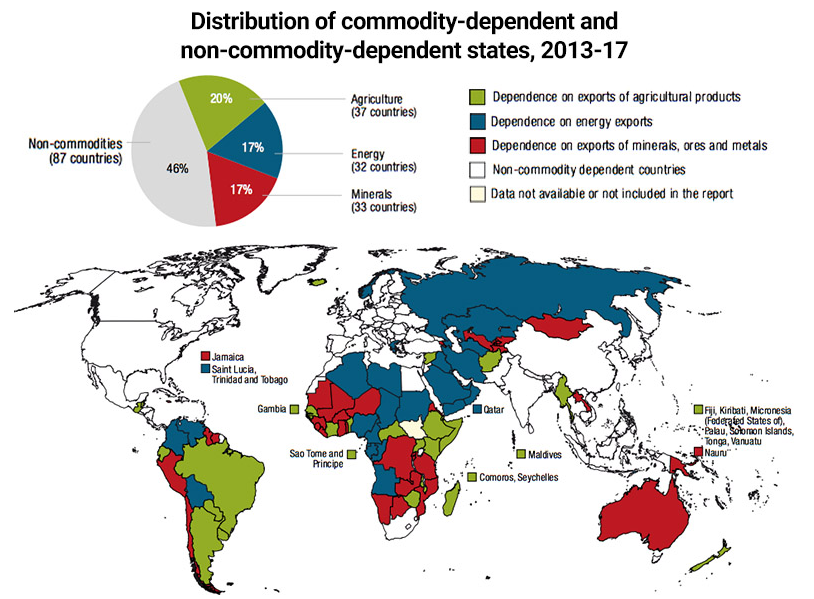
    One reason why climate change is of particular relevance to the region is that Latin America is highly dependent on exporting agricultural commodities, minerals, ores and metals, and energy products such as oil and gas. All of these activities are particularly vulnerable to climate change. A recent UNCTAD study has highlighted the concentration of commodity-dependence in the region. Meanwhile BP, one of the world’s oil majors, has argued that demand for petroleum may peak in the 2020s, and decline thereafter. The company says it will cut its oil and gas output by 40% in the next ten years as it shifts into renewables. If such a scenario plays out the implications for Latin American oil exporters such as Mexico, Brazil, Argentina, and Colombia are far reaching. Some of their major hydrocarbon resources could become “stranded assets”

    Source: UNCTAD

    Climate change has affected the region in multiple ways. In September 2020, for example, France’s President Emmanuel Macron said his country would not ratify the European Union–Mercosur free trade agreement unless it was amended to include stronger guarantees against deforestation. Mercosur is formed by Argentina, Brazil, Paraguay, and Uruguay. The FTA took roughly two decades to negotiate.

    A report by independent experts commissioned by the French government said that the FTA would increase Mercosur beef sales to Europe by 2%-4% a year, but this would require clearing land for livestock grazing that would increase the rate of deforestation in the Amazon to 5% per annum. As it stands, the experts claim the FTA would increase greenhouse gas (GHG) emissions by up to 6.8m tonnes of CO2 equivalents. These numbers are contested by Brazilian officials, who claim the country has already demonstrated that it can increase beef, soya, and maize cultivation while simultaneously reducing deforestation. In the same month Panama announced that because of falling rain and water levels in the system of locks and waterways that make up the Panama Canal, it was having to commission US$2bn worth of new investment to maintain navigability.

    If President Trump wins re-election, US policy will continue to favour fossil fuels and a generally laissez-faire approach to the environment. The government can be expected to continue its efforts to cut back domestic US environmental regulations and red tape, and to expand federal government jurisdiction versus environmental rulemaking at state levels. It is notable that US-owned oil and gas majors have done significantly less than European ones to prepare for the energy transition. The US oil lobby will continue to have special access to the White House.

    In foreign policy terms Washington will do little or nothing to encourage de-carbonisation in Latin America. However, even in this almost completely free-for-all non-interventionist model, it is worth noting that some aspects of the energy transition will continue. For example, high-cost US shale oil and gas producers may not be able to recover from the pandemic-related oil glut, and the wave of bankruptcies affecting that sector of the industry may continue (in other words the fossil-fuel boom-and-bust cycle will remain in place). It is also likely that the US auto industry will continue participating, and in some senses leading, the global trend towards the development of electric vehicles (EVs).

    A Biden presidency on the other hand holds out the possibility of increased action on climate change, initially focused on the domestic US economy. The candidate is committed to major investment in a “Green New Deal” which would include halting oil and gas exploration on federal land, as well as other policies that will increase the price of carbon emissions and provide additional incentives to de-carbonise. Biden’s vice-presidential running mate Kamala Harris is on record saying: “We need pro-labour, pro-environment trade deals – because it’s clear that Donald Trump’s protectionist approach has been a disaster.” While this will be welcomed in much of Latin America, it will also be resisted in some countries, notably Brazil which, as we have seen, has objected to environmental safeguards sought by the EU.

  • CARIBBEAN POINTERS

    LatinNews 13 April 2016 Hits: 1145

    *** TRINIDAD MOVES TO STRENGTHEN SECURITY CAPABILITIES. Trinidad & Tobago faces two major security challenges. The first is the issue of TT citizens’ involvement in terrorism. In February, the Trinidad & Tobago Financial Intelligence Unit (FIUTT) reported a “significant increase” in suspicious financial transactions that could be linked to terrorism. These are thought to have tripled between 2013/14 and 2014/15. The FIUTT also reported that it had “received and analysed information from other local and international sources on over 100 persons who are suspected of participating in terrorist activities”.

    The second issue is violent domestic crime, which Prime Minister Keith Rowley described on 3 April as a “national crisis”. In a speech to a gathering of the ruling People’s National Movement (PNM), Rowley said that there had been 122 murders so far this year, which put the country on course for a full-year murder total of 500. He said: “I am putting it to you today that that level of unacceptable conduct is a national crisis”.

    The government’s response to these twin crises has been to introduce new legislation to strengthen the Strategic Services Agency (SSA) and to give it greater authority and capabilities to monitor people who are suspected of involvement in serious crime. The issue is politically controversial because in 2010 the-then People’s Partnership (PP) government claimed that the previous PNM government had authorised the monitoring of phones used by journalists, politicians, and judges. The PP government amended the relevant legislation and dismissed a number of SSA employees.

    Separately, the PNM government has said that the Integrity Commission is to investigate members of the ousted PP government over their role in the multi-billion-dollar Point Fortin Highway project. On 1 April, Attorney-General Stuart Young said: “Government’s intention is to request that the Integrity Commission investigate this travesty as there appears to be a breach of Section 24 of the Integrity in Public Life Act, as persons performing their functions and administering public resources for which they were responsible did not do so in a cost-effective way.”

    *** PORTIA TO FIGHT FOR PNP LEADERSHIP. Having lost the 25 February general election, People’s National Party leader Portia Simpson Miller seems certain to face a leadership challenge at the party’s annual conference in September. But Simpson Miller has confirmed that she will be resisting any challenge, saying at a press conference on 4 April: “I’m not the only political leader in Jamaica that lost an election, and I didn’t hear calls for the others to step aside.” Perhaps, she added, it’s “because I’m of a different gender”.

    It is too early to say who will be the main challengers as nominations for the leadership do not have to be submitted until July, but former finance minister Peter Phillips seems certain to be one of those seeking the leadership.

    *** GUYANA WELCOMES DECREASE IN SERIOUS CRIME. According to the Guyana Police Force (GPF), there was a 14% decrease in serious crime in the first quarter of 2016. In total, there were 825 serious crimes recorded in the first quarter of 2016 against 963 in the same period of 2015. The number of murders, 42 against 40 (down 5%), showed only a marginal improvement, but the number of recorded rapes (70) was down 16% from last year’s first quarter figure of 83. Another significant improvement was in the number of robberies in which firearms were used, down 10% to 133 (from 147 in the same period of 2015). The GPF attributed the improvement, in part, to the “implementation of social problem-solving strategies…and the strong partnership we have forged with civil society”.

  • EL SALVADOR: Economic accord outweighs significance of election

    LatinNews 07 March 2012 Hits: 1903

    All eyes in El Salvador are on the congressional elections on 11 March. However, the outcome of this is likely to be far less significant than the evolution of an economic agreement with the US designed to drive the country’s development on myriad fronts. The government of President Mauricio Funes is desperate to push up growth rates in order to raise more revenue for social programmes to reduce poverty and create more jobs to keep disillusioned youths from drifting into crime.

    Congressional elections in El Salvador rarely throw up many surprises. Unless the ruling left-wing Frente Farabundo Martí para la Liberación Nacional (FMLN) or the main right-wing opposition Alianza Republicana Nacionalista (Arena) manage to secure an unprecedented majority of 43 in the 84-seat legislative assembly, there is unlikely to be much change. These elections are much more interesting than past contests in the sense that independent candidates can stand for the first time, and voters can express their preference for specific candidates on party lists rather than the party simply frontloading lists with bigwigs who are thus guaranteed to reclaim their seats election after election. But, ultimately, the elections are likely to produce a similarly balanced result where neither the Left nor the Right controls congress.

    The biggest concern for El Salvador is not minor musical chairs in congress but bolstering the economy, which grew by just 1.4% in 2011, the lowest rate of growth in the region, and has by and large stagnated since dollarisation in 2001. The prime objective of the Partnership for Growth (PFG), which El Salvador signed with the US on 3 November, is to identify barriers for improved growth to spur development and help to reduce poverty.

    A joint US-El Salvador economic team, which conducted an analysis of the constraints to growth in El Salvador, concluded that crime and insecurity and low productivity in tradables were the most serious constraints. No great surprise. It produced a five-year plan for 2011-2015 to tackle these constraints, including improving infrastructure, investing in human capital, and encouraging financial capital. The goals for tackling crime and insecurity include strengthening rule of law institutions and professionalising the police, although this problem clearly requires a totally holistic approach, as it provides a classic ‘Catch-22’ challenge: without economic growth, tackling all the causes of insecurity is beyond the State; but, unless insecurity is reduced, the environment required to foster economic growth is very difficult to create.

    The PFG is trying to address this. At the end of February the two countries agreed upon a ‘monitoring and evaluation framework’ to track progress towards meeting 20 specific goals such as: reducing the national homicide rate; improving the public perception of insecurity; increasing prosecutions and convictions as a percentage of violent crimes reported; generating per capita GDP growth; increasing exports as a percentage of GDP; and raising foreign direct investments as a percentage of GDP. It hopes that by transparently monitoring specific goals in this manner other donor governments and international institutions will be encouraged to participate, as well as civil society, and gradually a real difference can be made.

    Eric Postel, USAID’s new Assistant Administrator for the Bureau of Economic Growth, Agriculture, and Trade, who is overseeing the PFG, said El Salvador was a long way ahead of the other three countries pursuing a PFG - Ghana, the Philippines and Tanzania – as the Funes administration has also created a ‘council of growth’ including five high-profile Salvadorean businessmen and five government officials to help develop a strategic agenda to feed into the PFG.

    • Security

    US Secretary of Homeland Security Janet Napolitano visited San Salvador during a mini-tour of the region at the turn of the month. She signed an agreement with retired General David Munguía Payés, the justice and public security minister, affirming shared commitment to enhancing information sharing and aviation security. The orthodox wing of the FMLN alleges that the US conditioned the approval of the ‘Partnership for Growth’ scheme with El Salvador on the replacement of Munguía’s predecessor, Manuel Melgar, a former FMLN guerrilla. Munguía denied the new accord would lead to an increased militarisation of public security although since his appointment another military man replaced another guerrilla at the head of the national police (PNC) [RC-12-02].

  • Chill winds blow into Uruguay

    LatinNews 14 June 2012 Hits: 512

    Uruguay is not armoured. Its economy is small and highly open, meaning that it rises and falls in line with external trends and is very vulnerable to negative exogenous shocks. Local policymakers fear that the sliding industrial activity figures are a precursor of worse to come. If policymakers do not act quickly, employment could begin to suffer and with it the domestic consumption boom that has shielded some local manufacturers from the worst of the global economic crisis.

    In the first quarter of 2012, growth in the manufacturing industry (excluding oil refining) slowed to 2.4%, according to the national institute of statistics (INE), the second consecutive quarter of declining growth. In large part this is related to economic developments in Uruguay's larger neighbours (and its main export markets), Brazil and Argentina. In Brazil, the devaluation of the Real against the US dollar since April has made some Brazilian-made goods more competitive at home, luring Brazilian consumers away from (previously cheaper) Uruguayan imports.

    In Argentina, the problems stem from a different source: the Argentine government's restrictions on imports and the imposition of tighter currency controls. Those Uruguayan industries that depend most on the Argentine (and Brazilian) export markets were the most affected. These industries account for nearly a quarter (23%) of Uruguay's manufacturing sector and include chemicals, paper, textiles, car parts, cooking oils, medicines and plastics. Overall, these sectors grew just 1.2% in the first quarter. Conversely, those industries geared towards domestic demand grew 4.5%.

    Thanks to the still robust domestic market, the picture is not yet entirely gloomy, though it is worth noting that Industry Minister Roberto Kreimerman is relatively cautious about the industrial sector in 2012, projecting growth of just 3%, which is also the forecast of the national chamber of industries.

    • Real estate

    According to official figures compiled by the national tax directorate (DGI), tax revenues from the sale of properties shrank 0.7% year-on-year in the first quarter of 2012 to UR$320m, down from UR$322m in the same period of 2011. However, by number of transactions the fall was a much more significant 16.9%, meaning that fewer properties, but of higher value, were traded. According to Gabriel Conde, the president of the Uruguayan chamber of real estate, the slowdown is in part the result “of the Argentine measures restricting the exit of foreign currencies, as well as progress on the treaty for the exchange of information [on tax and assets], which has made some investors take caution”.

  • DOMINICAN REPUBLIC: IMF signals “challenging” situation

    LatinNews 21 September 2012 Hits: 547

    On 19 September the International Monetary Fund (IMF) released a statement from its recent fact finding mission to the DR, according to which the county’s short-term macroeconomic perspectives are “challenging”.

    The newly invested President Danilo Medina had asked the IMF to provide technical assistance to his government as it prepares to submit an important fiscal reform plan to deal with the country’s public sector debt.

    The DR terminated its last stand-by agreement (SBA) with the IMF in February, after the previous government led by President Leonel Fernández (1996-2000; 2004-2012) refused to adopt some of the IMF’s recommendations ahead of the general elections. After the ruling Partido de la Liberación Dominicana (PLD) retained power with Medina, the PLD appears ready to absorb the short-term political costs and look for definitive solutions to the country’s debt problems.

    According to the IMF, the DR’s fiscal deficit to June 2012 was already 3.3% of GDP - higher than the 2% full-year target included in the 2012 budget. The Fund found that despite the boost to State coffers from the sale of the State-owned Cervercería Nacional Dominicana, the country’s fiscal situation has deteriorated in the first half of 2012 on the back of higher spending, particularly on electricity subsidies. Given that the economy is slowing, with real annual growth now forecast at 3.8% in 2012 (below the previously expected 4%), and foreign reserves (US$3.4bn) are down to two months of imports, the IMF declared the country’s financial position “difficult”. It concluded that the government has a “necessity to significantly adjust its fiscal position”.

    The report has caused alarm in the DR, on the assumption that Medina will now seek to introduce stringent fiscal measures in his draft 2013 budget in order to seal a new agreement with the IMF next year. The constitution stipulates that the draft budget must be presented to congress by 1 October. The president of the senate, Reinaldo Pared Pérez (PLD), yesterday warned that the government may not be able to meet the constitutional deadline, saying that it required more preparation time. Pared Pérez added that deputies should be a bit more “lenient” and show some “understanding” with the new government, given the current situation.

    The opposition rejected this. It urged the new Medina team to keep the current budget in place, until such time as it introduces its fiscal reform plans and secures a new deal with the IMF. The opposition most likely intends to contest both.

    DR looking for FTA with Canada

    On 4 September President Medina met a delegation headed by Canada’s Associate Minister of Defence and Minister of State, Bernard Valcourt, and revealed that the two countries may begin negotiations on a bilateral free trade agreement (FTA).

    According to Medina, Valcourt’s visit was originally intended to discuss the possibility of increasing Canadian investment in the Dominican Republic and to promote bilateral tourism. However, after discussing the issues the two men agreed that their respective countries would make “excellent” commercial partners and that the signing of an FTA was a possibility as it would be “mutually beneficial”.