All Categories

Subcategories

  • ECUADOR-PERU: Taking drastic action

    LatinNews 19 March 2020 Hits: 4430

    The governments of both Ecuador and Peru ratcheted up their response to contain the outbreak of coronavirus (Covid-19) this week by implementing some of the toughest measures in the region. Presidents Lenín Moreno and Martín Vizcarra respectively declared a state of emergency, closed national borders and schools, restricted free movement, and imposed nocturnal curfews. The public health services in both countries would struggle in the event of a sharp escalation in cases but Peru is on a much sounder economic footing to weather the virus-induced slump. Ecuador, weighed down by a heavy debt burden and battling to reduce a high fiscal deficit, also heads into this struggle with oil prices falling to fresh lows.

    On 16 March President Vizcarra announced “firm and decisive action”, publishing a supreme decree proclaiming a state of national emergency for 15 days. This included the total closure of land, sea, and air borders; restrictions on free movement; the closure of all non-essential businesses; and the armed forces taking to the streets to guarantee public security and to impose measures such as an overnight curfew. Large gatherings had already been suspended and schools closed.

    Vizcarra acknowledged that obligatory social isolation was an extreme measure. The switch from limited to draconian action almost overnight in Peru, however, prompted uncertainty about the details of its application. An obligatory nocturnal curfew, for instance, began on 18 March with no shortage of people caught out. The interior minister, Carlos Morán, announced that henceforth anyone travelling in a private vehicle between 20:00 and 05:00, other than in a medical emergency, would be arrested.

    The same measures, including the declaration of a state of emergency and a nocturnal curfew, have been applied in Ecuador. President Moreno justified the strict measures by arguing that “in exceptional situations, exceptional measures are required”. But suspicion of the government is much more pronounced in Ecuador than in Peru. Indeed, shortly before the latest measures were announced, the umbrella indigenous organisation Confederación de Nacionalidades Indígenas del Ecuador (Conaie) declared “a permanent national mobilisation” in rejection of the budgetary cuts and other economic adjustments announced by the Moreno administration last week [WR-20-10].

    Conaie also demanded that the government “immediately” implement the economic plan the indigenous organisation presented after last October’s protests, which calls for a new national economic model, and the imposition of a 4% income tax and two additional taxes on the assets of the 270 largest economic groups in Ecuador. Conaie suspects that the government is intent on using its emergency powers to drive through its economic reforms, and quash any protests.

    Reform is needed, however, as Ecuador’s economic problems are now acute. Already flailing in its efforts to contain the fiscal deficit, Ecuador now faces the prospect of plummeting oil prices. The reference price of West Texas Intermediate (WTI) fell by 24% to just US$20.37 per barrel on 18 March, its third worst day in history. This is the lowest price since February 2002. It could continue to slide to fresh lows as Saudi Arabia remains committed to a price war with Russia, promising to supply a record 12.3m barrels per day (bpd) to the oil market in the coming months at a time when global demand is falling precipitately as economic activity winds down in the midst of the coronavirus crisis.

    Oil price slump

    Ecuador’s budget is predicated on an average annual oil price of US$51 per barrel so the continued decline in the reference price of WTI, to just US$20.37 per barrel, is a huge cause for concern. Ecuador’s energy and non-renewable resources minister, René Ortiz, announced on 18 March that the government would “accelerate pending processes to capture new investments”. He was flanked by the CEO of the state oil firm Petroamazonas, Juan Carlos Bermeo, who said that development of the Tambococha oil field in the Yasuní national park would be accelerated.

  • URUGUAY: LUC approval overshadowed by Talvi departure

    LatinNews 09 July 2020 Hits: 7737

    President Luis Alberto Lacalle Pou’s far-reaching reform bill cleared its final hurdle in congress on 8 July. The left-wing opposition coalition Frente Amplio (FA) strenuously opposed the so-called Ley de Urgente Consideración (LUC), arguing that it constrained fundamental liberties, and squeezed myriad unrelated issues which were far from urgent into a bill requiring approval within 90 days in the midst of a pandemic. But the five-party ruling coalition hung together to secure the LUC’s approval. Whether it will remain united throughout Lacalle Pou’s mandate is less certain. Stresses and strains can already be discerned. The foreign minister, Ernesto Talvi, tendered his resignation last week during the virtual summit of the Southern Common Market (Mercosur).

    Uruguay’s lower chamber of congress approved the LUC, which contains 476 articles, covering a vast array of issues, including economic, education, and public security matters, on 5 July. It seeks, inter alia, to toughen the penal code to combat rising crime and drug-trafficking; confer more powers on the police; downsize the state, imposing restrictions on public spending and austerity in public administration costs; reform the public education and pension systems; and reshape labour relations. The LUC returned to the senate, which harmonised its version of the bill with that of the lower chamber, where some 40 changes had been made, on 8 July. It will take effect after promulgation by Lacalle Pou.

    The sheen was taken off the LUC’s approval for Lacalle Pou, however, after Talvi resigned on 1 July on the same day as he represented Uruguay in a virtual summit of Mercosur foreign ministers in which the country assumed the pro tempore presidency of the bloc. Talvi, who had intimated on 11 June that he could resign in the near future, sent a letter to Lacalle Pou published on Twitter, announcing his departure after just four months in the job. Lacalle Pou said Talvi was leaving for “a mixture of political and personal reasons”. He appointed a loyalist, Francisco Bustillo, Uruguay’s ambassador to Spain, to replace Talvi. Bustillo arrived in Montevideo on 5 July and was in his new post the following morning, although he is in quarantine for five days.

    • Mercorealists

    “We don’t have to be mercopesimists or mercoptimists…but mercorealists,” President Lacalle Pou said, while spelling out Uruguay’s objectives as it assumes the pro tempore presidency of Mercosur for the next six months from Paraguay. Speaking at Mercosur’s virtual heads of state summit, Lacalle Pou stressed the need to improve infrastructure, connectivity, and customs within the bloc, and to eschew protectionism and embrace multilateralism, including the ratification of a trade deal reached with the European Union (EU). He also called for deeper relations with China (a complex matter not least because Paraguay retains diplomatic relations with Taiwan).

    Lacalle Pou said he saw no reason why Talvi’s resignation should weaken the five-party ruling coalition, adding that the main issue going forward would be how to resolve internal tensions that would inevitably arise. But the fulcrum of the ruling coalition is the alliance between Lacalle Pou’s Partido Nacional (PN, Blancos) and Talvi’s Partido Colorado (PC), traditional rivals. The PC party leadership committee expressed its continued support for the ruling coalition, which it said was “indispensable for the change the country needs”, but having lost one of its three cabinet posts, it will expect to be awarded control of the new environment ministry created under the LUC to preserve its quota.

  • COLOMBIA: Sexual assault scandal adds to military malaise

    LatinNews 30 July 2020 Hits: 3340

    The news that seven Colombian soldiers had pleaded guilty to the sexual assault of a 12-year-old girl from the indigenous Emberá tribe prompted widespread public outrage, and led to a barrage of similar cases from across the country making national headlines in June and July. Some had never been reported, but many more had seemingly been suppressed by state security officials, sparking a wider debate on the effectiveness of military justice in Colombia, and the consequences for victims of human rights abuses, especially those from marginalised or minority communities.

    The case that broke the floodgates was reported on 24 June by Juan de Dios Queragama, the indigenous governor of Risaralda department’s Gito Do Kabu reservation. He stated that the girl had been “kidnapped and sexually abused”, and the soldiers in question admitted their guilt in court the next day. President Iván Duque was quick to call for “the full weight of the law to fall on those responsible”, but as reports of similar cases from across the country quickly piled up, army commander General Eduardo Zapateiro was forced to reveal to the attorney general’s office that 118 soldiers have faced investigation in relation to the sexual abuse of minors since 2016, 73 of whom are still affiliated with the armed forces.

    The Organización Nacional Indígena de Colombia (Onic), which represents the country’s indigenous communities, was at the forefront of the public and civil society backlash; Onic’s human rights representative Aida Quilcué sought to get ahead of familiar excuses that such abuses are the work of ‘a few bad apples’, insisting that this is “not an isolated issue, it is structural”, linked intrinsically to “the doctrine of public force”. Onic’s 24 June statement was quick to highlight the broader failings of military justice, appealing for the case to be heard in a criminal court, to avoid excessively lenient sentences for the soldiers, who at the time were being detained in military custody.

    • Military scandals

    This marks the latest in a series of high-profile scandals for Colombia’s military, following the exposure of army spying operations against civilian targets [SSR-20-06], and warnings that the intensification of coca eradication efforts during the pandemic represents a threat to the lives and livelihoods of rural communities [SSR-20-07]. General Zapateiro recently insisted that “individual actions cannot define this institution, beloved and valued by the Colombian people”, but the reality is that the military’s reputation has taken a substantial hit in recent months.

    The authorities have made efforts to be seen to be taking more serious action, with the national police and attorney general’s office launching a co-ordinated national operation in July against “behaviours that affect the lives of children and adolescents”. However, in a month where congress passed a long-awaited constitutional reform enabling life imprisonment for those accused of sexual assault against minors, the news that the soldiers in the Gito Do Kabu case could face as few as 14 years in prison made it abundantly clear that members of the armed forces will still not face justice on the same terms as the rest of the country.

    Critics of the government have put a particular emphasis on the disproportionate impact of such crimes on indigenous and Afro-Colombian communities, in keeping with the increased scrutiny across the globe of structural racism within state security forces. Protests were held in several Colombian cities to this effect in late June, while the Inter-American Commission on Human Rights (IACHR) highlighted the need for the government’s response to “include an intercultural perspective”, to ensure that allegations from marginalised groups are believed, and proper legal protections applied.

    Another issue raised in the wake of this scandal has been the surge in gendered and domestic violence as a result of the coronavirus (Covid-19) pandemic, a phenomenon observed in many countries across the world. Lawyer and former senator (1994-2010) Piedad Córdoba has called for Duque’s government to respond to this crisis, arguing that mobility restrictions imposed in response to the virus have increased the frequency of domestic violence, while also making it more difficult for victims to report such crimes.

  • MEXICO: Seeking new ways to fight obesity

    LatinNews 02 October 2020 Hits: 1013

    The Mexican state of Oaxaca has taken the unprecedented decision to ban the sale of ‘junk food’ and sugary drinks to children. The Oaxaca authorities believe that the drastic move will help address Mexico’s growing obesity problem, which has been a major public health concern for years. The measure has inspired federal legislators, many of whom propose making the ban national and adopting similar measures against other unhealthy products. But the move has proved controversial with shop owners and the local food industry, who complain that bans have a negative economic impact and argue that their effectiveness in reducing obesity is limited. The public debate over these issues is likely to shape public health policies for the next few years.

    Mexico has a serious obesity problem. With 30% of the Mexico’s adult population classed as obese, the country has the second highest obesity rate in the world only behind the US. This produces problems for the national health system as obesity is linked to various chronic diseases such as diabetes and high blood pressure, which require prolonged and costly treatment and which often lead to other health complications that require hospitalisation. All this places significant strain on the public health system. The ‘Health at a Glance: Latin America and the Caribbean’ report published by the Organisation for Economic Co-operation and Development (OECD) in June noted that the high obesity rate has led to Mexico having a higher hospitalisation rate (248.5 hospitalisations per every 100,000 inhabitants) than the rest of Latin America (122.5 per 100,000).

    Moreover, the coronavirus (Covid-19) pandemic has shown other vulnerabilities of obese and overweight individuals, who are more susceptible to dying from the disease. Indeed the Mexican government has attributed the country’s high Covid-19 death rate (over 76,000 deaths recorded up to September) to the high incidence of underlying health conditions in the Mexican population, including diabetes (estimated to increase the chances of dying of Covid-19 by 37.42%), hypertension (42.26%), and obesity (25.41%). According to Mexico’s health ministry (SSA), 20% of all Covid-19 fatalities in the country concerned people who suffered from hypertension or diabetes. This has brought the obesity problem back into sharp focus, with activists and healthcare experts highlighting the need for public policy action to confront the problem.

    Successive Mexican governments have sought to address the obesity problem through pioneering policy action. This included the introduction of a ‘sugary drink tax’ in 2014, making Mexico one of the first countries in the world to adopt such a tax. But it is widely acknowledged that this has not resolved the obesity problem and that further measures are needed. In a bold attempt to further discourage the consumption of excess sugar and other highly calorific foods, on 5 August the Oaxaca state congress approved a new law that extends the ban on the direct sale of sugary drinks and any products classified as ‘junk food’ to underage children, which until then only applied inside schools. The new legislation bans the sale of these products, albeit with some notable exceptions, to children anywhere in Oaxaca.

    • Exceptions

    The law approved by the Oaxaca state government includes some notable exceptions of highly calorific but traditional foods, the sale of which will not be banned for children. Among these are ‘chocolate Oaxaqueño’ – an artisanal chocolate drink made with ground cocoa, ground almonds, ground cinnamon, and sugar – and ‘tlayudas’ – a traditional snack consisting of fried tortillas covered with refried beans, lard, meat, Oaxaca cheese, salad, and salsa, that is commonly served by street vendors across Oaxaca. Proponents of the law defended these exceptions saying that these foods are part of Oaxaca’s cultural heritage.

    The legislation places the responsibility on sellers, who face a heavy fine for violating the ban and knowingly selling banned products to minors. Proponents of the new law maintain that it is a justified response given that Oaxaca has the highest child obesity rate in Mexico and that this creates countless problems for the local public health system. The Oaxaca state congress, which is dominated by the nationally ruling leftist Movimiento Regeneración Nacional (Morena) party, even recommended that its initiative be adopted at the national level. Morena state legislators argued that while the initiative should help reduce the consumption of high calorific products by children, it should not have a major impact on the food industry or shop owners, as the sale of these products is not forbidden and can be sold to adults including parents, who can then be held responsible for giving them to children.  

    The calls for implementing a national ban have been heeded and federal Morena legislators have said that they plan to present a bill in the federal congress, along with other initiatives including slapping more taxes on other high-sugar content products. All of this has been backed by deputy health minister Hugo López-Gatell, who is leading Mexico’s Covid-19 response and considers that reducing obesity levels should be the country’s top public health priority aside from the pandemic. However, the introduction of the Oaxaca ban, the prospect that this could be extended nationally, and that further measures affecting the food industry may be forthcoming, have been rejected by the influential local agro-industrial sector, business groups, and some politicians.

    The national association of small shop owners (Anpec) has complained that the ban will inevitably hurt Oaxaca shopkeepers and a local family economy that is already facing considerable hardship due to the effects of the pandemic. Similarly, the national sugar and alcohol industry chamber (CNIAA), and even the Confederación de Cámaras Industriales (Concamin) confederation of industrial chambers, have also criticised the moves to restrict the consumption of food products.

    • López-Gatell

    López-Gatell celebrated the Oaxaca ban insisting that this was an “extremely positive” measure that addresses what he considers to be Mexico’s main long-term public health concern. In particular, López-Gatell said that he has long called for the authorities to discourage the consumption of sugary drinks by children and Mexico’s population in general. Describing sugary drinks as “poison in a bottle”, López-Gatell has noted that the Alianza por la Salud Alimentaria local healthcare sector NGO calculates that Mexico’s high consumption of sugary drinks accounts for some 40,000 deaths a year due to complications linked to obesity.

    The CNIAA noted that the sugar industry provides some 500,000 direct jobs and 2.7m indirect jobs and that many of these would be put at risk with the introduction of new regulations for products containing sugar. The CNIAA has argued that the Oaxaca ban will do more harm than good, arguing that its economic impact would outweigh any potential public health benefits. It has also complained that the law effectively “criminalises” shopkeepers by making them liable to be prosecuted for serving minors. Meanwhile, Concamin has accused Morena and the government led by President Andrés Manuel López Obrador of “demonising” sugar, even though reducing sugar consumption is not the only way to improve the nutritional health of the population.

    Concamin, CNIAA, and Anpec also warned that the ban will only promote the creation of a black market where unscrupulous individuals could sell these products to children at higher prices and without any sort of regulation. Moreover, the organisations argue that this would result in the measure failing to achieve its main objective of reducing children’s calorie consumption and would end up harming the local economy in the process. The Confederación Patronal de la República Mexicana (Coparmex), which groups together the leaders of some of Mexico’s largest businesses (including some of the world’s largest food manufacturers), has noted that while the ban affects packaged foods it seems to spare artisanal food products, which can also be high in calories.

    Meanwhile, some politicians argue that it is not the state’s role to dictate what individuals can or cannot eat, as this represents a curtailing on individual liberty. Critics also maintain that prohibition has historically been proven to be less effective than education and that the focus of the public health policies should be to educate children and individuals in general about nutritional health rather than impose bans. But supporters of the ban such as López-Gatell insist that this is a valid measure given that other attempts to address the issue – such as encouraging processed food producers to reduce their products’ calorie content and not to target children in their marketing campaigns – have demonstrably failed. With some Morena federal legislators already drafting various bills seeking to impose more restrictions on the sale of high-calorie processed foods, the public debate over whether prohibition is the best way to tackle Mexico’s obesity problem is just beginning, and is unlikely to be resolved soon.

  • TRACKING TRENDS

    Patrick de Courcy 28 April 2022 Hits: 4263

    MEXICO | Combating inflation. President Andrés Manuel López Obrador unveiled an anti-inflation plan during his morning press conference on 27 April. López Obrador said that his government had negotiated with producers, distributors, and big department stores to standardise the cost of 24 products in the basic basket of goods, such as beans, maize, milk, and rice, across the country to ensure “fair prices”, rather than impose “price controls”. Full details, he said, would be divulged next week.

    The plan is designed to try and mitigate the impact of soaring inflation on the purchasing power of the poor. Annualised inflation reached 7.72% in the first half of April, the highest rate for the last 21 years.
     

    MEXICO | Independent trade union triumphs. On 23 April, workers at an auto parts plant owned by Japanese conglomerate Panasonic in Reynosa, one of the largest cities in the northern border state of Tamaulipas, elected an independent trade union to represent them in the third such victory in Mexico in recent months.

    The Sindicato Independiente Nacional de Trabajadores y Trabajadoras de la Industria Automotriz (SNITIS), an independent union, won the vote with 1,200 of the 1,600 votes cast. The Sindicato Industrial Autónomo de Operarios en General de Maquiladoras de la República Mexicana (SIAMARM), part of the 86-year-old Confederation of Mexican Workers (CTM), obtained 390 votes.

    This follows recent victories for independent unions over CTM at a General Motors factory in Silao municipality, Guanajuato, and a Tridonex automotive parts factory in Mexico’s Matamoros city, Tamaulipas.

    These cases constitute precedents in Mexico, where companies’ managers and politicians often interfere in union elections by supporting compliant leaders who fail to effectively represent workers’ interests.

  • BRAZIL: Mixed economic signs for the election

    Patrick de Courcy 11 August 2022 Hits: 3472

    The state of the economy going into an election often plays a significant role. The problem in Brazil’s case is that it is not entirely clear what the economy is doing and which of the two leading candidates - President Jair Bolsonaro or his main rival, former leftist president Luiz Inácio Lula da Silva (2003-2011) - are likely to benefit more.

    Economic data released this week paints two different stories. On the one hand, Brazil is coming out of a rough patch. Hard hit by the coronavirus (Covid-19) pandemic, GDP growth has been mediocre at best, unemployment high but recovering, and inflation has eroded purchasing power. On the other hand, the government has orchestrated the biggest pre-electoral cash injection in recent history and consumer prices have abruptly started falling. The question is to what extent deflation and hefty cash bonuses generate enough of a feel-good effect to make a difference in voter preferences.

    The point of departure for many Brazilians is quite bad. One in four Brazilians cannot afford to pay all their bills each month, according to a survey published on 8 August by the Confederação Nacional da Indústria (CNI). Only 29% of those polled say they manage to save some money, while nearly 60% say that they have put shopping for shoes or clothes on hold. 

    Poverty in Brazil’s metropolitan areas has increased from 16% in 2014 to 23.7% in 2021, according to a study carried out by the Pontifícia Universidade Católica do Rio Grande do Sul (PUCRS), local research institute Observatório das Metrópoles, and regional research initiative Red de Observatorios de la Deuda Social (RedODSAL). The extreme poverty rate in large cities more than doubled over the same time period, rising from 2.7% to 6.3%, or 5.2m people.

    Brazil’s national statistics institute (Ibge) published industrial production figures for June, which are down 0.4% over the previous month, and 0.5% year-on-year. The decline in June ended four consecutive months of rising production. Ibge noted that the industrial sector’s output remains 1.5% below its level in February 2020. While the numbers reflect activity from two months ago, they underscore how fragile the economic recovery from the pandemic has been.

    But the Ibge also had good news this week, with consumer prices falling by 0.68% in July. This is the largest decline since the series began in 1980. Prices from a year ago are still 10% higher but that is down from 12% last month. At the same time the poorest Brazilians this week saw welfare payouts under the Auxílio Brasil programme jump by R$200 (US$39) per month to R$600, while taxi and lorry drivers will also get cash handouts, and cooking gas subsidies will be doubled.

    Will it all be enough to make a difference in opinion polls? It certainly amounts to a considerable boost in purchasing power. But one argument to take into account is that the headline deflation figure will be felt differently by rich and poor, the former predominantly Bolsonaro supporters and the latter mostly in the Lula camp. The items that saw the biggest reduction - energy and transportation - benefit the middle class most.

    On the flipside, the food and drinks category, which rose by 1.3% in June, is what carries the most weight in the budget of a household in the ‘D’ and ‘E’ categories, the bottom of the socio-economic ladder. To drive home the point, the petrol price fell 15.5% and long-life milk rose 25.5% in the month of July.

    Most voters decided

    It could be that not as many people as normal are disposed to watch the economic fireworks ahead of this year’s election. There are fewer undecided voters in this election than in most others. According to the most recent Poder360 opinion survey, 80% of voters have made up their minds. For Lula and Bolsonaro supporters, the percentage is 86% and 93%, respectively. Historically that is a very low rate of undecided voters.

  • COSTA RICA: Fiscal deficit progress as first external bond issuance since 2019 approved

    Patrick de Courcy 18 January 2023 Hits: 4739

    Costa Rica’s fiscal deficit has fallen after ballooning for years, and lawmakers have approved an external bond issuance after the International Monetary Fund (IMF) completed a successful third review of its agreement with the country.

    The IMF concluded its review under the Extended Fund Facility (EFF) on 14 November, according to a statement from the organisation, which lauded authorities for “taking important steps to strengthen their economic reform program”. Then there was more good news for President Rodrigo Chaves on 25 November, when lawmakers approved the issuance of up to US$5bn in Eurobonds over the next three years. These are intended to cover upcoming financial obligations, such as a US$1bn debt repayment due in early 2023, and will be issued in four tranches.

    Approval for issuances requires a two-thirds supermajority in the unicameral chamber, which last gave the greenlight to a bond issue in 2019. Uncertainty over financing has affected borrowing costs in recent years and, while the later tranches of bonds are subject to hitting fiscal targets, the approval will help to improve confidence. And on 5 December, the finance ministry released encouraging figures which showed that, as of October 2022, Costa Rica’s deficit was ¢798.0bn (US$1.3bn), equivalent to 1.8% of GDP. This represents a reduction of two percentage points compared to the same period in 2021, and the Chaves government claims that the figure is the lowest since 2013.

    Commenting on the developments, ratings agency Fitch Ratings said that Costa Rica is outperforming both its expectations and the EFF targets. The country recorded a primary surplus of 2.3% of GDP from January-October 2022, its highest since 2008, compared to a 0.3% primary deficit in 2021, said Fitch, and the agency struck an optimistic tone about the future in a statement published 5 December. “Financing needs will remain elevated given the concentration of debt maturing between 2023-2026, but robust fiscal performance and the government’s commitment to furthering this under the IMF Extended Fund Facility (EFF) should further ease liquidity pressures,” it said. Fitch also said that lower financing needs could help to cut government interest payments, which cost the equivalent of 4.1% of GDP according to the latest finance ministry figures and are a major cause of the country’s negative fiscal balance, but the agency warns that this depends on the state of the global financial markets.

    Fitch continues its rosy assessment by forecasting that central government debt will fall from 68.0% in 2021 to 63.8% in 2022, reversing the “steady fiscal deterioration that led to debt/GDP almost tripling between 2008 and 2020,” with a downward debt trajectory for the next five years. It also forecasts real GDP growth of 4.2% in 2022, slowing to 2.7% in 2023. 

    Pressure over social spending

    Overall the outlook for Costa Rica’s public finances appears largely positive given recent developments, but President Chaves will likely face pressure from civil society groups pushing for more social spending, which has fallen due to fiscal pressures in recent years.

  • TRACKING TRENDS

    Patrick de Courcy 13 April 2023 Hits: 3125

    CHILE | Reducing working week. On 11 April Chile’s federal lower chamber of congress approved a bill to reduce weekly working hours from 45 to 40. The bill was first proposed in 2017 and passed the senate in November 2019. Speeches given in the lower chamber highlighted the benefits that the change will bring to workers such as greater quality of time, allowing up to five additional days of annual leave, catering for condensed working (the working week fit into four days), and allowing for shared parental responsibilities for parents of children under twelve.

    However, some expressed concerns about the economic impact of the bill, especially in a time of economic crisis, as well as what this means for small and medium-sized enterprises (SMEs) and production costs. The law, which has now passed to the executive for promulgation, will be implemented gradually: 44 hours in the first year, 42 hours in the third year, and 40 hours in the fifth year. President Boric celebrated the bill via Twitter, saying it was “a pro-family initiative aimed at ensuring a good life for all”.

  • COSTA RICA: Set for the deadliest year on record

    Patrick de Courcy 28 September 2023 Hits: 3507

    The director of Costa Rica’s judicial investigation agency (OIJ), Randall Zúñiga, has warned that Costa Rica has already registered more homicides this year than in the whole of 2022 – itself a record year for homicides. Attributed to the growing presence of international drug trafficking organisations (DTOs), the surge in violence is a source of significant pressure on President Rodrigo Chaves, who in May was compelled to replace his security minister and introduce a new security plan [WR-23-19].

    Zúñiga issued his warning in a report broadcast by national TV channel TN7 on 22 September which noted 655 homicides had been registered so far this year, up from 654 registered in the whole of 2022 (revised down from the initially reported figure of 656). The figures registered so far this year compare with 448 tallied in the same period in 2022. The same TN7 report highlights that San José was the deadliest province (registering 163 homicides, up from 79 in 2022), followed by the coastal province of Limón (159, up from 113 in 2022), and Puntarenas (106, up from 75), also on the coast.

    Government officials like Zúñiga have been quick to blame the violence on DTOs and their battle for control over the transnational drug trade. Costa Rica remains the top transshipment point for cocaine en route to the US from South America as the latest (March 2023) annual International Narcotics Control Strategy Report (INCSR) by the US State Department notes. Zúñiga, who earlier this month said homicides could exceed 900 this year, made headlines in June warning that unless action was taken, a “mega cartel” could launch, whereby gangs from Limón province would collaborate with Colombian criminal groups, although he was careful not to name any names. He said that while for now, the provinces of San José, Heredia, and a part of Alajuela remain unaffected, criminal groups from Limón are seeking to extend their reach to parts of the Central Pacific, Northern Pacific, and Northern Huetar regions.

    The government has taken action in response to the violence; in April a new security plan ‘Operación Costa Rica Segura’ was launched, involving the deployment of more police, among other things [WR-23-17]. In May Chaves replaced security minister Jorge Torres with Mario Zamora, who previously held the post under former president Laura Chinchilla (Partido Liberación Nacional, 2010-2014), while operations have targeted specific areas. These include ‘Impacto Limón 2023’, a 100-day operation launched on 25 May in Limón where, according to the INCSR, the homicide rate is 35.8 per 100,000 inhabitants, up from the national average of 12.6 per 100,000. The operation involves the security ministry, attorney general’s office, and judiciary while the US has also announced cooperation for the province.

    In early July, Zamora and the US ambassador to Costa Rica, Cynthia Telles, unveiled the ‘Together for Limón’ initiative, a joint US-Costa Rican effort to “bring greater prosperity and security to Costa Rica’s Caribbean coast”, with a US government investment of over US$20m to provide training and cooperation with the police to improve public security and to combat drug trafficking and organised crime. Last month also saw the launch of the ‘Together for Puntarenas’ initiative for Puntarenas province, with nearly US$11m in new security assistance, according to the US embassy.

    However, a report published on 26 September by specialist website Insight Crime cites Chinchilla - herself a former security minister (2008) - as warning that the new security measures have been hobbled by a lack of coordination between authorities - a situation which Insight Crime attributes to the lack of a long-term, coherent national security strategy.

    Insecurity - the chief public concern

    A survey published this month by national pollster Centro de Investigación y Estudios Políticos (Ciep) of the Universidad de Costa Rica (UCR) showed that insecurity and crime remains the public’s chief concern. It was cited as such by 27.8% of respondents, ahead of corruption (15.9%) and unemployment (13.2%). The issue of insecurity emerged as the public’s chief concern in April – the first time since August 2018 that this had been the case.

  • TRACKING TRENDS

    Abbi Dicker 29 February 2024 Hits: 2329

    MEXICO | AWS announces major investment. On 26 February Amazon Web Service (AWS), a subsidiary of US company Amazon that provides cloud computing services, announced plans to launch an AWS ‘infrastructure region’ in Mexico’s Querétaro state by early 2025, representing an investment of more than US$5bn over 15 years.

    The project will see the opening of multiple data centres in Mexico, which AWS states will give developers, startups, entrepreneurs, and enterprises, as well as government, education, and non-profit organisations, greater choice for running their applications and ensure that customers who want to store their content in Mexico can do so. The project will also serve demand for cloud services across Latin America.

    The announcement comes amid an increase in nearshoring investment in Mexico in the wake of the coronavirus (Covid-19) pandemic and mounting diplomatic and trade tensions with China. The AWS investment eclipses the US$4.5bn investment announced last year by the electric vehicle (EV) manufacturer Tesla to construct a gigafactory in the northern state of Nuevo León.

    The state governor, Samuel García, said at the weekend that he had asked Tesla to lay the foundation stone of the new factory in March “and they didn’t tell me no”.


    MEXICO | Government completes purchase of Iberdrola plants. On 27 February Mexico’s President Andrés Manuel López Obrador hailed the “nationalisation” of 13 power plants as the government completed their purchase from Spanish energy company Iberdrola.

    Iberdrola announced that it had sold the plants, which primarily comprise gas-fired combined cycle power stations and have an installed capacity of 8,539 megawatts (MW), for around US$6.2bn. The company said the sale represented 55% of its business in Mexico in terms of its gross operating profit.

    Iberdrola will maintain ownership of 15 plants in Mexico, alongside its private customer base and renewable energy projects.

    The plants will now be operated by the state-run electricity company, Comisión Federal de Electricidad (CFE). Speaking from Tamazunchale municipality, San Luis Potosí state, where one of the plants is located, López Obrador stressed his administration’s work to strengthen the CFE, which is the focus of a constitutional reform he presented to congress on 5 February as part of a wider reform package [WR-24-05].

  • RASTREANDO TENDENCIAS

    LatinNews 17 September 2012 Hits: 430

    CUBA | Apagón. La semana pasada, Cuba sufrió su peor apagón en una década después de que gran parte del oeste fuera golpeado, con la capital, La Habana, y siete provincias (Artemisa, Ciego de Ávila, Cienfuegos, Matanzas, Mayabeque, Pinar del Río, y Villa Clara) quedando sin electricidad por más de cuatro horas el 9 de septiembre. En una declaración citada en la prensa internacional, el Ministerio de Industrias Básicas culpó del corte a una “interrupción” en una línea de 220.000-volt entre las ciudades de Ciego de Ávila y Santa Clara, afectando el servicio desde Camagüey hasta Pinar del Río, o el 60% de la isla. Unos 5m de cubanos, casi la mitad de la población de 11m, fueron afectados. El apagón, inevitablemente, evocó memorias del ‘periodo especial’ después de la caída de la Unión Soviética durante el cual los cubanos soportaron una severa escasez de electricidad.

    NICARAGUA | Retirada del Whinsec. El Presidente Daniel Ortega anunció recientemente que Nicaragua ya no enviaría tropas al controversial Western Hemisphere Institute for Security Cooperation (Whinsec – anteriormente la Escuela de las Américas de EU) en Georgia, EU. Hizo el anuncio en una reunión con una delegación de activistas de derechos humanos en Managua, el 4 de septiembre. De acuerdo con un informe de prensa de SOA Watch, una organización que busca el cierre de la institución, que es notoria por entrenar a algunos de los peores violadores de los derechos humanos de América Latina, Ortega la calificó de un “anatema ético y moral”. El primer país en Centroamérica en retirar sus tropas de la escuela desde su apertura en 1946, Nicaragua sigue los pasos de Argentina, Bolivia, Uruguay, Venezuela, y Ecuador, todos ellos habiendo retirado sus tropas del instituto.

  • EL SALVADOR: Arena-FMLN talks founder

    LatinNews 13 May 2014 Hits: 3283

    Interpol issued an international request to arrest former president Francisco Flores (1999-2004) on 7 May. On the face of it the pursuit of Flores looks like it could damage attempts by president-elect Salvador Sánchez Cerén, of the left-wing Frente Farabundo Martí para la Liberación Nacional (FMLN), to hold talks with the right-wing opposition Alianza Republicana Nacionalista (Arena) to pave the way for cooperation on a series of policy initiatives in the legislative assembly. What is really jeopardising talks, however, is not Flores (a powerful figure within Arena until his recent disgrace but now discarded by the party), but the possible impeachment of two Arena deputies.

    Interpol responded to formal charges of embezzlement, illicit enrichment and disobedience brought against Flores by a San Salvador judge. The first two charges relate to multi-million-dollar donations received by Flores while he was in power from his Taiwanese peer which were, at least ostensibly, meant for post-earthquake reconstruction efforts in 2001, combating drug trafficking and other things. The third charge refers to Flores’s sudden decision to stop appearing before a special legislative commission investigating the matter in February.

    No other former president has ever been charged with corruption or any other crime in El Salvador, which possibly explains why in his two appearances before the commission. Flores was remarkably candid about the complete lack of transparency and accountability surrounding his handling of the donations from Taiwan, which he admitted he had not received through any cooperation accord, even being vague about how much he had received: “some US$15m to US$20m”. Flores did say that he never put donations in his personal bank accounts in Costa Rica, the US and The Bahamas. The Costa Rican attorney general, Jorge Chavarría, has promised full cooperation in freezing accounts and passing on information related to the case.

    Since Flores absconded over two months ago, his whereabouts have been unknown, although the head of the legislative assembly, Sigfrido Reyes, claimed on 1 May to have received intelligence that Flores was hiding out in Panama at a luxury beach house belonging to former Panamanian president Mireya Moscoso (1999-2004), a personal friend who was in power at the same time as Flores.

    Impeachment of Arena deputies

    While the Flores case has captured headlines at home and abroad, another legal case involving the potential impeachment of two Arena deputies has only attracted interest from the local media. Yet from a domestic political perspective it could end up being more important. On 4 March President Mauricio Funes accused Arena deputies, Roberto d’Aubuisson and Ana Vilma de Escobar, of defamation and calumny for requesting that the attorney general’s office investigate whether he crashed a Ferrari into a tree early on 18 February in San Salvador under the influence of alcohol - the same day Funes fractured his hip and had to undergo surgery. Funes vehemently denied having driven the Ferrari let alone drink-driving and sought the impeachment of the deputies.

    Two legislative commissions will shortly present their findings for the full assembly to vote on whether to impeach the deputies. Arena’s president, Jorge Velado, said the impeachment proceedings conspired against a dialogue process being sought by the incoming FMLN government. Velado pointedly suspended a meeting with vice-president-elect Óscar Ortiz and FMLN bigwigs in early May.

    • Political asylum

    President Mauricio Funes made an appeal to the Panamanian government led by President Ricardo Martinelli on 3 May not to grant former president Francisco Flores (1999-2004) political asylum, arguing that Flores was “not a political target” but had to face charges of serious wrongdoing in El Salvador. Time is not on Funes’s side. Unless Flores is arrested and arraigned before 31 May, the statute of limitations will expire. Funes hands over power the following day.

  • BRAZIL: No change at top, despite police corruption scandal

    LatinNews 18 September 2014 Hits: 1175

    José Mariano Beltrame, the secretary of public security in Rio de Janeiro state, told reporters on 17 September that he was “comfortable” with the state’s police chiefs, despite the revelation of a major extortion racket among officers in the western suburb of Bangu. Twenty-four officers have been arrested, among them the third-in-command of the city’s military police, Colonel Alexandre Fontenelle Ribeiro, for demanding payment from shopkeepers, motorbike taxis and private van and bus companies in order to turn a blind eye to legal infractions.

    According to the public ministry, the gang, known as ‘Friends Inc.’, charged between R$30 (US$12) to R$2,600 (US$1,100). When police investigators raided the homes of one of the officers accused, they found R$287,000 (US$121,000) in cash. Rio has a long history of police extortion rackets; an investigation in 2006 resulted in the arrest of 75 serving police officers. In 2008, the former head of the city's civil police was jailed over the scheme.

    Beltrame, however, insisted he still had confidence in the police. “If you look at the incidents of criminality, you will see that the numbers are good, we are on the right path. The investigations against the police officers are ongoing; if we receive new information, we will do what is necessary,” he said. The overall commander of the military police in Rio, Colonel Luís Claudio Castro insisted that he did not feel “betrayed” by Fontenelle and that given his unblemished track record, he should continue to be considered innocent until proven otherwise.

    • Operation Lava Jato

    Alberto Yousseff, the financier who helped to launder around R$10bn (US$4.24bn) in bribes paid to the state oil company Petrobras and then distributed them to the government’s political allies, was jailed for 4 years and 4 months on 17 September. Meanwhile, Paulo Roberto Costa, the senior Petrobras executive who has been telling the police the names of some of the politicians involved in the scheme, chose to stick to his right to silence on 17 September when called to testify at the congressional inquiry into corruption at the state oil firm.

  • VENEZUELA: Tensions simmer with Guyana

    LatinNews 23 July 2015 Hits: 1362

    Raphael Trotman, Guyana’s minister of governance, has told Bloomberg that the latest offshore oil find in Guyana’s Atlantic waters by the US oil firm ExxonMobil, which on the face of it has prompted Venezuela to renew its longstanding territorial claims over its tiny neighbour, may hold oil and natural gas worth over 12 times Guyana’s GDP of US$3.2bn. “A find of this magnitude for a country like ours, which sits on the lower end of the scale of countries in this hemisphere, this could be transformational”, Trotman said. “From my sense, from speaking to experts outside of Exxon, it has to be something in excess of 700 million barrels”, he said. Trotman added that the Liza-1 well may begin pumping the valuable light sweet crude (of the type not found in Venezuela) within five years. According to Bloomberg, the prospect could be worth about US$40bn at current international crude prices.

    Guyana, it seems, is sitting on a small fortune and President David Granger has embarked upon a diplomatic mission to build international support for the country in its dispute with Venezuela. Having already received strong renewed backing from the Caribbean Community (Caricom), which though a Venezuelan oil client has been very clear about its longstanding support for Guyana’s territorial integrity, Granger was at the 16-17 July heads of state summit of the Southern Common Market (Mercosur) in Brasília, where he denounced Venezuela’s “aggression”. According to Brazilian conservative press reports, Venezuela’s President Nicolás Maduro was so incensed that he refused to attend a subsequent luncheon hosted by his Brazilian peer, Dilma Rousseff, and went straight back to Caracas instead. Taking over the Mercosur pro-tempore presidency, Paraguay’s President Horacio Cartes said that he would try to mediate – the Union of South American Nations (Unasur) has already called for dialogue in a carefully worded statement that seemed not to want to criticise Caracas.

    Granger’s next visit was to the US on 22 July, where accompanied by his defence minister Mark Phillips he attended a conference on defence and security in the Western Hemisphere and reportedly met US State Department representatives. The United Nations secretary general, Ban Ki Moon, has also offered to mediate in the Guyana-Venezuela dispute.

    • Essequibo ID cards

    Guyana’s minister of State, Joe Harmon, has said that Guyana will “stoutly resist” purported plans by Venezuela to issue (Venezuelan) identification cards to some 200,000 residents of Essequibo, the region at the heart of Venezuela’s territorial dispute with Guyana. Harmon made his comments following local press reports that the head of Venezuela’s ‘office for the rescue of Essequibo’, Retired Army Colonel Pompeyo Torrealba Rivero, had announced such a plan, along with a new campaign to ‘educate’ Essequibo residents that they are part of Venezuela.

  • TRACKING TRENDS

    LatinNews 02 March 2017 Hits: 714

    PANAMA | Strong growth. On 20 February Panama’s economy & finance ministry (MEF) reported that it expects the economy to grow by 5.8% this year, up from 5.2% in 2016. The MEF press release attributes this projected growth to dynamism in the sectors of construction, mining & quarrying; financial services; and electricity, gas & water supply.

    The MEF points out that this forecast is in line with the International Monetary Fund (IMF), while the World Bank is forecasting GDP growth of 5.4%, and the Economic Commission for Latin America and the Caribbean (Eclac) 5.9% growth.

    The same press release says that its estimate is also based on Panama Canal activity, following the inauguration of the expansion project in June 2016 [WR-16-25], along with substantial investment in both the public and private sectors. As regards public investment projects, these include the Atlantic Bridge (US$570m) over the north entrance to the Canal, and the Ciudad Esperanza construction project (US$137m), located near the village of Vista Alegre in the Arraiján district, which, once finished will provide over 2,200 new houses alongside schools, sport facilities and a new road.

    It also notes the construction of Metro Line 2 (US$1.86bn) to the east of the capital. The Metro Line 2, expected to be operational by December 2018, will connect Panama City at the San Miguelito station with Tocumen international airport.

    In terms of investment projects in the private sector, the MEF highlights the construction of Panama’s first liquid natural gas power plant in Colón province with a US$1.15bn investment. A subsidiary of US company AES, AES Panamá began work on the plant in May 2016.

    The MEF press release also highlighted another private-sector investment project: US$5.9bn by Minera Panamá, a subsidiary of Canada’s First Quantum Minerals (FQM) in Cobre Panamá, a large open-pit copper development project in the district of Donoso, Colón province.

    GUATEMALA | TCQ resumes operations. In February the container terminal at Puerto Quetzal (TCQ) in Escuintla department, on the Pacific coast, resumed operations.

    The announcement made headlines given that TCQ was at the heart of one of the corruption cases uncovered by the United Nations-backed anti-impunity commission in Guatemala (Cicig) and the attorney general’s office (AG), involving disgraced former president Otto Pérez Molina (Partido Patriota, 2012-2015) who was ultimately forced to resign.

    The case, which came to light in April 2016, involved claims that Pérez Molina and his vice president Roxana Baldetti (who also stepped down over corruption) had allegedly appointed a number of associates to leading positions in Empresa Portuaria Quetzal (EPQ), a government entity responsible for the port.

    In 2012 EPQ awarded a US$255m contract to TCQ, then a subsidiary of Terminal de Contenedores de Barcelona (TCB), to build and operate a container terminal over a 25-year concession period. Cicig and AG allege that some US$25m was paid in bribes to Pérez Molina and other senior government officials between 2013 and 2015 in exchange for the awarding of the TCQ contract. The issue was further complicated by the fact that before the bribery was discovered, TCB sold TCQ to Netherlands-based APM Terminals.

    While in June last year a local court declared the concession null and void and ordered the confiscation of TCQ assets, the local media reported that in January, EPQ’s board of directors had approved the start of operations at the facility, despite the fact that a new contract has yet to be awarded.

    On 20 February Orlando Blanco, the head of the main opposition Unidad Nacional de la Esperanza (UNE) announced he was filing a criminal complaint against the EPQ auditor Alexander Aizenstatd and other public officials for acting illegally by allowing the company to operate while it is under investigation for corruption.

    • El Salvador remittances

    On 22 February El Salvador’s central bank (BCR) released the latest figures on remittance inflows to the country which showed these reached US$345m in January 2017 – up 12.8% compared with the same month in 2016. Remittances in 2016 reached US$4.58bn, up 7.2% on the previous year – the highest growth of the last 10 years.

  • Argentina: Another wave of the currency storm

    LatinNews 07 September 2018 Hits: 570

    At different points in the last few decades a long list of Argentine presidents and ministers have tried to draw a line in the sand, defending the national currency against waves of apparently remorseless speculative attack. It usually hasn’t ended well. President Mauricio Macri undertook the latest defence of the peso on 29 August; while the currency markets have now calmed a little, the government remains under pressure.

    Argentina seems to have had more currency crises than other countries have had hot dinners. Over the years those who have tried to face down the markets have sometimes found their reputations destroyed in the process. One of the most memorable phrases was uttered on national television in 1981 when a hapless economy minister, Lorenzo Sigaut, pronounced “those who bet on the dollar will lose”. His bravado was spectacularly counter-productive. Almost immediately Argentines rushed out to buy more dollars and the national currency lost 30% of its value in a matter of days.

    Fast forward more than thirty years and it seems that the story hasn’t changed very much. The peso has been losing value since April. A record US$50bn stand-by agreement signed with the IMF in June – the largest in Argentina’s history – did not fully turn the tide. A new speculative sell-off on 29 August cut the currency’s value by 8%. There was a further 13% plunge on 30 August. That brought the total year-to-date decline against the US dollar to 51.7%, a steeper drop than that suffered by another troubled emerging markets currency, the Turkish lira (down 42.9% in the same period).

    The government tried to hold back the onslaught. On the 29th President Macri posted a two-minute YouTube video announcing plans to bring forward disbursements of the IMF credit. The message was designed to calm the markets, but had the opposite effect. The next day – which is now already known as ‘black Thursday’ – the central bank announced a crisis 15 percentage-point increase in is benchmark interest rate, taking it from 45% to an unprecedented 60%. It was not until Friday (31 August) that the peso began to rally. Macri’s reputation has not been destroyed, but the credibility of his economic programme and his hopes of re-election in 2019 have both taken a bad knock.

    What went wrong? There are various answers. One is that Macri’s ‘gradualist’ approach to correcting the big economic imbalances he inherited in 2015, including a massive fiscal deficit, which the markets initially supported, has lost favour as investors have pulled away from emerging markets. Other factors have also been in play. The worst drought in three decades has cut Argentina’s export earnings this year. The discovery of a public works corruption scandal, even though it took place under the previous government, has had a present-day negative impact on the construction sector and on confidence levels. Some analysts point to the country’s heavy borrowing from 2016-2017, which created an artificially strong peso. Alberto Ramos of Goldman Sachs told Bloomberg, “It is important to say that the Macri administration did not create the problem. This is the cost of the populist experiment he inherited. But the price of gradualism is that you depend on the kindness of strangers. Market sentiments change and that leaves you vulnerable, and then your only option is to adjust under duress.”

    There has also been criticism of the government’s short-term crisis management. Interior, public works and housing minister Rogelio Frigerio has acknowledged there were what he called “unforced errors”. Macri’s announcement that the stand-by disbursements would be brought forward appears to have initially caught the IMF by surprise, and there was confusion for several hours. Strategy has not been consistent (the central bank cut interest rates as recently as last January). One report spoke of “a mix of bad luck, bad communication, and confusing policies”. The price of these tactical errors is likely to be higher in Argentina than in other countries, because there is such a strongly embedded history of previous currency and payments crises: the disastrous 2001/2002 default and devaluation is vividly remembered.

    In response to the sharp increase in interest rates, consultancy Capital Economics made three points. These were first, that the government has significant foreign debt repayments falling due this year, particularly in November; second, that the government will need to rebuild shaken investor confidence in its ability to meet the fiscal targets agreed with the IMF; and third, that Argentina’s fiscal and current account deficits mean that it will remain “extremely vulnerable to swings in investor risk appetite”.

    Further measures announced

    On 3 September President Macri and finance minister Nicolás Dujovne announced further measures designed to try to build confidence. There will be a new export tax and a further round of government budget cutbacks, including a 50% reduction in the number of ministries. The tax is to be set at 4 pesos per US dollar’s-worth of primary exports (nearly 10% of value at current exchange rates) and 3 pesos per US dollar for all other exports, and would raise additional funds equivalent to around 1.1% of GDP in 2019. Dujovne said the government would now aim for a balanced primary budget in 2019 (excluding interest payments) and a surplus equivalent to 1% of GDP in 2020. Commenting on the measures Macri said “We know it’s a bad, terrible tax that goes against what we want to foster: more exports to create more quality jobs… but it is an emergency.”

  • ARGENTINA: Interpreting the Neuquén result

    LatinNews 14 March 2019 Hits: 3978

    The 10 March gubernatorial election in Argentina’s Neuquén province, the opening contest of this general election year, produced a re-election victory for the incumbent governor, Omar Gutiérrez. While this outcome may suggest that the Neuquén electorate is content with the status quo, the country’s main political parties are trying to interpret what it means for the national poll due to take place in October. Given that Gutiérrez stood for the regional party, the Movimiento Popular Neuquino (MPN), and defeated candidates from the main national political parties, accurately interpreting the result is difficult and yet it is already having repercussions.

    The south-western Patagonian province of Neuquén may not be among Argentina’s most populous electoral districts. But by being the first province to hold elections this year it has attracted significant attention as the main political parties fielded candidates in the hopes of securing a win that would help to gain momentum ahead of October. The fact that Neuquén is also home to the vast ‘Vaca Muerta’ shale hydrocarbon deposit, the development of which is widely seen as affording Argentina a once-in-a-lifetime economic windfall, also gave the election added relevance and ensured that it was closely watched by international markets.

    The national centre-right Cambiemos coalition government led by President Mauricio Macri has been clear that it wants to promote the development of Vaca Muerta with the help of private domestic and foreign companies. In contrast, the main opposition Partido Justicialista (PJ, Peronists), and in particular the hard-line Kirchnerista faction, is reluctant to allow foreign firms to freely exploit Vaca Muerta and would prefer for it to remain under some sort of state control. Pointedly, this was why the previous Kirchnerista administrations led by former president Cristina Fernández (2007-2015) were unable to exploit the deposit. With Fernández widely expected to launch a new presidential bid this year, there were fears that victory for a Kirchnerista candidate in Neuquén would drive away potential Vaca Muerta investors.

    These fears were fanned by opinion polls putting Gutiérrez in a technical tie with the PJ gubernatorial candidate, Ramón Rioseco, a member of Fernández’s new Unidad Ciudadana movement, and the Cambiemos candidate, Horacio ‘Pechi’ Quiroga. But in the event, Gutiérrez won convincingly after obtaining 39.5% of the valid vote followed by Rioseco on 26.1% and Quiroga on 15.3%. Gutiérrez and the MPN, which has ruled Neuquén since 1963, are supportive of the Macri government’s plans to promote the development of Vaca Muerta. Indeed, Gutiérrez has developed a good working relationship with the Macri administration. This led some analysts to suggest that the Neuquén election was a positive outcome for the Macri executive even if Cambiemos failed to capture the province.

    • Gutiérrez

    The re-elected governor of Neuquén is a lifelong member of the MPN, which was founded in 1961 by a group of local mayors led by Amado Sapag after they decided to break away from Peronism. After winning the 1963 gubernatorial election, the MPN has retained the governorship with the Sapag family or their close allies always at the helm. Gutiérrez himself served as economy minister under former governor Jorge Sapag (2007-2015), who chose him as his successor. Since then Omar Gutiérrez has established a good working relationship with President Macri over his efforts to promote the development of Vaca Muerta and to restore macroeconomic stability through the reduction of fiscal deficits at the provincial and federal level.

    Gutiérrez’s electoral win not only ensures continued support from the provincial government for the development of Vaca Muerta but by denying Kirchnerismo victory it helps dampen the prospects of Fernández’s return to power (Fernández actively campaigned for Rioseco). Rioseco received fewer votes than in the 2015 election when he obtained 28.8%. This suggests that support for Kirchnerismo and its policies have fallen, in Neuquén at least, since the last general election when Macri and Cambiemos prevailed.

    On the downside for Macri and Cambiemos, the share of the vote enjoyed by its candidate also fell, raising questions about the relative level of support that the ruling coalition now enjoys after almost four years in power. The poor showing by Quiroga, the incumbent mayor of Neuquén’s eponymous capital, has been attributed to the growing disillusionment with the Macri government and its failure to deliver on its promises to restore macroeconomic stability and return Argentina to stable economic growth. Pointedly, moderate PJ factions that act as a counterweight to Kirchnerismo have been encouraged by the Neuquén result. They believe that it shows there is an opportunity for a third political option outside of Kirchnerismo and Macrismo that could win over the Argentine electorate.

    Indeed, in the wake of the Neuquén election Senator Miguel Ángel Pichetto, the moderate head of the PJ bench in the federal senate and a PJ presidential pre-candidate, highlighted the need for PJ moderates to seize on the message sent by the Neuquén electorate and unite behind a consensus presidential candidate in order to defeat Kirchnerismo and Macrismo. “The masks are starting to fall, support for Cristina [Fernández]’s candidacy does not surpass 25%,” Pichetto said alluding to the Neuquén result. Pichetto went on to argue that “Peronism must reinvent itself” and that the aim of the party, and in particular its moderates, must be to secure the votes of those wanting something different. “Polls show that 45% want to vote for something else, not for continuity under Macri and not for returning to the past with the former president [Fernández],” he said.

    However, the first repercussions have been felt within Cambiemos. Following Quiroga’s defeat, his party – the Unión Cívica Radical (UCR), a junior Cambiemos partner – complained that his prospects had been hurt by a lack of support from the federal government and the negative impact that the economic adjustment policies are having on the general population. The discontent within the UCR, which has disagreed with some of the economic policy decisions taken by the Macri government, was such that on 11 March it was announced that the negotiations between the UCR and Macri’s Propuesta Republicana (PRO) for selecting a consensus candidate ahead of the 12 May gubernatorial elections in Córdoba province had broken down and that the UCR and the PRO would now each field their own candidates.

    The breakdown of the Cambiemos alliance in Córdoba came after the UCR gubernatorial pre-candidate, Ramón Mestre, accused the Macri executive of trying to impose the candidacy of UCR national deputy Mario Negri, the head of the Cambiemos bench in the federal chamber of deputies. But the local UCR leadership refused to accept this and announced that it would register Mestre, who has already served as Córdoba governor (1995-1999), as its candidate. Meanwhile Negri has said that he will run on a PRO ticket.

    The Cambiemos split in Córdoba is worrisome for the ruling coalition and Macri’s presumptive re-election bid. Córdoba is Argentina’s second-largest electoral district, and a poor showing there would raise serious doubts over his chances of retaining the presidency (Macri carried Córdoba in the 2015 election, a result that at the time was seen as key). Moreover, the split has also exposed the growing divisions between the PRO and the UCR, with Mestre mooting the possibility of the UCR not backing Macri’s re-election bid. While the next gubernatorial election is in Río Negro on 7 April, the Córdoba election now looks like a critical test for Macri’s re-election hopes and yet the chances of it producing a positive outcome for the whole of Cambiemos now looks bleaker.

    • Mestre

    Following the announcement that he will be the UCR’s gubernatorial candidate in Córdoba, Ramón Mestre said in a 13 March interview with the local press that he was “hurt” by the breakdown of the electoral alliance with the PRO but insisted that he simply could not accept the imposition of Mario Negri’s candidacy. According to Mestre the breakdown in the talks came after Negri refused to take part in an internal primary to decide who the candidate should be. Accusing the PRO of being “ungrateful” to the UCR, Mestre, who was one of the leading advocates for the creation of the Cambiemos alliance in 2014, said that the UCR must now carefully consider whether to back a Macri re-election bid.

    Macri reaches out to agricultural sector

    In order to improve his chances of winning re-election, President Macri knows that he must try to retain the support of the country’s influential economic sectors. A clear sign of this was his decision to attend the ExpoAgro, the agro-industrial sector’s national exposition, on 13 March.

    While initially supportive of the Macri administration, Argentina’s influential agricultural sector has been losing faith in Macri due to the dismal performance of the domestic economy following the implementation of Macri’s economic adjustment programme, and Macri’s failure to live up to his promise to eliminate the contentious retention tax on agricultural exports. Notably, Macri addressed this during his 12-minute speech at the ExpoAgro. He reiterated that in his view the retention tax is a “bad tax” but that his government simply had to retain it as an “emergency measure” to shore up the public finances.

    Then, in an attempt to mend fences with the agricultural sector, Macri announced three new measures in support of the sector: the opening of two new credit lines for the purchase of agricultural machinery with the state-owned investment and foreign trade bank (Bice); the extension of the ‘Cosecha Segura’ (‘safe harvest’) crop insurance programme; and the provision of high-speed internet to rural areas.

  • Concerns over setbacks to anti-corruption fight

    LatinNews 27 November 2019 Hits: 738

    International watchdogs have warned about possible setbacks to anti-corruption efforts in Brazil, following a series of decisions taken by the judiciary, the executive and the legislature which are weakening existing institutional frameworks.

    One of the more recent moves on this front came from the supreme court (STF). On 7 November, the STF ruled by six votes to five that defendants cannot be imprisoned until they have exhausted all legal avenues for appeal. Prior to this, based on a different interpretation of the same law upheld in an STF vote in 2016, defendants would begin serving their prison sentence after it had been upheld on first appeal. STF chief justice Antonio Dias Toffoli, who cast the decisive vote in favour of this new legal interpretation, explained that this understanding is compatible with the constitutional right to presumed innocence (he did add that congress has the power to pass legislation which alters the current law and clearly establishes imprisonment rules).

    In practical terms, this means that a few thousand prisoners, the majority doing time for white-collar crimes, are eligible to be released. Some already have been by judicial order, including former president Lula da Silva (2003-2011) who left the federal police headquarters in Curitiba, Paraná state, where he had been imprisoned since April 2018, on the evening of 8 November, just one day after the ruling. While the STF argues that it is merely upholding constitutional rights, its decision has been widely criticised as encouraging impunity and undermining the country’s fight against corruption, which has already encountered some setbacks this year.

    International warnings

    In reaction to the STF ruling, anti-corruption NGO Transparency International (TI) put out a statement urging “Brazilian authorities to act against the aggravation of impunity”. TI condemned “the dysfunctionality of [the Brazilian] Judiciary – which is excessively punitive and violates rights systematically at the base and [is] lenient with the impunity of the political and economic elites at the top.”

    Earlier in October, TI Brasil had published a report outlining recent setbacks in Brazil’s legal and institutional anti-corruption frameworks. Despite President Jair Bolsonaro’s frequent promises to root out corruption from the Brazilian political system, he has shown little commitment to supporting an anti-corruption agenda in practice. Instead, his government has presided over a series of reversals in this area, Guilherme France, the author of this TI report, told LatinNews in October.

    TI has documented setbacks at the level of the federal government, including in federal audit and antitrust agencies; of the national congress, which has passed legislation that TI considers to be criminalising law-enforcement agents and efforts; in the public prosecutor’s office (PGR); within the judiciary; and where the actions of the press and civil society are concerned.

    Separately, the Organization for Economic Co-operation and Development (OECD) has warned about threats to independence and capacity of law enforcement to fight corruption in the country. A high-level mission of the OECD Working Group on Bribery arrived in Brazil on 12-13 November to hold discussions with representatives from the government, the STF, and the legislature on the state of the country’s fight against corruption.

    “We are quite alarmed that what Brazil had managed to achieve in recent years in the fight against corruption may now be seriously jeopardised. Brazil must strive toward reinforcing its framework and legal tools to fight foreign bribery, not weaken them,” Drago Kos, chair of the working group on bribery, said at the outcome of the meetings.

    The abuse of authority law

    The OECD singled out a recently-approved piece of legislation, known as the ‘abuse of authority law’, as a point of concern. This law, tabled by congress and due to come into effect in January 2020, outlines what constitutes an abuse of authority by any public official. It has been heavily criticised by the judiciary and law enforcement sectors for specifically targeting their work.

    This is the concern that has been raised by the OECD, as well as TI. The OECD notes that it has been warning Brazil about the risks of broadening the definition of what constitutes abuses of authority by judges and prosecutors since 2016. TI notes that while Brazil must address the issue of systemic abuses of authority, the abuse of authority law is an inadequate tool to do so, citing the rushed legislative procedure and the vague definitions of abuses of authority “which leave ample room for judges, investigators and prosecutors to suffer retaliation from powerful individuals who are under investigation for corruption.”

    Lava Jato       

    The sprawling Lava Jato (‘Car Wash’) corruption probe, launched in 2014, has come to embody both the successes and disappointments of Brazil’s fight against corruption. Its unprecedented reach is frequently held up as a success, but the operation has suffered recently, as a result both of the setbacks outlined by TI and the OECD, and of its own credibility being undermined by judges and prosecutors’ failure to respect due judicial process. The latter has come to light following the publication of leaked messages between former judge Sérgio Moro, now justice minister, and Lava Jato prosecutors, in a case which has become known as the ‘Vaza Jato’ scandal [WR-19-27].

    Amongst the measures which impact the advance of Lava Jato investigations are a ruling by the STF’s Dias Toffoli in July relating to the use of confidential fiscal and banking records by prosecutors, which led to the paralysis of almost 1,000 investigations into suspected corruption. In late November, the STF plenary was slowly voting on whether to overturn this. The federal government’s changes to the council on economic activity (Cade), Brazil’s main antitrust body, and to a financial watchdog (UIF, previously known as Coaf) are also listed by TI Brasil as hindering Lava Jato’s work.    

    The STF’s ruling on imprisonment after a sentence has been upheld on first appeal, as well as having been politicised due to its concerning Lula, overturns the mandatory imprisonment rule that helped prosecutors secure convictions by encouraging suspects to negotiate plea bargain deals, a mechanism which has been key in the Lava Jato investigation. In this instance, a congressional decision could reverse the STF ruling. Proposals for a constitutional amendment which would enshrine into law the fact that prison sentences must begin to be served once upheld on first appeal are making their way through both the senate and the chamber of deputies’ constitution and justice committees (CCJ).

  • ECONOMIC HIGHLIGHTS

    LatinNews 19 February 2021 Hits: 1823

    BOLIVIA | Biodiesel plant. On 23 January, Bolivia’s hydrocarbons minister, Franklin Molina, announced plans to invest US$279m in the construction of a new biodiesel processing plant in 2021, to help reduce the country’s dependence on diesel imports, which are expected to cost Bolivia US$1.2bn in 2021. Molina did not specify where the plant would be constructed but noted that it is expected to produce 12,000 barrels of fuel per day, and forms part of state-owned energy company Yacimientos Petrolíferos Fiscales Bolivianos’ (YPFB) strategy to transition towards more sustainable energy sources. The minister also highlighted that the construction of the plant will create jobs and provide a boost for the country’s agriculture sector once in operation, by increasing demand for soybeans and other crops needed for biodiesel production.

    COLOMBIA | Coal giant withdraws. On 4 February, coal mining company Prodeco, the Colombian subsidiary of Switzerland-based multinational Glencore, announced the termination of operations in Colombia, and said that it will return its mining concessions to the government. Citing falling global coal prices due to the coronavirus (Covid-19) pandemic and the growing demand for more sustainable energy sources, Prodeco announced that its two mines in Colombia (Calenturitas and La Jagua, both in Cesar department) are “no longer economically viable”. The company described this as a “disappointing outcome”, noting that it had invested more than US$3bn in mining operations in Colombia in the past 30 years. The announcement caused alarm in the country’s coal sector, that had already been hit hard by the pandemic. The Asociación Colombiana de Minería (ACM) private sector mining lobby urged the government to provide emergency support to resuscitate the sector. But environmental groups suggested that Colombia would be better served investing in renewable energy, rather than propping up the struggling coal industry.

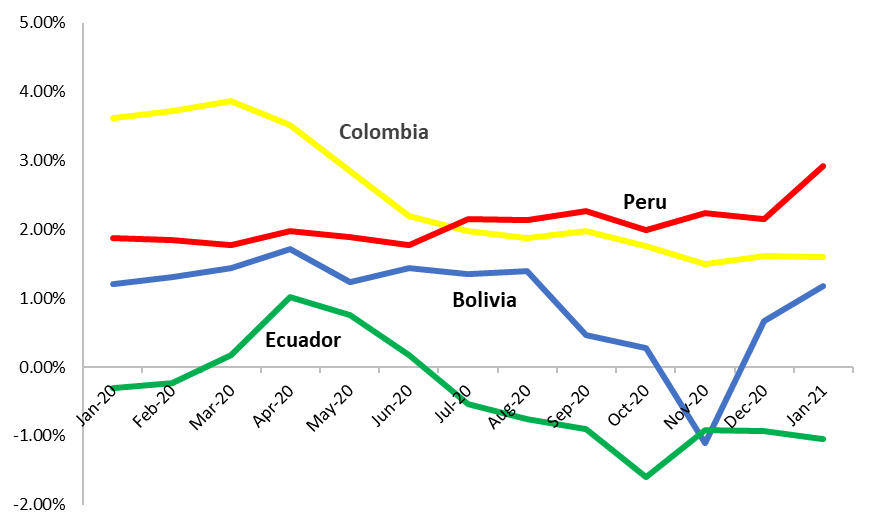
    Andean Countries: Inflation
    Monthly year-on-year figures

    Andean Countries: GDP growth (%)
    Quarterly figures are year-on-year growth
    GDP  2020 forecast* 2021 forecast* Q1 2020 Q2 2020 Q3 2020
    Bolivia -8.0 5.1 0.6 -21.7 Not yet available
    Colombia -7.0 5.0 1.2 -15.8 -9
    Ecuador -9.0 1.0 -2.4 -12.4 -8.8
    Peru -12.9 9.0 -3.4 -30.2 -9.4
    Venezuela -30.0 -7.0 No data No data No data
    *Figures from the United Nations Economic Commission for Latin America & Caribbean Dec 2020
    Quarterly growth based on figures from the local central banks


  • DOMINICAN REPUBLIC-HAITI: Canal construction causes a stir

    LatinNews 19 July 2021 Hits: 1625

    On 14 June the Dominican Republic’s President Luis Abinader called on the Haitian government to halt construction of an irrigation canal on the border between the two countries.

    “They should stop the project,” said President Abinader, the leader of the Partido Revolucionario Moderno (PRM), which came to power in August 2020. Abinader warned that the Dominican Republic (DR) had “a lot of options” in terms of a diplomatic response but remains open to reaching an agreement with his Haitian counterpart Jovenel Moïse. The canal on the Massacre river, also known as the Dajabón river, which runs along the border between the two countries, will irrigate 3,000 hectares of land in Haiti. However the plan sparked concerns that water supplies in DR would be hit, affecting agricultural production in the Dajabón area along the border.

    Tensions rose on 26 April, when four DR soldiers reportedly drove into the construction site, according to local Haitian media. An urgent meeting between the two nations was called to address the issue on 27 April, and then another meeting took place on 27 May. A further meeting on 28 May resulted in an agreement to create a forum to discuss ongoing work in the border area, and the DR foreign ministry released a statement in which it recognised that the canal “does not constitute a change in the course of the river.”

    Despite these encouraging signs DR officials later said they would not take part in any further discussions unless Haiti stopped construction work on the canal. On 29 May President Abinader proposed building a dam on the Artibonite river, which has its source in DR but meets the sea in Haiti. By the start of June, he was coming under increasing pressure over the canal. On 1 June Olgo Fernandéz, president of the opposition Partido de la Liberación Dominicana (PLD) in Dajabón, told local media that over 1,800 farmers and 6,000 rice fields would be affected by the canal. On 3 June, PLD national deputy for Dajabón Sonia Agüero joined hundreds of anti-canal protesters who marched through Dajabón. Protesters called on the DR government to halt the canal, citing concerns over its effects on local farmers. However local media also reported nationalistic placards, including one which read: “Them over there, us here, Haiti is Haiti and the Dominican Republic is the Dominican Republic.”

    While Abinader may have been forced to take a tougher line on the canal due to domestic pressure, the canal does not in fact violate any agreements between the two countries. The right to use water from rivers in the border area in a fair and equitable manner is enshrined in the 1929 peace accord between the two nations.

    Tensions since appear to have died down and DR media outlet Listín Diario called the dispute “a diplomatic storm in a teacup” borne out of “a lack of understanding and suspicions at a time of shared difficulties.” Yet journalist Guarionex Rosa wrote that this is a common problem in relations between the two nations, and that these kinds of disputes in the border area have been a long time in the making.

    • Fence

    At the end of February President Abinader revealed plans to build a fence along its border with Haiti, which extends for some 380km. He said that the fence, work on which would begin in the second half of the year, would help tackle illegal immigration, illegal drugs and the trade in stolen vehicles between the two countries. He also said that in some “conflictive” areas, the structure would include a double-fence, complete with motion sensors, infrared systems and facial recognition cameras.