All Categories

Subcategories

  • Guyana: Winner takes all

    LatinNews 07 January 2019 Hits: 2351

    Date: By 21 March (subject to legal challenge)

    Type: General Election, consisting of concurrent elections for President, National Assembly, and Regional Democratic Councils. The President is the leader of the party that receives the most votes in the National Assembly and Regional elections.

    Main contenders: On 21 December 2018, the coalition government led by President David Granger lost a no-confidence vote in parliament by 33-32 votes after one member crossed the floor. Under the constitution, elections have to be held within 90 days. The outgoing government consists of A Partnership for National Unity (Apnu), of which David Granger’s People’s National Congress Reform (PNCR) is the main component, and the Alliance for Change (AFC). The main opposition party, led by Bharrat Jagdeo, who is barred from standing for a third presidential term, is the People’s Progressive Party/Civic (PPP/C).

    In the 2015 general election, Apnu/AFC won by 33 seats to 32 for the PPP/C, it and also secured the presidency for David Granger with 50.29% of the vote.

    Since the 2015 general election, Guyana has made significant oil discoveries. First Oil is due in 2020, and whichever party is in power then will be able to use oil money and the power of incumbency to entrench its position perhaps for a long time. The PPP/C won five consecutive elections before losing in 2015.

    The central fact of Guyanese politics, which cannot be overstated, is the ethnic divide between those Guyanese of East Indian descent and those of African descent. The 2012 census figures showed that people of East Indian descent make up 39.8% of the population, those of African descent make up 29.2%, and the mixed-race population is 19.9% of the total. Amerindians add a further 10.5%. Apnu is largely supported by the African community, and the PPP/C by the Indian community. The AFC was created to appeal across the ethnic divide.

    But if race remains the unshakeable centrality of Guyanese politics, almost everything else is in flux, starting with the coalition. Apnu and AFC contested the November local elections separately rather than as coalition partners, and as a result the AFC revealed its political weakness by failing to make inroads into PPP/C strongholds (its main purpose as the multi-ethnic component of the coalition) and ended up losing ground in several constituencies where it had performed well in 2011. Since then, the AFC’s position in the coalition has further deteriorated as it was an AFC member (Charrandas Persaud) who defected in the vote of no confidence to give the opposition their victory. Apnu’s difficulties are compounded by President Granger’s ill-health (he is receiving cancer treatment in Cuba).

    The PPP/C has its own difficulties in that leader Bharrat Jagdeo, whose political position has been strengthened by winning the political gamble of holding a no-confidence motion, is constitutionally barred from standing again for the presidency. Whoever does stand in the party’s name will likely be controlled by Jagdeo.

    Overall, the PPP/C seems to be in the stronger position of the two main parties. It has the political wind in its sails, and by advancing the date of the general election from 2020 to 2019 it has cleverly forestalled the coalition’s undoubted intention of loosening the purse strings as the election approaches.

  • Eclac report shows mixed findings on inequality and wealth distribution

    LatinNews 11 July 2019 Hits: 1429

    On 15 January, the United Nations Economic Commission for Latin America and the Caribbean (Eclac) released its annual Social Panorama report detailing inequality and wealth distribution across the region. In Central America, where the period of study was marked by significant social unrest and the manifestation of climactic concerns that look set to shape the subregion’s future, a mixed set of results was reported. The document divides its analysis into socioeconomic inequalities, poverty trends, social spending, structural challenges, and women’s involvement and autonomy in national economies; and with regard to Central America there were some encouraging advances made in the reduction of inequality – although the pace of this decline has slowed universally in Latin America and in the subregion – but it remains to be seen whether this progress can be made permanent.

    The Northern Triangle

    With regard to inequality, Guatemala began the 21st century with the highest level of inequality in Latin America, demonstrated by a Gini index of 0.64 in 2002 (a technical measure of inequality, where 0 represents perfect equality and 1 perfect inequality). However, the indicator has seen a precipitous fall since then, although figures are not available for 2017. In El Salvador and Honduras, the Gini index reductions over the same period registered falls from 0.51 to 0.4 and 0.53 to 0.48 respectively. According to Eclac’s estimates, El Salvador’s 2.4 percentage point reduction in extreme poverty between 2016 and 2017 was comfortably the region’s greatest fall in this indicator. However, no corresponding data were available for Guatemala or Honduras. El Salvador also managed Latin America’s third-greatest reduction in overall poverty over the same period with a 2.7 percentage point drop. The report states that increased labour earnings among the poorest quintile were the main driver of poverty reduction in El Salvador over the period studied.

    In line with the UN’s Sustainable Development Goals (SDG) for poverty reduction, Northern Triangle countries sit considerably behind the regional standard. The first SDG dictates that extreme poverty should be eradicated and all dimensions of poverty lowered to at least 3% by 2030. Of the 14 countries in Latin America for which data were made available, El Salvador, Honduras, and Mexico are the only three projected to fail the first of these targets; while all three are also predicted to overshoot the second.

    In terms of public policy evaluation, the Eclac report shows that Guatemala dedicated just 6.9% of GDP to social spending in 2016, the lowest in the whole Latin America and Caribbean region. In contrast, Honduras and El Salvador spent 9.2% and 9.3% respectively. Due to differences in population size, the report places particular emphasis on per-capital spending in Honduras and Guatemala, where this metric corresponded to less than US$200 spent on each citizen – the lowest output in Central America. Unsurprisingly, Honduras’ social spending provision sees it rank among Latin America’s lowest spenders in each category.

    There are also numerous structural problems impeding progress in the Northern Triangle, where inequality of access between socioeconomic strata manifest themselves most keenly. Guatemala and Honduras ranked among the lowest in Latin America for high school completion, with fewer than 40% of 20-24-year olds having completed secondary education in 2016. Northern Triangle countries are also among the worst in Latin America for social and labour exclusion. The average percentage for exclusion from both social and labour systems across Latin America is 44.5%, but El Salvador, Guatemala, and Honduras all have much higher exclusion rates with 62.5%, 75.5%, and 73.3% respectively – the latter two ranking as the two highest exclusion rates in the entire region.

    Costa Rica, Panama, and Nicaragua

    Whereas 2018 in the Northern Triangle was characterised by drought and emigration, social unrest defined the year studied by the Eclac report in the rest of Central America. Despite small changes throughout the period, Costa Rica’s 2017 Gini index was 0.5, the same as the country recorded in 2002. While there were no 2017 data available for Nicaragua, Panama’s value dropped from 0.57 to 0.41 over the same period.

    No poverty data were available for Nicaragua, but 0.9 percentage point decreases between 2000 and 2017 were registered in extreme poverty in Costa Rica and Panama, while overall poverty decreased by 1.4 and 0.3 percentage points respectively in each country. In Costa Rica and Panama, the Eclac report asserts that conditional cash transfer programmes were at least as important in lowering poverty as labour income. Both Panama and Costa Rica are scheduled to hit the UN SDG targets for poverty reduction before 2030, but no estimation could be made for Nicaragua.

    In terms of social spending, the 2016 average for the percentage of GDP spent on social policies in Central America was 9.5%. Costa Rica’s figure of 12.3% far outstrips any other country in the subregion and even comes close to the higher South American average (12.8%). These welfare provisions saw Costa Rica run a fiscal deficit throughout 2018 (and, indeed, before), leading to protests and an eventual tax revenue reform. In Panama, a figure of 8.6% was below the average for Central America, while Nicaragua’s 10.6% GDP was higher even than Peru and Ecuador in South America, and the second-highest figure in Central America. The social unrest in Nicaragua had been building in recent years and a proposed reform aimed at increasing social security contributions proved the catalyst for demonstrations throughout 2018.

    The simple average for social spending across Latin America was 11.2% GDP. In Central America budgetary allocation varies considerably in both scale and destination. At the central government level, Costa Rica stands out as the country that allocates the largest share of its GDP to education (over 7%), but less than 10% to health. By contrast, both Nicaragua and Panama dedicated less than 1% of GDP to social protection and social security schemes, preferring instead to directly fund housing and community initiatives.

    Costa Rica is the only country in Central America to sit below the Latin American average for dual exclusion from both social and labour markets (44.5%), with an exclusion rate of 42.3%. Nicaragua’s rate of 69.6% was the third-highest in Central America – and consequently Latin America as a whole. No data for the metric were available for Panama.

    Selected indicators for monetary inequality, income inequality and social spending in Central American countries
    Country Inequality (Gini Index) Population with per capita income below median (2017) Central government social spending (% GDP)
    2001 2017 % change
    Costa Rica 0.497 (2002) 0.496 -0.002 20.1 12.3
    El Salvador 0.538 0.44 -18.2 16.2 9.3
    Guatemala 0.636 (2000) 0.535 (2014) -15.9 - 6.9
    Honduras 0.532 0.480 (2016) -9.8 20.9 9.2
    Nicaragua 0.568 0.495 (2014) -12.9 - 10.6
    Panama 0.575 0.508 -11.7 24.8 8.6
    Source: Social Panorama 2018 (UN Eclac, 2019).
  • REGION: Finding a way forward for the Caribbean

    LatinNews 19 August 2020 Hits: 767

    Apart from Haiti, for which fate seldom has a kind gesture, in terms of health the Caribbean has been relatively untouched by the coronavirus (Covid-19) pandemic. As detailed last month [EB-20-07], the same cannot be said about the economies of the Caribbean, in particular those of the small tourism-dependent countries. The latest forecast from the Eastern Caribbean Central Bank (ECCB) says that the economy of the Eastern Caribbean Currency Union (ECCU) will contract by between 10% and 20% in 2020, and debt is once again becoming a major concern.

    Figure 1 below shows just how much worse the economies of the Eastern Caribbean will fare compared both with advanced economies and the global economy in general, a fact that becomes starker when it is seen that the Eastern Caribbean outperformed the other two categories in 2019.

    Figure 1: Economic growth for Global, Advanced and ECCU economies 2019-21

    Notes: Green = ECCU Economies, Orange = Advanced Economies and Red = Global Economies. Data as of May 2020. ECCU worst case scenario shown in chart

    Source: Communique of the 96th meeting of the ECCB Monetary Council

    With regard to the all-important question of jobs, the Inter-American Development Bank (IDB) says that the tourism-dependent economies of the Caribbean could see anywhere from 12% to as much as 20% of their tourism-related labour force badly affected. In its latest Caribbean Quarterly Bulletin, the IDB added: “Many individuals and households in the region will suffer, implying severe social costs that are difficult to capture with economic aggregates”. And it concludes, starkly: “Taken together, this suggests that the Caribbean could be the most adversely affected region in the world in terms of the economic impact of Covid-19”.

    The debt question is clearly a serious concern. The ECCB warns: “Total public sector debt of the region is expected to rise in both nominal terms and as a percentage of GDP during 2020”. It lamented “the reversal of the significant progress made by member countries to meet the Debt-to-GDP target of 60% by 2030. At the end of 2019, the Debt-to-GDP ratio stood at 65%”. And it said that it “recognised that Member Governments will need to contract additional debt to fund critical support for their economies during this difficult period. The combination of economic contraction and the necessity of additional borrowing means a rise in the Debt-to-GDP Ratio in the short term”.

    The IDB is equally gloomy on debt, acknowledging that deficit spending in response to the crisis will result in an increase in debt, but it adds with brutal realism that it will be necessary “to recover fiscal sustainability following a build-up in public debt”.

    Caribbean leaders are acutely aware of the near impossible choices they face, and it is no surprise that they are looking for external help. The prime minister of Barbados, Mia Mottley, is calling for a Caribbean Marshall Plan, referring to the US-funded recovery plan for post-war Europe – and she, like others, is linking this to long-standing calls for reparations for slavery from the old colonial and slave-owning powers. The combination of the immediately adverse effects of the Covid-19 pandemic, the longer-term consequences of climate change, and the renewed focus on racial inequalities through the Black Lives Matter (BLM) protests has given added momentum to this argument.

    Speaking at a Caribbean Community (Caricom) Reparations Commission (CRC) virtual meeting in early July, Mottley said: “Economic transformation and growth depends on an international compact for the Caribbean. Covid-19 has already led, in many instances, to a doubling of expenditure in health and social care support, a quadrupling in other cases, because all of a sudden you go from tourism sectors that are earning to tourism sectors with zero revenue and therefore lack the capacity to employ anyone…The combination of the appropriateness of the reparations argument, as well as the reality of the economic implosion that has taken place as a result of the global pandemic, requires urgent conversations to begin to understand that a world that was rooted in immorality or a world that was rooted in people profiting from crimes against humanity runs counter to the very things at the democratic level that we have asked both small states and large states to be able to reflect”.

    The prime minister of St Vincent & the Grenadines, Ralph Gonsalves, who took over the chairmanship of Caricom from Mottley at the beginning of July, reiterated this call in a statement marking Emancipation Day on 1 August. Gonsalves said: “I urge all in Caricom to focus on reparation for the enslavement of Africans on Emancipation Day 2020. In our region, and elsewhere, we need to have a more thorough-going public education programme on the meaning and significance of reparatory justice for the Caribbean. Further, our governments must ramp up the political, diplomatic, and international legal struggle for reparation. All hands are required on deck as a matter of urgency”.

    In an opinion piece published by the Jamaica Observer on 2 August, veteran Caribbean diplomat Sir Ronald Sanders brought the question back to climate change in general, and food security in particular. He pointed out that “at least seven of the 14 [Caricom] countries import more than 80 per cent of the food they consume, resulting in the region's annual food import bill estimated in 2019 at US$5bn”. Sanders added: “This serious vulnerability has been alarmingly exposed by the Covid-19 pandemic, as the foreign exchange earnings of countries have diminished. Stark choices have had to be made about foreign purchases. Should the priority be medicines, food, or building materials? This has caused governments to encourage more local food production. However, these belated efforts in agriculture will be frustrated, if not overturned, by uncurbed climate change. Extreme heat, droughts, floods, salt water encroachment due to rising sea levels and storms have harmed agricultural productivity and caused food price hikes and income losses. These events have wiped out crops, bankrupted farmers, and forced them out of business, in many cases permanently”.

    It may all sound rather apocalyptic, but there can be no serious doubt that the Caribbean faces an unprecedently difficult time. Even if the Covid-19 health challenge is solved relatively soon, the setback to the Caribbean will have been immense, with all the recent good work on reducing external debt seemingly wasted.

    So, whether cast in terms of reparations or not, what seems certain is that substantial external help for the Caribbean will be required. As a recent analysis from the United Nations Conference on Trade and Development (Unctad) put it, there are only two ways to cope with the catastrophic fall-off in earnings that much of the Caribbean is currently experiencing, by borrowing or spending international reserves. Yet, as Unctad says, “Access to capital markets is increasingly difficult, even more so for…indebted, poorly diversified countries with low levels of international reserves, sufficient to cover a few months of imports…Without international assistance, the economic consequences of the pandemic will be devastating”. That is undoubtedly true, but, as Sanders emphasises, climate change will ensure that there is no respite in the longer term.

  • CHILE: Reckoning over police violence continues

    LatinNews 02 October 2020 Hits: 1034

    Eleven months on from the start of mass demonstrations that were met with an aggressive police crackdown against protesters, a bill has been presented to Chile’s congress that seeks to ban the use of rubber bullets and tear gas projectiles against crowds. The motion comes at a time of national reckoning over the police’s use of force in Chile, as the government faces pressure to hold human rights abusers to account.

    While global headlines continue to be dominated by the debate over police violence in the US, Chile is also undergoing a national conversation over the use of force by its security forces. The Carabineros militarised police have come under fire for their repressive response to the social unrest that erupted in October 2019 and that has continued to simmer throughout the past year. The Carabineros’ use of rubber bullets against demonstrators has been of particular concern to those calling for reform. According to Chile’s national human rights institute (INDH), 460 people suffered eye injuries as a result of projectiles fired by the police, resulting in the blinding or partial blinding of 35 demonstrators.

    In response to these injuries, which campaigners have decried as an “epidemic” of eye trauma, that many victims claim was deliberately inflicted by the police, congressman Jorge Brito from the opposition Revolución Democrática (RD) has presented a bill that aims to ban the use of non-lethal projectiles against crowds. On 3 September, Brito lamented that Chileans had been left “blinded, mutilated and with brain damage” by these weapons, urging his fellow members of congress to “protect the people and stop the Carabineros from continuing their history of abuse against the Chilean people.” 

    The bill comes as President Sebastián Piñera’s government faces growing pressure to hold to account those police officers accused of human rights violations. After months of inaction, two Carabineros were arrested in August, accused of blinding two protesters by firing rubber bullets and a tear gas canister at their faces from close range. However, in June Amnesty International (AI) accused the Carabineros of a cover-up operation intended to shield these officers from prosecution, with AI’s Americas director Erika Guevara-Rosas claiming that “rather than protecting the population, they seem to be protecting themselves.”

    The Office of the United Nations High Commissioner for Human Rights (OHCHR) has also published a damning report detailing systematic human rights violations by the security forces during the unrest, including “arbitrary deprivation of life and injuries, torture and ill-treatment, sexual violence, and arbitrary detentions.” The OHCHR also claims that Carabineros used “psychological torture” against detained protesters, including threats to ‘disappear’ or rape them, and threats to kill their families.

    In early September, the comptroller general’s office (CGR) began to bring charges against seven generals in the Carabineros’ high command for their alleged responsibility for the human rights violations, leading to hopes that some will be held accountable for the violence. Coming almost a year after the protests erupted, however, this may do little to reverse the collapse in public trust in the Carabineros, especially as the approaching referendum on a new constitution is likely to herald renewed public protests, and their violent repression. Following last year’s uprising, a survey by the Centro de Estudios Públicos (CEP) showed that only 17% of respondents trusted the security forces. For some, the Carabineros remain a symbol of repression for their role in supporting Augusto Pinochet’s dictatorship from 1973 to 1990.

    Carabineros controversy

    In a highly criticised move, on 19 August Carabineros director general Mario Rozas announced that the Police Sciences Academy would be renamed after Rodolfo Stange – the Carabineros’ director general during the Pinochet dictatorship. Although hastily retracted, the announcement did little to improve the Carabineros’ tarnished image, and the Partido Socialista de Chile (PS) slammed this “homage” to a man who “represents the saddest chapter in Chilean history”. Stange has been implicated in the murder of left-wing dissidents during the dictatorship, and the PS described him as being in “the inner circle of a regime that persecuted, eliminated, disappeared, tortured and exiled tens of thousands of Chileans.”

  • BRAZIL: Brazilian right celebrates Twitter takeover

    Patrick de Courcy 28 April 2022 Hits: 4226

    President Jair Bolsonaro has reacted ecstatically to the purchase of Twitter, one of the world’s largest social media networks, by Elon Musk, the world’s richest man, who has promised to defend freedom of speech. Brazil’s far- right has praised the move because it calculates that it will help Bolsonaro win re-election in October’s elections.

    It took the Brazilian government nearly 24 hours to congratulate President Emmanuel Macron on his re-election in France but only minutes to praise Elon Musk for his US$44bn takeover of Twitter. Bolsonaro re-tweeted Musk’s announcement and linked to an article telling those on the network how they can leave if they dislike the promised free-for-all debate. Bias Kicis, a prominent Bolsonaro supporter, said those dissatisfied with the “end of censorship” on Twitter could leave, while “those who like freedom, and the plurality of ideas can stay...isn’t that beautiful?”

    Congresswoman Carla Zambelli, another Bolsonarista, tweeted “@elonmusk is swimming in the tears of the international left”. She went on to describe the takeover as “a great defeat for the global left, which wants to shut down any dissenting voices”. Eduardo Bolsonaro, one of the president’s sons, said “@elonmusk never censored anyone”. The communications minister, Fabio Faria, said the takeover was “a step in the defence of freedom” and showed that Musk was two steps ahead of the opposition.

    Brazil is Twitter’s fourth largest market with around 19m users. While social networks like Facebook, YouTube, WhatsApp, TikTok, and Telegram are also widely used, Twitter is one of the key platforms for political debate and messaging. Broadly speaking the Brazilian left worries about mass disinformation and fake news on Twitter, while the right celebrates an anything-goes culture.

    President Bolsonaro himself has frequently quarrelled with social media platforms. He has recently been demanding explanations from WhatsApp, which has decided not to launch its ‘Communities’ function (which allows messages to be broadcast to very large groups) until after the elections. Supreme Court (STF) rulings have found him and members of his family guilty of peddling misinformation over the coronavirus (Covid-19) pandemic and allegations of electoral fraud. Because some of his posts have been taken down by the likes of YouTube and Facebook, Brazil’s head of state has partially migrated to Telegram which applies less stringent controls. As recently as 4 April, YouTube took down a Bolsonaro video where he made unsubstantiated claims over alleged electoral fraud in 2019.

    A Musk-owned Twitter could open the doors to further misinformation in the Brazilian election campaign, but this is far from a certainty. The STF is likely to remain watchful over claims of fake news. Under its new owner Twitter might also end up maintaining a number of controls: Musk has already suggested new actions to reduce the activity of bots and to authenticate users. Caio Machado, from the anti-disinformation lobby group Vero, says: “Platforms that have gone to the side of absolute freedom of expression have been marginalised or got into fights with countries’ regulators.” He adds that, in the long term, a complete free-for-all tends to reduce subscriber numbers. An extremely toxic and unmoderated Twitter could, in the final analysis, be bad for business. All this suggests that the platform may retain moderation and other controls and provide less of a boon than the Brazilian far right has been hoping for.

    Rio homicides fall

    Fresh from celebrating Carnival after a two-year absence due to the Covid-19 pandemic, Rio de Janeiro announced good news about levels of violence: there were 760 intentional homicides in the first quarter of this year, down by 18% on the same year-earlier period, and the lowest level in three decades. If other categories of violent death are included (such as robbery with violence and death at the hands of the police) the fall was 23% to 1,099. Homicide rates have been trending down in recent years, having peaked in 2017. No detailed analysis of the causes behind this year’s fall was immediately available, but Governor Claudio Castro cited close collaboration between military and civilian police units as an important factor.

  • COSTA RICA-NICARAGUA: Chaves under pressure over Sica appointment

    Patrick de Courcy 30 June 2022 Hits: 3893

    Costa Rica’s new president Rodrigo Chaves has received a letter from eight of his predecessors asking him not to back Nicaragua’s Werner Vargas, the preferred choice of the Nicaraguan government led by President Daniel Ortega, to serve as the secretary general of the Central American Integration System (Sica), a post vacant for over a year. The issue is proving a foreign policy test for Chaves and his foreign minister André Tinoco who, ahead of taking office [WR-22-17], suggested the new government would be open to re-establishing relations with Nicaragua, which remains isolated diplomatically due to international concerns over the deteriorating human rights and democracy situation there.

    The letter sent on 25 June was in response to the decision adopted two days earlier by the Sica’s council of foreign ministers to recommend Vargas, a former Sica executive director (2014-2020), for the post, which received the backing of the sub-region’s other foreign ministers. The appointment now goes to the sub-region’s leaders for approval. The letter cited familiar concerns regarding the human rights situation in Nicaragua, as well as historic bilateral tensions over issues such as Nicaragua’s 2010 invasion of Costa Rican territory and occupation of Isla Calero, as determined by a December 2015 ruling by the International Court of Justice (ICJ) at The Hague [WR-16-01].

    With Tinoco having backed Vargas, and uncertainty as to whether President Chaves will follow suit, bilateral relations remain otherwise strained, in part due to Nicaragua’s recent authorisation of the entry of Russian soldiers, ships, and aircraft to Nicaragua [WR-22-24], which prompted words of concern from Chaves.

    Meanwhile, on 17 June Tinoco was cited by the media as saying that there were no plans to name a new ambassador to Managua to fill a post vacant since 2018. Migration is also a key bilateral issue amid reports that the number of Nicaraguan refugees and asylum seekers fleeing to Costa Rica have doubled in the last eight months, reaching a total of 150,000 new applicants since 2018. This represents 3% of Costa Rica’s population.

    Signatories

    The letter was signed by former presidents Oscar Arias (1986-1990, 2006-2010), Abel Pacheco (2002-2006), Rafael Angel Calderón (1990-1994), Laura Chinchilla (2010-2014), José María Figueres (1994-1998,) Luis Guillermo Solís (2014-2018), Miguel Angel Rodríguez (1998-2002), and Carlos Alvarado (2018-2022).

  • Publishing note

    Patrick de Courcy 15 December 2022 Hits: 1902

    Please note this is the final Latin American Weekly Report of 2022. The next issue will be published on 5 January 2023.

  • CARIBBEAN POINTERS

    Sarah Sheldon 21 March 2023 Hits: 1085

    ***PROGRESS ON FOOD SECURITY. On 3 February, at the first Caribbean Community (Caricom) Ministerial Taskforce (MTF) on Food Production and Food Security meeting, it was announced that member states had achieved 57% of the target of reducing the regional import bill by 25% by the year 2025. It was reported that a number of key products had achieved especially good progress towards their production targets for 2025, namely cocoa (96.13%), dairy (84.36%), meat (72.28%), root crops (70.91%), fruits (70.77%), and poultry (70.19%).


    ***THE BAHAMAS IN BIG PUSH IN 2023 TO REDUCE CORRUPTION. In Transparency International’s latest Corruptions Perception Index (CPI), The Bahamas ranked as the 30th least corrupt nation, and the second least corrupt in the Caribbean after Barbados, retaining its score of 64 out of 100, when the higher the score means the lower the incidence of corruption. Nevertheless, Nassau intends to implement reforms during 2023 to further improve the country’s ranking.

    The measures planned for this year include reforms to the Public Procurement Act and the Public Disclosures Act. Also planned is legislation to create an Integrity Commission and an Ombudsman, both of which were 2021 manifesto pledges by the ruling Progressive Liberal Party (PLP).

  • MEXICO: Tensions high on Ayotzinapa anniversary

    Patrick de Courcy 28 September 2023 Hits: 2550

    Truth and justice still elude victims’ families nine years on from the kidnapping, murder, and disappearance of 43 student teachers in Mexico’s Guerrero state. On 26 September, to mark the ninth anniversary of the day the students from the Ayotzinapa rural teacher training college were abducted, thousands took to the streets in Mexico City (CDMX) to demand answers. This anniversary comes at a particularly tense moment, given recent disagreements between the government led by President Andrés Manuel López Obrador and the students’ parents and their legal representatives.

    The messaging from the families and their lawyer, Vidulfo Rosales, in recent days has been clear. They feel let down by a government that came to power pledging to solve the case. Meetings between the parents and high-level government officials on 20 and 25 September, rather than alleviating tensions, have led to a kind of stalemate. The victims’ families continue to demand specific information relating to the incident that they maintain the defence ministry (Sedena) is withholding, while the government insists the armed forces have delivered all information pertaining to the case.

    The documents in question are contained in the military archives and relate to transcripts of intercepted phone conversations. It appears to be the same information that the inter-disciplinary group of independent experts (GIEI) had sought to obtain. The GIEI, which was originally appointed to investigate the case by the Inter-American Commission on Human Rights (IACHR), withdrew from Mexico in July, stating that Sedena was withholding key information [WR-23-30].

    Following the meeting on 20 September, President López Obrador publicly promised that the parents would receive the information at a meeting five days later. However, speaking to the press after the second meeting, Rosales said that the specific information requested had not been delivered. Instead, he said that they had been presented with a report that was closer to the so-called ‘historical truth’ narrative peddled by the previous administration of former president Enrique Peña Nieto (2012-2018) than to more recent investigations.

    In a press conference on 26 September, López Obrador rejected these claims. He once again repeated that the army had handed over all the information it has in relation to the case, something he has claimed since the GIEI raised its complaints at the end of July. This sets a worrying precedent. Both the parents and the GIEI have stated that the truth about the incident cannot be known without full access to the armed forces’ archives, which it appears is still being denied. Indeed, although progress has been made into the case under López Obrador, it has also suffered many setbacks.

    These all seem to have taken place in relation to efforts to scrutinise the military’s role in the crime. The special prosecutor for the case, Omar Gómez Trejo, resigned in September 2022 after the attorney general’s office (FGR) cancelled 18 arrest warrants, including 16 for military personnel. The GIEI also came up against a wall when trying to extract information from the armed forces. This all suggests that López Obrador’s government is prioritising the protection of the military over solving the Ayotzinapa case.

    National register of disappeared people

    This all takes place as the government is carrying out a controversial census to update the national register of disappeared people. The United Nations (UN) Committee on Enforced Disappearances (CED) expressed concern over the census in a meeting with Mexican government representatives from 13-15 September, noting that the way in which it is being carried out revictimises family members. Rights groups have also raised concerns that the census has the aim of presenting a false decrease in the number of disappeared people in Mexico.

  • NICARAGUA: More efforts to stamp out dissent

    Abbi Dicker 05 July 2024 Hits: 2090

    The recent decision to place retired General Humberto Ortega, the 77-year-old younger brother of Nicaragua’s President Daniel Ortega, under house arrest is just the latest example of the authoritarian leader’s apparent unwillingness to tolerate any dissent.

    On 28 May, at an event marking the 45th anniversary of the start of the final offensive against the dictatorship of Anastasio Somoza (1967-1972, 1974-1979), President Ortega effectively accused his brother, a founding member and first commander of the Ejército Popular Sandinista (EPS) during the 1978-1979 Sandinista revolution, of treason. Without directly naming his brother, President Ortega referred to a case dating back to 1992 in which a US military attaché, Dennis Quinn, was decorated with the ‘Camilo Ortega’ medal (named after a younger brother killed in 1978 fighting the Somoza dictatorship) by the “army chief at the time”. Ortega went on to describe the act of decorating Quinn as “a national disgrace” and an “act of subservience and treason”.

    The previous week, local independent media outlets such as Confidencial and La Prensa reported that the police (PNN) and health officials had installed a medical unit at Humberto Ortega’s home, which critics suggested was tantamount to house arrest. The move, which was confirmed by a 21 May PNN statement, followed reports of an earlier police deployment to the house of Humberto Ortega, who on 12 June the media reported had been taken to hospital with “symptoms of a heart attack”.

    The apparent targeting of Humberto Ortega followed an interview that he gave to Argentine news portal Infobae on 19 May in which he discussed his relationship with his 78-year-old brother, from whom he had become somewhat estranged as the president’s authoritarianism grew increasingly apparent. Having made headlines in 2018 with his calls for elections to be brought forward and paramilitary groups to be disbanded amid the government crackdown on social unrest earlier that year, Humberto Ortega was unequivocal in the Infobae interview that the Frente Sandinista de Liberación Nacional (FSLN) administration led by his brother and First Lady and Vice President Rosario Murillo was “authoritarian” and “dictatorial”.

    Succession

    With regard to the interview that Humberto Ortega gave to Infobae, the Ortega government was reportedly particularly rattled by his remarks regarding the question of who would ultimately take over from Ortega, with successors tipped to be Rosario Murillo (who is 72) or one of their sons, Laureano Ortega Murillo. In the interview, Humberto Ortega raised questions as to their prospects, saying: “when there is an authoritarian, dictatorial type of power such as the current one, which is largely dependent on the figure of a leader who holds the presidency, in their absence it is very difficult for there to be a continuity of the immediate power group”.

    The latest in a line

    In a 28 May report, Salvadorean investigative media El Faro considers that the “de-facto house arrest of [Humberto Ortega] takes the purge of historic Sandinistas to a new extreme”. It highlights other recent examples of Ortega allies who have fallen from grace such as retired General Omar Halleslevens, who served as vice president from 2012-2017, and was ejected from Murillo’s office in May 2023.

    A group of former Sandinista guerrillas had already split from the FSLN in 1995 over concerns about Ortega’s authoritarianism. The group, which then formed a political party, Movimiento Renovador Sandinista (since known as Unión Democrática Renovadora) included former ‘comandantes’ such as Dora María Téllez and Hugo Torres, who were then targeted by the FSLN government and imprisoned. Torres died in custody in February 2022 aged 73 while Téllez was among the 222 political prisoners deported to the US in February 2023, who were stripped of their Nicaraguan nationality [SSR-23-04].

    Other members of Ortega’s inner circle have also seen the door – most recently his finance minister Iván Acosta (2012-2024), who left the post on 20 June. Described by Confidencial as the “regime’s main economic operator” Acosta’s departure came amid reports that his home and office had been raided, reportedly in relation to an investigation into alleged corruption. The independent media attributed Acosta’s departure to “differences” with the presidential couple’s son, Laureano Ortega Murillo, a presidential adviser on investment.

  • PERU: New finance minister appointed

    Patrick de Courcy 19 June 2025 Hits: 3485

    Raúl Pérez Reyes was sworn in as Peru’s new economy and finance minister on 13 May, with his predecessor José Salardi replaced as part of a cabinet reshuffle that also saw the prime minister, Gustavo Adrianzén, and interior minister, Julio Diaz Zulueta, shown the door. Adrianzén’s exit, which came as he faced insurmountable pressure from congress regarding his response to a massacre of gold miners, is a major blow to President Dina Boluarte. However, the replacement of Salardi has had the greater impact on the markets, which viewed him as a safe pair of hands. Peru’s currency and bonds slumped following his exit as investors digested the latest churn at the finance ministry, which has burned through seven ministers since elections were last held in June 2021.

    Adrianzén’s forced resignation came as he was facing four impeachment motions in congress over his clumsy response to the murder of 13 workers at the La Poderosa gold mine in Pataz, La Libertad region, in late April. Adrianzén’s fate was sealed when the right-wing Fuerza Popular (FP), the largest party in congress, indicated that it would support his removal. Choosing to step down rather than face the ignominy of impeachment, Adrianzén’s exit triggered the resignation of the entire cabinet, in line with protocol. All ministers were reappointed by Boluarte with the exception of the finance minister, Salardi, who had been in the role since January, and the interior minister, Zulueta, who had held the role since March. The role of prime minister went to Eduardo Arana, who had served as justice minister since 2023.

    Although Pérez is an experienced government minister, he is not without controversy. Shortly after his appointment to the finance ministry, concerns were raised about a potential conflict of interest due to his wife’s role as a consultant for Lima Airport Partners (LAP), the company that operates Lima’s Jorge Chávez International Airport. The television news programme Contracorriente reported that Pérez’s wife, Isaura Delgado Brayfield, had worked as a consultant for LAP on 19 occasions between 2021 and 2023, earning PEN119,000 (US$32,900). This raised questions over whether her role was to act as a link between private companies and the government, due to her marriage to a cabinet minister. Mónica Yaya, who headed Peru’s public oversight agency (Osce) in 2011, said in response to the Contracorriente report that “one might wonder whether these private companies that contract the wife of the new finance minister in order to coordinate with congress might be using her to pay bribes”.

    • Pérez

    Pérez has held a number of ministerial positions under three separate presidents. In January 2023, shortly after President Boluarte took office, he was appointed as production minister. In September that year he was rotated to head the transport and communications ministry, a role he held until his appointment as economy & finance minister this May. He previously served as production minister from 2018-2019 under former president Martín Vizcarra (2018-2020), and as deputy communications minister from 2011-2014 under former president Ollanta Humala (2011-2016).

    Pérez has vigorously denied any accusations of wrongdoing. In particular, he has noted that his wife’s time working for LAP was from September 2021 to May 2023, before he took on his role at the transport and communications ministry in September 2023, although overlapping with his tenure as production minister. Pérez has also insisted that he declared all relevant information about his wife’s work in line with transparency rules. In any case, this is far from the only allegation of corrupt or improper behaviour by members of Boluarte’s scandal-plagued government, and Pérez is unlikely to be brought down by the claims.

    Meanwhile, the short tenure of his predecessor raised concerns that Peru’s rampant political instability will spread to the economy. Salardi was one of the shortest-serving ministers of recent years in a post already known for rapid turnover; only one finance minister, Luis Miguel Castilla (2011-2014), has served for more than three years since 2011. Business groups had been supportive of Salardi and his promises to stabilise the economy by cutting through red tape. Of further concern is the announcement by Pérez that he will be proposing increased expenditure for the remainder of the year; it is likely that this will be the third consecutive year in which the fiscal deficit has exceeded its original target.

    A June review of the Peruvian economy by the executive board of the International Monetary Fund (IMF) concluded that the economy had recovered from the negative impact of natural disasters and social unrest, but that the fiscal position had weakened and that intensifying political uncertainty in the run-up to general elections in April 2026 remains a substantial risk. In most contexts, the expectation of a new finance minister appointed at this point in the electoral cycle would be to maintain stability. However, given the short tenure of his predecessor and the volatile legislative context, Pérez is far from certain to still be in post come election time.

  • TRACKING TRENDS

    Abbi Dicker 16 July 2026 Hits: 688

    PANAMA | Deepening Mexican ties. Panama’s President José Raúl Mulino visited Mexico on 15 July in a bid to strengthen bilateral cooperation on a range of matters including trade, investment, and security. Mulino met his Mexican peer Claudia Sheinbaum in Mexico City, as well as senior representatives of 23 Mexican companies interested in expanding their operations in Panama or establishing themselves in the country for the first time.

    Sheinbaum said that the meeting between the two heads of state would “allow us to deepen and relaunch our cooperation in strategic areas such as trade, investment, connectivity, infrastructure, security, and the fight against crime”. Both Presidents Mulino and Sheinbaum notably offered support for each other’s government in areas where the US administration led by President Donald Trump has expressed forthright criticism and interference. Mulino congratulated Sheinbaum for her government’s efforts to improve public security, singling out the military operation to take out the leader of the Cártel Jalisco Nueva Generación (CJNG), Nemesio ‘El Mencho’ Rubén Oseguera Cervantes, in February; Sheinbaum, in turn, expressed her country’s full backing for the Panama Canal neutrality protocol.

    Mulino held a meeting with Mexican business tycoon Carlos Slim and 23 business executives during his visit. “Panama is entering its biggest investment cycle in a century,” Mulino told the business leaders. “That’s why now is the time. Because this has already begun...You are the best in the continent at manufacturing, and we specialise in connecting the world. You produce and we distribute. We don’t compete: we complement each other,” Mulino added as he sought to attract investment, inter alia, in infrastructure development, technology, logistics, public transport, tourism, and agri-parks.

    SURINAME | Illegal gold mining. Suriname’s justice minister, Harish Monorath, claimed on 15 July that his government would end “anarchy and impunity” in the country’s interior rainforest area where large-scale illegal gold mining takes place.

    Monorath said 14 armed Chinese nationals wearing military uniforms had been arrested in a joint security operation. Police and army personnel were deployed to Sarakreek, in the gold-mining region of Brokopondo district, after videos began circulating on social media showing the 14 individuals carrying weapons and the Chinese flag while patrolling the area.

    Monorath said it appeared they were “carrying out security duties” but promised an in-depth investigation to establish what they were doing there.

  • GUATEMALA: Un debate con más sombras que luces

    LatinNews 24 October 2011 Hits: 503

    Un “espectáculo grotesco”, así fue como calificó un comentarista político al largamente esperado debate por la TV entre el ex General Otto Pérez Molina y el empresario populista, Manuel Baldizón, que competirán por la segunda ronda presidencial el 6 de noviembre. El intercambio degeneró en calumnias e injurias y acusaciones mutuas, que subrayan una vez más la ausencia del debate ideológico en la elección. Los dos candidatos, sin embargo, evitaron la mención de las más serias preocupaciones desplegadas por los diferentes sectores en relación a uno y otro.

    Las encuestas apuntan a una victoria para Pérez Molina, del derechista Partido Patriota (PP) (ver más abajo). Baldizón, de Libertad y Democracia Renovada (Líder), está tratando de socavar la plataforma del PP, que está basada en un enfoque de línea dura para la seguridad: él acusó a Pérez Molina de debilitar a los militares después de los Acuerdos de Paz de 1996, que pusieron fin a 36 años de guerra civil –la implicancia es que él no es confiable sobre la seguridad. Pérez Molina fue el negociador militar en los Acuerdos de Paz y más tarde asesor del ex presidente Oscar Berger (2003-2007) bajo cuyo mandato los militares fueron reducidos drásticamente –de 27.000 a una tropa de 15.500. Ilustrando la que parece ser una aceptación universal que la participación militar en la seguridad ciudadana es la respuesta apropiada ante el delito (señalando más divergencia aún con los Acuerdos de 1996), las acusaciones de Baldizón también se hacen eco de la línea adoptada por la gobernante Unidad Nacional de la Esperanza (UNE), que lo apoya a él en la segunda ronda.

    Mientras lanzaba otros alegatos de corrupción contra el hijo de Pérez Molina, quien fue recientemente electo alcalde de Mixco, un suburbio de Ciudad Guatemala, Baldizón casi llega a expresar las preocupaciones reales expresadas por los grupos de derechos humanos, internacionales y locales con relación al candidato del PP –su participación en abusos contra los derechos humanos como jefe de la inteligencia militar (D-2) durante la guerra civil [IL-11-25] como también la carencia de transparencia sobre las finanzas de su campaña.

    Pérez Molina respondió acusando a su rival de carecer de experiencia, descartándolo como un ‘comodín’ y cuestionando la viabilidad de una de sus principales promesas de campaña –el llamado ‘bono 15’ (un bono mensual extra pagado para los trabajadores). También lo acusó de violar los Acuerdos de Paz con su propuesta de establecer una guardia nacional: los Acuerdos de Paz limitan el rol de los militares a la “defensa de la soberanía y la integridad territorial”. Esto es una bofetada de hipocresía, considerando la propia propuesta del PP de crear una fuerza de tareas de seguridad ‘inter-institucional’, compuesta de la policía nacional (PNC), el directorio de inteligencia civil (Digici) y el ejército. Como Baldizón, Pérez Molina también evitó la mención del más serio cuestionamiento que pende sobre su rival –de nuevo en relación al origen de los fondos de campaña de Baldizón como también la sospecha más general sobre sus actividades empresariales. Baldizón representa a la región del Petén, en la frontera con México y Belice, que es ampliamente considerado como el centro nervioso del narcotráfico en el país.

    Alianzas concertadas

    Mientras Pérez Molina ha asegurado el apoyo de Visión con Valores (Viva) y de Acción de Desarrollo Nacional (ADN), buscando el voto de la centro-derecha, Baldizón ha sido más exitoso ampliando su apelación. Desde procurarse el respaldo de UNE-Gana [IL-11-39], él develado una “alianza nacional” formal con otros 10 partidos políticos. La alianza abarca todo el espectro político –desde el Frente Amplio de Izquierda (FAI) de la líder indígena Rigoberta Menchú hasta el derechista Frente Republicano Guatemalteco (FRG) del ex dictador militar Efraín Ríos Montt (1982-1983). Además de la antipatía general ante la perspectiva de un gobierno del PP, Baldizón ha estado mejor ubicado para ofrecer puestos ministeriales a cambio de apoyo, debido a la relativa juventud de Líder como partido, y la fluidez en la conducción. La carencia de ideología sustenta la plataforma de Líder, y también lo deja a él más dispuesto a incorporar propuestas de otros partidos. Los ejemplos incluyen una declarada voluntad de someter a una votación nacional su promesa de campaña que ocupó los titulares, de volver a establecer las ejecuciones públicas.


    • Encuestas

    Las primeras encuestas han sido difundidas ante la cercanía de la segunda ronda. Ellas muestran a Otto Pérez Molina adelante. El 12 de octubre el diario Prensa Libre publicó una encuesta de una compañía local, Prodatos, que muestra a Pérez Molina con 55,8% de los votos válidos frente a 44,2% para su rival Manuel Baldizón –casi idéntica a los hallazgos de la subsiguiente encuesta de Cid-Gallup, que otorga a Pérez Molina un liderazgo con 55% a 45% de los votos válidos. Ambas encuestadoras entrevistaron a 1.204 personas y tienen un 2,8% de margen de error. De todos modos, dada la sobre-estimación universal del apoyo a Pérez Molina en la primera ronda (en unos 10 puntos porcentuales), cualquiera de las encuestas deberían ser tratadas con cautela.

  • RASTREANDO TENDENCIAS

    LatinNews 02 April 2015 Hits: 810

    REGIÓN | El Icefi condena el poder político de la elite centroamericana. El Instituto Centroamericano de Estudios Fiscales (Icefi), con sede en Ciudad de Guatemala, difundió un nuevo volumen el 24 de marzo, titulado ‘Política fiscal; expresión de poder de las elites centroamericanas’.

    Basado sobre estudios extraídos de un gran proyecto conjunto de dos años sobre la composición y el rol de las elites centroamericanas, liderado por Icefi y el Centre for Latin American and Latino Studies (CLALS) de la Universidad Americana en Washington DC, y con la contribución de otras importantes instituciones de investigación regional, el libro “analiza cómo las elites influencian la estrategia de política fiscal” en Guatemala, El Salvador, Honduras, Nicaragua, y Costa Rica, arrojando luz sobre “las complejas relaciones entre el estado, la economía, y la sociedad en esos países”.

    El libro es crítico del ‘poder de veto’ retenido por una elite empresarial tradicional sobre las políticas fiscales en particular, que ha trabajado en su beneficio, pero que ha echado atrás el crecimiento en la región. Hugo Noé Pino, un economista hondureño y ex presidente del banco central, señala que como un resultado de eso, los estrategas locales de políticas ven las exenciones fiscales –típicamente para ‘zonas especiales’ o el sector de ensamblaje de bajo costo (maquilas)– como el único mecanismo para generar empleo y estimular la inversión en la región. Sin embargo, estos opacos ‘pactos corporativistas’ se traducen en una política fiscal injusta y poco propicia para el desarrollo económico inclusivo.

    COSTA RICA | ‘Puente al Desarrollo’. El gobierno de Izquierda ha lanzado un nuevo plan a cuatro años para combatir la pobreza extrema. El esquema ‘Puente al Desarrollo’, que se basará en fondos existentes, apunta a asistir a 54.000 de las 94.810 familias identificadas como indigentes en el 2014, que equivale a una tasa de pobreza extrema de 6,7%, de acuerdo con el instituto nacional de estadísticas y censos (Inec).

    La clave para el plan es una ‘co-gerencia social’, que actuará como un ‘puente’ entre familias e instituciones de bienestar social relevantes para elaborar planes para cada familia. Cada trabajador social servirá de enlace con 170 familias. Otra iniciativa buscará simplificar el sistema de bienestar social para las familias y los trabajadores sociales bao el ‘Sistema Único de beneficiarios’. El ministro para el desarrollo humano y la inclusión social, Carlos Alvarado, dijo que el gobierno esta haciendo “un cambio real en varios campos para reducir la pobreza, que se ha estancado en los últimos 20 años”. El Inec ubicó la tasa general de pobreza en 22,4% en el 2014, o 318.810 hogares, subiendo en 32.000 sobre el 2013.

    • Influencia de la elite se extiende ampliamente

    El economista hondureño, Hugo Noé Pino afirma que la influencia de la elite económica de Centroamérica se extiende des el financiamiento de las campañas políticas hasta el nombramiento de funcionarios públicos y el uso de los medios de comunicación para ejercer presión a favor de sus intereses.

  • GUATEMALA: Baldizón losing ground

    LatinNews 13 August 2015 Hits: 2328

    Following the recent corruption allegations involving the main opposition Libertad Democrática Renovada (Líder) [WR-15-31], the party is facing further problems ahead of general elections on 6 September. Last week the supreme electoral court (TSE) slapped it with a Q$760,000 (US$94,000) fine and banned it from future campaigning for exceeding the campaign spending limit. The presidential contender poised to capitalise looks to be Jimmy Morales of the small conservative Frente de Convergencia Nacional (FCN) whose surge in the pre-electoral polls to second place, behind Líder’s Manuel Baldizón, has been a major talking point.

    On 7 August the TSE announced the fine after Líder exceeded its Q$52.4m (US$6.9m) campaign spending limit by Q$1.79m (US$234,000). The TSE was clear that any “campaign activity” must be suspended but Líder’s spokesperson, Fridel de León, told reporters that the party would continue to hold rallies as the punishment – which it considered “unjust…[and] arbitrary” – merely applied to media activity, not campaign rallies.

    Meanwhile, the second pre-electoral survey by the leading national daily, Prensa Libre, published on 10 August found that Baldizón was losing ground, with 24.9% of polling intentions. This was down from 30.1% in the May survey and well below the 50% plus one vote necessary to avoid a run-off. Second with 16.2%, was Morales, a TV actor and comedian, positioning himself as the ‘anti-establishment’ candidate, who failed to feature in Prensa Libre’s previous survey. Third, with 14% (virtually unchanged since May) was former First Lady Sandra Torres of the Unidad Nacional de la Esperanza (UNE). Morales and Torres are within the error margin of 2.8%.

    The Prensa Libre survey explicitly attributed Baldizón’s slide in the polls to the corruption scandals implicating various key figures in his party – not least, his running mate Édgar Barquín, a former central bank president (2010-2014) whose future remains subject to doubt after the supreme court (CSJ) appointed a judge to determine whether to strip him of immunity in order to face investigation for alleged corruption [WR-15-31]. As well as Barquín, five Líder national deputies are also facing the threat of legal action for alleged crimes including influence-trafficking, illicit enrichment and abuse of authority.

    Manifestos

    With Líder’s refusal to heed the TE’s sanction serving as the latest reminder of the court’s weakness in enforcing electoral rules, last week Mirador Electoral, which groups together nine civil society organisations including the local think tank, Instituto Centroamericano de Estudios Políticos (Incep), and transparency NGO Acción Ciudadana (AC), released a report serving to expose further the limits of the electoral process. That study showed that of the 14 parties fielding presidential candidates, just Líder, UNE and the small left-wing Encuentro por Guatemala (EG) and a coalition comprising Unidad Revolucionaria Nacional Guatemalteca [URNG-MAIZ] and the Movimiento Político Winaq of indigenous leader and Nobel Peace Prize Winner Rigoberta Menchú, had bothered to present structured manifestos.

    The same study found that those put forward by FCN, Compromiso Renovación y Orden (Creo)-Unionista, Movimiento Nueva República (MNR) and Partido Republicano Institucional (PRI) lacked substance while those parties which had failed to publish any manifesto whatsoever included President Otto Pérez Molina’s Partido Patriota (PP); Unión del Cambio Nacional (UCN); Visión con Valores (Viva) and Partido de Avanzada Nacional (PAN).

    • Campaign financing

    A report released last month by the United Nations (UN) anti-impunity commission in Guatemala (Cicig) on campaign financing found that according to data submitted by electoral authorities (TE) in the 2011 general elections, over Q$300m (US$39m) of campaign financing was unaccounted for. The report also found that in the last elections the ruling Partido Patriota (PP) exceeded the legal campaign spending limit by Q$101m (US$13m); Libertad Democrática Renovada (Líder) by Q$68m (US$9m) and Unidad Nacional de la Esperanza (UNE) by Q$56m (US$7m). Cicig also cites local watchdog, Acción Ciudadana, which put these figures at Q$189m; Q$114m and Q$84m respectively.

  • Another price-fixing scandal uncovered in Chile

    LatinNews 08 January 2016 Hits: 13

    Development: On 7 January Chile’s finance minister, Rodrigo Valdés, condemned instances of collusion – a reference to the latest uncovered price-fixing scheme, this time carried out by local supermarket chains Cencosud, SMU and a local branch of the US’s Wal-Mart, in relation to the sale of fresh chicken between 2008 and 2011.

    Significance: The latest economic collusion scheme was made public the previous day when Chile’s Fiscalía Nacional Económica (FNE), the national agency responsible for safeguarding fair competition, called on Chile’s tribunal for the defence of free competition (TDLC) to fine each of the companies US$22.9m (or 30,000 annual tax units, UTA) for their involvement in the alleged scheme. The case, which follows the discovery of a similar scheme carried out by Chile’s two largest toilet paper manufacturers, CMPC Tissue and SCA Chile, uncovered at the end of October 2015, deals yet another blow to the credibility of Chile’s institutions, which is currently in tatters as a result of a string of corruption scandals over the past year implicating the political and business classes alike.

    • According to the FNE, in 2011 the three firms indicted accounted for 91.2% of the sale of fresh chicken to supermarket chains. However, the accused firms look set to fight the sanctions. SMU and Cencosud have both denied involvement in the practice of collusion, with Cencosud saying that it would “energetically defend” its innocence. As regards Wal-Mart – formerly Distribución y Servicio (D&S), before Walmart bought a majority share in 2008 – D&S former accountant Nicolás Ibáñez also denied the allegations and accused the leftist Nueva Mayoría coalition government led by President Michelle Bachelet of seeking to discredit the business sector.
    • In a further sign that the practice of price-fixing extends to other sectors in Chile, yesterday Chile’s supreme justice court (CSJ) announced sanctions of 87.8 UTAs against 25 gynaecologists from Ñuble province, Bío- Bío Region, and ordered the dissolution of the local gynaecologists’ association (AGGOÑ). This was in line with an accusation by the FNE made in October 2013 that these specialists were operating an agreement to fix the minimum price of medical consultancies and surgery for patients.
    • Also yesterday, a group of social organisations including Fundación Chile Movilizado and the Comisión por la Renacionalización del Cobre, as well as political party Poder Ciudadano, presented a legal complaint against the six deputies recently accused of receiving favourable loans from the national congress – a scandal which broke earlier in the week following the publication of an audit by a local firm.

    Looking Ahead: Valdés has said that the government will now prioritise the approval of a bill that would strengthen sanctions against those who commit collusion.

  • Reacting to the fossil fuel shock

    LatinNews 05 May 2020 Hits: 851

    The oil price bust will force a re-appraisal of energy production, trading, and investment decisions right across the continent. In March, a month in which oil prices had roughly halved to around US$30 a barrel, Ruaraidh Montgomery, an analyst at oil research company Welligence, told Reuters news agency that “Latin America’s flowing production is over 7m barrels per day. At current prices, we estimate that half is non-economic, taking into account all costs, including transportation and taxes”.  Most of the region’s production is composed of heavy crudes, which have experienced sharp demand and price falls. According to projections, global demand for heavy crudes will fall by 10% or more in 2020.

    Although various different estimates are made, Reuters calculated that the average marginal or ‘lifting cost’ of a barrel of Latin American crude oil is US$13, excluding indirect costs and taxes, according to data provided by Ecopetrol in Colombia, Petroecuador in Ecuador, Pemex in Mexico, Petrobras in Brazil, and PDVSA in Venezuela. In the current climate many wells have become uneconomic. Welligence calculates that since the oil price slumped, the global oil industry has cut planned 2020 investment by 35% or US$40bn. In Latin America the cut to planned capital expenditure has been greater, at 43%. Areas most at risk include some high cost deep and shallow water wells in Brazil (but not the offshore pre-salt fields in the country, where lifting costs are particularly low, at around US$5.60 a barrel). The heavy crude oil sands in Venezuela and the shale oil and gas formations in Argentina are also high cost.

    While lifting cost is at the margin, the more inclusive break-even cost is higher, and takes account of all the prior capital investment needed to develop a field. In a research note issued in April Swiss bank UBS commented that “Petrobras should have a slower development of its investment case, while Ecopetrol and YPF would struggle as they have a breakeven of US$30 per barrel and US$40 per barrel, respectively”.  Ecopetrol said it was still covering its costs and was therefore not cutting back production. In April Venezuela’s President Nicolás Maduro confirmed that PDVSA, which claims its lifting costs are around US$11 a barrel, was selling its oil at below the cost of production. Among the state-owned oil companies, Mexico’s Pemex appears to be one of the most vulnerable. While lifting costs average US$16 a barrel according to company data, Fitch Ratings has calculated Pemex cannot cover operating and financial costs at below US$20 a barrel and has ‘full cycle costs’ as high as US$80 per barrel after taxes.

    An assessment of Latin America’s response to the oil glut conducted by the trade publication Petroleum Economist confirms that roughly half the region’s 7m bpd production is currently uneconomic but notes that that does not mean the wells involved will be rapidly closed down. There can be good commercial and technical reasons to keep the oil flowing in the hope of an eventual price upturn, not least because shutting down wells is itself a complex and costly business that could damage reservoirs. Local currency operational losses are serious, but to some extent have been limited in US dollar terms, given the sharp depreciation of a number of Latin American currencies.  
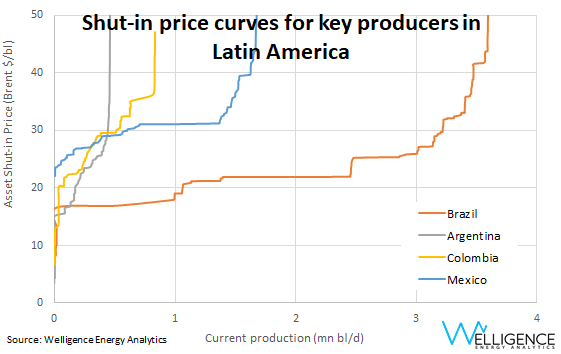
    The shut-in price curve for Latin America shows that Argentina is worst-placed, while Brazil is best-placed, with Colombian and Mexico somewhere in the middle. Argentina is in some ways comparable to the US where shale oil production, which depends on drilling thousands of short-lifetime wells, has boomed during periods of high prices, but becomes uncompetitive when prices are low. Brazil’s good position reflects its pre-salt deep-water projects, which have very high capital costs, but once they come onstream become ‘cash generating machinesi with relatively low operating costs.

    The IOCs

    A number of international oil companies (IOCs), as well as independent local producers, have already announced cutbacks in capital expenditure (capex). Chief executive of US-based oil services provider Halliburton, Jeff Miller, has said he expects capital expenditure to be cut back most sharply in Africa and Latin America with double-digit percentage declines. Research company IHS Markit says up to US$65bn of planned oil and gas investment could be at risk with Brazil most likely to be impacted because of the high cost of developing the pre-salt offshore fields.

    Italy’s ENI, with operations in Mexico, Venezuela, Ecuador, and Argentina, has announced a 25% or US$2bn capex reduction for 2020, attributed to “sharp decreases in commodity prices and the foreseeable constraints emerging from the Covid-19 pandemic”. The company operates the shallow-water Mitzón field in Mexico. Norway’s Equinor, with operations in Brazil, Argentina, and Venezuela, says it has reduced capex by 20% to US$8.5bn. ExxonMobil has cut capex by around 30% to US$23bn but intends to press ahead with major offshore development in Guyana. Royal Dutch Shell, a major player in Brazil, has cut capital spending by 20% to US$20bn. France’s Total, a significant natural gas producer in Argentina, has cut capex by 20%, while UK-based BP, with upstream operations in Mexico, Brazil, and Trinidad and Tobago, has reduced its capital spending by 20% to US$12bn.

    There have also been cutbacks among the juniors - smaller independent companies - such as E&P Geopark, which operates in Colombia, Peru, Chile, Brazil, Ecuador, and Argentina, and which has slashed its work programme by 60-65% to US$70m-80m. Canada’s Gran Tierra Inc, active in Colombia and Ecuador, says it is closing non-profitable wells, and has reduced capital spending by more than half, to US$60m-80m. Another Canadian company, Frontera Energy, active in Colombia, Peru, Ecuador, and Guyana, has slashed capital spending by 60% to US$130-US$150m.

    Crisis and energy transition opinions

    “Hundreds of billions of dollars will be spent in the coming months to reflate declining economies. These investments could simply restore the high carbon and unequal economies of today. Or they could help drive low carbon development and protect against the threats that already exist.” Dr Andrew Steer, CEO World Resources Institute,

    “The sharp decline in the oil market may well undermine clean energy transitions by reducing the impetus for energy efficiency policies. Without measures by governments, cheaper energy always leads consumers to use it less efficiently. It reduces the appeal of buying more efficient cars or retrofitting homes and offices to save energy. This would be very bad news, since improvements in energy efficiency, a vital element for reaching international climate goals, have already been weakening in recent years.” Fatih Birol, Executive Director, International Energy Agency.

    “There will not be a fast recovery from these low prices. We are now seeing demand destruction, and we all know what comes after that: layoffs, production cuts, and investment postponement.” (Off the record) Latin American oil trader.

    “As history demonstrates, innovation will thrive at this time of crisis, and this time may provide an opportunity to explore the use of renewable energy and take the leap into the next generation of technologies.” Ragnheiður Elín Árnadóttir, senior fellow, Global Energy Centre, Atlantic Council.

    “It seems likely that the coronavirus-induced global economic downturn will cause carbon dioxide emissions to drop this year, the first time since the financial crisis of 2009, with one projection predicting an overall annual decline ranging from 0.3% to 1.2%…That it requires a global pandemic with thousands of deaths, rapidly increasing unemployment, and huge amounts of economic dislocation to reduce emissions by a relatively small amount should instead be one more wake-up call to the scale of the climate challenge and the complexity of solving it.” Randolph Bell, director, Global Energy Centre, Atlantic Council.

    “Energy transitions are already underway in many countries. These transitions have become increasingly affordable because of forward-looking policy frameworks, ongoing innovations, and falling technology costs for renewables. Solar photovoltaic (PV) and wind power have become the cheapest sources of electricity in many markets, with other renewable power sources poised to reach cost parity within a few years. In the power sector, renewables have dominated new capacity additions and increasingly outpaced fossil fuels for the past seven years. Last year alone, renewables accounted for nearly three quarters of global power capacity additions.” Francesco La Camara, International Renewable Energy Alliance (IRENA) director general

    “For their part oil majors that have recently made pledges to cut carbon emissions and diversify their businesses into renewables, electric mobility, and other low-carbon energy services may back away from the sector under balance sheet strain from low oil prices. One possible twist is that oil prices might remain volatile for several months, which could prompt energy majors to boost their investments in wind and solar projects that produce smaller but stable returns. Low interest rates could also help shore up the renewable energy market.” Julia Pyper, senior editor, Greentech Media; senior fellow, Global Energy Centre, Atlantic Council

    Brazil

    By April 2020 it was clear that falling energy demand, record low oil and gas prices, and pandemic-related financial turbulence were all delivering a serious blow to Brazil’s hydrocarbons sector. Despite that, the state-owned oil company Petrobras showed signs of resilience. Petrobras announced various emergency measures. Unsold oil stocks were mounting up, with chief executive Roberto Castello Branco saying: “We’ve had to contract ships to maintain stocks floating at sea until we find a buyer.” Output was reduced by around 200,000 barrels per day (bpd). Capital spending for the year was being slashed from US$12bn to US$8.5bn. Operating expenses were being cut by US$2bn, and staff costs by US$133m. In view of the crisis, industry regulator Agencia Nacional do Petroleo (ANP) suspended the country’s 17th oil and gas licensing round, which had been due to offer 128 blocks across five offshore basins.


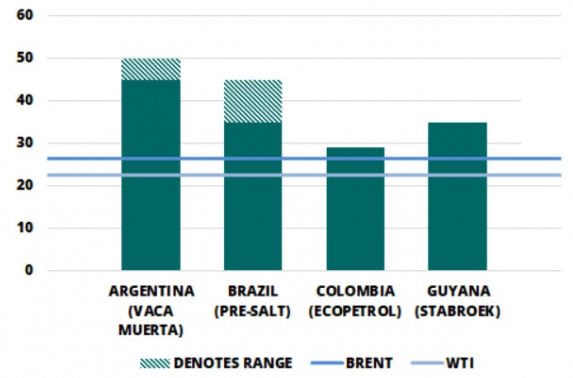
    Average Production Breakeven Price (US$/BBL)
    Source: Natural Gas World

    After heavy losses in the years after 2015, Petrobras registered record profits of US$9.2bn in 2019. The company has been divesting non-core subsidiaries to focus on upstream production. Perhaps critically, the marginal or lifting cost of producing oil from the offshore pre-salt fields has been around US$7-8 a barrel, while estimates of the longer-term breakeven price range from US$21 to UDS$40/barrel. Analysts note that if international prices increase moderately from the lockdown lows of March 2020 to US$30/barrel by the end of this year, Petrobras will be able to find buyers, particularly in Asia, for its relatively low-cost light crudes extracted from the pre-salt fields. The company began cutting output at its higher cost fields first.

    Vera De Brito, energy specialist at law firm Mayer Brown, noted that developing the pre-salt fields had been a costly and capital-intensive process. “Therefore”, she said, “the players involved are strong major oil and gas companies that will likely survive the downturn, as they have survived previous downturns. It is the smaller companies and oil and gas service providers that are more at risk. Cleveland Jones, an energy professor at the State University of Rio de Janeiro, agreed, pointing out that “large new projects will be economically viable again even if prices rebound only moderately”.

    Mexico

    In April, Mexico said it would cut oil production by 100,000 barrels per day (bpd) starting in May. The reduction was part of a 9.7m global production cut agreed by Opec+ producers and the US and is designed to end the price war that had broken out between Saudi Arabia and Russia. President Andrés Manuel López Obrador (Amlo) had refused requests from the other producers for Mexico to make a larger cut of up to 400,000 bpd, causing the global agreement to be delayed. To break the deadlock, US President Trump agreed to cut his country’s output by 250,000-300,000 bpd on Mexico’s behalf. Mexico’s foreign minister, Marcelo Ebrard, praised his colleague Energy Minister Rocio Nahle for “defending Mexico’s interests” in the negotiations. He said that it showed that Amlo’s strategy of energy nationalism was working.

    Amlo’s refusal to back down was in line with his fossil-fuel-based energy nationalism. He used the result to underline his commitment to reversing 16 years of declining Mexican oil production. Current output is 1.7m bpd, down from 3.5m bpd in 2004. Amlo has promised to push production back up to 2.5m bpd by 2024, the end of his term in office. Mexico’s success in winning only a modest production cut means that the negative impact on exports and government revenues will be relatively limited. Domestically, the news that Trump had to make a concession on Mexico’s behalf was likely to boost Amlo’s popularity, given Trump’s well-known hard line on Mexico-related migration and border issues.

    Despite the short-term benefits for Amlo, greatly reduced current global energy demand means that oil prices may not increase significantly in coming months, limiting any financial benefits for the country. In addition, Trump was expected to demand some quid pro quo concessions from Mexico in the near future. The US president had previously applied import tariffs on Mexican steel and could take other similar protectionist measures. In addition, Amlo will face considerable challenges in his attempt to boost oil production. State oil firm Pemex is one of the world’s most indebted oil companies. At the time of the announcement it was at risk of having its credit rating cut to junk status - something which became a reality later in April. Pemex is therefore unlikely to increase production enough to reach Amlo’s target. In addition, around 50% of Mexican oil output is unprofitable at oil prices of US$30 a barrel or lower. Meanwhile the president has nevertheless pushed on with his plan to build a US$8bn refinery at Dos Bocas in Tamaulipas, despite doubts over its commercial viability.

    A large proportion of Mexico’s oil exports for this year have been hedged at US$49 a barrel, which will cushion government finances for now. In March, the private sector proposed up to US$92bn in energy projects in 2020-2024, but this would require Amlo to accept more market-friendly policies. The government was reportedly about to launch a more modest US$13.5bn energy plan. The government hopes that some of the investment for this will come from the private sector. However, unless Amlo relaxes his hostility to greater private involvement, major private commitments are unlikely to be forthcoming. The worsening overall economic picture means that Amlo may eventually be forced to take a more pragmatic line and accept more private sector involvement (an approach favoured by presidential chief of staff Alfonso Romo). This would possibly allow for a limited rejuvenation of the industry, although the lengthy investment timescales mean that significantly increased production would nonetheless still be unlikely for several years.

    Argentina

    There is a long-standing narrative that Argentina will be saved from its economic travails by the development of the Vaca Muerta shale oil and gas fields in Patagonia. Vaca Muerta has frequently been seen as a game changer. It is one of the world’s largest shale deposits. Only 4% of its surface area is currently being developed. Under the previous government’s National Energy Plan, Vaca Muerta was expected to drive a new oil and gas export surge, generating US$37bn worth of annual sales by 2027 and overtaking agricultural exports as the country’s main source of hard currency. In early March, President Alberto Fernández told congress that “hydrocarbons will be a lever for the productive development of our country”. The IMF has suggested that developing Vaca Muerta could help reduce the country’s foreign debt burden. And yet, in the current global economic crisis, Vaca Muerta seems to have relatively little to offer a government in desperate need of a lifeline.

    The combination of the Covid-19 lockdown and depressed international oil and gas prices is in fact proving lethal for Argentina’s oil and gas sector. Daniel González, chief executive at state-owned oil company YPF, has said that petrol sales have slumped by 70% because of the lockdown. With storage tanks at refineries rapidly filling up, YPF said it was shutting down 50% of its production at the 40,000 barrels per day Loma Campana field in Vaca Muerta, which it operates jointly with Chevron. Other companies including Shell, ExxonMobil, Pan American Energy, and Vista Oil and Gas have also announced production cutbacks.

    A key problem is that the commercial break-even point for Vaca Muerta shale oil production is around US$45-50 a barrel, at a time when the crisis and the Russia-Saudi price war has brought the international oil price down to a low point of US$20-30. A recovery is possible, but most forecasts do not see the average oil price for 2020 climbing up much past US$40, and many see it remaining below that.

    The government has used various mechanisms to subsidise shale production. The energy secretary for Neuquén province has called for a minimum support price for locally produced shale oil (known as the barril criollo) of US$50. But with the country on the verge of defaulting on its foreign debt it is hard to see how the federal government could afford such a commitment. Some relief has been offered by limiting crude and fuel imports through a system of “non-automatic licences”. The oil industry has had spectacular busts before, which are eventually corrected as higher-cost producers are driven out of the market. But at a time when the oil majors are cutting their capital expenditure programmes and Argentina is seen as a high-risk jurisdiction, it is hard to see anyone willing to make an increased commitment to Vaca Muerta. Renewable energy projects (such as wind and solar) have also been hit by the crisis, but at current prices they are looking competitive in terms of return on investment and attractive because they offer environmental benefits.

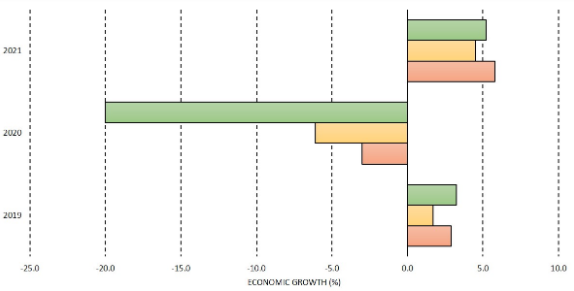
  • ARGENTINA: Still playing for time

    LatinNews 18 June 2020 Hits: 5538

    The Argentine government has extended, for the fourth time, the deadline for the holders of US$66bn of sovereign debt issued under international law to accept its debt restructuring offer. But this might not be the last extension. With the new 19 June deadline looming, there is still no sign that a deal will be struck before then. However, President Alberto Fernández insists that his government wants to reach a deal with bondholders, take the country out of default, and resolve its debt problems once and for all. This suggests that while the Fernández administration may be driving a hard bargain it will ultimately cede to bondholder demands and secure a deal for the sake of the national economy. 

    The latest deadline extension was announced by Argentina’s economy minister, Martín Guzmán, hours ahead of the expiry of the previous deadline on 12 June. In a statement, Guzmán explained that the new extension would be used to analyse the latest proposals by bondholder groups of what improvements could be made to the government’s offer in order to make it more palatable.

    According to Guzmán, the government is now seeking to “maximise the support of investors” for its offer. To secure a binding deal, the government needs at least 75% of all bondholders to subscribe to it. The negotiations are confidential, but it is being reported that the government is still far from reaching this threshold and that is why it has adopted a flexible stance that contrasts with its initial hard-line strategy.

    President Fernández himself confirmed that the government was working on yet another improved offer that “moves a little closer to the creditors”. The economy ministry announced that this new improved offer was presented to bondholders on 17 June. Given that two days does not provide much time for this to be evaluated, the speculation is that the government will have to extend the deadline beyond 19 June to give sufficient scope to bondholders to weigh up the improved offer.

    According to local media reports, a new 10-day extension is likely. However, there are no guarantees that the new improved offer will be accepted by a majority of bondholders, with some reportedly losing patience with the government and its negotiating strategy. Bondholders complain that while they have made it clear that the aggressive negotiating style adopted by Argentina does not impress them, the government and Guzmán, in particular, continue to adopt an aggressive stance.

    Yet despite all of this there are still hopes that a deal can be struck. The difference between the government’s offer and the bondholders’ demands is not deemed to be insurmountable. And it is evident that the Fernández administration needs to resolve the debt situation to stabilise Argentina’s domestic economy and start plotting the path back to recovery.

    Argentina is still reeling from the foreign currency crisis of 2018-2019, exacerbated by the subsequent economic crisis caused by the coronavirus (Covid-19) pandemic this year. The country is set for a third straight year of recession in 2020, with most forecasts pointing to a 6%-7% GDP contraction. Not resolving the debt problem will only make it harder for the country to recover; and the longer it takes to resolve the deeper the damage to Argentina’s economy and its people.

    There are growing calls in Argentina for the government to close a deal with bondholders sooner rather than later so as to allow the country to start setting the foundations for an economic recovery. It is worth recalling that resolving the debt dispute with foreign bondholders is only one component of Argentina’s debt problems. The Fernández administration also needs to renegotiate its debt with the International Monetary Fund (IMF). Meanwhile, some provinces, such as Buenos Aires, Río Negro, Mendoza, Santa Fe, and Chubut, have also missed debt repayments and are facing default unless they can restructure their debts. It is unlikely that this will be possible, however, unless the national debt issue is resolved first.

    Fernández calls for patience

    During a television interview on 18 June, President Fernández was questioned as to why his government had not yet closed a deal with bondholders even though he had said that resolving the debt problem would be his administration’s immediate priority and that he hoped this would be done by March. Fernández said that the government was putting all its efforts into the negotiations and was keen to reach a deal as soon as possible but that this needed to be a fair deal. He also called for patience, noting that it took Argentina a whole year to conclude the 2005 debt renegotiations. “I don’t understand why there is such a hurry now,” Fernández, who was part of the government that conducted those negotiations, said.

    Vicentín

    The executive director of Vicentín, Sergio Nardelli, met President Fernández and part of his cabinet in the official presidential residence Quinta de Olivos, along with the governor of Santa Fe, Omar Perotti, on 11 June in order to discuss the future of the agro-export firm, which was founded in 1929. Perotti said Fernández had not yet sent the bill to congress to expropriate the company and was open to “alternatives”. On 12 June Vicentín representatives also held a meeting with senor officials at the state-run oil firm Yacimientos Petrolíferos Fiscales (YPF) to discuss alternatives to expropriation. But alternatives now appear to be off the table. Vicentín’s assets will be placed in a trust managed by YPF’s agriculture arm, which will then absorb it entirely.

    Vicentín expropriation stirs up controversy

    A large convoy of vehicles took part in protests in Argentina’s northern province of Santa Fe on 16 June against the decision by the federal government to assume control of the local agro-export firm Vicentín [WR-20-23]. There have also been street protests and pots-and-pans protests (cacerolazos) in the province in recent days.

    President Alberto Fernández, who announced the move on 8 June, defended the decision to “rescue” the company in a radio interview on 14 June, to prevent it “falling into foreign ownership” like four of the other seven major agro-export firms in Argentina, while the production minister, Matías Kulfas, described it as “a virtuous intervention” to save jobs.

    “The only alternative left to us is expropriation,” Fernández said. But Vicentín shareholders published an open letter in various local newspapers accusing Fernández of not having considered alternatives at all. The opposition Juntos por el Cambio coalition, meanwhile, denounced the move as “dangerous, illegal, and unconstitutional”, raising the old argument of whether it is Fernández or his vice president Cristina Fernández calling the shots.

    Vicentín has debts of US$1.35bn, and the opposition argued that the expropriation would place a heavy burden on the state. This also sends a mixed message to creditors, after the Fernández administration defaulted on its debts last month, arguing that it had no cash with which to honour them

  • TRACKING TRENDS

    Patrick de Courcy 09 November 2023 Hits: 2017

    MEXICO | Government accepts another US labour rights complaint. On 2 November Mexico’s economy ministry (SE) announced that it had accepted a request made by the Office of the US Trade Representative (USTR) on 23 October to review whether workers’ rights to freedom of association and collective bargaining were being denied at an Asiaway automotive parts facility in San Luis Potosí state. Asiaway is a Chinese-owned firm that sells locomotive parts to companies in 22 countries, whose subsidiary plant in San Luis Potosí was only officially opened in June.

    The SE press release stated that Mexico’s labour ministry (STPS) had 36 days to conduct an internal review to establish the accuracy of the allegations, and reiterated the government’s “commitment to effectively implement labour legislation, as well as the labour provisions set out in the US-Mexico-Canada Agreement (USMCA), thereby ensuring compliance with and protection of the collective rights of the country’s workers”.

    The US Department of Labour investigated the claim against Asiaway, which was made in a petition filed by independent union Liga Sindical Obrera Mexicana (LSOM) under USMCA’s Rapid Response Labour Mechanism (RRLM) in August this year, the fifteenth time that the US has formally invoked the RRLM. 


    MEXICO | International tourism going strong. Mexico’s tourism ministry (Sectur) reported on 5 November that 16.1m international tourists visited Mexico by air in the first nine months of 2023, representing a year-on-year increase of 7% and an increase of 13.4% on the same period of 2019, before the onset of the coronavirus (Covid-19) pandemic. According to Sectur, the greatest number of tourists arrived from the US (10.98m), Canada (1.71m), and Colombia (535,893).


    MEXICO | Inflation declines. Mexico’s annualised inflation rate in October fell to 4.26%, its lowest level since February 2021, from 4.45% in September, the national statistics institute (Inegi) reported on 9 November. The consumer price index for October stood at 0.38%.

    The October figure marked the ninth consecutive month that annualised inflation has fallen, having started the year at 7.91%. In October last year it stood at 8.41%.

    Despite the fall in overall inflation, underlying inflation, which strips out volatile energy and food prices, actually increased by 0.39% in October. This brought underlying inflation to an annualised figure of 5.5%, more than a full percentage point higher than the main inflation rate.

    The index of prices for the basic basket of goods, comprising 176 products and services, increased by 0.33% in October, reaching an annualised figure of 3.83%.

    The October inflation figure was published shortly before the central bank Banco de México (Banxico) decided to keep the benchmark interest rate unchanged at 11.25% for the fifth straight month.

    President Andrés Manuel López Obrador responded to the Inegi figure by saying that “our currency is the strongest against the US dollar [the peso has appreciated more than 9% against the dollar this year to M$17.6/US$1], which has not been seen for a long time…and inflation keeps falling, although I know that none of this will be reported in the media so I will just keep on going like a broken record”.

    GN to Acapulco

    President Andrés Manuel López Obrador announced on 7 November that 9,500 additional members of the militarised national guard (GN) would be deployed to the city of Acapulco, which continues to reel from the impact of Hurricane Otis, bringing the total number of GN agents in the city to 9,860. López Obrador said the GN’s main priority would be to ensure the security of residents, as well as participating in rebuilding activities and the reactivation of the local economy.  

  • BRAZIL: Tensions escalate over tax breaks

    Abbi Dicker 02 May 2024 Hits: 2600

    The government of President Luiz Inácio Lula da Silva has been trying to meet its fiscal objectives by raising more revenue, a goal complicated by congress, which has backed legislation to extend tax benefits. Last year Lula vetoed a bill to extend tax breaks on payrolls for 17 sectors, but congress overturned his veto. On 25 April these tensions over tax breaks escalated when the government petitioned the supreme court (STF) to suspend them. On 30 April congress also passed a bill to extend a programme to provide tax benefits for the events industry (Perse), another spanner in the works for the government’s fiscal goals.

    The controversial bill which congress approved in October and President Lula vetoed in November was promulgated in December after lawmakers overruled the president, enshrining the bill into Law 14.784/2023. The law extended tax breaks first implemented in 2011, which have since been updated and renewed in several pieces of legislation. The latest renewal reduced taxes on payrolls from 20% to a rate of 1.0-4.5% until the end of 2027 for companies in sectors such as construction, clothes manufacturing, and meat processing. It also reduced social security contributions from 20% to 8% for public sector workers in the municipal governments of small and medium-sized towns and cities.

    Due to the significant potential decreases in tax revenue, Lula signed a decree in late December to re-impose the taxes on payrolls but then partially revoked the decree in late February, widely seen as a concession to congress. Since January this year, the senate president, Rodrigo Pacheco, has signalled his willingness to negotiate with the Lula administration to find a solution to this impasse over tax benefits. However, Pacheco expressed disappointment with the government when STF justice Cristiano Zanin ruled on 25 April to suspend Law 14.784/2023, on the grounds that the legislation for this law did not provide an adequate assessment of the measure’s “budgetary and financial impact”, which violates articles in Brazil’s constitution aimed at guaranteeing fiscal discipline. 

    Zanin’s decision to halt the tax breaks came after the government’s legal representation, the office of the solicitor general (AGU), filed a petition to the top court to declare the tax breaks unconstitutional. On 30 April Pacheco said that getting the judiciary to intervene on an issue being negotiated between the executive and legislature has dented the trust between the two branches of government. The senate president said that the Lula administration should work with congress and the municipal governments benefiting from the tax breaks to draft new legislation for the imposition of taxes on payrolls, rather than using legal technicalities to block measures that congress had approved.

    Pacheco made these comments on the same day that the senate approved a bill to extend the Perse tax breaks programme, which was first launched in 2021 to help the events industry recover from the economic impact of the coronavirus (Covid-19) pandemic. In the same decree signed last December to undo the payroll tax breaks, Lula also decreed that the events sector activities enjoying tax exemptions from the Perse programme would lose some tax breaks in 2024 and then the programme would be completely phased out by 2025. The bill approved by the senate on 30 April has extended Perse until December 2026. However, the Lula government managed to negotiate with lawmakers to add limits to the extended Perse programme. For example, the tax breaks would only be applied to 30 events and services, including dance, theatre, cinema, and sporting events, whereas the programme had previously benefited 44 categories of events.

    Monthly deficit down in annual terms

    The finance ministry announced on 29 April that the federal government’s primary deficit in March 2024 totalled R$1.53bn (US$295m). However, in the first quarter of this year, a primary surplus of R$19.43bn was registered. The government is facing challenges to reach its zero-deficit target for 2024, but officials from the treasury have highlighted that the latest monthly deficit is lower than the primary deficit of R$7.08bn in March 2023, although the accumulated surplus in the first quarter of 2024 is down from the R$31.21bn surplus registered for the same period last year.