One troubling feature of Brazilian society over the last decade has been the sustained increase in crime. A significant proportion of the electorate feels threatened and unsafe on the streets and in their own homes. The data show that in terms of the homicide rate, Brazil is a violent country in a violent region of the world. Latin America and the Caribbean (LAC) is home to 8% of the world’s population but accounts for 33% of the world’s homicides. In 2016 there were just under 160,000 murders in the region as a whole, equivalent to about 21.5 per 100,000 inhabitants (this is three times the global average of seven per 100,000). The highest homicide rates were recorded in countries like El Salvador, Jamaica, and Venezuela, but in absolute numbers the greatest number of homicides occurred in just four countries: Brazil, Colombia, Mexico, and Venezuela.
Taken together these four countries accounted for one out of every four homicides committed anywhere in the world. Most murders take place in cities. No fewer than 25 of the world’s 50 most murderous cities are located in Brazil (led by Marabá, Grande São Luis, Ananindeua, and Serra). In LAC most victims are male, and aged between 15 and 29. In Brazil there are also regional and racial dimensions. Victims are more likely to be poor, from the northeast, and black. Half the region’s murders involve the use of firearms.
Brazil: Number of homicides
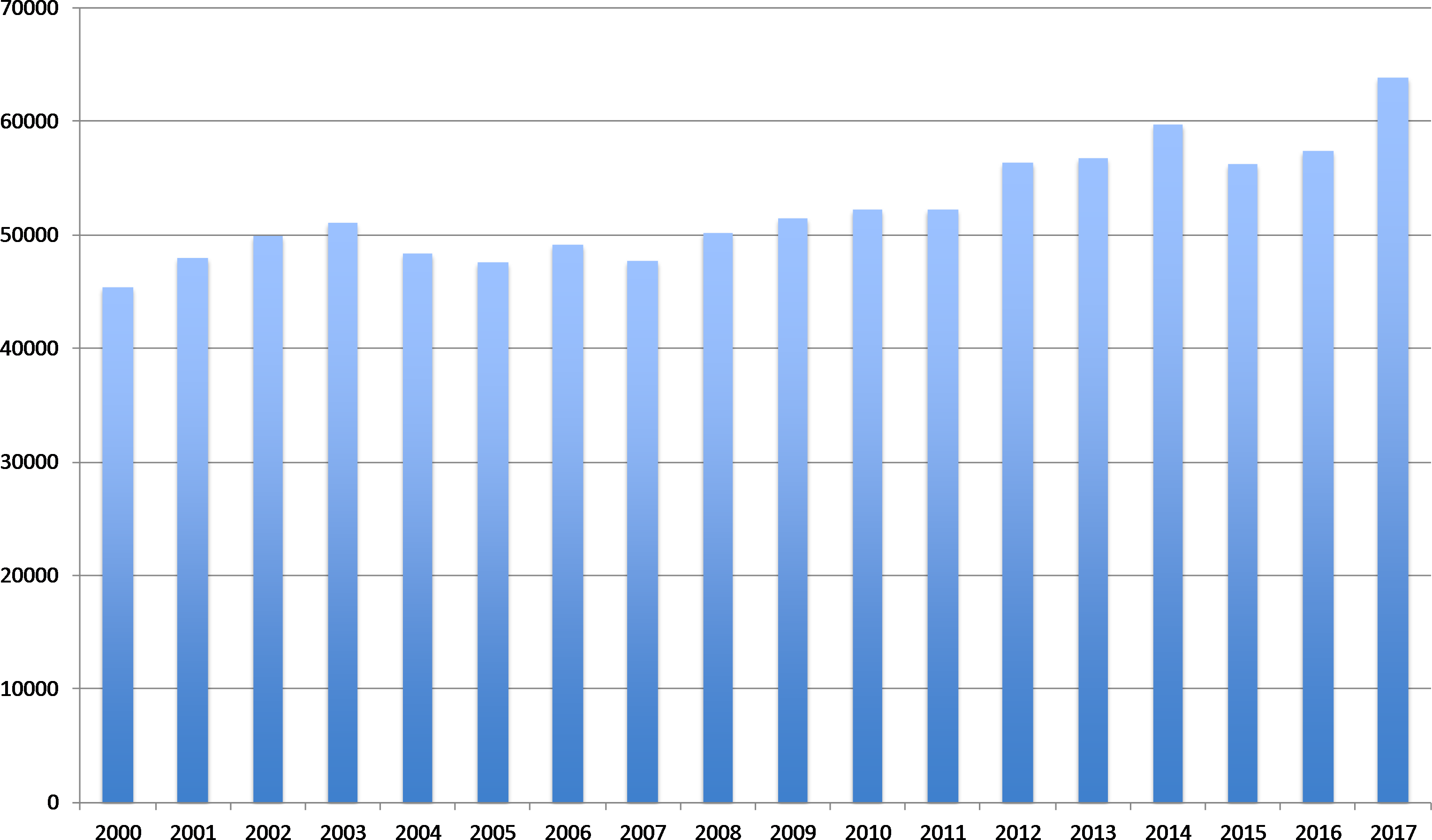
Source: Instituto Igarapé, Reuters
The number of homicides in Brazil in 2016 was 57,395, equivalent to a homicide rate of 27.8 per 100,000. The total increased to 63,880 in 2017 or 30.8 per 100,000, four times the global average. The 2016 total ranked Brazil as number 13 of the world’s top 20 countries by homicide rate. The number of people killed as a result of police action in Brazil is also high, at around 5,000 per annum. Murderers frequently go completely unpunished. Studies show that only six out of every 100 murder investigations lead to a conviction. Police tend to be reactive and do not adequately prioritise the resource-intensive investigation of serious crime. Despite the large number of homicides, only 11% of the prison population is charged with that crime. Data on crime clear-up rates is lacking in 21 of the country’s 27 states.
There were nearly 50,000 reported rapes in 2016. A woman is murdered somewhere in the country every two hours. The prison population is over 700,000. With intense overcrowding (occupancy rates at around 200% of prison capacity) there is a shortfall of at least 350,000 prison places. Prisons are not reducing re-offending rates: on the contrary, the country’s main criminal organisations were created and gained strength inside the prison system, from where they continue to get most of their recruits. The economic cost of crime more than doubled in between 1996 and 2015 to reach an estimated BRL285bn (US$75.4bn) or 4.4% of gross national income. Opinion polls show that violence and crime are considered one of the four top problems facing the country. In a December 2017 according to an Ibope survey, 38% of respondents highlighted crime as the top problem.
Ilona Szabo, executive director of think tank Instituto Igarapé, says that crime is traditionally seen purely as a police matter, but there is now an increased understanding that it is linked to all aspects of the country’s development and has an incredibly high social and economic cost. Renato Sérgio de Lima, director of lobby group Fórum Brasileiro de Segurança Pública (FBSP), says that one of the tasks facing the next government will be to review and update the overall public security framework. “The 1988 constitution sets out fundamental principles. The law on the military police was written earlier, in 1983. The law on the civilian police dates back to the time of Empire. The criminal justice system was set up in the 1940s. So a first task for a new government must be to do some housekeeping, make sure public security regulations are updated and made consistent, to find a way of articulating the way the country’s 1,300 public security institutions should work together,” he said.
A significant proportion of middle-class voters believe they should have expanded rights to own and carry firearms for self-protection. Bolsonaro successfully tapped into that sentiment during the election campaign. But a number of security experts believe greater gun ownership is not necessarily an answer to the problem, and could make it worse. Ivan Marques, director of NGO Sou da Paz, notes that 70% of violent deaths in Brazil involve the use of firearms, way above the global average of around 40%. In his view this means that more effective regulation and control of gun ownership is required. He says there is a positive correlation between the number of guns in circulation and the number of homicides. The FPSB’s Sergio de Lima agrees. In what could be taken as an indirect reference to Bolsonaro, who during the campaign advocated lifting all restrictions on gun ownership, he criticised “candidates who make a big issue of the right to own weapons, as if it were banned in Brazil, which it isn’t: they are trying to surf a wave of panic among the population”.
Predicting the future is always difficult. What is clear, however, is that if present trends continue unchanged, the problem of crime is set to intensify. The number of homicides per 100,000 members of the population has been increasing. Demographic factors may in the long term begin to push it back down (simply because most of the killers and their victims are young men, and as the population ages, young men will form a smaller group within the total). However, that factor is unlikely to have much impact over the next ten years.
It can be argued that there are two radically different approaches to the problem of crime. One is the hard-line or ‘iron-fist’ (mano dura) approach. This emphasises repressive policing, punitive justice, and tough incarceration. The paradox is that this approach is highly popular with voters in Latin America, even though the evidence for its effectiveness is at best mixed. Some aspects of a hard line on law and order can be counter-productive (for example tough sentencing can lead to overcrowded jails which become criminal recruiting grounds). President-elect Bolsonaro appears to be continuing a long tradition of ‘get tough’ policies, the only difference being that he has expressed them in more extreme terms (such as defending a police shoot-to-kill policy) and that, because of a real and perceived surge in crime, the electorate has been more than usually receptive to his approach.
The other approach to crime has become known as ‘citizen security’ and is supported by many academics and NGOs. Rio-based think tank the Igarapé Institute says that although rather loosely defined, citizen security approaches “include a range of ideas and practices designed to prevent and reduce violence, promote public security and access to justice, strengthen social cohesion and reinforce the mutual rights and obligations of states and citizens”. This approach suggests there is no simple response to rising crime, but that action needs to be evidence-based and multi-faceted. It notes evidence across the region that some citizen security approaches have successfully helped reduce homicide rates. For example, a succession of comprehensive and sustained social and urban citizen security measures in the Colombian city of Medellín helped reduce the homicide rate from 266 per 100,000 in 1991 to 30 per 100,000 by 2015. There were also significant reductions in the Brazilian cities of São Paulo and Rio de Janeiro (although the latter witnessed a new deterioration in 2017 and 2018), and in the Mexican city of Ciudad Juarez.
An FPSB report published in 2018 has no less than 35 recommendations in seven policy areas. The first of the seven programme areas creates an efficient public security system. Recommendations under this heading include creating a permanent ministry for public security; increasing funding; improving training in public security; and creating a properly integrated national security system (Sistema Único de Segurança Pública – SUSP). The second programme area is to build state-level law enforcement and regulatory agencies to tackle organised crime. The third is to increase police effectiveness and efficiency, at both state and federal level; this too involves action against corruption. A major reform of Brazil’s prison system is identified as the fourth programme area, to include action to regain control of prisons from criminal groups, strengthen prison management, and allocate prison places in a “more rational and human manner”. The fifth programme area involves violence-reduction and crime prevention programmes, particularly among the 123 municipal ‘hot spots’ which accounted for 50% of the national homicide rate in 2016. The sixth programme area is described as a reconsideration of policies on drugs to include decriminalisation of consumption and increased medical and education programmes to discourage drug use. Finally, the seventh programme area concerns gun control: here recommendations include continuing the ban on public carrying of weapons while improving police records and control of gun permits.
If – and the issue is still the subject of much debate – the ‘citizen security’ approach is ultimately more effective than the ‘iron fist’ the problem is that it is less popular with the voters. The idea of ‘getting tough’ is a simpler, more instinctive message, and one that comes more naturally to politicians on the campaign trail. Even if ‘get tough’ policies do not at first succeed, and violence continues to increase, many voters may conclude not that the policy was wrong, but simply that it was not executed properly or was not tough enough. Many Latin American countries have found themselves caught up in this logic.
This then points to a potential worst-case scenario for the next 10 years: that Brazil under Bolsonaro and his successors will follow hard-line anti-crime policies which satisfy the demands of voters even though they fail to stop, and may even contribute, to rising violence. In other words, the country might follow recent experience in the Philippines under President Rodrigo Duterte.
Duterte took office in June 2016 advocating a ‘war’ on drug traffickers and explicitly defending shoot-to-kill and extra-judicial executions by police. Between mid-2016 and late 2018 the homicide rate rose sharply to total around 23,518. This surge in violence does not seem to have affected Duterte’s standing in the opinion polls: in June 2018 his approval rating stood at 65%, down from 76% in September 2016, but still substantial. Other polls suggest that nearly eight out of ten Filipinos support the state-led killing spree. The reasons for this are complex, but seem to resonate with the situation in Brazil. Jayeel Cornelio, a sociologist at Ateneo de Manila University, says some surveys show people welcome the war on drugs, while feeling unease over the death toll: “People are worried but they welcome it, because paradoxically it makes them feel safer in their communities,” he said, adding “It is not so much that Duterte has changed traditional Filipino values. On the contrary, the time was ripe for him to become president because many Filipinos were already disillusioned with previous regimes marred by corruption, inefficiency and a perceived preference for the elite.”
Filipino political analyst Richard Heydarian describes both Bolsonaro and Duterte as exponents of a wave of “emerging market populism” which has benefited from electoral anger and disillusion. He says, “When people feel let down by the traditional political class and begin to doubt values of democracy and human rights to the point they want to try something different, it is reasonable that they are willing to take two to three years to test their choice.”

